Categories
Work Life

Thursday Miscellany

Spring Flowers
Spring Flowers Near the Garlic Patch

LAKE MACBRIDE— Sound sleep and dreams populated the last two nights as physical labor dominated much of my time this week.

Yesterday was a three job day, which made things easier and harder. Easier because the schedule drove everything, requiring less thinking. Harder because of the long hours and limited flexibility. I crashed into bed before the sun set.

Tuesday was also a full day: farm work, finance, gardening, and a long dinner meeting with the board of directors of a national NGO based in Washington, D.C. I had quinoa stir fry— my first time to eat the high protein vegetable— and decided to continue my moratorium on buying it for the time being. It is not good enough to cause trouble for indigenous people in South America who rely upon it.

I’ve been neighboring. Folks next door asked where they could get some bales of hay to use in landscaping. A friend raises livestock, so I delivered four bales with my Subaru Outback after making seed planting trays in the germination shed. No one was home when I arrived, so I left them under the garage eaves and they left a check wedged in the brick work of our front yard planting area. The transaction was positive all around.

There is a sense that Spring is slipping away before everything can get done: making less time for Internet activities, and a web of opportunities elsewhere.

Categories
Living in Society

Sine Die? Not So Fast!

State Capitol
State Capitol

DES MOINES— Governor Branstad’s office released an end of session message for the 85th Iowa General Assembly at 8:41 a.m. yesterday, saying, “despite the partisan tone of the session, we are pleased there was agreement on the majority of our legislative plan.” The House had been all high fives and out of there before 6 a.m., busy posting brilliant photos of the east side of the capital on Facebook as the sun rose.

Not so fast! The senate hadn’t adjourned.

House Majority Leader Linda Upmeyer cautioned members that the session was not over until it was over— after the Senate adjourned sine die. Switching my audio feed over to the Senate, instead of calling up HCR 109, the Sine Die Resolution, Majority Leader Mike Gronstal called for a rules committee meeting and recess. When the Senate re-convened at 7:34 a.m., a prayer was said, they pledged allegiance, approved the April 30 journal, and then adjourned at 7:48 a.m. until Friday morning.

What happened has been well reported by corporate media. Rod Boshart of the Cedar Rapids Gazette was one of the first to break the story.

“The shutdown of the split-control legislature’s 2014 session got messy Thursday morning when Senate Democrats attempted to pass a resolution giving a legislative panel broad investigative power to look into alleged mismanagement and secret dealings by Branstad administration officials,” he wrote.

Session may end today, but the politics is far from over.

Republicans provided comic relief in the wee hours of Thursday when it was announced State Senator and Republican U.S. Senate hopeful Joni Ernst called in around 4 a.m., asking the chair to be excused. The Republican level of participation in the Senate has been a joke, and Ernst has been campaigning with a clown car of candidates, running down the presumed Democratic nominee, Bruce Braley, and the president. Occupied by posting on Twitter about her footwear, she is likely to miss Friday as well.

The 2014 general election has begun in earnest. It is framing up nicely for Democrats.

Progressives should love it when the Republican U.S. Senate candidates, like Ernst, tie Bruce Braley to the Affordable Care Act. The law is working and its popularity will increase. If that is their campaign issue, please bring it on, because the law is already saving federal dollars on health care. In case you missed it, the escalating cost of health care was one of the drivers behind the law. It was designed to bring health care costs down and it is.

A reason to feel good about it is in light of 17.8 million sign-ups through Medicaid expansion and the healthcare.gov web site, the Republicans are trying to switch their narrative to Benghazi faster than the sinking of the Titanic.

Another reason Democrats should be hopeful is the mail from the TEA people indicates they don’t realize their group’s influence peaked in the rebellion of 2010. The TEA party is over, and that they don’t get it is good for progressives.

Iowa Democrats are also fielding excellent candidates in all four congressional districts. The tides are shifting. Signs are everywhere that this could be a great year for Democrats, and with all of the women running, Iowa seems more likely than ever to elect its first female U.S. House member.

There is no useful Republican campaign story for the corporate media to cover outside the weirdness of their debates and events. The more weirdness on display, the more swing voters will be alienated. It seems clear that Iowans don’t want a “true conservative” representing them in the U.S. Congress. Pragmatism would serve them better, but who am I to give advice?

Meanwhile, Braley continues to build support, Hatch is catching Branstad in the polls, and with all their Benghazi, Obamacare, gun, abortion, military hagiography, pro-Israel, free market talk, what reasonable person could take Republicans seriously?

I appreciate the work of our legislators this session, and when the Senate adjourns it will be over, but beginning again with the 2014 general election campaign. I’m in. Are you?

~ Written for Blog for Iowa

Categories
Living in Society

Some Politics Before Sine Die

Iowa Capitol
Iowa Capitol

LAKE MACBRIDE— The Iowa legislature was still working when I awoke at 3:30 a.m. If they had pulled an all-nighter or two earlier in the session, they would likely have finished up last month. As it is, the house adjourned sine die at 5:54 a.m. this morning, and the senate adjourned until Friday. The 85th Iowa General Assembly is still in session, even if the lower chamber is all high fives and out of there.

When I expected the senate to adjourn sine die, Senate Majority Leader Gronstal called a rules committee meeting and recessed until today, then Friday.

“The shutdown of the split-control legislature’s 2014 session got messy Thursday morning when Senate Democrats attempted to pass a resolution giving a legislative panel broad investigative power to look into alleged mismanagement and secret dealings by Branstad administration officials,” wrote Rod Boshart of the Cedar Rapids Gazette.

Let the  campaigns begin in earnest, (no, I’m not talking about State Senator Joni Ernst Republican U.S. Senate hopeful who called in about 4 a.m. this morning, asking the chair to be excused). I’m referring to the 2014 general election campaigns.

A couple of notes:

I love it when the Republican U.S. Senate candidates, like Ernst, tie Bruce Braley to the Affordable Care Act. The law is working and its popularity will increase. If that is their campaign issue, please bring it on, because the law is already saving federal dollars on health care. In case you missed it, the escalating cost of health care was one of the drivers behind the law. It was designed to bring health care costs down and it is.

The mail from the TEA people indicates they don’t realize their group’s influence peaked in the rebellion of 2010. The TEA party is over, and that they don’t get it is good for progressives.

Iowa Democrats are fielding excellent candidates in all four congressional districts. The tides are shifting. Signs are everywhere that this could be a great year for Democrats.

The reason I say this is there is no real story for the media to cover outside the weirdness of the Republican debates and events. The more weirdness on display, the more swing voters will be alienated. It seems clear that Iowans don’t want a “true conservative” representing them in the U.S. Congress. Pragmatism would serve them better, but who am I to give advice?

I appreciate the work of our legislators this session. Now let the campaigns begin.

Categories
Living in Society

Corporations Are Making Me Grumpy

Capitol Dome
Capitol Dome

LAKE MACBRIDE— The bills come quickly as the second session of the 85th Iowa General Assembly draws to a close. They are required to produce a budget, and legislators tend to follow this law. It is not every day they comply with the law. For example, they still owe the school districts a 2016 supplemental state aid number. Not likely that will happen before adjournment sine die.

It is not the scofflaw aspect of the group that makes me grumpy, although there is plenty about the legislature’s actions or lack thereof to grumpify a person. In many cases they are puppets for corporations and that isn’t a happy thought. I’d be happier if the members were required to wear lapel pins to show their corporate sponsorships— the way ARCA, NASCAR and other motorsports club drivers adorn their fireproof suits. Maybe then I wouldn’t be appalled by some of the bills they support. It wouldn’t be good, but it might make the citizen experience more tolerable and lower my blood pressure. After all, in the post-Reagan era it’s all about me, isn’t it?

Garrison Keillor’s appearance at the First United Methodist Church in Iowa City at 7 p.m. on May 4 is making me grumpy.

My favorite local bookstore is sponsoring Keillor at a reading from his newly released collection of writing, “The Keillor Reader.” Back in the day I would have been first in line to buy a copy and be inside the church to hear him from the pulpit. But you see, we had a falling out over his acceptance of a sponsorship from the investment firm Allianz which invests in the nuclear weapons complex.

Maybe be he read my blog and dropped them based on the strength of my position, I hoped. Anxiously googling their relationship, it was worse than I thought. Congresswoman Ileana Ros-Lehtinen of South Florida tried to get National Public Radio to pull the Allianz ads because the company collaborated with the National Socialist German Worker’s Party in their heyday. No Keillor for me, even though until last year, I listened to his program on Saturday nights, and had done so since our daughter was very young.

Which brings me to the connection. Why do I care about these corporate sponsorships anyway? Whether it is our legislators, or Garrison Keillor, or whoever? Why can’t I just live my life?

Someone has to be engaged in sustaining a life on the prairie, and it isn’t the ones sponsored by corporations.

Categories
Social Commentary Writing

First Share and Living in Society

Asian Greens in Scrambled Eggs with Vermont Cheese and Pickled Bits and Pieces

LAKE MACBRIDE— The first share from the Community Supported Agriculture (CSA) farm was ready yesterday— asparagus, lettuce, baby bok choy and Asian greens. Anticipation over spring and summer cooking is building, even if living on bits and pieces from the pantry will continue until the full flow of local produce is unleashed. Picking up the share at the farm was a fine beginning.

We had more than two inches of rain since Earth Day, so outdoor plants are growing. The garden is too wet to work, although as soon as the soil dries, seedlings are ready to go into the ground. Meanwhile I will go on living in society, and that is today’s topic.

The phrase “in society” has a particular usage here. It is part of a spectrum of relationships with people that contrasts with “chez nous,” the French term that refers to “at home” or “with us.” Maybe there is something else on this jumping green sphere (thanks Lord Buckley for this phrase), “outside society” or “foreign,” but most of our lives are spent chez nous or in society. My tag “homelife” could be changed to “chez nous” and sustain the meaning.

Living in society is that set of relationships which sustains a life on the plains. It includes friends, family, neighbors, workplaces, institutions, retail establishments, and organizations with which we associate or interact. The relationships are interpersonal, that is, specific people are associated with each part of society— it is not an abstraction.

When young, we don’t see our life in society this way. We had an ability to live in the moment without a history of interpersonal relationships, anchoring us into something else. As we age, we are more like a character in a William Faulkner novel that must work to suppress the endless flow of memory.

If experience connects us, the way we live in society is based on thousands of previous interactions. For example, someone ran for the U.S. Senate after a long, productive life. If I saw him today in any of a number of settings— at a retail store, at the retirement village, at a literature reading, at a veterans meeting, at a public demonstration— I would think of the courage he displayed by taking on personal debt to challenge an entrenched incumbent politician who would otherwise have run unopposed. I would also think of our many conversations over a period of years. Our relationship is driven by my respect for his courage, and I picture him when I think about the associations we share. When I use the phrase “in society,” it might be referring to an interaction we had, or one like it with someone else.

My usage of the phrase “in society” may have been explained by others who are smarter, but because it is organic there is a peculiar sense to it on this blog. It is personal, but not really, because is it also public.

I am entering one of the richest periods of personal interaction in life. Old enough to have had experience, and young enough to gain new ones. Each day’s potential is vast midst the galaxy of people with whom I interact. Favoring the phrase “in society” enables me to talk about them without revealing where the specific interaction may have occurred. This protects people from unwanted intrusion into their lives, and enables the writing I do for a couple of hours each day.

Chez nous, we would have had breakfast of Asian greens mixed with scrambled eggs, Vermont cheddar cheese and pickled veggies from last season. In society I am part of the local food movement and post photos of my breakfast. Maybe I am drawing a fine line, but it is an important one for a writer.

Categories
Social Commentary

Teeming with Life

Main Street
Main Street

SOLON— While waiting for the transcription from paper to digital, the newspaper office door was open on a cool spring evening. From that frame, I looked across the highway to the city park. There was a lot of traffic, and downtown, nary a parking spot to be found.

Commuters on their way home, a scrapper with corrugated metal stacked on a trailer, boaters and fishers and scores of unrecognized people bustling at the city’s main intersection. Life in motion.

Our publisher entered to download a few hundred photographs from the soccer game, then returned to see its conclusion— making sure some of the photos were good enough for the next edition. When the typist finished, I loaded the weekend’s work on my flash drive and headed home for dinner chez nous.

Main Street has become a place to be of an evening. The new brewery attracts people, and their appearance must be good for the pizzeria, the grocery store and other restaurants and bar. The town comes alive, and we couldn’t say that when we moved here more than 20 years ago.

Main Street is teeming with life, and most of it good.

Categories
Home Life

Checking In

220 East
220 East

LAKE MACBRIDE— This week has been a whirlwind— the action is not finished. Another Climate Reality talk in Independence tonight, followed by a full weekend of warehouse work. In between, there are three newspaper articles to write and the usual proof reading. This not to mention all the home work that needs doing. I should be able to come up for air by Wednesday.

Last night was time with friends in Waterloo, where we attended a double bass concert and my Climate Reality in Iowa talk. Afterward, we went for dinner at a nearby Mexican restaurant and talked until way too late. I arrived home near midnight.

The benefit of presenting a talk about climate change is the intellectual process of questions and answers. I leave half of the time for that, and it always proves to be the most rewarding part of the hour. A question came from a woman who said she was getting cynical about all the petitions, and asks to write letters to elected officials— a seemingly futile effort. Don’t give up, I said.

I spent the drive home watching the road, and feeling the energy from that room. There was no trouble sleeping after falling into bed.

Categories
Home Life

Easter Darkness and Light

Easter 1946
Easter 1946

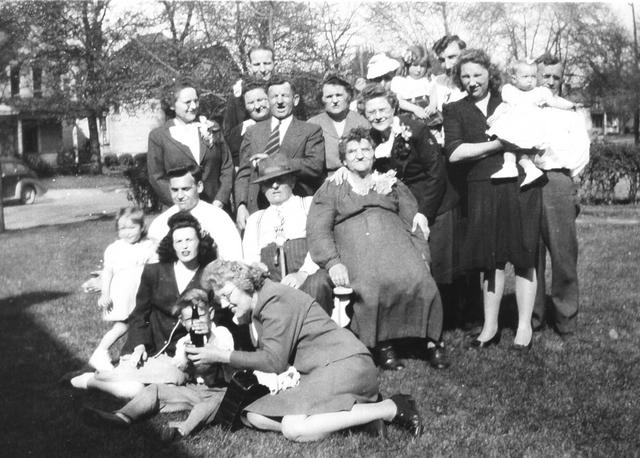
LAKE MACBRIDE— Easter was the biggest holiday after Christmas while I was growing up, although its importance diminished when I left home at age 18. This photo of my maternal grandmother’s parents— my great grandparents— typified the gatherings of an era that is gone.

Things are more casual today, and seldom do we gather on the lawn for a photo. If we did, our small family wouldn’t have many people in the image. A sign of the times and choices made when we were young.

Our next door neighbor gave birth to her third child on April 10 and yesterday she carried the baby in the yard while we talked about our shared lot line. The baby, swaddled in a blanket, didn’t make a sound. We walked the length of the line, discussing the easement and placement of gardens, hers and mine. The two younger children and her husband joined us. It was a pleasant moment in a life of neighboring.

The lettuce is not up in the garden. In fact the surface looks pretty dry. After the newspaper proof reading, I plan to spend the balance of the day preparing a bed for spring vegetables and working in the yard and garden. There is a lot to be done.

Lingering in the pre-dawn darkness, there is an hour to write, read and think before the rising sun of Easter morning.

Categories
Work Life

Money Smart Week Presentation

Money Smart WeekPrepared remarks for the Solon Public Library Money Smart Week presentation on April 19, 2014.

Thank you for coming to my talk titled “Alternate Living: Focus on Finance.”

This talk is partly about me, but it is really about you. I seek to present some of the ideas and financial tools I use to make a life, as an example of how to cope in a society that has changed dramatically since I grew up in the 1950s.

I hope to generate a discussion in the second part of the hour, that focuses on the idea that alternative living is not only possible, but is a necessary approach to life expectancies that stretch into our 80s and beyond thanks to adequate nutrition and good health that is endemic to our way of life in Iowa. I hope you find value in hearing my story.

My father worked at a meat packing plant in Davenport for $85 per week, and my mother worked at home. We had enough money to afford a home with a mortgage, food, clothing, parochial schools, transportation, health insurance and vacations on a household income of around $4,500 per year.

As we know, things have changed. In 2011, the estimated median household income in Solon was $61,394 or 14 times what my parents generated. Many people I meet believe that amount of income is not only needed, it may not be enough.

Something else has changed in 60 years, and what I am most concerned about is the value of work, the kind my mother did at home, and my father did at the plant, has been degraded and replaced with something else in our burgeoning consumer society. It has taken us away from the foundations upon which lives used to be built. Our lives must be about something besides consumption of stuff, and appreciating the value of work is a starting point.

My story is about getting back to a kind of living that is more diverse than holding one or two well paying jobs in a household and slaving away to save enough for retirement, whatever that is in the 21st century. One that enables us to earn a living wage, contribute to the broader society, and sustain our lives on the Iowa prairie.

I re-purposed my life in 2009 after 25 years in transportation and logistics. Our daughter graduated from college in 2007 with minimal debt, and my wife Jacque and I were in reasonably good financial shape. We had no chronic health conditions, and hopefully, a lot of years to live.

When I left CRST Logistics in Cedar Rapids, I was on track to earn a six figure salary, so with Jacque’s income from her part time job, we were doing better than average. I might have stayed on, and pursued the rewards of longevity, but there were vulnerabilities.

The Toyota Financial Services job seeker web site, says it in black and white: normal retirement age is 62, which is my current age. As I approached traditional retirement age, I didn’t know where I stood in the broader scheme of the company. I had contributed to the rapid and sustainable growth of CRST from a $60 million trucking company that thrived after the Motor Carrier Act of 1980 deregulated trucking, to a full transportation solutions company that earned more than $1 billion in revenues last year. I felt too young to slow down, but the company could hire three people for my salary, and when I left each position I held, they usually did. This is normal in large organizations, something we don’t hear much about. While I was treated fairly where I worked, there is no obligation for any company to keep employees until retirement. That’s just the way it is.

Another important aspect of my work was I felt ready for a change. While I helped build the company over 25 years, and had experienced its growth and the opportunities that go along with that, I felt stale. When our daughter graduated from college, I was not adjusting well to being an empty nester. This feeling increased as she chose to leave Iowa.

I felt ready for a change and on July 3, 2009, left the company for good. I was not ready to retire, even if I had a retirement cake and party when I left, and an unexpected call from the owner expressing his thanks for my 25 years of work.

If there are stages to life, which one am I in? My colleague at the Solon Economist, Milli Gilbaugh wrote about the trouble defining that stage past middle age, and before elderly, in a recent column.

I suppose it is nearly impossible to find a word for the stage of life I’m in; a word that seems accurate and inoffensive to everyone. As a matter of fact, I’ve had trouble knowing just what to call myself for some time.”

Ages seem to be rather neatly divided into 20-year segments, up until we reach 60 and are unceremoniously thrown into the ‘elderly’ cauldron, ready or not. The term ‘child’ generally includes everyone from birth through their teens. After that they are ‘adults’ for another 20 when they suddenly enter the category of “middle age” that will last until they turn 60. After that, we are apparently doomed forever to be ‘elderly’ which I think begins too soon and lasts too long.

What we need here is another 20 year category between ‘middle age’ and “elderly” that includes the years from sixty to eighty.

I couldn’t agree more. With good health, proper nutrition and financial sustainability, there is a lot of living to be done between 60 and 80.

Where I landed after a career in transportation was with a portfolio of activities, some paid and some not. I value all of the work I do and have to make choices on how I spend my time. My life is a systematic and thoughtful process of continuous evaluation and improvement.

My recent work has been general farm work, warehouse work, issue and candidate advocacy, public speaking, and writing. This is much different from my transportation career, which included experience in operations management, personnel recruitment, procurement and logistics. I have served on a number of non-profit boards, including the Johnson County Board of Health, and the Solon Senior Advocates, and am currently serving a four year term as one of three Big Grove Township Trustees. It keeps me busy, and there is a process to achieve financial sustainability over time, and that’s what I want to spend the balance of my time describing.

There are four financial tools I want to discuss, retirement, financial management, research and development, and investment.

Let me cross retirement off the list right away. What an outdated concept in an era when companies are shedding liabilities like pensions and health insurance like there is no tomorrow. Perhaps there is a role for retirement among people who perform physical labor for a career, as they may truly need to slow down and take it easy at age 62. But the idea that we save for a lifetime to enjoy a well financed retirement life, as we hear from financial planners of every stripe, is a joke. The reality is that people in the United States have one of the lowest household savings rates in the world, ranking 22nd among industrialized nations. We say we should be saving for retirement, but aren’t. A better process for aging is needed.

We all know life doesn’t stop, and neither do expenses. What I propose as a replacement for retirement is re-imaging what the years between ages 60 and 80 could be: a portfolio approach to financial sustainability. It begins with the idea that all work has value whether it is compensated or not.

If you look at my weekly activities, they include about 20 hours working as a shift supervisor at a warehouse, 10-15 hours working for the weekly newspaper, 3-5 hours working on a farm, 20 or more hours writing at home, and 5-8 hours volunteering with various organizations. The balance of my time is spent gardening, cooking, reading, doing chores and most importantly, networking.

I am constantly seeking new opportunities to earn income, but have little interest in going back to work that requires 60-70 hours a week of my time and excludes other opportunities. There is too much risk in that. Like large companies that have research and development operations, so too, we should be constantly in the hunt for interesting opportunities for engaging and useful work. When we find a new opportunity it needs to be evaluated and fit into time constraints. There is a process for that.

This is where financial management comes in. It is important to use a few tools that are common in business to evaluate and make improvements in our financial situation. Most important is periodic reporting and planning.

Each month I sit down and write a report of what happened. This is not a personal diary, but a tool to think about what happened, what is important, and what needs to change to sustain our lives. I share this with my spouse, so I have an audience and potential feedback.

The report begins with a general discussion about health and welfare. If we don’t have and maintain good health, getting along can be a challenge. It pays to formally think about it, put it into words and make needed changes on a regular basis.

The second section is a financial report that covers periodic income and expenses, and highlights things that were different about a particular month. It included a budget analysis, which helps identify problems before they happen.

I also keep track of certain activities, like events, meetings, business development activities, and others and record them in the third section. I refer to this often as memory sometimes fails me.

The final section is a balance sheet depicting assets and liabilities. This is a basic and fundamental tool to know where one stands financially and the library has some good resources on this.

My goal is to develop a stable analytical platform from which I can explore opportunities for part time work, temporary jobs and projects that will produce value. My current focus is to add more farm work.

Over time, the kinds of activities may change, but the biggest risk we may face is getting stuck in something that is neither sustainable nor good for us. Retirement is replaceable, and that can be a good thing, especially if we have a process for positive change.

Research and development is mostly about networking. I have found it is important to get out of the house and talk to real people about what is going on in society. There are more than enough volunteer opportunities, so most often, I seek to develop a particular interest when I network with people, that will hopefully point to income opportunities.

One of the key roles work with non-profits served after leaving my transportation career was to introduce me to a wide range of people n the community. There is value in friendship and working on a common purpose, and it is important to maintain engagement in some non-profit volunteer work as part of a sustainable portfolio.

Lastly, I want to discuss investment, and I don’t mean stocks and bonds. Financial resources are important, but I found the best investments have been in myself.

The key lesson I learned has been that many small investments of time and resources are better than staking a single claim on something big. The benefit is that if one source of income goes away, or an investment doesn’t make a return, it is not devastating to replace part of a financial system rather than a single high stake investment. This is what successful business people do, and why shouldn’t we operate the same way? We should.

This has been my personal story about choices I made for sustaining a sound financial life, and some of the tools I have used. Thank you for coming to listen and now let’s open the floor to questions.

Categories
Juke Box

Juke Box – This Train is Bound for Glory