We can end the witch hunt because it’s been found in the person of Iowa House Speaker Linda Upmeyer.
I had hoped our first female speaker would be different from other politicians. Those hopes were dashed as she proved herself otherwise in pandering to the sizable Iowa veteran population.
In her May 19 legislative newsletter she wrote as if it were for FOX News,
With Memorial Day right around the corner, I encourage everyone to take a moment to reflect on the service and sacrifices that our veterans and active duty members of the military make each and every day. Please also take some time to recognize those that protected us and kept us safe who are no longer with us. It truly takes a special kind of person to put their country and others above themselves and for that we thank each and every member of our armed services, past and present. Thank you for your service and I wish everyone a safe and happy Memorial Day.
Nuts to her. It’s not Memorial Day.
Had Upmeyer made her statement in support of Armed Forces Day, which was the next day, it wouldn’t have caught my attention. President Truman led the effort to establish a single holiday for citizens to come together and thank our military members for their patriotic service in support of our country. In that context, Upmeyer’s statement may have been appropriate. Instead she politicized military service.
I take offense to Upmeyer’s thoughtless muddle because it casts a polite if patriotic fog over the fact of increasing militarism under President Trump. Not only is our country considering ramping up our 15-year war in Afghanistan, fighting a proxy war in Yemen through Saudi Arabia, and working to isolate Iran, we have forgotten the fact that real people serve in the military and put their lives at risk for this failing foreign policy. Under the 45th president there will be more war dead.
The purpose of Memorial Day is to honor men and women who died while serving in the U.S. military. It’s not to thank veterans for their service. It’s not to thank currently serving military staff. It’s not to reflect personally about highway safety or being happy. Those are political calculations. Memorial Day is to participate as part of a community in honoring our war dead.
One hopes that is something most Americans can agree upon.
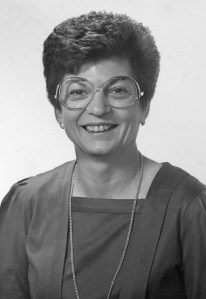
Joy Corning was on our target list to become an advocate for U.S. Senate ratification of the Comprehensive Nuclear Test Ban Treaty.
Heady with Barack Obama’s 2008 victory, and confident Senate ratification of the New START Treaty would be a slam dunk, a nationwide coalition was formed to advocate for CTBT ratification after the 1999 failed attempt during the Bill Clinton administration.
Corning was on a short list of Republicans we wanted to contact Senator Chuck Grassley about the treaty. As things go in an advocacy coalition, I wasn’t the one to contact her. Someone in Des Moines phoned her and she called back.
“(Corning) had to decline our request that she make an appeal to Senator Grassley,” he wrote. “She said she needs to contact him on so many things, and she needs to have only a few top priorities and couldn’t add this. She said she is working hard to bring her Republican Party back toward the center.”
Joy Corning died yesterday.
As it turned out, ratification of the New START Treaty was not a slam dunk and we adjusted our focus. Nonetheless, our contacts with Corning taught some lessons to those willing and able to hear them.
Always return phone calls. People who get things done in society almost always do.
Know who you are. While she couldn’t sign on to our cause the way we wanted, her efforts to “bring her Republican Party back toward the center” seem ennobling in the era of FOX News and right-wing talk radio. She fought that fight against steep odds and never gave up.
Focus on what’s most important. There is never unlimited time to advocate with an elected official. One must always be brief, be brilliant and be gone, lest our cause fade into obscurity.
Set the example. Corning’s daughters added the following to her online obituary, “Mother’s life was a model of class and grace, kindness and cooperation, service and civility. She led by example and always saw the good in everyone. She was active until the very end on efforts that supported human rights and justice for all.”
A person should embrace these qualities. That is Joy Corning’s legacy.
(Editor’s Note: One of the roles this blog plays is helping decipher Iowa politics. Now that I am president of our home owners association there is an occasional reason to do so and communicate to our members).
Association members,
As many of you may know, the state legislature passed a law allowing for the sale and use of fireworks during the periods immediately prior to Independence Day and New Year’s Day.
I asked Rod Sullivan of the Johnson County Board of Supervisors what this means for people like us who live in unincorporated Johnson County. His answer was pretty straight forward.
Nothing has changed regarding fireworks sales and use in the unincorporated county for this year’s Independence Day holiday.
The county placed a 90-day moratorium on sales to study how the new law impacts existing law. The supervisors are watching how other counties implement the law and are drafting an ordinance to bring county code into compliance regarding sales of fireworks. After the moratorium and the update of county code, sales of fireworks are expected to be permitted, but not this Independence Day.
The existing requirements for using fireworks remain in place. Below is a link to the rules for obtaining a permit. There are four requirements: evidence of operator qualification, diagram of the shoot site, proof of insurance, and a $20 application fee.
I am glad to see there is a contested race for the Solon city council seat vacated by Mark Krall.
Even though I don’t live within city limits, voter turnout is one measure of the degree to which people participate in the community. A lot of people outside city limits call Solon home and want to see a good participation.
Voter turnout has been sparse for city elections. In 2015, 53 voters turned out with Steve Stange getting 44 votes for mayor, and council candidates Mark Krall and Dale Snipes getting 49 and 44 votes respectively. Both Krall and Snipes resigned midterm and that’s why Solon is having a special election May 30. Since 65 people signed the special election petition, turnout should easily beat 2015.
Record turnout for a Solon city election was 468 voters in 2011. That year there was a loan agreement on the ballot. The city proposed to borrow $1,350,000 to buy and refurbish Brosh Chapel and Community Center and use it as a city hall and community center. The loan agreement was stomped out with 66 percent of voters against it. Cami Rasmussen was elected Mayor that year and Ron Herdliska set a record as the highest vote-getter in Solon history according to the County Auditor. The City of Solon hasn‘t had a special election for city council since the auditor started keeping records in 1977, so this year is of interest to people who follow local politics.
In my experience with the two candidates, Dale Snipes and Lauren Whitehead both seem level headed and community minded. Both have active campaigns which highlight their differences. The special election should be good for the Solon community whether or not one lives within city limits. If you live in city limits, I hope you get out and vote May 30.
~ This letter was published May 18, 2017 in the Solon Economist
The folks I hang with in the local food system are focused on product.
Is the asparagus ready? What about the rhubarb? When should I plant peppers and tomatoes? How much should we put into a member share?
I’m interested in the answers, yet those aren’t my questions. My work in the local food system is to inform and supply culinary endeavors in our kitchen. Technique and creativity seem more important than the fungible commodity fresh produce is becoming. Objectifying and standardizing things, an American obsession, plays a role in the kitchen. At the same time inspiration, creativity and technique seem more important than consumable objects. That’s where I live.
My questions are different from farmer friends. What food can be sourced locally? How can I use an abundance of spring greens before they spoil? What seasoning tastes best with scrambled eggs? What is the best way to preserve food in the ice box? How many pints and quarts of tomatoes shall I can this year? How do I combine bits and pieces from the pantry with fresh food to make satisfying meals? At some point, questioning must yield to creativity.
There is something about Saturday afternoon in the kitchen. It’s partly immersion into the cooking process and partly reliving memories. Saturday was a time to work in the yard and garage, then cook a meal while my spouse worked in town. I used to listen to Iowa Public Radio all day. Due to budget priorities, those programs are gone. Cooking time came with the beginning of Garrison Keillor’s A Prairie Home Companion which is gone too. I now draw life from the task at hand without musical accompaniment.
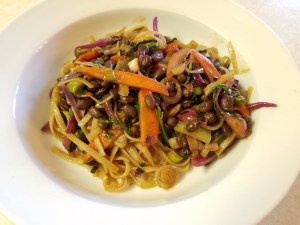
I made an Iowa version of pad thai last Saturday.
The dish has been in the works for a while. A couple of months ago I noticed the warehouse club sold USDA Certified Organic pad thai noodles for about $0.37 per serving. I bought a box on Friday.
With cabbage, onions and carrots from last season; a drawer and more of cooking greens from the farm; spring garlic from the garden; and bits and pieces stored in the ice box and pantry, the dish came together. The resulting meal was tasty, filling and seasonal — satisfying on multiple levels.
My kitchen experience made the dish as much as the ingredients.
I stock basic kitchen staples — high smoke point oil, salt, extra virgin olive oil, celery, onions, carrots and cabbage. Sources included retail merchants and local farms, however, the essence of cuisine is using what’s ubiquitous and on hand. It’s a fine distinction. Regardless of source, what’s in the pantry, ice box and garden now is what’s on hand. Creativity is in that moment.
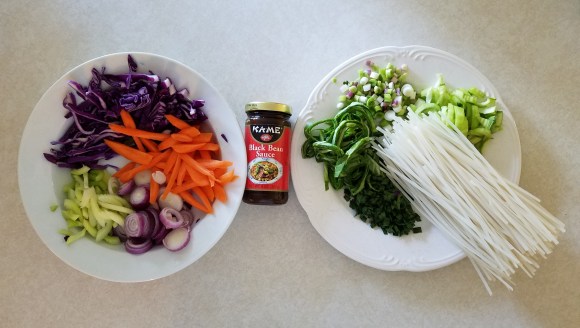
Except for the noodles, no specific shopping was needed to prepare pad thai. Canned black beans and a jar of fermented black bean sauce were the only prepared foods used and I stock both in the pantry.
Spring Garlic
Inspiration for the meal occurred at the intersection of discovery of a small patch of spring garlic in the garden and the memories it aroused. I recall a paper sack of garlic cloves brought home from the library and planting them more than a decade ago. The scent was intoxicating. I harvested enough for a meal.
Where is the creativity? Thinly cutting vegetables, sorting ingredients by cooking time, and measuring seasonings can all be taught. With an eye toward plating, carrots can be cut on the bias, green leaves julienned and celery stalks cut thick. Pad thai noodles are to cook 5-6 minutes, according to the package, then immersed in an ice water bath to stop the cooking. These techniques are like loading a palette with paint.
Creativity begins once the noodles are on and the wok is heated to high temperature. There’s no going back.
Using a high smoke point oil, onions, carrots, celery, cabbage go into the wok first. It’s “stir fry,” not “occasionally stir” fry, so full attention is required at the stove. Season with salt. Once the timer for the noodles expires, strain and dump into the ice water bath. When the first round of vegetables is tender and add plate two (spring garlic, garlic chives, sliced bok choy stems, and julienned bok choy leaves, stirring constantly. Add the drained and washed black beans and a generous serving of cooking greens. Once the greens are wilted, add a couple of tablespoons of fermented black bean sauce. Strain and add the noodles last, garnishing with a couple of tablespoons of extra virgin olive oil. Toss gently until heated. Plate and serve with your favorite sweet chili sauce.
Cheap, prepared food is everywhere in the United States. It’s convenient. It reduces time in the kitchen. It is engineered to appeal to our senses. Most of us eat at a restaurant or get help from the industrial food supply chain from time to time. However, there is no substitute for inspired cooking.
It provides engagement seldom found elsewhere in life. It’s a source of satisfaction hard to replicate. It sustains us in a turbulent world. This kind of inspiration and creativity is needed more than ever.
The weather forecast is for near-perfect spring weather. No rain and a high around 65 degrees.
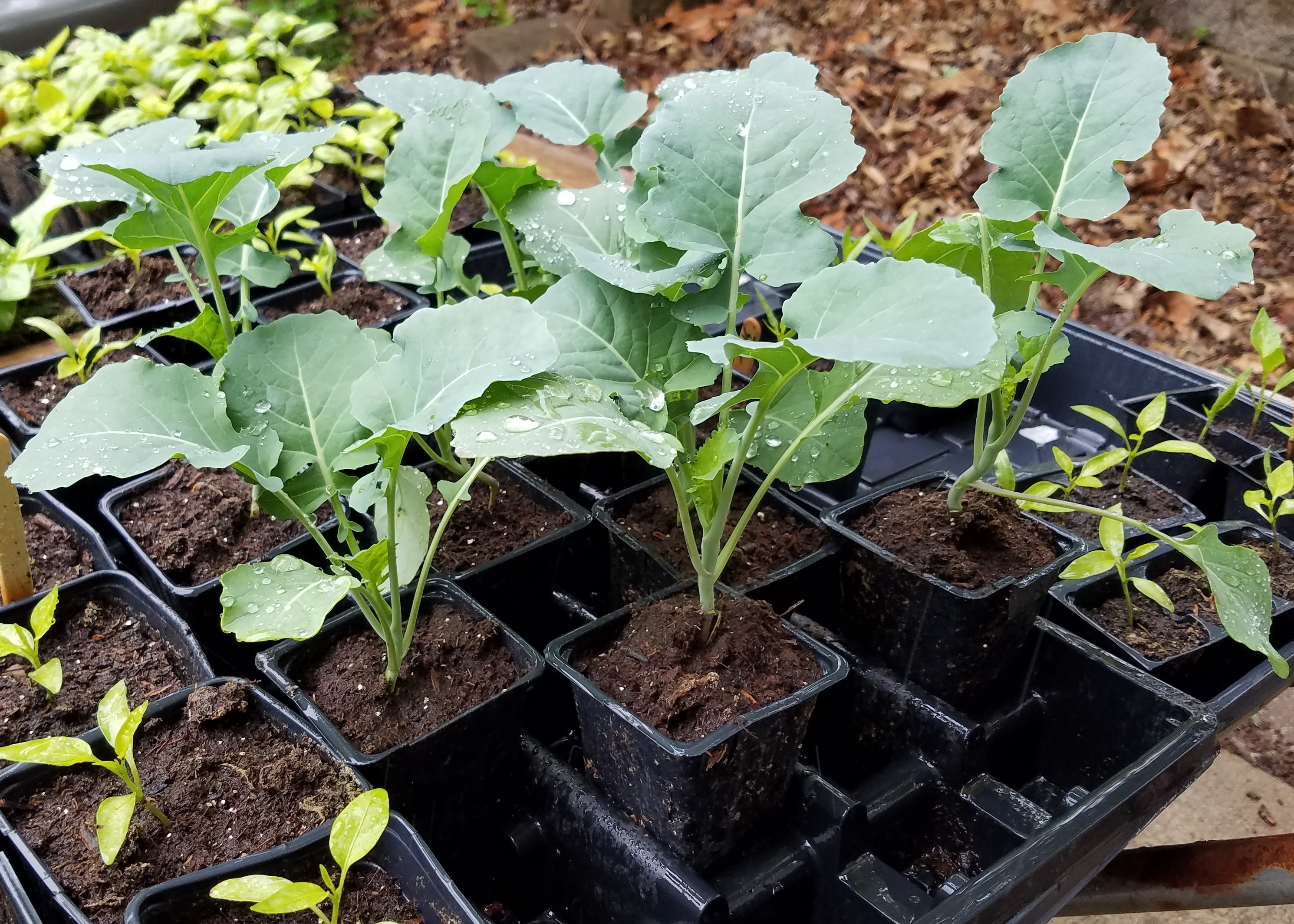
The day began at 4 a.m. with reading and laundry. I moved the cars down the driveway and rolled the seedlings out of the garage before dawn.
There should be fewer seedlings on the cart by day’s end.
The lilacs are toward the end of the season. I stood inside the branches, lush with flowers, and let the scent envelope me.
Years ago our daughter kicked a soccer ball under the lilacs. For a moment I was distracted… I retrieved the ball then I saw her. This memory of her in sunlight from under the lilacs is part of me this warm spring day. I carried her with me as I prepared for a day of gardening.
After a shift at the home, farm and auto supply store I begin a nine-day vacation. I say “vacation” but really mean “reboot.”
I hope to plant most of the garden, work in the yard and re-engineer parts of our homelife for efficiency. Why? To reap that feeling of being organized and prepared for summer.
It’s not as easy as re-booting a computer. Old habits are embedded in the code of this life.
In any case, I’ll hit the switch and see what happens. Hopefully good will come of it.
It’s been a struggle to get a grip on the presidency of Donald Trump. There’s nothing he’s done to give us hope.
Just give me a handle — anything to grasp onto as normal! Nothing.
Like many who care about the environment, nuclear abolition, and the commons, there seems little hope of advancing a positive agenda during the first term of the 45th president. What some settle on is giving up on 45 doing anything positive, resisting his degradation of our previous work, and working toward the 2020 presidential election and a Democratic president. In other words, create a political climate more receptive to our initiatives.
“I think we have to use the coming four years to create an understanding in the general public and amongst (sic) the security community that we need a fundamental change in nuclear weapons policy,” Ira Helfand, co-president of International Physicians for the Prevention of Nuclear War, wrote yesterday in an email. “Our goal should be that the new administration that takes office in January 2021 is fully committed to this change in policy, and staffed with people who share this vision.”
I respect Helfand’s sense of urgency to use the time we have to accomplish something. At the same time we can’t afford to shelve our priorities until the political climate is more likely to support them. What’s right is right and our work on the environment, nuclear abolition, and the commons must continue even if the odds are against us. There may never be a political climate receptive to the change we seek.
It’s time to turn the page on our reactions to Trump and do what’s right. For me that means joining together with others to work on preserving an environment where humanity can live out its next era in dignity and relative peace. That’s something to grasp onto.
If the evolution of homo sapiens is to eventually become extinct, there is little we can do about that. Whether it is the return of the Imam Mahdi before the end of the world, or the second coming of Christ, we can’t place all our hopes on a life after this one. We live here and now and must act to mitigate the damage we humans have wrought on the planet.
Earth is our only home and we must make the best of what we inherited.
All around us Spring is regenerating the biosphere as it has done for millennia. To be a part of that, especially with others, can only bring us good. Even if the political climate runs against our common sense, hope remains.
This spring we must re-dedicate ourselves to that hope.
I assumed it was the long day, split between two farms, getting tired after making 57 trays of soil blocks.
As I placed the last tray of 72 blocks on the table for cucumber seeding, I washed my tools and headed for the car. Something was up.
It took three days to winkle it out: I caught some kind of bug that kept me from working at the home, farm and auto supply store.
On Monday morning I was dizzy and nauseous. I brushed my teeth, shaved, showered and dressed, then headed to the car for the drive across Mehaffey Bridge. Just after I crossed the south arm of Lake Macbride I stopped, too nauseous to continue. I called off sick and turned around. Near the old barn north of the lake I stopped again and vomited twice. I spent most of the rest of the day sleeping. I did pick up our vegetable share at the farm — probably not my best decision.
Determined not to take a second of my five annual sick days today, I woke, got dressed and tried it again. I made it to the parking lot, went in and found my supervisor. After preliminary pleasantries told him I felt too sick to work and went home and back to bed.
In all I clocked 25 hours of sleep in a 36 hour period. As the sun moves lower in the western sky I’m on the mend. I don’t recall much about the last 48 hours.
I woke this morning about 9 a.m. just when Governor Terry Branstad’s hearing at the Senate Foreign Relations Committee was beginning. Branstad is President Trump’s nominee to become ambassador to China. The Des Moines Register live-streamed it, so I watched on my phone in bed. He looks to be a shoe-in because of his service as governor of Iowa and his long relationship (since 1985) with Chinese President Xi Jinping. I posted on Twitter, “Branstad seemed present, cognizant, schooled and mannered at his hearing today. Much different from person who nominated him.” It was a sign I was feeling better.
This week is the anniversary of President Nixon’s 1970 invasion of Cambodia and the protests that erupted around the country. At Kent State four students were killed by national guardsmen during the protests. My reaction to the news was to participate in my first-ever protest march. I carried one corner of one of four mocked up coffins to the National Guard Armory on Brady Street in Davenport. I felt participation would raise awareness about the war. When our photo appeared in the local newspaper, it confirmed my belief.
This week’s hope is that the ground will dry. The farming community is waiting for the ground to dry to begin planting. After a Rip Van Winkle style nap, what I winkle out is the need to focus on today because we never know what tomorrow will bring or what may disable us.
Rain began mid-morning and is expected to continue until sunset.
Let it rain.
It’s an opportunity to work on inside chores before spring planting.
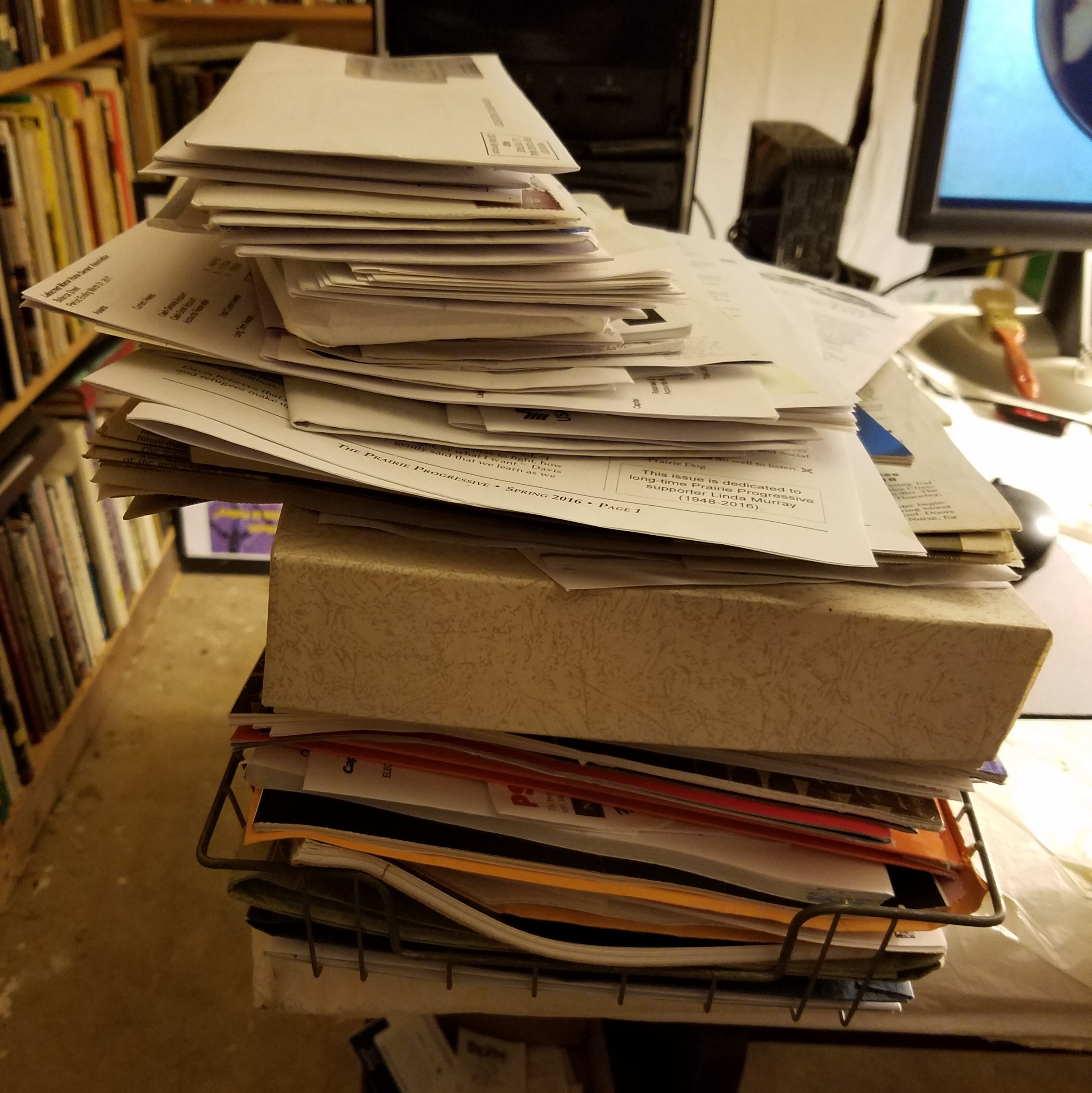
I’ll tackle a long-neglected inbox and use produce in the ice box and freezer to make soup. There’s plenty to do in the jumble the garage has become since winter — moving the lawn tractor toward the door, organizing the planting tools and cleaning shovels, rakes and bins for the season. I’m antsy about getting the garden planted — I accept it won’t be this weekend.
A few friends are participating in the People’s Climate March today. CNN and the Washington Post covered the District of Columbia march. There are several marches in Iowa and elsewhere. The key challenge for participants and other climate activists is determining what to do in a society where the importance of action to mitigate the causes of climate change garners slight interest.
“Surveys show that only about one in five adults in the United States is alarmed about climate change,” Jill Hopke wrote in The Conversation. “This means that if climate activists want this march to have a lasting impact, they need to think carefully about how to reach beyond their base.”
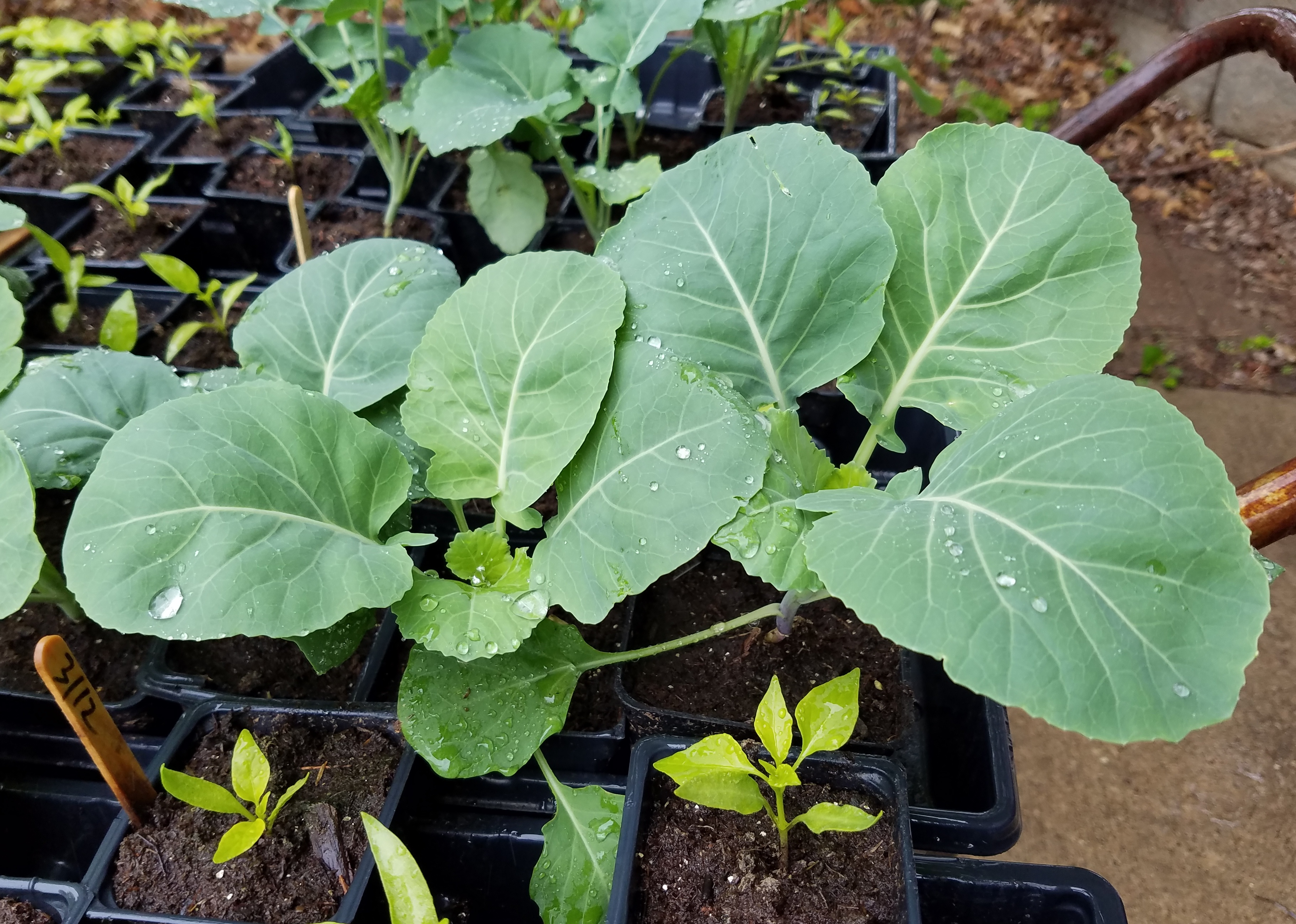
Collard Seedlings in the Rain
The unanswered question is how shall people outside the activist community be recruited to take climate action and by whom?
There are no good answers and no reason for climate activists to lead the effort. However, we can’t give up if we value society’s future.
The main issue is the increase in atmospheric greenhouse gases since the beginning of the Industrial Revolution. The good news is there are renewable sources of energy for transportation, manufacturing and electricity. How will society make climate change action ubiquitous with a majority of the world population?
Mass demonstrations can play a role in an effort to raise awareness about climate change. So can articles written by journalists, scientists, bloggers and organizations. At a minimum we can each strive to live with as light an environmental footprint as possible. We can explain to our friends, family and neighbors. Everyone has the potential to do something.
Today’s cool weather and gentle rain is a reminder.
“Staying out of the cold and warm inside? So are we,” Richard Fischer of Bernard wrote this afternoon via email. “Due to the weather we’re moving the event over to Convivium Urban Farmstead and Coffee shop, 2811 Jackson St., Dubuque.”
We must consider our lives in the built environment and let it rain. Have faith in today’s potential and adjust, knowing as long as rain comes and sustains our gardens and farms we too will be sustained.
There is much we can do when it rains. We can act on climate before it’s too late.






 Journey Home

You must be logged in to post a comment.