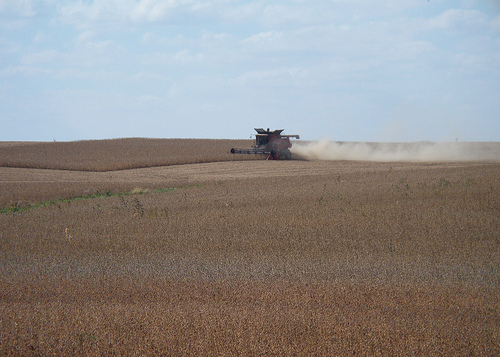
CHICAGO, Ill.— Yesterday I was surprised to notice the irrigation of corn fields along the Ronald Reagan Toll Road, or Interstate 88 in Illinois. What defines the Midwest and its row crops is the generous rainfall that enables crops without irrigation. This isn’t Nebraska after all.
Maybe the rigs have been there for a while, but they were not a good sign of how the Midwest is contending with dry conditions. It was irritating to see the nozzles aimed poorly, watering large sections of roads. Not irritating enough to stop the car, find the farmer and ask him or her about it. I didn’t want to be late.
In preventing the effects of climate change, depleting our aquifers for crop irrigation is not the right path.
There was plenty to think about as I made my way into the loop and McCormick Place for the conference. Water management in the climate changed Midwest is a thought that persisted until morning.
On Saturday, July 27, Rep. Dave Loebsack (IA-02) and Rep. Collin Peterson (MN-07), ranking member of the house agriculture committee, held a farm bill forum at the Johnson County Extension Office. Over 40 people attended, and a lot of ground was covered related to the farm bill, how the U.S. Congress works (or doesn’t), and during an open question and answer period with discussion of the Supplemental Nutrition Assistance Program (SNAP), change in the agriculture committee makeup after the 2010 election, crop insurance, conservation, rural development, LIHEAP (Low Income Home Energy Assistance Program), the renewable fuel standard and target prices for direct payments for wheat, corn, soybeans, cotton and rice. The forum was a primer for anyone who wanted to learn the recent history of the farm bill.
Rep. Loebsack said, “last year was the time to pass the farm bill.” Congress extended the 2007 farm bill for a year, and that extension expires on Sept. 30. Representatives of the Iowa Farm Bureau and the Iowa Corn Growers Association present at the forum indicated they did not want another extension. One audience member pointed to a $50,000 direct payment he would receive this year he didn’t need and didn’t want. Loebsack attributed the situation to the failure of congress to pass a new farm bill last year.
Rep. Peterson said the agriculture committee members had reached a bipartisan agreement last year, but the problem was (and remains) the Republican leadership. He was more specific, saying “it wasn’t Speaker Boehner… he never got in the way.” He added, Eric Cantor is the problem, “he’s the guy who screwed this thing up in the house.”
Mike Owen, executive director of the Iowa Policy Project, entreated the congressmen to take the political spin out of SNAP because it was destructive to families who depend upon the $1.30 per person per meal the program provides. A food pantry volunteer added, “it’s not just SNAP.” The farm bill impacts food pantries, meals on wheels and other nutrition programs people rely upon. Rep. Peterson was direct, “there will be more SNAP cuts (in order to pass a farm bill).”
The clock is ticking on getting a farm bill passed by Oct. 1. After this week, congress begins the August recess, reconvening on Sept. 8 or 9. The U.S. Senate has formally requested a conference committee, but house members have not been appointed. According to Peterson, they may not be until after the recess. There is time, but not any extra.
The framework for the farm bill has been set by the U.S. Senate version, for which the entire Iowa delegation voted. Passing the farm bill comes down to the U.S. Congress doing their work, something at which they have been less than effective. Also something could go wrong between now and Oct. 1 to stop the farm bill from moving, according to Peterson.
After the farm bill failed last year, Peterson said, speaking of the Republican house majority, “you guys have finally made me a partisan.” If SNAP is cut completely by the conference committee and replaced with block grants, as some conservatives want, the Democratic house delegation is expected to walk away, and the farm bill would expire. Well funded groups like the Heritage Foundation, Club for Growth, the Wall Street Journal and others have lobbied hard to cut SNAP, get rid of conservation and rural development programs, and crop insurance.
If readers are interested in more information about any of these topics, please post a comment below, and I’ll reply with any relevant information from the forum.
LAKE MACBRIDE— The summer weather has been as good as it gets, a reminder of what it was like as a child, with endless days to play in the sunlight, safe and without worry. This summer has been unforgettable. Besides the weather, it has been a different and somewhat tribal life after turning to those with whom we live out our lives in the neighborhood.
A quick garden update. Removing the green caterpillars with a medical grade forceps did the trick of removing the pest, and the new leaves are growing bug free. The white butterflies are around, so there may be more, and I lost one plant, but the new growth looks great.
Cucumber Seedlings
Today, I harvested the rest of the green beans, composted the plants, and planted a row of cucumbers from seedlings. I planted the seed in pots on July 13, so they are two weeks from seed to seedling. The benefit of growing them this way is with the wet root ball, they can tolerate diverse conditions better to get off to a good start in the ground. They bring their own moisture with them to the initial planting. I watered them well and mulched. With my newly developed pickle addiction, I may plant more before summer is gone. There were some seedlings leftover from planting a row, so maybe next weekend.
Three Rows of Lettuce
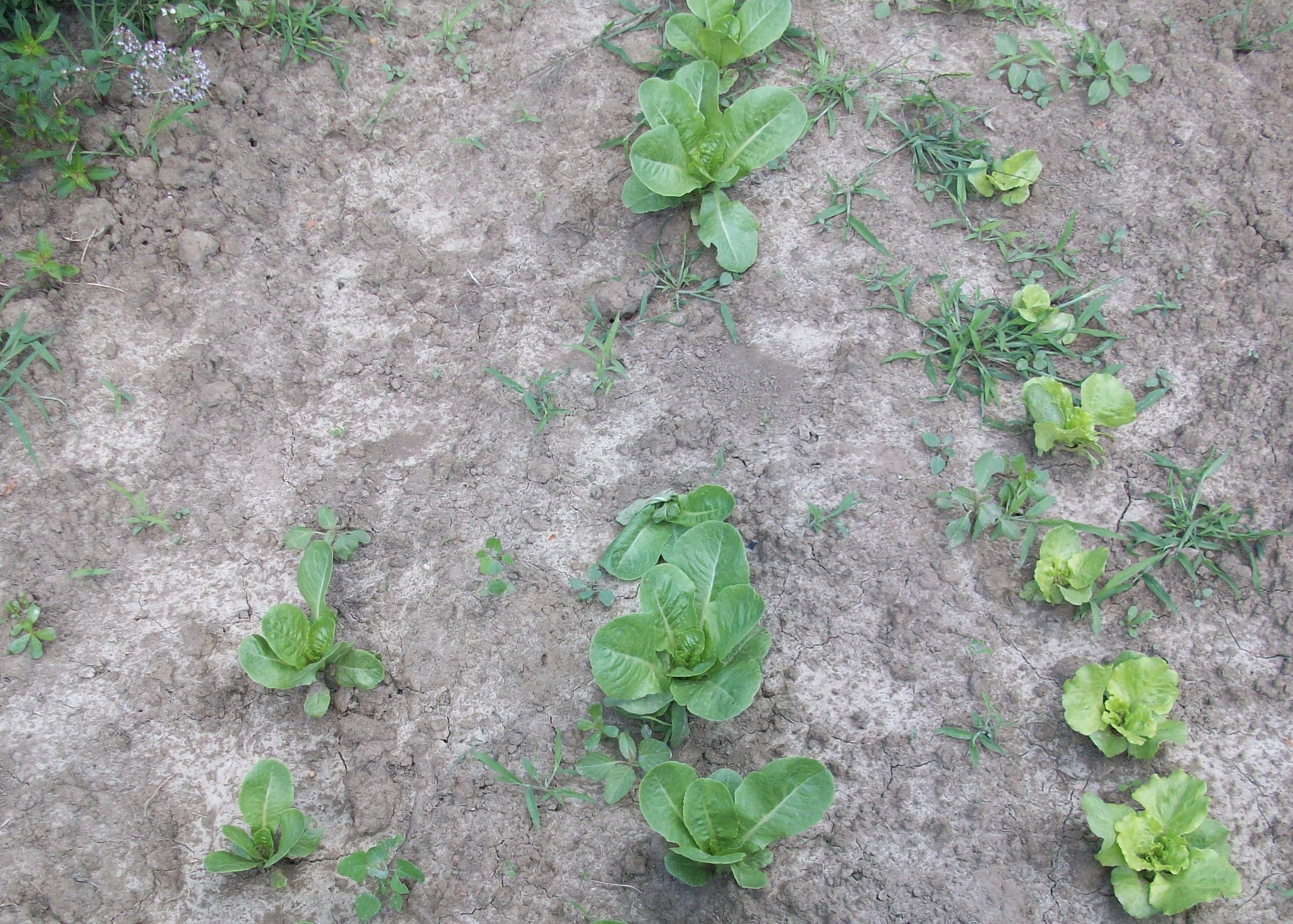
The current crop of lettuce is suffering. Not from the heat, or lack of water, but from disappearing. There used to be three full rows here, and some plants are missing. Not sure what is the pest, but it seems doubtful deer are jumping the fence as there are no deer footprints inside. Perhaps a rabbit, or something else. Whatever is left, will be enjoyed by the humans. The leaves are big enough to pick, so when I return from my trip, we’ll bring some in for a tasting.
Green Tomatoes
Finally, the tomatoes are maturing and three varieties have begun to ripen: two cherry tomatoes and Roma. Tomatoes have been the continuous crop in our garden, since the first duplex where we lived after our wedding ceremony. Perhaps there was a gap in Cedar Rapids, but not much of one. This year’s crop was the first I planted as seeds, and based on the results, I’ll do that next year as well.
Roma Tomatoes
The primary concern this year is to finish processing tomatoes before the apples come in. There are a lot of apples. I know what I want from the tomatoes: 12 quarts and 12 pints of tomato sauce, the leftover juice, 24 pints of diced tomatoes, and maybe a dozen pints of hot sauce using the cayenne and jalapeno peppers. Knowing how to approach it is half the battle.
Tonight for dinner, I made a pizza. Thin, wheat crust with tomato sauce I canned in 2011 mixed with fresh basil and salt. Toppings were half an onion from the CSA, thinly sliced zucchini, diced green peppers, sliced green olives with pimiento, halved cherry tomatoes and 6 ounces of mozzarella cheese. It is out of the oven, so I had better go sample.
LAKE MACBRIDE— As July draws to a close, much needed rain came last night, tapping lightly on the bedroom windows. Predawn, the driveway was wet, and the clouds had opened to reveal the waning gibbous moon which illuminated the landscape, reflecting its silvery light in pools of rainwater.
It seems halfway through the gardening season, and the spring abundance has turned to waiting— for the late lettuce to mature, tomatoes to ripen, and four or five varieties of peppers to fruit. The apple and pear trees are laden with fruit, weighing the branches so that I can’t get under them with the riding mower. Biting into a fallen apple, there was sweetness, but also the sourness of immature fruit. Not ready yet, but soon.
One Japanese beetle was spotted on an indicator plant I let grow in the garden, a weed the bugs favor. There was only one, and otherwise, the invasive species has left my apple trees and garden alone this year. Other gardeners and farmers in the area report the same thing. The only thing that changed from years they swarmed is that no one planted winter wheat in our area, favoring corn. This is anecdotal, but there seems to be a connection between winter wheat and an abundance of Japanese beetles showing up in our yard after the wheat is harvested from nearby fields. We dodged the bullet this year, and the apple harvest will be one of the best we have had.
The drama of a great gardening year has paused. We never know what today, or tomorrow might bring, and look forward to seeing how it unfolds as we reach toward winter. Winter. An unlikely topic now. Invoking it reminds us to live as best we can in the moonlight after rain has fallen.
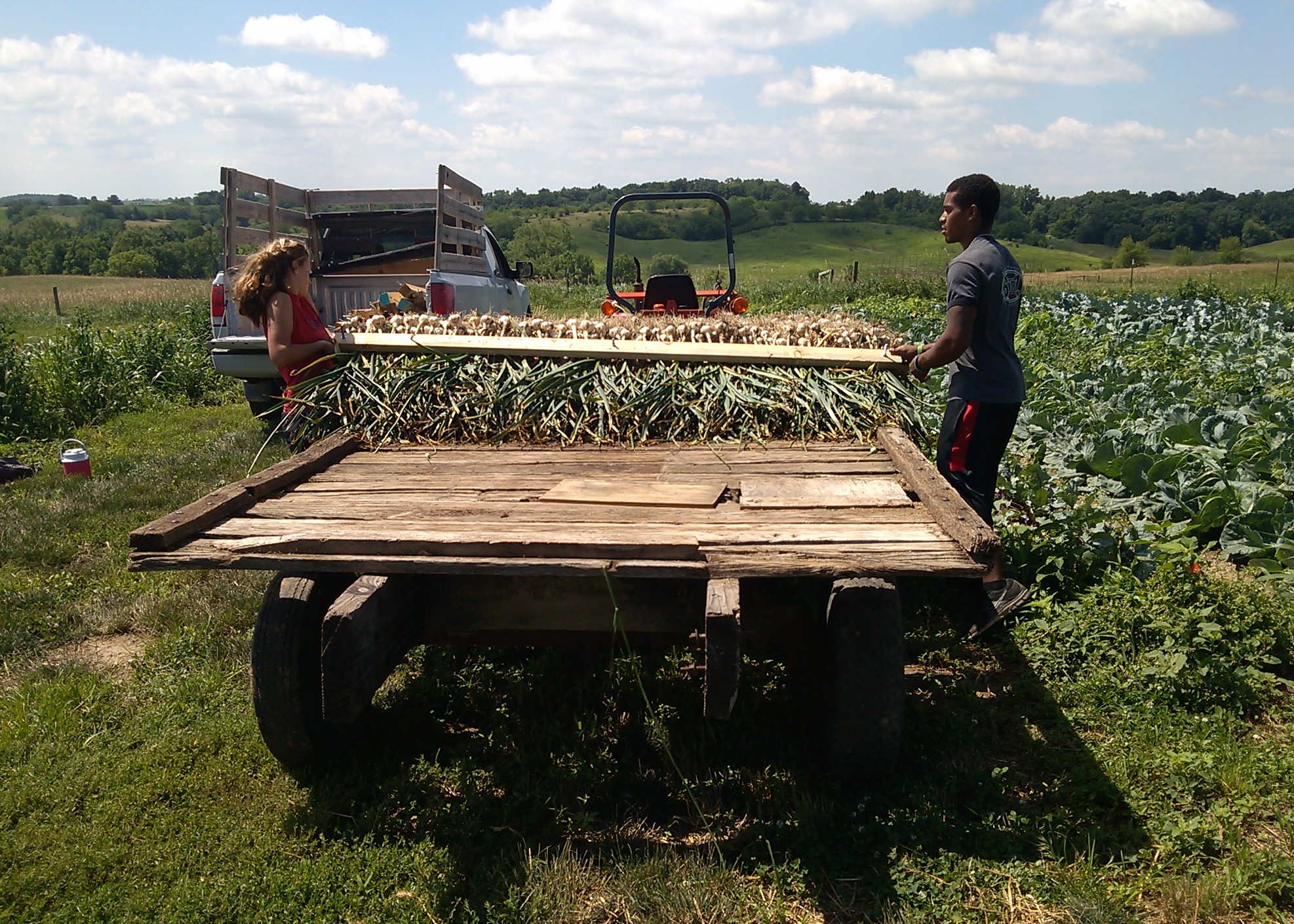
BIG GROVE TOWNSHIP— Shares are ready at our community supported agriculture farm late Monday afternoon. When making my pickup, I also help load the truck for the Cedar Rapids distribution. It’s a half hour job and my work for food arrangement continues for another ten weeks or so. Loading coolers and crates full of cucumbers, squash, kale, potatoes, onions, basil, tomatoes and other vegetables is not physically demanding, but it is a two person job. It takes a community to get everything done at a CSA farm.
It rained last night, leaving wet spots on the driveway. When the sun rises we’ll see how much fell. This morning’s clear sky, bright with stars and moonlight was memorable for its predawn tranquility.
Before leaving the landscape illuminated by moonlight, I reached out to touch the sky with its shiny orbs twinkling through the atmosphere. Reaching is one thing, touching quite another. The airy vapors of predawn dew wetted my feet through the clogs, and captured my attention, leaving the moon forsaken. Grounded in this reality, I returned to the house to get on with a life on the Iowa prairie.
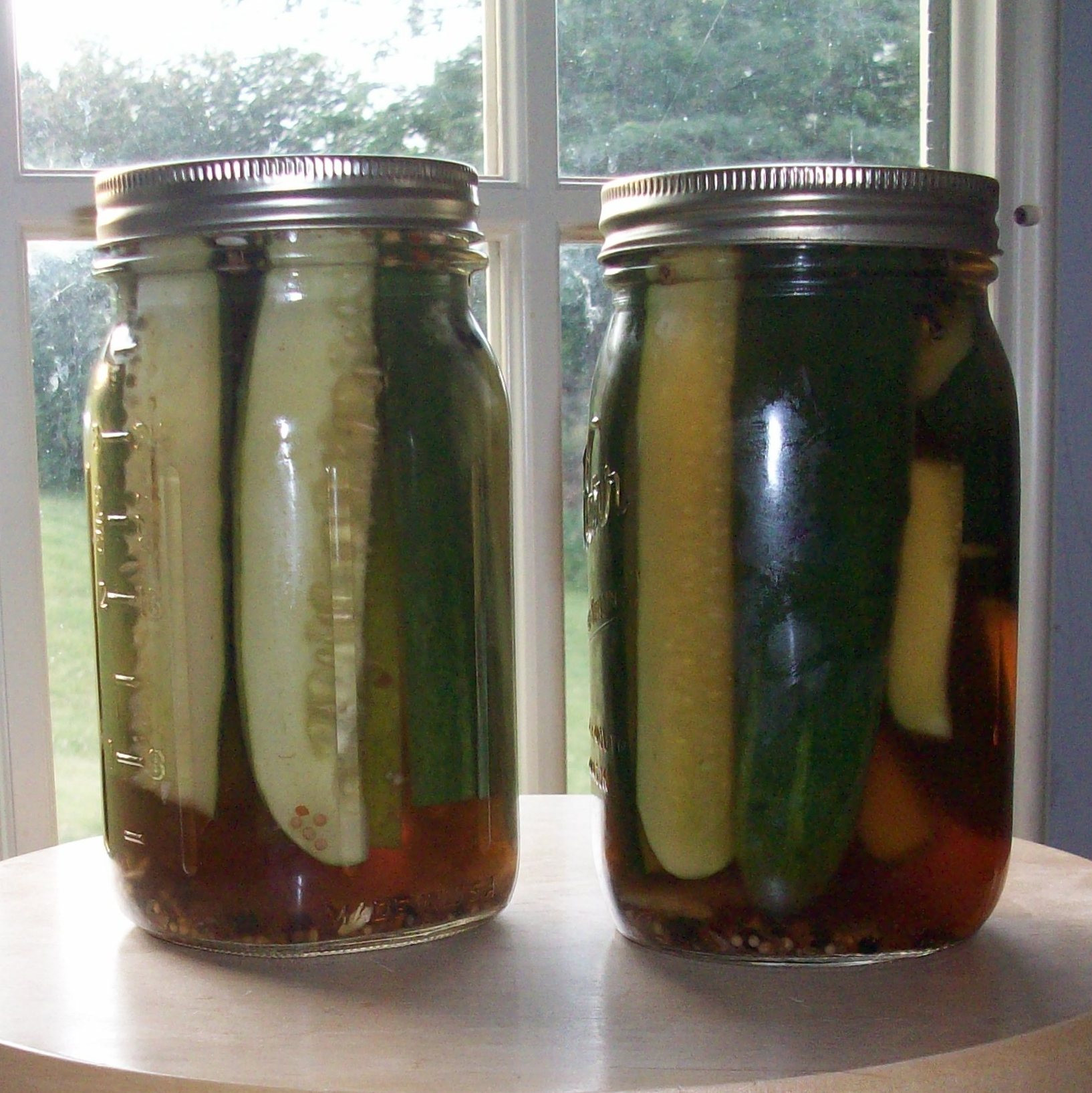
LAKE MACBRIDE— People are surprised that I’m making pickles without vinegar. Truth be told, until this summer, every pickle I have made was with vinegar, and the results were not optimal, with jars of sliced pickles lingering on in the refrigerator— I quit canning them years ago. Using the fermentation process, the results are so good, I may be fermenting a path to addiction. So what’s different?
It is the lactic acid created by bacteria action that preserves the cucumbers and provides their distinctive pickle flavor. This instead of the acetic acid of vinegar. Basically, waves of different bacteria become active in the salt brine and transform the cucumbers.
The process is so easy, and the results so good, I needed a bigger crock. If you want to try them, I used a celebrity chef recipe which readers can find here.
LAKE MACBRIDE— David Biello of Slate wrote an opinion piece in Newsday titled, “Why Don’t Farmers Believe in Climate Change,” on July 16. Link to the article here or here, but here’s a spoiler alert: it’s the Farm Bureau. I commented on the article, but my comment was removed because it violated Newsday’s conditions of use. It’s their world. What’s a blogger to do? If you’re reading this, you know the answer.
In the article, Biello wrote, “take, as an example of skepticism, Iowa corn farmer Dave Miller, whose day job is as an economist for the Iowa Farm Bureau. As Miller is happy to explain, it’s not that farmers in Iowa don’t think climate change is happening; it’s that they think it’s always been happening and therefore is unlikely to have much to do with whatever us humans get up to down at ground level. Or, as the National Farm Bureau’s spokesman Mace Thornton puts it: ‘we’re not convinced that the climate change we’re seeing is anthropogenic in origin. We don’t think the science is there to show that in a convincing way.'”
If there is a record drought like last year, large farmers will capitalize the loss over a period of years, plow the crop under and start over next season. For them, it’s just another aspect of dealing with farming as a business. This attitude is consistent with what I experienced when listening to row crop farmers in Iowa.
The idea, “they think it’s always been happening and therefore is unlikely to have much to do with whatever us humans get up to down at ground level,” is ridiculous. Climate change doesn’t just happen— it happens for a reason. And today, the main reason is carbon pollution from dirty energy like coal, oil and natural gas.
I encourage you to read the article if you are interested in the interface between Iowa farmers, the Farm Bureau and the environment. There is a lot to learn before Iowa makes progress in protecting our environment. Some say the Iowa Farm Bureau runs the state of Iowa. I say it could only do so in a vacuum of action from people whose views are closer to the reality of climate change.
LAKE MACBRIDE— The dawn dew barely moistened my shoes while venturing to the garden to water the plants. Much needed rain failed to precipitate last night, and without daily irrigation, the produce yield would be reduced. The lettuce seedlings planted last week are surviving with twice a day watering. The morning shade of the locust trees protects them from the parching effect of the sun. The forecast is for zero chance of rain before noon.
Last night I made two quarts of deli-style refrigerator pickles. The brine is the same as the one processing cucumbers in the crock, just that in the refrigerator they will be ready in four or five days. There are more cucumbers on the vine, and one kept fresh for salads. The flow of cucumbers through the kitchen has been about right.
The ice-box is packed and filling with food. I added a couple of more packages of grated zucchini to the freezer drawer and today’s plan is to make pesto to freeze. Produce rotation and preserving to prevent spoilage has become a thing around our household.
I decided to take down the advertising calendar on the bulletin board in the garage and replace it with photos. I spent an hour sorting through digital photos on my computer and ordered prints from Walgreens online. They were ready for pickup across the lakes in about an hour.
After making the pickup, I spent another hour selecting prints to post, and processing memories of our life since we became empty nesters. Better to be reminded of our family life than the days on a calendar. If one has children, it is a blessing to know them at all. Reflecting on who they have become is a luxury as good as gold.
No pickling brine will stop death’s inevitable advance. As long as we can process— cucumbers, zucchini and basil, photographs and memories— we can go on living. As Walt Whitman wrote, “and as to you death, and you bitter hug of mortality . . . it is idle to try to alarm me.” Fearless we enter the day, endeavoring to accomplish something with our lives.
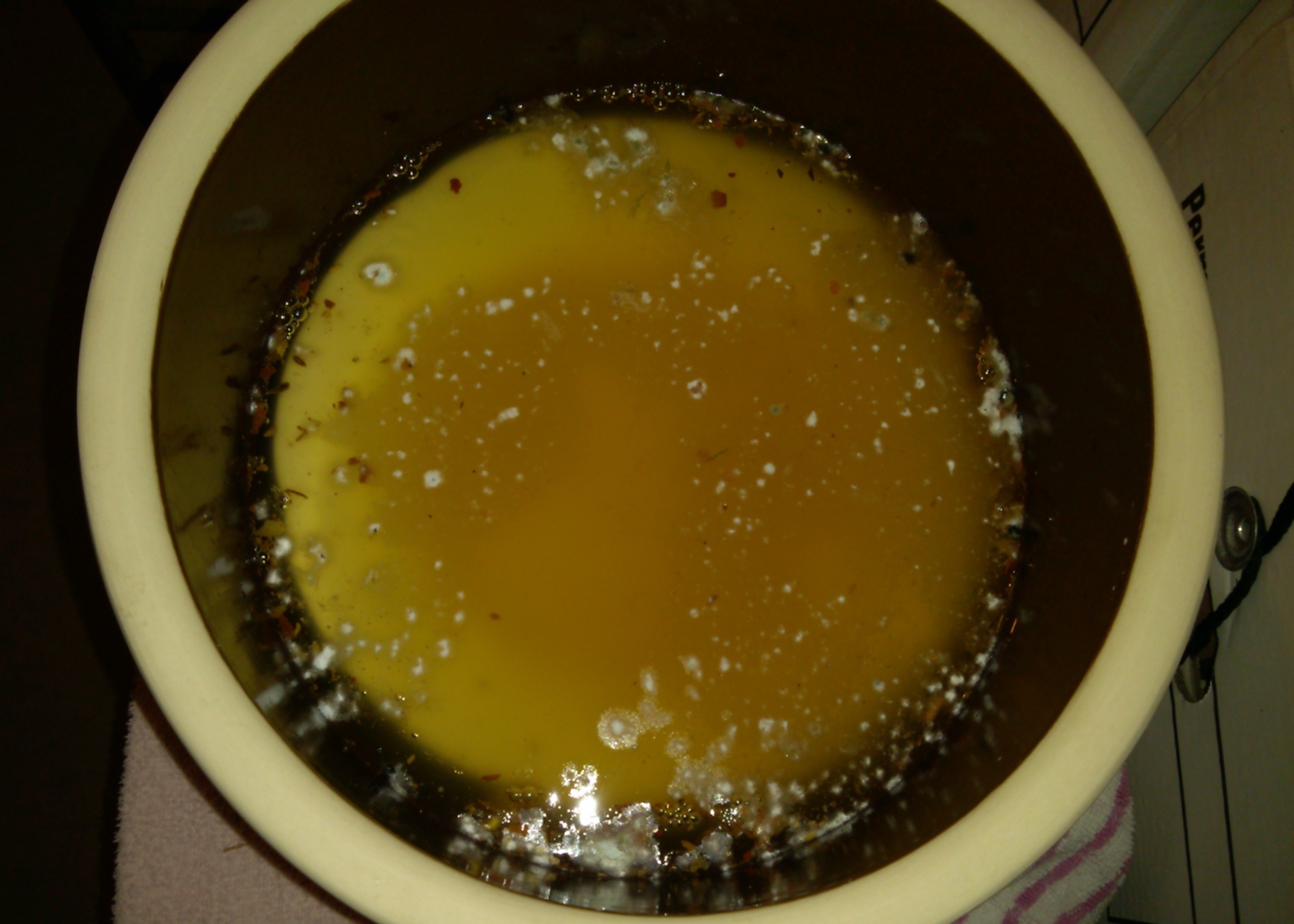
LAKE MACBRIDE— Scum is forming on the surface of the crock liquid, and that’s a good thing: a sign of bacteria working the cucumbers, transforming them into pickles. Sounds kind of gross, but hopefully fermentation is going as it should— there are only so many times one can check the progress in a day, then it’s time to move on to something else.
Saturday’s weather was hot, but otherwise gorgeous. The work outside was invigorating and sweaty. The pest du jour was swarms of gnats which, upon arrival in the garden, were a reminder to apply repellent. An application of imitation vanilla around my nose and mouth took care of the annoyance, and unintentional ingestion of gnat protein.
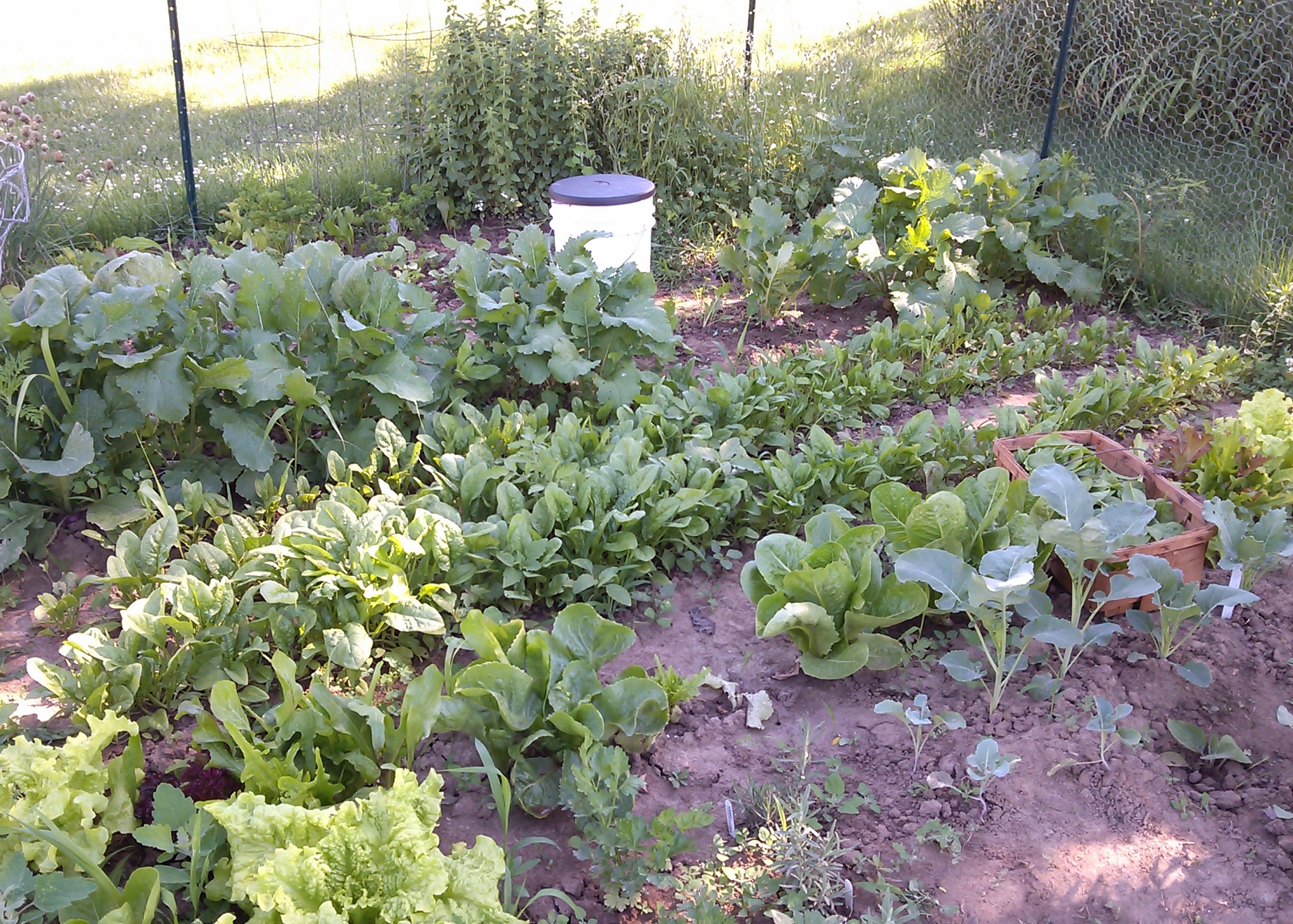
The main garden task was to turn over soil where the spinach and radishes were to plant lettuce seedlings. It seems hot to be planting lettuce, but with the shade of the locust trees protecting the plot in the morning, I am hopeful of another crop. Much of gardening consists of experimentation and my newly found ability to start seeds in the garage has me doing more of it this year.
I cleaned up the plot, removing the fence to cut the grass, weeds and small trees growing around its base. Then I picked a bushel of lettuce from the previous plantings, and sorted, washed and dried it to make two bags for salads. There were a couple of small turnips, one of which was later grated onto a dinner salad. When the work was done, the garden plot looked well groomed.
As the kitchen fills with food, it is time to process the new and do something with the old. I separated the leaves from the stems to make a quart jar of dried oregano for winter cooking. I cleared some space in the freezer by removing bags of last year’s Anaheim, Jalapeno and red and green bell pepper and cooked them in a Dutch oven in a cup of white vinegar. When they were tender, I ran them through a food mill and put the resulting green hot sauce in a Mason jar in the refrigerator to use in Mexican-style dishes.
Using four pounds of yellow squash and zucchini, I made a casserole, which will keep for a few days. The idea was to use the squash, and I made a large recipe with the idea of following the chef’s instructions to produce the desired result. Next time, and it won’t be long, I’ll scale it down to portions for a household of two.
How many kohlrabi can a person eat in one season? I intend to find out. I made mashed potatoes for dinner using leftover roasted turnips and two kohlrabi cut into half inch dice and cooked in a separate pan. When the potatoes and kohlrabi were cooked, I added them to a large bowl with the turnip and mashed them. Once the blend seemed right, I added some salt, butter, sour cream and chopped fresh rosemary. It seems wrong to mixed potatoes with cruciferous vegetables, but what came out passed the taste test.
After dinner, I inspected and watered the garden. The new lettuce will need watering more often, and there is more to harvest Sunday: zucchini, green onions, herbs and broccoli. Chard and collards are plentiful, but there are enough leafy green vegetables in the refrigerator, so they’ll stay in the garden for now.
Septoria Leaf Spotting blighted some of the tomato plants. The ones with the first cherry tomatoes look like they will make it to harvest, but not much longer. I noted the last planted tomatoes have not shown evidence of the disease. Will observe them as the season progresses to see if any conclusions can be drawn. We are a week or two away from some ripe cherry tomatoes.
This is how it goes in a kitchen garden. A constant activity that is not tremendously exciting, but a template for living and eating well on mostly locally grown food and the work of our hands. Life could be a lot worse than this.









 Journey Home
You must be logged in to post a comment.