Categories
Home Life Kitchen Garden

Nostalgic Breakfast Tacos

Fresh Cilantro Tacos

There is a 25 percent chance of rain beginning at 9 a.m., according to the weather application. I pulled the cars out of the garage so that space can be used for other projects if the forecast proves to be true. Despite the coronavirus epidemic the waste hauler is working today so I put the trash and recycling bins at the end of the driveway.

I made a taco for breakfast this morning and one of my go-to recipes is easy.

Nostalgic Breakfast Taco

When Mother began cooking tacos at home it was revolutionary. We hadn’t had that at home until the 1960s. The change was partly due to the rise of mass-produced, Mexican-style options at the grocery store. It was also a result of her work at the grade school cafeteria where they made dishes different from what we grew up with. Cafeteria work broadened our home food repertory. While we don’t eat beef in our home now, commercial soybean crumbles create a texture and flavor that reminds me of those early days when she made tacos for the first times. Here’s how it went this morning.

Two frying pans go on high heat. In one cook a pre-made organic flour tortilla. In the other heat a scant tablespoon of extra virgin olive oil.

Dice half a medium-sized onion and part of a frozen bell pepper. They go into the hot oil. You’ll hear the sizzle. Stirring constantly, season with salt, dried cilantro and powdered chilies. Cook until the onions and peppers are soft. Stir in a clove or two of minced garlic and cook until a garlic aroma rises from the pan. Stir for a minute or so and add one half cup of commercial frozen soybean crumbles. Stir until thawed and set aside.

Place the cooked tortilla on a dinner plate and garnish from the bottom up: a layer of Mexican cheese to taste, pickled sliced jalapeno peppers, salsa or hot sauce to taste. Put the fry up on top of the garnishes and serve with a beverage of choice.

I look forward to when garden cilantro and tomatoes are available. Tacos are a way to explore your palate and discover who you are. For me it’s a chance to remember standing around the kitchen in that American foursquare home with family while reflecting on how our lives have changed. Even on a rainy day that is positive experience.
Categories
Kitchen Garden

Onion Experiments

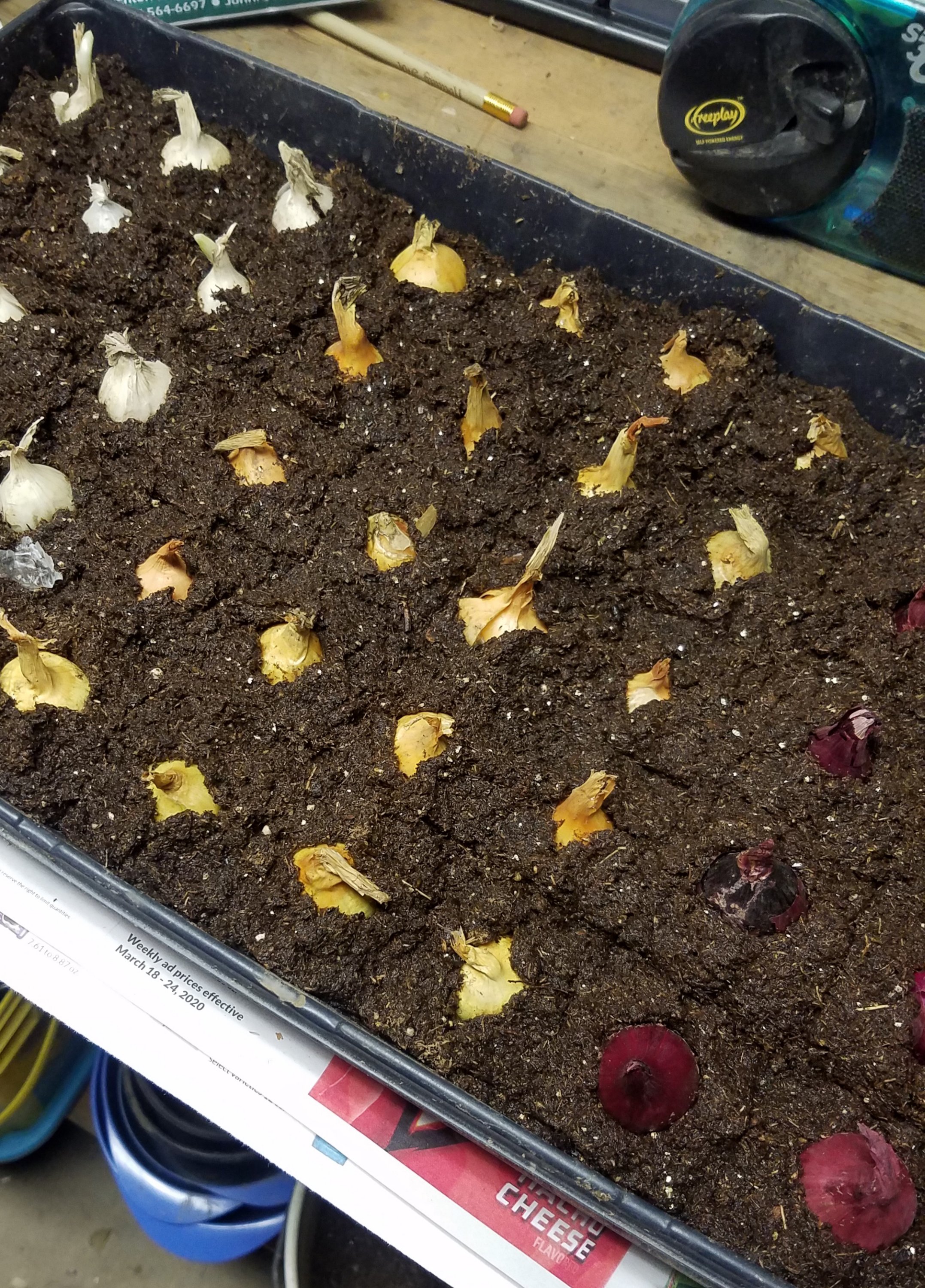
Onions planted in soil blocks.

Growing large storage onions has been challenging. I yearn to grow large onions and use them throughout the year.

Spring onions? No problem. Larger red, yellow or white, the kind we most use in the kitchen, have eluded me.

I’m determined this year will be different. Toward that end I’ve launched some experiments to see how I can do better.

Friday, Feb. 7, I planted Talon Yellow and Red Burgundy onions at home from seed. After six weeks the yellow germinated, the red did not. After chatting on line with another grower, they pointed out fresh onion seed is important. The Talon Yellow seeds were this year’s crop from Johnny’s Selected Seeds and Red Burgundy were end of season discards at the home, farm and auto supply store. Lesson learned: get fresh onion seeds.

That same day I split my Matador shallot seeds with the farm. They are growing their half in the same environment as the rest of their onions, I started mine in a tray at home. Mine don’t look that healthy although they germinated. If the targeted planting time is mid-April, there is time for them to grow and hopefully survive transplant. I’m looking forward to comparing results.

I bought red, yellow and white onions starts from the home, farm and auto supply store. These are the same variety I bought every year since working there. I divided them roughly in half and planted some in soil blocks to give them a head start, and reserved the rest to plant in the ground as soon as it is tillable.

This year I ordered some onion plants from Johnny’s Selected Seeds. They are to be shipped in a couple of weeks and then direct planted in the soil. The varieties are Ailsa Craig, Patterson and Redwing. While more expensive than seed at about 30 cents for each plant, I’m hoping to find something that works in trying it. I would much rather grow everything from seed yet I want other options as back up.

Finally, this morning, I planted six 3 x 3 containers with White Lisbon Bunching Onions from Ferry-Morse (60-110 days). I mixed both pelleted and non-pelleted seeds and broadcast them in the pots. If they germinate and grow, I’ll transplant the entire pots as groups of spring onions. It is a month behind where they should have been started, so we’ll see what happens.

The last part of my experiment is twofold. I am researching types of soil nutrients which support onion growth. My normal process is to hand till composted chicken manure into the soil before planting. If the several garden books in my library suggest another approach, I may try it as long as it is not a commercial, chemical fertilizer. This year I bought a small tiller which will break up the soil more thoroughly than handwork.

I am also planning a disciplined approach to watering and weeding the crop once it is in the ground. Because of our climate, I plan to mulch the crop to retain moisture in the soil. Weeding and regular watering has proven to be challenging, partly because weeding gets away from me and partly because my approach to watering is sparing. With a framework of “experimentation” perhaps I can do better.

I know growing storage onions is possible as I get them from the farms each year. With effort, maybe I can grow my own.

Categories
Kitchen Garden

Last Day of Winter and Garlic is Up

Garlic planted last fall.

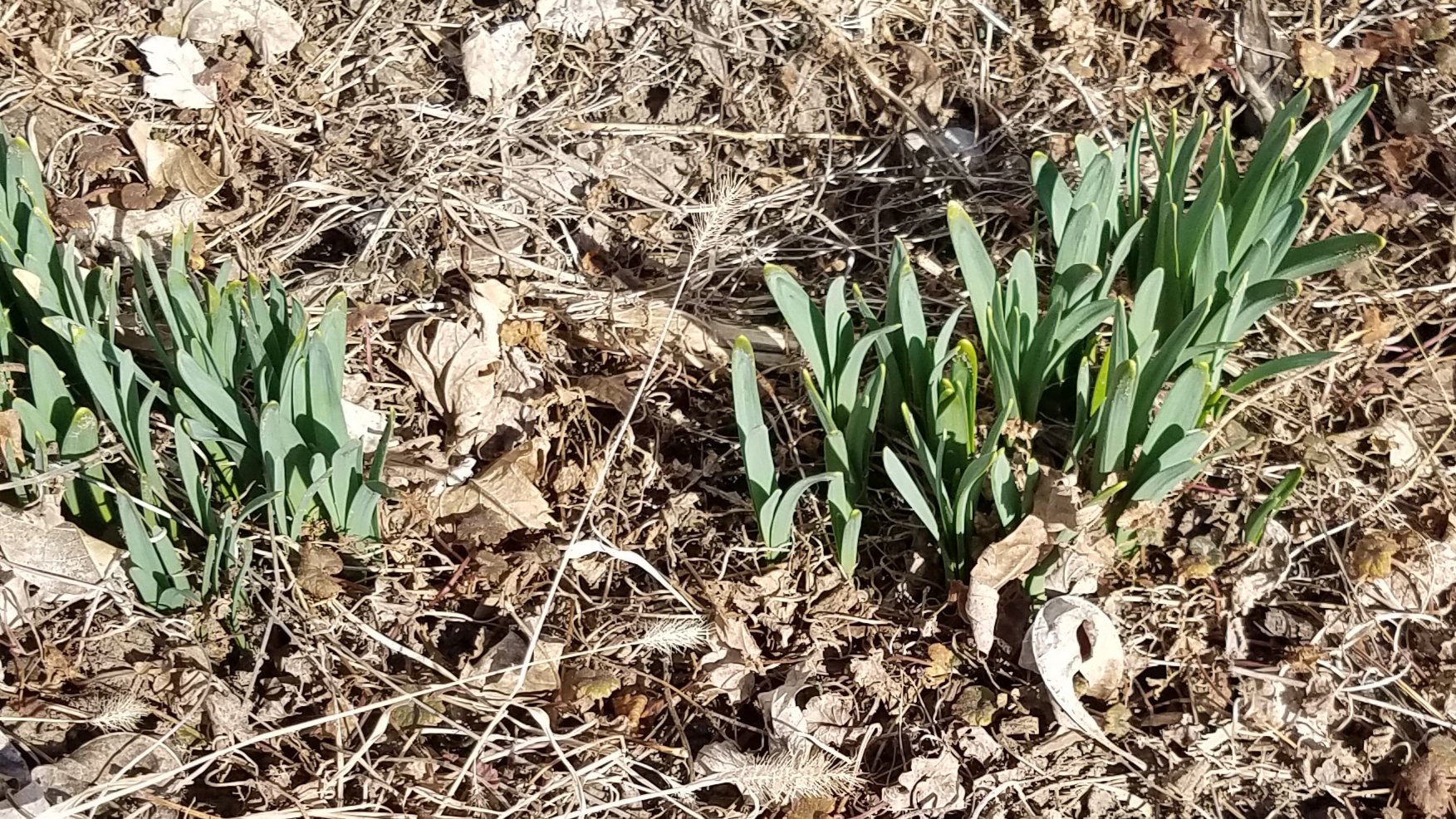
Garlic plants emerged in the garden.

It was a mild winter so I expected they would. The actuality of it is what we crave.

The rows were mulched in autumn, although they could use more. Next time I head into town I’ll pick up a couple of bales of straw. I don’t know when that will be.

In the early morning of a normal work day I weighed whether to work my shift. The managers at the home, farm and auto supply store are the main reason I’m still there. They treat me fairly and have been flexible with my schedule. As coronavirus spreads in our county I don’t want to be exposed. In the morning huddle last week the store manager echoed the guidance of the Iowa Department of Public Health in saying if I’m sick, I shouldn’t go to work. Except for a couple of sneezes this morning, I’m not that sick. There’s more to it than that.

I’m more worried about exposure to coronavirus in a public place than in spreading my germs. My age puts me in an at-risk group to contract COVID-19. Likewise, I’m fighting diabetes with which I was diagnosed last year — another risk group. Most deaths from COVID-19 are in people over age 60. No one in my family is encouraging me to work my shift. At this point I was waiting for the early crew to arrive at the store so I can call off.

During this pandemic it’s hard to know what to do. The number of cases statewide is low at 29 as of yesterday. Of those, 18 are in our county. The number could quickly escalate, so the CDC guidance to stay home if we can makes sense for the 15 day recommended period.

The federal government is flailing. They throw hundreds of millions of dollar proposals around like we have it. The current national debt is over $23,475,000,000 with a budget deficit over a trillion dollars. We’ll have to borrow the money, most likely from China. All the jiggering of the economy seems likely to put money in the hands of people who need it least rather than address the pandemic.

As my garlic grows the tumult of national discourse seems remote. I don’t want to die from coronavirus and am doing my best to manage the risks. When I was at Fort Benning a radio station in Alabama would to play a Merle Haggard song in the wee hours of morning. It explains how I feel as well as anything:

I’m only human. I’m just a man.
Help me to believe in what I could be and all that I am.
Show me the stairway that I have to climb.
Lord for my sake, teach me to take, one day at a time.

One day at a time, sweet Jesus, that’s all I’m asking from you.
Give me the strength to do everyday what I have to do.
Yesterday’s gone, sweet Jesus, and tomorrow may never be mine,
So for my sake, teach me to take one day at a time.

Categories
Kitchen Garden

Pandemic Provisioning

Dinner March 16, 2020.

A foundational aspect of our lives in Big Grove Township is reliance on others when it comes to food. We use the international supply chain which brings items closer to home so we can buy them at the grocery store.

At the same time, we spend 24 percent of our food dollars on products where we know the face of the farmer. That’s a lot more than most families and it results in a pantry full of staples like potatoes, onions, carrots, canned tomatoes, frozen vegetables, pickles and apple products.

Our regular habits prepare us for a month of quarantine without the coronavirus pandemic. We’d suffer for lack of milk and eggs, yet in a global society where millions go hungry each night, it’s more inconvenience than any kind of deprivation. We’ll get by.

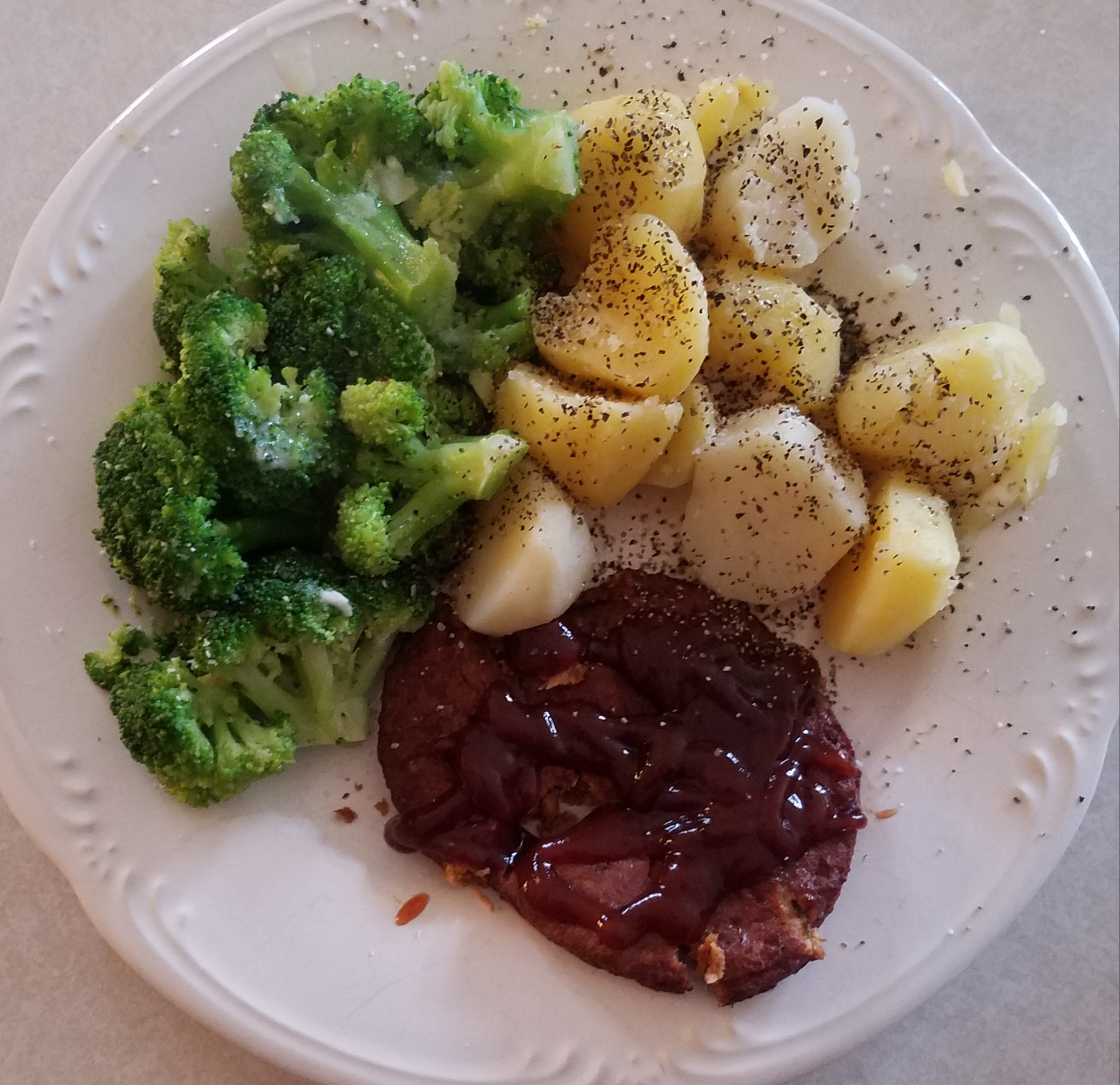
The meal in the photo is our home food story. One third Farmer Kate’s potatoes, one third frozen organic broccoli from the wholesale club, and one third a commercial, mass produced soybean burger from the grocery store. The garden broccoli crop wasn’t so good last year and we’ve depleted the freezer of our own. That’s where the food supply chain comes in handy.

I don’t know if I’ll venture to work at the home, farm and auto supply store tomorrow. After the management team arrives later this morning I’ll phone in and see what protections they offer employees. I work in the warehouse and am isolated from most customer contact. All the same, retail is a people-contact job and there is more risk there than in staying home. If I choose to stay home, there will be no compensation.

I’d feel better about the isolation if it were warm enough to work in the yard. Yesterday morning patches of snow remained on the ground. It should melt today as ambient temperatures are expected in the mid-forties this afternoon. Instead of working outside, I read and wrote in the usual places. About 5 p.m. I started peeling potatoes and making dinner. It wasn’t much, but will sustain us as we ride out the coronavirus pandemic over the coming weeks.

Categories
Kitchen Garden

Seeding During the Pandemic

Kale and Broccoli Seedlings at Two Weeks.

Most of the usual seeders were absent from the greenhouse as I made blocks for 3,840 seedlings. Those who did work tried to stay at least six feet away from each other, although it was hard given the confined space.

“You may be the vector,” I said to one.

“No, you are the vector,” they replied.

It was in fun, but a serious note rang heavy in the atmosphere. None of us wants to die from the coronavirus.

I worked mostly alone as the farmers tended sheep in the barn. There are now 45 lambs and they are not ready to be outside all the time. Before she left I reviewed my planting plan with the farmer, made adjustments, and planted the following for my garden:

Early White Vienna Kohlrabi, Ferry-Morse, 55 days.
Swiss Chard, Mixed Colors, Ferry-Morse, 30-60 days.
Fordhook Giant Swiss Chard, Ferry-Morse, 60 days.
Florida Broad Leaf Mustard, Ferry-Morse, 48 days.
Southern Giant Curled Mustard India, Ferry-Morse, 56 days.
Bibb Lettuce, Ferry-Morse, 57 days.
Buttercrunch Lettuce, Ferry-Morse, 65-70 days.
Parris Island Cos Lettuce, Ferry-Morse, 68 days.

I noticed the kale and broccoli planted March 1 germinated with a high rate. Some of the seeds planted last week have already sprouted, although it will take celery a couple weeks.

19,920 seedling blocks made during the first five weeks. The crew will begin transplanting to the high tunnel maybe this week.

Categories
Kitchen Garden

Spring Song

Spring on Lake Macbride

The surface of the ground crunched as I walked the compost bucket out to the bin. The ground was frozen.

Grass has been greening up with the recent rain and ambient temperatures above 70 degrees. The frosty morning wasn’t a permanent setback as green grass was visible through the glaze of frozen rain.

Farmers have produced first batches of maple syrup, so it’s undeniable spring is close by. This in-between time on the margin of winter is unsettling. I want to get going on the garden… but not yet.

The sound of bird songs returned. Voices of children playing outdoors are evident. The trickle of water in the downspout informs us of the spring melt, that despite crunching under my boots it won’t be long.

This is my spring song.

Categories
Kitchen Garden

Refilling the Seed Gaps

Onions Drying

One batch of onion seeds germinated poorly so I seeded the failed blocks with Cilantro, Parsley and Dill.

Cilantro, Ferry-Morse, 28 days.
Parsley, Ferry-Morse, 70-90 days.
Dill, Ferry-Morse, 70 days.

This is my first attempt to grow onions at home and there’s a lot to learn. Once the seeds germinated, I moved them upstairs into sunlight. They grew long and spindly, laying down over each other in the tray. Carefully, I trimmed the tops to about two inches and they sprung up. The expectation is they will start to right themselves and grow more vertically.  The backup plan is to buy and beg some onion starts in case these don’t mature. For the time being I’m not giving up on them.

Categories
Kitchen Garden

Celery – In!

Spring Plants from Indiana

It was another busy day at the farm for seeding session #4.

I planted one tray of

Conquistador Celery, Johnny’s Selected Seeds, 80 days.

and one tray with

Georgia Southern Collard, Ferry-Morse, 75 days.
Pak Choy Toy Choy, Ferry-Morse, 30 days.
Teton Hybrid Spinach, Ferry-Morse, 45 days.
Cilantro, Ferry-Morse, 28 days.

Space is beginning to fill with trays.

I delivered a box of flower seeds for the farm’s coming garden class at a local food pantry.

We talked, a lot, about everything. We were chatty.

I enjoy my time with eight people talking and seeding trays of soil mix. I don’t say a lot, just do my work and bask in the sounds of another day on the farm.

The lamb count is now 40 and there are five new goats.

Categories
Kitchen Garden

Frozen Ground

Burn Pile

A friend grows straw for the home, farm and auto supply store and he isn’t in the fields yet. The ground is frozen.

In addition to producing wheat straw he grows commodity crops and has a tough row to hoe… literally.

I enjoy interacting with him and his crew as they remove a hundred bales from a gooseneck trailer and put them on pallets. Once re-stacked, I move them indoors with a lift truck.

I have been drafting emails to groups of which I am a part since I woke. Gotta stay on top of all that so when the ground thaws I can get my spade in it. Not yet… but soon.

Categories
Kitchen Garden

Belgian Lettuce 2020

Belgian lettuce patch with arugula

Today I planted Belgian lettuce. There is nothing particularly “Belgian” about the seeds. According to my maternal grandmother it is called Belgian lettuce because it is planted March 2. It’s the tradition and that’s that.

I planted arugula as well because when everything is mixed together in a salad it will taste great. I planted:

Lettuce

Mesclun Mix of Seven Varieties, Ferry-Morse, 40-80 days.

Arugula

Arugula/Roquette Heirloom Variety, Ferry-Morse, 40 days.
Rocket Salad Coltivata Da Orto, Ferry-Morse, 60 days.

The ground was still frozen about an inch below the surface, so no other planting today. This morning’s activities signal the beginning of the garden.