Categories
Living in Society

Independence Day 2023

Along the state park trail.

Our local daily newspaper printed the entire Declaration of Independence in this morning’s edition. I didn’t read it again yet appreciate the gesture.

Even though “men” were “white men” in the document, and slaves, indigenous people, and women were not included in the lofty talk about “the separate and equal station to which the Laws of Nature and Nature’s God entitle them,” the document served to change the course of human events and resulted in the United States of America. It was a radical beginning, one whose promise has not been fulfilled by 2023, if it ever will be.

I am restless about it no more, as instead of turning in my bed while the sound of fireworks ignited near the lake last night, I slept straight through. I have come to terms with American’s many imperfections and focus on making my small corner of it more tolerant and diverse.

Our local food bank was closed for donations on the third, so I found another food bank that could take a large box of cucumbers and zucchini. I had planned to make and can pickles this year but our inventory from previous years is strong. I decided to eat from previously canned pickles for another year, and that created an excess of pickling cucumbers. As I drove across the lake to deliver them in North Liberty, the wakes of pleasure boats were evident on most parts of the surface. The Independence Day weekend was in its full bustle. The food bank appreciated the donation.

We found a water line break on the main entry road to our development. I spent Monday morning coordinating communication with members while the repair was effected. Partly, it is a thing for septuagenarian men to gather at construction events in the neighborhood to “watch.” Partly, as outgoing board president I wanted to make sure the well was turned off and back on in a way that minimized contamination of the water system. Things went well and I felt good about one of my last actions as board president.

We don’t celebrate Independence Day in our household. In the pantheon of annual holidays, it ranks second behind Memorial Day.

Based on what’s in the garden and refrigerator, we’ll be eating one of ten kinds of leafy green vegetables for dinner. That and other dishes as yet unknown. I’ll dig the first garlic plant to see where we are. It has to be close to harvest, so on my to-do list is preparing the garlic rack. Today’s to-do list is long.

Spring has turned to summer and with forecast ambient temperatures above 90 degrees today, I plan to spend the afternoon indoors. I will be cooking, reading, writing, and noting my independence from the tyranny of cultural traditions surrounding our nation’s birth.

As Robert Browning wrote, “God’s in his Heaven, all’s right with the world.” Or so we convince ourselves to believe when the holidays arrive.
Categories
Kitchen Garden

After a Day of Rain

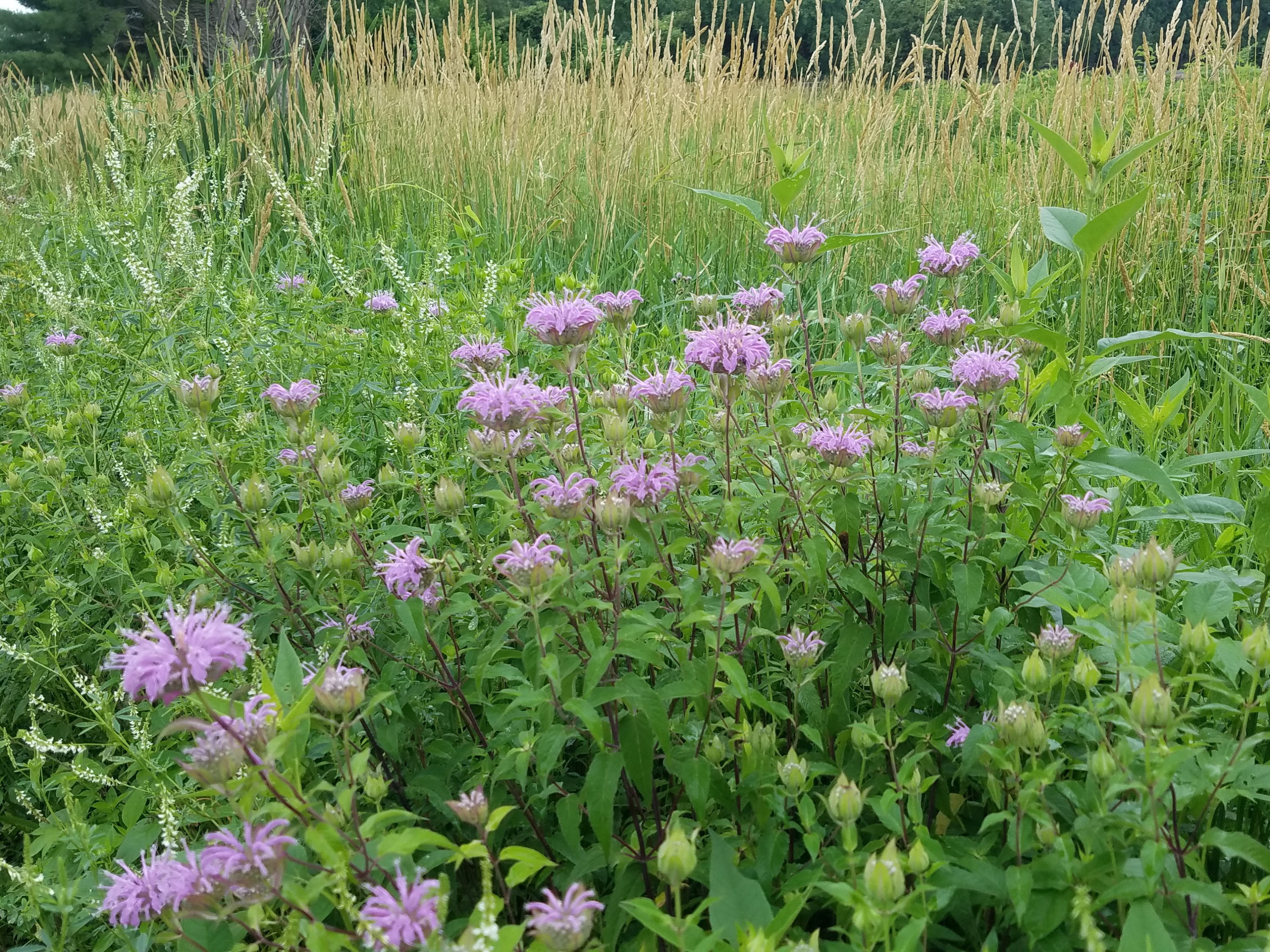
Wild Bergamot on the state park trail on July 2, 2023.

Rain was forecast all day Saturday and it did sprinkle some in each hour. In between sprinkling I made my way to the garden and found the first head of cauliflower was ready to pick. I grabbed it and headed back indoors.

It was a punk day while rotating between my writing desk, the living room, the kitchen, and taking naps. We both continue to suffer from contact dermatitis, my spouse worse than me. There was tending to treatments to alleviate pain and itchiness. At the end of the day I was tired, yet I can’t put a finger on exactly what exhausted me.

First cauliflower on July 1, 2023.

I’m in a pickle over the vegetable harvest. The refrigerator and freezer are close to capacity and I’m only just beginning. Pickling cucumbers and other veggies is not a path to exit, since I have too many pickles canned in jars from previous years. I messaged a friend who works at the local food bank and if they are working the day before Independence Day, I will transfer much of what I have to them for distribution. I like the excess produce as we can take the best and give the rest away to people who need or want it.

It is a lazy, early summer day. It’s not hot like it can get in August, yet spring is over. It’s an in between time of organizing for the next big project, yet not starting it. It’s time for taking naps in the middle of the day. How long it took us to get to this place in our lives.

Categories
Writing

Zucchini Bread from a Church Cookbook

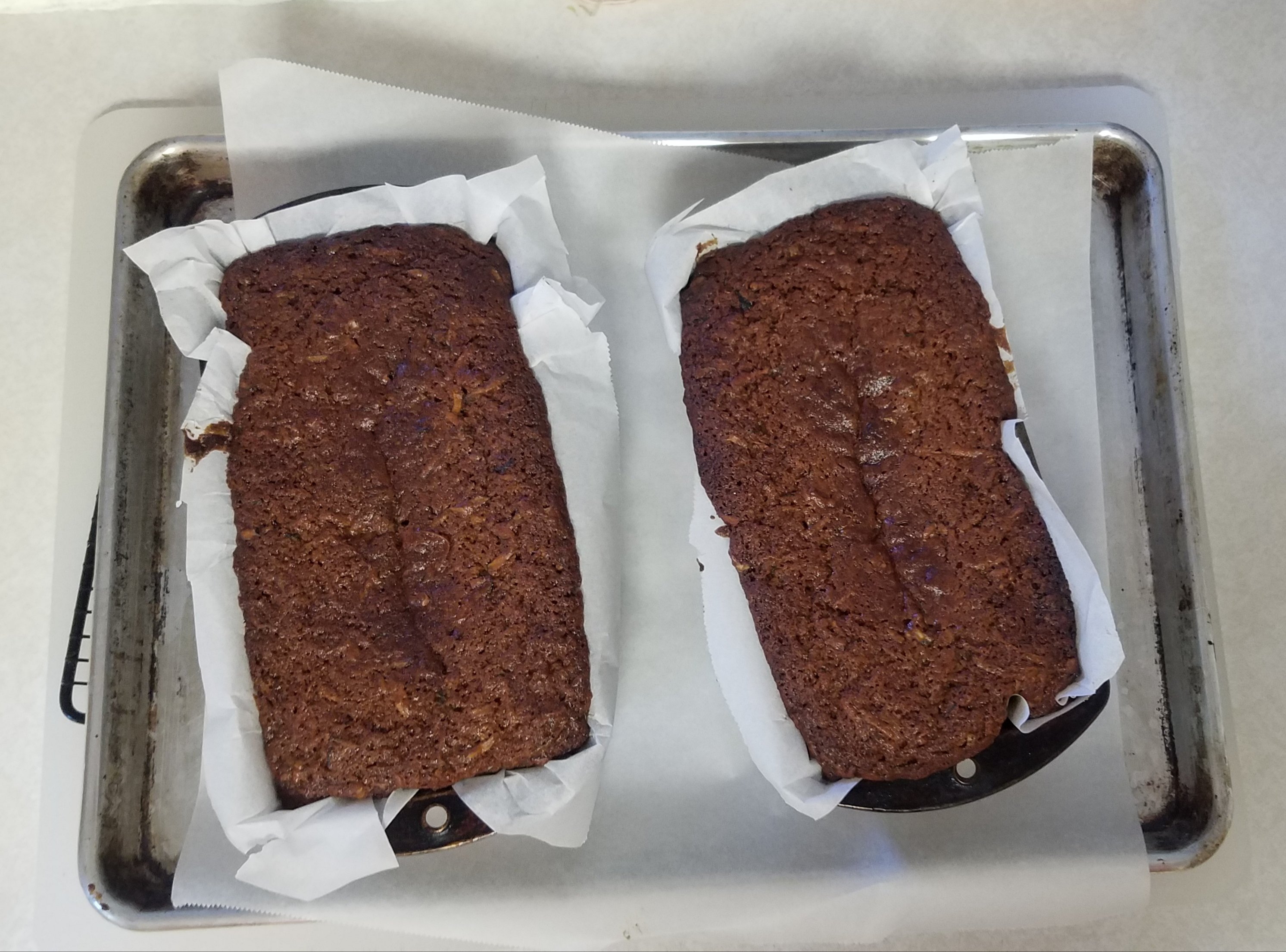
Zucchini bread, June 30, 2023.

The garden is producing zucchini, so much there is pressure to do something with it. Zucchini bread is a traditional way to use the excess… some of it, anyway.

Zucchini bread is a seasonal dish predicated on having a surplus of the vegetable. Home cooks don’t usually go out and buy zucchini. Confronted with garden reality, or a gift from a friend, there is an urgency to do something with it before it spoils.

I reached for recipes from my childhood neighborhood during the 1950s through ’70s. The recipe I found didn’t really work in 2023.

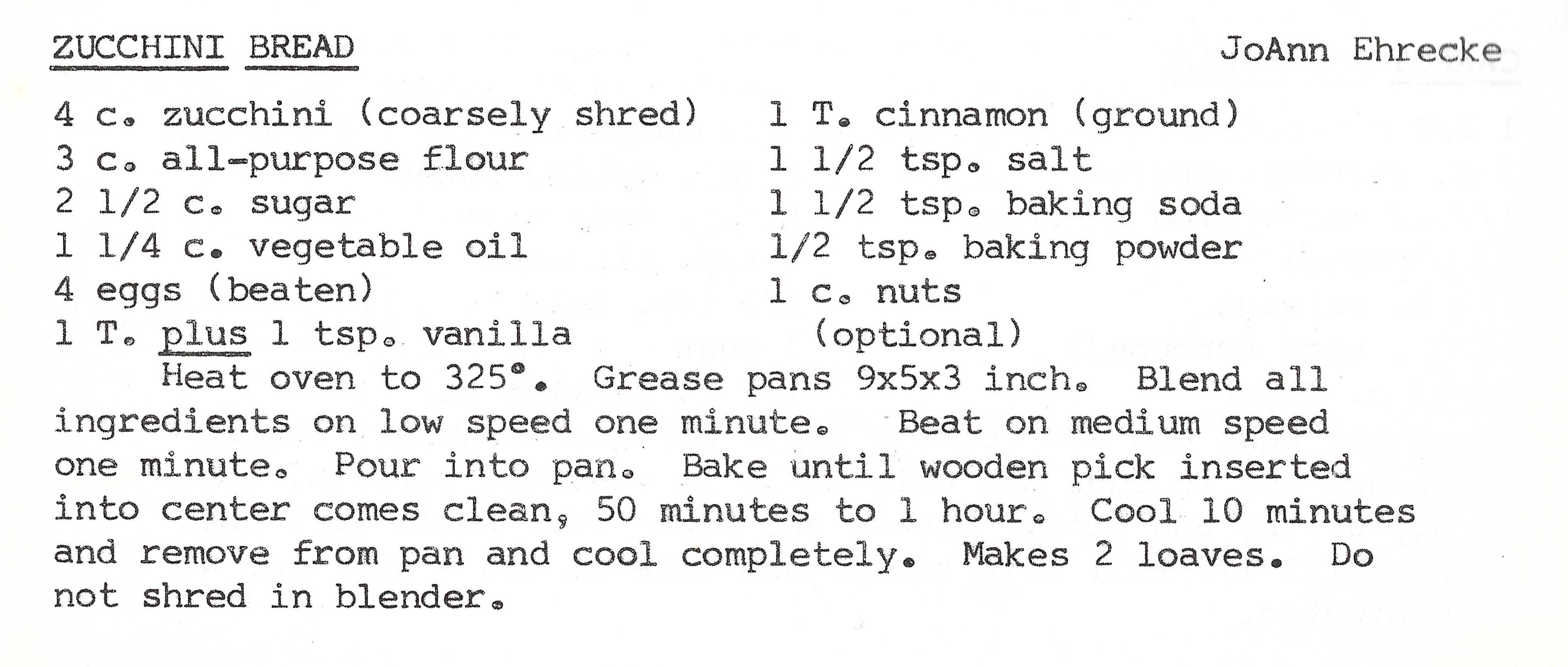
JoAnn Ehrecke submitted a recipe for zucchini bread to the Family Favorites cookbook published by Holy Family Parish, Davenport Iowa in 1977. It used four cups of shredded zucchini, which is a lot. I had been to the Ehrecke home at least once while I was in school, so the recipe came with a positive vibe. Not only is it a product of the 1970s, it is set in that time. I followed the recipe with some adjustments to accommodate vegan eaters and modern times. The result was a dense, sweet loaf, more like cake than bread. We’ll use it, but won’t return to this experimental recipe.

There were problems:

While I knew to put the grated zucchini in a tea towel and press the excess moisture out, there was no such instruction in the recipe. If I hadn’t performed this basic culinary task the loaves would have been a disaster of moisture.

My typical egg replacement is applesauce. I think the recipe relies on the leavening quality of eggs to give it a rise. Applesauce added flavor, but not leavening. Applesauce also tends to be a substitute for oil in recipes, although in our vegan cornbread recipe it serves as an egg.

Along those lines, 1-1/2 teaspoons of baking soda and 1/2 teaspoon of baking powder did not seem like enough leavening. The crumb wasn’t a crumb at all. More like a gooey, sweet mass with a crust. There are positive qualities in that, but it is not a bread.

Finally, the baking time of 50-60 minutes was too short. The 325 degree oven worked, yet it took longer. A toothpick did not come out clean until 90-100 minutes. When I cooled and cut into a loaf, it was exceedingly moist inside. The flour taste was gone and the sweetness of the sugar and flavor of apples and cinnamon stood out. That part was good.

The saving grace of this result was a loaf that could be used as a dessert. Cut a thick slice and re-heat it in the microwave or fry it to make a crispy crust. Drizzle with apricot preserves, honey, or your favorite jam, add in-season fruit like raspberries, or pour on a little chocolate ganache. It would be good to go for regular or formal dining.

The path to this dessert was unexpected. Recipes in old church cookbooks assume a lot, much of it lost in the decades since that culture thrived. In any case, we’ll have dessert for a week and I used up the three largest zucchinis. Now what shall I do with today’s crop of zucchini?

Categories
Environment

Hazy Summer Days

Lake Macbride State Park covered in a thin haze of smoke from Canadian wildland fires, June 28, 2023.

On Tuesday, June 27, there were 66 wildland fires being tracked across parts of Ontario Province in Canada. As a result, smoke and particulate matter is spreading over much of the United States, and across the Atlantic Ocean to multiple European countries. It has rendered the air quality “very unhealthy.” What is there to do at this point but monitor our local air quality and moderate our time and activities outdoors? The underlying science and human behavior which favor conditions for the fires have been ignored so long, we transitioned to a mode of acceptance and now focus on coping with the disaster.

At least the scenery on the state park trail is nice.

I got into something while working in the yard. I believe the ailment is contact dermatitis and the little spot where I got it itches constantly. I put some ointment on it a couple times a day and should be fine after two to four weeks, according to the Mayo Clinic. I don’t know what I contacted, although I found some nettles out by the composter. I harvested the nettles and hung them in the garage to dry. There is a cup of nettle tea in my future.

The garden is really coming in. The freezer and refrigerator are almost full. I am much closer to the garden this year than previously. I never fail to marvel at what it can produce. For now, life on Earth is pretty good, despite the contact dermatitis.

Categories
Writing

Newspaper Writing

Editor’s Note: This is one of 100 newspaper articles written for the North Liberty Leader, The Solon Economist, and the Iowa City Press Citizen beginning in 2014. The North Liberty Leader stopped publication in early 2022. The Solon Economist remains on the bubble. This is an example of the collaborative type of writing produced with my newspaper editors. The whole experience of freelancing was beneficial if low-paid.

Iowa City Community School District board meeting on Jan 28, 2014. Photo by the author.

Van Allen school to be expanded
Four new classrooms will serve 100 additional students

By Paul Deaton

IOWA CITY (Feb. 5, 2014) – Paintings by Van Allen and Penn Elementary School students on the walls of the Iowa City Community School District (ICCSD) school board meeting were a colorful backdrop as Superintendent Stephen Murley and the board held brief discussions during an equally brief meeting on Jan. 28.

The board held the second of three readings of Appendix 9 , the ICCSD capital projects planning and approval process document that guides the board in its oversight and implementation of the district’s facilities master plan. The long-range plan was adopted on July 23, 2013, and proposes to spend an estimated $252 million on capital improvement projects during a 10 year period. Included in the plan is an addition to Van Allen Elementary School in North Liberty.

Following the formal meeting, the board’s Operations Committee met, and began with an update on the Van Allen design project by representatives of the architectural firm Neumann Monson and Van Allen Principal Pat Brown.

On Dec. 17, 2013, the Iowa City school board approved a project design expenditure of $123,250 for Van Allen. The design was to include additions to the current structure, containing four classrooms to house approximately 100 additional students. A committee of staff volunteers worked with Neumann Monson during the design development phase of the project. Three schematic designs were evaluated, with a final preference for additions to existing pods two (on the East side of the building housing Kindergarten through second grade) and three (on the West side of the building housing grades three through six. The design would create about 5,600 square feet of new space and fall within the approved budget of $1.68 million.

Principal Brown explained the criteria the committee developed for the addition.

“One of the things we’d like to do is to continue, as much as possible, is (keeping) like grades together so that we can group our first grades together, second grades together. Our teams do a lot of collaboration in their planning and delivery of instruction. It works much better when we keep those grades together,” she said.

Brown said another important criterion was flexibility of classroom design.
“We are anticipating growth in the North Liberty area. And as we’ve seen with enrollment, kids don’t always come to us in neat packages with the numbers just right as they move up through the grades. (The additions) could give us growth on both sides of the building.”

“We will have additional classroom space to meet student instructional needs in a positive learning environment,” said Brown in an email after the meeting.

Current enrollment at Van Allen for K-6 is 489 students. In addition, the elementary school also serves 27 preschool students. Projected enrollment for the year 2022-2023 is 527 based on the school’s current attendance area.

According to Brown, there are plans to rezone the attendance areas in North Liberty and Coralville beginning this spring. Additional students will likely be zoned into the Van Allen Elementary attendance area to help with projected elementary population growth.

“North Liberty enrollment projections for the school-aged population taken from the U.S. Census (2000-2010) shows an increase of 122 percent. Coralville increased 29 percent,” said Brown.

Van Allen Elementary School was Iowa’s first LEED certified public school. LEED (Leadership in Energy and Environmental Design) is a set of rating systems for the design, construction, operation and maintenance of greens buildings intended to help building owners be environmentally responsible and use resources efficiently. Van Allen received a silver LEED certification, and features natural lighting, recycled building materials, geothermal heating and cooling, and natural landscaping. Neumann Monson expects to preserve LEED certification with completion of the project.

The board will hold a public hearing on the final project design in April. Once the design is approved, Neumann Monson expects the bidding documents to be prepared for distribution to contractors by April 24, and returned by May 16. Construction is to begin June 1, with a construction completion date not later than June 30, 2015.

~ Written for the North Liberty Leader.

Categories
Writing

The Dam Breaks

Checking the Earliblaze apples on June 26, 2023.

The cartomancer drew an Ace of Spades, indicating things that have been in disarray in my life may be coming together. After mild spells of undiagnosed dizziness today and yesterday, I feel the dam breaking and am ready to portage to the other side as the impoundment pool is released. That means I will return to writing my autobiography soon.

I sent the first half to four friends from whom I hope to hear feedback. Two have responded and two are married and will respond together when both finish reading. The feedback garnered thus far has been invaluable.

The next decision is whether to work on the part just reviewed or work to get the rest of it up to the same level of completion. The second part is problematic in that there are multiple narrative threads which represent a lot of work. At the same time, revising what was reviewed makes some sense while the feedback is fresh.

In part two there will be the experiences with family before our child attended formal school. Those are the most important years and they are over before we realize it. It is important to capture some of those fleeting essences while we can. We brought her home from the hospital to Cedar Rapids, Iowa where we lived the first 30 months, then moved to the Calumet region of Indiana where she started Montessori School, followed by public schools. We moved to Big Grove Township in 1993. That’s one narrative.

I lived through the post-Reagan years of turmoil in the workplace and have things to say through the frame of living in the Calumet and recruiting truck drivers and mechanics. More than anything, in interviewing some 10,000 people, I learned and felt directly the pain Reagan’s initiatives put so many working people through. I want to tell that story.

The challenge of being a writer intensified with the advent of computer technology. Of what was this new tool capable? What were realistic expectations? How did it change the way I wrote? How did writing in public change from my first letter to the editor in 1974 until today? Another narrative worth exploring.

During my career in transportation I traveled all around the country. I spent the most time in Indiana, Michigan, Illinois, Georgia, Tennessee, Ohio, Pennsylvania, New York, West Virginia and other states. I used to bring a magnet home from each new place and filled up the front of the home refrigerator with them. I spent time with some of the poorest people in the country and with large corporations far removed from the reality most of us know. Sorting that out will be a big task in itself and seems worth doing.

There is a lot in front of me. It appears to be in the cards for me to get going again. I can feel it. I am ready.

Categories
Writing

Writing in Public

My writing desk, December 1979.

My first letter to the editor of a newspaper appeared in the Quad-City Times on Dec. 30, 1974. I had just returned to my home town from Europe after college graduation. I did not like the culture I experienced in Davenport. The letter was a way to express my opinion in public and garner feedback from other members of the community. It worked to a fashion before the time of social media. It would not be my last letter to a newspaper complaining about living in society.

There are risks when writing in public. When I wrote letters to the Cedar Rapids Gazette, in response, I received anonymous threatening letters in the mail. It was a form of intimidation for having an opinion with which someone disagreed. Because the letters were anonymous, and didn’t threaten me physically, I discarded them and wrote more letters to the newspaper. I’m not certain I’ll write any more letters to the editor, yet I won’t let intimidation be the reason to slow me down.

In Iowa, we are considering the incident of a prominent meteorologist named Chris Gloninger who received a death threat after educating his viewers about climate change. Repeated email harassment over his weather reports led to a case of PTSD, after which he resigned his position. I seldom watch television weather reports, so I likely don’t understand the situation. Harassing a T.V. meteorologist via email is a lazy person’s way of “sticking it to the man.” How infantile!

In his upcoming book, The Hidden History of American Democracy: Rediscovering Humanity’s Ancient Way of Living, author Thom Hartmann closes with the following:

You may think your voice is but a faint whisper in the wilderness, but there are ways you can amplify it at no cost other than a bit of effort. Write letters to the editor of your local newspapers. Become active on social media. Volunteer with the dozens of great good-government groups and organizations devoted to saving our environment, our democracy, and our world.

The Hidden History of American Democracy: Rediscovering Humanity’s Ancient Way of Living by Thom Hartmann.

Hartmann reiterates one of the best remedies for feeling impotent or down is to take action. We can’t let the inevitable naysayers get to us when we do.

Good luck Mr. Gloninger. May your future be bright.

Categories
Kitchen Garden

Deer Jumped the Fences

First summer harvest of vegetables.

For the first time since I began gardening in Big Grove, deer jumped the fences and began nibbling on my plants. Thus far, they got into two plots, eating peas, green beans and cucumber plants. I put up supplemental fencing where I thought they jumped over, yet I’m not sure that will do any good. I don’t have enough fencing to elevate the height to eight feet all around every plot.

What is going on? I haven’t changed anything. My instinct is the exceedingly dry weather hindered growth of their natural food supply and my tasty plants were better than starving. The damage of one eating session is substantial, and will impact yield. I need to do something.

I mastered the art of keeping rabbits out of the garden. By securing the bottom of the fence to the ground, and letting the clover grow in the yard, they have plenty of food without intruding on my vegetable patch. It is a success story. I’ve long realized deer can easily jump my four and five foot fencing, yet because of the how I planted, they haven’t… until now.

I’ll rig up some additional fencing after the sun rises and I view last night’s damage. What I believe would resolve the problem is getting a good, long rainfall.

U.S. Drought Monitor
Categories
Kitchen Garden

A Day in a Garden

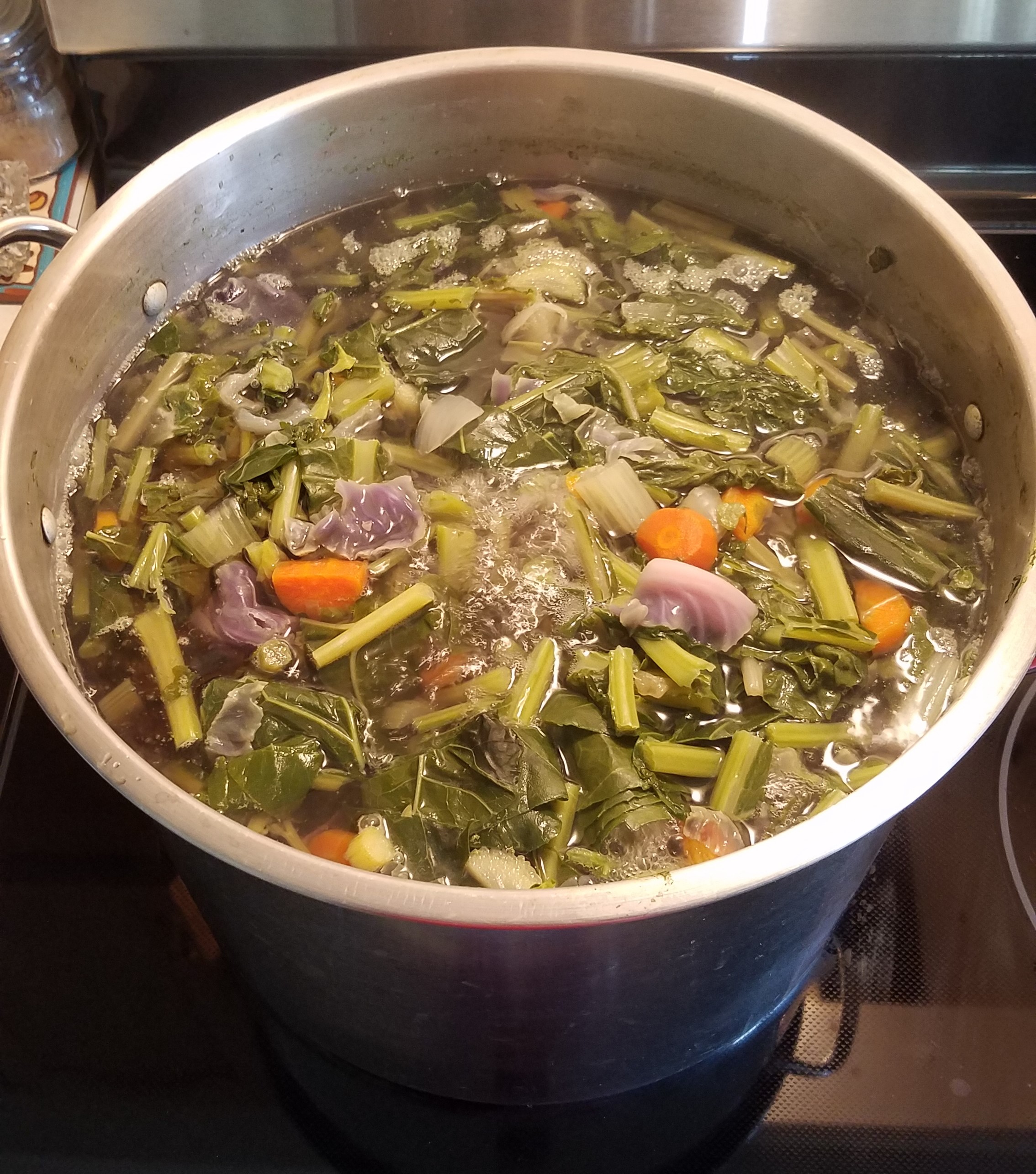
Vegetable broth simmering. Made with many kinds of garden greens.

A hummingbird dipped water from the leaves of cabbage plants throughout the garden. It has been a dry season, yet the bird found enough to drink condensed from the night and pooled in drops on the leaves. The garden is full of such life. By taking time to stand, listen, and look, we share in the experience. We become part of the garden, which is not nature, yet as close as we can get.

A deer was eating pea blossoms over the fence. I let it go on for two nights then installed additional fencing to make it eight feet tall and restrict access on that corner of the garden plot. It worked, but the deer jumped the fence on the other side and tried to access the peas from inside the fence. It ate one or two, leaving hoof marks in the fresh-dug soil where I planted spinach seeds. I wonder what happened that it only took one bite.

Predictably, I found the first little green worm on a kohlrabi plant yesterday. The egg-laying white butterflies have been thick in recent days. It was only a matter of time. The challenge now is to seek them out and pick them off in the mornings. Hopefully the organic insecticide I applied will suppress them. They arrive just as the heads of broccoli are beginning to form. Half the battle is knowing their behavior. It is a battle that can be won by diligent humans.

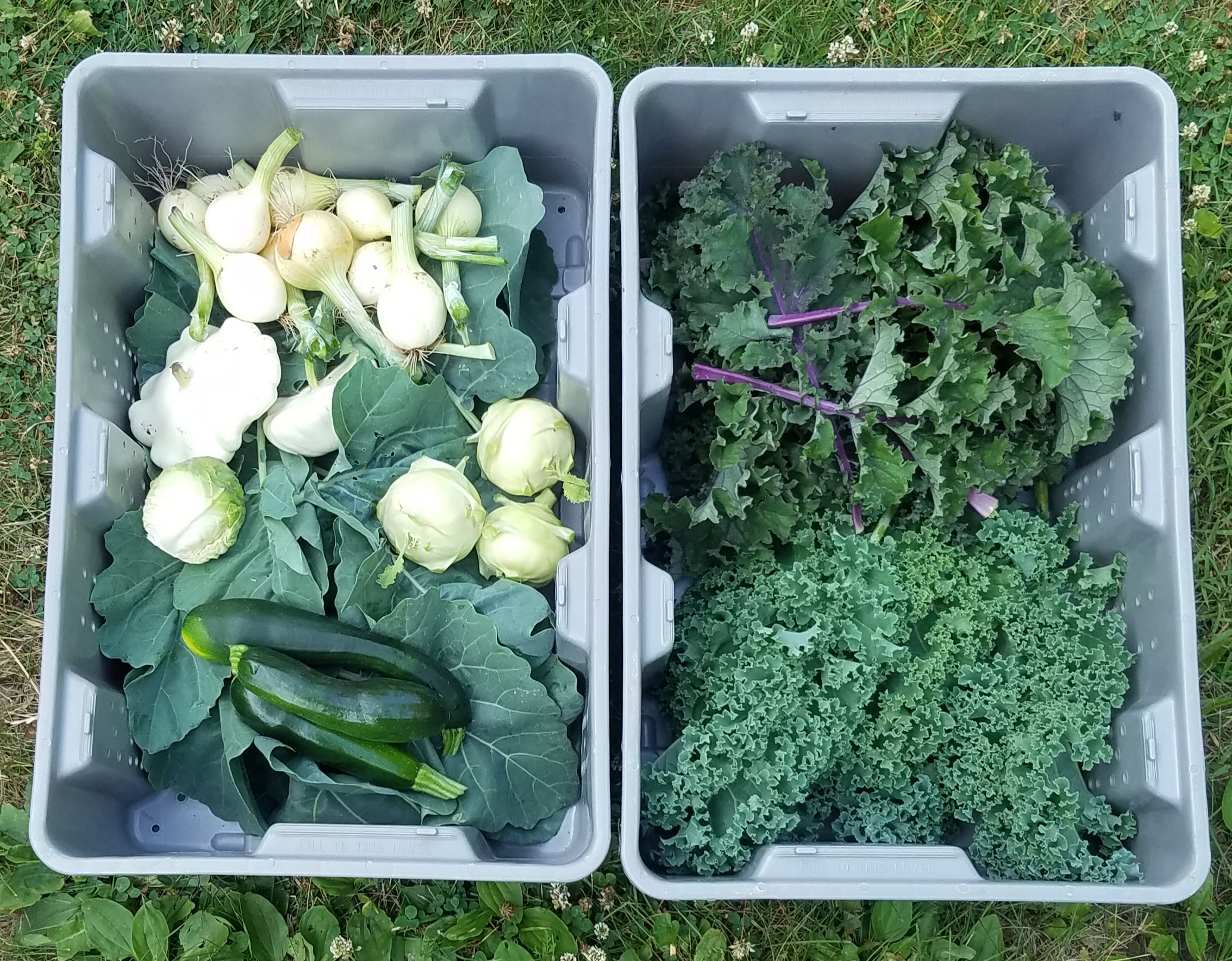
My daily morning walk through the garden is rewarding. Everything is growing and besides early greens, I harvested the first zucchini and patty pan squash. This is my first year growing patty pan or scallop squash. This first one will go into stir fry later this week.

Tomatoes and tomatillos are beginning to blossom. Onions are forming bulbs. Green cabbages are about three inches in diameter. Soon I will turn over the first tub of potatoes for small ones. Apples and pears are growing. There is a lot going on.

We are lucky to be able to age in place. I don’t think of the outside world when I’m in the garden. I listen, observe and experience the ecosystem I made while wondering how I fit in. It’s the wondering that’s the best part.

Categories
Kitchen Garden

Spring Kale is the Best

Cart of five varieties of kale picked June 17, 2023.

The best kale is harvested before the characteristic little green worms have a chance to establish themselves. I deter them from getting too far by a couple of applications of Dipel, an insecticide containing toxins from Bacillus thuringiensis kurstaki (Btk), a naturally-occurring bacterium found in soil and plants. Btk is not harmful to humans, to birds, or to most beneficial insects and pollinators. It is widely used by farmers who use organic practices. The truth is one has to do something about the little green worms to have a good crop. This year, because of these applications, the cruciferous vegetable patch of kale, collards, broccoli, cabbage, chard, and cauliflower looks quite good.

The spring greens harvest has two major purposes outside eating fresh kale and collards. I stem the leaves and put as many packages as will fit in the freezer. Less attractive leaves, as well as the stems go into canned vegetable broth. I have been following this practice since we got a small freezer during a power outage. Since then, we upgraded to an upright freezer. This enables us to eat greens all year, until next year’s crop. It is something that goes well in our garden. Something upon which we rely in our everyday cooking.

Based on the number of white butterflies spotted in the cruciferous vegetables yesterday, it will be hard to keep up with them soon.

We like kale, especially in stir fry, soups, and tacos. Many people do not care for it. I learned to grow it from my friend Susan back in 2013. I would stop eating it if I didn’t grow it myself and control all the inputs. Part of aging successfully will be figuring out how to continue the annual kale crop.