Categories
Home Life Kitchen Garden

Making Pesto and Other Things

Fresh Kale
Fresh Kale

LAKE MACBRIDE— Summer’s harvest has been bountiful and we are less than two weeks in. Keeping up with the vegetables we grow and get from the CSA, has been a challenge of cooking, preserving, refrigerator and freezer space, and rotation. Thus far, little that was brought into the house spoiled. We are thankful to have enough food to eat in a society where so many people go hungry. Even our small town of 2,037 souls requires a food bank, making adequate food for everyone a tangible, local issue.

Yesterday was the first pick of green beans and we steamed them for dinner. Over the years Asian aphids have been a pest for this annual favorite— to the extent I quit planting them for a while. This year they were pristine in the basket. Not sure what happened, but I suspect row-crop farmers didn’t care for the damage to soybeans, and “did something” during the past few years.

I picked broccoli for dinner, and some Swiss chard. Spinach is ready to harvest, the last before the fall planting. There is also lettuce ready to go and plenty of herbs. The apple trees are still looking good: no sign of dreaded Popillia japonica, or Japanese beetle, which during previous years had made its debut by the first of July. Last year was a horrible year with them, and they are sure to arrive soon.

A summer indulgence is to make pesto. The process is simple. Into blender put a cup of first cold pressed extra virgin olive oil, with equal amounts of chopped garlic scapes, basil leaves and kale leaves with the stems removed. Blend the mixture, adding enough olive oil to make it a liquid, or additional garlic and basil to thicken it. Then add a handful of pine nuts, half a cup of Parmesan cheese and salt to taste. Blend until the mixture is a thick puree. The recipe produced enough to fill Mason jars with pesto for the freezer. I reserved some for immediate use, of course.

The thing about pesto, is it can be made with a number of summer greens and herbs. It’s a way to preserve the summer harvest. The other thing is a person can consume only so much of the delicious spread/sauce at a time. For now, we’re living the high life and contemplating dishes, other than just spreading it on bread, in which to use it. Pesto pasta will definitely be one dish on the menu.

Once one is plugged into the local food system, there is little cost to make pesto, except for the olive oil, which is always a luxury. During the summer harvest, a gardener and cook can live in the lap of luxury, even on a limited budget.

Categories
Home Life

Garage Day

Buckets Drying
Buckets Drying

LAKE MACBRIDE— Proofreading the newspaper didn’t take long this morning, so after making the smoothie mentioned yesterday, I inspected the cruciferous vegetables and found very few green caterpillars. Either the sunlight chased them away, or they were gone. I picked ten cucumbers, but my focus was on cleaning the garage.

Things had gotten spread out, rendering the garage space unusable. My car has been parked outside since spring began, and nothing seemed in a place when it could be found. By the end of the afternoon, the trash cart was full, there was room for both cars inside, and serious progress was made getting rid of things.

Walnut Logs
Walnut Logs

Some sections of walnut tree trunk have been sitting on the radial arm saw for a while— a long while. Time has come to either make something from them or get rid of them. I harvested them in the 1990s in Ames after lightning struck the tree and felled it. I cut them into 16 to 28 inch pieces to haul them around in our Plymouth Horizon. We got rid of the last Horizon in 2002, so that’s an idea of how long they have been in the garage. Too long.

Buckets, Plates and Flower Pots

The buckets for gardening had gotten disreputable, so they all got washed. Same for the flower pots and vases. I re-seeded some cucumbers that didn’t germinate in the tray and watered the four trays of seedlings. They will get planted this week.

On a bulletin board near the work bench were pinned a number of magazine clippings of Adirondack chairs. The images were to be the inspiration to build a couple of our own. Like so many ideas, its diaphanous suggestion was torn asunder by a life occupied by a career. I took the clippings down and put them into the recycling container.

With a clean board, I pinned a poem by Wisława Szymborska, translated as “A Man’s Household”— a Polish poet for a descendent of Poles. A few other photos were already in the garage, a photo of our daughter at Lake Michigan, a post card of some textile workers holding a large 48-star American flag, a photo of my father when he was a toddler, a photo of my maternal grandmother and her second husband. It is the beginning of something hopeful— a place to make dreams into something tangible.

Categories
Kitchen Garden

Battle for the Cruciferous Vegetables

Fresh Kale
Fresh Kale

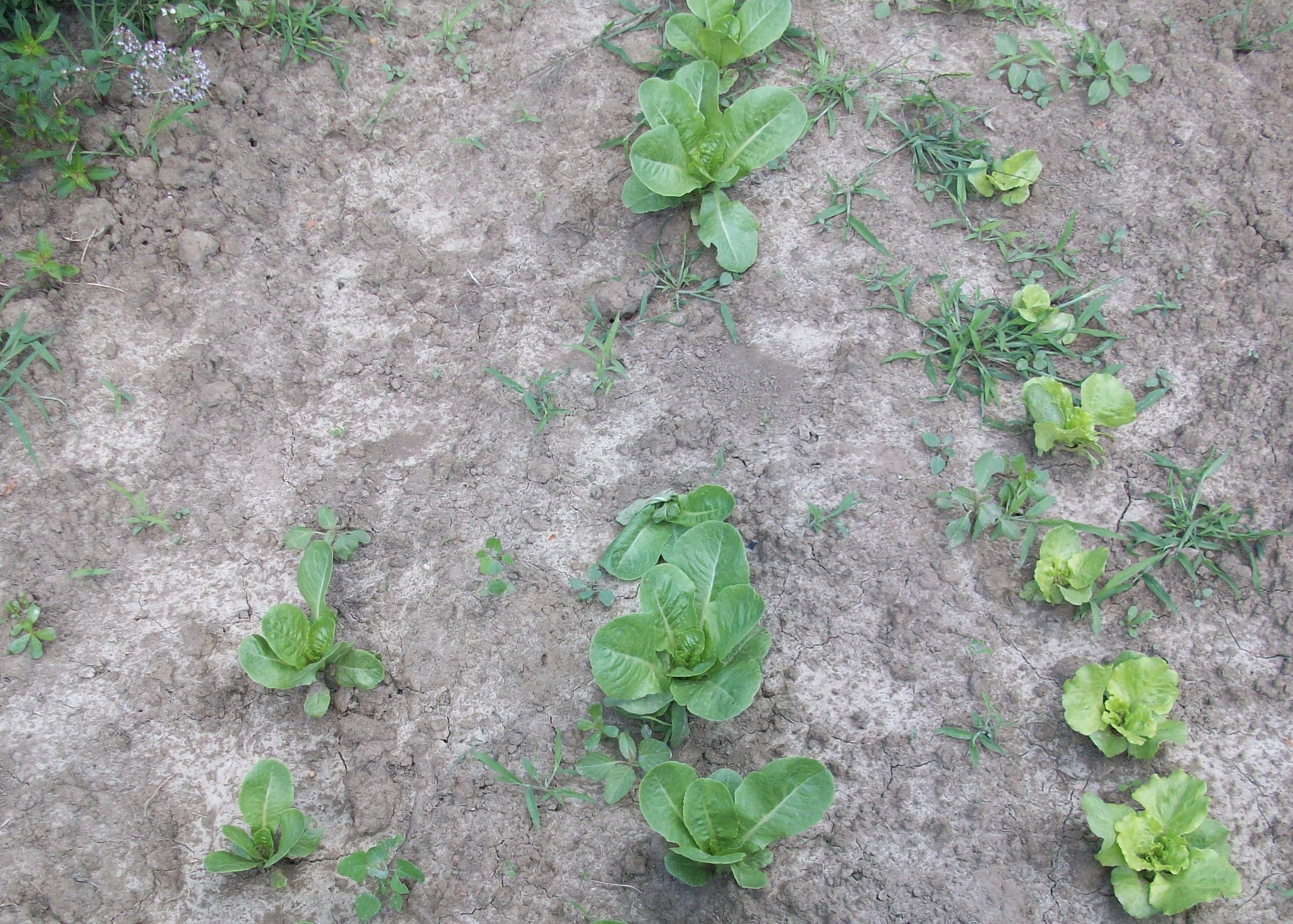
LAKE MACBRIDE— Summer arrived and the battle for the cruciferous vegetables has begun in earnest. The progeny of the white butterflies— that were flitting about laying eggs less than two weeks ago— have arrived in large numbers. Too many to count, the small green caterpillars have done their damage to broccoli, Brussels sprouts, collards and kale leaves planted in the middle southern garden plot. They either like something or they don’t because the Swiss chard planted between the kale and collards was untouched by the caterpillars. The bugs also appeared in the spring vegetable plot where I put a few extra broccoli and kohlrabi seedlings. They don’t seem to bother the turnips, radishes and arugula, also cruciferous vegetables, although something else pokes tiny holes in those leaves.

I don’t have many defenses, except to limit the damage by picking off the caterpillars and dropping them into a bucket of soapy water. Because my fingers are so big compared to the bugs, I went to the medical supply house and bought a surgical grade, stainless steel forceps to aid me in plucking them off the leaves. It’s a nice piece of equipment.

I harvested all of the kale to get rid of one food source for them. It is now debugged, washed, dried and stored in the refrigerator. I have new collard, Swiss chard and kale seedlings ready to plant, so I need to consider where to put them. Outside the current colony/restaurant for caterpillar dining, methinks.

While I mull that over, I’ll make a smoothie with kale, strawberries, peach, Greek yogurt, honey and ice. By acting quickly, I got my share of the kale harvest and intend to enjoy it.

Categories
Home Life

Moment in Time

Fishing Trip
Fishing Trip

LAKE MACBRIDE— Today will be a work day, but before I get to it, there is this image of a fishing trip to South Dakota from the 20th Century. Among the men in the picture are my great, great grandfather, and my great grandfather. We don’t have a lot of photos of them, and this is the only known image of my great, great grandfather. He is seated in the foreground, baiting a hook.

With the explosion of photography, there are too many images to count and assign a meaning. So many people carry cameras all the time, on devices that are more powerful computers than were imaginable during the 1990s when I secured this image by photocopying the page of the book where it was published.
We select and bring artifacts into our narratives, just as this photo is now part of this blog.

Behind every narrative, there are moments in time when they are made, and when they take on meaning. In a consumer society, we can forget where things come from, the meaning of an artifact being the fact of its collection. That someone planned the fishing trip, invited guests and made this image using technology of the era is forgotten.

We seldom see the face of the photographer, but he or she is an unseen part of the narrative, as is the technology and the people who created it. The narrative of our lives is unavoidably collaborative, with people we know and those we don’t.
It would be presumptuous to pretend otherwise.

Today, I feel the presence of so many people who have influenced, fed and nurtured me. Whether they are here or not doesn’t matter. What matters if continuing the search for truth and meaning in the world, and creating a useful narrative out of these moments in time. Something that serves a greater good than a single life on the Iowa prairie.

Categories
Writing

Turnip Harvest

Turnip Harvest
Turnip Harvest

LAKE MACBRIDE— Today was the turnip harvest, and the crop was the best ever: plenty to use this season, and more to give away. There were so many greens that once I reserved a couple of gallons for soup stock, the rest went into the compost. It is turnip city over here.

We have a tradition to make soup stock in our household when the turnips are in. A large pot is coming to a boil on the stove. It includes, broccoli stalks, carrots, onions, celery, zucchini, yellow squash, bay leaves and importantly, the turnip greens which color the stock deep brown and add a delicious flavor. No salt is added until the stock is used in the final application. After cooking for a few hours, the stock will be turned off, to sit on the stove overnight, and canned in Mason jars tomorrow. In the past, I’ve used the cooked vegetables from stock making as a base for barbeque sauce, but I have several jars leftover from the last batch.

Great Grandmother with Turnips

With all of the large roots, we’ll have roasted root vegetables with turnips, potatoes and onions. If we had similarly size beets, those would be added. The recipe is easy— cut everything in half, approximately the same size. Coat with olive oil, salt and pepper to taste, and place open side down on a cookie sheet. Roast at 350 degrees for one hour or until done. It is a highlight of the season.

According to a CSA farmer, July 25 is the date to plant the second crop of turnips, and I’m about ready. One more row this year should be sufficient, and if I can find beet seeds, I’ll plant those as well. The question is how to arrange the spring vegetable patch for optimal July planting. A topic for another day as I bask in a successful harvest of a traditional vegetable in our family.

Categories
Kitchen Garden Living in Society

Vegetable Gardening and DOMA

After the Storm
After the Storm

LAKE MACBRIDE— When President Bill Clinton signed the Defense of Marriage Act (DOMA) in 1996, it seemed wrong. It was one more in a series of his actions I didn’t like. The political reasons for denying federal employee benefits were easy to understand. The blatant discrimination was not, and time and the Supreme Court of the United States (SCOTUS) decision yesterday vindicated the judgment of those who felt like I did.

Yesterday, bills were introduced in the U.S. House and Senate to remove DOMA completely, as some don’t feel SCOTUS went far enough in saying, “DOMA is unconstitutional as a deprivation of the equal liberty of persons that is protected by the Fifth Amendment.” The decision was good enough for me, although I downloaded the text and will read it— comparing it to Iowa’s Brien v. Varnum, dated April 3, 2009, that held the state’s limitation of marriage to opposite-sex couples violated the equal protection clause of the Iowa Constitution.

After three days of rain, thunder, lightning and hail, I spent time in the garden yesterday. Contrary to my previous post, I found hail damage, particularly on leaves of cucumber and squash plants. The damage was not severe, but a lot of leaves had small punctures.

Food production is outpacing our kitchen’s ability to store and process it. This afternoon’s local food shift at home will include harvesting turnips, preparing and freezing broccoli, planting seedlings and rearranging the fencing in the plot where the green beans are located. With the rain and fair weather, combined with more knowledgeable planting, this year’s garden is already a bin buster. More food will be given away as the week progresses.

At the farm, I soil blocked for the seventeenth week yesterday. The seeds planted are for fall harvest of cucumbers, broccoli and cabbage. While I was working, one crew had finished and was doing bicycle maintenance near the machine shed, and another was processing kohlrabi for share holders. The germination building was completely empty, and when I entered to get trays for soil blocking, the temperature was intensely warm. Seedlings trays were on wagons under a nearby tree to avoid the heat while they waited for planting.

With the rain, trip to Des Moines and farm work, everything is behind this week. Hopefully today will be a catch up day as I endeavor to stay on the property, with nose to the grindstone.

Categories
Environment

Trip to the State Capitol

State Capitol
State Capitol

DES MOINES— Making my first trip to Des Moines this year, it occurred to me there is not a lot to distinguish Iowa’s largest city. The legislature meets here, some businesses headquarter here, and the downtown area continues to have light foot traffic despite the sprawl to West Des Moines, Ankeny, Clive, Altoona and Johnston. The capitol city attracts people and money and that is about it. Yesterday’s trip was mostly to meet with Ed Fallon, founder and director of the Great March for Climate Action and his director of operations.

The Great March for Climate Action is ambitious. It proposes “to change the heart and mind of other Americans and our elected leaders through mobilizing 1,000 people to march coast-to-coast to demand action on climate change.” The march will set-out from Los Angeles, Calif. on March 1, 2014, scheduled to arrive in Washington, D.C. on Nov. 1. Logistics will be a key consideration, and since I can’t afford a sizable donation, nor spare eight months away from Big Grove, I offered some help on the logistics of the march. The meeting went well.

While we were meeting in Des Moines, President Obama was giving a speech on climate change at Georgetown University in Washington. He said, referring to rising CO2 levels in Earth’s atmosphere,

“That science, accumulated and reviewed over decades, tells us that our planet is changing in ways that will have profound impacts on all of humankind.”

A warming and increasingly polluted planet is one of the key threats to the survival of humanity, and reasonable people can agree on that. There is an urgency to do something now about continuing CO2 emissions. As the president said,

“Today, about 40 percent of America’s carbon pollution comes from our power plants.  But here’s the thing:  Right now, there are no federal limits to the amount of carbon pollution that those plants can pump into our air.  None. Zero. We limit the amount of toxic chemicals like mercury and sulfur and arsenic in our air or our water, but power plants can still dump unlimited amounts of carbon pollution into the air for free. That’s not right, that’s not safe, and it needs to stop.

So today, for the sake of our children, and the health and safety of all Americans, I’m directing the Environmental Protection Agency to put an end to the limitless dumping of carbon pollution from our power plants, and complete new pollution standards for both new and existing power plants.”

This is one part of a broader plan outlined yesterday by the president. If readers are interested in climate change,  click on the link to read the entire speech.

Whether 1,000 people marching across the country, to win the hearts and minds of Americans about climate change, will culminate in a course of action seems uncertain at best. But we have to try everything we know to reduce global warming pollution and mitigate the impact of a changing climate. Our survival as a species depends upon it. One hopes Ed Fallon will be successful in raising the funds, organizing the march and recruiting marchers for the Great March for Climate Action. If you would like to learn more, check out the group’s website http://climatemarch.org/.

Categories
Home Life

Busha’s Birthday

Mae Jabus

LAKE MACBRIDE— My grandmother was born on June 24 or 25, 1898 at home on the farm, west of the Catholic church in Wilno, Minn. The official record is unclear as to the precise date, and the clerk in the recorder’s office in the county seat told me that often births were not directly reported, but only when someone from the farm made it into Ivanhoe.

The church records show she was born Salomea Nadolski on June 25, 1898, and baptized on July 10, 1898 by the Rev. J.F. Andesejewski. Her godparents were Ladislaus Kuzminski and Maria Nadolski. I believe this version of the truth is closest.

The certified copy of the birth record I got from the county seat in Ivanhoe listed place of birth in Royal Township, Lincoln County, Minn. as Soluma Nadolski on July 10, 1898. Parents listed as Frank and Katie Nadolski.

Her certificate of death lists June 24, 1898 as the birth date of Mae N. and then Selmae M. Jabus, and those names and date were provided by my mother. The newspaper listed her as Mae M. Jabus in the obituary. Whatever may be official, we called her Busha after our daughter was born.

She told countless stories of life on the farm near Wilno and those stories came to life when I visited the home place, the church and the county seat after she died. If I am a story teller at all, it is because of her.

Her birthplace was still standing when I visited, and the owner kindly let me look around inside. I think he and his wife were looking to tear it down and build a more modern home for their growing family, although he didn’t say it. By today’s standards, the house was very small. There were shirttail relatives everywhere I went, including a gent who lived across the road from our home place. He was not doing well so we chatted only for the briefest of moments. He was connected through my great grandfather.

Like many descendents of Polish immigrants, my grandmother was fully assimilated. She still spoke Polish, but only with her sisters, and to the occasional wrong number who also spoke the language. There are stories about that for another telling.

Despite all the stories that have been and might be, I’ve been thinking about Busha’s life as I knew it the last couple of days. When I last saw her, she had moved to a nursing home where she used to work. She was mentally alert, and worried that the staff was stealing from her, even if there was not much to steal. She fumbled with her hearing aid so she could pay attention to what I had to say.
She got it to work, and we talked as we always had.

It has been 115 years since she was born, plus or minus a day. I feel so lucky to have known her for so long. The memory of so many things we did together persists as the sun sets over the Iowa prairie. I’m glad for that.

Categories
Sustainability

After the Hailstorm

Cherry Tomato Plant
Cherry Tomato Plant

LAKE MACBRIDE— The garage door opened on a wet driveway. The rain had stopped, leaving a pool of water that crept under the door. I swept it outside. The nearby seedling trays were filled with rainwater, so I dumped them into the flowerbed and moved the trays into the garage. I need to plant the next iteration of leafy green vegetables soon. No damage was done to the plants by the hail that fell around 4 a.m.

President Obama spoke in Berlin this week, and I have been waiting to listen to the speech, doing so this morning. Friends have been talking about Obama’s call for a new series of steps toward nuclear abolition. One friend, who is not an Internet user, called and left a voice mail message saying he hoped that Obama’s speech would generate new energy around nuclear abolition within Veterans for Peace. I don’t know about that. The speech was less than inspiring, even if filled with lofty ideas, many of which have been heard from this president before. Referring to the global AIDS initiative, Obama spoke about peace with justice,

“Peace with justice means meeting our moral obligations. […] Making sure that we do everything we can to realize the promise– an achievable promise– of the first AIDS-free generation. That is something that is possible if we feel a sufficient sense of urgency.”

That last part, “a sufficient sense of urgency,” is always the problem in our consumer society, isn’t it? At the same time, we can’t ignore the president’s call for new energy around what threatens life as we know it— nuclear proliferation, a warming and increasingly polluted planet, and social injustice.  Obama touched on all three in the speech.

The heavy lift of the New START Treaty between the United States and the Russian Federation was a signature achievement of Obama’s first term. I was proud to have been part of the effort toward ratification. There was a sense in the conference calls with key State Department leaders, even shortly after Russia’s parliament ratified the treaty, that it was the last big thing regarding nuclear abolition for this president. Maybe I’m wrong, but that’s how I heard it from people in a position to know.

Nuclear abolition matters, so it is important to consider the president’s announcement in Berlin, his plan to move forward in slowing nuclear proliferation. The U.S. will negotiate further reductions in deployed strategic nuclear weapons, by up to one third, with the Russian Federation; the U.S. will negotiate with Russia a reduction in tactical nuclear weapons in Europe; we must reject the nuclear weaponization that North Korea and Iran may be seeking; the U.S. will host a summit in 2016 to secure nuclear materials in the world; the administration will build support for ratification of the Comprehensive Nuclear Test Ban Treaty; and the president called on all nations to begin negotiations on a treaty that ends the production of fissile materials for nuclear weapons. These are all continuations of previous administration policies.

The day after the speech at the Brandenburg Gate, Daryl Kimball, executive director of the Arms Control Association, posted an article in Foreign Policy titled, “Death by Cuts to a Thousand.” He wrote, “while (the president’s) remarks are overdue and welcome, the pace and scope of his proposals for further nuclear reductions are incremental at best and changes in the U.S. nuclear war plan are less than meets the eye.” I met Kimball in Washington in Fall 2009, and he is a key person among the non-governmental organizations that work on nuclear weapons issues. One suspects he was putting the best face on what was a disappointing policy announcement.

Despite this, as Kimball wrote in the article, “doing nothing in the face of grave nuclear weapons threats is not an option.” My work with others toward nuclear abolition will go on. It is a core part of working toward sustainability in a turbulent world.

Categories
Environment Kitchen Garden

A Local Food Saturday

Saturday Farmers Market Produce

LAKE MACBRIDE— Herbs are abundant in the garden, so I have been making dishes that taste better with fresh herbs: red beans and rice with fresh thyme, pasta sauce with fresh basil, and bread with sun-dried tomato and fresh rosemary. Each iteration of a dish, prepared in a moment of time, has consequence in our lives. Every bowl of soup, sandwich and plate of pasta is different for a home cook. Sometimes the food is better than others— our homemade meals speak to who we are, what we want to be and what we can be.

The idea of local food Saturday is simple. In order for there to be a vibrant and sustainable local food system, individuals must want to find, purchase and cook with local food items. We have to make a market in the things we hold dear. That’s how I landed on the important role home cooks can play in sustaining a local food system. Saturday is a weekend choice that fits a lot of people. It’s not like I am the first to come up with this— I’m not.

It is possible, and rewarding, to change our outlook from a being a consumer who goes to market to being a producer of home cooked meals that includes local food. One could do as well to develop a meal plan that includes local food and local food outlets, since almost no one cooks all, or even most of their own food at home.

The act of buying is such a brief part of our lives. We should make the most of it by unchaining ourselves from the mega-mart and relegating grocery stores to a more proper role as supplemental sources of provisions. It costs nothing to change one’s perspective, and the financial and personal payoff can be superior.

What did I do with the items in the photo from last Saturday’s farmers market?

The turnips were an impulse purchase as I could have waited a week to get fresh from my garden. I cut and washed the greens, cutting about a cup into quarter inch strips for soup, and putting the remainder in a container to use as cooking greens later in the week. Using the bulbs, I made turnip soup that included a quart of homemade stock, carrot, onion, celery, the turnip greens and the finely sliced stalk of the broccoli in the photo. I added dried chervil, salt and a bay leaf to make four servings.

The kohlrabi was for an experiment cooking it with potatoes. There will be a number of kohlrabi from the CSA, and a couple are growing in the garden. I’m trying to figure out how to use them. They also go well in a salad, cut into raw, matchstick-sized bits.

The radishes, cucumbers and zucchini were for fresh salads. The garden and CSA are producing lots of lettuce, and we have salad almost every night— sometimes as a meal. Lettuce and other leafy green vegetables are an important part of a local food system, and because we produce our own, there are none in the photo. The yellow squash was to slice and cook with greens.

Broccoli was to steam with dinner as it is a favorite and the broccoli in the garden was not ready yet. One stalk is not much, so we also steamed the last of the fresh asparagus from the CSA. A vegetable side dish to soup and a salad seems a bit weird, but was delicious nonetheless.

Finally there is the local honey. I got it home and realized there was another open jar in the pantry. I made the previously mentioned bread with local honey, fresh rosemary, sun dried tomatoes and a custom mix of flours.

In all, I spent about two hours in the kitchen with local food preparation, not including the rising time of the bread. On average, people spend a lot less kitchen time in a day, but ganging up on the prep work on Saturday made for better meals later during the week.

The revolution in local food will come when we change our attitude from being a consumer of goods to a producer. There will be a time when our lives are more interesting than who gets booted on the television program “Chopped.” For some of us, that time is already here, at least on Saturday afternoons.