Categories
Living in Society

December is Caucus Prep Time

Caucus-goer

As the sun rises on Big Grove Township an electric space heater keeps my writing room warm. It snowed overnight and I can’t be distracted by chills. I did chores and am ready to go.

The current president won the 2016 election by 46 votes in Big Grove precinct after Barack Obama won in 2008 and 2012. Despite the attention Iowa gets as first in the nation, the general election is more important here.

Of 1,431 registered voters, only 467 registered as Democrats. A more practical way to look at precinct politics is two out of three (66.7 percent) voters are not Democrats. While our county is strongly Democratic, our precinct is a swing district, regularly picking candidates based on factors other than party registration. This year local Republicans are expected to support Donald Trump for a second term, whereas Democrats have several major candidates and decisions to make. No preference voters will decide who wins in Nov. 3, 2020.

Between now and the caucuses I’m reaching out to Democrats. My purpose is to encourage caucus attendance and find volunteers. With the rule changes from the Democratic National Committee and Iowa Democratic Party, there is a lot of new stuff to learn. I attended training on how to run a precinct caucus last Saturday and will need help to check voters in and manage the gathering. I secured a voter list from the county auditor’s office to help find them.

The number of Democrats here shrunk by 20 percent since 2008, the last time we had so many candidates for president. I’m expecting 225 or so attendees in February, less than the 268 we had in 2008. That would be 48 percent turnout. There are a lot of new names on my list. In addition, about half of my volunteers from previous years either died or moved out of the precinct. I’ll need to get to know new people to recruit those I need.

With end of year holidays upon us the best use of today is to get organized so the final month can be spent pulling everything together.

Categories
Kitchen Garden

Saturday Luncheon – Red Beans and Rice

Red Beans and Rice

Preparing to cook red beans and rice has been a year-long process because most of the ingredients were produced in my garden or on farms where I work.

The garden produced red beans, okra, tomatoes and celery. Local farms produced onions, garlic and bell peppers. I also grew red pepper flakes and blended the powdered dry spices. Pantry staples of extra virgin olive oil, all purpose flour, and long grain brown rice were USDA organic but not produced in Iowa.

I invested several hours preparing a luncheon meal and time was worth it because of the flavor.

In the morning we discussed my 5-1/2 quart Dutch oven, the enamel of which is wearing off the inside. I’m don’t favor replacing it. Not because of the $350 price tag for a new one from Le Creuset. With a bit of cooking oil on the bottom to prevent rusting it will serve many more years. It is my go-to pan for making red beans and rice. It has been a reliable part of our kitchen.

Cooking is a ritual that evokes memory and skill in bringing a dish together. I soaked a cup of dried red beans in the Dutch oven overnight, then cooked them with half a diced red onion until tender but not mushy. I drained the beans and reserved the cooking liquid, letting them sit on the counter until ready to make the dish.

Around 10 a.m. I started work.

I fried a couple of home made vegetarian burger patties from the freezer and set them aside to drain. (Andouille sausage would be more traditional).

Heating the dutch oven, I added two tablespoons of extra virgin olive oil and cooked a generous tablespoon of red pepper flakes. I diced half a large onion, red bell peppers, and celery stalks and sautéed them in the oil-pepper mixture with a little salt. Once they began to soften I added two cloves of minced garlic and added home made seasoning — think powdered garlic, curry powder, paprika, and powdered hot, red peppers. I added a few dashes of prepared hot sauce from the refrigerator and stirred until everything was incorporated.

Next came additions. I deglazed the pan with a pint of diced tomatoes. Next, a cup each of sliced okra and long grain, brown rice. I stirred in two tablespoons of all purpose flour, then the cooked beans, until everything was incorporated. I tried not to bust up the beans.

What liquid to use was an open question. This time my answer was two cups of the bean cooking liquid (that’s all there was) plus two cups of water. Other options I considered were canned tomato juice and home made vegetable broth. The flavor of the bean cooking liquid made it a good decision.

Stirring everything together, I brought it to a boil then turned the heat down to a simmer, cooking until the rice was done and most of the liquid had been absorbed. Toward the end of cooking I crumbled the burger patties and folded them into the mixture.

It was ready to eat at noon, making four to five portions.

We seek opportunity to follow our creative impulses and cooking is primal. It provides an opportunity to shed anxiety from quotidian affairs, if only for a few hours. A recipe makes the experience replicable but not really. Cooking is a story of how we sustain ourselves in a turbulent world.

Categories
Kitchen Garden

Into the 2020 Garden

Kale Coming Back to Life. Photo on Dec. 7, 2019.

Brown leaves droop over tall stalks in the frosted garden. In the center tiny new leaves appeared.

Kale plants are growing again.

Each year the best ideas from the garden follow me into the future. From the 1983 summer in Iowa City when we planted our first tomato seedlings until today, we’ve either had a garden or have been able to forage the lot where we lived. Gardening has been a continual presence, improving each year.

In the 2020 garden there will be patches of tomatoes: one for cherries and another for slicers and plums. 2019 was a banner year for tomato quantity and quality. We canned and froze a lot so the plot will be smaller. Best new tomatoes were Black Krim, Granadero, Speckled Roma, and Martha Washington. Seeds that didn’t produce well won’t be planted, including commercial varieties Beefsteak, Roma, Early Girl, Big Boy and Better Boy. I want to get better cages, but do not want to spend the money. The main innovation regarding tomatoes was installing a four-foot chicken wire fence elevated a foot off the ground. This barrier kept deer out of the tomato patch during the past two seasons, improving yield.

I’ve been able to produce cucumbers to meet household needs. My varieties were two types of pickling cucumbers, Marketmore and Tasty Jade. In 2018 I over-produced with two patches. In 2019 I hit it about right with one. Allowing them to grow on a welded wire fence kept ground-bound critters from taking a bite out of them. A backlog of jars of pickled cucumbers is in the pantry, so next year’s planting will be about the same.

Hot peppers grow well here. After experimenting with a number of varieties, I find the most used ones for fresh are Serrano and Jalapeno. After a couple of seasons of long, red hot peppers, I need only two plants of each variety to have enough for a year of kitchen use. I make a few Louisiana-style dishes and sprinkle dried red pepper flakes on pizza. The supply of powdered chili peppers won’t run out in my lifetime. My experiment with Guajillo peppers goes into year two. I dried some red and green ones and have yet to make chili sauce with them. More production is needed to make it a viable experiment. Dried New Mexico chilies are inexpensive at the grocery store, so I’m not sure it’s worth the work to grow and process my own. Before making a decision I need to grow a bunch of them. I plan to grow only Guajillo chilies this year.

I found okra easy to grow and a few plants produce enough for a year. This was my first year growing it and I’ll skip next year. There’s plenty in the freezer.

Next year I’m reducing kale varieties to two: Redbor and Winterbor from Johnny’s Selected Seeds. It is an endeavor to try something new and reduce the number of suppliers.

Success with onions has been marginal. I had no trouble producing spring onions, but the full-sized bulbs never materialized the way I wanted. I’ll try it again next year. I also plan to grow shallots from seed as an experiment. I bought an organic seed called Matador from Johnny’s Selected Seeds. Onions are almost daily fare in our kitchen so next year I hope to resolve some of the challenges I faced producing them. The shallots remind me of a local grower from France who produced them in abundance: I know they will grow in Iowa.

Beets produced better when I started them in soil blocks. I never have enough of them in the kitchen so I plan to grow lots. It’s time to go much bigger with beets by planting several long rows. The same applies to radishes.

There’s a lot to think about when planning next year’s garden. With the first seed order in the house, I can turn to other areas of planning.It’s taken years, but I’m finally feeling like a gardener.

Categories
Writing

A Sense of Self

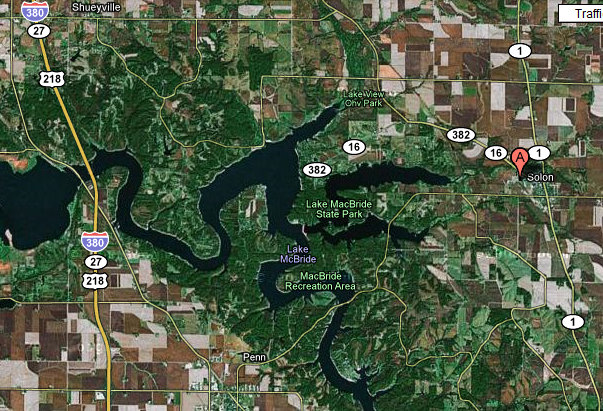
Big Grove on Google Maps

My history begins with today’s vantage: looking backward in time from an unfinished writing space in our Big Grove Township home. Such perspective helps our story makes more sense than it did while living it.

I understand all of my writing — countless emails, letters, social media posts, and blog posts — is derived from experience residing in memory. Sometimes it is unique, sometimes not.

I look, as if in a deer stand along a familiar pathway, hoping to encounter a subject, without its being aware. Armed with my senses, and hope I will find uniqueness in quotidian moments, I endeavor to capture such fleeting essence.

In that light I write this autobiography.

It is unthinkable that we are here only to consume, grow and die. There is a greater purpose, and in writing, I hope to reveal it to those close to me, to any reader who finds these words, and importantly, to myself. I find purpose in every piece I write, just as in more practical work like planting a seed, driving a lift truck, making the bed, or speaking in public.

There is a necessary organizational component to writing a longer piece. We shouldn’t be consumed with organization. Like an underground coal miner we need a framework of timbers, buckets, picks and shovels, water pumps, labor, and air circulation to do the work. We also need freedom to follow the seam where it leads.

Sometimes a remembrance stands alone as a solitary and specific instance of creation. Yet most memories are part of a social context. Understanding social context can make the narrative ours with broader applicability.

My autobiography is not as much about me, as it is about the people places and processes of which I have been a part. My task is not to chronicle events and ideas that were my experience. It is to tell a story of a life beginning in the present. It will include characters, locations, processes and events. Writing is a way to learn how to do that. Autobiography seeks ways we are unique grounded in shared experiences. If it is that, a finished work is more likely to have relevancy.

Writing autobiography is an American thing. I studied at university under Albert E. Stone who edited J. Hector St. John de Crèvecoeur’s Letters from an American Farmer. We Americans, especially in this century, often seem completely self-absorbed. There is a native impulse to write or tell a single, brief narrative of our life when more accurately it is a combination of essential, defining moments and multiple, broader narratives. At the root of autobiography, we must answer the question Crèvecoeur did, “What then, is the American, this new man?”

I will follow an outline. It is important to note the perspective of the present necessitates blending memory and experience into a life story. Likewise, the process of writing is an interrogatory, the answers to which must come through structured thought and research. I seek to gain understanding of which I am not now possessed.

I have a pile of subject cards on my writing table. I envision a story board, with segments centered around organizing principles, such as the locale, ideas, processes, and characters that have helped define me. Just as artists create self-portraits, this autobiography would also be one in a series of them.

There is something about the idea of artistic creation. While process is important, imagination is too. As I endeavor to capture fleeting moments of insight about our lives in society I eschew automatic writing and everything that means. From my perch near the lake I hope to take flight from time to time and bring back essential materials to make an engaging story. Whatever I write will be my story, crafted by two working hands and centered on a vision of understanding I discovered early on.

Fingers crossed the narratives have broader appeal.

Categories
Writing

Wedding Announcement

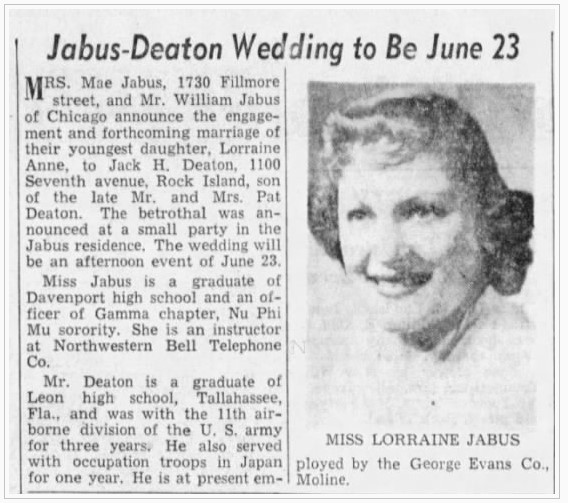
Wedding Announcement in the Daily Times, May 23, 1951.

When researching our lives, official publications like my parents’ wedding announcement in the May 23, 1951 Daily Times are never completely accurate.

William used the Polish spelling of his last name, Dziabas, rather than the anglicized version, Jabus, Grandmother did. Why was he in Chicago and Mae in Davenport? Despite Mother writing about it in a partial memoir, we’ll never fully know.

The article omits Father’s step mother, who lived in Rock Island well into my lifetime. I corresponded with her by mail but we never met. She said her marriage to Grandfather was a “business arrangement” in a letter. The business was named the Deaton Diner and she kept his name until she died, burying Grandfather and two subsequent husbands in a row near her eventual grave. She was known by the sexton at the cemetery but not a significant part of my life.

Despite the partial picture official announcements present, they detail biographical information that might otherwise be lost.  Mother talked about graduating from Davenport High School and working for the phone company until her 90th birthday this year. The clipping is evidence. Our family visited Leon High School during a trip to Florida before Father died. I visited his alma mater while working in South Georgia for a logistics company. Father was a welder at George Evans Company according to the story. He seldom talked about his military service although an omitted fact — he was born in Virginia — was a primary influence when I was growing up.

As members of society we publish official notices to mark rites of passage. When I found this clipping by chance on the internet, it made my day. Official notices provide an opportunity to sand off the rough spots in our lives as we pass through milestones. As a biographer one has to ask whether to present the narrative as-is, or to embellish it with additional facts derived from experience outside its context. My answer is to present the artifact with sparing interpretation.

While presenting artifacts, I’m also weaving a narrative, something derived from both artifacts and experiences. The artifact never really stands alone. It becomes part of a narrative reduced to writing or told orally time and again until it becomes part of our world. Where such narratives will go remains uncertain. They have a basis in clippings like this wedding announcement.

Categories
Writing

One Chance to Remember

Mae

(Editor’s Note: I’m working on a longer, autobiographical piece this winter. From time to time I’ll post findings from our family archives. The following was dated Dec. 11, 2010).

If I get this one chance to remember my maternal grandmother, what would I say?

That she was part of our family since my earliest remembrances.

That she encouraged me as her aunt had not encouraged her, that horrible instance when playing the piano would never be possible.

That she worked as a seamstress into her 80s and worked hard in what we would call menial positions.

That she reaped the benefits of the social programs of FDR and because of them, was able to live on her own until finally she had to go to the Kahl home, a place she had worked earlier in her life, to be tended by the Catholic charities for whom she had also worked.

That she had suggestions for how to life my life, but they were neither mandates, nor things I would not do willingly.

That she had become a part of my life, incorporated into my being like mixing pancake batter.

That she would come to adore her great granddaughter and be the first to offer her a piece of meat at a family meal.

That she would be sorely missed when she died while we lived in the Calumet.

Categories
Living in Society

Will Trump Supporters Abide by 2020 Election Results?

Woman Writing Letter

I read with interest Monte Whitlock’s exhortation in the Dec. 2 Cedar Rapids Gazette that, “every American should vote Republican next election.”

Despite the author’s assertions, I decline to follow his advice. He presented no evidence of his claims, and as a life-long Democrat I need to see something before changing my views.

What interests me is that he even wrote to the newspaper. Views like his are found more frequently in the realm of talk radio and cable news shows. Public engagement is a good sign that all hope for our governance is not lost. I disagree with what Whitlock said but don’t argue with his right to hold opinions and write about them. I’m glad he wrote to a newspaper to get his views in the public domain.

Solon, from which the author hails, is a place with a strong Trump following. One can count at least five blue and white Trump banners flying in front of homes here. It seems a bit early for yard displays, but the fandom is evident.

The main question I have is will Trump supporters abide by the 2020 general election if Democrats win? I hope so.

~ Published Dec. 9, 2019 as a letter to the editor of the Cedar Rapids Gazette

Categories
Living in Society

Money and Theresa Greenfield

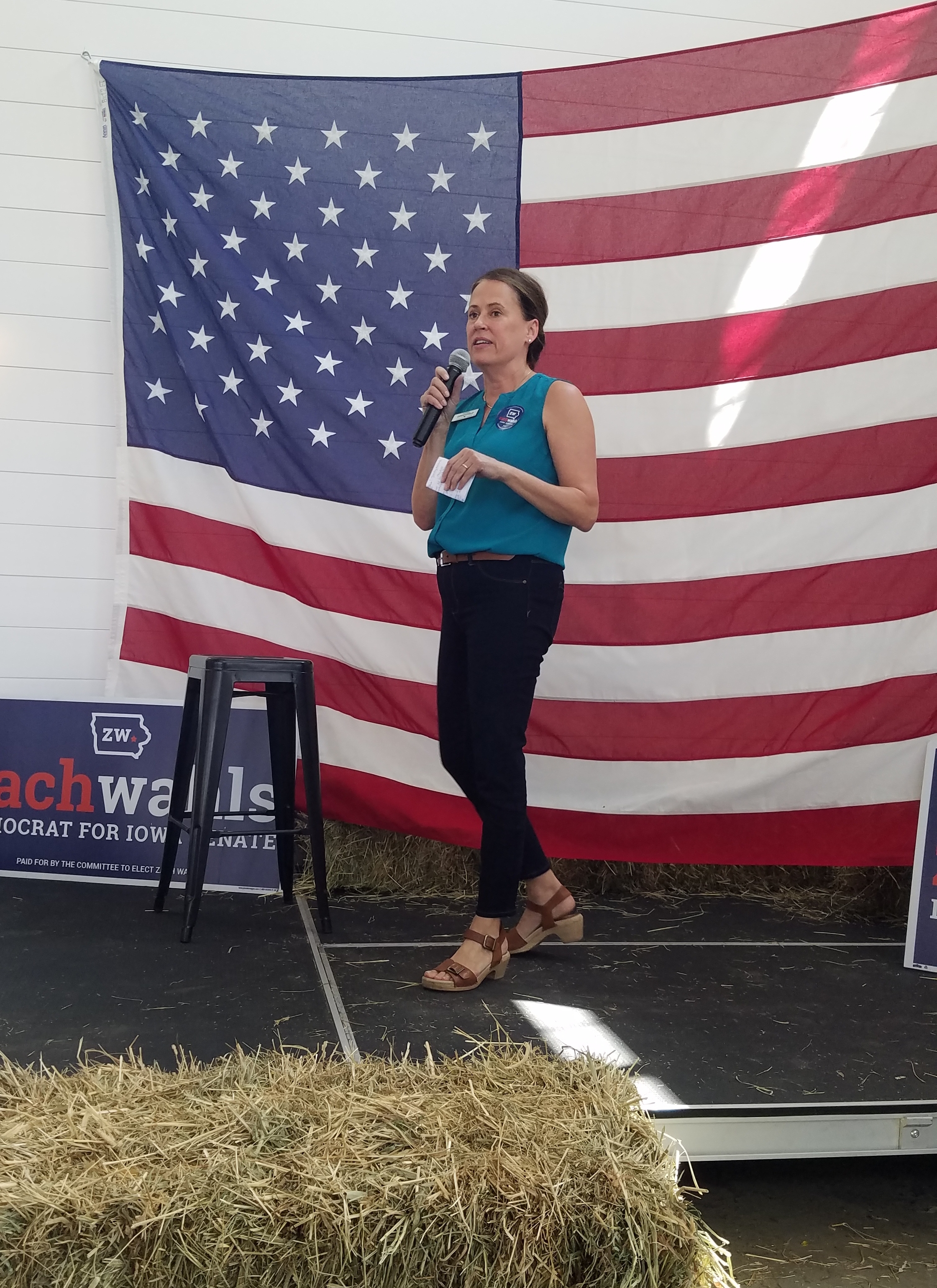
U.S. Senate Candidate Theresa Greenfield, Walker Homestead, Johnson County, Iowa. July 14, 2019

Theresa Greenfield is a Democrat running for U.S. Senate and appears ahead in the money game.

She got positive press after third quarter fundraising numbers were released. She raised $1.1 million in Q3 compared to Joni Ernst who raised less than $1 million. Ernst had $4 million on hand.

Greenfield was bullish, saying to The Hill, “It’s clear that the momentum and energy is on our side to flip this Senate seat, and I’m so proud of what our grassroots campaign has already been able to accomplish to lay the groundwork to win this race next year.”

Not so fast.

Campaign money is not the only money in the 2020 elections. Greenfield’s campaign eschews donations from corporate political action committees and secured 92 percent of donations at $100 or less. These are positive things. Even so, millions of dollars will be spent on this election by both major parties, political action committees, and others. Not all of it will be from donations that meet a candidate’s criteria, because legally, the campaign can’t coordinate activities with outside groups. The Democrat will benefit from big money spending regardless of how donations to their campaigns are filtered. A significant source of money, the DSCC, has backed Theresa Greenfield to take on Ernst. There will be others.

Underlying the last paragraph is a notion that in 2020 the Iowa U.S. Senate election will be a fair fight. It won’t. Brian Slodyko of Associated Press posted a story yesterday titled “‘Dark money’ ties raise questions for GOP Sen. Ernst of Iowa.” The author opens,

An outside group founded by top political aides to Sen. Joni Ernst has worked closely with the Iowa Republican to raise money and boost her reelection prospects, a degree of overlap that potentially violates the law, documents obtained by The Associated Press show.

As we’ve seen in the results of the Russia and Ukraine investigations of the president and his campaigns, Republicans appear to be a lawless bunch. Ernst has repeatedly demonstrated there is little daylight between the president and her. What you see is what you get.

After hearing three Democratic senate candidates speak at Iowa events and taking a phone call from a fourth, I found each to have positive qualities. In this race money matters as much as any other aspect of a campaign. Sure we’d like to overturn Citizen’s United in an effort to take money out of politics. Public financing of campaigns might also be good. Democrats have to win elections under the current rules before there is an opportunity to change campaign financing laws. Or we could break the law as Ernst and her cadre of close supporters may have done. Democrats have become the party of law and order and I don’t see Greenfield or the others breaking the law.

We want and need to flip the U.S. Senate to a Democratic majority so if our presidential candidate wins, they have a chance to govern. Republicans want to hold this seat for similar reasons. With 33 U.S. Senate seats on the ballot, there are enough to flip control, but only so many competitive races in which big money could make a difference. The Iowa seat is one of them.

Each of the Democratic candidates for U.S. Senate has asserted they are best to unseat Joni Ernst. Which is accurate? Answering this question assumes playing by rules of logic that simply aren’t being used by Republican and right wing Ernst supporters.

A winning quarter of fundraising may not be enough to stand down the challenges of the influence of third party money in our elections. It is a positive start, but only part of the picture.

~ Written for Blog for Iowa

Categories
Home Life

Into Winter

Iowa Winter

After I returned from a shift at the home, farm and auto supply store I scrubbed and cut up potatoes to roast for dinner. Roasted potatoes, a burger patty and frozen peas made a dinner — comfort food as winter approaches.

The Thanksgiving leftovers are gone, our pantry and ice box are full. There was no need to grocery shop after my shift comme d’habitude.

In eight weeks it will be time to start onions, leeks, and shallots inside, then begin soil blocking at the farm a week or two later. For now there’s indoors work of reading, writing, cooking and cleaning.

A neighbor put out bird feeders to attract birds, then expressed concern that cats were hanging around, chasing the birds away and prompting her dogs to bark at them. I wrote a response.

This is an interesting topic. Although I don’t have any solution to the issue of dogs barking at wandering cats, by putting out bird seed, like I have, a person attracts a variety of animals to the yard, which includes not only birds but mice, voles, chipmunks, squirrels, raccoons, deer, and maybe others.

Because of our proximity to the state park, we see almost every species native to Iowa here.

The bird feeder also brings predators of small animals, including cats, but also hawks, owls, and foxes. Then there are the scavengers like possums, turkey vultures and crows.

My point is when we decide to place a bird feeder out we are creating an ecosystem, especially if we fill feeders year-around. If members have pets, they should be kept on a leash or indoors, that’s long been our policy. However, there is a bigger ecosystem that will continue, even in the event pets can be controlled.

On that note, we head into winter.

Categories
Living in Society

Fixing the Leak, Kamala Harris is Out

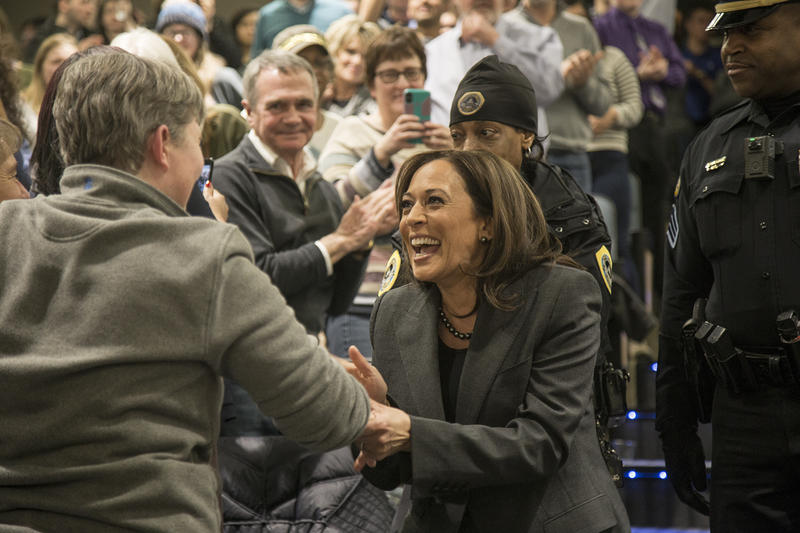
Kamala Harris in Iowa. Photo Credit – Clay Masters, Iowa Public Radio.

A plumber arrived yesterday at our home to repair the leaking water heater. I asked for permission to watch him work.

He removed the cover panel, turned the water back on ever so slightly, and a pinhole in the copper tubing feeding the household showed itself. He turned the water back off.

The model and serial number of our water heater is printed on its side, with a phone number to the manufacturer. He called them and sadly, the replacement part, a heat exchanger, is no longer being manufactured. The technician on the telephone suggested some parts houses who might have one in stock and identified a newer model with the same footprint as our current unit. He provided pricing and an estimate of the time to replace the heat exchanger if one could be found in a parts house.

Next the plumber called a recommended parts supplier and asked them to see if a part could be found. If they can’t find one, we’ll install the new unit, what else would we do? He patched the leak with a section of high pressure water hose and buttoned things up. The whole process took less than an hour.

While he worked I told him I work at the home, farm and auto supply store the next couple of days and Friday would be best to schedule the repair or replacement. It turns out his boss’s spouse works there part time as well. He is the plumber the store manager calls to make minor repairs. It is a small world.

Yesterday Kamala Harris suspended her presidential campaign. I received an email within the hour of news hitting the internet that included this:

I’ve taken stock and looked at this from every angle, and over the last few days have come to one of the hardest decisions of my life.

My campaign for president simply doesn’t have the financial resources we need to continue.

I’m not a billionaire. I can’t fund my own campaign. And as the campaign has gone on, it’s become harder and harder to raise the money we need to compete.

In good faith, I can’t tell you, my supporters and volunteers, that I have a path forward if I don’t believe I do.

During Harris’ first trips to Iowa, I felt she could win it all. Her campaign had such organizational strength and energy. She appeared to be doing the right things to secure the nomination and then roll easily toward victory in the general election. Others have opinions of why her campaign failed to gain sufficient traction, I do not.

Elizabeth Warren commented about the presence of billionaires in the Democratic nominating process in an email which arrived eight hours later:

Kamala Harris and Kirsten Gillibrand — two women senators who, together, won more than 11.5 million votes in their last elections — have been forced out of this race, while billionaires Tom Steyer and Michael Bloomberg have been allowed to buy their way in.

Our party and our democracy deserve better.

While I didn’t hear Kamala Harris in person, her strength as a U.S. Senator, history as an attorney, and ability to attract some of the best political organizing talent in the state made her a contender. We all realize it takes money to run a presidential campaign. The competition for the nomination is the less for her exit.