LAKE MACBRIDE— Trish Nelson will be taking the summer off from editing Blog for Iowa, and I’ll be filling in. There is a small stipend, and the work will give me a chance to develop ideas around the 2014 midterm elections, and on other topics.
With the retreat of so many people to no preference voter registration, to say that party affiliation matters a lot misses the point. In my statehouse district, the Iowa Secretary of State May report showed 19,802 active voters, of which 6,275 are registered Democratic, 5,666 Republican, and 7,576 No Party. The Democratic edge is largely irrelevant with so many no party registrants.
Don’t get me wrong, there is a devoted corps of died in the wool Democrats and Republicans. They just make up a minority of the electorate. In my experience, the further down the ticket, the less party affiliation matters, and the more the personality and policies of candidates come into the foreground. This summer will be a time to explore the meaning of this in light of the Nov. 4 general election campaign. It should be fun and interesting. My posts can be seen at this link.
The other new summer job is a woodcutting project in nearby Cedar County. The work has flexible hours, and will add some needed income to the household budget.
Meanwhile, the farm, newspaper and warehouse work will form a base of income upon which I can build. One thing seems certain, with all of the gardening and my share from the CSA, there will be no shortage of good quality food for our pantry and table.
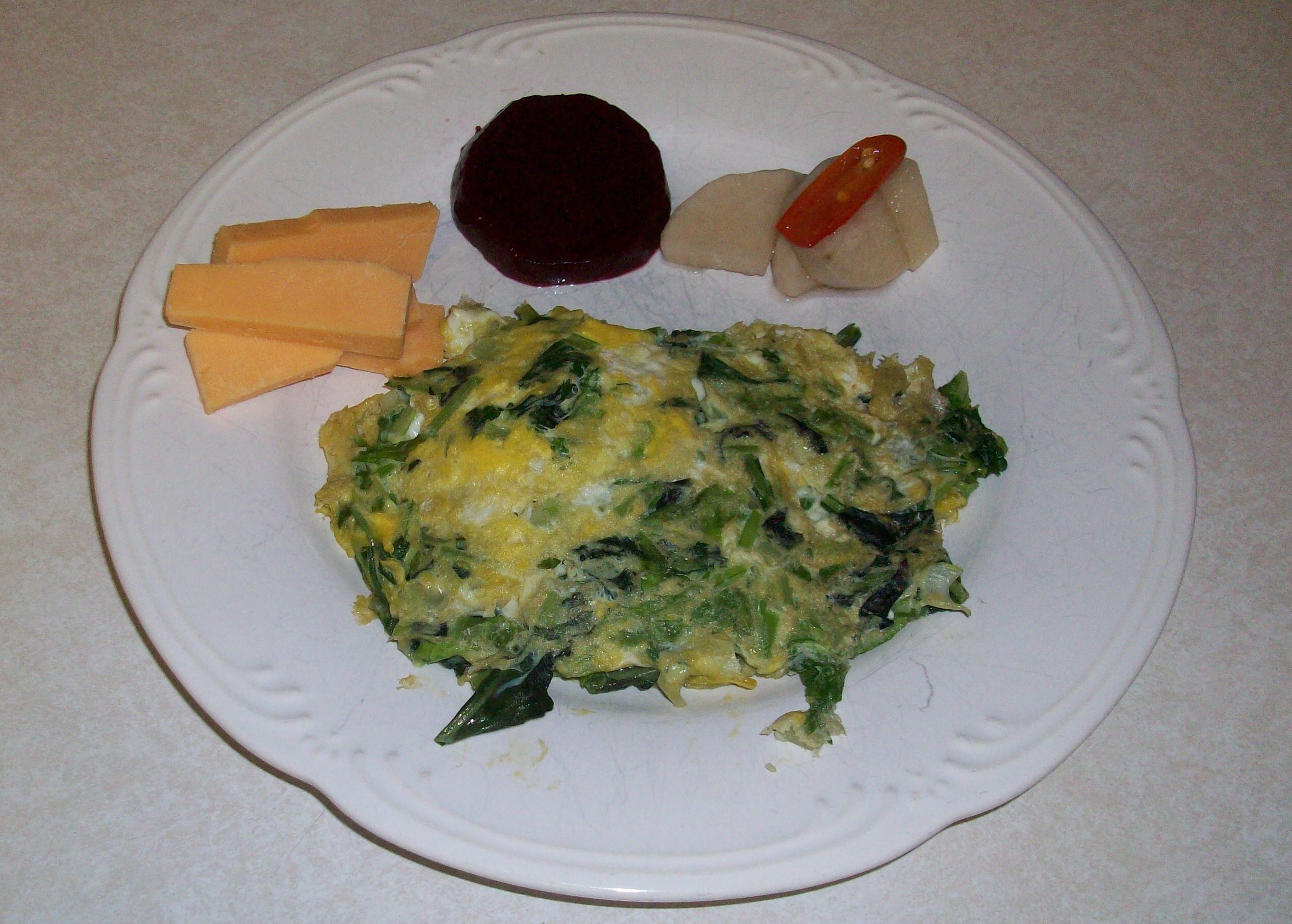
Asian Greens in Scrambled Eggs with Vermont Cheese and Pickled Bits and Pieces
LAKE MACBRIDE— The first share from the Community Supported Agriculture (CSA) farm was ready yesterday— asparagus, lettuce, baby bok choy and Asian greens. Anticipation over spring and summer cooking is building, even if living on bits and pieces from the pantry will continue until the full flow of local produce is unleashed. Picking up the share at the farm was a fine beginning.
We had more than two inches of rain since Earth Day, so outdoor plants are growing. The garden is too wet to work, although as soon as the soil dries, seedlings are ready to go into the ground. Meanwhile I will go on living in society, and that is today’s topic.
The phrase “in society” has a particular usage here. It is part of a spectrum of relationships with people that contrasts with “chez nous,” the French term that refers to “at home” or “with us.” Maybe there is something else on this jumping green sphere (thanks Lord Buckley for this phrase), “outside society” or “foreign,” but most of our lives are spent chez nous or in society. My tag “homelife” could be changed to “chez nous” and sustain the meaning.
Living in society is that set of relationships which sustains a life on the plains. It includes friends, family, neighbors, workplaces, institutions, retail establishments, and organizations with which we associate or interact. The relationships are interpersonal, that is, specific people are associated with each part of society— it is not an abstraction.
When young, we don’t see our life in society this way. We had an ability to live in the moment without a history of interpersonal relationships, anchoring us into something else. As we age, we are more like a character in a William Faulkner novel that must work to suppress the endless flow of memory.
If experience connects us, the way we live in society is based on thousands of previous interactions. For example, someone ran for the U.S. Senate after a long, productive life. If I saw him today in any of a number of settings— at a retail store, at the retirement village, at a literature reading, at a veterans meeting, at a public demonstration— I would think of the courage he displayed by taking on personal debt to challenge an entrenched incumbent politician who would otherwise have run unopposed. I would also think of our many conversations over a period of years. Our relationship is driven by my respect for his courage, and I picture him when I think about the associations we share. When I use the phrase “in society,” it might be referring to an interaction we had, or one like it with someone else.
My usage of the phrase “in society” may have been explained by others who are smarter, but because it is organic there is a peculiar sense to it on this blog. It is personal, but not really, because is it also public.
I am entering one of the richest periods of personal interaction in life. Old enough to have had experience, and young enough to gain new ones. Each day’s potential is vast midst the galaxy of people with whom I interact. Favoring the phrase “in society” enables me to talk about them without revealing where the specific interaction may have occurred. This protects people from unwanted intrusion into their lives, and enables the writing I do for a couple of hours each day.
Chez nous, we would have had breakfast of Asian greens mixed with scrambled eggs, Vermont cheddar cheese and pickled veggies from last season. In society I am part of the local food movement and post photos of my breakfast. Maybe I am drawing a fine line, but it is an important one for a writer.
LAKE MACBRIDE— I will be speaking about personal finance, the environment and nuclear abolition four times between April 19 and 24. If you are nearby, please consider attending one of these events:
April 19, 11 a.m.: “Alternative Living: Focus on Finances” with Solon resident and writer Paul Deaton. Paul gave up his 9 to 5 job to focus on his writing. He will describe his creative methods of putting food on the table and how he covers his expenses to survive and thrive. Part of the American Library Association Money Smart Week, Solon Public Library, 320 W. Main St., Solon, Iowa.
April 19, 1 until 3 p.m.: Soap Box Speech on the environment: “Mount Tambora, Mount St. Helens and Nuclear Famine” at the Celebration of Life at Old Brick, 20 East Market St., Iowa City, Iowa.
April 23, 6:30 p.m.: “Earth Week: Climate Reality in Iowa” at 220East, 220 East Fourth St., Waterloo, Iowa.
April 24, 6:30 p.m.: “Earth Week: Climate Reality in Iowa” at the Independence Public Library, 805 1st St. East, Independence, Iowa.
11 a.m.: “Alternative Living: focus on finances” with Solon resident and writer Paul Deaton. Paul gave up his 9-5 job to focus on his writing. He will describe his creative methods of putting food on the table and how he covers his expenses. – See more at: http://www.soloneconomist.com/content/solon-public-library-50#sthash.PGm9t3cj.dpuf
11 a.m.: “Alternative Living: focus on finances” with Solon resident and writer Paul Deaton. Paul gave up his 9-5 job to focus on his writing. He will describe his creative methods of putting food on the table and how he covers his expenses. – See more at: http://www.soloneconomist.com/content/solon-public-library-50#sthash.PGm9t3cj.dpuf
11 a.m.: “Alternative Living: focus on finances” with Solon resident and writer Paul Deaton. Paul gave up his 9-5 job to focus on his writing. He will describe his creative methods of putting food on the table and how he covers his expenses. – See more at: http://www.soloneconomist.com/content/solon-public-library-50#sthash.PGm9t3cj.dpuf
11 a.m.: “Alternative Living: focus on finances” with Solon resident and writer Paul Deaton. Paul gave up his 9-5 job to focus on his writing. He will describe his creative methods of putting food on the table and how he covers his expenses. – See more at: http://www.soloneconomist.com/content/solon-public-library-50#sthash.PGm9t3cj.dpuf
11 a.m.: “Alternative Living: focus on finances” with Solon resident and writer Paul Deaton. Paul gave up his 9-5 job to focus on his writing. He will describe his creative methods of putting food on the table and how he covers his expenses. – See more at: http://www.soloneconomist.com/content/solon-public-library-50#sthash.PGm9t3cj.dpuf
LAKE MACBRIDE— The ambient outdoor temperature was 50 degrees at 3 a.m., creating a yearning to work in the yard and garden. Other work, however, kept me busy this weekend. So much so, that when each day was done, bedtime couldn’t come soon enough— outdoors had to wait.
I’m okay with that, but I’m not.
When first feeling the urge to be a writer, many years ago, I had no idea what that meant. Now there is a full slate of writing jobs, some paid and some not, and meeting deadlines has become more of an issue. Writing and proof reading our weekly newspaper can’t be described as a stressful job, but beginning on Fridays, it’s crunch time.
The supervisory work at the warehouse also occurs on weekends, so there is little time for extras in the arc from Friday through Monday. The result has been to hang with a new, and very different group of people from the academicians, political activists, public figures, and peace and justice crowd that had become staples of my social life.
American lives move from a fixed point in time toward insularity. Frederick Jackson Turner wrote in 1893,
As each generation of pioneers moved 50 to 100 miles west, they abandoned useless European practices, institutions and ideas, and instead found new solutions to new problems created by their new environment. Over multiple generations, the frontier produced characteristics of informality, violence, crudeness, democracy and initiative that the world recognized as “American.”
The degree to which one takes issue with the frontier thesis asserted by Turner in The Significance of the Frontier in American History, there is no denying the bent toward utopianism that exists in daily life. People don’t care about money as much as they want to be able to pay their bills and live their lives. In doing so, they create an island of utopianism carved out of a complicated society. Perhaps I am corrupting what it means to be utopian, but that too is an American idea.
I heard a woman say she wanted the man to make the decisions for her last week. I was stunned. Only an insular life can espouse such a world view. One that lacks a basic connection to a greater society, and exists in the rarefied air of a peculiar social network.
“Ugggghhhhh. That’s depressing,” said one friend.
“Thank goodness she’s in the minority,” said another.
“A sample of one does not a movement make,” said an activist I know.
Whatever repulsion there is to a woman who wants her man to do the thinking, it is part of the diversity of life which has become a context for my writing.
A writer must necessarily become isolated while working. At the same time, there is a constant want and need for contact with humanity in all of its diversity. Writers must break from the swaddling of the familiar and dive in— it’s as close to utopia as American living gets.
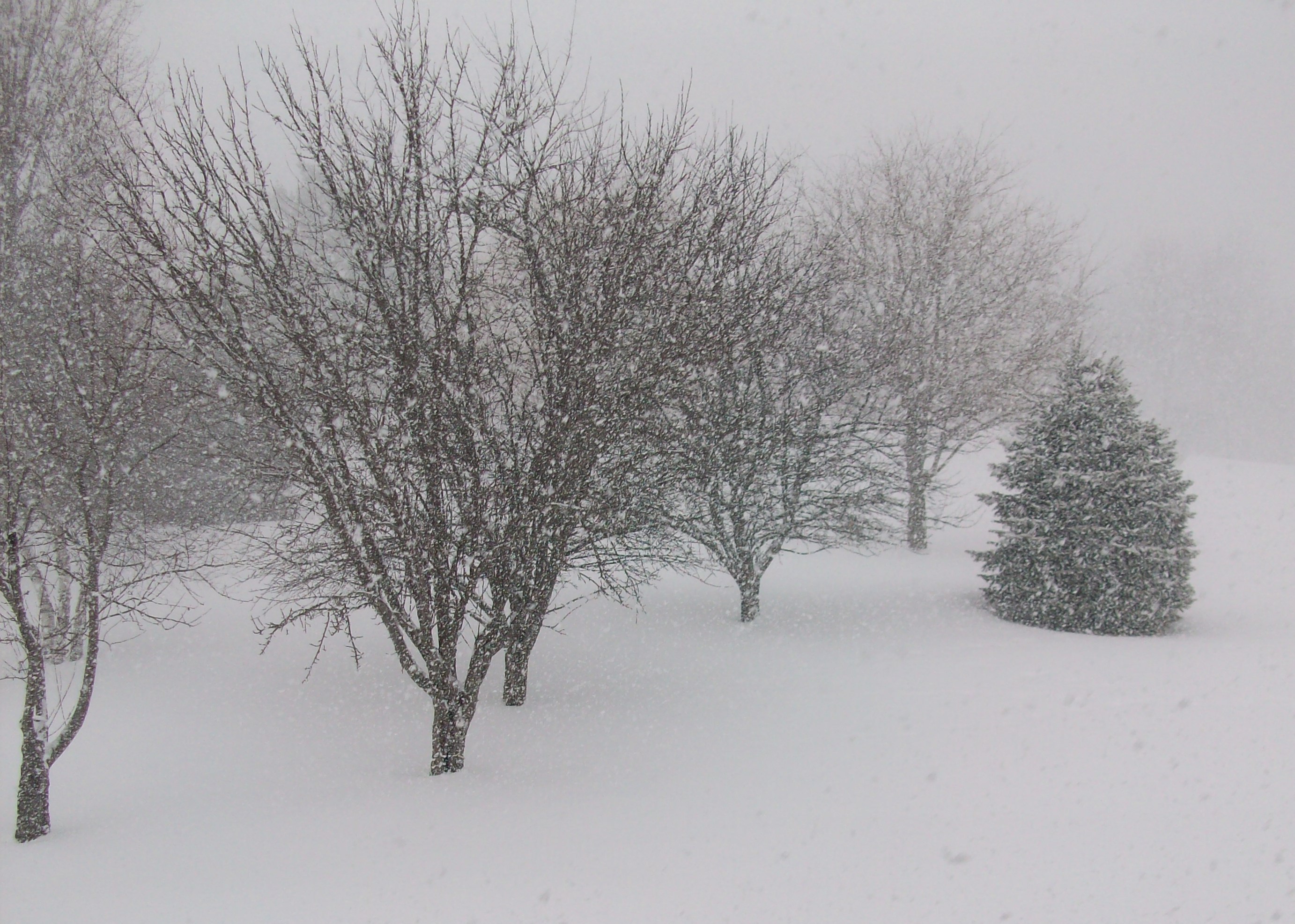
LAKE MACBRIDE— Falling snow whited out the world beyond our driveway. Isolated, it was hard to avoid wondering what was happening out there. The pipeline of data packets delivered to a screen beckoned us to leave our wonder, and engage with society beyond the driveway. At some point, I turned the computer off and set the mobile phone in another room.
Should a writer write what one knows, or what one wonders or imagines? And who is this writing to be about? If it is narcissistic preening, then why not take the whole endeavor off-line, get a paper journal, and write there— because who cares but the individual? Unless we write what we imagine society could be, and how we fit into the greater aspects of it, there is little reason to post on the Internet.
Apple Trees in a Winter Storm
I believe food is a connection to the rest of society and that’s why I write about it. At once it encompasses personal experience, labor, production, the environment, soil quality, botany, chemistry, biology, consumerism, preservation and packaging, distribution, cooking and eating— the whole enchilada of sustaining a life. Since everyone has to eat, food culture has been and remains a fertile field for the imagination, and a practical way to connect with people. That said, why care about what I cooked in the kitchen last night? One needn’t.
If we develop a sustainable culture where we live, we will be better able to survive in a turbulent world. We would be less distracted by media and outside factors, and empowered to act with authority on what we know. One needs a cultural platform to serve as a fulcrum for change. If we don’t make one, social progress becomes difficult.
As the snowfall slowed and stopped, the sun came out. The new fallen snow resembled a blanket over life’s previous markings— a chance to start again. Soon, I’ll grab a shovel and dig a path out to the street and a society with which I was always connected, but from which I took a retreat to work toward sustaining a life on the Iowa prairie.
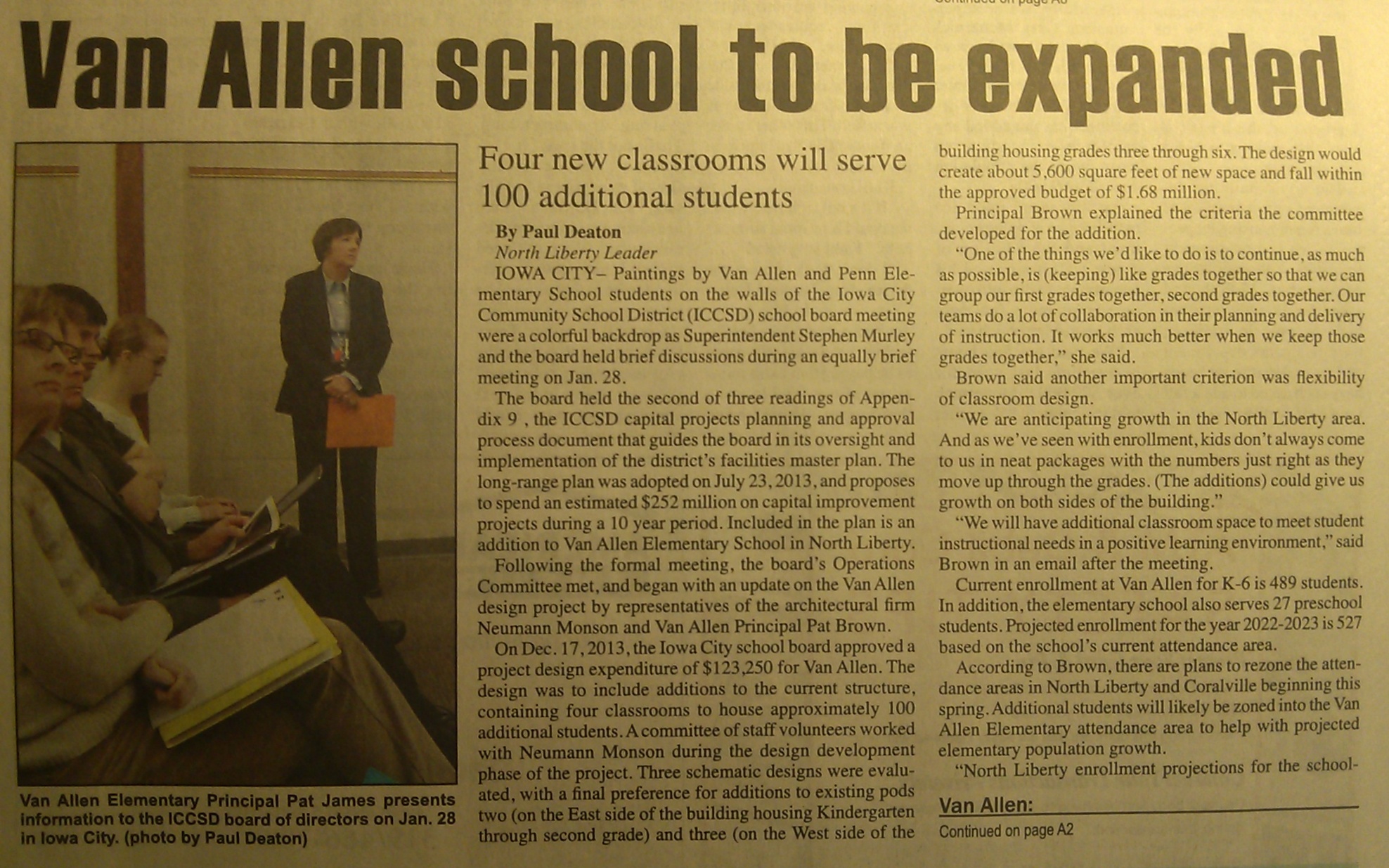
NORTH LIBERTY— On the front page, below the fold, is my first article written for a newspaper— The North Liberty Leader. I have two beats, the Iowa City Community School District Board of Directors, and the Solon City Council. We’ll see how it goes, but the work has been a plus.
Most importantly, I now have an editor who reads what I write and provides feedback. Every writer needs that, although in the era of social media and blogs, few have it. In my evolution as a writer— from high school work in the 1960s, to fledgling efforts in the 1970s, to graduate school, and through today, my writing has gotten better. Now there is a structure for improvement and I like it… a lot.
While life will continue to be busy as a low wage worker, at least part of my time is compensated for doing what I love. That is like Thanksgiving in February.
LAKE MACBRIDE— The sound of scraping entered the house and overpowered the muffling noise of the furnace fan. It will require work to get to town for a meeting. At least the snow plow did its part.
The driveway is snow-packed from the car tires, so whatever fell last night won’t be easy to remove. Work was planned for indoors this morning: to write a story for the newspaper. Snowfall is a happy coincidence that will break the quiet and be part of today’s process of fresh air, physical labor and writing. It’s as good as it gets.
Whatever funk descended upon me in December is gone. The new jobs, the promise of spring, and hope that a sound financial platform will enable better writing portend great things. Here’s hoping I’m equal to February’s promise.
LAKE MACBRIDE— The newspaper where I proofread offered me an opportunity to write a few articles on city council and school board meetings. I filed my first story yesterday morning and it was more work than I anticipated. By the end of a 5-hour writing session, my shoulder was sore, and I was reminded that journalism requires a different kind of energy and intensity. One down and four more to go during an initial, mutually agreed trail period.
I attended the Iowa City Community School District Board of Directors meeting on Jan. 28, and took notes while making a voice recording of the meeting. Getting to the meeting and attending took the better part of four hours. What surprised me was how little work actually got done at the formal board meeting. There was no substantial discussion, only ratification of work that occurred outside the meeting.
The operations committee meeting that occurred after the formal board meeting appealed to my inherent process orientation. It went on for more than two hours, and I felt engaged the entire time.
The budget assumption presentation was particularly enjoyable and I interviewed the district CFO afterward. Because of story length constraints, the budget information ended up on the virtual newsroom floor. What I noticed about the Iowa City school district is they are spending money like they have it. Because of the strong tax base they do have it.
We’ll see how this project goes, but I hope to become more efficient in producing stories, to reduce the investment of time, and to get better at writing news articles. The financial contribution will be, as my editor described it, “pocket change.” It will be another check predestined to go toward sustaining a life on the Iowa prairie.
LAKE MACBRIDE— Journal and blog writing is an open book filled with blank pages and freedom. There are few rules, and readership is limited, even when posting publicly on the Internet. Sometimes a writer wants to be read, and others, not so much. There is a formative urge that drives us to understand our world through language. Not everything we write is suitable for framing, in fact, most isn’t. We are driven to write, and occasionally to be read.
In the darkness of night, by the glow of the laptop, it is quiet. Mistake not this silence and solitude for separation from society. What we sense of the world is from constant acculturation beginning before our birth. If we write well at all, it is because of engagement in a world beyond the walls we see. There are no walls, there is no other, only the one of which we are all a part.
LAKE MACBRIDE— Almost every creative person could use more money. This has been true, not only for the vast majority of writers I have known, but for artists, musicians, potters, actors, dancers, painters, singers, theater technicians, and others who pursue creative endeavor. Very few people make a living in creative endeavor without working at something else for money that pays basic living expenses. It is tough to blend a personal economy with being creative without compromise. It is impossible to keep the two in separate isolation chambers, nor would we want to.
During my senior year at the university, a group of creative people shared expenses in an old house in Iowa City. We each had our own room, but shared the common space, holding periodic meetings when an issue arose. Residents came and went, poets, artists, musicians, a travel guide, a tropical fish breeder, and a mechanic. There was always something going on, most of it interesting, and some of it annoying. It was the creative life.
One day a poet arrived to set up shop. She found a job in town, and wrote every morning in the entryway. As an early riser, I encountered her often, and tried not to disturb the work in progress as I walked to the kitchen to make breakfast and get on with my day. After a while, and after giving a few readings in town, she left for California with another poet who was a frequent guest. She adjusted to a sparse life, focused on experience and her writing. Our shared moments seemed to be a way station on her longer journey. She swiped the cooking pans my grandmother had given me when she left, evidence she could have used more money.
That living arrangement and my undergraduate years were a way station for me as well. Early on, I was an admirer of people who worked a career and wrote, notably the pediatrician/poet William Carlos Williams. I thought I could do something similar. It takes a certain kind of career to avoid disrupting one’s creative outlook and I found my time in transportation and logistics wasn’t it. I’m thankful for the ability to earn a living, and led a full life. For 25 years, creativity wasn’t as much a part of my life as I would have liked. It took leaving the security of that work environment to enable writing. Now there is new hope.
Most days I get a chance to write here or off line. I continue to need monetary income to pay monthly bills, although I am no longer in search of a career, having left the one I had. That’s where gardening comes in.
The less than $200 in seeds and supplies will multiply tenfold in value during the growing season: home grown food reduces the need for money. I have a couple of paying jobs, and need one or two more to make ends meet. That’s life in the personal era of creativity. The good news is the garden seeds have been shipped.
I hopefully await arrival of the germinal package, and the chance to forget about money for a while and work directly with Earth’s bounty. Money may always be tight, but nature can help us survive if we are paying attention— and invest in the work.



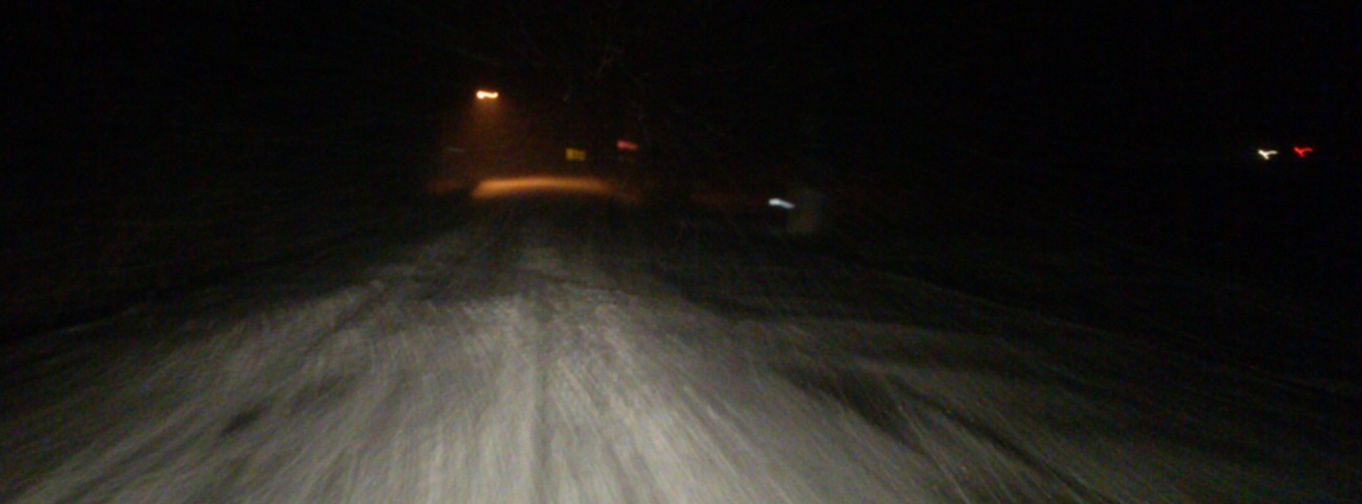


 Journey Home
You must be logged in to post a comment.