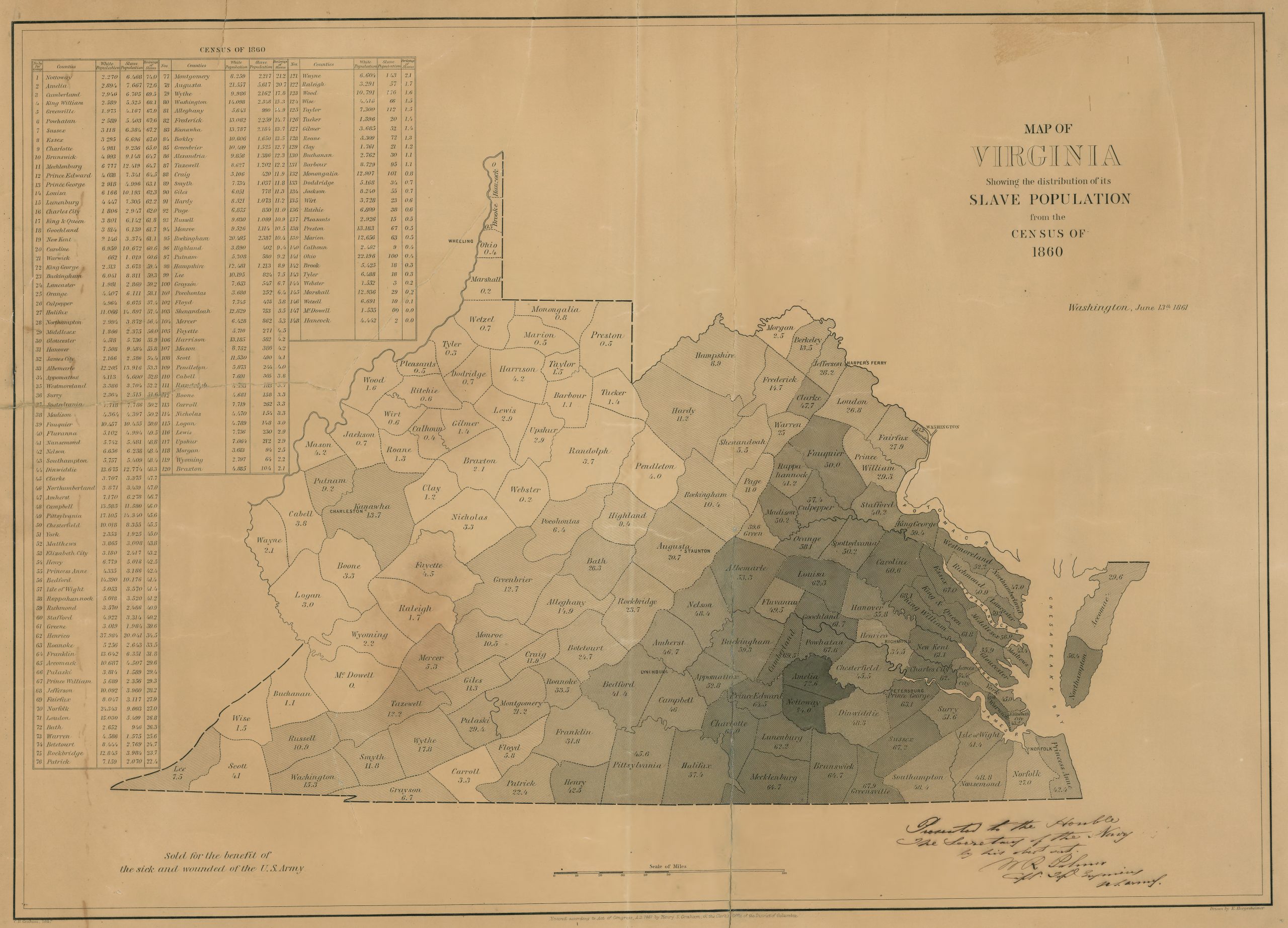
1860 U.S. Census map with number of white and enslaved Virginians by county.
While revisiting my life history I’ve been increasingly aware of what doesn’t get said between family and among friends. In particular, a gap in the narrative exists on Father’s side of the family when it comes to the legacy of human enslavement.
I intend to use the 1927 Pound Gap, Virginia lynching of Leonard Woods as the coda to the autobiography. I have a photograph my spouse took of me standing in front of a Welcome to Virginia highway sign not far from where Woods was lynched, and a memorial of the event was erected in 2021. At the time of the photo, I did not know that history.
Below are two paragraphs I wrote Wednesday as an example of an approach to the section. Slavery was almost never discussed among family.
In 1860, the last year the U.S. Census counted enslaved African Americans, a third of the population of Virginia was enslaved. In Wise County, 66 enslaved persons were counted along with 4,416 white ones. Family lore does not include much about slavery. We note that Thomas Jefferson Addington, my paternal grandmother’s paternal grandfather, served in the army of the Confederate States of America during the Civil War. Family lore is men from Wise County served in both the Confederate and Union armies. There is no discussion of Thomas Jefferson Addington’s military service in his entry in The Stallard Connection, a thick family history tracing parts of our line back to the 17th Century. There is a Salyer – Lee Chapter of the United Daughters of the Confederacy in Wise County. I have family photographs of Father playing with some of the Salyer girls when they lived in Glamorgan. They attended school together. During the two trips I made to Wise County, I don’t recall seeing any African Americans or even once discussing slavery. There must be more to the story, although it may be lost in history.
Leonard Woods, a 30-year-old black coal miner, lived in Jenkins, Kentucky, the same town where Uncle Melvin and Aunt Carrie operated a bakery. He was accused of murdering a white coal mine foreman named Herschel Deaton (no relation). On Nov. 30, 1927, a mob broke Woods out of the Whitesburg, Kentucky jail and took him to Pound Gap, Virginia, where they hanged him and shot his corpse many times. Accounts vary, yet when the mob arrived with Woods around 3 a.m., the crowd numbered 1,000 to 1,500 people, in some 500 cars. Members of the sheriff’s office who were present failed to note any of the vehicle license plates. It is difficult to believe members of my family did not know of this history or participate in it. It never came up.
Draft autobiography by Paul Deaton, Feb. 2, 2022.
I don’t know if it fits, yet I feel I should make it fit. Avoidance of the legacy of human enslavement is as American as apple pie. The sweetness is of short duration.
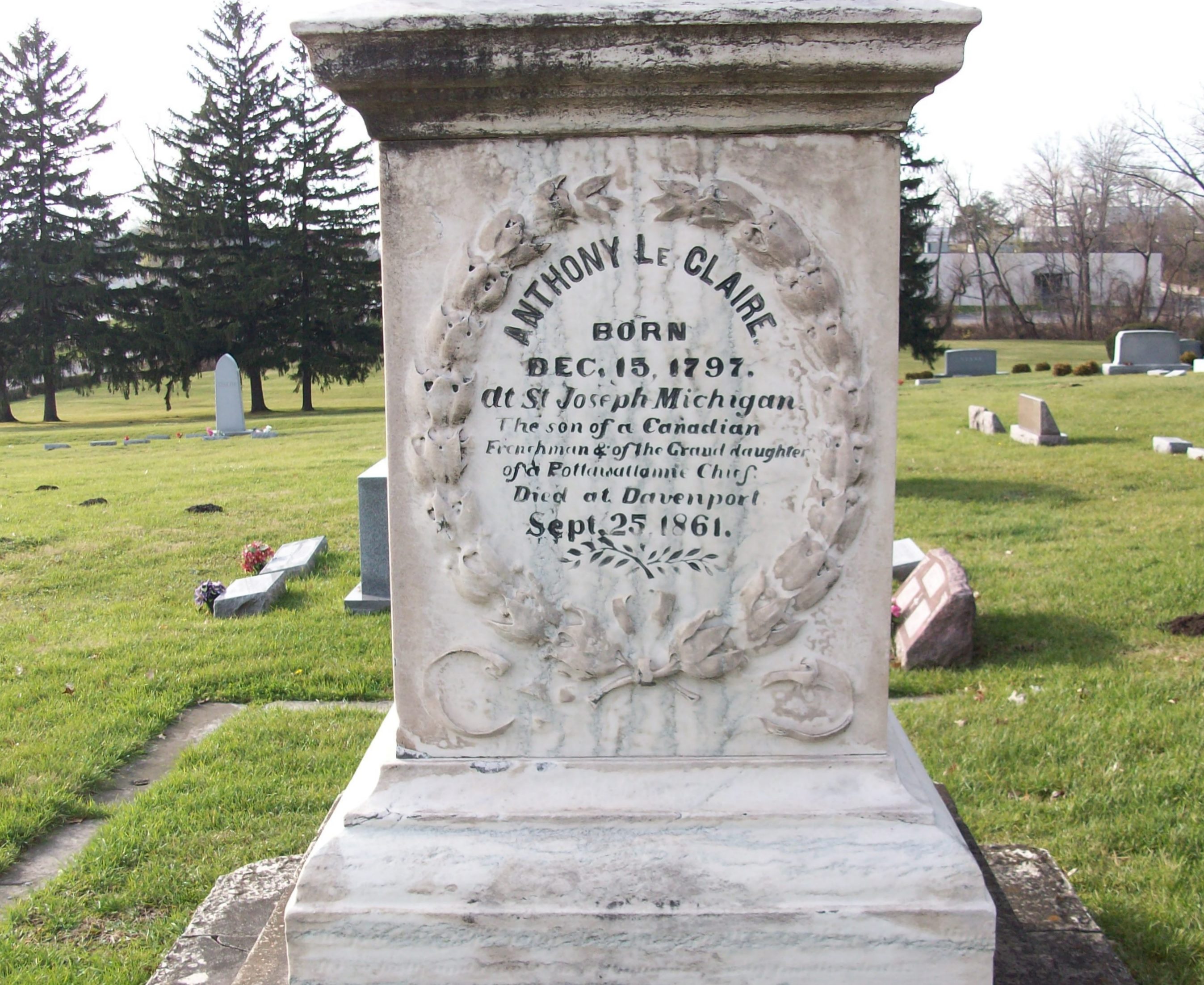
Detail of the Antoine LeClaire grave marker at Mount Calvary Cemetery, Davenport, Iowa. Photo by the author.
The history of Davenport, Iowa was largely absent from my upbringing. I was born there, yet nothing. There was no Iowa history curriculum in K-12 schools, nor at university. The first biography of George Davenport, one of the city’s founders and its namesake, was not published until May 21, 2020.
I left Davenport for university in 1970 and haven’t missed learning the history. I am revisiting it now that I’m writing my autobiography.
The Trader at Rock Island: George Davenport and the Founding of the Quad Cities by Regena Trant Schantz is a serviceable biography which reflects detailed research into the history of the region. Schantz obviously reviewed documentary records, physical artifacts, and sites. It adequately tells the story of early traders, mineral extraction, land speculation, river culture, and the relations with Black Hawk and other indigenous tribal leaders from the perspective on one of history’s most prominent participants. Because of my education, this history matters little in my outlook toward my home town.
By the time my awareness came of age, the city was in a post-World War II economic boom. Depending upon how one reckons economic history, this was preceded by the trader days, land speculation, the surge in lumber milling after 1850 (as Wisconsin and Minnesota forests were clear cut and rafted down river without replanting), and the rise in farming after the Black Hawk War finished in 1832. Some of my spouse’s family were among the early Iowa settlers after the war. A tide of immigration to Iowa started by the 1840s. With the removal of indigenous tribes and native forests, along with ripping up and plowing the prairie, the landscape in which I found myself was already in existence. There was little reason to think about the early days of settlement.
By the time Mother graduated high school in 1947, the city was ready for the post-World War II boom. Settlement had grown far beyond the initial lots surveyed in the 1830s. The house in which we lived while I was in high school was built in 1910, well above the antediluvian banks of the river. There was infrastructure, a bus route, medical facilities, a wide range of churches, and corner grocery stores waiting to get displaced by supermarkets. Many large manufacturing and food processing companies existed. A person could go their whole life without knowing about the exploits of George Davenport, Antoine LeClaire and other traders turned land speculators during the time before the initial plat was laid out.
What does my writing owe to the history of the city of my birth? Not much, I reckon. It served as a landing place for ancestors displaced from other states. Grandmother arrived with children in tow during World War II. My paternal grandfather arrived after the war and didn’t live much longer.
I plan to tell the story of the initial lot sales, the lumber boom, and development of industry. I suppose that’s needed to set context. Besides the meat packing plant where my father, grandmother and I worked, I don’t have many connections to the old days. Most of our early family stories are derived from immigrant experience in Minnesota and Illinois on Mother’s side, along with Father’s ancestry in Southwestern Virginia and nearby Kentucky.
The biography of George Davenport is engaging, and of interest as an alternative to many stories of settlement in the Tidewater and New England. The Louisiana Purchase is often discussed, yet what happened locally is not. I tip my hat to the work of traders, land speculators and developers yet realize that is not my history.
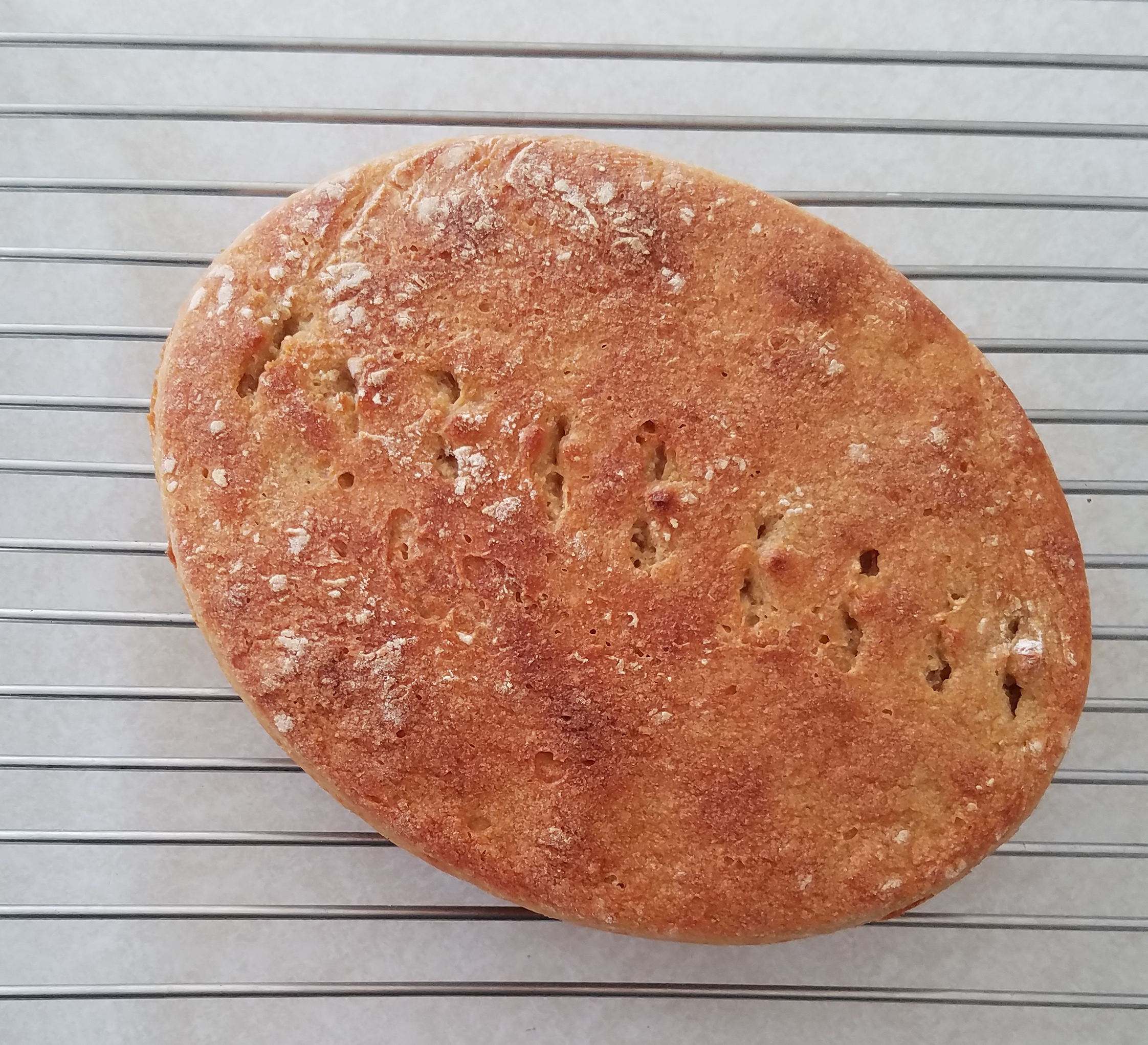
Bread made from a mixture of regular organic all purpose flour and flour of an indeterminate kind.
The coronavirus pandemic persists toward the end of its second year.
Mostly, I stayed home in January. I made five retail store visits: two to the wholesale club, one to a supermarket, one to the orchard, and another to the home, farm and auto supply store. I picked up milk at the convenience store twice when grocery store trips became too infrequent. Only so many jugs of milk fit in the refrigerator at a time.
Snow covered the ground for much of the month so I moved exercise indoors. I don’t want to risk turning an ankle on the snow pack during walkabout, or slip and fall on an ice patch. The trip to the mailbox and weekly delivery of trash and recycling bins to the end of the driveway became my main regular outings. Using sand collected from the road during previous years, I heavily sanded the ice patch where the concrete meets the gravel.
Other outdoors activities included pruning fruit trees and emptying the compost bucket. Compared to normal times, outdoors activities slowed.
Indoors, I have been cooking more and reading a lot. I finished nine books in January. I’ve been making steady progress on the autobiography. We are using up food preserved in the pantry, freezer and refrigerator.
In my quest to make a weekend, I’ve been thinking of the loaf of bread I baked Saturday. Setting aside some Saturday time for baking would be a positive, potentially recurring thing. It would also enable me to use up some of the older flour sitting in cupboard containers.
I found two containers of mystery flour. At first I thought it was whole wheat. After tasting them, I’m not sure. Mixed half and half with all purpose flour, whatever it is made a grainy loaf that was risen, yet somewhat dense. It was great for making finger sandwiches with mustard and cheese from the refrigerator for afternoon snack.
I started onions and shallots and they are doing well. In early February I plan to start cruciferous vegetables. Inch by inch the garden is beginning to grow. Outside, deer are beating a path between the plots. They are coming from the 25-acre woods and heading west to parts unknown, likely the wooded area west of our subdivision. The fencing hopefully discourages them from stopping to see what I’m growing during the gardening season. There is not much edible out there now.
Debt was incurred in January. On a fixed income, I use a credit card to handle spikes in expenses. There were one-time expenses: subscription to the Washington Post, biannual servicing of the John Deere, and printing an annual blog book. There were increases across the board on recurring expenses: the monthly escrow amount, gas, electricity, broadband, and health insurance. The debt is manageable and it won’t take long to pay down if there are no February surprises.
Noteworthy is the sense of being alone when my spouse is sleeping or busy working on a project. Since I can remember I’ve been active in society. I wrote a friend,
I’m leery of volunteering with the COVID-19 surge and all. I would like to volunteer doing something once I feel more comfortable being out in the world.
Just turned 70 years old last month, so there is a lot of living left to do.
Editor’s Note: Apologies to those who read this in 2016 or previous times I posted it. I continue to return to these paragraphs because the pandemic has driven me to seek ways to return to normalcy. One of them is by creating a weekend. It’s French!
A benefit of an American lifestyle is having the occasional weekend off.
Yet the weekend is more French than American – le weekend!
In June 1977, over two weekends, I was in France with the French military. Those days imprinted the meaning of “weekend” on me.
My guide for the exchange officer experience was an infantry marine platoon commander stationed at Vannes. The unit was on alert to deploy to Djibouti, which had recently declared its independence from France. If there was trouble in the transition, my unit would head there.
Upon arrival at the train station Friday afternoon, my escort took me straight to the officer’s club. I drank too many pastis before attending a reception in my honor. No one told me about the reception until several pastis had passed my lips. The non-commissioned officers lined up one aperitif after another in front of me with glee. Too drunk to be embarrassed, when someone mentioned the reception, I decided to leave the remaining drinks on the table, sober up, and listen and learn about the culture.
I practiced my French and mustered a dim comment about the Concorde, which was still new, at the reception. Because of the alcohol it was the best I could do. I’m not sure I made a positive impression.
In homes and apartments in which I lived, I did as French people did. Weekends continue to be French in Big Grove, although with much less alcohol and no drunkenness. God’s in his heaven, all’s right with the world.
I heard about the Library of Congress partnership with Twitter to archive all of Twitter, past, present and future since its launch in 2006. I hadn’t heard the project went bust with insufficient funding in 2017. Too many tweets, one presumes.
Should we care? We should, but not because there is profound knowledge on Twitter.
Yes, noted scholars create multi-tweet threads with reasoned arguments, citations, and links to references. Yet what role does that play in advancing learning? The potential audience seems limited on Twitter. Wouldn’t the same argument inform more effectively in a newspaper, blog, or scholarly journal? It would be more targeted, for sure. Such targeting would garner better impact on learning than the transitory ephemera of Twitter..
News writers use tweets as a source of quotations from prominent people. A quote is a quote, I guess. It’s easy, which prompts the related sentence, “they are lazy.” What point are they making? Why not get an actual quote from a news maker? I know the answer: access is easier on Twitter. Definition of the word “access” is peculiar here.
With hundreds of millions of tweets per day, who could read all of that to glean valuable content? Some form of artificial intelligence or tweet-bot, maybe. Not a human. I can’t think of who would want to review all of that. I hardly look at my own tweets from yesterday, let alone something I posted in 2008. There are three hundred million or more tweets per day.
If a user considers their universe in Twitter, a time line can be carefully curated. It is only within this curation that any of it has much meaning. Archiving Twitter would seem to preserve little of that personal vantage point. Tweets are a fungible commodity only to the extent an individual user loses their individuality. We Americans resist that.
The role for libraries and archives with regard to Twitter and other social media platforms is to push governments to define better laws regarding collection, archiving, and ownership of our posting. As the example of Cambridge Analytica during the recent presidential election illustrates, there were few rules about scraping the internet to collect detailed voter information and using the aggregated data to influence the election. At what point does that become an illegal invasion of privacy? The answer hasn’t been defined and doing so falls in the wheelhouse of people who spend their lives compiling archives of information and documents.
When we examine the history of libraries and archives, my bet is as much that was important has been lost as was saved. I think of the Protestant Reformation and its raiding of libraries and archives to destroy the physical records of the Catholic Church. There are plenty of other examples. Regarding Twitter, if the Library of Congress can’t preserve it, then who can and to what end?
With planetary warming, we may not have to trouble ourselves with these questions for much longer. If archives exist to tell the story of humanity’s demise to beings living multiple millennia from now, there is no point. Like us, I doubt future such beings will be much interested in those billions of tweets.
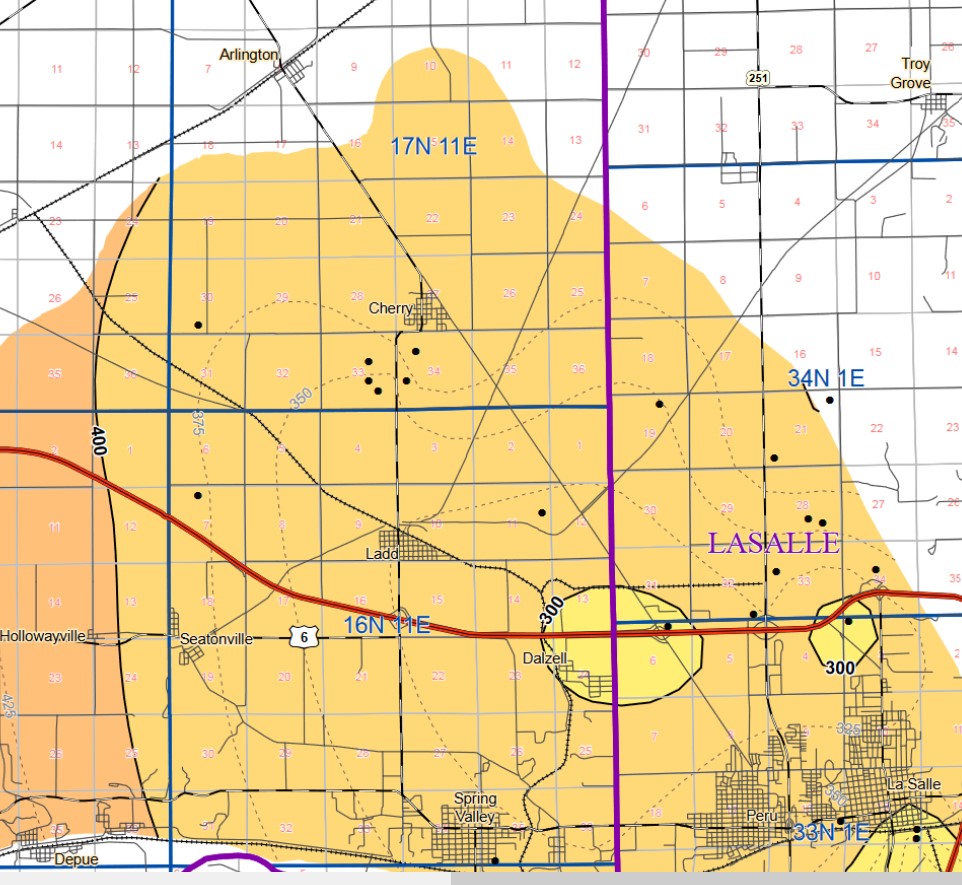
Detail of the USGS quadrant map for coal mining in Bureau/LaSalle County, Illinois. There were three coal seams in the Cherry mine, the deepest at 485 feet.
A Twitch-TV streamer played Minecraft in the background as I worked on daily rushes about… coal mining. From there I descended into the mines, at least figuratively, for several hours.
My maternal grandfather mined coal in Bureau and LaSalle Counties in Illinois for at least 30 years that we know. Besides family lore and my interactions with him while young, I knew little about this aspect of his life. He was the guy from Illinois, no longer married to Grandmother, who gave me a handful of pennies each time he visited. Coal mining was a much bigger deal than I thought in the basin of the Illinois River in Central Illinois.
The Saint Paul Coal Company operated the Cherry mine in Bureau County, one of the places Grandfather worked. The company was established in Illinois in 1902 and owned two mine properties in 1909, the year of the Cherry Mine disaster in which 259 men and boys died. The mine operated on 7,217 acres of land, producing about 300,000 tons of coal annually with a daily capacity of 1,500 tons.
Because of the mining disaster, a significant amount of documentation exists, including the 96-page report on the disaster from the Bureau of Labor Statistics. At this writing, the Cherry Mine disaster remains the third most deadly in American coal mining history. Grandfather first showed up as a miner on the 1910 U.S. Census in LaSalle County, old enough to have worked at the Cherry Mine during that period.
Rushes are the first draft of a section of my book. My process is to take a topic, typically a couple of paragraphs, and write rushes which will be heavily edited before being added to the draft of my autobiography. It gives me a chance to refine what I want to say without mucking up the main draft of my work. So far the process has served.
I decided the chapter about my maternal grandparents’ early days needed historical background. In a couple of ways, the mining history of LaSalle and Bureau Counties depicts a similar lure of wage work that attracted many European immigrants to the United States in the late 19th and early 20th centuries. This includes my maternal great, great grandfather, who mined coal in Allegheny, Pennsylvania after arriving from partitioned Poland in the 1880s. My paternal grandfather mined coal in the early 20th Century in Southwestern Virginia, although his ancestors were well established in the United States by then.
I found a history of Saint Hyacinth’s Church in LaSalle, written on the occasion of their diamond jubilee in 1950. Established in 1875 by a community of mostly Polish and German immigrants, it is named for the saint, a Polish Dominican priest and missionary who worked to reform women’s monasteries in his native Poland in the 13th Century. The Polish exclamation Święty Jacku z pierogami! (“St. Hyacinth and his pierogi!”) is an old-time saying, a call for help in some hopeless circumstance. Pierogi was a constant topic of discussion during family visits to our relatives in LaSalle. It likely remains available there. According to family lore recorded on Ancestry.com, My great grandparents contributed to establishment of the Saint Hyacinth cemetery where they and Grandfather are buried.
I started the day’s research late morning and the next thing I knew, it was time to start dinner. It wanted pierogi, yet we had to settle for enchiladas. I’m not finished with this topic yet.
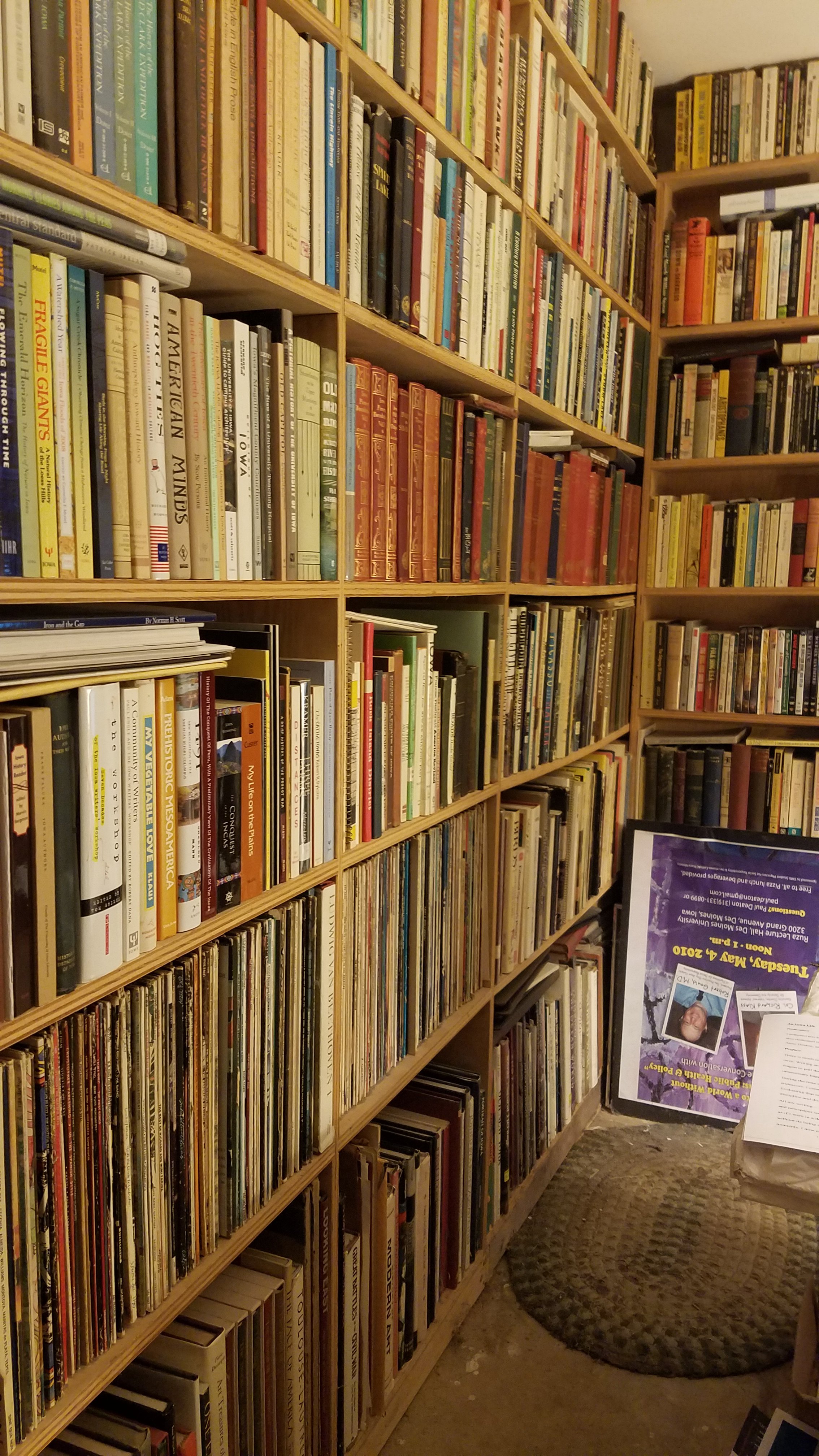
The place where I write is surrounded with books. There are more books in the next room, in boxes and piled on tables. There are shelves of books in the garage. There are documents going back to the 1950s. There are also boxes of artifacts. What is all this stuff?
To call it a library is not quite accurate. It is a collection of things, yet only in the loosest sense of the word. I set up my desk when we moved in, the same place it is today, before electricity was connected to the structure. Things collected here the way flotsam washes to shore. There is little agency in the word “collection” as applied to my place.
“Archives” doesn’t get it right either. In a corner is a tree trunk from the pine tree that grew outside my window during the 1960s. On top of it I pile each bill as it comes in and is paid. The stack of papers is 16 inches tall. When someone wants a document, I say it is filed on the stump. A stump is not a filing system, they say. I don’t argue the point.
As a newly minted septuagenarian I’m concerned with a couple of things.
When I die, I want people to be able to find relevant things, such as my will, whether I paid the last electricity bill, the title to the automobile, and a list of my computer passwords: an archive of the exigency of now. This is a given, it exists, and can be improved upon.
There are too many books to read or to pass on to someone else to sort through. A sorting has begun. A library is a place to find something specific. As needs change, so should the contents. Getting rid of many books and papers is common courtesy to my survivors. I try to be courteous. It is difficult to find things if I’ve forgotten what I have. This can be a problem when considering what I leave behind.
Mainly I want quick access to books and papers I need for my writing. Egads! I’m not there and time’s a wasting! Archival materials would describe this if I had taken time to archive everything, which I have not. I’d like to get the collection to a manageable size, one that would fit in a single room. Once I get there I may call it a home library and be justified in doing so. For the time being, it is what it is and the word “library” is not an accurate fit.
It is a place to work. A place of my own. That will have to suffice for now.
I discarded worn hats and pulled these out. Spring styling has begun.
It was a good week for my autobiography.
I made steady progress on re-writing the first four chapters. The time was about ten to one editing over writing. The most difficult challenge is getting the narrative right so it is honest and understandable. I located key documents I’d forgotten. I also created one empty banker’s box. That last part is particularly rewarding for a retiree with too much stuff.
There was a file with old resumes in it, including a Statement of Personal History (DD Form 398) I completed in 1982 or 1983. It includes every job I held and every address I had from birth. That will be useful in creating a time line. A quick glance revealed a number of inaccuracies. I know more now about my life than I did when I was living it, which seems normal.
Importantly, I located the family history documents Mother provided about my paternal line. It is a set of genealogy forms with a lot of information completed. This makes the process easier. Like with every documentation, there are some mistakes and omissions. I can fill in the blanks if I choose. I debate whether to tamper with the originals and have thus far mostly left them as is.
In 1983, we made a long automobile trip from Iowa City to Saint Louis; Evansville, Indiana; Wise County, Virginia; and then to Philadelphia to visit friends and relatives. It was a sort of second wedding trip after our first one to Chicago in December 1982. I located my journal entries from the trip, in which I recorded the interaction with my Uncle Gene when he traveled from Florida to Wise County to be with us. He explained his family life in and around Glamorgan, Virginia where he and Father were born. The journal will help. I may quote most of it directly as it tells the story as well as anything I could write now.
Uncle Gene also took us to some of the home places, including a parcel of land described as “lying and being in Wise County, Virginia on the waters of Guests River in the Rocky Fork section of the Gladewell Magisterial District.” This property, called Rocky Fork by family, goes way back. We explored it during the visit.
I spent considerable time thinking about the 1920s and 1930s this week. I’m reading a book called Radium Girls: The Dark Story of America’s Shining Women by Kate Moore. It recounts the history of use of the element radium in manufacturing consumer goods, and the impact of radioactivity on workers. The radium girls literally glowed from toxic radium contamination.
Part of the Radium Girls narrative presents the history of The Radium Dial Company, founded in 1917 in Ottawa, LaSalle County, Illinois. It supported what became the Western Clock Company in 1919, featuring the Westclox brand. Radium Dial Company made watch dials painted by hand with radium so they would glow in the dark. The Westclox manufacturing plant was in Peru, LaSalle County, Illinois.
In the book there are two references to Starved Rock, which is where my maternal grandmother worked when she arrived in LaSalle County from Minnesota about 1925. It was a place for group outings for the radium girls and others. I hadn’t considered the broader context of LaSalle County in my autobiography, but now I am. Reading this book was a breakthrough.
As Moore points out, not everyone had automobiles at that time. Likewise, there was radio but no television. People mainly got news from each other, and from newspapers. For a historian, newspapers make it relatively easy to follow coverage of major stories like the one of the court cases of the radium girls.
This led me to think about how I gather news.
We need news, especially during the coronavirus pandemic, yet always. First priority is news about key family members, which is mostly sourced from networks of family and friends. After that, we seek news about what could impact our daily lives. How we gather news changed since the 1920s and during my lifetime. It will likely continue to change.
Our family tuned the television to watch the Huntley-Brinkley Report for news during my formative years. With theme music from the second movement of Beethoven’s 9th Symphony, it had a weighty feel. News stories were told in direct, clear language. It catered to what passed for adults back then. It went off the air the summer after I graduated high school.
We subscribed to local Davenport newspapers, the Times-Democrat and the Catholic Messenger. In eighth grade we had a project to read and clip newspaper articles into a scrapbook. I got an A on the project. I was a paperboy who delivered the Times-Democrat in our neighborhood yet hardly read it except for a school project.
In graduate school we watched KWWL-TV news when we had a chance. They had opened a news bureau in Cedar Rapids which featured a recent college graduate, Liz Mathis. Mathis is currently running for Congress. I can’t recall when I stopped watching television news. It was long ago.
Today the day begins reading newspapers. I subscribe to online editions of the Washington Post, Cedar Rapids Gazette, Iowa City Press Citizen, and Solon Economist. Each of them informs me from a different part of the community. I’m a member of Practical Farmers of Iowa, the Arms Control Association, and the Climate Reality Project. Each of these sources provides specialized news. I subscribe to the governor’s press releases, to the county supervisors and public health news releases, and to a number of political office holder newsletters, including people who represent me in the Iowa legislature and the Congress. Lastly, I follow news reporters on Twitter. One exercises caution in picking them. I read their biographies and some of their work before following. There are a lot of great people writing relevant news stories about contemporary society if one is lucky enough to find them.
I had a good writing week and felt like sharing. Thanks for reading.
I’ve been reading more obituaries lately, partly because of my main writing project, and partly because as I age, long-time friends and acquaintances are passing. Survivors put the best face on the deceased in an obituary. That is okay. I wrote a draft of my own obituary to make it easier on my survivors. Not everyone does it and that’s okay, too.
As a proof reader at the local weekly newspaper I edited the obituary section. Mostly, they needed work in terms of format, grammar and punctuation. It was easy to tell when a funeral home used a template. I tried to make them grammatically adequate and positive regarding the life of the deceased. It was a minor part of the job yet I enjoyed it. No one ever complained.
An obituary requires specific information and it should all be accurate: birth date, death date, and if married, a wedding date. Survivors are a nice addition, yet we don’t need to read the names of all the great, great grandchildren or pets. Spouse, children, parents, siblings and partners, if any, are enough. The author should mention a career although an obituary is not a resume. What the deceased did in retirement is good if they were lucky enough to live so long. The obituary should make the deceased stand out without portraying them as being too highfalutin or better than everyone else.
Instead of “devoted wife,” I’d like to read how impossible the marriage was because she was a shrew. I’d also like to hear how the husband spent all his time at the bar after work improving the cirrhosis of his liver. I don’t suppose my wishes will be granted.
Military service is typically mentioned, although is not really necessary. Uniformed service is nothing special unless one served in a combat zone. I read this in an obituary about someone I had been with twice. The header was “Another of the ‘Greatest Generation’ has passed.”
How fitting that his death came in alignment with Veteran’s Day, for he was a true patriot. He is a decorated veteran of World War II, having been awarded the Purple Heart and Bronze Star medals for his actions during combat operations in the Ardennes Forest, known as the Battle of the Bulge. He was an infantryman in the 23rd Armored Infantry Battalion, 7th Armored Division, and fought across Belgium in the winter of 1944-45.
If they had mentioned it while living, I may have thanked them for their service and talked about General Anthony McAuliffe’s negotiations with the Germans in the Ardennes. McAuliffe told them “nuts,” in case you forgot or didn’t know. I might have mentioned my own trip to the Battle of the Bulge site during the 1970s.
Where this ramble is going is whether what people say about each other is real. It is as real as it can be, I believe. At the same time, I read accounts of history in which there is no agreement over simple things. Spelling of the name of a person can vary radically. Dates were not the forte of 19th Century rural communities. Everyone knew at the time when someone was born, yet when a relative made it to the county seat to have the birth recorded, time could pass and with it some of the specifics.
When it comes to public events, vagary is endemic. In the case of the 1927 lynching of Leonard Woods in Pound Gap between Jenkins, Kentucky and Pound, Virginia. There are multiple stories of what happened and depending upon to whom one listens there are many interpretations. What stands out to me is the local sheriffs did not write down a single license plate number of the hundreds of vehicles driven and parked at the site of the lynching. Sometimes people don’t want to say what happened.
Leonard Woods Lynched — Leonard Woods, a black coal miner from Jenkins, Kentucky, was lynched near here on the night of 29-30 Nov. 1927. Officers had arrested Woods for allegedly killing Herschel Deaton, a white man from Coeburn, Virginia, and had taken him to the Whitesburg, Kentucky, jail. On the day of Deaton’s funeral, a white mob numbering in the hundreds broke into the jail and brought Woods close to this spot, where they hanged, shot and burned him. No one was ever arrested. In the aftermath, at the urging of Norfolk editor Louis Jaffé, Norton’s Bruce Crawford, and other journalists, Virginia Gov. Harry F. Byrd worked with the General Assembly early in 1928 to pass the nation’s first law defining lynching as a state crime.
From what I’ve read, these words are true. They are not the whole story and maybe that’s my point. The historical society put the best face on this murder. I want to know the rest of the story.
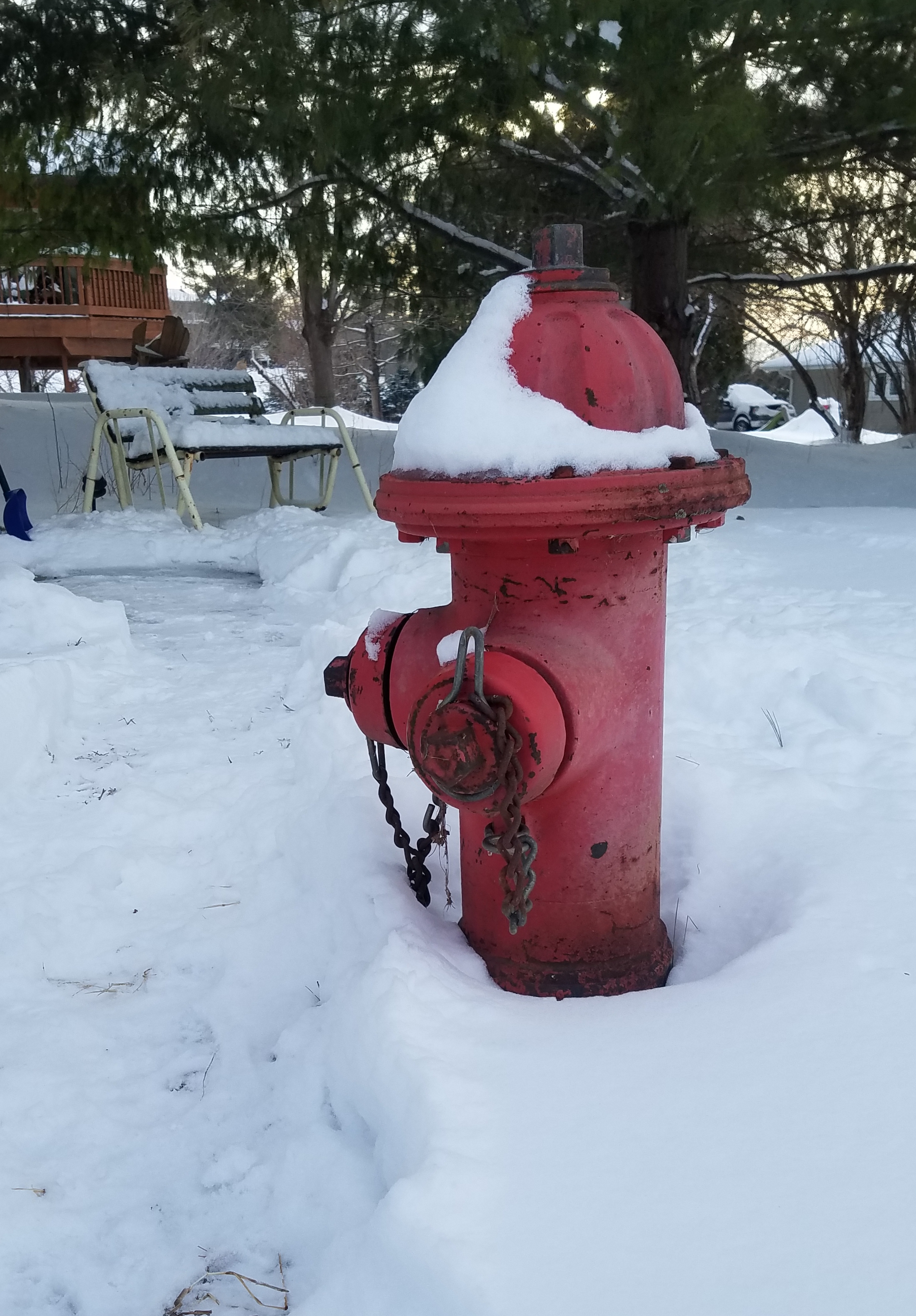
I unlocked the door to the village well for two technicians. Today’s task was short: they drew raw water samples from the Silurian aquifer for analysis. We didn’t chat much. I stayed outdoors while they worked because the coronavirus is surging.
It has been cold with about six inches of snow on the ground. I stay on paths that have been cleared so I don’t turn an ankle. That means I started a compost bucket in the garage until the path to the composter near the garden is clear. Winter is just beginning. We are heading into a cold spell with subzero temperatures forecast the rest of the week.
There are limits to how long I can work at my writing table. I acquired provisions to last two weeks during a trip to a local commercial center. Maskless minions were everywhere. Luckily, there were few of them out early in the morning and I could avoid them. Bloomberg is reporting the U.S. today exceeded one million COVID infections in 24 hours, doubling the figure from just four days ago and setting a global record.
I appreciate being able to go on walkabout. Even if it is only to visit the village well.



 Journey Home
You must be logged in to post a comment.