Categories
Writing

Writing Autobiography

Working copy of my autobiography.

Starting an autobiography is easy. Finishing it… is something else.

I began my autobiography a dozen times over a period of decades, and each time it found no conclusion. Last year, while making substantial progress, I had an epiphany. I had no idea what the process should be. I start 2022 with a work plan to remedy that.

Process became a collection of things.

At first I sat and wrote about whatever came to mind, about 150,000 words in 2021. I merged this writing into a single document (with multiple backups). After all that writing, I determined another, better method was needed to write. Too much of the blogger in me was coming out in my daily writing.

I had to get a better plan written down. I began with 3 x 5 inch index cards in a rough outline of topics, one per card. I made a Word document with a more detailed outline. It included most of what was on the cards and more. Finally, after a year of writing, I wrote a Word document called “big sections” which is a list of the chapter headings. I printed it out and placed it on my white board. The big sections will change going forward, yet I developed a way to add topics as the meaning of them was discovered or developed. It took last year’s writing experience to sort out what I would include in the finished product in the form of chapter headings.

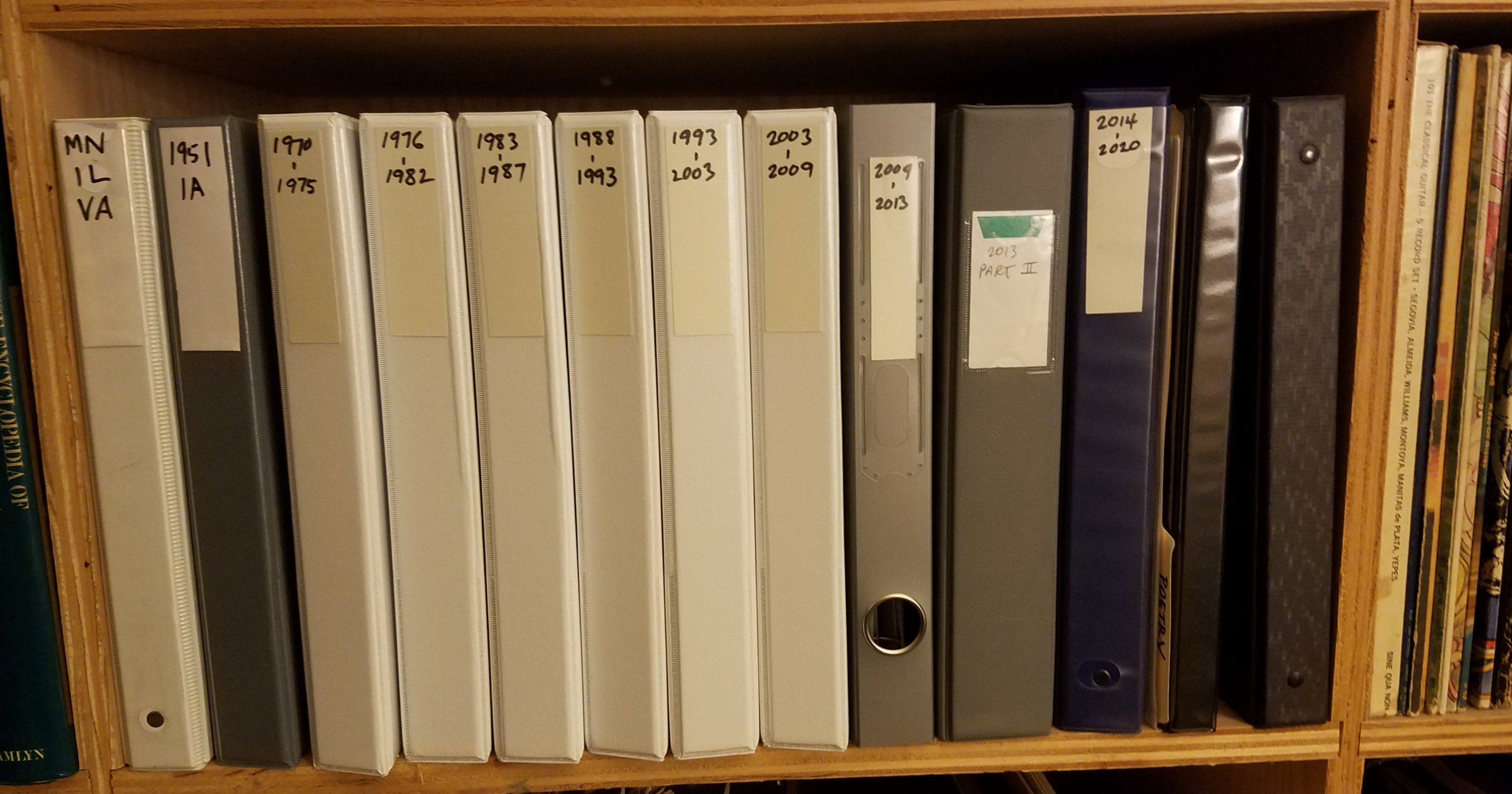
As written on Dec. 16, 2021, I made a shelf of three-ring binders to contain my rough draft. I set aside my 2021 draft document and began a new rough draft which I expect to print and place in the binders. The binders have become a storage place for documents and writing I find along the way. As I write the 2022 draft, documents in the binders will be used as reference. I expect the number of binders to increase as writing proceeds, with the printed draft in front of each chapter heading and source documents behind it.

A main challenge is to follow Robert Caro’s advice to turn every page. At present I don’t know where all those pages reside. I organized my collection of personal journals beginning with school work in 1966. I have a shelf of books which contains my blog writing since 2007. I also placed the letters written to Mother from her estate in three-ring binders. There is a significant trove of emails in electronic form dating to 1999. In a pile on a table are stacks of clippings of opinion pieces, letters written to the editor, and articles I wrote as a freelance journalist. These documents alone are a lot.

What is more challenging is the many boxes of documents and artifacts stored throughout the house. I haven’t counted, yet there are scores of them. They settled in beginning when we moved here in 1993, and I can’t say what is in them with specificity. The way they exist is not in usable form, so I’ll have to open and go through them.

I developed a discovery process to interface with source material. The idea is to methodically go through everything to decide whether it goes in the autobiography, will be stored elsewhere, or discarded. If a particular container is useful to the autobiography, I’ll write about what is in it.

The format will be what I call “rushes,” a name taken from daily rushes in the film days of motion picture making. I’ll encounter an artifact and if applicable, will write a rush, and then edit and place the rushes into the main autobiographical document. I’ve been writing rushes since the beginning of last year. This formalizes what I’ve already been doing.

Along the way, I will edit the main draft of the autobiography for continuity, grammar, spelling, and better word choices. Once the whole document is done, and I’ve examined all the artifacts, true editing will begin. This will lead to eventual publication of the work in an undetermined format, although it likely will be both on paper and in electronic format.

The first year of writing my autobiography felt productive. What I learned makes me optimistic about progress this year. I don’t know if I’ll finish the first draft this year. I know it will be better than the draft I produced in 2021. There is clarity about process, better than there was. Like any process, it will be subject to improvement as I write and learn.

Categories
Reviews

Book Review: My Own Words

Ruth Bader Ginsburg Official Portrait. Photo Credit: Wikimedia Commons

The final book I read in 2021 was My Own Words by Ruth Bader Ginsburg with Mary Hartnett and Wendy W. Williams. It is a compilation of writing by Ginsburg framed by the co-authors as autobiography.

In 1993, when Ginsburg was sworn in to the Supreme Court, I was busy living: moving from Indiana to Iowa to take on new work at the corporate headquarters of the company with which I would finish my transportation career. I wasn’t paying much attention to this supreme court appointment. Maybe I should have been.

Reading My Own Words was part of expanding my range of what types of memoirs have been written. It became more than a writer’s exercise. I realized on how many important decisions Ginsburg opined, and the prominent impact her work for the court had on my liberal sensibilities. Her writing on gender equity, presented in this book, is particularly noteworthy.

My Own Words was for me an infrequent foray into the judicial branch of government. A justice’s official writing, mainly in the form of court documents and opinions, is a matter of public record. To a large extent their work eclipses the personal story of a justice’s life. I am more interested in Ginsburg’s remarks on Brown v. Board of Education, Loving v. Virginia, and Burwell v. Hobby Lobby Stores, Inc. than I am in her opera-going habits with Justice Antonin Scalia or her twice-weekly workouts in the Supreme Court gymnasium. I do not own a Notorious RBG t-shirt and am unlikely to get one, even after reading this engaging book.

The writer’s question was how did she handle her prolific writing as it relates to autobiography. I read reviews that expressed disappointment this wasn’t an “actual memoir.” I don’t understand that criticism. As a public figure, one of the most prominent in the United States, we come to the book knowing more about Ginsburg’s personal life than normal. News media of the time tended to focus on the fact her spouse was an excellent cook rather than her intellectual capacities as a jurist. The latter is clearly more engaging.

If you are a liberal, read this book. If you are a conservative, read this book. If you are engaged in society with its cultures around abortion, gender equity, corporate influence, equal protection under the law, or how the supreme court works, I recommend it as a primer. While Ginsburg was a liberal jurist, the lessons she presents in these writings apply to us all. Highly recommended.

Categories
Milestones

Looking Forward

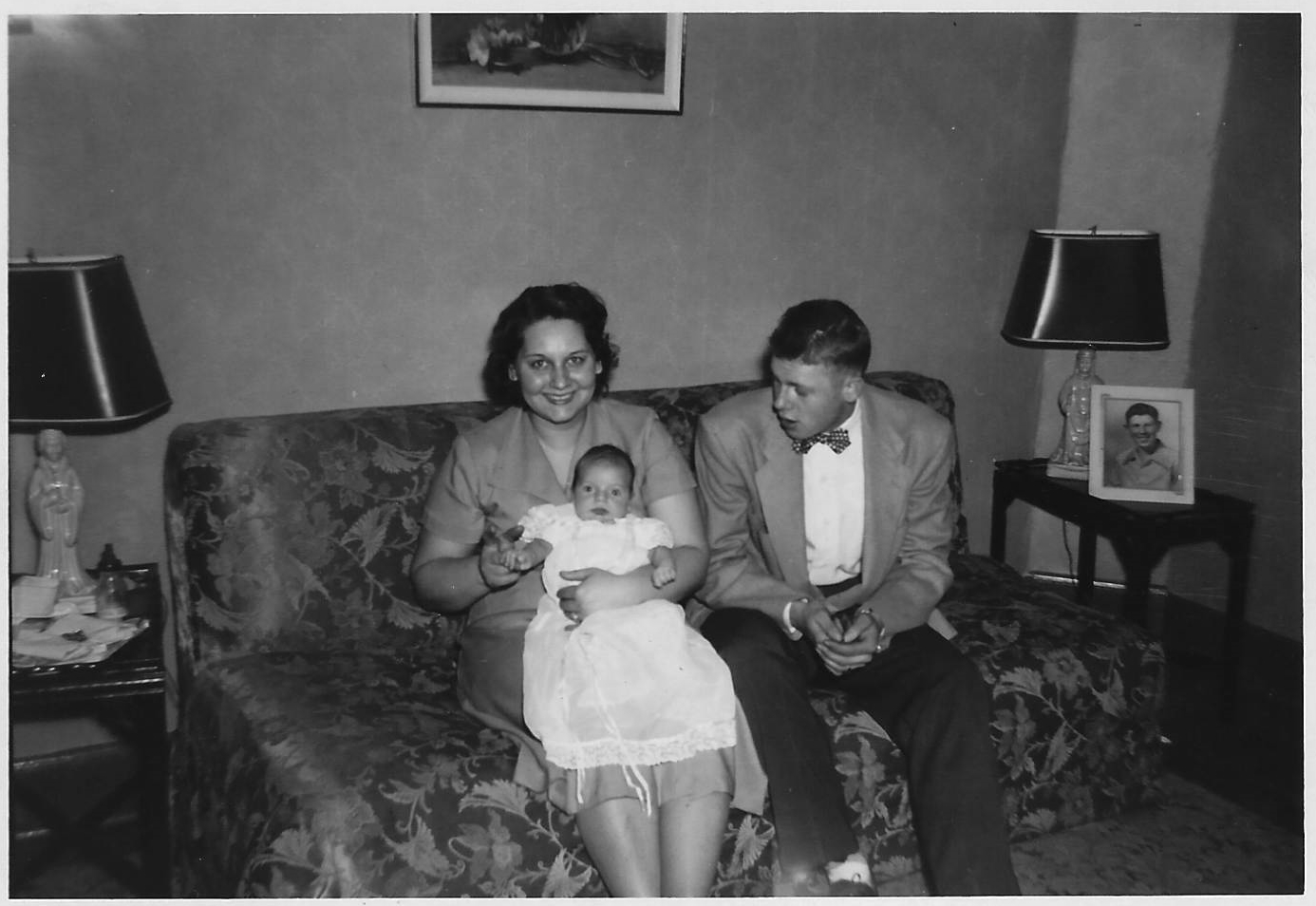
The author at age five weeks with my baptismal sponsors, Aunt Winnie and Uncle Bill.

Today I am officially a septuagenarian. Deep in memories of the previous 70 years, on this day, my birthday, I’m looking forward.

Blessed with good health, I can see 80 from here. 90 is too far ahead for clarity. The goal is to make the best use of my time before shuffling off this mortal coil.

I have no profound thoughts or statements upon turning 70. It is another day to accomplish things. I may accomplish taking a nap after lunch. Priorities change with age.

Yesterday, for the third year in a row, this blog passed 12,000 views. While I’m not running a major outlet here, I am grateful to everyone who finds me and spends time reading what I wrote.

My best wishes for the next ten years. There is so much to do before the final curtain call.

Categories
Living in Society

List of Things — 2021

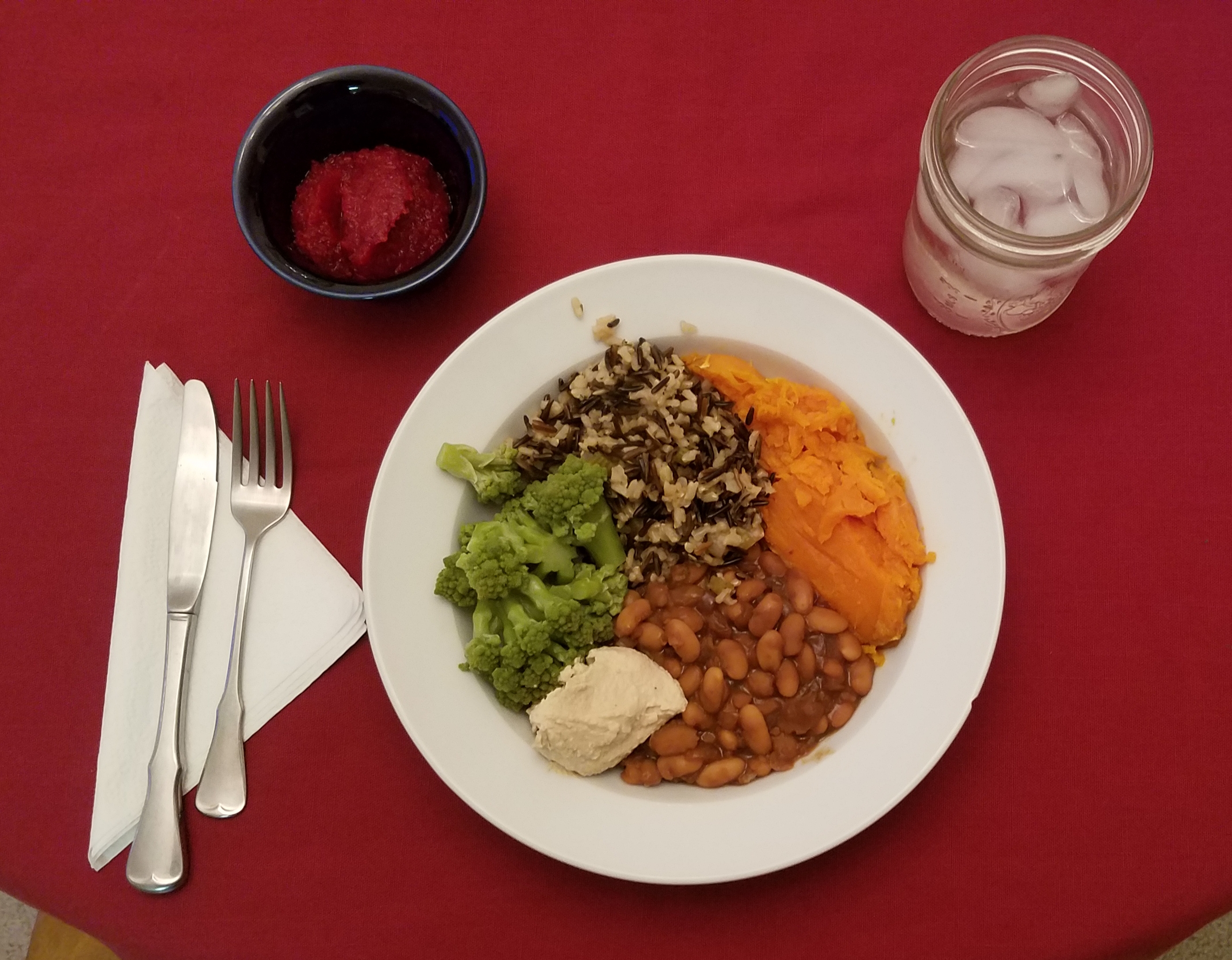
A vegan Christmas dinner, 2021.

The year began with the Jan. 6 attempt by President Trump and his supporters to overturn the results of the 2020 presidential election. Those events confronted us with the possibility the work of our founders, to create a society built on new foundations contrary to a monarchy, may fail. It was a sobering realization, even if insurrection leaders were pathetically unskilled at insurrection. After Biden was sworn in, he got to work and the economy came roaring back. We are not out of the woods yet.

On my Christmas morning walkabout the air was quiet and still. Scarcely a sound besides birds. Normal background noise of traffic on surrounding highways was silent. Ambient temperatures were in the forties and winds calm. It was a peaceful time to be with family.

Because of the coronavirus pandemic we did not travel to be with our child at Christmas this year. We joined their festivities via video conference and met some new friends. I’m not sure who came up with the idea yet it was a good one.

We spent the morning sleeping in and doing individual things around the house. After noon we joined in the kitchen to make our vegan Christmas feast. According to the scale this morning I lost one pound overnight. There will be leftovers all week.

As year’s end approaches taking stock is important. Here is a list of the most significant events of the year:

  • Jan. 6, 2021 insurrection.
  • Coronavirus pandemic entered its second calendar year and persisted.
  • Served as president of the home owners association and secretary of the sewer district.
  • Wrote at least 1,000 words of my autobiography per day through April.
  • Worked at Sundog Farm in the spring.
  • Twice served as a Climate Reality Leadership Corps mentor.
  • Helped Jon Green get elected as a Johnson County Supervisor.
  • Donated excess garden produce to the local food pantry.
  • Trip to Boone, Iowa to visit my sister-in-law.
  • Trip to Orlando, Florida to help our child move to Illinois.
  • Covered Blog for Iowa editor’s summer time off.
  • Walked in the Coralville Independence Day parade.
  • Two family trips to visit our child in their new apartment. They visited us, too.
  • Became a single automobile family.
  • Worked through a manganese contamination at the community well.
  • Tooth extraction #14. Decided to leave the gap.
  • Covered the Solon School Board election on this blog.
  • Wrote a series of posts about carbon capture and sequestration for Blog for Iowa.
  • Grew net worth by seven percent.
  • Read 54 books.
  • Successfully increased garden production.

Time passes quickly these days. We grasp today, only to soon let it go into the drift of society. Luckily, with some focus, I got a few things done in 2021.

Categories
Living in Society

Retro Post – Christmas Morning

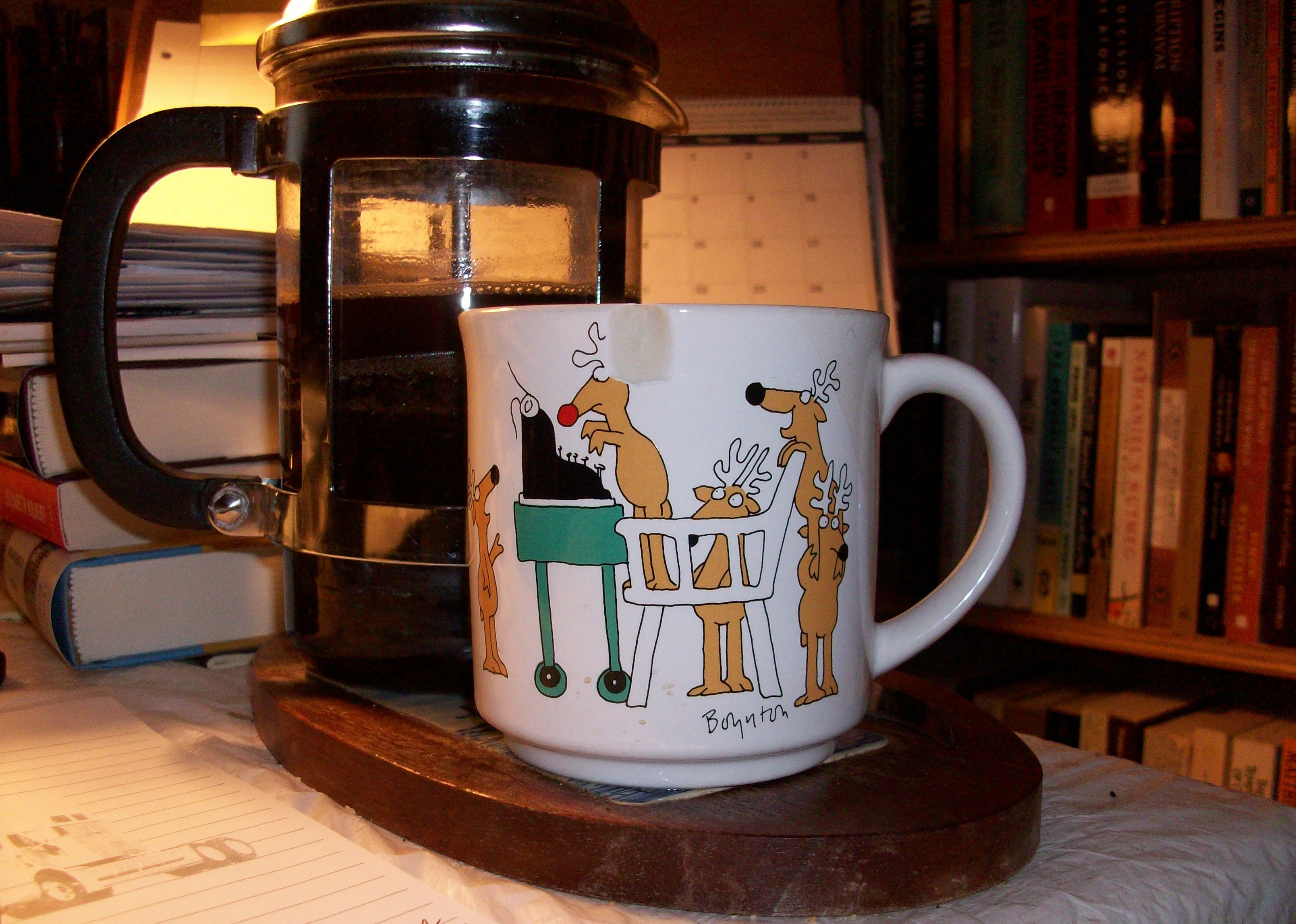
Christmas coffee mug.

(First posted on Dec. 25, 2007, during the first year I wrote a blog. Lightly edited because I couldn’t stand some of my previous usage).

The meaning of Christmas is derived from my remembrance of priests at Holy Family Catholic Church in Davenport genuflecting while reading John 1:14 “And the Word was made flesh and dwelt among us…”

There are many translations of this verse and the idea that an omniscient God would take human form remains a compelling idea. In order for our lives to have meaning, we should live them as Jesus did, through acts in human society.

If Jesus was the incarnate God, we are something less.

If the meaning of Christmas can be found in John 1:14, how should that affect us with our imperfections?

My Christmas story is about the coffee cup that we keep in our bins of Christmas decorations. It was a gift from my spouse and printed in the glaze are five reindeer around a typewriter consulting on a message. The reindeer at the keyboard has a red nose, and must be Rudolf. On the other side of the mug are misspelled the words “Merry Christmas,” presumably typed by Rudolf. At some point I chipped the cup and each year we discuss whether we should get rid of it because of the chip. I have always said no, although I should probably let go. The chipped cup with the animals trying to put a message into human language using human technology has become part of our Christmas tradition. Because it is so similar to the meaning of Christmas, I have trouble letting go of it. We have always ended up keeping the cup and I am using it now to hold the coffee I made this morning.

We humans can use some coffee on Christmas morning, and we need to put it in something.

Merry Christmas reader!

Categories
Living in Society

Christmas Eve – 2021

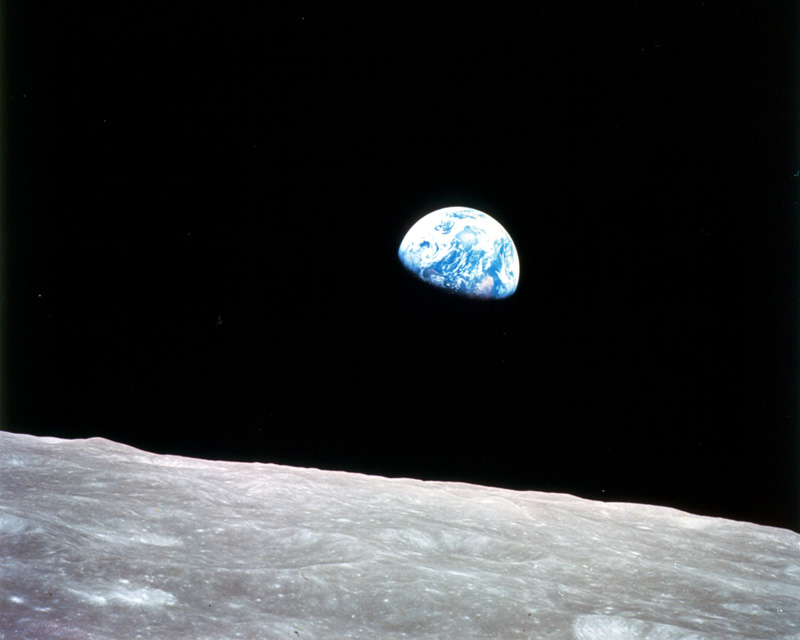
Earthrise by Bill Anders, Dec. 24, 1968

Best wishes to readers for end of year holidays.

In our house, it is Christmas Eve, although there is a string of notable days running from mid-December through January. I enjoy those Christmas seasons when I can stay home without pressure from work or other social obligations. During the coronavirus pandemic, it makes sense to avoid exposure to others, although the isolation is only partly mitigated by modern communications technology.

Leaving home can be a traumatic experience. When I left home in 1970 to attend university I didn’t understand there would be no permanent return to my home town. When our child left Iowa in 2007 there was also a lack of understanding of how the change would affect us. We do the best we can during holidays, whether child or parent. The veil of our illusions wears thin at the end of the year.

On Christmas Eve my tradition is to review this photo taken by Bill Anders during Apollo 8. It changed my life, and those of many others, to see Earth suspended in space, alone and vulnerable. Some say it sparked the environmental movement. The problem is the environmental movement and society more generally have been doing a poor job of mitigating the worse effects of the climate crisis. The coming week before New Year’s Day is projected to be the warmest December week in recorded history for North America. It is a cause for concern for us all.

For Christmas Eve dinner there will be cornbread and chili, followed by settling in to a long night. We did not decorate the house for the holiday and haven’t the last few years. If we have guests during a future holiday season I expect we will get the boxes out from under the stairway, reminisce about the decorations and how we came to have them, and put them up. Not this year, though.

It is a time for letting go the frustrations and tensions 2021 created within and among us. The year began with an attempt to overturn the results of the November 2020 U.S. presidential election. It is ending with a robust economic recovery that could only have happened with the leadership of President Biden and his administration. It was a year of the yinyang of being American.

As we prepare for a winter, delayed by a warming planet, it’s time to consider the future and actually do things to bring peace on Earth. That we will is my Christmas Eve wish.

However you celebrate year’s end, I wish you health and happiness as we prepare to enter the new year.

Categories
Writing

We’re Going Home – Joan Didion

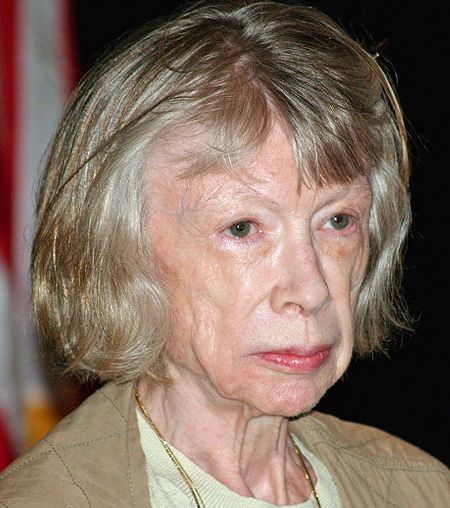
Joan Didion in 2008. Photo Credit Wikimedia Commons.

When I write my best I think of Joan Didion. She died of Parkinson’s Disease on Dec. 23, 2021 in Manhattan at age 87.

I will continue to think of her while I’m writing.

The reason her writing has such influence is she has been in and on my mind since high school. I thought, if I could write like Didion it would be the pinnacle. I won’t ever be as good as she was at her worst.

I was thrilled when I found South and West: From a Notebook and Let Me Tell You What I Mean this year. I wolfed them down, starved for what she brings to writing. While she studied Hemingway and Conrad, she did not write like them. She had her own lean, assertive simplicity to make her points. I was enraptured.

I didn’t understand California after a half dozen trips there. While Didion’s stories are her unique, single perspective, they are believable and seem probable. They informed my understanding that California was more than what we witnessed through media combined with ocean, desert, farmland, and what seemed like an unlimited number of highways. She exposed a side of it I wouldn’t have known. There is value in that.

In college I struggled to find a path. I was on a trajectory supercharged by the death of Father in 1969. Didion’s writing was something I could look to and see myself. Although being a successful writer wasn’t meant to be my career, Didion gave me hope in dark times.

We’ve known the end was coming for a while. Now that she passed there are no surprises, just a feeling of desolation, restlessness and sensibility characteristic of her work.

Her writing will persist, as will memories of her frail frame on talk shows as she headed home.

Categories
Writing

Did Kurt Vonnegut Drink at The Mill?

The Mill on Burlington Street, Iowa City, Iowa. Photo Credit: Wikimedia Commons

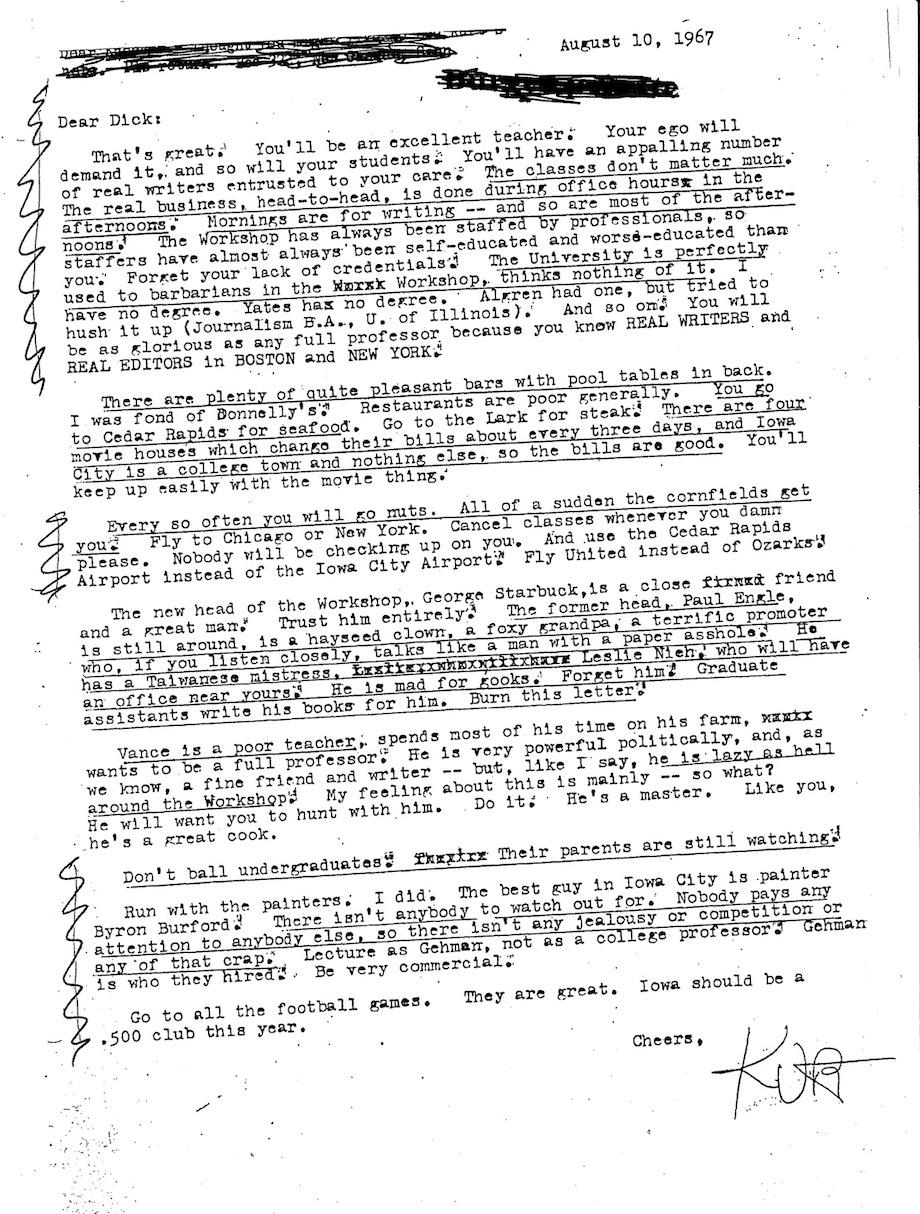
Someone posted a notice on social media that a demolition permit was issued to tear down the building where The Mill operated. They had been in business since 1962. I’ve forgotten more than I remember about The Mill. Time for demolition? So it goes, Kurt Vonnegut may have said. He wrote Slaughterhouse-Five after he moved to Iowa City in 1965.

Who knows if Vonnegut drank at The Mill during his two-year stay in the future UNESCO City of Literature? We do know he was fond of Donnelly’s. There were only so many bars within walking distance of his home at 800 North Van Buren. Given random associations between Vonnegut’s two years in Iowa City and a finite set of bars, it seems likely he did.

So it goes.

What I recall of The Mill is spending time with friends in graduate school. I listened to Joe Pratt, who dragged his new wife with him to Iowa from California for the American Studies Program. He played Stan Rogers songs on Open Mike nights at The Mill. Our writers for Blog for Iowa met up there for beverages and food. When I was more active in the Johnson County Democrats there were events at The Mill, or we’d just go to hang out after an event finished elsewhere downtown. It was a serviceable bar, which by the 2000s showed its age.

The Iowa City I knew upon arrival in 1970 is long gone. One more non-historical landmark demolished is no big deal. It would be best if the corporation razing the property built another high rise. More people of means could live near the city center. I don’t know what residents might do with their automobiles yet that never seems to be an issue. Downtown should be built up while there is interest among wealthy people and contractors to do so.

To me the death knell for downtown Iowa City was when Things, Things, Things closed. The department store came out of the turbulent 1960s and found commercial success into the 21st Century. It was administratively dissolved by the Iowa Secretary of State on Aug. 9, 2012 for failure to file a biennial report.

So it goes.

Categories
Writing

Walkabout #3

Village Well, Dec. 21, 2021.

Every village has a well. I began helping manage ours in 1995 when I joined the association board for our village of 85 homes. It has been an interesting project. We don’t really call it a village, yet the size is right.

I used this morning’s walkabout to head up the hill to meet with a contractor about a maintenance job. Ever since our main contractor died it has been a challenge to find technicians to work on our specialized equipment.

We met and they explored the well house, took photographs and asked questions. Like those before them they would not commit to bidding on the job. Fingers crossed they do bid.

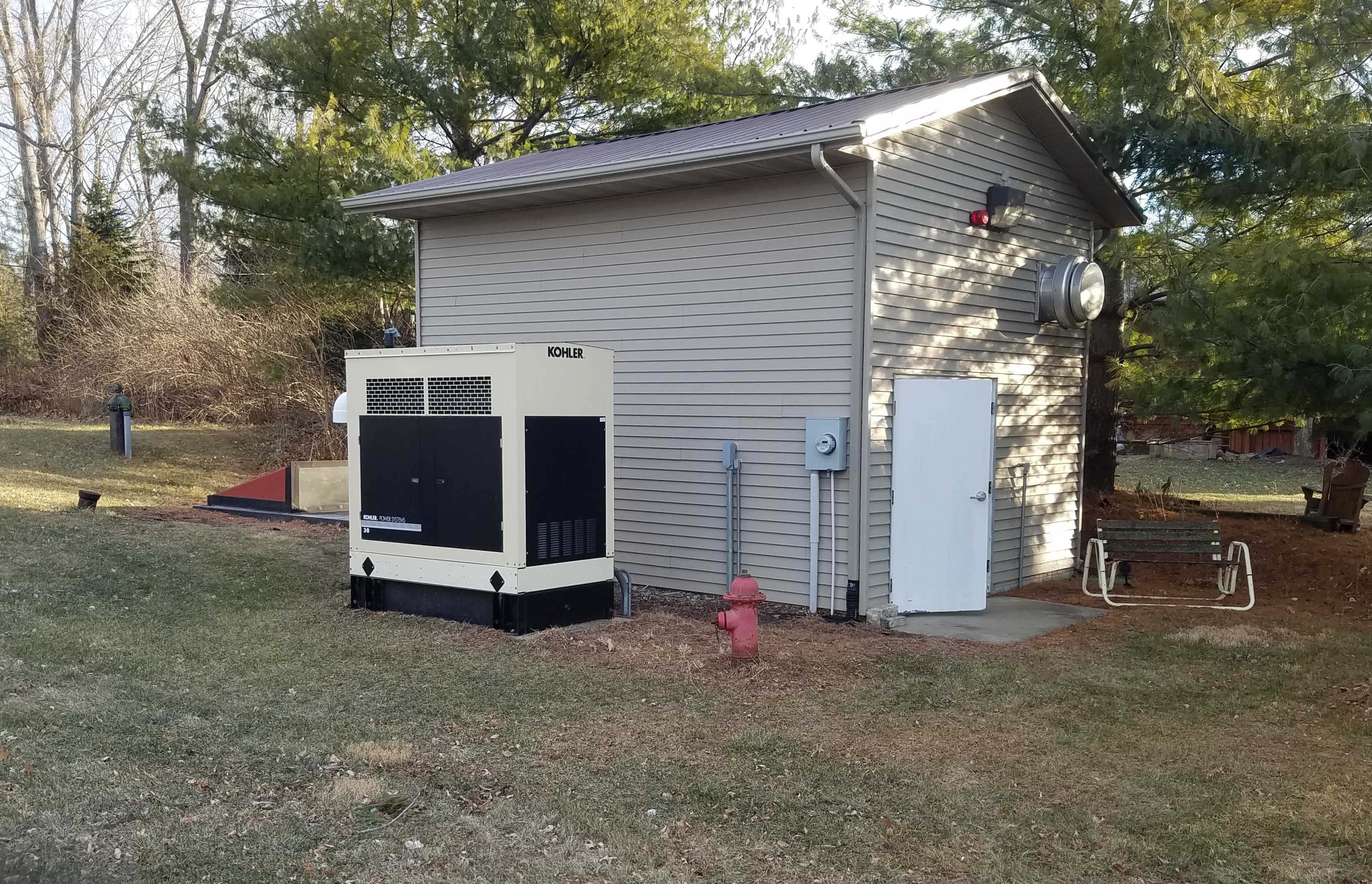
We have had issues with our mostly volunteer managed well. At one point we bought the generator in the photo so an outage wouldn’t cause us to lose water pressure. When we lose pressure for a period of time the Iowa Department of Natural Resources requires a testing protocol, which is a bit of a pain. We have enough volunteers so whenever electrical power is lost, someone runs up the hill and starts the generator so it’s back on line before running out of water.

Water is life. Every village has a well. While mostly unseen behind the tall pine trees the village well is at the center of our lives.

Categories
Writing

Holiday Notes

Sunset from our front steps, Dec. 19, 2021.

The coronavirus pandemic continues during a second holiday season. I had hoped to be done writing about that by now. The omicron variant of the virus informed me, “No, you are not done.”

Dr. Anthony Fauci, the nation’s leading infectious-disease specialist, said yesterday on CNN, “Unfortunately, I think that (record numbers of coronavirus cases and hospitalizations are) going to happen. We are going to see a significant stress in some regions of the country on the hospital system, particularly in those areas where you have a low level of vaccination.”

We had already cancelled a Christmas trip to be with our child and their close friends, because of increased incidence of COVID-19. Today I’m making a list for a trip to the grocery store to provision up with fresh vegetables so I don’t have to leave the property until the new year. I seek to minimize our exposure to the new, highly contagious variant of the coronavirus.

“It is going to be a tough few weeks, months, as we get deeper into the winter,” Fauci said.

Merry f*cking Christmas, y’all.

The Christmas Holidays in my childhood home were mostly a product of my maternal grandmother’s imagination. She was born and grew up on a remote farm in rural Minnesota. At a young age, she moved to Minneapolis where she worked as a servant. She and a man got together (and presumably married) and had two children. Her plain, difficult life was punctuated by the special occasions of weddings, baptisms, first communions, and religious holidays, especially Easter, yet Christmas too.

Part of her Christmas holiday culture was creating a tableau of the nativity, with a manger and ceramic figurines she molded, glazed and fired herself. My inheritance from her includes this sort of creating something from the dross of daily life, something in which we could participate and enjoy. She recognized the fleeting moments of those special days and the work that went into making them. Without her, the Christmas holiday would have been much different.

End of year holidays have been secularized. Instead of making tableaux from home made things as a celebration of religious culture, we insert figurines that came down from grandmother in what has become a hollowed out, personalized family tradition. These are essentially habits repeated for lack of something better to be doing. Am I cynical? No, not really. When we put out decorations, we enjoy the time remembering where special artifacts originated. With the decline in participation in formal religion, people now craft their own end of year holiday occasions which may or may not include such traditions.

Americans’ membership in houses of worship continues to decline, dropping below 50 percent for the first time in 2020, according to the Gallup organization’s eight-decade polling trend. That year, 47 percent of Americans said they belonged to a church, synagogue or mosque, down from 50 percent in 2018 and 70 percent in 1999.

In our household a number of special occasions mark the end of the calendar year. First is our wedding anniversary on Dec. 18, followed by the winter solstice, this year on Dec. 21. Christmas Eve is a time to make chili and cornbread, and on Christmas Day we make a special meal. If others are in the house, we may exchange gifts. My birthday follows on Dec. 28 which leads into New Year’s Eve. Dec. 31 involves a weak effort to stay up until midnight to ring it in. I usually have a drink. New Year’s Day is another special meal and by then all the leftovers from Christmas have been eaten. This year I plan to start a new tradition of starting onion seeds indoors on New Year’s Day.

As I age, there is a sense of loneliness and sadness as I survive more people I knew with each passing year. Coping with aging is increasingly present during the holidays. There are holiday phone calls, video chats, texts and emails. If we weren’t in the worst of the pandemic, I could engage with a local organization to help others. Such communication helps us cope.

Staying busy also helps. Garden planning is a natural undertaking for the holidays. I placed my first three seed orders and will work on another. In addition, I began a project in the garage to organize everything. Yesterday I discovered a drawer that was crammed full of telephone wire and connectors brought back from my father-in-law’s home in the late 1990s. He owned and operated a rural telephone company and I don’t recognize half of the tools and supplies. Land line telephones are in decline, so a lot of it will be sold at a yard sale or pitched. There is also plenty of reading and writing to be done to cope with loneliness.

The end of year holidays are much different from what I recall from childhood. I no longer believe there is a Santa Claus, even though I remember seeing him and the reindeer flying in the sky when I was in first grade. As we discover the new, electronic globe in which we find ourselves, there will be other changes. I predict end of year celebrations will continue. I expect to note the annual rites for many years to come.