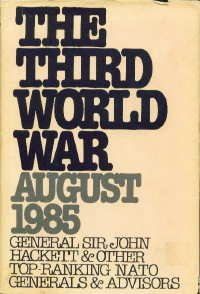
In his 1979 book The Third World War: August 1985, General Sir John Hackett identified that the public generally disregards the possibility of war. He wrote about the role media embedded in combat units would play in his hypothetical war, bringing home different aspects of the conflict from what had been experienced in previous wars. What he didn’t predict was the role of mobile devices sending video and photographs from war zones like those we see on social media posts from Ukraine.
At the time, when I was returning to Iowa after leaving military service in West Germany, Hackett’s book was a page from the lives of everyone like me who participated in making battle plans to defend Western Europe as Soviet army units attempted to penetrate the Fulda Gap. Hackett was right about new methods of reporting from war zones. The experience is more immediate after the rise of Twitter and social media. It changes everything.
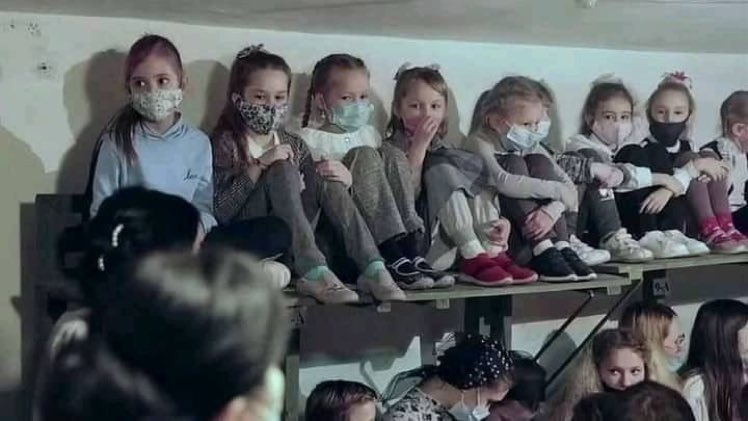
It is difficult to winnow kernels of fact from streams of social media. While something real goes into images posted there, their meaning and veracity, is an open question. It is not helpful that certain photos, like those of children in a bomb shelter, get the most views. I mean photos like this.
We should take video and photographs coming out of Ukraine with a grain of salt. We should resist confirmation bias and let the events tell their own story. That may not be possible, yet it is important to how we determine what political action our country should be taking.
For example, is this photograph posted on Twitter real or fake? I separated it from the accompanying text which appears below.
The post appears to be real. While the reliability of this reporter is known, there has been an attempt to create a fake profile of him as part of a larger disinformation campaign by the aggressors.
Most reasonable people know social media posts are hardly unbiased information. We should remind ourselves as they become a major source of information about the Russia-Ukraine conflict.
An inch or two of snow fell overnight indicating winter is not finished.
There is not enough trash and recycling to roll the carts through freshly fallen snow to the street for pickup. I’ll wait until daylight to blow snow from the driveway, without cart tracks and my footprints. With our intent to stay home, I could let it go and natural warmth would clear the driveway within 24-48 hours. I’m ready for some outdoors activity.
Despite snowfall, one senses a pivot toward spring.
The ten-day forecast is for ambient temperatures to begin climbing above freezing tomorrow. After that, highs are forecast in the upper thirties to mid forties going forward. I’m reminded some of our worst Iowa blizzards have happened during March. It may not be the end of winter, yet one can’t help but think of spring. The ground remains frozen.
We hope for spring, even if another thing that fell overnight was Russian missiles on Kyiv, Ukraine.
I try to shut out commentary and focus on news of the Russian invasion. There is plenty of news available, although one needs a filter to separate wheat kernels from the chaff. A cook can’t make bread from opinions. It is ironic that U.S. companies maintain large grain export operations in Ukraine and Russia when Iowa grows 50 percent of its corn to make ethanol. Ethanol should be eliminated due to its impact on the environment. That is commentary readers may not welcome.
While stationed in Germany as an infantry officer, I prepared to fight a European land war against the former Soviet Union in the Fulda Gap. A soldier should know that if Russia planned to lay siege to Kyiv, it would begin this morning at dawn. There is no satisfaction from seeing my prediction come true as it did. Spring is not the best time for tanks to navigate through the countryside. One presumes Russia will make quick work of the invasion and occupation of Ukraine, while the ground remains frozen, before spring thaw and planting time arrives.
I have reading and writing to do and welcome a couple more days of cold weather. I’d like nothing better than to browse a bookstore for a while to see what is available. Instead, due to a lingering coronavirus, I’ll stay in and follow the news of the Russian invasion while keeping my eyes on imminent spring. The pivot has already begun.
These cold, windy days have been invaluable for writing. There have been some warm spells, yet the ground remains frozen, and desire to stay indoors is strong. Highs are forecast in the teens the next couple of days.
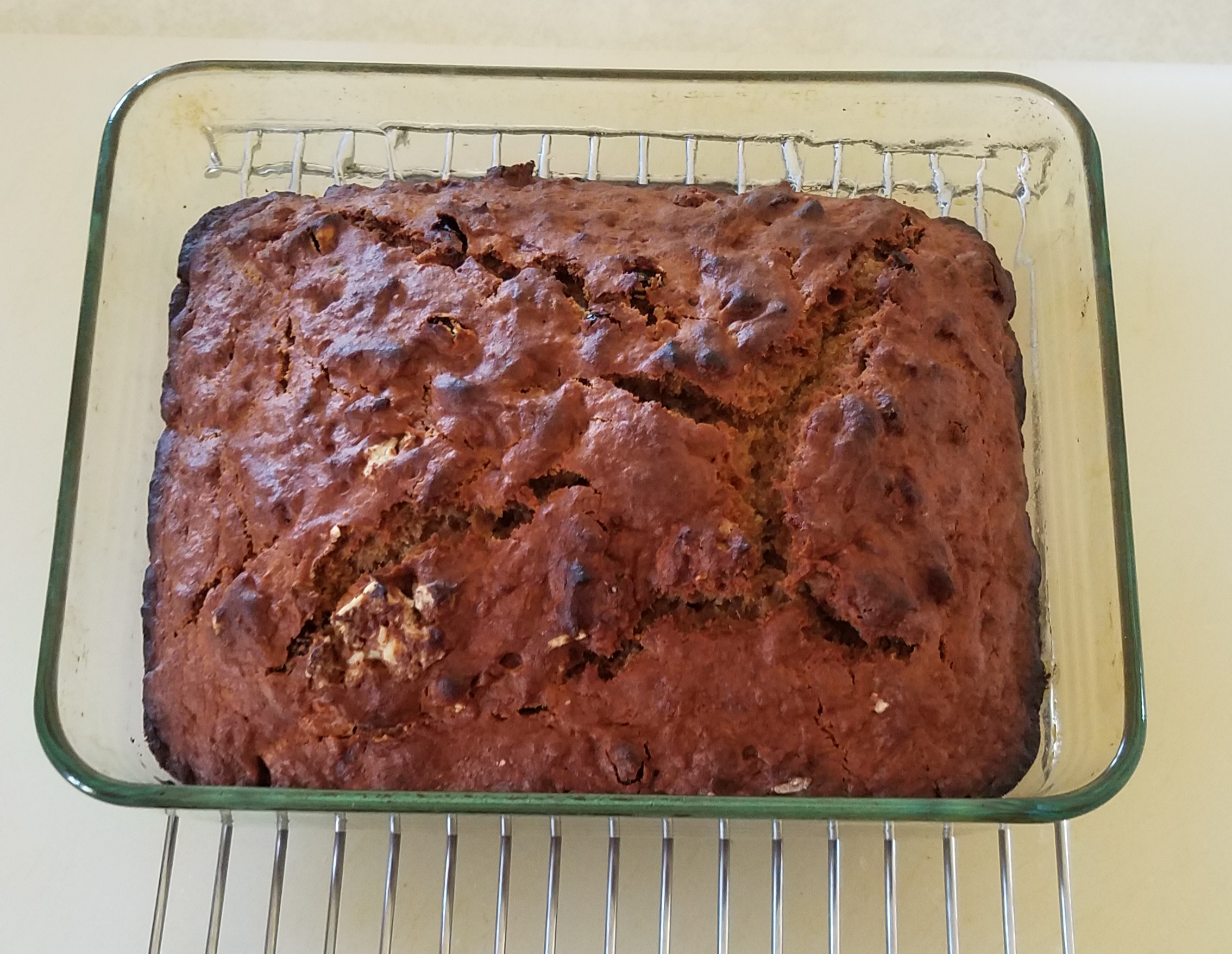
I found an old jar of applesauce, tasted it to make sure it was good, and baked an applesauce cake. This dense, slightly sweet cake could be split into two loaf pans and made as bread. Who wants to wash the extra dish? Topped with homemade apple butter, it is a mid-winter treat made from pantry staples.
A lot is going on in the political world. Reports say there is a high level of engagement among Democratic activists. Activists are one thing. Voters are another. More work is required on the latter. The field of candidates won’t be known until the filing period closes on March 18 for federal and state offices, and March 25 for county ones.
In the state senate district a bicycle ride away, Molly Donahue and Austin Frerick are in a primary for the Democratic nomination to replace state senator Liz Mathis, who is running for the U.S. Congress. I like Molly a lot and have attended her public outreach sessions held in nearby Ely. Frerick may be better known state-wide, and is expected to be better financed. It’s a race to watch. In the meanwhile, I am expecting a formal announcement from incumbent Kevin Kinney in my senate district in early March.
At the beginning, I didn’t think there would be much about which to write regarding my four-year stay at the University of Iowa. It turns out I was wrong.
The first third of my current project was written mostly from photographs and memory with a few history references scattered in. Now that I’ve entered the part where there is more written record, the story got complicated.
The period from Kent State on May 4, 1970 until May 1972 encompassed most of the anti-war activity at the University of Iowa campus. Both former university president Willard Boyd, and former dean of the Graduate College D.C. Spriesterbach wrote of the events in their memoirs. In addition, the Daily Iowan newspaper stores archived editions online at no cost for users. I have been able to re-read newspapers from the spring of 1971, my freshman year. Combine that with my personal documents and memory, there is a lot to go through and distill.
Music was important during university. I learned to play guitar and participated in the local music culture which included countless appearances by bands touring the country. There were big venue offerings like The Grateful Dead, Grand Funk Railroad, The Allman Brothers Band, and Leon Russell. There were smaller venue offerings with Muddy Waters, Luther Allison, and Ravi Shankar. I can’t recall all the long-time blues artists who performed in downtown Iowa City. My mates from high school and I started a rhythm and blues band about 1973. My record collection grew considerably at university. All that experience needs some clarity and compression, yet not too much.
When I moved to Forest View Trailer Court, I started cooking and have some memories of early experiments to share. I recall using the first loaf of bread I baked as a door stop because it was so dense as to be inedible. Food will be a major theme later in the story. I’ll be planting some seeds here.
I was able to graduate in four years, debt free. Things didn’t cost as much in the early 1970s. In light of the $120,000 expense our child incurred at a private college, there is a point to make about student loans and the cost of higher education.
The choice a writer has to make is whether to do all the work in the present, or to write one version today and add to it later. I’m likely to write my autobiography just once, so this is it. That makes the process longer than cranking out a 100,000-word work of fiction in a year. Progress was made this week. For that, I am thankful. Plenty of additional work lies ahead.
The Republican elected officials who represent me have forgotten the most important thing about education: its purpose is to educate children.
On Nov. 9, 2021, Rep. Mariannette Miller-Meeks introduced the CHOICE Act (HR 5959) which is a bill that takes federal money from public schools for private schools in states like Iowa. This bill is going nowhere if Democrats hold the majority.
I asked a group of parents and educators whether they had heard of the CHOICE Act. They had not. It is a distraction from the main goal of educating our children. What is the congresswoman up to?
Miller-Meeks seeks to acquire some more Iowa Republican extremism in education to garner a few votes in the midterm election.
Iowa Republicans support discrimination against a class of young children (HF 2416), seek to lock up teachers who don’t do what they want (SF 2198), and play three-card monte with childcare by doing nothing except raising the number of children each provider can serve (SF 2268).
No public dollars should go to private schools. We should focus on educating children, not playing political games with their future.
~ Published by the Cedar Rapids Gazette on Feb. 24, 2022
Fiction usually serves a specific purpose in my reading life: it functions the way a palate cleanser prepares us for flavors ahead, or in the case of reading, the next serious book. It is not that fiction writers are trivial in their efforts, it takes the same hard work to produce decent fiction as it does any other type of writing. Fiction is not the main event for me, so there are different expectations.
A novel must be paced quickly to hold interest. While fans of Tolstoy and Dostoevsky exist, their books have been difficult reads. I’m willing to suspend disbelief, yet only for so long.
I don’t like it when the mechanics of assembling a story are visible in the narrative. Yes, the author has to end a novel, although arbitrary resolutions of plot, ones in which the author’s hand is clearly visible, are particularly annoying. I’m thinking of Richard Powers novel The Overstory, an otherwise engaging tale.
Reading the first chosen novel of an author is almost always better than the next. I’m comparing Amor Towles books A Gentleman in Moscow and The Lincoln Highway. I was enraptured by the former and the latter seems forced and vapid. Towles seems full of himself and we don’t read fiction because of that. The same applies to Zeyn Joukhadar’s The Map of Salt and Stars and The Thirty Names of Night. The former is memorable, and the latter, not so much. All of them helped pass the time, so what am I complaining about?
Time was I wanted a novel to teach me something. Michael Crichton’s State of Fear cured me of that. One needs no further thinly veiled and polemicized presentations of a political argument. That Crichton was required reading to work in a logistics company rubbed salt into the wound. I seek to engage in a good story, follow it through to the end, and move on. Spare me the polemics, please.
When I consider past reading, there are only a few novels I would read again. Among them are The Great Gatsby by F. Scott Fitzgerald, Tolkien’s books The Hobbit and The Lord of the Rings, The Adventures of Augie March by Saul Bellow, and On The Road by Jack Kerouac. I enjoy reading John Irving, who is an exception to the rule about next books. Before I’d re-read one of his, I’d finish reading what I haven’t. My favorite was A Prayer for Owen Meany.
Give me a good novel, one that reads quickly, encourages me to suspend disbelief, and is a narrative for the sole purpose of telling the story. Do it well and you’ve got me hooked… at least until I move on to the next main reading event.
I arrived at Hillcrest dormitory in the fall of 1970 and decided I didn’t like my roommate and his clutch of friends from Western Iowa. I quickly moved into the Quadrangle dormitory with a high school classmate I didn’t know well. During my brief stay at Hillcrest, I met Jim, who would become my brother-in-law in the 1980s.
Construction of Quadrangle began during World War I. It was to be used as a training barracks to support the war effort. Work was completed in 1920 well after the armistice. It was a serviceable place to live with a big room, high ceilings, and a closet big enough for me to live in for a while – which I did.
We ate in the Quadrangle dining facility. I had been reading about macrobiotic diets and for a while adopted a no-meat diet. This may have been partly a reaction to the quality of dormitory food. Many complained about cafeteria food, yet once I went “macrobiotic” it was easy to find something to eat in the line. Macrobiotics caused me to lose weight, weighing less than 160 pounds for a while.
My grades were lackluster at university, achieving a 2.93 grade point average on a 4.0 scale. My approach after washing out of engineering was to graduate with a non-teaching degree in English and to take a varied assortment of classes to give breadth to my education in the humanities. The classes and instructors I remember most were Chaucer with Stavros Deligiorgis, Shakespeare with Sven Armens, American Folk Literature with Harry Oster, Modern Fiction with David Morrell, American Indian Signs and Symbols with Hyemeyohsts Storm, and Anthropology with June Helm. In addition, I took French for three years, enough to gain a basic level of fluency. There was philosophy, linguistics, engineering, art history, ceramics, anthropology, literature, and physical education. The classwork prepared me to become a writer, yet that wasn’t a specific outcome I sought. My attitude toward university was typified by the fact I skipped the graduation ceremony and spent the time listening to it on the radio while I tie-dyed some t-shirts in the basement of our rented house.
Tuition and fees in 1970 were $310 per semester. Room and board added $1,040 for the academic year. My $1,250 per academic year scholarship from the Oscar Mayer family, secured by Father’s friends at the labor union after his death, paid most of my expenses. I funded the rest with my savings from high school, summer jobs, and my share of the settlement with Oscar Mayer and Company over Father’s death. Occasionally Mother sent a check to help pay my U-bill. There was no presumption of going into debt to attend a state university.
My life at university was likely not typical. During freshman year I tried things out. Shortly after classes began, we went to a scrimmage of the University of Iowa Hawkeye football team. We spent most of our time there making fun of coach Ray Nagel. It was the only time I remember attending a sports event during the four years. I visited a couple of student organizations and didn’t feel enough connection to join. During sophomore year I went on a date with a female student. We didn’t click and that was it for dating during the four years. When I interacted with women after that, neither of us considered it to be dating. I did my share of studying and walking all over campus. I stayed busy with classwork even if I wasn’t that good at it.
Through my friend Dan from grade school and high school, I got involved with the Commission for University Entertainment. The university was a stop for touring bands in the early 1970s. My first year I ran a Trooper carbon arc spotlight for musical acts at the University Field House. I heard or worked on acts, including The Grateful Dead, Leon Russell, Freddie King, Albert King, Laura Nyro, The Allman Brothers Band, Neil Diamond, and Grand Funk Railroad. I also got a chance to hear musicians elsewhere in the region, including Ravi Shankar at Coe College in Cedar Rapids. It felt like we were part of what was going on in the national music scene.
I studied Renée Descartes at university and spent substantial effort considering his first principle, cogito, ergo sum, or in English, “I think, therefore I am.” I wrote about my Cartesian outlook toward life. We are isolated beings, wrapped in a veil of humanity, closer to God, or its divine essence than we realize. Such veil, metaphorical or not, is woven of delicate threads, like the lace of Morbihan, or silk from China. We could spend a lot of time marveling in its delicate needlework or shimmering surface. Yet we are compelled to reach out beyond the veil. A Cartesian view of life if there is one. Some say we should live our lives in the presence of God and perform all works for its honor and glory. The Sisters of Mercy taught us this and had us inscribe it on each sheet of schoolwork, “All for the honor and glory of God.” If God is reading this writing, my offerings may not be living up to divine standards.
University was a period of trying to figure out how I would live in society. During my freshman year I was introduced to R. Buckminster Fuller. The book, I Seem To Be a Verb by Fuller, with Jerome Agel and Quentin Fiore, blew apart my desire for consistency and predictability in life. “The most important fact about Spaceship Earth: An instruction book didn’t come with it,” the authors proclaimed. Chaos ensued.
These were the times of Marshall McLuhan, The Last Whole Earth Catalogue, James Baldwin, Joan Didion, Phillip Berrigan, Richard and Mimi Farina, Ken Kesey, Tom Wolfe, Hunter S. Thompson, Norman Mailer, and Bob Dylan. I read them all. They were in the wake of Jack Kerouac, Allen Ginsberg, and William Burroughs, whom I also read. If there were few female influences, it speaks to my education and upbringing. There was learning my first year at university. There was little consideration of what I might do with it after graduation.
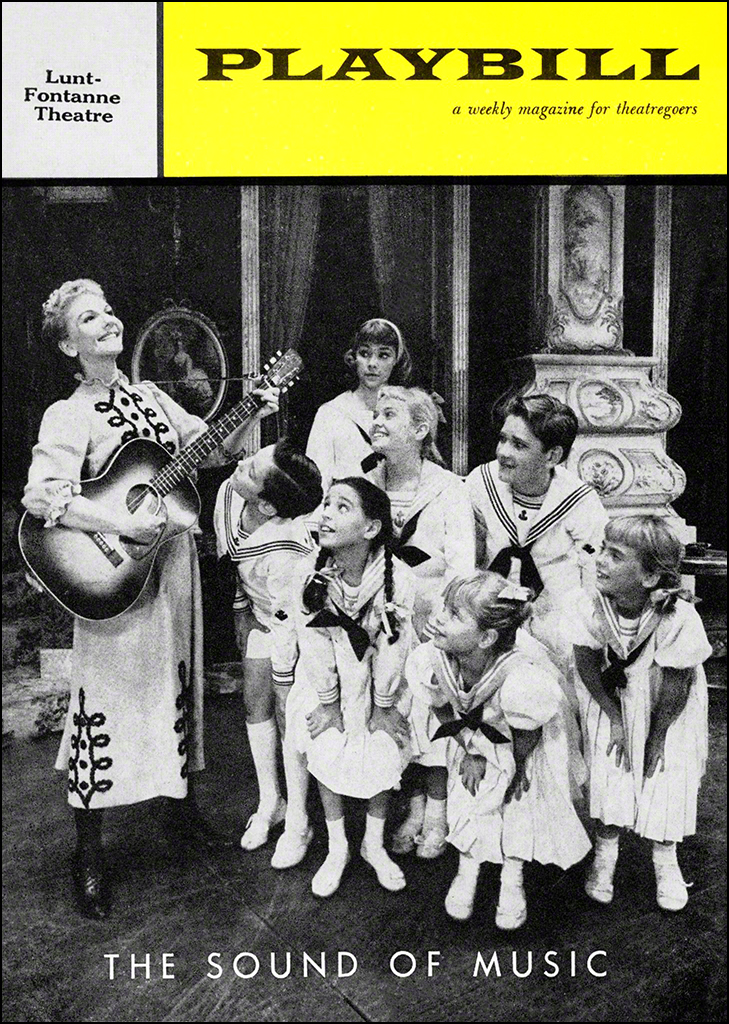
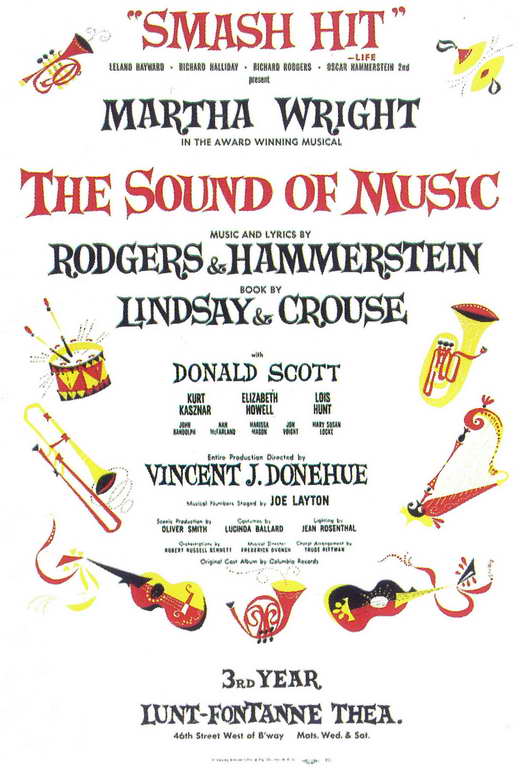
Folks may not recall Mary Martin and Theodore Bikel starred in the Rodgers and Hammerstein Broadway musical, The Sound of Music, which opened on Nov. 16, 1959.
Maria Von Trapp published her memoir of 1938 before the Anschluss in 1949. It was immediately recognized as having commercial potential and two German films were made of the story, The Trapp Family (1956) and Die Trapp-Familie in Amerika (1958). While the Broadway production began without music, it was the songs, many of which have become standards, that engaged people. The play won five Tony awards in 1960, including best musical.
The Sisters of Mercy in my grade school had become enamored of music from the play, from the beginning. We performed several of the songs at the former Jackson School when I was in sixth grade. I had never seen nuns so enthusiastic about anything before. When the film version came out, it was a sensation among nuns, grandmothers, and parents who had lived through World War II.
The film starred a 20-year-old Julie Andrews as Maria and Christopher Plummer as Captain Von Trapp. It opened on March 2, 1965. My grandmother had heard about the movie, and in a rare instance took us all to see it at the Coronet Theater on Harrison Street in Davenport. She insisted on paying. The music of the play, and the character Maria spoke to her. The Coronet had been remodeled that year and the Sound of Music ran for over a year.
In school we sang and played the many recognizable songs repeatedly. The whole thing was a phenomenon for us Catholic school children.
There were other plays and films that came from the World War II experience, yet nothing like the Sound of Music.
I broke through 65,000 words on the current draft this week. What’s different this time is completion of the narrative from the beginning through 1970 without breaks in the text. It actually reads like a story.
There is a lot of editing to do. There is nothing to edit unless words get on paper. The writing went well and about a third of the main text has been drafted.
Once I established the process and got going, the words flowed. The section just finished, about where I lived with my family for the final eleven years, is by far the longest. I compressed many potential stories into fewer to make the key points of the autobiography. I wrote smaller inserted parts to set up some of the major themes.
I’m interested in dealing with a couple of themes.
When I was injured and hospitalized at a young age, I learned how interdependent we are in society. It helped me realize how much besides myself is going on. Learning about and leveraging our interdependence has been a part of my life for a long time. My outlook is what I call Cartesian, and I’ve written about that before. Is there anyone else out there? In the context of my hospitalization, the answer is definitely yes, and they can be helpful. We also have an obligation to give back.
My early experiences discussing ethnicity with Father led me to believe I was “American,” whatever that was. What I came to know through life experiences and research is there is a gaping hole in the oral history or what I’ve been calling “family lore.” My focus has been on the coal mining culture. Yet there were enslaved humans in Wise County, Virginia where the family came up, and a climate of racism that was never mentioned among family. The way I learned about Virginia and the Civil War, the enslavement of humans, post-Civil War racism, and the rosy portrait of Robert E. Lee and other southerners in school books, was problematic. Today I recognize being born into white privilege. How I came to that awareness is a major theme.
Lastly, in the first part of the narrative is a discussion of losing Father in an industrial accident when I was age 17. That affected my decision to leave home to attend university. It shaped my life ever since. Having a father and then suddenly not, was traumatic. There were no guideposts on how to handle it. Tracking the change and how I learned to cope is another theme.
What is new to me as a long-form writer is how setting these themes in the narrative is done. Simply put, I had no idea before now. Now that I am figuring it out, and as I do, the pace is snowballing. After writing thousands of blog posts, the challenge of writing in longer form is a voyage of discovery. I’m liking what I see.
It looks like it will be cold again this week, and a chance to stay indoors to write. The pace of social engagements is picking up and somehow I need to blend everything in and stay the course to finishing the main part of the narrative this year.
The North Liberty Leader, a local newspaper with about 300 subscribers, announced today will be their last issue. If that’s all the subscribers they had in a city with a population of more than 10,000 they deserve to go out of business. Harsh assessment, yet true.
The Dubuque corporation that bought them, Woodward Communications, Inc., likely knew this fate was coming before the acquisition. Today they informed readers of the Solon Economist unless something is done, they are on the chopping block as well.
Folding the Economist seems inevitable when community leaders surveyed felt ambivalent or indifferent about the newspaper’s future. I sent a note around to the Facebook group of neighbors to which I belong, encouraging them to subscribe. It may be too little, too late. Facebook is likely part of the problem causing a decreased subscription rate.
I’ll do my part by encouraging people to subscribe, providing free content if we can work something out, and advertising if I have need. In the transition of local culture, the demise of local newspapers is just one more unwelcome step.
January has been good for my writing. I organized an approach and it served to reduce stress. I’m better able to sit down, write, and feel like I accomplished something.
I eliminated a daily targeted number of written words. I mean, there is no deadline. It would be great to finish the book so I could begin the next project, yet I’m in no hurry. I want to be true to myself, not to an artificial writing goal.
Instead of a specific daily goal, I make sure to do something related to the project each day. Some days it’s hours, and some days it is minutes. I feel I have a grip on what was an unmanageable project.
I stopped writing and that enabled me to write. It’s the way a lifeguard overpowers a drowning victim to save them. I stopped writing and organized. First I developed a chapter list, or as I call it, the “big sections” list. There are 31 sections and seven appendices. I typed them all in a new document and as I find previously written sections or write new ones I hang them on the framework. The same with fragments located in folders or audio tapes of interviews. It is less hodgepodge than the way I wrote last year. Last year’s work can be plugged into the new framework and rewritten. The whole thing works.
The writing divides into some clean big parts. After the dedication and preface there are five sections where I combined my personal experience with whatever artifacts I could locate or had in my collection. These sections involved historical research and probing my memory. The working titles are Minnesota, Illinois, Virginia, Davenport and 1951.
The next part is written mostly from memory beginning with my earliest ones in the duplex where my parents brought me after being born. We lived there and three subsequent places before Father died and I left home. I don’t have much documentary evidence from these times: report cards, a few letters written to parents, and a small folder of school papers. The 1960s were the beginning of an explosion of home photography, so I have albums and extra photos from that time. I also scanned copies of Mother’s photographs before she died. While documentation is scant, there is plenty to prompt memories. I find it remarkable the detail with which I remember things long hidden in my brain. The working titles of these sections are Madison Street, Starting School, and Marquette Street. I’m a few thousand words into the latter and have to get through grade school, high school, music, work experiences, and leaving for college. This section ends with the Kickapoo Creek Rock Festival I attended with high school classmates the day after graduation.
The next sections are better documented. Leaving Home is about my conversations with my parents about going to university, and after Father died, about whether I should give up college to stay in Davenport and help Mother. I have many letters received from friends, university papers, photographs and newspaper clippings. There are also a few pieces of ceramics I made, some musical instruments, and memories of my time at the University of Iowa. I began writing a personal journal after graduation from university. This section also includes my 12-week tour of Europe in the Fall of 1974, and the year I spent in Davenport afterward.
There is a gap in recent writing during the period when I left for military service, returned to Davenport, and then moved to Iowa City for graduate school. That takes the narrative through four sections titled, Military Service, Homecoming, Iowa City and Graduate School. By this time, I was a regular journal writer and had published a small number of pieces, including travelogues for the Belgian Society in the Quad Cities. I was still taking photographs with film cameras, I had begun to write letters to the editors of newspapers. This section ends with the job search to find something to enable me to stay in Iowa City after graduate school.
A good part of the next section was drafted last year. It takes us from finding a job at the university, our marriage, beginning a career in transportation, the birth of our daughter, and moving to Cedar Rapids, then to Indiana. These sections are titled My Spouse & Me – 1982, Career, A Daughter – 1985, and In the Calumet (1988). By now I’d developed an extensive document collection method producing financial records, photographs, journals, letters, and all the raw material to turn into something. These were years before we adopted email or owned a home computer other than a word processor. When I worked at the oil company, I was introduced to email around 1990.
The final big section is of our return to Big Grove Township in 1993, where we currently live. Because this section has the most documentary resources, I saved it to write last. There are currently 11 sections and the organization and titles of them is fluid. No point writing them down because they are sure to change. I lived here longer than any other place, more than twice as long as I lived on Marquette Street with my family.
The difference this change in organization and methodology made is I have a sense of purpose when I’m writing. When I write something, I know where it goes, or whether it goes. I started a complete rewrite from the beginning and am now on section 10 of 31. It lets me know where I am. I can sleep at night knowing I won’t lose the thread.





 Journey Home
You must be logged in to post a comment.