“Each moment is different from any before it. Each moment is different, it’s now.”~ Incredible String Band
Best wishes for a happy 2018!
The ambient temperature is 23 degrees below zero outside, the kind of winter we expect in the Midwest. The cold snap should and hopefully will last a week or more. If we’re lucky, it will be followed by another later this month. After that, I’m ready for winter to be over.
There is a lot to do in 2018.
January will be a month to see if financial plans made in December work.
The switch from work-based health insurance to Medicare means managing six different payments for health insurance each month. With this change, my net income from the home, farm and auto supply store should increase, less any additional tax. There is also Social Security, scheduled to begin the fourth week of the month. Now begins the monitoring to see if it comes together as planned. Assuming it does, the rest of the year falls into place as follows.
I haven’t set a date to leave the home, farm and auto supply store, although I’m looking at March 16, giving me three full months of paychecks, which when combined with Social Security, will help the transition. Farm work starts in late February/early March and is expected to run through June or July. Orchard work starts in August. There are only a few other focal points.
Writing: After picking a project, I plan to get back to writing 1,000 words a day, six days a week by spring.
Reading: Read 50 pages a day, six days a week, split between books for learning, enjoyment, and research for writing.
Social Media: Who knew this would even be a category? I plan to maintain my blog and use Facebook and Twitter to develop a readership for new writing. I may add other social media platforms.
Business Development: Once I leave the home, farm and auto supply store attention will be turned to generating cash to help pay down debt and take care of major, deferred household expenses. This must be done in a sustainable way, one considering my aging frame. Over the next year or two I will reduce income from work that makes physical demands.
Food Ecology: Combining gardening, farm work and networking, leverage the local food system to provide a greater share of the food we consume at home. Get better at gardening.
Social Engagement: Develop a sustainable, local group to work on the midterm election, and advocate for environmental, public health, and social justice issues. Work with national organizations to reduce the existential threat of nuclear weapons.
Health: Take care of myself so I can do the aforementioned things.
While not really resolutions, there is a lot to do. Without a plan, one might slip into the abyss and never be heard from again. I’m not ready for that.
Best wishes to readers for a peaceful and prosperous 2018.
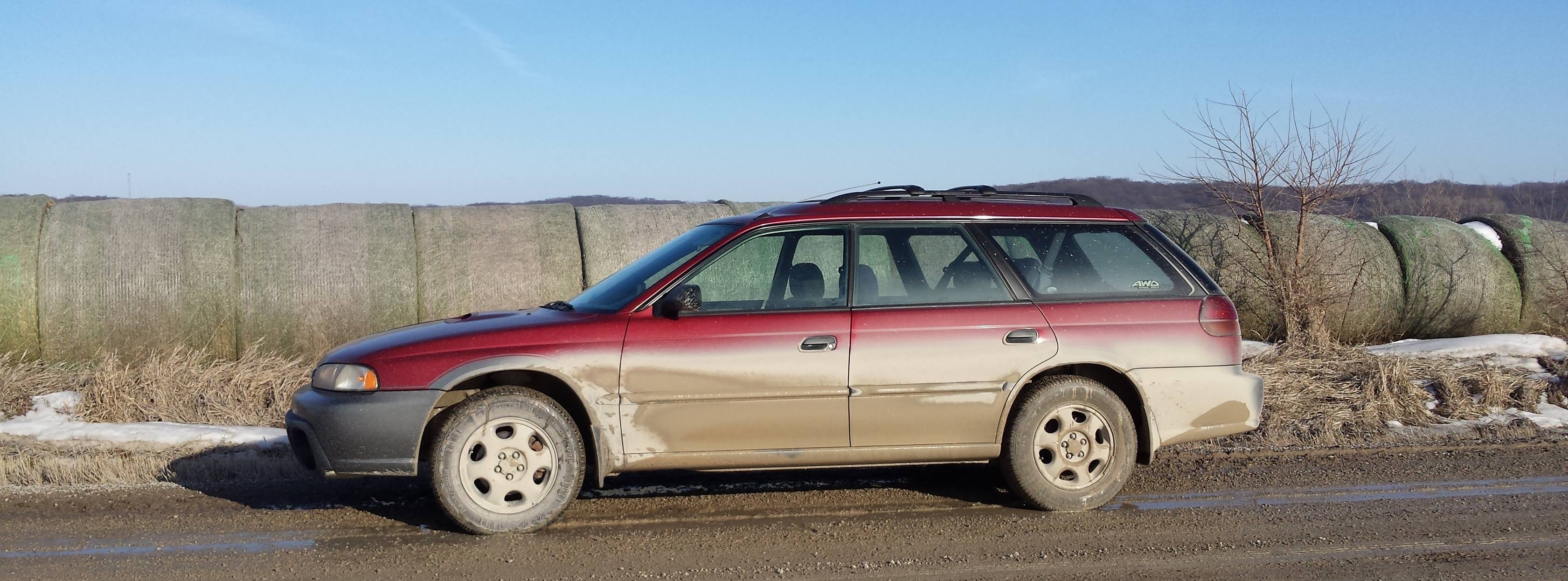
One of my work buddies is a mechanic and Vietnam veteran. He was a mechanic during the war although it’s his brother who now operates an auto shop in the county seat. He is active in the American Legion and has a reputation as a curmudgeon. I find myself pointing out I’m older than he is, although I defer to him because of his veteran status. He drives a vehicle similar to my 1997 Subaru.
Transportation is important when working for low wages. The idea of buying a new car — straight from the dealer — is a fantasy reserved for immediately after buying a winning lottery ticket or hitting it big on Bitcoin futures speculation. The chances of doing any of them are minuscule. When someone gets a new car it means nicer and newer than the previous one. My colleagues at the home, farm and auto supply store favor used cars that work and one or another of our collective vehicles is always acting up. We help each other with rides, loaner cars and jump starts without questioning it.
Essential to life with an old car is knowing a good mechanic, “good” being the hard part. Finding one means slogging through abundant folklore, experiences and stories of wrench turners to identify someone gifted at diagnosis with an approach that produces excellent results inexpensively. Being a good mechanic includes willingness to work on an old car, knowledge about the model, and doing what’s needed to keep it running and nothing more.
Acknowledging the importance of diagnosing automotive problems, three groups of mechanics took medical-sounding names for their automotive businesses in the small city near where I live. There’s an auto clinic, auto medics, and an ag clinic. Proper diagnoses are important and good mechanics are possessed of the knowledge, resources and skills to make them. I don’t normally use my curmudgeonly Vietnam veteran friend as my mechanic, even though he would likely work on my car for free.
A while back my Subaru began intermittently overheating. I took it to my mechanic and after several diagnostic attempts we figured a leaking head gasket caused the problem. We weren’t sure, but were sure enough to give it a try. If a dealer were to replace a head gasket in my car, the book calls for pulling the engine because of the configuration of the engine compartment. My mechanic saved me 10 hours labor by replacing the head gasket with the engine in the chassis. He understood ten hours labor made a big difference in our budget.
Recently the electrical system went on the fritz and I suspected the battery was going bad.
Troubleshooting began by asking people I know. My Vietnam veteran friend checked the battery and results of the computerized test he ran showed it to be okay. It wasn’t, but I took his word it was and tried charging the car each night in the garage. The issue did not resolve and repeated charging may have made the battery worse.
I called my regular mechanic, whose schedule was packed, and got an appointment for the following week. When my spouse was not working I used her car to get to work. When I used mine, it continued to lose a charge after four hours in the parking lot until it would not re-start immediately after parking it for the day. It was frustrating.
My colleagues at the home, farm and auto supply store stepped up with five jump starts during the period. On my second break I’d pore over the schedule to see whose shift ended the same time as mine and ask a co-worker for a jump. The first person I asked always jumped me: we all understand cars that have been in service for a while have issues. I was cautious about asking the same person more than once for fear of wearing out the welcome.
Car problems are an existential annoyance. They are also less important than maintaining relationships, including with family, co-workers and neighbors. We are stronger together and will need strength for the coming years. That and a good mechanic.
This year a group of Ukrainians with temporary work visas joined us at the orchard.
They were hard-working and fun to be around.
Their contracted wage far exceeds the $185 per month they can earn in Ukraine from their trained profession as English teachers. The visa sets a specific hourly rate of pay and the host is required to provide round trip transportation to Iowa plus housing. They can stay for up to eight months at a time. The Ukrainians went home to their families after the season, although each of them plans to return in a couple of months to help prune apple trees.
Saturday I drove to the orchard to pick up apple cider and frozen cherries. While there, the octogenarian friend who referred me showed up. We talked with the owners long enough for my spouse to wonder where I was. We ran through the usual topics —the hickory nut harvest, Gold Rush apples, cooking projects, which books we were reading, activities of mutual friends — and told jokes, usually one at the expense of another. It was a great conversation among friends.
We live in the same political precinct and have common political interests. We discussed the surprising plan to move the U.S. Embassy from Tel Aviv to Jerusalem within a few years, and scuttlebutt about Democratic candidates considering a run to replace our state senator Bob Dvorsky when he retires at the end of 2018.
Multiple sources told me local internet personality Zach Wahls and former diplomat Janice Weiner are both kicking tires on a state senate run. I’ve not met either of them and it was news to my co-workers. While politically engaged, each of us has bigger fish to fry than politics.
The orchard sales barn will be open next weekend and that’s it for the year. I’ll need more cider… and conversation by then.
Everyone wants work that’s fairly paid. Once one accepts a work contract — agreeing to work for a wage — that usually ends discussion about compensation. We turn to our co-workers and the life we share in a place and time. If the job is any good we don’t talk about compensation, work hours, or much of anything but the idea of what we do and how to do it better. This has been the case most of my life in every job I’ve held.
At the home, farm and auto supply store we recognize it as lowly paid work, not just for hourly employees but for management. Yet we engage in work as a team and do our best to meet our goals. Employee turnover is high in retail and based on my experience compensation is not the driver. What matters more is it’s relatively easy to get retail work and if one keeps their nose clean and shows up, the employment and paycheck are predictable. A job easily secured is one easily left and that drives turnover. Our workplace is a stopping point for many people enroute to something else.
One of my colleagues was recruited from the sales floor to help check in freight during our busy season. We talk while working. Cognizant of his low wages, he said, “you get what you pay for,” indicating he would work harder if paid more. I’m not sure about that but didn’t tell him so. He is already a hard worker compared to others, and his income contributes to a household with his wife and two children. The job means something to him, but he’d leave it on short notice if a better one came along. We don’t talk much politics at work but he wears a stocking cap and coat with the word “Trump” screen-printed on them.
As my worklife winds down before taking “full retirement” next year, I value the people with whom I spend time. They are a diverse group and I hope to add something to our relationship before I go — remembering the past and living each moment to the fullest extent. These are stopping places, part of a long, personal journey that’s not over. As Robert Frost wrote in 1923, “I have miles to go before I sleep.”
The desultory nature of lowly paid work is a grind.
That’s what I found yesterday upon returning to the home, farm and auto supply store after a four-day vacation. By afternoon I was ready for a nap but instead scratched at the stacks of piled up work and made a day of it. I won’t run out of work there any time soon.
I had thought to secure provisions at the warehouse club after work but was tired, achy and my feet hurt. I skipped shopping and drove straight home.
Vacation consisted mostly of sleeping, reading, napping, cooking, writing and resting. I’ve been working almost every weekday and weekend since February when I started soil blocking at the farm. It all caught up with me. By Tuesday night I felt more human if not fully rested.
I left our property exactly three times: to meet with a neighbor about our relationship with Iowa Department of Natural Resources, to fill Jacque’s car with gasoline, and to pick up our share at the farm. Most of what I hoped to do while vacationing remains undone. I did manage a few things using the internet: applying for Social Security retirement benefits, ordering a couple of books for winter reading, and ordering parts to repair a burner on our aging electric range. It’s something.
I’m not complaining. We have it better than most who make it on less than a livable wage in the post Reagan society.
What matters more was the ability to author a few posts during this down time. Nothing profound — public journaling really — and that escape into the imagination made all the difference.
It’s a crash landing after the apple harvest and a summer working almost every day at the orchard or the home, farm and auto supply store. Time to sleep, read and rest.
Four days off work is not enough to fully recuperate but it’s what I have.
Saturday was mostly at home resting, then cooking. Sunday was several long sleep sessions, reading and staying indoors. Today and tomorrow turn toward stuff I want to do and stuff I have to do, mostly the latter. There’s more on my list than will fit in the remaining 48 hours so it’s not really a vacation but more a time to do other kinds of work.
The most important things I do are related to full retirement. Specifically, submitting my application for Social Security benefits to begin after my birthday and changing our health insurance from my work to Medicare. I expect to spend much of today doing just that.
What matters more is figuring out how we want to live going forward. I am already up to my armpits in community organizing so there’s that for the time being.
Once our financial situation reveals itself after Social Security and Medicare, I want to change things around. I expect to slow down or quit at the home, farm and auto supply store next year to focus on writing, gardening and preparing our home for a long retirement. I expect to continue to work in the local food system — at the farms, and at the orchard — but the focus will be on our homelife. It’s been neglected for too long.
Needed work toward sustaining a life in our turbulent world.
Financial inequality is impacting society by making men protectors of what limited resources each family has.
I know few people who are increasing their wealth in the post-Reagan era. The rich get richer and the rest of us pay for it as dollars systematically, relentlessly find their way to the richest one percent of the population. Families struggle to get a share of societal wealth and if they do, feel privileged enough to say, “I’ve got mine.”
The struggle to provide for a family is getting harder with the transformation of American business to globalization, government efforts to eliminate regulations, and the current administration’s tampering with healthcare, defense, foreign policy, energy, education, immigration and more.
The impact of financial inequality on the role of men in society has been to make it more difficult for them to provide for their families. That said, I don’t know many families where a male is the sole provider. Women began moving to the paid work force in large numbers decades ago. The idea women wouldn’t seek paid work is a social legacy of male dominance. The male narrative lacks proper consideration for the value of work by women. That seems obvious in workplaces where women earn a fraction of a dollar men do for the same work, and also in homes where a male provides money and resources for the family and women work unpaid.
Men are challenged to be providers so their role shifted to being protectors of what they have. The rise in gun ownership in the United States is directly related to income inequality and the diminished role of men as providers. Let’s talk about that.
Some of my friends and acquaintances are women who carry handguns.
It’s no big deal. The banal and ubiquitous presence of guns is part of living in the United States.
I’m not worried about getting shot over lunch or at an event. I also don’t feel any more secure knowing she has a handgun in her purse. It used to be a bit jarring to see weapons unexpectedly in everyday places. Not any more. I’m confident in studies that show women are not the main problem with gun violence, it’s the men.
Data shows gun violence is disproportionately a male problem. Of the 91 mass shootings in which four or more victims died since 1982, only three were committed by women, according to a database from the liberal-leaning news outlet Mother Jones. Men also accounted for 86% of gun deaths in the United States, according to an analysis by the non-partisan non-profit Kaiser Family Foundation.
Men are more likely to own a gun — three times more, according to a 2017 survey from the Pew Research Center. This, despite marketing from gun manufacturers and groups such as the National Rifle Association to lure women.
Fast forward to Dastagir’s conclusion that to understand gun violence we must examine the cultural forces that equate being a man with violence. Read her information-packed article here.
What is it to be a man? It’s no secret having a Y chromosome is less important than the culture in which boys are nurtured to adulthood. There remains a significant, lingering perception that procreation is part of being a man even though wombs are more important than sperm. Only primitives continue to believe having a large family is a sign of manhood. At the same time male sexual dominance often trumps a woman’s right to choose. We read news daily about sexual predators, soldiers raping villagers, and widespread sexual harassment. Even so, something more powerful than traditional views about the role of men in procreation is at work.
After my first year in college (1971) I went home for the summer. I met with a number of male friends from high school and we each had been able to apply for work at manufacturing plants in the Quad Cities and find a summer job. Some literally went from business to business until they found a job and everyone who wanted one got one. It was easy. That changed.
The jobs environment has gotten very scrappy in Iowa and well-paid jobs with benefits are difficult to find and secure. Such jobs exist, however, the rise of professional human resources consultants has businesses seeking employees who meet very specific “profiles.” Don’t meet the profile or offer something unique to the position? Applicants will politely be sent on their way. If an applicant is lucky enough to be hired, human resource consultants have structured pay and benefits to meet the company’s minimum needs more than the needs of employees. Under the guise of taking inefficiencies out of business operations well-paid jobs with benefits are hard to get for almost anyone. It is worse with large companies who have the capitalization and scale to hire human resources consulting firms.
The transformation from manufacturing jobs to service jobs has not gone well from the standpoint of men seeking work. Retail, lawn care, janitorial, restaurant, banking, accounting, health care, sales, and other low-skill level employment performs necessary work in the economy. Such jobs are far from adequately compensated. Our education system increasingly fails to prepare students for jobs in a service economy. I’m not talking about adding a STEM curriculum in K-12 classrooms, but simple things like how to make a decision to start a business, work for a service company, or get a government job. Provider males are increasingly on their own when it comes to crafting a career, if that’s even possible in the 21st Century. Most I know get by, just barely.
In a society of income inequality, limited resources, women’s rights, and unsatisfactory job options, men get stymied in traditional roles of procreation and providing. They turn to protecting what they have, and that often includes buying guns. It is a predictable reaction in a society with a legacy of male dominance with no outlet.
A focus on resolving gun violence in the United States without considering the changing role of men in society isn’t going anywhere.
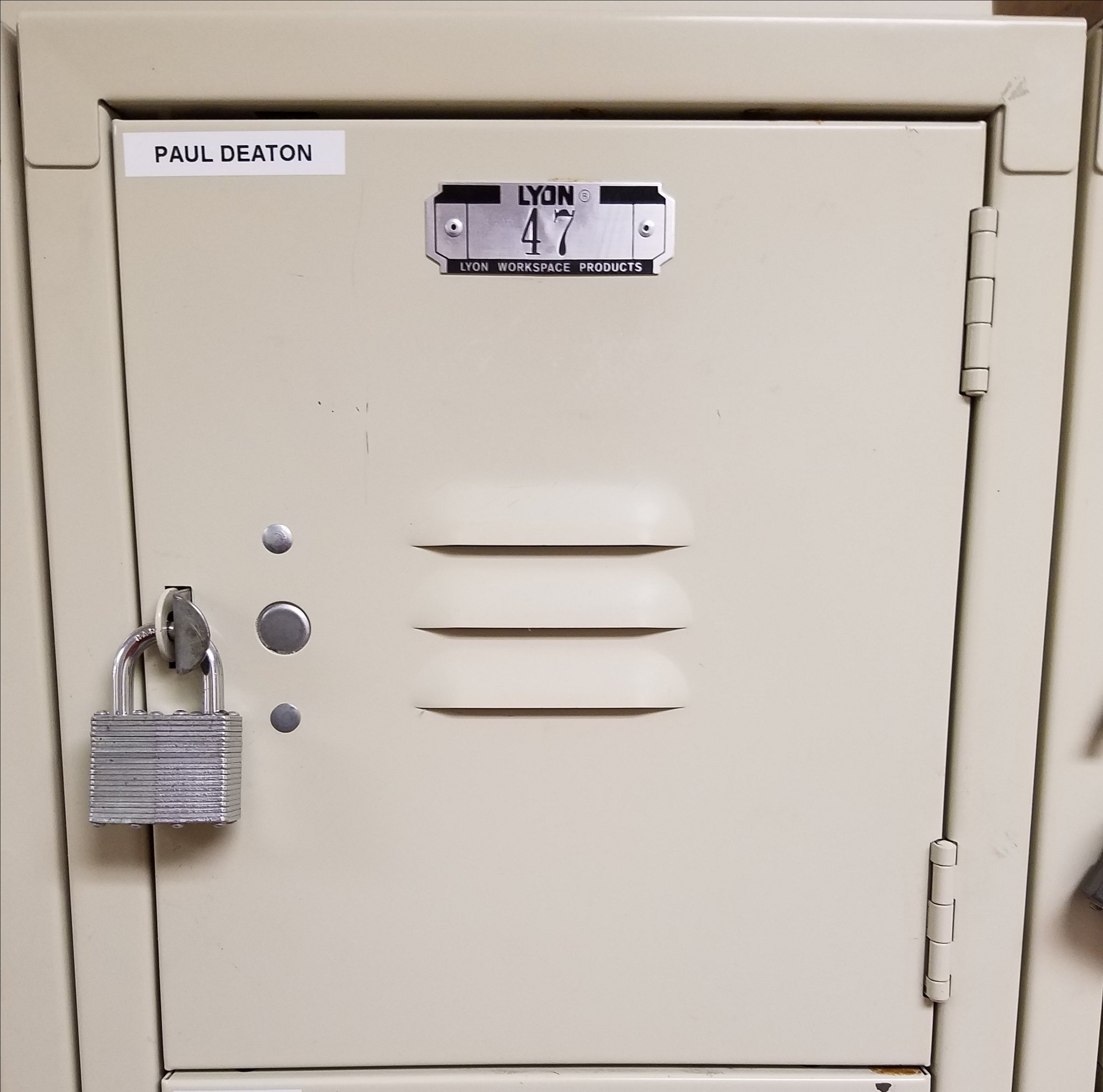
My mobile device lived in this locker for 3,960 hours since I began working at the home, farm and auto supply store.
Carrying our devices with us while at work is not allowed and that’s fine with me.
There is no need for a human to be constantly connected to social media, email and news, especially when engaged with people at a job site or other location in the real world. I don’t suffer from lack of connection.
What matters more is the security of my lunch until I eat it. Marauding teens and twenty-somethings have been known to pillage the shared ice box while hungry, eating anything found. The locker resolves that concern.
While I’m gone from work, the locker is home to a radio earpiece, ink pen, box cutter, name tag, padlock keys, tape measure, duster, hat, aspirin tablets and a few other work items. Those might disappear if the locker wasn’t locked.
It’s a flimsy locker and anyone who wanted to break into it easily could. Suffice it the padlock discourages people from looking inside. I’ve had no issues since I began working there about two years ago.
I won’t get the time spent at the home, farm and auto supply store back. I took the job to avoid taking loans for living expenses. I stayed because of the reasonably priced group health insurance plan. It fills the gap between failure to start a viable business after my transportation career and Social Security.
Time spent there is fit bookend to my part time high school job in retail. The company I work for now bought the building where I worked almost 50 years ago and opened a store. I hope to visit before long, before fading into the oblivion of an ultra local life writing, gardening and living from a perspective built on the shore of a man-made lake.
This week is the biannual vendor show at the home, farm and auto supply store. We’ll be short staffed today and tomorrow while associates from Iowa and Wisconsin travel to Dubuque to attend seminars and discuss products and process with our vendors.
If it’s like last year, my work queue will build up and I won’t dig out until Thanksgiving. The days will pass quickly and my aura may be colored in shades of grumpiness.
Coffee helps.
This weekend — Labor Day weekend — is the unofficial end of summer and I’m ready to glean most of the garden leaving only kale and peppers until first frost arrives in October. I secured seed garlic from one of the farms and will plant in September. The garden has been successful, the most successful in memory. It has been encouragement to plan for next year.
Saturday and Sunday I made a large pot of vegetable broth with items mostly from the ice box: kale, collards, chard, celery, three kinds of summer squash, carrots and onions. The resulting product was dark and rich.
I made rice with the broth, poured some in canning jars, and made a big batch of lentil-potato-barley soup for work lunches. I used eight or ten leeks in the soup which made it slightly sweet. Growing leeks creates a wonderful availability for the kitchen.
Last night I picked tomatoes, peppers, celery and leeks while the water bath canner came up to temperature on the stove. I ate a Red Delicious apple from the tree. It was slightly sweet and mostly starchy. It is time to begin monitoring the fruit’s progress. The pear tree is close to ripe and will be picked this week.
There is plenty of kitchen work ahead.
So begins another day in the final lap of a working life. I’m heading to the kitchen where I’ll make a second pot of coffee before work. The hot beverage doesn’t resolve our challenges. It makes them more tolerable.
A co-worker asked if I needed to borrow another water bath canner to survive the season.
This year’s abundance of vegetables has been stunning. There is a lot to preserve including apples, pears, celery, peppers and a couple dozen pints of tomatoes.
I said no.
By the time I get home from a shift — either at the home, farm and auto supply store or the orchard — and start in the kitchen, I’ve found barely enough time to prep seven containers for a water bath batch. Although it seems like a second canner would increase production, the most time-consuming home canning work is done before turning on the stove. At best, we can only capture a part of seasonal abundance in jars. A second canner doesn’t resolve the issues created by low wage work and the time it absorbs in our days.
Canning Soup and Jalapeno Peppers
Being a low wage worker is an economic grind. One knows there will never be enough money to pay for what we need. Financial friction wears us down. Avoiding spending on anything not related to basic survival becomes a primary focus. This may seem negative, and it’s not all good. However, it’s a life with as much potential as any I’ve experienced. That’s not saying a lot for our society.
There is dignity in work whether it is paid or not. Each jar of applesauce put up contributes to our lives. In the twilight of a career as a wage worker life changes. Youthful ambition wears down. Unpaid work becomes more important to sustainability and displaces paid work in our days. There are expenses to be paid and they shift as full retirement approaches. Figuring out how to adjust and what to emphasize in a society wanting participation is challenging. Developing resilience under the weight of social responsibilities becomes key to sustainability.
After what for him is detailed consideration, our president chose perpetual war in Afghanistan as he announced last night. Dealing with constant negative information about the 45th president has become a grind as well. While Obama chose perpetual war, there were redeeming aspects of his presidency, including a sharing of important issues. There was a sense the country was heading is a positive direction, despite his many legislative setbacks. There is none of that with President Trump. We go deeper into the grinder.
A low wage worker withdraws into a small circle of family and friends. In so doing our circle of influence shrinks on its way to irrelevance. What remains is work: low wage jobs, fixing the toilet, cooking breakfast, cleaning the house, and tending the garden. Such activities fill our days and hinder our relevance in political life. At the same time, there is work in society that needs to be done.
To work on resilience, persistence and engagement is as important as anything we do. It sustains our lives in a turbulent world.
Just as the election of Barack Obama encouraged me to leave a 25-year career in transportation and logistics, the presidency of Donald J. Trump is stirring winds of change.
Where they will take our small family is uncertain.
Each year presents its challenges and successes. We’ve been able to hold on financially — by the skin of our teeth. There is more to life than money.
Because of a decades-long plan I rely on Social Security and Medicare, to both of which I began contributing in 1968. Whether they will be there for us long-term is uncertain. We are too deeply invested to back out now. We can’t let an unknown future stymie hope and aspirations.
The cycle of our lives is around work, gardening and health. Take paid work out of the picture and there should be an opening to do something different next year.
In 2009, when I retired from transportation and logistics, I took a path of civic engagement. I joined organizations and spent time working with people in society. The next retirement — beginning in spring — is expected to be one of reading and writing much more than I am able to do in hours stolen from days of hard work. There must be some form of civic engagement, but this time I expect it to be much closer to home.
Regardless of outcome, I’m repairing my mast, mending my sails, and ready to put the winds of the national culture to work at home.







 Journey Home
You must be logged in to post a comment.