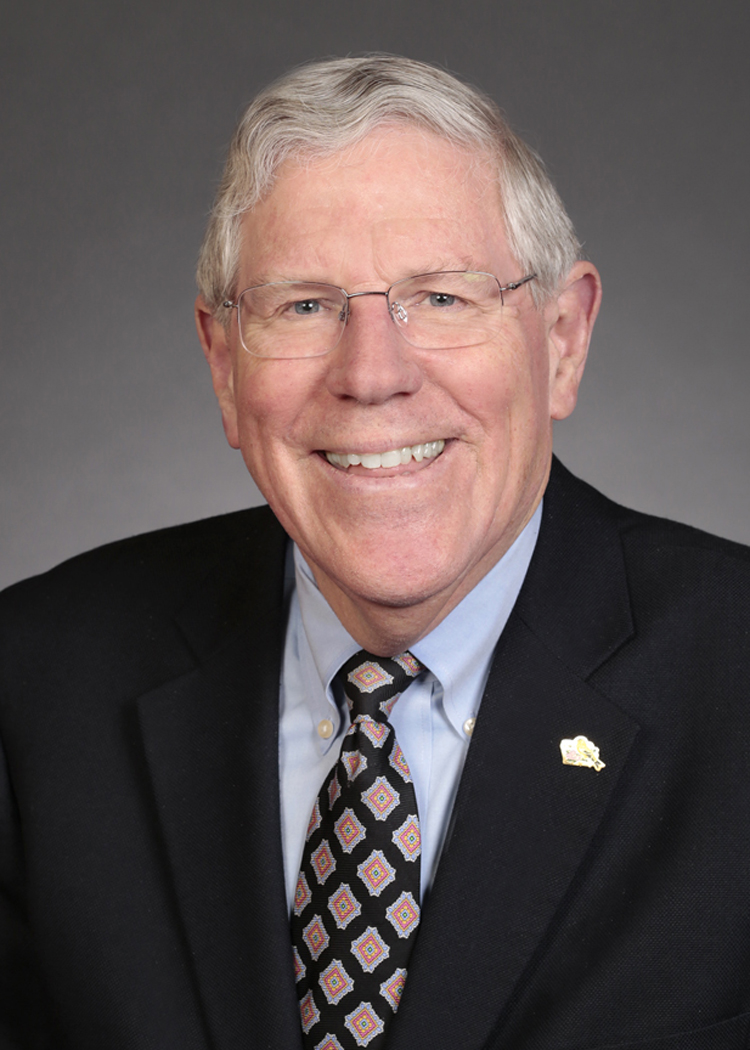
State Senator Robert Dvorsky Photo Credit – Iowa Legislature
State Senator Bob Dvorsky’s decision to retire at the end of his current term hits close to home for a lot of reasons.
He represented our family since we returned to Iowa in 1993. During the time since then he became a key player in Democratic politics and in the Iowa Legislature.
He did a lot for Iowans when Democrats held the majority in the Iowa Senate. He also worked to get things done regardless of which political party was in control.
With Bob Dvorsky in office, politics became personal in a way it hadn’t been before.
I began corresponding with him on issues shortly after he was elected to the Iowa Senate. My last letter from him, a response about the no wake issue on Lake Macbride, was dated April 25, 1996. A few years later I became politically active again and saw him everywhere, eliminating the need to write.
During the decades I’ve known him, I can’t recall a single time Bob didn’t seek me out for a brief conversation, whether at the capitol, at a political event, or at my workplace. He knew the owners of the company where I spent most of my transportation career, and after my retirement we encountered each other at the warehouse club where I worked part time. He was always positive and encouraging.
When people say all politics is local, I think of Bob Dvorsky. He’s been a friend and mentor who represented my interests in the legislature. I wish him well in the second half of the 87th Iowa General Assembly and ever after.
On several occasions, friends and family politely informed me I must downsize my book collection.
I resisted.
The specific enjoyment of working at a desk, surrounded by books, may not be everyone’s idea of idyllic, however, for me it is close to sublime. It’s who I am.
While pondering a work backlog in said enjoyably sublime, idyllic location, my mind began to wander. It arrived, somewhat predictably, on the question which book to read next? One thing led to another and finally to the context of the current series of posts about going home, my remaining time, and this analysis.
How many books can I read during the coming years?
Set aside what we all know about life — we could die tonight — and answering this question is useful to a bibliophile. Here goes:
I can read 50 pages a day if I keep at it. I don’t read books every day but expect to come close as I transition to full retirement next year. It’s an inexpensive way for a person with limited resources to stay engaged in society. Assume I read 50 pages, six days per week.
According to the Social Security Administration life expectancy table I can expect to live another 18.5 years. Assume I do. That would be 288,600 pages read. Sounds like a lot, yet it is a finite number.
How long is a book? Obviously they vary in length and some are more interesting than others and read faster. For purposes of analysis, I used the Harry Potter series (UK edition) as my guide to book length. The seven books in the series total 3,407 pages, averaging 486.7 per book. This is somewhat arbitrary but sounds about right. My reading potential is 592.97 books during the coming years. If I can do it, that would more than double the number of books I now read per year to 32.
There are issues with this hopeful analysis.
What if my eyesight fails? That’s possible and somewhat likely given the results of my infrequent visits to the optometrist. We’ve discussed macular degeneration, cataracts, optic nerve disorders like glaucoma, and the condition of my retinas. While my eye health is reasonably good, that could change. If it does, it could impact my ability to read. It could also restrict books read to large print editions or those available electronically where the font size can be enlarged. I don’t like thinking about it, but there it is: a bibliophile’s nightmare.
There is also a question of cognitive engagement. Will I be able to understand what I read for my life span? Will reading help resist neurodegenerative disorders like Alzheimer’s disease, Parkinson’s disease and Huntington’s disease? Will the head trauma I experienced at age 3 manifest itself in my remaining years in the form of a neurocognitive disorder? Will I experience a stroke or head trauma that will impact cognitive function? While less worrisome than loss of eyesight, if I lose the ability to comprehend what I read I’ll just have to deal with it.
An air traffic controller can land only one plane at a time and so it is with reading books. The most important question was my first one: which book will I read next? Carefully considered answers are important at full retirement age.
My friends and family are right, I should downsize my collection of books. Partly because given the remaining time I can’t read but a small percentage of them. I must focus on those relevant to my current life. Downsizing is also important because I don’t want my paternal legacy to be passing on an unorganized mountain of stuff for our daughter to spend her time going through. That would be rude and not what I want to be as a father.
I’m going home next year and hope to continue reading books. There’s a lot to learn and experience inside their covers. Reading helps sustain our lives in a turbulent world.
I’m going home now that my applications to the U.S. federal retirement program are approved.
My first payment from Social Security is scheduled around Jan. 24, 2018. We both have health coverage through Medicare, a Medicare supplement policy, and a prescription drug plan effective Jan. 1. We’ll need the money and hope we don’t need the health insurance.
It’s not clear what “going home” means today, but for sure, I’ll be leaving employment at the home, farm and auto supply store in the first half of 2018 — likely late winter or spring.
I don’t write in public about family, but plan to nurture those relationships.
Compensated work is on the 2018 agenda, specifically farm work for the sixth season at Community Supported Agriculture projects and at the orchard. I’d work for wages after my retail experience but need to transition out of driving a lift truck and lifting 50-pound bags of feed in long shifts. If I took a new job for wages, the commute would have to be less, the pay more, and personal fulfillment high. I hope to get better as a gardener, transitioning to a more productive vegetable patch and more fruit trees.
Uncompensated work is on the agenda as well. Scores of household projects wait for time and resources. I expect to have the time and some of the resources in 2018. We built new in 1993 and that reduced our home maintenance expenses in the early years. Things now need attention and preparation for the next phase of our lives in Big Grove. I expect to reduce the number of things we possess, converting current warehouse space to better livability.
I’ll continue to be active in our local community, but less outside Big Grove and surrounding townships. The home owners association, sewer district and membership on the political party central committee will serve as primary volunteer activities. I’ll also seek volunteer opportunities in nearby Solon. For a broader perspective I belong to the Arms Control Association, Physicians for Social Responsibility, Practical Farmers of Iowa and the Climate Reality Project.
Importantly, writing is on the 2018 agenda. I’ve been planning an expanded autobiography and that will be the first major project. With it I hope to develop a process to research, write and re-write a 20,000-word piece for distribution, if not publication. If my health holds and the wolves of an increasingly coarse society are held in abeyance, there will be additional projects. My first six decades have been in preparation for this. I believe positive outcomes will result.
I’m going to home to the life we built for ourselves. We’re not from here, yet after 24 years we have deep roots in this imperfect soil. I’m ready to settle in and grow.
With yesterday’s announcement Hamburg Inn No. 2 is being sold by 68 year-old David Panther, another chapter in the long exodus of sixty-somethings from Iowa City’s public stage is closing.
With growth and a burgeoning new population, long time aspects of Iowa City iconography have changed and are changing. Old is giving way to new.
I more miss Hamburg Inn No. 1 on Iowa Avenue than any changes at No. 2 on Linn might bring. Arriving in Iowa City in 1970 to attend college, I had a notion I could experience every business and cultural institution in town and become a part of city social life. Hamburg Inn No. 1 was part of that. Like so many others, I left after graduation from the university, but remember fondly what the city was then.
My recent awareness of the exodus of sixty-somethings began with closure of Murphy Brookfield Books and the retirement of Riverside Theatre co-founders Ron Clark and Jodi Hovland. Hamburg Inn is another among many changes from what Iowa City grew up to be after the 1960s. Some businesses, like The Mill, made a successful transition. Others have not.
Why should we care? After all, change is the only constant in a transient city like Iowa City. It is made so by the University of Iowa: a primary driver of almost everything. It is partly nostalgia driven by personal memories and change in the world which increase in importance as we near the end of life’s span. There’s little reason to cling to the past instead of embracing the new. Opportunity also belongs mostly to the young, so some of us are going home.
I’ve never eaten a pie shake at Hamburg Inn, and until recently wasn’t aware they served such a dessert. It has been breakfast with our daughter or a friend that drew me there of late. The last political event I attended at the Hamburg Inn was with Chet Culver during his last campaign. Culver didn’t appear to have a clue how to get re-elected and the stop did little to enhance his chances.
Life will continue with the best intentions, which is what I’m reading in the news. The operation will continue at Hamburg Inn No. 2 and importantly, people will keep their jobs. I read Panther will be retained by the new owners for a year as a consultant. According to the Warren Buffett playbook for business acquisition retaining current managers is important to a smooth and profitable transition. I wish everyone well.
Details of the sale aren’t quite worked out, according to news reports. We should embrace the change and give the new owners a chance or two as they continue the effort in its new form. If new management focuses on the quality of food and customer service they should be alright. A different, and new chapter in the life of an aging Iowa City scene being reborn.
IOWA CITY— The number of used bookstores in the county is reduced by one. Murphy-Brookfield Books closed after 33 years in business, and its owners sold their historic stone building to the Haunted Bookshop. The deal is done and people and cats were in their new digs when I stopped by earlier this afternoon. Murphy-Brookfield Books went on-line.
I don’t like any of it… except maybe the cats.
I’ll start by saying that if I want to find something to read, there will be no problem. Our home library has enough reading material to last the rest of my life, and then some. Most of what I read is found here. Too, the public library provides on-line access to ebooks I can download to my phone for free if someone else doesn’t have them checked out. From time to time I browse the selection, and it is pretty good. If I can’t find what I want there, I go on-line and buy it from Amazon.com, eBay or one of the bookstores on the Internet. It isn’t for reading material that I frequent bookstores. I can get that at home.
Last year I stopped at the large chain bookseller at the mall. It had changed. It was as if they took everything I liked and removed or placed it out of sight. There was plenty of pulp fiction, and novels that looked like they all had been designed in the same advertising studio— similar titles, same sizes and an array of brilliant covers embossed with foil— lined up like so many treats in an old fashioned candy store. The caché of hanging out at a bookstore, reading and drinking coffee has faded. I’m no longer a fan of coffee bars and besides, who has time any more? I haven’t been back.
Browsing used books is like taking a vacation. I plan the trip for weeks, and upon arrival, one never knows what to expect. By chance, something catches the eye and comes off the table, down from the shelf, or out of a bin. If the price is right, the bound volume comes home.
Through Salvation Army stores, Goodwill and thrift stores, used book stores large and small, rummage and library sales, and estate auctions I have browsed since high school looking for something. In a box of discards I found a 19th Century edition of the collected works of James Fenimore Cooper— the pages turned yellow and brittle, too fragile to turn. At a thrift store in Sweetwater, Texas, for a dollar I bought an autographed copy of Iowan W. Edwards Deming’s “Out of the Crisis” while the rattlesnake roundup was going on. At the library used book sale I found Alexander Kern’s copy of Charles and Mary Beard’s “The Rise of American Civilization,” signed by Kern and dated Sept. 1932 inside the cover. That signature itself was a piece of local history. There is always something to connect to bits and pieces of my history or theirs.
So why don’t I like it? The people seem nice at the Haunted Bookshop. And after all, I was able to survive when the Epstein Brothers closed shop and their portable building was removed from Clinton Street. There is Prairie Lights on Dubuque Street. It was good enough for President Obama, so why not good enough for me?
I didn’t know Mark Brookfield at all… except that he was there most times I stopped by over three decades. I recognized him when I entered, and he was helpful without exception. Whether I was looking for something, or had a box of books to trade for store credit, each transaction went well. I was always happy when I left, and looked forward to the next visit. I doubt he knew me. Now he’s out of sight in the ether.
Maybe I just don’t like change— knowing another landmark off Market Street is gone. One less old haunt in a block where so much has happened in my life. Maybe it’s something else. The new place is packed with books, as if a massive shedding of the printed word was underway— more than just the university community ditching books before moving on. It may be something like that.
So one last time to consider the past, get used to the change, and then go on living with one less used bookstore in which to dig for memories. I won’t get over it. But maybe I will.


 With yesterday’s announcement
 Journey Home
You must be logged in to post a comment.