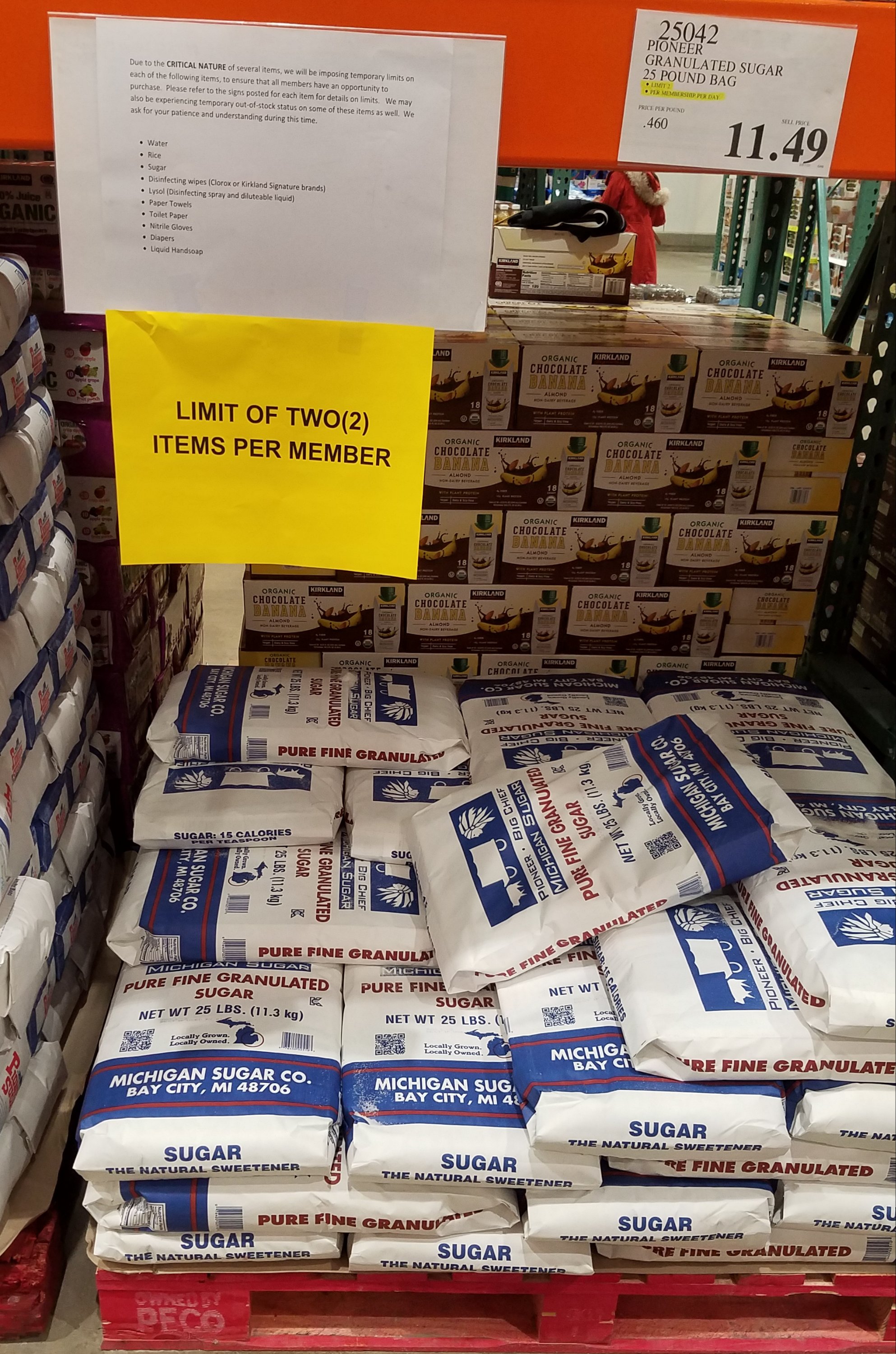
Sugar rationing at Costco Wholesale, Coralville, Iowa, March 11, 2020.
We have a Costco Wholesale Club near the home, farm and auto supply store where I work two days per week.
Wednesday is my day to pick up provisions there on the way home after work. Costco sells a lot of what we use in our kitchen but especially organic frozen vegetables, milk, butter, cheese, eggs, jarred olives, tomato paste, prepared black beans, raw tortillas, flour, sugar and the like. They are a good fit for our semi-veg cuisine and we like the USDA Organic shield on much of what we buy.
Costco was rationing provisions yesterday because of the coronavirus. Rationed items included water, rice, sugar, diapers, paper towels, toilet paper, disinfecting wipes, nitrile gloves and liquid handsoap.
While waiting in the checkout line, the woman behind me commented that I had no water or toilet paper in my cart, referring to a common social media meme about “Costco panic buying.” I replied we manage our own well so we don’t buy bottled water. The person in front of me asked the cashier if this would be a record sales day for the store. The cashier replied decidedly not. One has to wonder if those rationing signs on certain items increase sales more than the social phenomenon of “panic buying.”
A crew inside the entry offered to wipe down carts with hand sanitizer. A few members wore the kind of masks I keep in the garage to prevent breathing sawdust. More than anywhere else I go, Costco is a petri dish of international human interaction, mostly because of the nearby university hospitals and clinics. I declined the sanitizer and kept a comfortable social distance from fellow shoppers. If I die of COVID-19 you’ll know it was a bad call.
News this morning is the president twiddled his thumbs while addressing the pandemic to the nation from the Oval Office last night. Pandemic response seems outside his wheelhouse. The World Health Organization identified the coronavirus as a pandemic about the same time the president was preparing his speech. Also in that time window, actor Tom Hanks and his spouse were diagnosed with COVID-19 in Australia. At least the rich and famous can get a test kit and have results reported.
At the end of the day it was a regular experience, one among many. Our best chance to survive is to listen to health professionals and work to follow their guidance. That can be done. It’s all part of sustaining a life in a turbulent world.
The surface of the ground crunched as I walked the compost bucket out to the bin. The ground was frozen.
Grass has been greening up with the recent rain and ambient temperatures above 70 degrees. The frosty morning wasn’t a permanent setback as green grass was visible through the glaze of frozen rain.
Farmers have produced first batches of maple syrup, so it’s undeniable spring is close by. This in-between time on the margin of winter is unsettling. I want to get going on the garden… but not yet.
The sound of bird songs returned. Voices of children playing outdoors are evident. The trickle of water in the downspout informs us of the spring melt, that despite crunching under my boots it won’t be long.
This weekend was unsettling beginning with Friday’s news that OPEC couldn’t reach consensus on reducing crude oil supply. Russia dissented. In response, Saudi Arabia decided to slash prices and increase production by as many as 2 million barrels per day.
“This OPEC summit was among the worst meetings I have ever seen during the history of this organization,” Bijan Zanegneh, Iranian petroleum minister told reporters on Friday.
Oil prices fell so far, one could purchase two barrels of crude for less than the cost of a liter of Purell hand sanitizer in Manhattan.
Futures trading in the 10-year U.S. Treasury note yield dipped below 0.50 percent for the first time ever last night. It should be hella day when markets open this morning. One aspect of our being in debt is we own no stocks and therefore are insulated from daily market peaks and valleys, but still…
Speaking of hand sanitizer, Iowa Governor Kim Reynolds announced last night the first three cases of coronavirus have been diagnosed in Iowa. The individuals live in our county seat and have been quarantined at home. I’m weighing whether or not to attend meetings in town this evening because of it. National leadership on identifying the emerging risks of coronavirus, and doing something to prevent a national crisis over the pandemic, has been absent. Our local warehouse club was rationing basic food stuffs, even though few Iowans seem likely to starve if they have to stay home for a while to avoid contact with the disease.
Also Sunday night, Yonhap News Agency of South Korea reported North Korea launched three projectiles toward the East Sea. The projectiles are believed to be missiles being developed as a result of stalled talks over denuclearizing the Korean peninsula. The U.S. is not leading efforts to rid the north of nuclear weapons, but rather seeking to distract us from our own nuclear complex modernization and testing of new nuclear weapons. American leadership is absent in compliance with Article 6 of the Nuclear Non-proliferation Treaty.
Changes announced this weekend include the orchard where I worked the last seven seasons. On Friday they posted job openings for my manager and the bakery manager, who have worked there since before the current owners bought it in 2009. There have been discussions about extending the season to include other activities and produce for a couple of years. It looks like plans are coming to fruition (yes, that’s an apple joke), which means changes in staffing to accommodate new demands.
We’ll see if I’m invited back for the fall season, and if I am, whether I would work for a new manager in a new retail environment. Our personal situation has changed since 2013 when I first applied for a job there. The changes at the orchard are evidence of the shifting sand of a small business trying to survive in a competitive marketplace. If the job ceases to be fun, I won’t return.
Why all this now? It may be the beginning of all the wheels coming off the wagon of society. Whatever the causes, it is going to be a rough ride at least through this year, and maybe for a lot longer.
When I returned from my Sunday shift at the farm I walked the garden. It’s still pretty barren, garlic hasn’t begun to emerge. The plot where I sowed lettuce was dry with a few deer footprints in it. I went to bed worried about late winter drought. When I woke there was rain against the bedroom window. Welcome relief from the dry spell and a sign that all hope is not lost.
One of the roles I play in society is secretary of the Macbride Sanitary Sewer District, a public entity that manages wastewater treatment for our group of about 84 homes. I recently spent time writing a questionnaire about water softener usage and tabulating the results from a user survey. The report I sent to members this month has broader application so I’m publishing it here for my WordPress community. Your feedback would be welcome.
Thanks to the 66 home owners who submitted a survey on home water softener use. Before discussing the survey results, you may be wondering why we are working to reduce chloride in our wastewater. Short answer: the rules changed after our previous NPDES permit expired. Our new one, issued May 1, 2017, has new requirements for chloride and other elements. Here is some information about the new standard from the Iowa Department of Natural Resources which manages NPDES permits for the U.S. Environmental Protection Agency:
Iowa adopted water quality standards for chloride and sulfate in November 2009. These two new standards replaced the previous water quality standard for total dissolved solids. “Total dissolved solids” is a measure of all chemical elements that have become dissolved in water. It includes chloride, sulfate, nitrate, sodium, potassium, and magnesium, among other chemicals. The total dissolved solids standard was designed to protect aquatic life from toxic conditions caused by these chemicals. However, research by DNR showed that in Iowa waters, chloride and sulfate are more accurate predictors of toxicity to aquatic life than the combined measurement of total dissolved solids. DNR thus undertook to replace the water quality standard for total dissolved solids with specific standards for chloride and sulfate.
Of the people who responded to our survey, 31 use a timed-cycle water softener, 30 use on demand-initiated cycling, and 5 didn’t know.
Reported annual salt usage ranged from zero to 2,000 pounds. 20 homes used less than 250 pounds, 21 between 251 and 480, 15 used more than 480 pounds, and ten didn’t know.
A couple of things are clear from the data: 1. Many people don’t think much about their water softener or keep records about how much salt they use. One 40-pound bag per month is 480 per year and several people used that as an estimate; 2. We use a wide variety of brands of water softeners. Kinetico was most popular. There are a half dozen others; 3. Most families installed their softener and seldom had maintenance done on it; 4. The three most popular plumbers were Water Conditioning Systems (Kinetico), Affordable Soft Water, and Neal’s Water Conditioning; and 5. Most homes have a separate line to run untreated water outside for lawn, garden and cleaning.
What should home owners do regarding salt use?
Contact a plumber to have your water tested for hardness and your water softener checked for proper functioning and adjustment. Have the plumber program your softener to a low-salt setting appropriate for the water hardness in your home.
If you plan to replace your water softener, get one that cycles based on demand rather than on a timer. This will ensure all the water used is properly softened and save salt if your usage is lower.
Install high-efficiency water fixtures, like low-flow shower heads, to reduce your home’s soft water use.
Have a plumber disconnect water that doesn’t need to be soft, like toilets and lines to outdoors, from the water softener.
If your household is using more than 480 pounds of salt annually look at replacing your water softener to take advantage of new technology and use less salt. A new Kinetico softener will use about 250 pounds of salt annually for a household with two people.
Water is not an unlimited resource so develop creative ways to conserve water at home, such as taking shorter showers, running only full loads in the dishwasher and clothes washer, and turn the faucet off when taking care of personal hygiene or doing dishes — break the bad habit of letting it run. Consider getting EPA WaterSense-certified toilets which use less water for flushing.
At this time the Macbride Sanitary Sewer District is not considering a mandated salt reduction program. We are to be in compliance with the new chloride standard by April 1, 2022, and if voluntary efforts produce the desired results, that will be that. If we don’t meet standards, the board of trustees will revisit the issue of more specific requirements.
State Senator Liz Mathis (L) and State Representative Molly Donahue at the Ely Public Library, Ely, Iowa. Feb. 29, 2020.
It should be no shocker that I attended a political event on Saturday. How could I miss it? It was six miles from our house.
State Senator Liz Mathis represents the 34th Senate District in the Iowa legislature. Alongside State Representative Molly Donahue, who represents House District 68, they hosted a legislative listening post at the Ely Public Library.
The closer one gets to Cedar Rapids, the more likely we are to encounter kolaches, a traditional semi-sweet roll originating in the Czech heritage of Iowa’s second largest city. Mathis pointed out the box of kolaches in the back of the meeting room soon after my arrival. About 16 people attended.
I was in graduate school in Iowa City when Mathis began her broadcast news career at KWWL at their then new Cedar Rapids bureau. She has been a broadcast anchor, television producer, college professor, and is currently an executive at the non-profit organization Four Oaks Family and Children Services. Donahue has been a teacher for 30 years with a current focus on secondary students in special education or those who have behavior disorders that can affect their learning. They were well qualified to discuss Iowa’s mental health system, school safety, the K-12 education budget, the school bus driver shortage, and related topics. I listened and tried to learn.
News on Friday was Pattison Sand Company of Clayton sought to extract 34 million gallons of water per year over a ten-year period from the Jordan Aquifer, according to Perry Beeman of Iowa Capitol Dispatch. The water would be shipped by rail to arid regions in the American west, potentially to New Mexico, Colorado, Wyoming, Nevada, Utah, Arizona or California. The Jordan Aquifer is also the source of municipal water for the city of Marion which lies within Mathis’ senate district.
Earlier this month Pattison proposed to extract 2 billion gallons per year from the Jordan Aquifer using wells they drilled to support their frack sand mining operation. This proposal was rejected by the Iowa Department of Natural Resources.
The problem with tapping the Jordan Aquifer is it is prehistoric water, in other words, it has been there a long time. The aquifer does not recharge at the same rate as the Silurian Aquifer which lies on top of it. Once the Jordan Aquifer is drained, the water will be gone and communities that currently rely upon it could be left without a reliable water source.
The climate crisis is evident in the American west. Demand for water exceeds the region’s capacity to produce it through rainfall, snow melt, and underground aquifers. Something’s got to give for people who settled there to survive. Mining and shipping water from Eastern Iowa is not a good idea because what may be abundant to meet our current needs will be diminished by the extraction proposed by Pattison and others. It is easy to see how a discussion over water rights could escalate into regional conflict over this basic human need.
If we look at history, humans have continued to exploit natural resources until they are gone, in many cases leading to the collapse of societies. Our brains are not wired to perceive the threat shipping billions of gallons of water from Iowa to the west could have. We have to pay attention, and the role of government is to look out for the common good.
It is hard to image an overall plan to resolve the climate crisis at its root causes. Further exploitation of natural resources doesn’t solve anything and could potentially make matters worse. At least we were discussing it and in doing so raising awareness on a sunny morning in Ely over kolaches.
The driver delivering pallets of yard and landscaping stone, peat moss, and dirt said his spring deliveries are running about two weeks behind last year.
We just finished our annual inventory at the home, farm and auto supply store and are ready for incoming freight of garden supplies, utility trailers, wheelbarrows, fertilizer, three-point farm equipment, and the like. I unloaded a pallet of 50-pound bags of seed potatoes. The greenhouse will be installed in the parking lot next week. Spring seemed late to our suppliers but it’s almost here.
It’s more like we didn’t have a winter.
In a retail warehouse we notice the seasonality of commerce. Shelves fill with mowers, trimmers, blowers, chain saws and tillers. We received two tall pallets of box fans. Large ceramic pots were shipped in crates from Mexico. We have a delightful collection of ceramic and metal rooster art. This entire post could be a repetition of inbound inventory processed during my two days per week part time job. I have something else in mind.
The intersection of commerce, private lives, spirituality and society is where we spend most of our lives. In time, if we are lucky and talented, we create a process of living that ensures our survival. In Eastern Iowa it is pretty straightforward how one secures food, shelter and clothing: seek training and then work as a skilled professional, an entrepreneur, or for someone else. There is no guarantee of success but most people in my circle make it, including those who are forced to live in their cars because they are poor, or who sleep on someone’s couch for a while due to physical abuse at home. We live a privileged life despite the real problems people have.
There is a sense our process of living, for lack of a better description, is built by us, for us, and there is separation from what others do. That’s okay. If we have more in common than we believe, the articulation of a life can be a conscious effort with variations in the use of materials from a mass society. We make something of our selves. Such a process may seem individualistic, bordering on taking care of “me only,” but it is intertwined with the fate of the society which provides context.
I may subscribe to the local newspaper, but so do a thousand other people, our subscriptions and advertising giving life to the enterprise. In a few brilliant moments I find my life has not been consciously nurtured, nor has it been self made. It has been a collaborative undertaking in a social network from which I emerged and in which I remain rooted… kind of like the newspaper.
I read an article about the high cost of prescription drugs. The Congress is working to lower the cost of such medicine, yet to date their work has been an utter failure. People are skipping medically necessary prescriptions because of the cost, Megan Leonhardt of CNBC reported. There is another side to this issue.
Over the years I’ve had several conversations with physicians, and now my nurse practitioner, about taking prescription medicine. Just like finding a good auto mechanic or a reliable technician to work on my yard tractor, it is part of a process for living. Every time a medical practitioner suggested a prescription — either to control cholesterol or prevent Type II diabetes — I pushed back.
I have been able to address each diagnosis through behavioral changes coupled with regular visits to the clinic. These physiological conditions may persist, and at some point I may have to accede to medication. Last year I took a small step and began taking a low-dose aspirin in addition to my daily vitamin B-12 tablet. We’ll see how things go during my follow up appointment later this year. My point is when we focus on the failure of our government to properly regulate the pharmaceutical industry we neglect focus on a process for living. Having a process for living is more important than what our government does or doesn’t do.
I feel life in society all around me. Maybe that is a Cartesian outlook, one rooted in my earliest memories of reading at home before breakfast, after being an altar boy for Catholic Mass at the convent. Despite whatever separation I feel in intellectual outlook our future is inseparable from its context. The fate of our society is complexly intertwined. To separate a single strand of it in the form of an individual life, from the broader organism, would be to our mutual detriment.
I don’t understand how we will manage the many challenges we face — environmental degradation, climate change, economic inequality, the threat of conflict, and diminished natural resources. I do know that without a process for living that recognizes the web of life that engendered us, that brought us to this moment, we may not be up to the challenge. Humanity’s well-being will predictably decline. I’m not ready to say it is inevitable. I don’t believe it is.
Yet so much depends on the observations of truck drivers who pay attention to the variability in our lives — and together try to make them better.
On certain days the weight of civilization is crushing.
Despite occasional good news, our steady decline into the abyss seems imminent.
Signs of it are everywhere.
Iowa is a manufactured place. The wilderness that once existed here is gone. It was the first thing to go after the Black Hawk War. A few stands of oak-hickory forest remain but not many. Instead we have endless miles of farm fields fenced neatly on the landscape. With the ancient forests so went our dreams.
It’s an ersatz life we created, lived in a wake of environmental destruction. We do the best we can. Row crop fields look dull, almost gray. It feels like we are in end times.
That’s not to say there is no hope of improving our lot. The political will to do so is in remission, gone like big groves of trees that used to live here. New trees could grow yet someone must plant them. It would take more time than is left in my life to restore what used to be. I wait. For what?
Snow lingers on the ground as I plan the gardening season. We have to eat and what we grow is better than what can be bought in retail outlets. The cycle of gardening and harvest inspires hope that our efforts will produce something. We keep at it.
All the while, the gray, predawn sky reminds us of a new day’s potential. Today comes down to what we will do to make the most of it, to get along with others, to be kind.
Pulling plastic at Wild Woods Farm, Feb. 23, 2020.
Sunday a group of us gathered at Wild Woods Farm to pull plastic over the new greenhouse.
Pulling plastic takes a couple of experienced team leaders and a crew that can follow directions. The idea is to make the plastic covering as taught as possible then secure it with wiggle wire for years of use. The work proceeded as planned on a warm, clear and calm day.
It’s pruning time for grape vines, fruit trees, and any kind of tree. This weekend people were pruning in t-shirts because it was so warm. The concern is sap begins to flow before the cuts heal, creating an entry point for disease. Fingers crossed I got mine pruned in time. Folks are preparing to tap maple tree sap for syrup so we are at the in between time for finishing pruning.
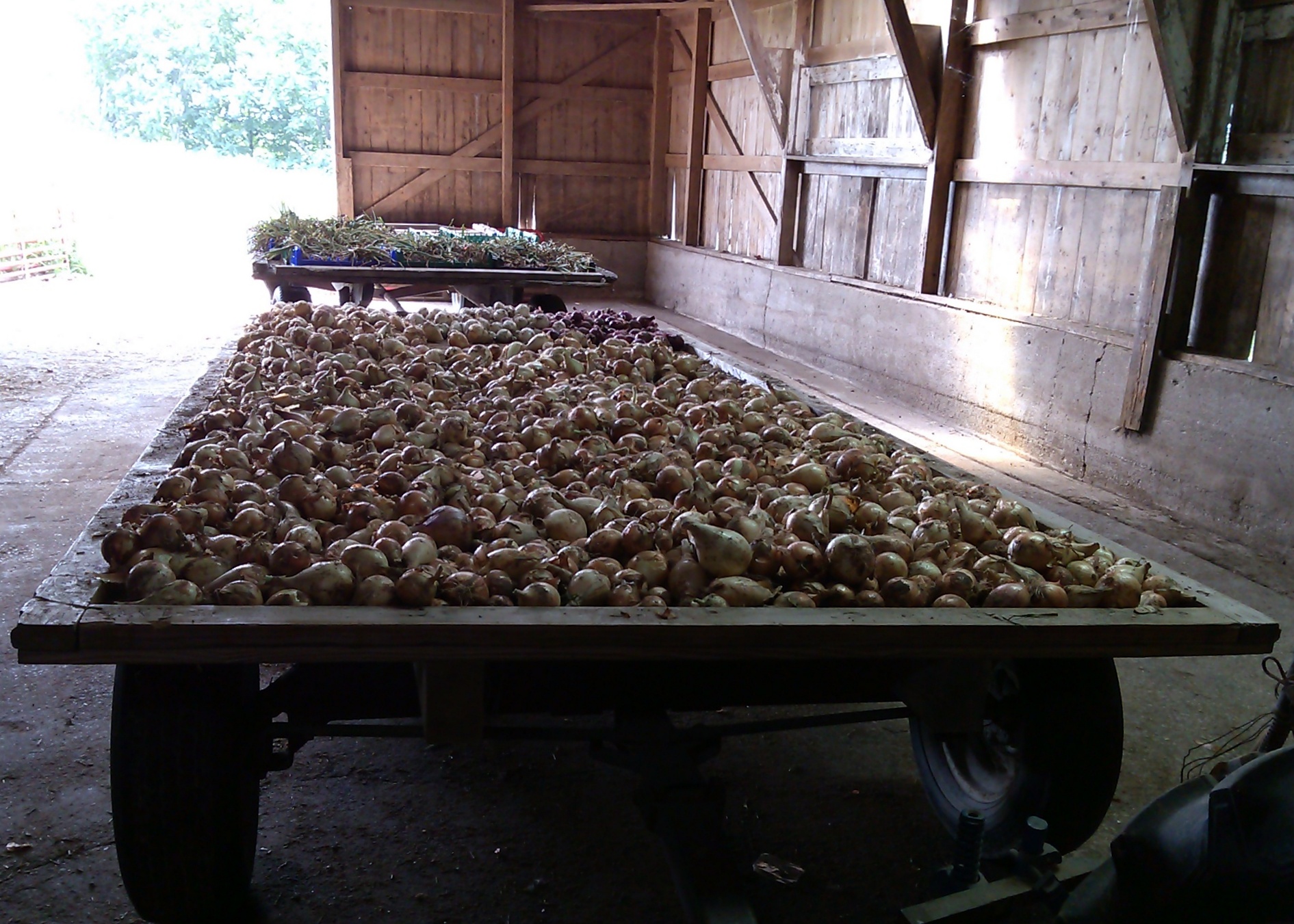
My onions and shallots have sprouted and I moved them to the landing to get more light. They seem feeble at this stage. I’m not sure what else I can do but make sure they have moisture and light. This is the second year I tried starting them myself. The first didn’t produce usable onion sets. This year’s experiment is for the crew at Sundog Farm to start some of my shallot seeds as well to compare results. Eventually I’ll get this right, hopefully this year.
While garden and yard work beckons it is still winter. Piles of snow remain on the ground. Snow is forecast this week. There is hope for spring, but it is a false hope. It’s best to use the time to catch up on indoors work so when true spring arrives we are ready.
Eight years ago I attended a local food summit in Iowa City with more than 80 people. It was an event designed to connect local meat and vegetable growers with customers.
Among the speakers was Andy Dunham of Grinnell Heritage Farm. He spoke about the challenges of scaling his carrot production to meet consumer demand at New Pioneer Food Coop in Iowa City. It made no sense at the time they couldn’t produce more, although eventually they did.
Yesterday Dunham revealed New Pioneer and other grocers weren’t buying as much organic produce as they had. Because of decreasing grocery sales and Iowa’s unpredictable weather made worse by climate change, they are exiting their community supported agriculture business and what they characterize as a broken local food system.
It was a surprising decision from a farm many considered to be vibrant and sustainable.
For the full story about changes at Grinnell Heritage Farm read Cindy Hadish’s post on Homegrown Iowan here.
The idea there is a functional “local food system” is a story we tell ourselves to get through the challenges of raising and marketing locally grown meat, vegetables, fruit and flowers. The challenges of sustainability for a community supported agriculture project don’t go away be saying these three magical words. It’s hard work, subject to the vagaries of weather, cultural adaptation, marketing, and endemic farming challenges.
Each farm runs differently with unique revenue streams from CSA shares, meat sales, restaurant and grocery store sales, farmers market sales, government programs, pasture rentals and more. In the world of big agriculture operators carve a niche of customers and product lines to keep themselves financially sound. It doesn’t always work.
Grinnell Heritage Farm is a USDA certified organic fruit and vegetable farm. Most local food producers are not certified organic because of the expense. Many follow organic practices but can’t afford, don’t want, or don’t feel a need to get certified. Most consumers can’t tell the difference in farm products. For Grinnell Heritage Farm to downsize is a bad sign for the future of organic farming in Iowa. If they can’t make it, who will?
Climate change is real, it is happening now, and we haven’t seen the worst of it. The last two years were hell for local food farmers used to predictable growing seasons. Variation from year to year is expected, but not like this. Larger operations like Grinnell Heritage Farm feel the brunt of changing climate.
Consumers are a fickle lot. Yesterday I calculated spending about 24 percent of our 2019 food budget on locally sourced fruit and vegetables. We buy more local produce than most regional consumers. We also have a large garden not included in my calculation. A bag of locally grown carrots is stored in the crisper drawer of our ice box yet I buy USDA certified organic carrots at the wholesale club as well. I haven’t been able to grown enough carrots to meet our needs and the ones from the store are cheap and serve culinary purposes. I know the face of the farmer on the local food I buy but they and I combined can’t supply our household with enough carrots.
The changes at Grinnell Heritage Farm were surprising, but not completely unexpected. With growth in the market share of organic produce, large corporations are getting involved and comparatively smaller operations are being pushed out. Whatever arguments one might have with Dunham’s characterizations of the marketplace or his assessment of the impacts of climate change, he and his family are doing what they believe will save their farm. That’s what all insurgent local food producers do.
As consumers we need to be ready to support local food farmers or decide we don’t care. Either choice has ramifications for our local food environment. I can’t call it a system today because a big part of it will be lost with the exit of Grinnell Heritage Farm from the marketplace.
We had hoped for and worked toward a local food system and could imagine it. The dream hasn’t proven to be sustainable yet.
On Thursday, Jan. 23, the Johnson County Supervisors appointed me to fill a vacancy on the Food Policy Council.
There were eight applications for the position according to county records. Supervisor Janelle Rettig made the motion to approve, with Supervisor Lisa Green-Douglass seconding. All five supervisors voted for my appointment.
I accepted and look forward to my first meeting. Now my part of our work begins.
The Food Policy Council was established in 2012. The county website explains its purpose:
The purpose of the Council is to improve dialogue and discussion and provide necessary advice on food and agriculture issues to the county, municipalities, community boards, local agencies, nongovernmental organizations, businesses, and other interested groups. The Council will address food system issues in the county, including the development of the Council’s Governing Principles and strategic goals, data-gathering, research projects, and policies to address food system issues.
On my Aug. 30, 2019 application I listed my reason for applying, “Have long been interested in this voluntary position and there is an opening. I have time and interest sufficient to serve. I have financial resources to be able to do so.” That seems pretty boring, a comment others have made about some of my posts here.
The contributions I hope to make by serving on the council include, “I am particularly interested in learning about and taking action to meet hunger needs in the county. I am also interested in the relationship between food, Type 2 diabetes and poverty.” We’ll see where the work takes us.
What I’ve learned on the county board of health, as a township trustee, and as an officer of our home owners association is listening is the key skill required to get anything done. I approach this new project with an open mind and a bias toward doing the most good for the largest number of people. As soon as the caucuses are done I plan to dig in.





 Journey Home
You must be logged in to post a comment.