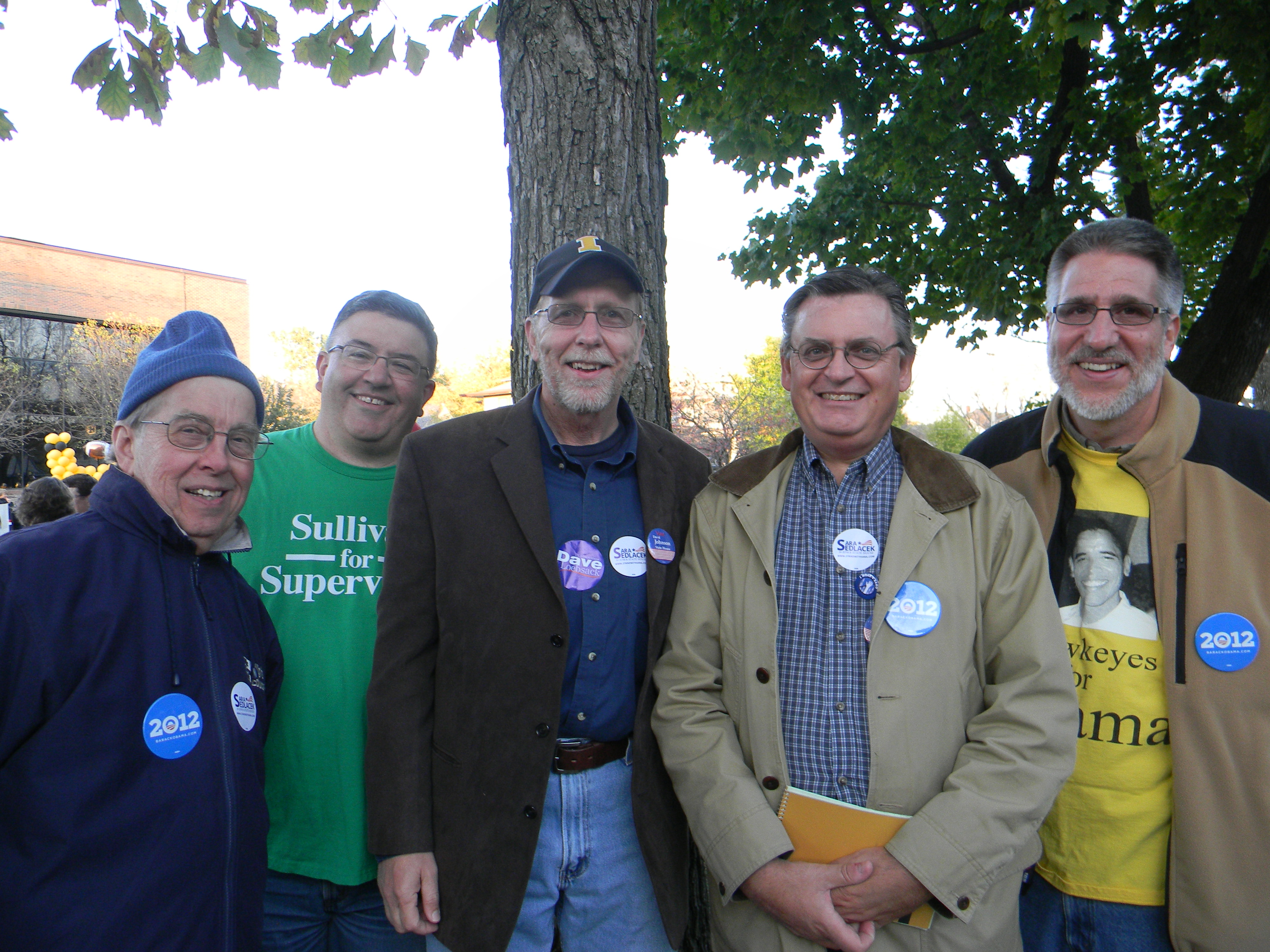
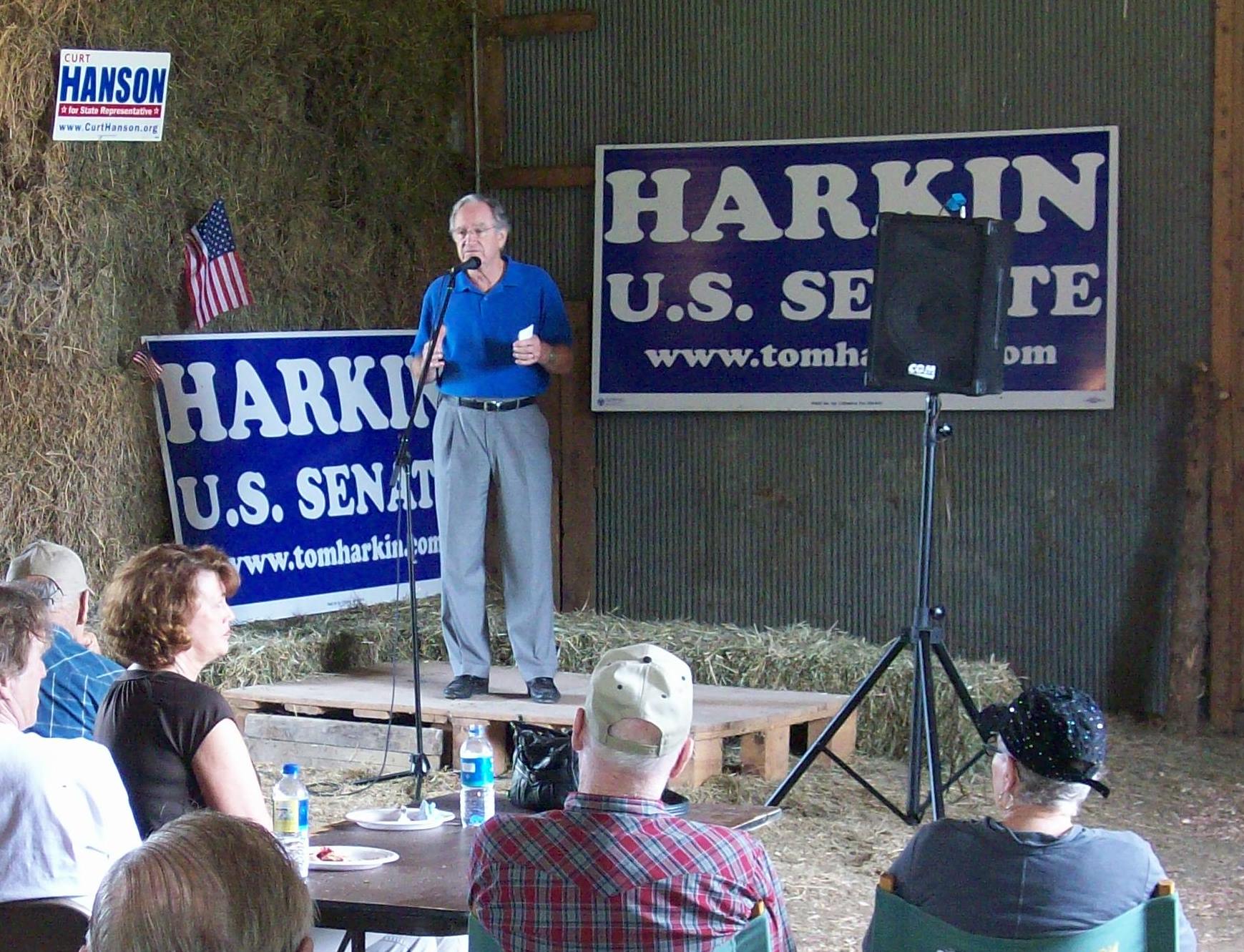
Senator Harkin Speaking at Aug. 2, 2009 Curt Hanson Fundraiser
What seems most important about last night’s Iowa House District 82 special election to replace Curt Hanson is Democrat Phil Miller won in a post-Tom Harkin era.
Iowa no longer has a Democratic U.S. Senator able to travel most counties, recount his local margin of victory to politicians and engage voters. When Harkin visited Dick Schwab’s 2012 house race in Cedar County, his presence didn’t tip the scale in our favor but gave us hope a Democratic candidate could win rural, conservative areas. A case could be made that when Harkin retired so did Democratic hopes for the state. Democrats fell apart, first by losing his U.S. Senate seat, and then by crafting a spotty effort to support Hillary Clinton for president. Given the scale of President Trump’s Iowa win, such hope is needed.
If you want election night analysis, read Bleeding Heartland’s detailed report on the numbers and potential meaning for Democrats by clicking here.
Here’s the crux: “Today’s result is proof that good Democratic candidates can still compete in Iowa’s smaller towns and rural areas where Republicans made huge gains up and down the ticket in 2016,” DesMoinesDem wrote.
It is significant that one of Iowa Republican Party chair Jeff Kaufmann’s stated goals for 2017 is to shore up support among “new Republican voters.” In a July 27 article in the Cedar Rapids Gazette he said of his “new voters,”
I’m worried about them because, in general, what they know is Republicans have control and Republicans aren’t doing what they promised, even though individual congresspeople and senators are doing what they have promised… The people that are less informed about the process, yes, I worry because it contributes to a climate that we’ve given you what you’ve asked for and we haven’t delivered.
I hope the House District 82 election results give Mr. Kaufmann something else closer to home to worry about.
The test for Democrats will be whether they can walk and chew gum at the same time in 2018. It is one thing to concentrate resources on a single race and win, quite another to turn the Iowa house, senate and governor’s office Democratic again. Democrats have done it in Iowa with mixed results. Governor Harold Hughes’ term beginning in 1964 was notable and largely successful. Governor Chet Culver’s 2006 term hangs like an albatross around neck of the Iowa Democratic Party.
Democrats can have a drink to celebrate Miller’s win thanks to Harold Hughes’ revamping Iowa’s alcohol control system and legalization of “liquor-by-the-drink.” This morning after they can hopefully develop momentum toward additional wins in 2018.
Dr. Phil Miller’s win last night provided evidence hope is alive.
There’s a school board election Sept. 12 in the Solon Community School District and I’m pumped! We all should be jazzed if we care about K-12 education.
Like Ahab hunting Leviathan I believe big voter turnout in school board elections is possible. History shows me wrong — in the 2015 school board election only 281 people turned out at the polls. History notwithstanding I encourage people to vote in every election.
Current school board president Dick Schwab was involved with the 2014 general obligation bond voters approved by 71 percent.
“I’m delighted. I couldn’t be happier,” Schwab was quoted in the Iowa City Press Citizen as saying at the time. “We obviously have a lot of work to do; we’re basically on a path to make the district even better and these are resources that will help us do that.”
He was right. We see the physical plant improvements the bond made possible: notably a middle school and the performing arts center. Compare that to this year’s Iowa City Community School District bond proposal and Solon’s bonding process was no drama, no tax increase, results only.
Many of us will miss Dick Schwab when he leaves the school board.
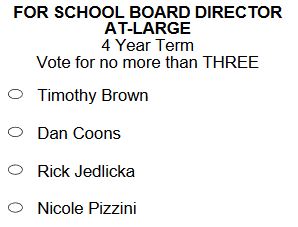
When the filing period for three school board positions closed Aug. 3, Schwab’s name wasn’t among the candidates. The four who did file include current board members Tim Brown and Rick Jedlicka, and Dan Coons and Nichole Pizzini. Presuming the incumbents will be re-elected, Schwab’s open seat is contested.
I believe every voter in the district should learn about Coons and Pizzini, make a reasoned decision, and VOTE. Admittedly not every voter will follow my advice. I also know the Solon community can do better when it comes to voting in school board elections.
Haying is a social and economic movement and around here farming takes precedence over schooling.
There’s a school board election Sept. 12 in farm country.
Farmers are buying 9,000-foot spools of Brazilian baler twine, windrow teeth, left and right handed rake wheels, baling wire, reels of bale netting and a lot more.
Tens of thousands of straw and hay bales have been harvested the last couple of weeks. Some went into bunkers and barns, some sit in large round rolls near the field, and some were sold and trucked out.
Because of Thursday’s rain showers more farmers than usual came to town. I got an update on the season from several of them at the home, farm and auto supply store. Not one talked about the school board elections.
Thursday was also the school board election filing deadline in Iowa. I live in the Solon Community School District where activities of the school board continue as background noise to a number of large construction projects. Since 2000, district resources have been invested in a new high school, a ready to open middle school, a new performing arts center, a new football stadium and a new sports complex. Except for the graduates who stayed in town, public works projects are the most visible aspect of recent school board activities.
I tried to get the skinny about who was running for three seats in the Sept. 12 election but no one seemed to know, including current and former board members, the newspaper, and local political activists. I found out from the county auditor after the filing deadline. Four people filed for three open seats.
The terms of Dick Schwab, Rick Jedlicka and Tim Brown are up this year. Jedlicka and Brown filed for re-election and barring controversy should be easily re-elected. Former board member Dan Coons and newcomer Nichole Pizzini also filed. Schwab decided to end his long service on the board, opting to move out of state before the next school board term would have ended. That leaves his seat open for either Coons or Pizzini in this non-partisan election.
A few years back a local group, many of whom were associated with Saint Mary’s Catholic Church, made a successful, concerted effort to take control of the Solon school board. Coons and Brown were candidates the group supported. Both are registered Republicans according to Johnson County Auditor records.
Pizzini’s family has long been interested in politics. Her husband, Shawn Mercer, filed for state representative as a Democrat when Ro Foege retired in 2008. He withdrew once party leaders indicated Nate Willems of Mount Vernon was the insider pick to replace Foege. Mercer is a current member of the Solon City Council. Pizzini is a registered Democrat.
In school board elections personality matters more than politics, so the advantage goes to Coons over Pizzini from the get-go because he organized for previous campaigns and has name recognition as a former board member. There is a stunning lack of controversy about the school board today. Because of the positives of a new middle school and sports complex, the political environment favors incumbency.
In recent years, the highest vote getter in a Solon school board election was Don Otto in 2000 with 1,118 votes, according to the county auditor’s website. Word of mouth is the most effective tool to get information from the candidates to voters. Pizzini is the underdog as a newcomer, however, with smart work she could get the votes needed to win a seat. That makes the Coons – Pizzini match up interesting. The expectation is voter turnout will be low, even with a contest, so either Coons or Pizzini could activate the number of voters required to win.
In Solon there is living memory of attending the one-room school house at the edge of town. For many we are not far removed from that time and its deep roots in farming. Nonetheless, in addition to qualified teachers, adequate, modern facilities are important. Recent school boards in Solon have delivered.
I look forward to learning more about the candidates as the campaigns progress.
Image of Earth 7-6-15 from DSCOVR (Deep Space Climate Observatory)
A recent article at Nuclear News reminds us the world is on the cusp of an energy revolution.
“The cost of renewables like solar and cell batteries for electric vehicles are making the carbon-based economy obsolete, with the turning point only a few years away,” author Christina MacPherson wrote.
The age of centralized, command-and-control, extraction-resource-based energy sources (oil, gas, coal and nuclear) will not end because we run out of petroleum, natural gas, coal, or uranium,” Stanford University professor Tony Seba recently said. “It will end because these energy sources, the business models they employ, and the products that sustain them will be disrupted by superior technologies, product architectures and business models. Compelling new technologies such as solar, wind, electric vehicles, and autonomous (self-driving) cars will disrupt and sweep away the energy industry as we know it.
When we consider the use of coal in Iowa, there are many of us who remember the coal trucks plying the streets and alleys of our childhood, dropping loads of the black stuff down chutes leading to a basement coal bin and then to our gravity furnaces. Through the winter, people shoveled coal into burning embers to heat their homes. Coal ash was shoveled out and in the spring, it was tilled it into gardens and spread on fields. Coal ash was also sent to dumps. On the farm, coal was purchased with seeds, feed and grain. It was part of a background to life that did not consider the potential harm to human health we now know it represents.
Those born in the 1950s and before have living memory of how natural gas replaced coal for home heating. The conversion was driven by much lower natural gas cost compared to coal. Similarly, lower costs of renewables will drive the move away from fossil fuels. We are almost at that point, as MacPherson indicated, and the business community is recognizing the reality by investing in renewables.
A recent article by Eva Zlotnicka for Morgan Stanley reiterates this point.
Economics and improving technologies, not regulation, are the driving forces behind many of the sustainability trends in global markets today. Our energy commodities team’s fundamental analysis of power-generation economics shows that longer-term coal can’t compete with natural gas or renewables, even on an unsubsidized basis. In a recent report, the team cut its 2017 coal-burn forecast by around 4%, and now sees only a modest year-over-year improvement, with most of those gains lost by 2018, due to ongoing competition from natural gas and renewables.
The 45th president made much of reviving the coal industry during his election campaign. The trouble for him is the market is heading a direction that not even he and his fossil fuel friends can stop. He can roll back all the regulations he likes and the market will continue to drive the switch to renewable energy.
Many of us were disappointed when President Trump announced his decision to exit the Paris Climate Agreement. It was all hat no cattle.
There is almost no disagreement in the scientific community that fossil fuel use contributes significantly to planetary warming and related climate change. However, that’s not the point. What gave rise to the Industrial Revolution continues to work, and as renewable energy costs decline and become cheaper than the cost of fossil fuels and nuclear, bankers, manufacturers, and service industries will convert because it makes business sense to do so.
Add the public health, environmental, business and economic value of renewables together and a scenario where energy companies may start divesting themselves of coal and oil operations emerges.
How will the U.S. exit the Paris agreement? 45 didn’t say. Will his administration follow the four-year exit process outlined in the agreement, or will he remove the United States from the U.N. Framework Convention on Climate Change (UNFCCC), exiting in about a year? If the drivers of transformation in our energy system are economic, what whit of difference does his decision make?
The agreement posed no financial risk to the United States, according to Morgan Stanley. It seems doubtful other nations will follow the United States out of the agreement, although some may. The pursuit of the goals in the Paris Agreement by remaining countries, combined with the efforts of U.S. states and cities acting on their own, offer the best chance to reduce carbon pollution in the atmosphere.
Nonetheless, an energy revolution is going on and at this point little politicians do seems able to stop it.
I can’t believe we have to cover this Iran sh*t again.
Point 1: The 45th president doesn’t like the Iran Deal. While he twice certified Iran’s compliance with the July 14, 2015 agreement between Iran, the P5+1 (the five permanent members of the United Nations Security Council—China, France, Russia, United Kingdom, United States—plus Germany), and the European Union, each time his State Department under Rex Tillerson undercut any positives.
“Today I’d like to address Iran’s alarming and ongoing provocations that export terror and violence, destabilizing more than one country at a time,” Tillerson said in April after the first certification. According to Time Magazine, he proceeded to lay out a long list of bad things Iran is doing, from sponsoring terrorism to oppressing its own people to violating U.N. constraints on its missile program. When it came to the nuclear deal, he said it failed to ensure Iran won’t become a nuclear state in the future and said the administration was conducting a “comprehensive review of our Iran policy.”
The comprehensive review was ongoing when Tillerson made the second certification last week. The 45 administration proceeded to impose more sanctions on Iran.
We get it. 45 called the agreement “bad,” “horrible,” “stupidest deal,” etc.
Point 2: There was no question Iran was pushing the limit of the Nuclear Non-proliferation Treaty (NPT). I posted about this March 5, 2010:
The reason Iran is in the news is reasonably straightforward. As signatory of the NPT, Iran has the right to the peaceful use of nuclear technology. The trouble is that in 2003, the International Atomic Energy Agency (IAEA) determined that Iran had not been forthcoming about its uranium enrichment program, as required by the NPT. The IAEA conducted an investigation and their Board of Governors reported Iran’s noncompliance with the NPT to the United Nations Security Council. The Security Council demanded that Iran suspend its enrichment programs. The Council imposed sanctions after Iran refused to do so. When the uranium enrichment facility in Qom was made public in 2009, this heightened awareness of Iran’s apparent belligerence precipitated the current discussions between the parties about further sanctions and/or diplomacy. The corporate media latched on to an easy news story.
Point 3: President Barack Obama chose diplomacy. He initiated discussions about nuclear non-proliferation with Iran. Crazy, no? To actually talk to Iran and engage the European Union and the P5+1 states in the deal. The deal was consummated and is in effect. It stopped Iran’s nuclear program. As 45’s administration indicated with its certification of Iran’s compliance, the Iran Deal is working.
Point 4: While 45 hasn’t fulfilled a campaign promise to dismantle the Iran nuclear deal, he remains deeply suspicious of it according to a Sunday article in the Los Angeles Times. The war hawks in Washington, led by former U.N. ambassador John Bolton wanted 45 not to certify compliance. On its own terms the agreement has accomplished its purpose of preventing Iran from enriching uranium to develop technology to make a nuclear weapon, things of which they were well capable in 2009.
On any given day one might say, “who knows what the hell Trump will come up with?” In a dangerous world we should be thanking President Obama for avoiding war with Iran and stopping its nuclear program, something that can’t yet be said about his successor in the Oval Office.
It seems too early to be talking about the 2018 Governor’s race. However, people are politically active and there is a gaggle of candidates.
I have no preference today and assume they are all serious about their campaigns. Here’s my first look at the race.
I favor Corbett over Reynolds on the Republican side because I know and worked with him during my transportation career. I heard him speak in 2015 at the Climate Reality Leadership Corps training in Cedar Rapids. He did some good things after the 2008 flood devastated downtown Cedar Rapids. Because he’s still got an R behind his name, that pretty much disqualifies him for me in the general election.
On the Democratic side I’m not sure who’s who. Here’s the ones that are running or considering a run in no particular order.
I know the two women best.
This is Andy McGuire’s second bite at the gubernatorial apple (2006 being the other). Her recent tenure as chair of the Iowa Democratic Party should disqualify her for two reasons: over reliance on national campaigns for funding IDP operations, and for running an imperceptible 2016 campaign in my precinct and the ones around me where Trump won. She seems a bit tone deaf to be running again.
I like Cathy Glasson from past associations, mostly with John Edwards’ 2008 campaign. She is like most SEIU leaders I’ve met in that when she gets behind something she puts her all into it. When she says something, she means it and her policies have a lot to like. Mostly she is about the struggle working people face — with a asterisk next to “working people” indicating “strong union” in the definition. I imagine she was pissed when Governor Chet Culver would not support the union agenda. Women I know tell me they don’t see any Democratic women being able to win as governor. I don’t know, but I like her.
There’s also some men.
John Norris has the resume to be governor, but I’d rather his spouse Jackie were the nominee. I suspect his political chops will play well in the areas Chet Culver won.
Jon Niederbach’s campaign tagline is “Bold New Leadership Not Beholden To Any Special Interest.” He’s been president of the Des Moines School Board, and a former board member of Proteus, an organization that provides medical services to migrant workers. Proteus gave me a lot of insight when I was on the county board of health. I’m not sure people outside Des Moines have heard of him, so he will need to work hard on a steep hill to gain name recognition.
A number of Iowa legislators support State Senator Nate Boulton in the primary. First elected to the legislature in 2016, he’s a political newcomer who gained prominence in the first session of the 87th Iowa General Assembly. He argued diligently for Democratic positions and the governor’s office needs that kind of person. Just because he’s popular among legislators, doesn’t mean he’s ready for prime time.
Todd Prichard is from my home town and is now a state representative from Charles City. He announced for governor May 16, then last week headed for Bulgaria in the National Guard. Other than his military service, I’m not sure what distinguishes him from the pack.
Fred Hubbell is a retired business executive whose family founded Equitable of Iowa. If any among the candidates is a household name, he is. The Hubbell family donated Terrace Hill to be the governor’s mansion, and his family have been significant donors to numerous causes, including the 2008 flood recovery, United Way, Planned Parenthood, and the Iowa Democratic Party among others. He announced last week and hasn’t held political office. Hubbell is expected to have few financial hurdles in the governor’s race. Rep. Mary Mascher’s endorsement of Hubbell means a lot.
Finally, former Iowa City Mayor Ross Wilburn is exploring a run for governor. He lives in Ames and little has been posted in media about the progress of his candidacy. Wilburn’s name recognition is less than Niederbach.
A lot is at stake for Democrats in the 2018 governor’s race. Here’s what Johnson County’s Sue Dvorsky had to say:
“We will be a dangerous group of people with nothing to lose. We will be unleashed,” Dvorsky told the Des Moines Register. “We’re gonna win this time, or we’re going down for 40 years.”
Tres Leches Cake Photo Credit – Stu Spivack, Wikimedia Commons
The Cedar Rapids Gazette was sitting on the break room table last week at the home, farm and auto supply store, open to an article about IPERS, Iowa’s public employee retirement plan.
Written by Matt Sinovic of Progress Iowa, the first sentence asserted more of the usual fare from the progressive group, “Once again, Republicans in the Iowa Legislature are inviting an out-of-state attack on the economic security of Iowa families.”
Thanks, but I’d already had my allowable dose of confirmation bias that morning. I closed the paper and started my shift.
That would have been that, except my state representative, Bobby Kaufmann, raised the article in a July 21 update to his legislative newsletter list.
Finally, I want to address the conversations being had regarding IPERS. I want to ensure (sic) everyone that your retirement is safe and will continue to be. There was an unfortunate editorial in the Gazette. I am being complimentary when I call it misleading and partisan. Every two years a committee meets to ensure our retirement fund is solvent. That is all that is happening. Every two years members of both parties get together and examine our retirement system to make sure our promises can be kept. I have said it before and I will say it again: I am a HELL NO on any bill that would negatively impact the retirement promise that has been made to you.
A long-standing complaint of Blog for Iowa is the legislature does little to address long term plans for IPERS.
“As it stands, there is no long term plan for educational financing, Medicaid, IPERS or property tax reform,” Chad Thompson wrote May 24, 2005. “What we did get was some reshuffling of bank accounts and a further drain on the reserves we do have.”
When Lieutenant Governor Kim Reynolds brought up the idea of a task force to evaluate modification of IPERS last January, my nerves tensed.
Reynolds, who soon will become the state’s governor, said in remarks at a Scott County Republican Party fundraiser Jan. 26 (reported by Ed Tibbetts of the Quad City Times), that commitments already made to IPERS members would be honored. “I feel very strongly about that,” she said. However, she also raised the possibility of moving toward a “hybrid” system that would include the current defined benefit pension arrangement as well as a defined contribution component. The latter is akin to a 401(k) system that is common in the private sector.
While Reynolds’ statement garnered attention, IPERS did not seem like a high priority on its own.
On January 30, 2017, I issued a statement telling IPERS members they should be concerned about the future of their benefits.
Since that time, my concern has continued to grow. After witnessing how quickly the legislature and governor were willing to move without input from the people would privatize the investment of employees’ and retirees’ pensions. Individuals will pay more and private companies will reap the benefit.
We have made adjustments over the years to ensure the success of IPERS. We do not need to tear this plan apart, but rather continue to manage it well.
In the context of Governor Reynolds’ and Treasurer Fitzgerald’s January statements, Kaufmann’s assurances raise a flag.
I read Sinovic’s article and one of his issues is the Reason Foundation will be involved with the biannual review Kaufmann referenced.
What should we care who reviews IPERS?
The Reason Foundation, established in 1978, is part of a dark money network of wealthy libertarians that has been at work in our recent elections, according to Jane Mayer, author of Dark Money: The Hidden History of the Billionaires Behind the Rise of the Radical Right. “Reason Foundation advances a free society by developing, applying, and promoting libertarian principles, including individual liberty, free markets, and the rule of law,” according to their web site. Their tagline is “free minds and free markets.”
Fitzgerald and Sinovic are saying the cake is baked regarding the IPERS solvency review. We don’t know the result, but can get a taste of what to expect by reviewing the law Michigan Governor Rick Snyder signed this month. Here are some key features of the new Michigan public pension plan reported by the Reason Foundation:
New hires will be auto-enrolled in a defined contribution retirement plan (DC Plan) that has a default 10% total contribution rate. DC Plans inherently have no risk of unfunded liabilities, and the maximum employer share for the plan (7%) is less than what employers should be paying for the current plan.
However, if new teachers would prefer a defined benefit pension plan (DB Plan), they will have the choice to voluntarily switch to a new “hybrid” plan that, unlike the current “hybrid” plan offered to teachers, uses very conservative assumptions and short amortization schedules and splits all costs 50-50 between the employee and employer.
Uniquely, the hybrid plan will have a safeguard mechanism that would trigger closure if the funded ratio falls below 85% for two consecutive years.
And to top it off, the reform design improves certain actuarial assumptions and infuses the plan with $250 million in additional contributions to chip away at the pension debt.
Sound okay? Obviously any change will be viewed with suspicion by IPERS participants. I don’t agree with Sinovic that the Reason Foundation’s involvement is an “attack on the economic security of Iowa families.” What will annoy people is if Republicans try to slam through a hybrid plan similar to Michigan’s as Fitzgerald feared they might.
If, as Rep. Kaufmann indicated, the biannual review is simply to produce solvency, then good job for relieving unnecessary worry. As Fitzgerald indicated, “as state treasurer, an IPERS board member, and trustee of the Fund, I can tell you that Iowa has worked hard over the years to ensure IPERS is on solid ground. And we are.”
If, as Fitzgerald and Sinovic believe, the end result will be major changes to IPERS similar in scope to the Michigan law, that’s something else entirely. Time will tell. Current IPERS participants are forewarned to pay attention.
Sinovic is free to publish his opinion about whatever he is paid to advocate. However, when he posts an article like the Gazette piece he does no favors for Democrats hoping to win back seats in the Iowa legislature in 2018. Readers can see straight through the hyperbole and associate his comments with the Democratic Party. Democrats become defenders of the status quo by default, a status quo Blog for Iowa has been complaining about for 12 years.
And seriously Republicans. You have to pick a Koch network think tank for the solvency review? One that while claiming to be non-partisan favors a certain outcome?
What’s needed in public discourse is a statement of what progressives are doing to ensure IPERS is solvent. We also need a chance to win elections, something Sinovic’s article didn’t help.
Sunday my spouse and I took the public library poster she made to the fairgrounds where the county’s seven libraries have a booth for the fair which runs Monday through Thursday this week.
We parked outside Building B, went in, and slid the foamcore board into a slot. It took a couple minutes.
A friend was there setting up an adjacent booth shared by Physicians for Social Responsibility, Veterans for Peace, PEACE Iowa and 100 Grannies for a Livable Future. We chatted for a while, about raccoons, chipmunks, single use water bottles, libraries and why I haven’t attended more events. We then went our separate ways: she and her son to Village Inn, and we to buy the first sweet corn of the season from a local farmer.
I could make similar connections with many fair booth sponsors, almost anyone could.
Last night I volunteered selling tickets at Solon Beef Days, which is the annual festival near our home. We sold about 500 tickets during my shift and had a brief conversation with each buyer.
I knew the voter registration of many who bought tickets. I remembered who they supported, which elections in which they voted, when they donated, and who lived in their households. It’s not that I’m snoopy or a gossip. It just comes with the turf of political canvassing near one’s home for two decades.
Some say we should volunteer to make phone calls and door knock on political campaigns to win elections. That may have once been true, however, the electorate is going through a profound change with the rise in importance of personal computers and cellular technology. That change is not finished.
James Carville is hard to stomach these days, but during the Bill Clinton campaign his fax machine and “rapid response” was a competitive advantage no one else had. It was an innovation that contributed to Clinton’s win.
People don’t talk much about Joe Trippi but he was one of the first to understand a virtual community and its implications for political campaigns. In his book, The Revolution Will Not Be Televised: Democracy, The Internet and The Overthrow of Everything he points to the moment he understood it.
“I sat at my PC, crying and watching as people eulogized David (Haines) and mourned him the way you would a good friend.
And that is the precise moment that I got it.
I was attending a funeral on the Internet.
This was not a bunch of individual people sitting in front of a television alone, watching a sad program, reaching on cue for the Kleenex brand tissue. This was a rich, fully realized community, a world of real people interacting with each other, sharing their kids’ first steps and crying on each other’s shoulders when they lost someone they cared about, someone most of us had never met.
Now campaigns have IT staffs but the Howard Dean campaign had Joe Trippi.
Today, people can always be in touch thanks to mobile communications devices and cellular technology. They are also increasingly suspicious of someone or something they don’t know or understand. I suspect that’s natural human behavior writ large as a defense mechanism to easy and increased electronic connectivity.
It’s not that people don’t know or want to know what’s going on in the broader world. World events are filtered by members of much smaller social groups, taking on more specific meaning.
Confirmation bias, the tendency to interpret new evidence as confirmation of one’s existing beliefs or theories, increasingly plays a role in elections by drawing people into smaller, more personal networks of social relationships facilitated by electronic networking. An email, a knock at the door, or a phone call does little to penetrate such relationships in any positive way. Such personal groups may span time and distance but members are hardened into a set of beliefs that becomes resilient. That spells trouble for political campaigns trying to keep up. It deflates the value of phone calls and door knocking in political campaigns.
What to do?
My answer is pretty simple. Make friends with neighbors. Go to the county fair or a church social. Work with seniors in your community. Spend time talking to people at the town festival. Buy sweet corn from a local farmer. While these things don’t seem political, they represent a radical approach to succeeding in politics in response to the Trump phenomenon. Political operatives will adapt to the new model or hate it because small consulting firms that came up since the 2004 election may go out of business using the old one.
The potential exists for a new democratization of political campaigns but no one has cracked the code. That is, no one except Donald Trump, according to cognitive science and linguistics professor George Lakoff.
Maybe once we understand everything we like to hear on the internet is not true there will be a useful democratization of campaigns.
Until then, I’ll look forward to the next trip to the farm to get sweet corn, and my next outing tomorrow to be with people in the physical world. That’s where the action is and where the next winning campaign is being formed. Don’t get left behind.
McConnellville (Greensburg, Kansas May 7, 2007). Photo Credit – FEMA
Mitch McConnell must miss Harry Reid and Barack Obama.
Without their foil he’s got no one to blame but himself for failing to craft a legislative agenda to support the Republican president.
He tries to blame Democrats but it falls flat.
McConnell’s agenda is built on the flawed expectation that legislation can only be passed based on Republican priorities. The approach is bound to fail in a time citizens pay more attention to politics and increasingly hold members of congress accountable.
The majority leader gets credit for holding his caucus together when Senate Republicans were in the minority. His tactics were brilliant, however, since they won the trifecta in the 2016 general election he’s been like a ship without a rudder — demonstrating the craven, whining, victimized and ultimately ineffective strategy that has been present all along.
The same electorate that gave Republicans a big 2016 win will take their power away. Trouble is the corporate media narrative — that “Democrats don’t know what they stand for” will delay this inevitable outcome.
House Democratic Caucus Chairman Joe Crowley hesitated when asked about his party’s core message to voters.
“That message is being worked on,” the New York congressman said in an interview this past week. “We’re doing everything we can to simplify it, but at the same time provide the meat behind it as well. So that’s coming together now.”
The admission from the No. 4 House Democrat — that his party lacks a clear, core message even amid Republican disarray — highlights the Democrats’ dilemma eight months after President Donald Trump and the GOP dominated last fall’s elections, in part, because Democrats lacked a consistent message.
Many of us remember Bill Clinton’s famous campaign assertion, “it’s the economy stupid.” It made for good press stories almost three decades ago. Today the Democratic Party is both more diverse, and part of a larger electorate where party registration is less important. A simplistic and all-encompassing, “core message” would be so watered down as to render it meaningless. The fact there are political parties at all is less relevant than the cultural aspects of an electorate that can turn an Obama voter into a Trump voter. The narrative “Democrats don’t know what they stand for” is fake as a three-dollar bill. Just ask a Democrat and they will tell you what they stand for.
Democrats should not hope for relief from McConnell’s craven allegiance to libertarian financial backers. The Senate majority leader is a pawn in their game, one being played in shadows by a dark money network. A media narrative about Democrats lacking a consistent message plays to dark money strengths by asserting the problem in politics is us, not them.
In response to a Republican majority, Senator Chuck Schumer has been able to hold his caucus together, at least on the first couple health care bills. As Mitch McConnell’s tenure in the minority demonstrated, such tactics may create some wins, but are no substitute for strategy.
The trouble in McConnellville is different from the media narrative about Democrats. The majority leader’s expectation Democrats should join Republicans to craft legislation is laughable. The fact of voter engagement in politics by contacting elected officials effectively shut down the first three Senate proposals for repealing the Affordable Care Act. Voters are becoming more a part of the legislative mix than any political party is willing to acknowledge. Democrats should pay attention to this dynamic and leverage it for wins in 2020 and maybe 2018.
Here’s a core message for partisan elected officials, “we’re the party that doesn’t do stupid stuff.” That’s a message that makes sense. How I wish it were true.
61 million beneficiaries — retirees, disabled workers, spouses and surviving children — will get an increase in monthly benefits. The forecast increase is 2.2 percent or about $28 per month on the average payment of $1,253. Not a lot, but something.
In low wage work world, where I spend a lot of my time, I meet sixty-somethings and we talk about Social Security. They have it figured out. They’d better take what they can from Social Security as soon as they can, because one never knows if the program will be around or for how long. The presumption is the Congress will do nothing to preserve it. I’ll tell you I’m living with a bunch of spoons. That’s to say, none of them is the sharp knife in the drawer when it comes to Social Security.
“Neither Social Security nor Medicare faces an immediate crisis — they both currently have surpluses,” Stephen Ohlemacher of Associated Press wrote. “But the trustees warn that the longer Congress waits to address the programs’ problems, the harder it will be to sustain Social Security and Medicare without steep cuts in benefits, big tax increases or both.”
Those “steep cuts” and “tax increases” need not come now, as some Trump Republicans have been suggesting. The program does need reasoned consideration about who we are as an American society and what, if anything we will do to keep people out of poverty as they exit the work force. The Congress won’t address it unless there is interest from the electorate. In a time when people have U.S. Senator phone numbers on speed dial, “interest” means often and specific contact repeated over and over.
Hillary Clinton concisely stated her position during her 2016 presidential campaign.
“We can never let Republicans cut or privatize Social Security — we should protect and expand it,” Clinton tweeted on June 3, 2016.
Clinton’s statement aged reasonably well despite other options. However, it’s useless for prominent personalities to address the long term issues Social Security faces if people who will use the program don’t speak up.
I encourage people to speak up about Social Security because its future is not guaranteed. A word of advice. Before you open your mouth and remove doubt you are an idiot, learn about the Social Security program here. No need to read all 269 pages of last week’s report, but familiarize yourself with the summary beginning on page two. Once armed with knowledge, and potential questions, contact your federal elected officials and suggest we should protect and expand Social Security now. You’ll be doing yourself a favor.
You must be logged in to post a comment.