BIG GROVE TOWNSHIP— Shares are ready at our community supported agriculture farm late Monday afternoon. When making my pickup, I also help load the truck for the Cedar Rapids distribution. It’s a half hour job and my work for food arrangement continues for another ten weeks or so. Loading coolers and crates full of cucumbers, squash, kale, potatoes, onions, basil, tomatoes and other vegetables is not physically demanding, but it is a two person job. It takes a community to get everything done at a CSA farm.
It rained last night, leaving wet spots on the driveway. When the sun rises we’ll see how much fell. This morning’s clear sky, bright with stars and moonlight was memorable for its predawn tranquility.
Before leaving the landscape illuminated by moonlight, I reached out to touch the sky with its shiny orbs twinkling through the atmosphere. Reaching is one thing, touching quite another. The airy vapors of predawn dew wetted my feet through the clogs, and captured my attention, leaving the moon forsaken. Grounded in this reality, I returned to the house to get on with a life on the Iowa prairie.
LAKE MACBRIDE— More has been written here about zucchini than any vegetable of late. In an effort to figure out more ways to prepare and preserve it, I posted a note on Facebook. It proved to be beneficial.
Not only did I receive good suggestions on how to prepare the vegetable, several ways to dispose of excess were identified. This is an inherent part of a local food system— social networking to resolve issues like an abundance of zucchini.
It’s not that I have been short of recipes, I haven’t. So far, I have prepared crudites, toppings for salads, soup, zucchini fries, baked zucchini, a squash casserole, zucchini lasagna, mandolin sliced zucchini pasta, and as soon as there is eggplant, the classic zucchini dish— ratatouille.
There were new ideas for cooking. A friend wrote, “Oh and re. Zucchini— they’re never to big to stuff! That’s what we do. Cut in half length wise, core out the seeds. In the depression add your favorite things For us that’s lots of walnuts, mushrooms, celery, rice? and what ever else you have laying around— almost anything can make for a fine stuffing. Use favorite spices. Melt Cheese on Top. Enjoy again, and again.”
“A friend had a pretty good recipe for “mock apple pie” that was made with zucchini and a lot of cinnamon.”
“Sliced in half with some olive oil and garlic salt, then grilled. We’re also big fans of zucchini bread.”
“I just shared a thing about oven baked zucchini chips. never heard of them done that way before myself, but could be worth a try.”
What else to do with excess? There were people that wanted some to eat. Also here are some comments:
“Chop them up and feed it to the chickens. They love zucchini.”
“right to the compost”
“Sounds like you have the basis for a cottage industry… upgrade the packaging and sell frozen zucchini for those of us who aren’t in a position to have any in our own freezers!”
“Contact the veterans shelter house in Cedar Rapids, … they have storage and will distribute green grocery items to their homeless veterans.”
…and there is my favorite, trade zucchini as chicken feed for farmer’s eggs.
As we savor the most recent pick of zucchini, we’re far from exhausting the possibilities. And thanks to social networking, we’re better together.
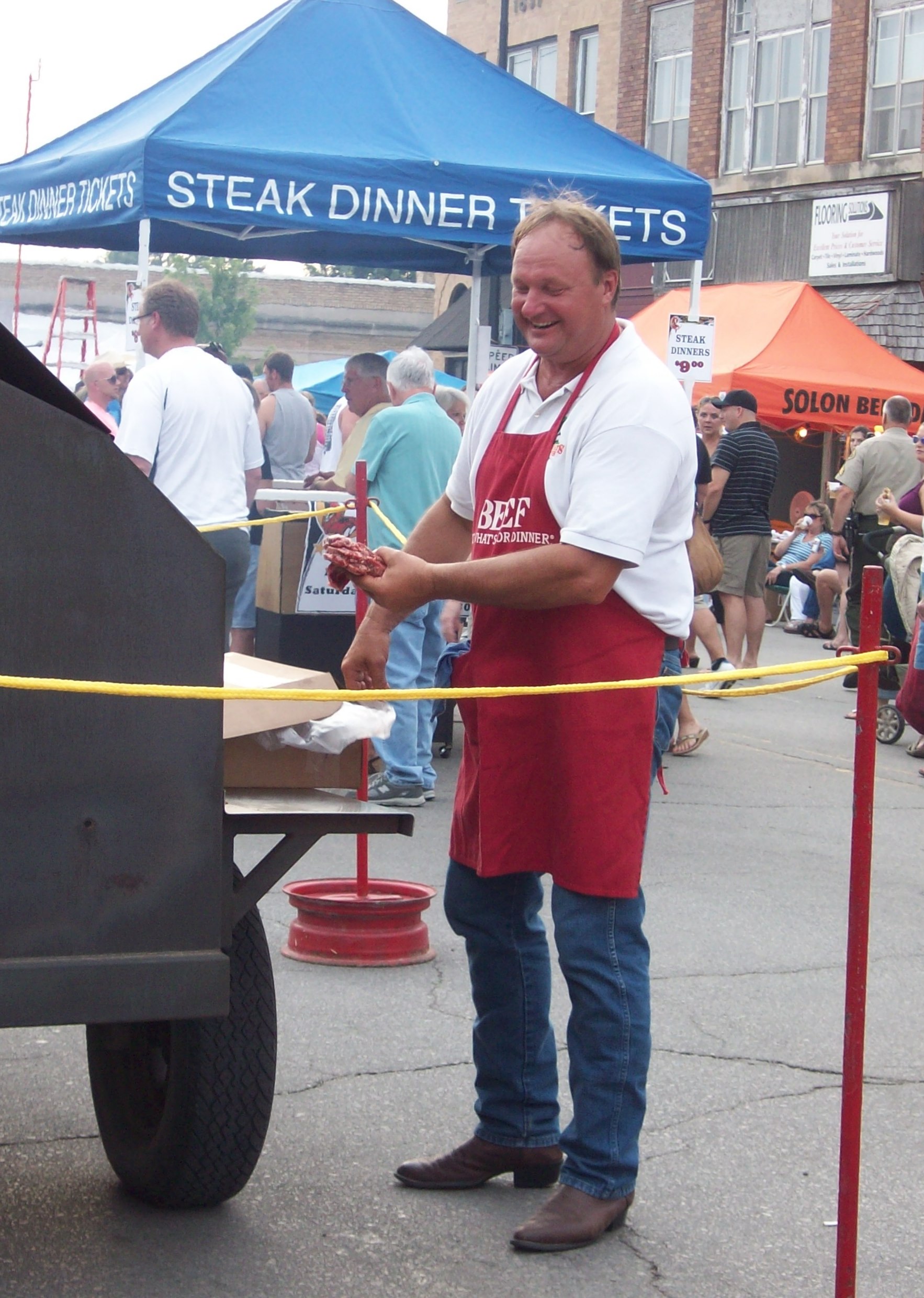
SOLON— Almost every small town or city has an annual festival and ours is going on this weekend. Solon Beef Days began in 1971 when the fire department, Optimists Club, Jaycees and American Legion got together to re-enact what they referred to as an “Old Time Celebration.” The Johnson County Cattlemen’s Association came in to cook steaks and this local meat product provided a name for the event. Later, the Pork Producers Association got involved and pork burgers are now served: steak dinner is $10; steak sandwich is $5, and pork burger is $3. A bargain for carnivores. Octogenarians walk to the festival to purchase the cheap food and carry it home on trays brought from their kitchens.
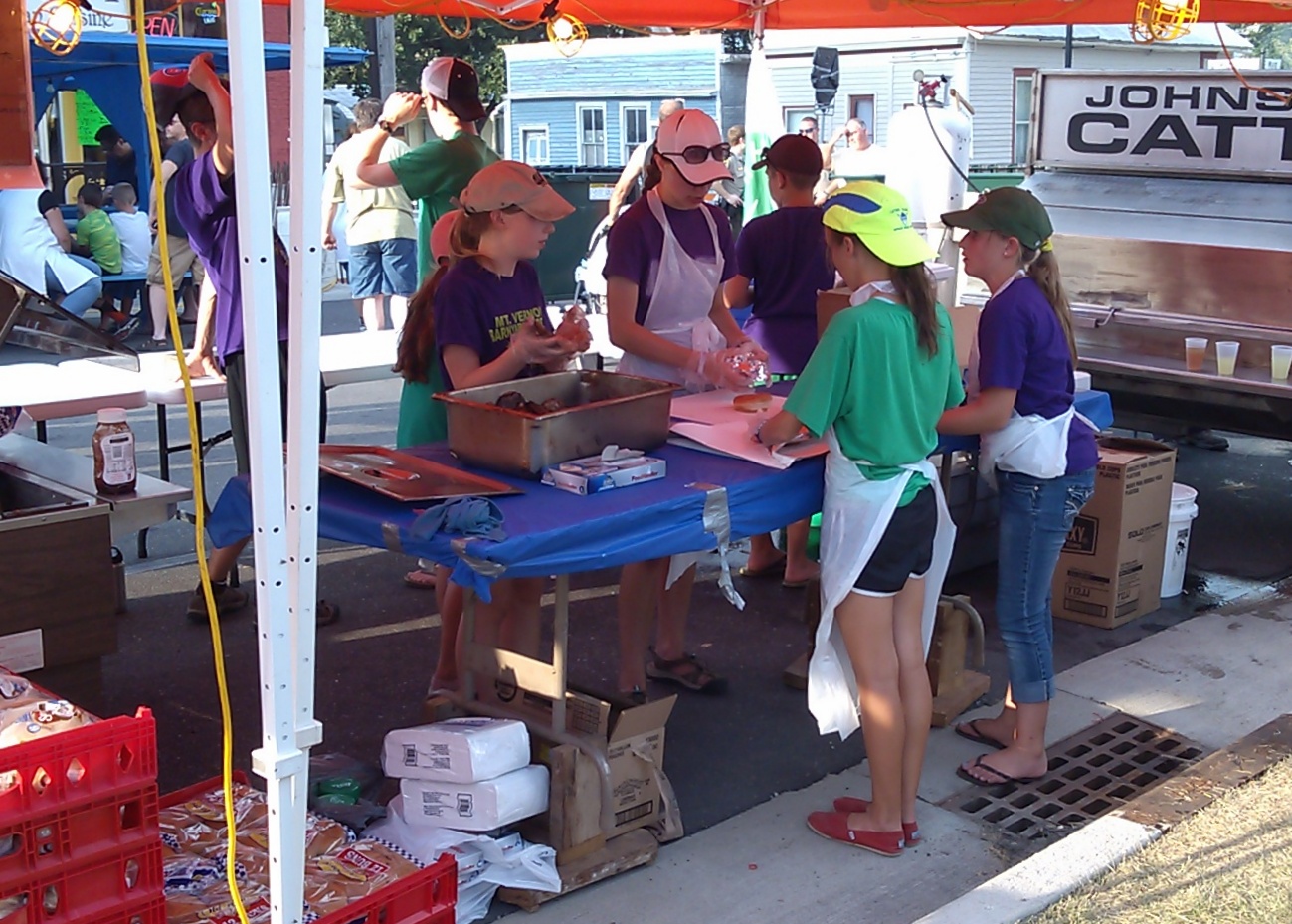
Pork Burger Assembly
As a vegetarian and flexitarian household, the association with beef was a turn-off for us when we moved to the area. Nonetheless, we participated by taking our daughter to try the carnival rides when she was young. Later, I got involved in helping the public library serve sandwiches to festival goers. As time passed I came to enjoy being a small part of the festival.
For some, Solon Beef Days is the time of year to let loose, have a few beers in the beer tent and designate a driver to get them home. This year there was a booth to arrange for a ride home for the intoxicated. It wasn’t used much.
Sandwich Booth
The town re-built the bandstand in the center of the old part of town, and there is live music both nights. The hay bale toss on Friday is popular, and the parade on Saturday attracts civic groups and winds its way through town. The parade crosses Highway One to go past the care center where wheel chairs with residents are lined up on the south side of the building. This was a later addition to the route to include everyone in town.
The legion has a food tent, bingo is called on Main Street, there is a street dance, and something for everyone. Whatever money is left after paying the bills is donated to community groups by the Beef Days Committee. I’ve never eaten the steak or pork at the festival, but enjoy socializing with friends, neighbors and people I don’t know on a warm summer evening. In the end, who wouldn’t?
LAKE MACBRIDE— Yesterday zucchini came in from the garden, a lot of them. Knowing the CSA share would include more, I called a friend who manages the local food bank and arranged to donate freshly picked vegetables. Posting on Facebook, I encouraged others to do likewise,
Just donated ten pounds of organic zucchini and yellow squash to the local food bank. They really need our help. If you have garden extras, I hope you will pick up the phone and call the nearest food bank to see if they could use it. Willing to bet they will.
A commenter on this blog wrote,
It is the only time of the year you have to lock your doors when you go to the local drug store, grocery store or funeral parlor in a small town so you won’t receive the “bounty” of someones inexperience of planting way to many summer squash! If you aren’t cautious, they will hunt you down and fill your back seat in a New York minute!
It may be possible to have too much of a good thing, although I won’t admit it. Even though ten pounds was donated to the food bank, there is an abundance in the ice box and plenty more growing in the garden. Soon the recipe for zucchini chocolate cake will come out of the arsenal to be deployed in a last ditch effort to deal with the proliferation. Maybe I need to deescalate.
This is the first year zucchini growing has been an unmitigated success in my garden. It is attributable to working at the farm and seeing how professionals do it. In past years, I planted squash in mounds with a number of seeds in close proximity to each other. They grew in a tangled mess and never produced very well. This year was different.
Using some plastic trays provided by a friend, I planted the seeds in individual soil blocks. They germinated and grew well, and when the plot was ready, I transplanted them in tight rows next to a big patch of radishes. Once the radishes were harvested, the squash vines had room to grow. It may seem simple, but the results were dramatic.
As long as we repeat the same behavior, change is unlikely. More than anything else, a gardener should be a tinkerer with cultivation. Trying different tilling methods, considering shade that falls on the garden when planting, seed variety selection, row arrangement, and adjusting every possible variable in the garden. Most importantly, a gardener should let the seed genetics do their work after creating a suitable environment. If we sometimes hit the zucchini jackpot, then we learn from that and adjust next year.
With a bit of thoughtful work, it is much more likely to succeed in gardening than in winning the lottery of a random life.
LAKE MACBRIDE— The advantage of a kitchen garden is when a cook needs something, it is a short walk to the food supply… and it’s ultra-fresh. While making red beans and rice for lunch, I remembered there were large Anaheim peppers in the garden so I went to pick a couple to dice and add to the dish. While there, the cucumber plants were droopy, meaning they wanted water in the hot sun. My policy is watering cucumbers and squash twice a day is all I’m willing to do. If they can’t make it here on that— well tough toenails.
Perhaps it’s a little harsh, but drought is an ever-present reality in Iowa. The pattern of average annual rainfall makes it possible to grow crops in abundance without extensive irrigation like they have on Nebraska’s Ogallala Aquifer. It’s part of what makes Iowa Iowa, but that may be changing.
While early summer has been as good as it gets, we need rain now. The few extra gallons I may sprinkle on squash and cucumber plants will not deplete the Silurian aquifer, yet frugal dispensation of water is one way I am adapting to climate change. The county actually studied the aquifer and found there is plenty of water to meet current and future needs.
There have been and will be plenty of cucumbers. I started my third fermentation of dill pickles this morning, and yesterday planted new cucumber seeds in trays for the fall harvest. Schedule permitting, I’ll plant a couple more rows directly in the garden as July wanes. These actions, with a supply from the CSA, and there is no need to preserve the current cucumber plants by abnormal watering. In any case, they still might make it.
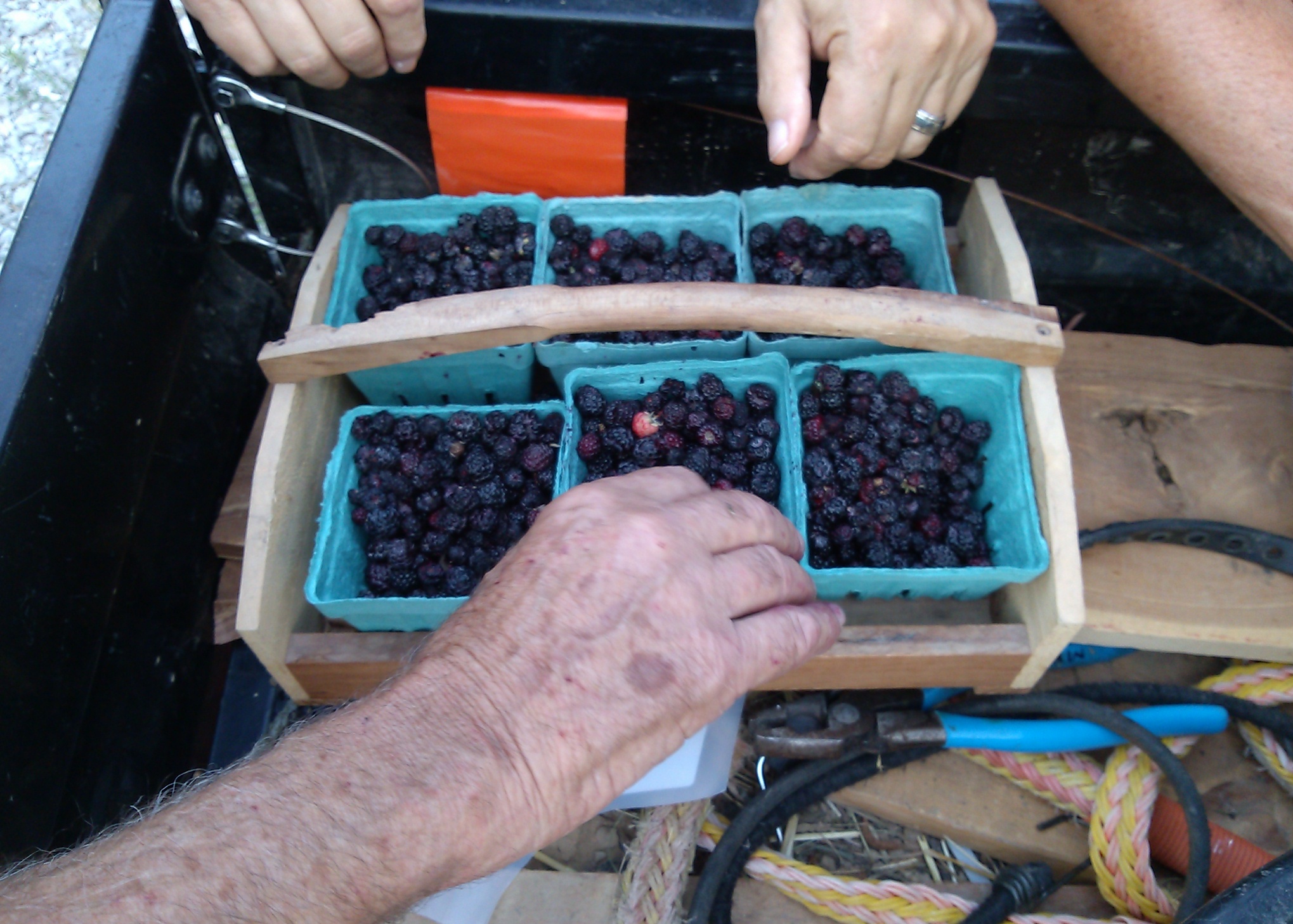
Black Raspberries
It has been a busy day in the kitchen. In addition to dill pickles and red beans and rice, half of the black raspberries were made into a thick dark syrup to use on biscuits, toast, pancakes and other applications. If I had pectin on hand, I would have made jelly. The syrup is so good and can be used in other applications, so the pectin was not missed.
One other item for my wheat-free friends. We had a pint of pasta sauce on hand, and instead of pasta, I got out the mandolin, purchased for a buck at a household auction, and using the finest blade, cut a long yellow squash and zucchini into “noodles.” I brought a pot of water up to a boil, cooked them four minutes and served like pasta. Very tasty and gluten free. Also one more thing to do with the abundance of squash.
Now off to the kitchen for the perpetual cleaning up.
LAKE MACBRIDE— The first two cherry tomatoes were ripe in the garden, so I picked them, along with three meals worth of green beans, two cucumbers, a bunch of kale, two stalks of broccoli and two kohlrabi. In addition, I planted more cucumbers and Swiss chard. There remains plenty to eat in our household.
It’s time to review the seed packets and plan the rest of the year’s planting. July 25 is the traditional day to plant fall turnips, and more radishes, green beans, cucumbers and spinach are in the works. The lettuce seedlings I planted about a week ago appear to be taking, and I’ll plant more before the summer is over. Because of succession planting, the salad days, where we can have fresh salads with dinner, may extend the whole summer. Here’s hoping.
When the morning garden work was finished, I cleaned up and drove to Lake Macbride State Park to sit on a bench and write. On an impulse, I stopped by a friend’s home where he was returning from a neighbor’s home with a bucket of just-picked Lodi apples. Lodi is one of the earliest producing cultivars, and the fruit is used in baking, applesauce and cider making. He offered and I took four to make a dessert. We chatted for a while, and then made arrangements to go foraging for black raspberries after supper.
Black Raspberries
With the sun heading for the horizon, we met up and drove a few miles to a mutual friend’s acreage. We spent about 90 minutes trolling the wood line, where all kinds of produce was evident. Wild plums, hickory nuts, blackberries not ripe yet, and plenty of ripe black raspberries. We filled two gallon jugs and split the proceeds.
We toured the property owner’s garden and the apricots were ripe, falling from the tree. Like many gardens in the area, this year it is doing well.
On the drive home, we talked about the Michigan cherries due in at a local orchard on Saturday. I plan to stop by and participate in the summer cycle of fresh produce and the social life surrounding it. Not sure which I like better, and both seem inextricably intertwined.
SOLON— Word is out that another Main Street restaurant is gone. Reggie’s Weenies of Solon shuttered their doors last week. I noticed the for lease sign, then it was taken down, then the lights were off during the breakfast service and people started talking. Telltale signs of the end in a small town.
Partly, the restaurant never took off. Every time I dined there, either mine was the only table with customers, or maybe one other. The menu may have been part of the problem. One morning while I was having breakfast, Reggie mentioned how popular biscuits and gravy are among the breakfast crowd. He had no wait staff but himself, and had to tend to the gravy, so he couldn’t elaborate. He sold a lot of biscuits and gravy— but not enough.
While “weenies” is in the name of the place, and Reggie got his start selling Chicago-style hot dogs at Nile Kinnick Stadium in Iowa City on game days, he expanded the menu beyond hot dogs and was a skilled chef. The dishes I tried were tasty and had plate appeal. Word about the menu didn’t get around town, despite Reggie’s marketing efforts.
Part of the problem may have been a dispute with one of his original business partners, which caused people to line up on sides. There was an informal boycott of the place for a while, but that wasn’t the reason for the problems.
When Smitty’s Bar and Grill closed before Reggie remodeled the space, the cook and wait staff moved to a new breakfast operation at the American Legion down Main Street. The legion became the place to have breakfast in Solon, leaving Reggie and his investment in the lurch.
Since we moved to the area, there have been at least six different restaurants in that space. Maybe the building has a restaurant curse on it. Reggie tried to make it, as entrepreneurs with an idea do. The new microbrewery opening this summer across the street, with chefs trained in culinary school, may have been the final straw. No one was at Reggie’s Weenies when I knocked.
Reggie was a friendly guy. I hope he lands someplace good. Good people usually do.
LAKE MACBRIDE— Writing about gardening, farm work, fermentation, soup-making, canning and cooking is personally satisfying, but what is the connection to our broader society? Why does one person’s journey in life with friends and family matter in the broader scope of things? With a global population of more than 7 billion, and expected to hit more than 9 billion by mid-century, life on earth is changing in ways that test the limits of our ability to comprehend. Will the lives of individuals matter as Earth reaches its tipping point, pushing the envelope of its geophysical limits?
American society, founded in part on the cultural resonance of eighteenth century agrarian individualism, promotes the moral worth of an individual. Independence, self-reliance, freedom and the ability to work toward self-realization are core values of our society. The idea that we can own a plot of land, grow some of our own food and prepare it in ways steeped in process, learning and tradition, yet how we want, is as American as the apple crisp I make from my apple trees. What is often forgotten is that individual lives occur in the context of a society that was founded during the Age of Enlightenment, and that society is coming apart at the seams.
If romantic concern for the good old days is what drives people to work toward a local food system, the idea is bound to be abandoned. In Iowa, we created the Leopold Center for Sustainable Agriculture at Iowa State University. The center has conducted hundreds of grant studies and reported on them with an eye toward sustainable agricultural practices. The Leopold Center is key to understanding our food system and providing reasons and process to create and strengthen community-based food systems. It is uncertain their work will take, despite the fact that locally grown food produced with sustainable practices is highly cost competitive with the products of the industrial food supply chain.
What makes a local food system possible is not the development of practices and high level theory, but the support behavior change receives in society. Behavior that congealed during the post World War II economic boom that included development of our industrial food supply chain. With population growth, society requires an organized mechanism to produce, preserve and distribute food to a growing population. In that sense, the industrial food supply chain is as necessary to a local food system as are the practices developed by the Leopold Center. To choose between them is a false choice.
Based on my experience with local farmers who use sustainable practices, there is tremendous capacity for improvements in efficiency, fuel use, water management, labor practices and mechanization that are untapped because of capital constraints. What the local food system may need most is an infusion of capital to create business incubation centers, sustainable water management systems, efficient farm to market systems, and most importantly, a sustainable source of labor that pays a living wage. The industrial food supply chain, because of its strong capitalization, has essentially blocked out competition from sustainable local growers who struggle to pay bills each month.
The question comes down to what individuals do in society with others, and there is no template for it. Stories about dealing with excess zucchini, kohlrabi and leafy green vegetables serve as examples of how to live with the challenges of a local food system. My garden won’t grow everything we need to provide all of our own food, so we leverage outside entities. Whether it is electricity to run the stove, cheese and milk from dairies, veggie burgers from Morningstar Farms®, or cooking oil from California, Italy and Iowa, how and why we leverage these entities and others matters a lot to a local food system.
That’s why I write about local food systems, as an example in which I hope others find value. If we’re lucky, and with collective action, tenuous local food systems will be strengthened as we work toward sustainability in a turbulent world.
LAKE MACBRIDE— The dawn dew barely moistened my shoes while venturing to the garden to water the plants. Much needed rain failed to precipitate last night, and without daily irrigation, the produce yield would be reduced. The lettuce seedlings planted last week are surviving with twice a day watering. The morning shade of the locust trees protects them from the parching effect of the sun. The forecast is for zero chance of rain before noon.
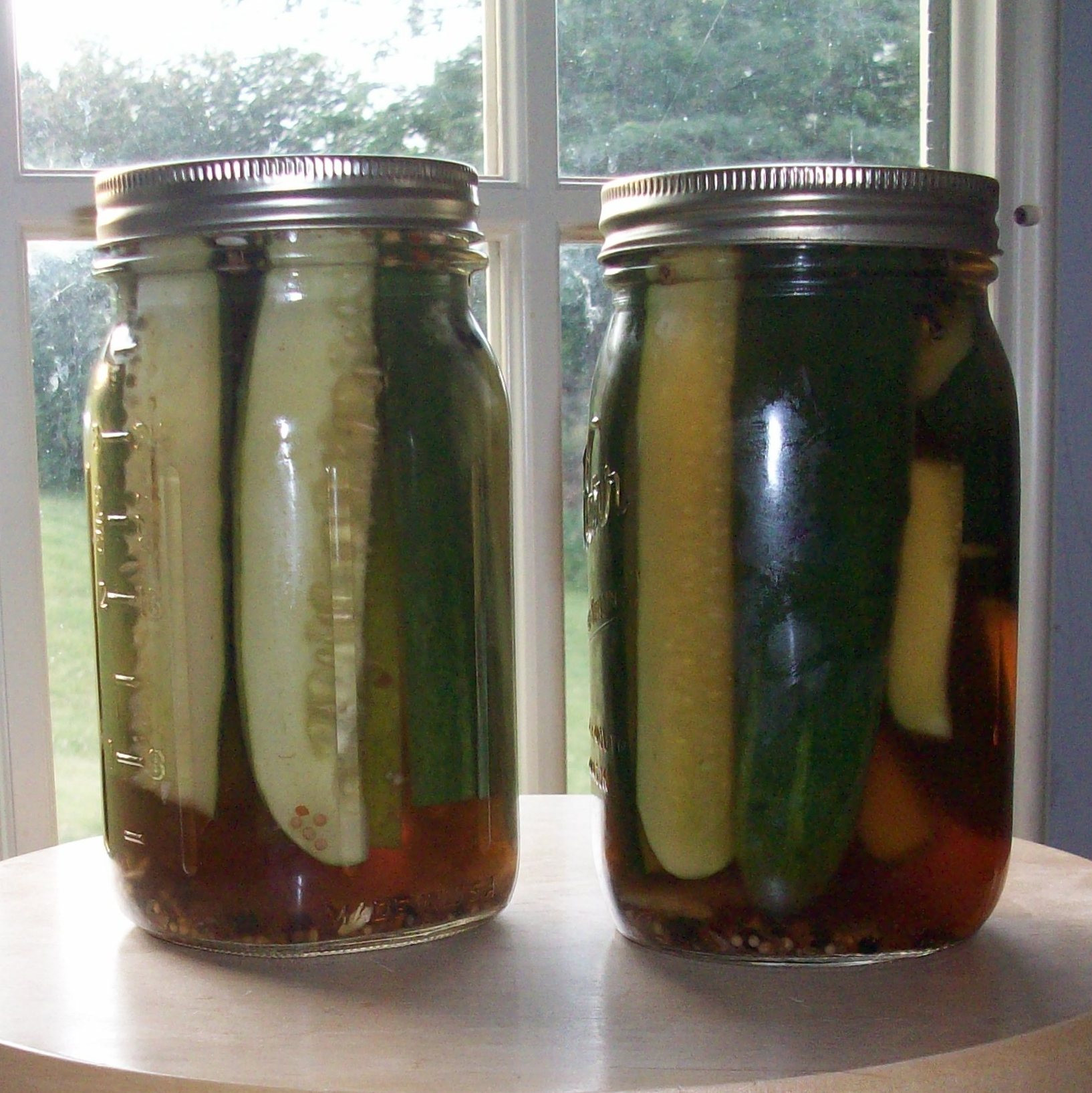
Last night I made two quarts of deli-style refrigerator pickles. The brine is the same as the one processing cucumbers in the crock, just that in the refrigerator they will be ready in four or five days. There are more cucumbers on the vine, and one kept fresh for salads. The flow of cucumbers through the kitchen has been about right.
The ice-box is packed and filling with food. I added a couple of more packages of grated zucchini to the freezer drawer and today’s plan is to make pesto to freeze. Produce rotation and preserving to prevent spoilage has become a thing around our household.
I decided to take down the advertising calendar on the bulletin board in the garage and replace it with photos. I spent an hour sorting through digital photos on my computer and ordered prints from Walgreens online. They were ready for pickup across the lakes in about an hour.
After making the pickup, I spent another hour selecting prints to post, and processing memories of our life since we became empty nesters. Better to be reminded of our family life than the days on a calendar. If one has children, it is a blessing to know them at all. Reflecting on who they have become is a luxury as good as gold.
No pickling brine will stop death’s inevitable advance. As long as we can process— cucumbers, zucchini and basil, photographs and memories— we can go on living. As Walt Whitman wrote, “and as to you death, and you bitter hug of mortality . . . it is idle to try to alarm me.” Fearless we enter the day, endeavoring to accomplish something with our lives.









 Journey Home
You must be logged in to post a comment.