SOLON— Salt Fork Kitchen, 112 E. Main St., is slated to open for Sunday brunch on Sept. 22 from 8 a.m. until 2 p.m., with jam session. My friend Bill posted this note about the grand opening on Facebook,
I’ve been helping open Salt Fork Kitchen, Solon’s newest restaurant, get up and running. Supplied by it’s own farm (Salt Fork Farm). Chef Jay, and crew sport a great menu. Everything made from scratch from fresh ingredients. Sauces, by Jay, are incredible, as is everything. Home made bread, and biscuits, and yesterday was hummus making. I could go on, and on, so please come by, and enjoy. Grand opening this Sunday, September 22nd, 8:00 to 2:00. Jam session so follow, so bring your fiddle, guitar, or bluegrass bongos.
The restaurant grew from Salt Fork Farms and readers can find more information at the website saltforkfarms.com. Here is a snippet,
Salt Fork Kitchen is a long time dream of Eric’s. It will be a locally sourced, made from scratch restaurant providing quality food at a fair price for you, and the farmer.
The article I wrote with background information can be viewed here. If work schedule permits, I plan to stop by for the opening.
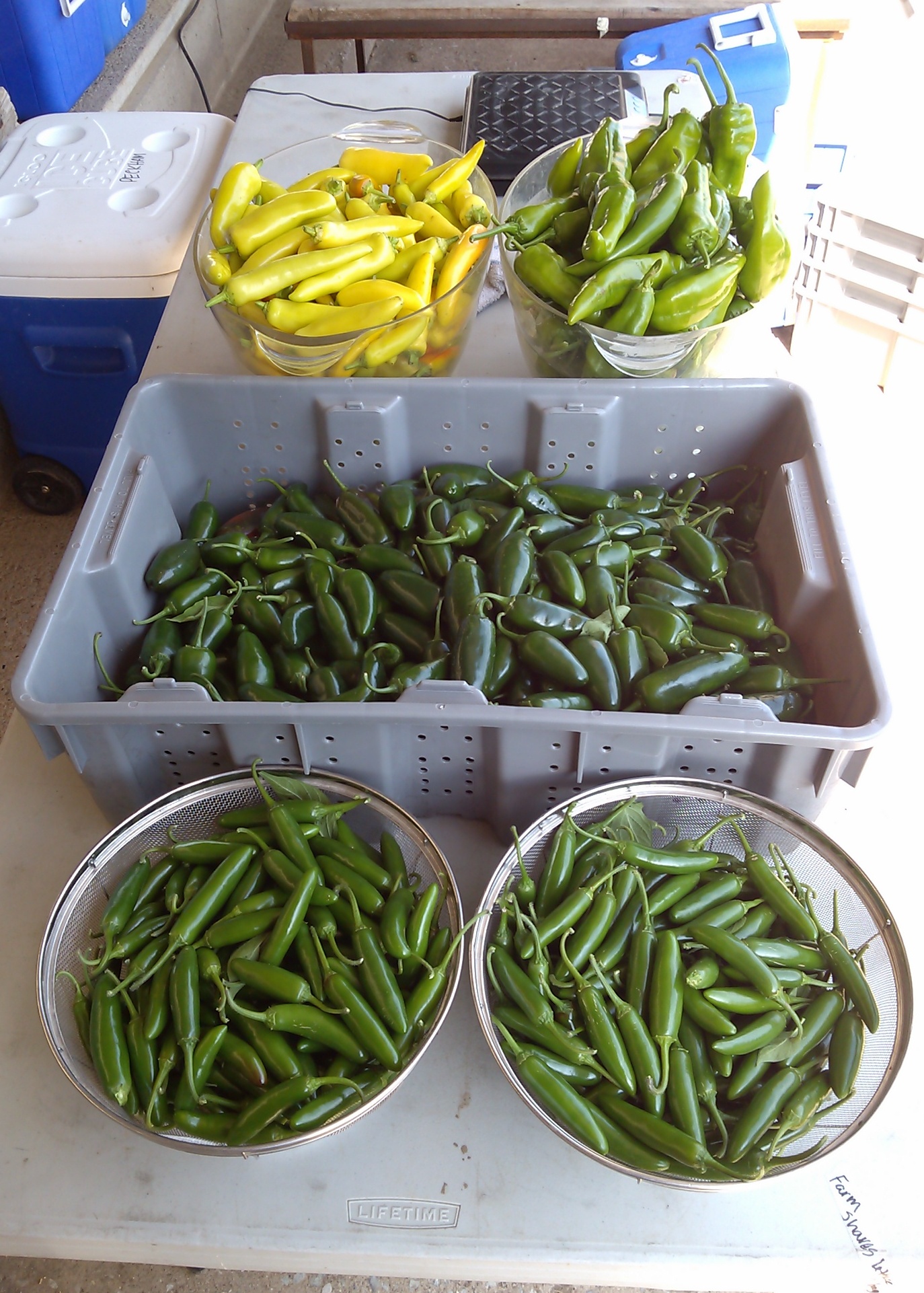
RURAL CEDAR TOWNSHIP— Part of Thursday’s work was to harvest the hot pepper row at the CSA. We have Anaheim, which is not really hot, Hungarian wax peppers, jalapeno and Serrano. The peppers looked very nice, and the work prepared me to discuss them with customers at the drop site later that afternoon. I am ahead of myself.
The day started by picking kale, as it does on delivery days after the plants mature. The customers like kale, especially young children who anticipate it will be turned into baked kale chips for snack. For every leaf put in the cooler, two are discarded in the field, so there is a lot of marginal quality kale that returns to compost.
On a vegetable farm, there is a lot of marginal food generally: not quite good enough for customers, yet still a fresh and delicious food ingredient. Some is offered as seconds to customers, the farm workers take some home, and some returns to compost. This year I am experimenting with a bartering business of processing labor traded for a share of marginal food. A crate of peppers with bad spots becomes cut pieces in bags to be frozen. This operation included broccoli, tomatoes, bell peppers, hot peppers and eggplant, resulting in a more than adequate household supply for the coming winter.
I harvested eggplant after the kale and before the hot peppers. There is a lot in the field. Eggplant is a global favorite vegetable, but in Iowa a person can only eat so much of it. We offer half a dozen varieties of eggplant, and customers take it with their share. The eggplant from my weekly share was aging, so upon returning home, I baked off half of it and removed the flesh to make babaganoush, some for now, and some to freeze for later.
While I was working, others were bagging potatoes, picking lettuce in the high tunnel, harvesting tomatoes, collecting herbs, counting onions, preparing garlic and doing all that is required to get the Thursday deliveries out to customers. It’s a day in the life of a community supported agriculture project.
RURAL CEDAR TOWNSHIP— A co-worker was asked when the last rain fell. The answer was July. In a community supported agriculture project, there is no option other than to irrigate when drought comes, and that means a series of hydrants spread throughout the farm, and frequent draws on the underground reservoirs. So far, there has been enough water.
In the list of 2014 legislative priorities recently sent to our state representative, I wrote the following paragraph,
Once again Iowa was short on rainfall, especially the last 6-8 weeks. If the dry weather and drought continues, there will be pressure to irrigate row crops in a place where traditionally we have had enough rainfall to do without. In late July, I traveled to Chicago and along Interstate 88 they are already irrigating corn. Water use will be a key issue for Iowa going forward, and if irrigation of Iowa corn and beans starts, I’m not sure how management would be structured, but more attention to water use would be needed. The legislature should play a role, in evaluating the science, and taking appropriate preventive action. Evaluating the science doesn’t mean just calling the folks at Farm Bureau, asking for an opinionaire from their members.
That there is a connection between human activity, climate change and the current drought can be a matter of some discussion in Iowa. For the most part, industrial agricultural producers see the climate changing, but do not attribute it to anthropogenic origins. It is just another thing to deal with while farming. Those of us more familiar with the science of climate change see the direct connection. The two positions haven’t yet been reconciled.
June 2013 was the 340th consecutive month with a global temperature above the 20th century average. 2012 was the 36th consecutive year with a global temperature above the 20th century average. On a local level, here in Cedar Township, this translates into wanting rain and wondering what would happen if the well runs dry. The answer to that question, is farmers may give up, especially small scale local producers like the one where I work.
There is a connection between the global climate crisis and extreme weather events like this year’s drought. As global CO2 levels have increased above 400 parts per million, global temperatures rose in tandem. As temperatures increase, the atmosphere can hold more water vapor. This makes rainfall and flooding more frequent and intense like spring 2013 was in our area.
The effect of global warming, and the hydrological cycle’s absorption of water vapor, also creates longer intervals between rainfalls, making droughts even worse. Because of the atmosphere’s increased capacity for hold water vapor, the land can become parched without irrigation.
People who live from the land, have to do something, and in Iowa we have relied upon abundant rainfall to grow crops without irrigation. As climate changes, that means considering how to make the land productive absent the conditions that led us to be what we are. It requires us to to adapt to the changing climate, and take action to mitigate the causes of this year’s flooding and drought. Before we begin large scale irrigation, Iowa should consider the consequences of increased water usage.
Locally, the climate changed, when we least needed or expected it. There is little to do now, other than adapt and mitigate the human causes of climate change.
LAKE MACBRIDE— In 100 degree temperatures the walk to the garden to pick yellow cherry tomatoes and basil for dinner didn’t seem hot. Perhaps I am adapted to the unseasonably hot weather… intensified by climate change. We can’t recall the last rainfall. According to the state climatologist, “Iowa temperatures averaged 72.1° or 0.6° above normal while precipitation totaled 1.57 inches or 2.63 inches less than normal. This ranks as the 7th driest and 65th warmest August among 141 years of records.” It has been exceptionally dry in Big Grove. However, life goes on, and having a house guest provides a special reason to used locally grown food to prepare meals for the table.
That we would have a salad was determined when a co-worker at the farm carried a crate full of freshly picked lettuce from the field to the cooler yesterday morning. Mixed greens, washed and spun dry, topped with zucchini, cucumber, orange bell pepper, red onions, wedges of red tomatoes and sliced carrots were topped with a dressing of choice. Balsamic vinegar and olive oil with salt and pepper is my favorite.
We also served pesto pasta. During early summer I made and froze half a dozen jars of pesto, using various ingredients. Slicing the yellow cherry tomatoes in half and putting them in a small bowl along with a chiffonade of basil leaves, I cooked six cups of bow tie pasta to al dente. The pasta, tomatoes and basil, half a pint of pesto and a roughly measured cup of Romano and Parmesan cheese were mixed thoroughly in a large bowl and served alongside a one-inch thick tomato slice topped with kosher salt and strips of fresh basil. A simple late summer feast.
LAKE MACBRIDE— Only time for a brief post before heading out to job three of a four job day. Already this morning I finished proof reading the newspaper and worked on preserving bell peppers. Next the orchard, followed by work on the farm and then canning if I am still up to it. Sunday is anything but a day of rest in Big Grove.
My biggest ever crop of apples is turning into something of a bust because I can’t make time to harvest and preserve the first two trees. Then yesterday I read about Arctic® Apples, the genetically modified organism that is designed to repress creation of the enzyme that turns apples brown when exposed to air (after cutting or biting into) or bruised. In other words, the traditional way of knowing an apple is going bad is repressed, and this creates a longer shelf life for the fruit.
Not an issue here, where in the race against nature’s clock, I hope to eke out one or two dozen more pints of apple butter before the first picks go bad. I need the browning action to know where I stand. But in the industrial food supply chain, shelf life matters… a lot.
The new cultivar is going through the regulatory process in Canada and the U.S. presently. Friends of the Earth created an on-line petition to encourage Gerbers to continue to use non GMO apples to make applesauce and other products. From the perspective of having my own supply, and working in a large local orchard that produces cultivars going back to the 17th century, what the hell?
LAKE MACBRIDE— Today begins with two Tylenol® for the headache caused by I don’t know what. Perhaps it was the lack of fresh vegetables and protein in meals made of potato bread purchased once a year from the grocery store, evenly toasted and spread with salad dressing, topped with thick, red slices of tomato. An annual ritual of the tomato harvest in Big Grove Township. With coffee and writing, the headache is receding. It’s 4 a.m.
There was no harbinger of how it would in the local food system this fall. Farmers need help for harvest: picking kale, squash and tomatoes, selling apples, and cleaning onions and garlic. Add the work of preserving some of the harvest, gardening and just living, and it is a full life. Suddenly, I’m working four paid jobs, and a lot that aren’t paid.
More than the pay, which certainly isn’t a living wage, is the value of the experiences. Some of which I’ll recount here to provide a flavor of an Iowa life in September.
Last Sunday I sampled Dolgo Crab Apples and liked them so much, I made five pounds of them into Dolgo Crab Apple Butter.
Picked the pears from our tree. There was about a bushel of them.
A branch broke on the Golden Delicious apple tree. The fruit was ripe, so I picked it from the branches.
Perhaps the best tomato harvest from my garden in a single day.
Canned diced tomatoes, four quarts and 27 pints. Plus about three gallons of juice.
Roasted peppers and marinated them in olive oil with a clove of garlic.
Froze bell peppers for a farmer friend.
Put up a dozen ears of corn in the freezer.
It all takes time, with little reflection, which perhaps will come when the work is done, if ever.
LAKE MACBRIDE— Dust is still settling on life made turbulent by the harvest, new work, writing and commitments with friends and family during August. Top that off with talk about retaliation against Syria for using banned chemical weapons, and summer is ending with a bang, perhaps literally. It’s time to regroup and deal with the challenges.
A neighbor and I did a deal on raspberries yesterday. He provided eight pints to process, half into a spread for his morning toast, and half into what I want, probably the same, or maybe pancake syrup. After a shift at the farm this morning, raspberries, tomatoes and apples will all enter the canning mix. It’s now or never for the ones already picked. An eight hour canning session begins at 1 p.m. and I’ll locate my second canning pot to process two batches at a time. Times like this, I wish we had six or eight burners on our stove.
The garden has been on its own for three or four days. Tomatoes are ready, and not sure what else. When I return from the farm, I’ll empty the compost bucket and find out, picking tomatoes for sure, and likely Anaheim peppers.
There is a lot more to organize, and the food work is in the must-do, nature-can’t-wait category. There’s more work, my presentations on climate change Sept. 17 and 29, particularly. That’s not to mention finding replacement revenue for when the seasonal farm work ends soon. It looks to be a very busy autumn as we enter September.
LAKE MACBRIDE— There is a sense that the season has turned. Clutching the harvest, preserving it as best we can for winter, its abundance slips through our hands to compost, and with time, back to the earth.
Bones and joints are weary from farm work, that work displacing time normally spent in the garden, yard and kitchen. Fallen apples line the ground and the branches of the late trees touch the grass, laden with the developing fruit. In nature’s abundance we cut a sliver and sustain ourselves on its freshness.
It’s labor day in the U.S., but that matters little in nature’s calendar. The work of a local food system goes on, and paid work calls me again today.
Soon I’ll finish preparing the onions drying in the germination house for storage. After that, I will be ready for autumn and the acceleration of changing seasons into winter.
LAKE MACBRIDE— There is an idea about egg salad, but I don’t really know how to make it. Peeling three hard-cooked eggs, I halved them to remove the yolks, and minced the whites finely into a bowl. Two slices of home made dill pickle finely minced, and half of a medium onion, also finely diced went into the bowl.
In a separate bowl, adding to the cooked yolks, a teaspoon of celery seed, half a cup of light salad dressing, and a squeeze of yellow mustard, I stirred thoroughly and added it to the rest of the ingredients, mixing as I went. It’s what I call egg salad, but is it really egg salad?
Call it what one will, spread on two slices of bread, and eaten with an ear of corn on the cob, it made dinner.
I may not know much about egg salad, but know less about the situation in Syria. It sounds really bad, and has for a long time. It is something to refrain from comment until a few people much smarter than me weigh in. The Carter Center weighed in, as did Pope Francis, and Bishop Desmond Tutu. Economist Robert Reich weighed in, even though it is not really his bailiwick. Will wait a while and see who else has something to say.
Let’s hope the U.S. doesn’t end up with egg on our face, because no one seems sure how they might make a meal to sustain a life using that.
SOLON— Happy hour turned into dinner hour as a group of participants in the local food system spent the inaugural Friday afternoon at Big Grove Brewery. It was farmers night out. The new restaurant got a collective thumbs up from the group.
My happy hour choice was a beer brewed in the building, one of two on the menu. I haven’t developed a lexicon for beer criticism, but it was reminiscent of the Stone City Brewery fare, cloudy and strong. It was called Big Grove IPA, and the happy hour special had us buying two glasses at a time and passing them as people joined us at the table.
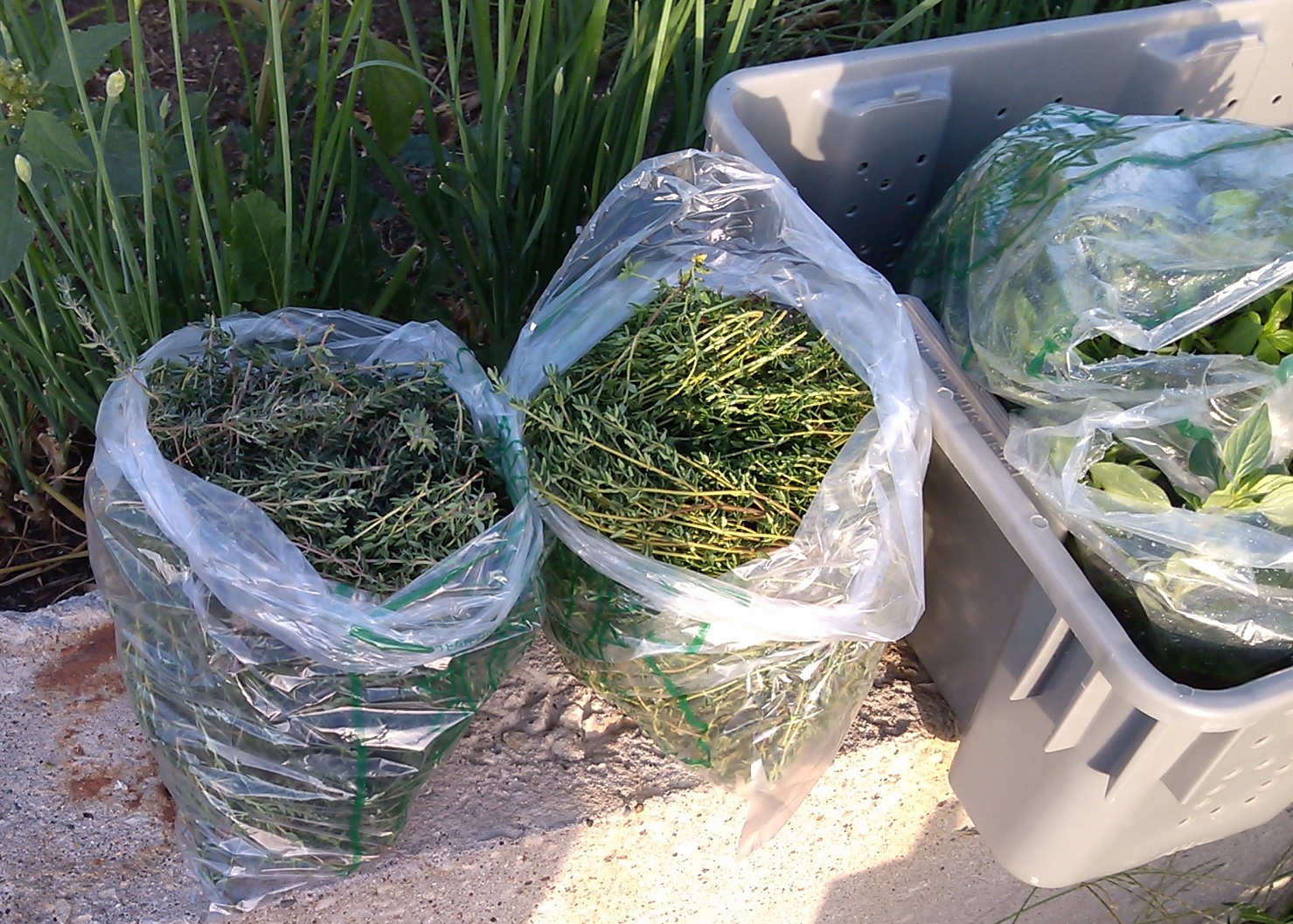
Our group included suppliers to the restaurant, and the first thing we did was try to figure out how the chefs would use the pound of thyme that was picked that morning. We couldn’t tell from the menu.
There is some vegetarian fare on the menu, and I tried the tomato and eggplant caponata, which is grilled focaccia topped with an eggplant ragout, sliced tomatoes, Parmigiano Reggiano and fresh basil. For only eight bucks, we can afford to return.
Every seat was filled, with people waiting. Even the outdoor patio was full, despite the 100 degree heat. Looks like Big Grove Brewery is off to a good start.




 Journey Home
You must be logged in to post a comment.