Categories
Kitchen Garden

Warm Winter Day

50 degrees in Big Grove, Feb. 15, 2022.

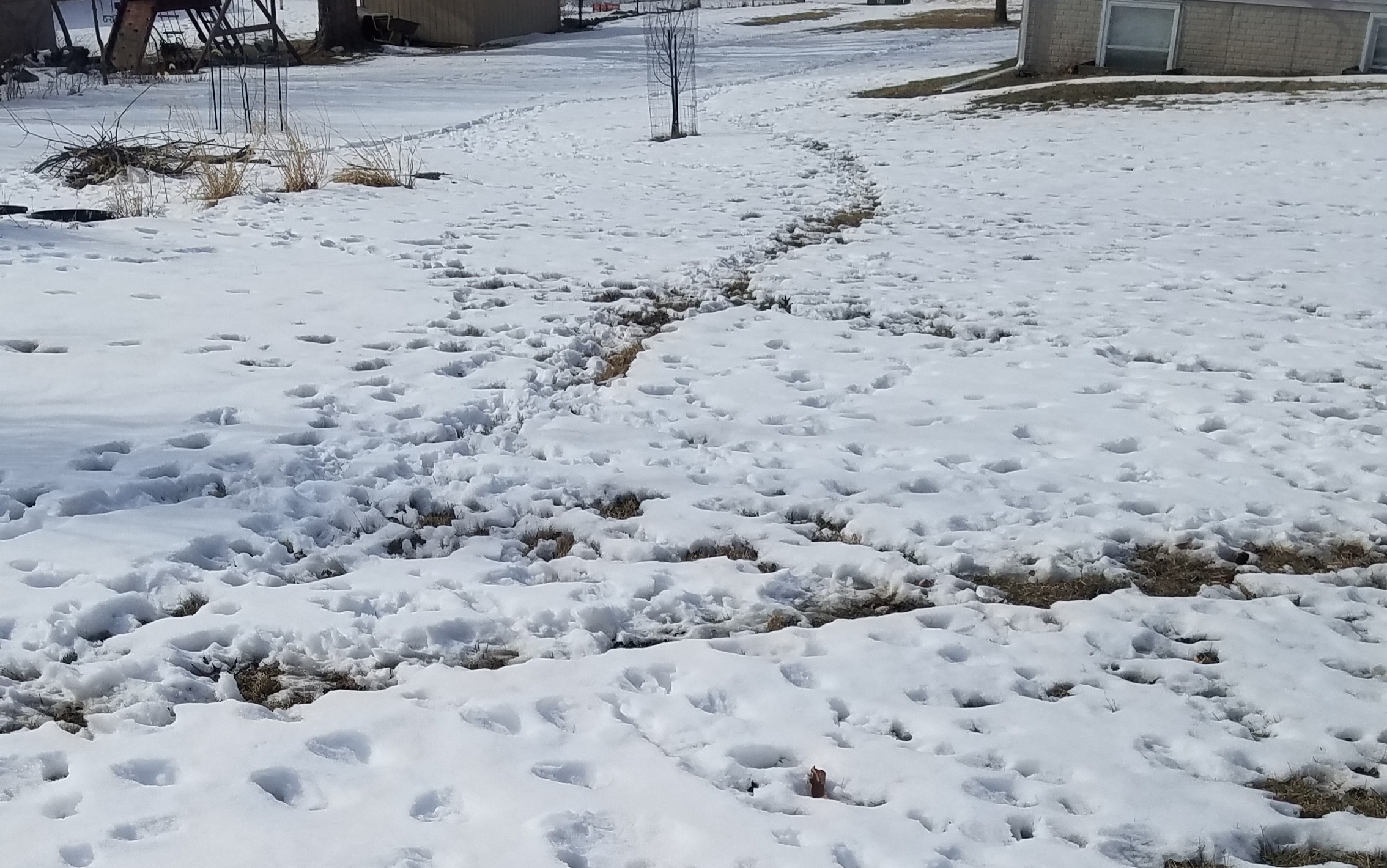
Two days of ambient temperatures in the 40s and 50s drew back snow cover to reveal a well-beaten deer path. Their droppings are scattered all over the ground. They hadn’t yet eaten tender young branches growing above the six-foot fence protecting two new apple trees. Maybe they won’t. Deer have become a regular animal in the yard. I don’t always look when I see them running down hill from the corner of my eye.

I walked around, picking up branches pruned from the fruit trees and placed them in a brush pile for spring burn. The ground didn’t give at all, remaining frozen. With temperatures today and tomorrow back in the single digits and teens, we are a distance from spring thaw.

I went to a grocery store. You know the kind. One that sells lots of different things. The organic kale looked great so I bought a bunch for stir fry and soup. I picked through the cauliflower for a clean head. Can’t remember if I ever bought kale in a store before. I don’t think so. Previously its been grown by me or my farmer friends. Frozen kale is used up, so a person has to do something to secure greens for winter meals.

One of the varieties of kale seeds didn’t germinate. The seeds are from the 2019 season, so it’s not a surprise. I’m putting together another order from my main seed vendor and expect it to be the final seed order for the 2022 garden. Seed catalogues are piling up next to the reading chair in the living room. Any more, I don’t spend much time looking at them as I know most of what I want.

A neighbor is planning an extended visit to relatives this summer. They offered me their garden plot, which is a nicely fenced area adjacent to our property. I’ve been thinking I could use more space. I’m considering it. I’d plant it with a uniform variety of vegetables, maybe fall crops of broccoli or cabbage, and adopt it for the season as the eighth plot. We’ll see.

It was good to get outside and exercise. It’s too early to begin turning dirt, so we wait. Parsley looks like it will over winter. It’s time to finalize plans for the garden.

Categories
Environment

Mid-winter Thaw

Deer paths in the snow.

Ambient high temperatures are forecast around 40 degrees the next couple of days. If that bears out, most of the snow should be gone. It has been a welcome time for cocooning yet this week’s weather indicates it won’t be long before working outdoors.

Onions and shallots need a trim. Broccoli seeds planted Sunday have begun to germinate. It’s good to see the older seeds are still vital. I’m thinking of setting up the greenhouse yet it’s too early.

We’ll see what Iowa’s weather does. For the moment, hope of spring is not far away. That’s enough to encourage me to get to work on everything.

Categories
Kitchen Garden

Pruning Day

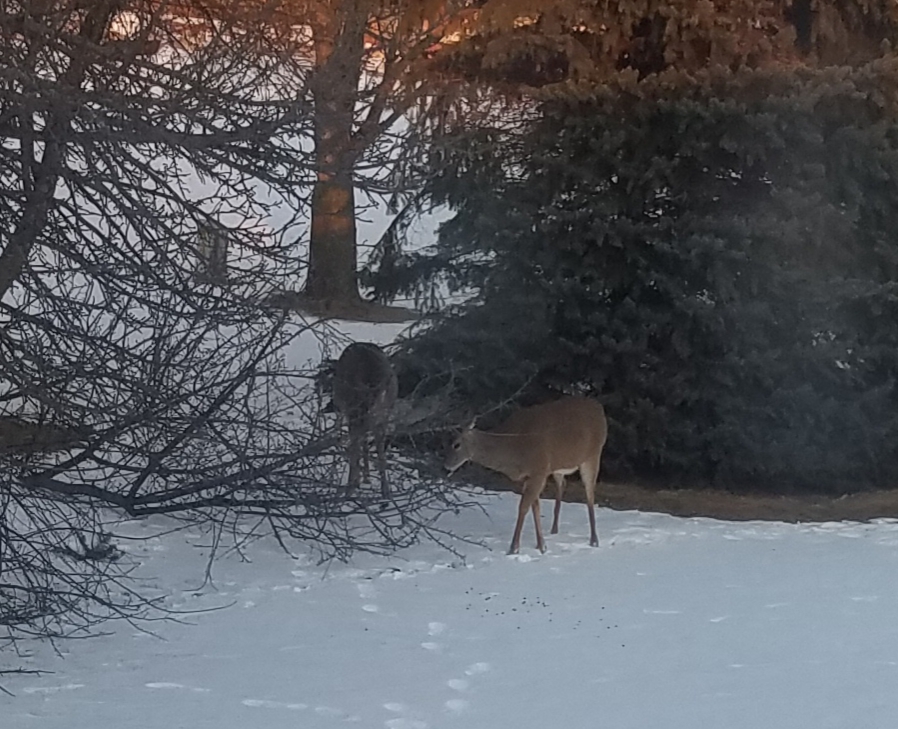
Deer eating buds and tender branches of a limb felled during apple tree pruning.

On the fourth day in a row of freezing and subzero weather I bundled up and pruned the pear and three apple trees. As the sprouts and branches came down, they were frozen: sap flow had ceased. That’s what we want during fruit tree pruning.

I pruned what could be reached. I used a ladder to remove a large branch that was crowding the spruce tree. With the bulky clothing I didn’t want to maneuver too much on the ladder, risking a fall. If the trees survive, there should be a crop in 2023.

Branches will remain where they fell until it thaws. In late winter or early spring, I’ll move the branches toward the brush pile, cut them up, and burn them, delivering their minerals to a garden plot. I enjoy the spring burn as much as anything I do in the garden.

A couple of hours after pruning, deer arrived to eat what they could of the fallen tender buds and first year growth. Food for them is scarce in mid winter.

I read my ninth book this month. In winter, when I’m not writing, cooking, sleeping, or shoveling snow, I’m reading. There is a list of my reading at the menu tab labeled “Read Recently.”

We have been avoiding public contact as much as possible during the surge in COVID-19 cases caused by the Omicron variant. The county Democrats decided to convert the Feb. 7 in person precinct caucuses to online because of the surge. My spouse hasn’t been out of the house in quite a while. I go to the grocery store once every week or two. I still drink fluid milk and have to re-provision from time to time at a convenience store. I frequented about half a dozen retail stores during the pandemic and organized my shopping so I spent the least possible time inside each.

Onions and shallots are doing well on the heating pad. When it’s time to plant the first spring seedlings, they come off the heat and get a trim. Last year I started cruciferous vegetables indoors on Feb. 7, so there are a couple of weeks to take care of shallots and onions.

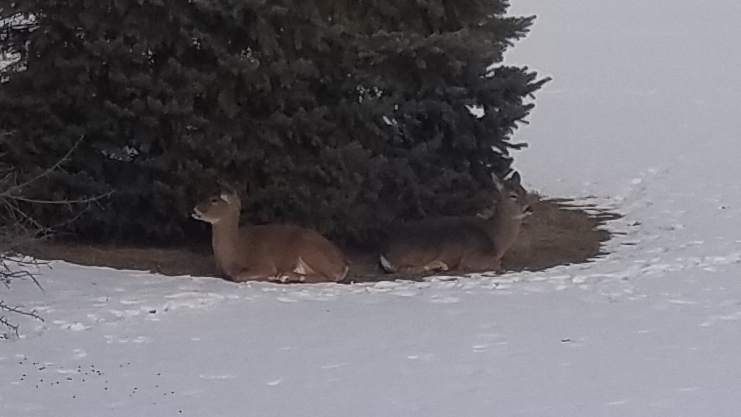
Deer took an after dinner rest near the spruce tree. It is a popular spot for wildlife year around. Creating a habitat is one of the successes we have had. It is an accomplishment. Each time I see deer, squirrels, foxes, birds or an opossum, I consider how little wildlife there was when we built here. Hopefully the apple trees will survive long enough for birds to nest in them a few more seasons.

Deer resting on the grass near the spruce tree.
Categories
Writing

Double Dipping on Carbon-Capture

Field Corn

Governor Kim Reynolds mentioned carbon-capture in her condition of the state address during a segment on renewable energy.

I am introducing new legislation that will improve access to E15 and B20 and upgrade Iowa’s fuel infrastructure to offer higher blends. And I’m proposing that we invest in carbon-capture solutions to sustain and build on our leadership position in renewable energy.

Governor Kim Reynolds Condition of the State Address, Jan. 11, 2022.

To be clear, the governor supports carbon-capture to protect Iowa’s investments in ethanol and bio-fuels. It has nothing to do with addressing the climate crisis, and everything to do with continuing to grow corn for ethanol. We are not sure if carbon-capture even works.

“The U.S. Department of Energy invested $684 million in unsuccessful carbon capture and storage demonstration projects at coal plants under the 2009 stimulus package, a U.S. Government Accountability Office audit found,” according to Karin Rives at S&P Global. “This time, the DOE has close to $1 billion from the 2021 infrastructure law earmarked for large-scale carbon capture pilot projects, as well as $2.5 billion for carbon capture demonstrations.”

If DOE spent $684 million on carbon capture and it failed to capture carbon, why would our government increase the amount to be spent? To address the climate crisis, ethanol and bio-fuels need to go out of business. Society should develop true alternative fuels that free farmer fields to grow food crops and don’t rely on release of carbon dioxide to produce ethanol.

Fool me once on carbon capture, shame on you. Fool me a second time, shame on me.

Read all of my posts on carbon-capture at this link.

Categories
Living in Society

Christmas Eve – 2021

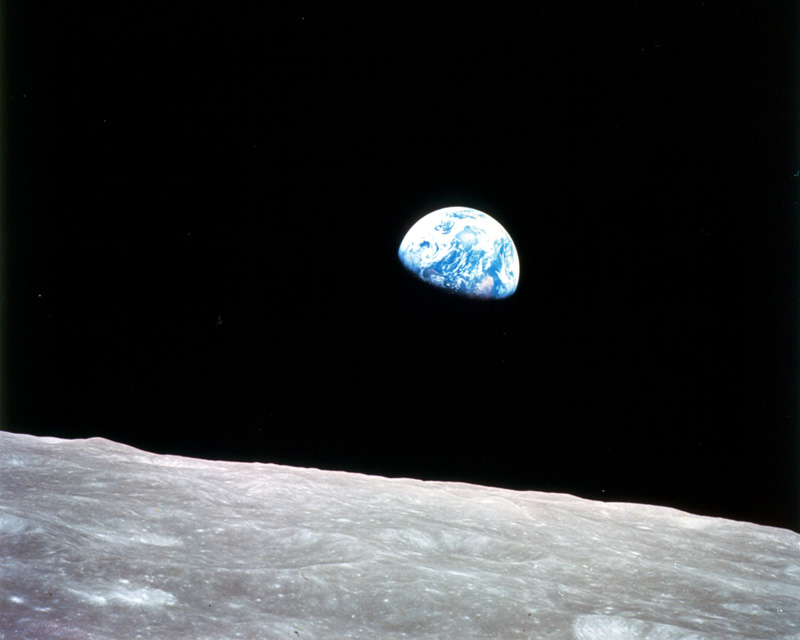
Earthrise by Bill Anders, Dec. 24, 1968

Best wishes to readers for end of year holidays.

In our house, it is Christmas Eve, although there is a string of notable days running from mid-December through January. I enjoy those Christmas seasons when I can stay home without pressure from work or other social obligations. During the coronavirus pandemic, it makes sense to avoid exposure to others, although the isolation is only partly mitigated by modern communications technology.

Leaving home can be a traumatic experience. When I left home in 1970 to attend university I didn’t understand there would be no permanent return to my home town. When our child left Iowa in 2007 there was also a lack of understanding of how the change would affect us. We do the best we can during holidays, whether child or parent. The veil of our illusions wears thin at the end of the year.

On Christmas Eve my tradition is to review this photo taken by Bill Anders during Apollo 8. It changed my life, and those of many others, to see Earth suspended in space, alone and vulnerable. Some say it sparked the environmental movement. The problem is the environmental movement and society more generally have been doing a poor job of mitigating the worse effects of the climate crisis. The coming week before New Year’s Day is projected to be the warmest December week in recorded history for North America. It is a cause for concern for us all.

For Christmas Eve dinner there will be cornbread and chili, followed by settling in to a long night. We did not decorate the house for the holiday and haven’t the last few years. If we have guests during a future holiday season I expect we will get the boxes out from under the stairway, reminisce about the decorations and how we came to have them, and put them up. Not this year, though.

It is a time for letting go the frustrations and tensions 2021 created within and among us. The year began with an attempt to overturn the results of the November 2020 U.S. presidential election. It is ending with a robust economic recovery that could only have happened with the leadership of President Biden and his administration. It was a year of the yinyang of being American.

As we prepare for a winter, delayed by a warming planet, it’s time to consider the future and actually do things to bring peace on Earth. That we will is my Christmas Eve wish.

However you celebrate year’s end, I wish you health and happiness as we prepare to enter the new year.

Categories
Writing

Swallowing the CCS Proposition

Field Corn

Two corporations plan to install Carbon Capture and Sequestration technology to collect CO2 emissions at about 40 ethanol and fertilizer plants spread across Iowa. Next, they plan to permanently bury the resulting liquefied CO2 in deep rock formations in North Dakota and Illinois. I don’t know who is swallowing this malarkey. Almost no one is.

The CO2 pipeline is planned to cross Karmen McShane’s family land in Linn County.

“It’s heartbreaking,” McShane told Gannett’s Donnelle Eller for a story. “My dad is 77. My mom needs care. And he feels powerless (to fight the pipeline).”

There is a lot of that going around.

The pace of news articles on CCS is increasing. Eller wrote about it in Monday’s Iowa City Press Citizen and followed it with another article in Tuesday’s newspaper. Erin Jordan of the Cedar Rapids Gazette has been covering CCS as well. When the regular news coverage is frequent, we should read what paid media writers have to say. That’s what I’ll be doing to see how the process unfolds over the end of year holidays. This is my seventh post on CCS.

The Iowa oligarchy of agriculture decided to do this thing, so resistance may be futile unless more people than have become engaged. If McShane is typical, the train left the station and once ground is broken for the pipeline, there will be no stopping it.

As long as Iowa focuses on ethanol, industrial agriculture using manufactured fertilizers, and monoculture row crops and livestock, the environment will get worse. It is pretty bad already if one looks at water and air quality. Implementing CCS does not address any of this and is a distraction from needed action to address Iowa’s water and air quality.

CCS is premised on a vague statement that we must decarbonize the economy. People have written books on this, and just because two companies are spending big bucks on the project, the one-off process in Iowa does not address broader concerns about reducing the amount of greenhouse gases being released into the atmosphere as if it were an open sewer. As far as I can tell, the sole reason for the project is to protect agricultural oligarchs’ two children: corn ethanol production and fertilizer manufacturing.

To read the rest of my coverage of carbon capture and sequestration in Iowa, click here.

~ Written for Blog for Iowa

Categories
Environment

Conservatives Have a Climate Caucus

On walkabout, Dec. 18, 2021.

When I wrote my Federal Elected Officials about climate change on Oct. 18, Congresswoman Mariannette Miller-Meeks was first to respond a few days later (see below). I did not know there was a Conservative Climate Caucus. She is a member and lifted the third paragraph of her response to me from the caucus website.

As long as she supports the beliefs of the caucus, there will be trouble reconciling my views with hers. In the long run, that’s okay. It is a starting point and we need to get going. We needed to get going 50 years ago.

The Conservative Climate Caucus was founded by Republican Congressman John R. Curtis (UT-03) in June this year with the following statement of beliefs:

What We Believe

The climate is changing, and decades of a global industrial era that has brought prosperity to the world has also contributed to that change.

Private sector innovation, American resources, and R&D investment have resulted in lower emissions and affordable energy, placing the United States as the global leader in reducing emissions

Climate change is a global issue and China is the greatest immediate obstacle to reducing world emissions. Solutions should reduce global emissions and not just be “feel good” policies

Practical and exportable answers can be found in innovation embraced by the free market. Americans and the rest of the world want access to cheaper, reliable, and cleaner energy

With innovative technologies, fossil fuels can and should be a major part of the global solution

Reducing emissions is the goal, not reducing energy choices

What We Do

Educate House Republicans on climate policies and legislation consistent with conservative values

Organize co-dels and staff-dels to better understand technologies and issues related to climate

Organize Member and staff briefings on conservative climate proposals

Bring Republicans to the table to fight against radical progressive climate proposals that would hurt our economy, American workers, and national security

Introduce Republican members and staff to leaders in industry, think tanks, and more

Conservative Climate Caucus website.

When it comes to hurting our economy, American workers, and national security, engagement of the federal government to address the climate crisis is essential. As long as Iowa focuses on ethanol, industrial agriculture using manufactured fertilizers, and monoculture row crops and livestock, the environment will get worse. It is pretty bad already if one looks at water and air quality. There is not much hope for the Conservative Climate Caucus as it was introduced, yet it’s what we have. It is an open question whether Democrats are up to the challenge of retiring Miller-Meeks after her first term. She is a strong campaigner and well known in the district. We have to begin somewhere, and soon. This may be it.

Email from Mariannette Miller-Meeks, Oct. 22, 2021.
Categories
Living in Society

Another Derecho

Sun shining through clouds the afternoon of the Dec. 15, 2021 derecho.

While Wednesday’s extreme weather manifested as a blustery thunderstorm in Big Grove, meteorologists have since categorized the multi-state storm as a derecho. It was nowhere as severe as the Aug. 10, 2020 derecho. (Update: The National Weather Service said it confirmed 43 tornadoes on Dec. 15, 2021. On Jan. 7, 2022 the number was revised to 61).

The good news is with generator and fuel standing by, and gallon jugs of bottled drinking water stored downstairs, we are ready. Practice makes perfect, as they say.

I spent 30 minutes chatting with a registered Republican, small business owner, and FOX News watcher this week. Things went well. We had plenty in common. The challenge is turning points of commonality into votes for progressive ideas. When push comes to shove, abortion is the dominant wolf in the pack. It is a firewall against political persuasion because if raised, the chat stops right there. People who oppose a woman’s right to choose raise the issue early in political conversations.

I have no choice but to interact with Republicans. They are and have been a part of our community since we lived here. During election cycles when I’ve had access to the voter rolls, I looked for the Democrats and increasingly they are in a minority where I live. I’m not complaining, just saying.

On a Zoom meeting with Iowa gubernatorial candidate Deidre DeJear last night, I asked what we should be doing to organize between now and the June primary. The response, somewhat predictably, was we should sign up to work on her campaign. It was her event, so I’m okay with that. A challenge remains unaddressed, though.

Democrats have three U.S. Senate candidates, two for governor, an unknown Democrat for the First Congressional District, and no declared candidate for either my state senator or state representative. There is a lot of work ahead if we want to elect more Democrats.

There is a case to be made the party primary election should be eliminated in favor of selecting candidates at a convention. It sounds undemocratic yet we could pick our people soon after the February precinct caucus rather than wait until June. That would give us four additional organizing months. We need every one of those in the current environment.

Back in the ancient days when megafauna roamed Earth, during the run up to the 2020 Democratic precinct caucuses, Iowa’s system failed to produce a clear winner in the presidential race. Instead results were delayed, the winner barely won the delegate count, and a loser asked for a recanvass of selected precincts. It wasn’t much better in 2016 when Hillary Clinton bested Bernie Sanders by a few delegates. There is no perfect system yet we can do better than the Iowa caucuses.

What I do, talking to Republican neighbors, is part of the political process yet I don’t see how it dovetails into the broader, state-wide politics. Politicians should concentrate on counting votes, yet there are endless conversations in all settings going on every day. These local conversations matter more than the vote-counting of politicians. They are valid and useful if sometimes frustrating. Often people who are different in political views put their best foot forward to get along in society. That may be all we have together. Democrats have yet to define our values in a way that resonates outside our clan.

I’m glad to have survived my second derecho. Now if I can survive our politics. That would be the rainbow at the end of a storm.

Categories
Environment

Shine More Light on CCS

Field Corn

The more sunshine that falls on Carbon Capture and Sequestration plans of Summit Carbon Solutions and Navigator CO2 Ventures the better.

On Sunday, Erin Jordan of the Cedar Rapids Gazette reported something surprising: “Scientists with the Iowa Geological Survey say the state has the underground infrastructure for sequestration here, which would allow Iowa companies to keep more of the federal tax credits for CO2 storage and build fewer miles of new pipelines.”

If CO2 can be stored in Iowa, why build the contentious pipelines from Iowa to North Dakota and Illinois?

“Elizabeth Burns-Thompson, Navigator vice president of government and public affairs, said at a meeting last week Iowa isn’t suited for carbon sequestration,” Jordan wrote. Not so fast say Iowa scientists who produced a study of the matter.

My point in publicizing this article is 1). to thank Jordan for covering an important issue, and 2). what is the rush in building the Summit and Navigator CCS operations?

The climate crisis is an urgent matter now and will escalate in importance during coming years. Before we invest dollars in an unproven, complicated scheme to protect ethanol and fertilizer production in a decarbonized economy, perhaps government should take the lead in determining whether CCS will actually work. In other locations around the world it hasn’t, for example, in Chevron’s operation in Western Australia. Asking the current Iowa government to get involved in examining project viability is contrary to the direction legislators and the governor would take us.

While the federal government budgeted a significant amount of money for CCS, how exactly it will be used is a moving target. Reuters reported “California lawmaker Ro Khanna introduced a bill into the U.S. House of Representatives on Monday that would prevent investors from securing carbon capture and sequestration tax credits if the carbon is used to boost oil production.” Given the propensity of the Congress to support CCS, it seems unlikely Khanna’s bill will see passage. As Reuters reported, “The bill… reflects deep political divisions in Congress over whether and how carbon capture can be used as a tool in the fight against climate change.” Until the Build Back Better Act is passed CCS funding won’t be final. Even then it is subject to modification by the Congress.

As the public and members of news media engage in the Summit and Navigator proposals it should be positive for Iowans. To learn more, check out our updated resource page here. And let the sunshine fall.

~ Written for Blog for Iowa

Categories
Reviews

Book Review: Birds in the Morning, Frogs at Night

I met Maureen McCue, who just published a memoir Birds in the Morning, Frogs at Night: Sharing Life Along the Road, when we were both on the Johnson County Board of Health in 2006.

As soon as McCue arrived to become the board’s physician, she drove us to become quite busy both with required tasks like replacing the director, and voluntary initiatives like educating other county boards of health in the effects of coal-fired power plants on human health. Given our shared history, I didn’t know what to expect when the memoir was released earlier this year.

While much in the book is familiar, the author’s interpretation of events is fresh. The road in the title, along which life is shared, was the same one I drove many times to get to their home: all without incident or specific inspiration. I recall when the bridge was out and had to take the long way around. It was a road, a conveyance. Or was it? The central assertion of the book is it was more than that, a metaphor for a path forward from environmental degradation.

It is a book worth reading for a couple of reasons.

McCue creates a sense of place that is hers alone and explains its risks and rewards. We see life along her road with all its wonder and tragedy. There are a number of Grade B roads in the county, yet she made hers special by describing animal and plant life along with changing weather in which she found herself. She attempted to connect it to the broader world she experienced in international travel as a physician. One experiences the sense of place in the writing. That alone is enough to make Birds in the Morning, Frogs at Night worth reading.

Life along the road includes their adopted son Michael who has special needs, or as McCue put it, “The diagnosis according to specialists that day was ‘mild to moderate’ mental retardation.” Over the years I spent time with Michael. He is a unique person and a familiar face around the county. While I feel I know Michael well, it is unclear what, if anything he remembers of me when I approach him to engage. McCue’s narrative about caring for Michael is compelling and an engaging read for people with special needs children.

When professors and instructors leave university many have written books. Stow Persons’ The University of Iowa in the Twentieth Century, D.C. Spriesterbach’s The Way it Was: The University of Iowa 1964 – 1989, and others come to mind. I asked McCue about this retirement, book-writing phenomenon. She answered, “I’ve asked myself the same question, but it’s not so much about writing after retirement, it’s more like having the time and will to get it published — this book and it’s parts were weaving there way out of me over a long time.  Writing happens whenever, but following it to the publisher takes a different kind of mind set and time line facilitated by retirement.”

There is an obvious comparison between Birds in the Morning, Frogs at Night: Sharing Life Along the Road and Cornelia F. Mutel’s 2016 book A Sugar Creek Chronicle: Observing Climate Change from a Midwestern Woodland. McCue and Mutel are friends and share many elements in their lives, McCue said. I wouldn’t want to pick between them so I advise reading both.

Birds in the Morning, Frogs at Night: Sharing Life Along the Road is published by Ice Cube Press. Find it by clicking here.

~ First posted on Bleeding Heartland on Dec. 11, 2021.