Categories
Environment Sustainability

Iowa Hosts Physicians for Social Responsibility

Student Physicians for Social Responsibility in Cedar Rapids
Student Physicians for Social Responsibility tour Kirkwood Community College

CEDAR RAPIDS– Iowa played host to the national organization Physicians for Social Responsibility (PSR) from May 6 through 10 at the Hotel at Kirkwood.

Iowa held center stage for meetings convened by national and international leaders of the 52 year old, Nobel peace prize winning organization. Thanks to the kind attention and assistance of the many expert hotel staff and the Kirkwood Community College affiliated training programs, this remarkable, first ever, national PSR gathering concluded a successful meeting on Saturday, May 10.

Those who attended the meetings work to address and reduce the humanitarian and health risks posed by the growing threat of nuclear weapons, the changing climate, and toxic environmental degradation. These first time visitors, initially quite skeptical about Iowa, were especially appreciative of its many unique offerings, both practical and recreational, available in and around the Kirkwood campus and the greater Cedar Rapids area.

The intractable challenges of our times were addressed in the meetings with U.S. Senate staff, Iowa elected officials, and online participants followed by experiences arranged by the Hotel at Kirkwood staff. Participants concerned about sustainability were able to visit and learn from the Kirkwood wind turbine and training center, the new Cedar Rapids LEED certified library with its green roof and inviting community center atmosphere, and the Kirkwood gardens and greenhouse. These tours, combined with the tasty, locally sourced and produced meals at the hotel, and an evening at the Cedar Valley Winery all served to showcase Iowa’s forward looking spirit and renew participants hopes for the future.

The troubled world presents us with so many new dangers and challenges. But the practical and creative talents of Iowans, especially those involved in Kirkwood’s uniquely integrated educational programs, services, entrepreneurship, and hotel partnership, manifest ample reasons for a positive outlook.

Board members, chapter leaders, staff and students from across the country join Iowa PSR in extending our deepest appreciation and gratitude to our hosts in Iowa. A special thanks to Tom Larkin of Senator Tom Harkin’s office, State Senator Rob Hogg of Cedar Rapids and State Representative Sally Stutsman of Johnson County. PSR leaders departed Iowa renewed by the gracious hospitality, insights and new sense of possibility gained by their experience.

~ Written for Blog for Iowa

Categories
Environment

Farming and Climate Change

PSR - IowaPrepared Remarks for the “No Talent, Talent Show” at the National Physicians for Social Responsibility Leaders Meeting in Cedar Rapids, Iowa, May 9, 2014.

Farming and Climate Change

Welcome to Iowa.

In Iowa, where we hold the first in the nation political caucuses, we view political discourse as a talent. I heard Mitt Romney speak down the hall from here in 2010, so this argument remains an open question. Whether political discourse is talent will be for our out-of-state guests to determine tonight. My subject is farming and climate change.

One can’t help but notice the bucolic setting in which we find ourselves tonight at this first ever national meeting of Physicians for Social Responsibility in Iowa. Within walking distance, the spring images of agribusiness play out in real life: plant genetics, row cropping, fertilizers made from natural gas and associated nutrient runoff— a chemically intensive food production system developed in the industrial era. It features enormous single-crop farms and animal production facilities based on a misguided hope of feeding the world from these fields.

Expand the circle several miles, and a few dozen small farms engage in sustainable practices, have crop diversity, use cover crops to enrich the soil, muck out barns for manure to spread on fields, and produce pasture fed meat and dairy products along with vegetables. The contrasts between the two models couldn’t be more different even if they have the same roots in Iowa’s fertile soil.

In Iowa, agriculture connects us to the rest of the world. When Russia, Ukraine and Kazakhstan suffered a drought in 2010 and stopped wheat exports, neighbors of mine planted winter wheat almost immediately on the news. The dead zones in the Gulf of Mexico can be traced directly to our land. When Iowa trade missions visit China, South Korea and Japan, the framing is export of commodities that include pork, beef, corn and soybeans. When our cultural missions visit Africa it is partly to propagate plant genetics and row crop methods, displacing native staple foods with corn and soybeans in the ersatz colonization we call international development.

It’s all good… or is it?

More than most people, Iowa farmers deal with the reality of the effects of climate change and I want to spend the rest of my time on their resistance to mitigating the causes of climate change.

During the drought of 2012, more than 6,500 daily heat records were tied or broken in the United States, including in Iowa. July 2012 was the hottest month on record in the United States. I was engaged as a political consultant that summer, and the work took me out among farm fields on a daily basis. I learned what stressed corn looks like and came to understand what drought means to crop production. That year, U.S. corn production decreased by almost 20 percent.

Conditions were so bad the governor called a meeting in Mount Pleasant to discuss the drought. Invited speakers included farmers from Iowa agricultural groups: the Cattleman’s Association, the Pork Producers, Corn Growers Association and the Iowa Soybean Association. None of my sustainable farmer friends were invited.

Their comments were similar: the way farmers would deal with the effects of the drought would be to plow the crop under, capitalize the loss over five years, and start planting again the next year. Not once during the meeting were the words climate change uttered by anyone. Iowa agriculture doesn’t connect the dots between extreme weather and how it is made more frequent and worse by global warming. They just deal with it as best they can.

Iowa Farm Bureau economist Dave Miller provided some clarity about where farmers are coming from at a recent conference in Des Moines. Miller is a farmer who also ran the now defunct Chicago Climate Exchange, a company that made a market in carbon with companies who voluntarily adopted a cap on CO2 pollution and traded carbon credits toward that end.

“If there is no profit in farming, there is no conservation in farming,” said Miller. “You can’t pay for conservation out of losses,” he added. Farming economics drive farming behavior and what he said to close his remarks has broader significance:

“Capital investment horizons are three to 20 years, but my farming career is 20 to 40 years. The climate conditions and those things are millennial.”

There it is, the Iowa resignation that climate change may be real and happening now, but what’s a person to do about it since it is much bigger than my life?

From the perspective of a single life of economic struggle, it is difficult to raise our heads and connect the dots between an industrial society that includes farming and its production of greenhouse gases that contribute to the droughts and extreme weather that make our lives worse.

This is where Physicians for Social Responsibility must step in and connect the dots. With education, by framing actions, by pointing to the health consequences of global warming and the changes in our climate it is producing.

We must do this with an eye toward the future, and an avoidance of alarmist rhetoric that deniers use against us. We must make it a tangible behavior in our daily lives. The words are familiar. We must use our standing as health professionals and recommit to preventing what we cannot cure in every action we take in constant vigilance of the gravest threats to humanity.

Thank you.
Categories
Environment

Environment for Change

Corn Field
Corn Field

LAKE MACBRIDE— Green up has come and blossoming trees paint the landscape with their white and red petals. Back in the day, when work took me to Georgia and Tennessee, I managed to see dogwood in bloom most years. It was ersatz when reminders of spring were close by if we could have but recognized them.

Spring weather has been dicey and farmers are adapting. One farmer got sick of the fields coated with a thin layer of mud and headed into the house to stop looking at it. For some, planting began yesterday. With modern technology, the whole state could be planted in under a week— one of the ways farmers have adapted to global warming and climate change, although most wouldn’t talk about this.

The central question regarding global warming and climate change is whether people will join together and do something about it. Some are, and more will, but most don’t connect the dots. A common obstacle to progress has been that some people feel the problem is too big to deal with. There is no denying it is a complex problem that doesn’t lend itself to easy solutions.

What’s a person to do? Go on living.

If we don’t take care of ourselves first— by sustaining our lives together— we have little to offer. Taking care of ourselves is not optional.

At the same time, being self-centered is not good for us, or for society. There is plenty to occupy our bodies and minds on earth, and while some days we just get by, on others we rise to our potential and contribute something to a greater good. If this were a cafeteria, I would have another serving of the latter.

Life in consumer society may resemble a cafeteria, where we get a choice on everything, but it is not that. We have a home place, and somehow it has gotten to be a storage shed rather than a center for production. Once we make our choices, then meaningful articulation of our life becomes more important than accumulating additional things.

In the end, the case for taking action to mitigate the causes of global warming and climate change will be made by the environment itself. The environment doesn’t care much about humans.

It will become abundantly clear, and some say we are already there, that humans control our environment in a way we couldn’t when the population was much smaller. Logic won’t make the case to sustain what we have. It will be made of our existential experience and awareness that our lives have meaning beyond answers to the questions where will I stay tonight, and what will be my next meal. When people go hungry or without a place to sleep, it is difficult to think about much else, making change nearly impossible.

We live in an environment ready for change and there’s more to it than singlular voices on the platted land.

Categories
Environment Sustainability

Changing Sprockets

Sign Post Near the Exit

LAKE MACBRIDE— It is time to shift gears from the environment to nuclear abolition— two aspects of the same thing. It’s a false choice to pick one over the other, as mismanaging either could have dire consequences for life as we know it. There are so many causes; and limited time.

What environmental and nuclear abolition advocacy have in common is they are global movements where the U.S. has taken a back seat.

Francesca Giovannini, the program director of the International Security and Energy Program of the American Academy of Arts and Sciences, summarized the as-is situation with nuclear weapons in an article for Rotary International.

Although we live in the Post-Cold War era, we remain trapped in a nuclear weapons-reliant world order in which the maintenance of active nuclear arsenals provides ultimate assurance of both survivability and destruction. Today, we talk much less about nuclear weapons than we did during the bi-polar era and the public globally is generally unaware of the continuous existence of thousands of nuclear warheads targeting cities and populated neighborhoods across the globe.

Rotarian at Work
Rotarian at Work

The Rotary Action Group for Peace announced  a collaboration between International Physicians for the Prevention of Nuclear War and Rotary International:

Nobel Peace Laureates International Physicians for the Prevention of Nuclear War and Physicians for Social Responsibility offer educational resources to Rotarian Action Group for Peace members interested in sharing information about nuclear weapons and peace with their Rotary clubs.

I am pleased to be part of the speaker’s bureau created to support the collaboration and look forward to reporting these new activities  going forward.

Categories
Environment

Finishing the Gig

the-climate-reality-project-logoINDEPENDENCE— Last night I gave my tenth presentation for the Climate Reality Project, and have now completed 40 acts of leadership as a climate leader. This Earth week is a time to reflect on my recent experiences as part of the climate movement.

My contractual obligation with the organization may be complete, but the work will go on. Politico recently published an article based upon an interview with Al Gore, and there are some lessons to be learned.

There is no question that Gore has become a polarizing figure in the climate movement. We can’t blame him for making a living, and if he invests in companies that move the economy toward sustainability, much the better. At the same time, his $200 million net worth, and how he got it, are sticking points for many people I know and respect. That he is associated with the Climate Reality Project puts me, and others, on the defensive from the get go. I’m okay with that, but defending Al Gore is a distraction from the work, and at the end of the day, there is little about him that needs defending.

One concern expressed after my presentation was how to combat the proliferation of letters to the editor by obvious climate deniers. The answer I gave was simple. Ignore them and speak the truth. What the deniers want more than anything is to delay any change that moves us toward a sustainable future. The less we get involved in their spurious arguments, the more potential we have to advance ours. A denier with vested interests wants nothing better than to engage and distract people who seek a solution to the climate crisis.

Money is currently winning the conversation about climate, and it is not that of Al Gore or Tom Steyer, another wealthy member of the movement. The money is not from the Tides Foundation or Michael Bloomberg, which both fund environmental NGOs. The money is coming from the fossil fuels industry and from a host of foundations that want to delay meaningful government action on global warming. By contract, I work as a volunteer, where every tank of gasoline has been from my own checking account, which is miniscule compared to theirs.

The truth is on our side. Regardless of what people come up with as counter arguments, hundreds of millions of people on the planet are being affected by global warming. It is clear that the frequent droughts around the world are made worse by global warming. To an extent, it doesn’t matter that people try to deny it. At some point, and it won’t be long, the need for action will be so clear that people will rise up and take action. We are already seeing it in Syria, Egypt, and other Mediterranean countries caught up in the food shortage caused by the 2010 drought in Russia, Ukraine and Kazakhstan. We are buffered from food price spikes it in the U.S. because of our sophisticated food supply chains, but eventually environmental incidents like the 2012 drought, which caused a 20 percent decline in the U.S. corn harvest, will impact our family budget as well.

How long will it take? Al Gore, quoting Dr. Martin Luther King Jr. said, “not long.” I am ready for the work.

Categories
Environment

Earth Day 2014

1970 Earth Day Button

LAKE MACBRIDE— Needed rain came yesterday, 0.63 inches according to our local precipitation tracker. Things are greening up, and the exposed soil in the garden looks black and teeming with life. Today is a farm day, and along with soil blocking, I hope to spend time outside when my shift is done, soaking in the results of their recent work.

I don’t have a commemorative post for the 44th anniversary of Earth Day, except to say I am still here working, as are many people around the globe. While few knew what we were talking about in 1970, that’s not the case today. For that I am thankful.

The sticky wicket that is environmental advocacy must continue on Earth Day and every day. The focus should be on clean air and clean water— protecting the commons. Yet finding a fulcrum on which to turn the discussion toward sustainability is elusive as society serves the interests of capital.

Even Goldman Sachs and Warren Buffet are in the game of renewable energy, because its economic viability has been proven, and investment in solar arrays can provide a better return on investment than other parts of the economy. Wealth gets increasingly concentrated in a smaller group of people, and I’m not ready to tackle that problem.

In a little while I’ll drive my beater of a car over to the farm and get the next trays ready for seeding. It’s a lot closer to the earth than I have been— and there is much to be done before my life is done and I return there.

May your days be many and your troubles be few. Happy Earth Day!

Categories
Environment

Earth Week Celebration

Earth WeekEarth Week Celebration
Remarks delivered at Old Brick on April 19, 2014
Iowa City, Iowa

If you haven’t seen the buffalo at Yellowstone National Park, you should. One gets a sense of possibilities that existed on the plains as the herds wander and belch their way back and forth inside the park. There is space for them to seem vast, even if they are a fraction of what they once were. The herds will never return to the great plains, but to see the bison at Yellowstone made the trip for me.

If you are on the Internet at all, you have likely heard of the YouTube videos showing buffalo exiting Yellowstone. The assertion is that the giant caldera that makes the park unique is getting ready to erupt in a cataclysmic explosion that portends the end of life as we know it.  Scientists don’t agree. Yes, Yellowstone is a big volcano. Yes, it last erupted over 600,000 years ago. But no, a new eruption isn’t overdue because science doesn’t work like that, despite the activities of bison.

Here’s what does matter. The difference between natural pollution of the atmosphere caused by volcanoes and that caused by humans.

I want to discuss three more things: Mount Tambora, Mount Saint Helens, and nuclear famine.

On April 10, 1815, Mount Tambora in Indonesia produced the largest volcanic eruption in recorded history. The blast was so loud, it was heard 1,200 miles away in Sumatra. It is estimated that the eruption produced 38 cubic miles of volcanic debris.

While some 12,000 people were killed directly by the eruption, the larger death toll was from starvation and disease, as fallout from the eruption ruined local agricultural productivity, killing another 50,000 people or more.

What made matters worse was the dispersion of ash throughout the atmosphere. It darkened the sky and created climate anomalies including what we call volcanic winter. 1816 became known as the year without a summer because of weather. Crops and livestock died in much of the Northern Hemisphere, resulting in the worst famine in the 19th century.

While nowhere nearly as bad as Mount Tambora, the volcanic eruption on May 18, 1980 at Mount Saint Helens is fixed in memory for people living at the time. It was the deadliest and most economically destructive volcanic event in the history of the United States.

If we compare them, Mount Saint Helens was much smaller than the Mount Tambora eruption. According to the index that measures these things, Mount Tambora was rated 7 while Mount Saint Helens was rated 5. We know about Mount Saint Helens because it is fixed in our memories. We should also remember Mount Tambora as it was more important.

That brings me to nuclear abolition. Recent research has indicated that two billion people may be at risk in a limited, regional nuclear weapons exchange by two of the world’s nuclear states. The reasons are similar to what caused the year without a summer. The firestorm after the exchange would create soot and ash in the atmosphere many times worse than the single year without a summer after Mount Tambora erupted. Simply put, it would be a disaster of unprecedented proportion. One that could happen or be prevented by humans.

The conclusion people should draw is there is no reason for nuclear weapons to exist and they should be abolished.

The next time people on the Internet worrying about the end of civilization as we know it based upon YouTube videos, I recommend you turn off the computer and focus on preventing disasters we can by abolishing nuclear weapons.

Categories
Home Life

Rain and Other News

Lunar Eclipse April 15, 2014

LAKE MACBRIDE— Sunday and Monday rain was welcome and much needed. According to the Community Collaborative Rain, Hail and Snow Network, 2.7 inches fell. The ground remains too wet for planting, and this morning, temperatures dipped below freezing— it’s 25 degrees presently and too cold for outdoors work. There was a large crew at the farm yesterday, so the soil blocking for the week got done without me. If the ground dries later in the week, there will be planting, but for now there is a schedule gap— also welcome and much needed.

The sound of cello on my smartphone alarm woke me at 1 a.m. to view the total lunar eclipse. Still in my bedclothes, I pulled up the blinds and the sky was as clear as it gets. The eclipse had just begun.

I pulled on my jeans and a shirt, donned my winter coat, and went outside to witness the proceedings. The houses were mostly dark and moonlight reflected off the surface of the lake. Only the sound from a distant I-380 could be heard. I was the only person outside in my neighborhood.  It was worth breaking deep sleep to watch as Earth dimmed the moon for a while.

There were spectacular images and a live stream available on the Internet, but I preferred my own view, filtered by the atmosphere and my aging retinas, captured on a handheld digital camera. Along with the light pollution from Cedar Rapids and Iowa City, the Milky Way could be seen. And so many stars.

Checking my email on the smartphone before heading back to bed, I found my state representative, Bobby Kaufmann, formally announced his campaign for re-election yesterday. That’s not really news, just a tick mark off a list of political events I am monitoring. The newspaper asked me to do interviews with the two candidates in the Democratic primary, and I accepted the assignment. The newspaper work gives me more reason to keep my views in this race to myself.

When I returned to bed, I slept a full five hours, and am ready for the day with the unexpected gift of a couple of hours to myself. A rarity in sustaining a life on the Iowa prairie.

Categories
Environment

Earth Week Sustainability Schedule

the-climate-reality-project-logoLAKE MACBRIDE— I will be speaking about personal finance, the environment and nuclear abolition four times between April 19 and 24. If you are nearby, please consider attending one of these events:

April 19, 11 a.m.: “Alternative Living: Focus on Finances” with Solon resident and writer Paul Deaton. Paul gave up his 9 to 5 job to focus on his writing. He will describe his creative methods of putting food on the table and how he covers his expenses to survive and thrive. Part of the American Library Association Money Smart Week, Solon Public Library, 320 W. Main St., Solon, Iowa.

April 19, 1 until 3 p.m.: Soap Box Speech on the environment: “Mount Tambora, Mount St. Helens and Nuclear Famine” at the Celebration of Life at Old Brick, 20 East Market St., Iowa City, Iowa.

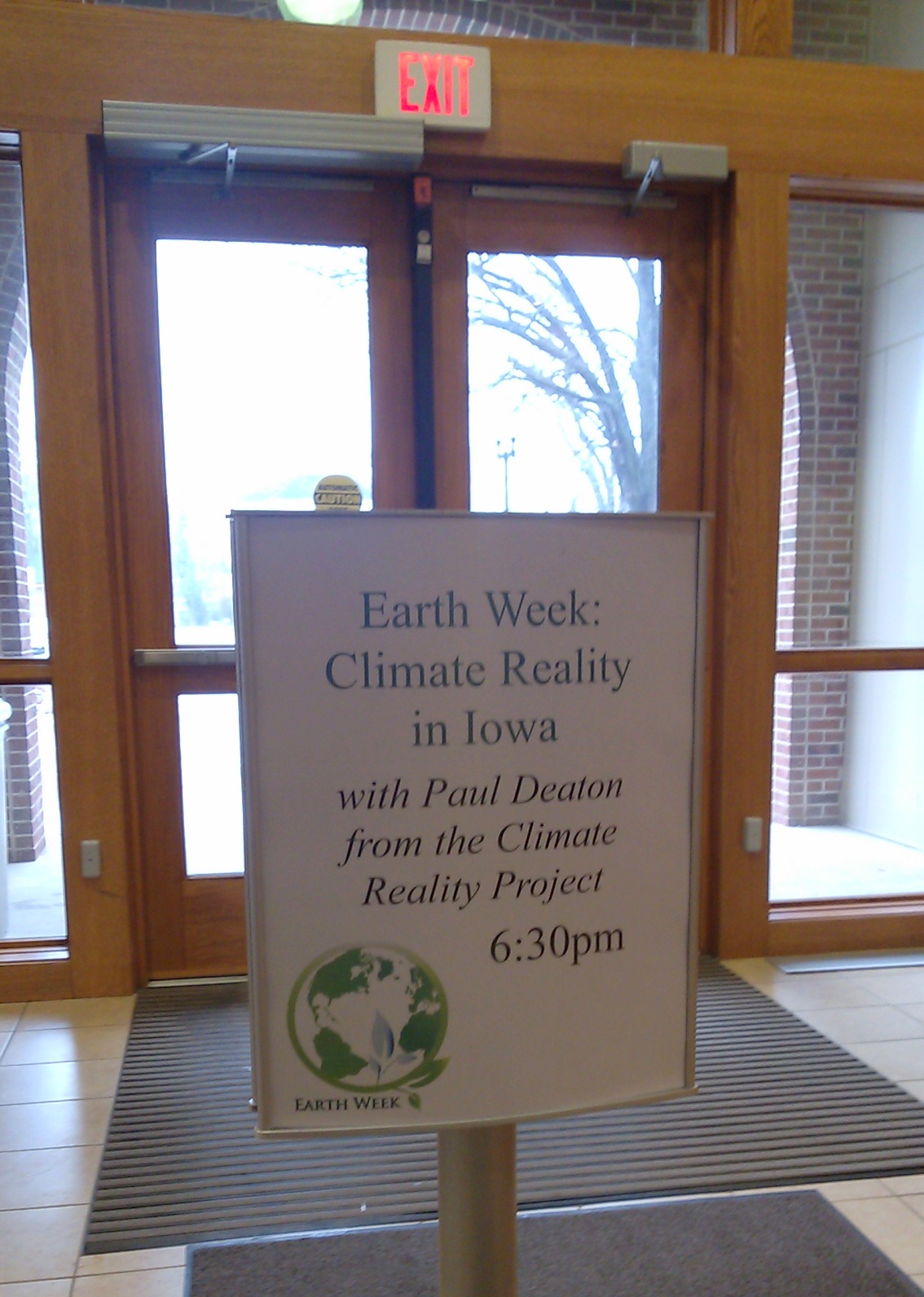
April 23, 6:30 p.m.: “Earth Week: Climate Reality in Iowa” at 220East, 220 East Fourth St., Waterloo, Iowa.

April 24, 6:30 p.m.: “Earth Week: Climate Reality in Iowa” at the Independence Public Library, 805 1st St. East, Independence, Iowa.

11 a.m.: “Alternative Living: focus on finances” with Solon resident and writer Paul Deaton. Paul gave up his 9-5 job to focus on his writing. He will describe his creative methods of putting food on the table and how he covers his expenses. – See more at: http://www.soloneconomist.com/content/solon-public-library-50#sthash.PGm9t3cj.dpuf

11 a.m.: “Alternative Living: focus on finances” with Solon resident and writer Paul Deaton. Paul gave up his 9-5 job to focus on his writing. He will describe his creative methods of putting food on the table and how he covers his expenses. – See more at: http://www.soloneconomist.com/content/solon-public-library-50#sthash.PGm9t3cj.dpuf

11 a.m.: “Alternative Living: focus on finances” with Solon resident and writer Paul Deaton. Paul gave up his 9-5 job to focus on his writing. He will describe his creative methods of putting food on the table and how he covers his expenses. – See more at: http://www.soloneconomist.com/content/solon-public-library-50#sthash.PGm9t3cj.dpuf

11 a.m.: “Alternative Living: focus on finances” with Solon resident and writer Paul Deaton. Paul gave up his 9-5 job to focus on his writing. He will describe his creative methods of putting food on the table and how he covers his expenses. – See more at: http://www.soloneconomist.com/content/solon-public-library-50#sthash.PGm9t3cj.dpuf

11 a.m.: “Alternative Living: focus on finances” with Solon resident and writer Paul Deaton. Paul gave up his 9-5 job to focus on his writing. He will describe his creative methods of putting food on the table and how he covers his expenses. – See more at: http://www.soloneconomist.com/content/solon-public-library-50#sthash.PGm9t3cj.dpuf
Categories
Environment

Letter to the Editor

Self Portrait in ShadowTo the editor,

It is ironic that Gary Wattnem, a career ophthalmic instrument salesman, can’t see clearly enough to support Senator Rob Hogg and Representative Bobby Kaufmann in their opposition to the Keystone XL pipeline, based on eminent domain concerns. In his recent letter to the editor, Wattnem signed as a U.S. Army officer, reminding us that old soldiers never die, but in his case, should consider taking Douglas MacArthur’s example and just fade away.

Under the Obama administration, there has been a resurgence of domestic oil production. “For the first time in nearly two decades, we produce more oil here in the United States than we buy from the rest of the world,” said President Obama on Jan. 16.

According to former oil man T. Boone Pickens on a recent episode of Iowa Press, the U.S. exports three million barrels of light sweet crude each day because of development in the Bakken and Eagle Ford formations, and West Texas. If refineries would retool to process light sweet, said Pickens, the oil could be used domestically. If foreign oil were a national security issue, that’s what we’d do.

Keystone is about getting tar sands oil to the global market, not about U.S. national security. Condemning U.S. property to serve the interests of a Calgary, Alberta based company would be plain wrong.

By throwing his uniform around the issue, Wattnem tarnished the rest of us who served.