In his new book, Breakneck: China’s Quest to Engineer the Future, author Dan Wang contrasts the engineering society of building stuff in China with the lawyering society of delaying and litigating things in the United States. The comparison seems apt and I recommend the book.
It seems obvious the United States is bogged down with lawyerly concerns, beginning with the current president. Donald Trump has weaponized the Justice Department to serve his every whim. Likewise, he has a large stable of attorneys representing him on countless legal matters. More than any person I know, the president is the living incarnation of “lawyering up.” How is that working for most Americans?
The problem I see is the president’s approach results in China getting way out ahead of the United States in technology development important to our global future. China’s embrace of renewable energy alone will make them a formidable power going forward. They who control energy can control a lion’s share of the economy. The president should get out of the way and enable the country to embrace renewable energy now.
The downside of lawyering up is we can’t develop technological innovation to create a society in which we all want to live.
On July 1, Interstate Power and Light Company, the parent company of Alliant Energy, filed an application to add 1,000 megawatts of wind energy “to help boost Iowa’s electric grid and further diversify its energy portfolio,” Olivia Cohen wrote in the Cedar Rapids Gazette. The timing of the filing takes advantage of tax credits included in the Inflation Reduction Act before they change as a result of the budget reconciliation bill enacted this month. This project seems like a good deal for everyone.
What we don’t see is applications to construct new nuclear reactors to generate electricity. There has been a stream of media articles about pulling the Duane Arnold Energy Center in Palo out of mothballs and bringing it on line again. There is an exploratory committee for that purpose. In addition, the Linn County Supervisors have undertaken to establish a nuclear zoning code for parts of the compliance not preempted by federal authorities. These are not real solutions to meet energy demand.
I wrote before, “The technology at Duane Arnold is old. The physical plant is old. Its permit has been renewed twice. There is a limit to the life of these facilities built in the 1970s. Why throw new money after old technology? We shouldn’t.” If we do anything regarding nuclear power generation, we should wait until known problems have been resolved. That is one of Bill Gates’ current projects. Gates appears to rely heavily on government subsidies for his small modular reactor in Wyoming.
Why even consider nuclear energy? I knew why when I was a kid back in the 1950s and ’60s after President Dwight Eisenhower’s Atoms for Peace speech at the United Nations General Assembly on Dec. 8, 1953. Eisenhower sought to solve the terrible problem of splitting atoms in nuclear weapons by suggesting a means to transform the atom from a scourge into a benefit for mankind. Follow this link for the text of the Atoms for Peace speech. That idea had its heyday. That time is over.
Even Iowa is getting in the act with Governor Reynolds’ Nuclear Energy Task Force created via Executive Order to make recommendations for how we can move forward with nuclear energy in Iowa. The task force was just formed, so we don’t know the direction they will take. Well, we do. There is only one game in town. Generate nuclear powered electricity using government subsidies to offset the high costs which render the idea a non-starter as a stand alone business proposition.
Today our government wants nuclear weapons and nuclear power for the express purpose of making money for contractors and their wealthy owners. Profits are to be propped up by government subsidies. The message, clear in the Alliant Energy application, is government subsidies for green energy are coming to an end under the current administration. Why not phase out and end the subsidies for nuclear power and fossil fuel companies as well? We know why. The government has been captured by these energy industries.
Society has not begun to tap the potential of wind and solar energy. When the issue of storage is solved, the two methods of electricity generation should just take off. It is up to us to resist a resurgence of nuclear power and allow wind and solar to take market share. Based on what is happening now in Europe, they will. The United States has chosen to service oligarchs and large corporations in its energy policy. We should lead rather than do this and fall behind.
If a person doesn’t believe an industry can capture the U.S. government, they haven’t been paying attention. The proposed rescission of congressionally approved funding for clean energy projects, combined with the omnibus reconciliation bill endeavor to strip away any government support for wind and solar generated electricity, electric vehicles, and more. The same moneyed players are at work here to retard progress toward a clean energy future: the fossil fuels industry.
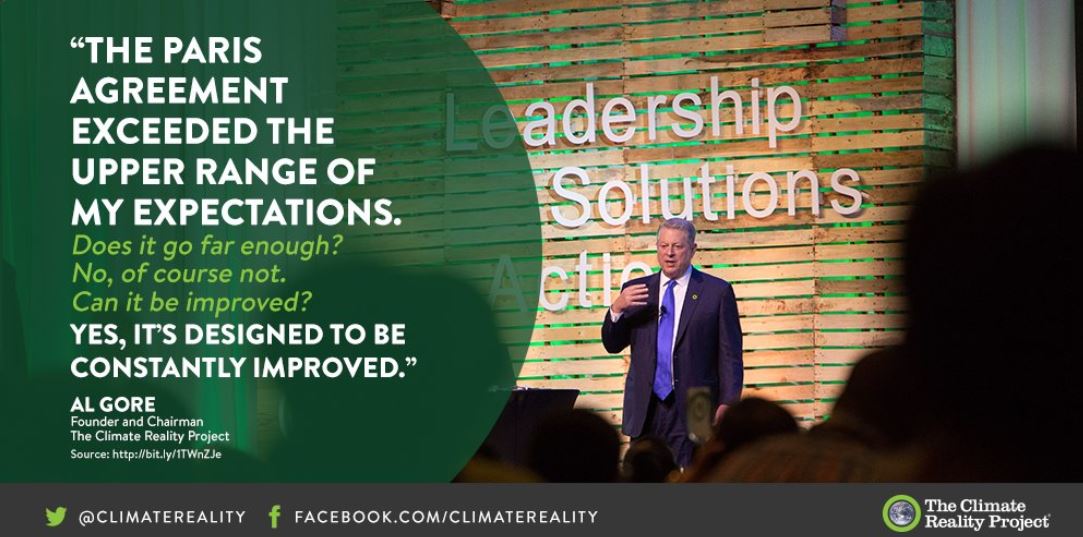
Former Vice President Al Gore of the Climate Reality Project shared his thoughts on the regressive Republican policies:
We don’t have any time to waste if we want to solve the climate crisis in time to avert the truly catastrophic impacts that can still be prevented. But dangerous delay – which is the new “climate denial” – is exactly what Congress has done by repealing the clean energy provisions of the IRA: wasting time we don’t have by trying to prop up the fossil fuel industry while the world burns.
Make no mistake, the clean energy transition will continue in the United States despite these efforts – our direction of travel is clear.
But by prioritizing the fossil fuel industry over true climate solutions – even forcing taxpayers to add yet more subsidies for large oil and gas companies – our leaders are shirking their responsibility to the American people and ceding leadership in the global economy to China, Europe, and others who are embracing the many benefits of a clean energy future. (Statement by Former Vice President Al Gore on the Budget Bill, The Climate Reality Project, July, 3, 2025).
Gore is right. An obvious truth is that if the United States steps back from what once was robust governmental support for clean energy, there are two consequences. The domestic transition from fossil fuels to solar and wind powered energy will continue. The course is set, despite hobbles the fossil fuel captured Trump administration tries to attach to it. Second, if the United States doesn’t want to lead, China, Europe and others will, putting our country at a competitive disadvantage.
Last Wednesday, Reuters reported, “Solar power was the European Union’s largest source of electricity for the first time in June, overtaking nuclear and wind while coal’s contribution fell to an all-time low, data from energy think tank Ember showed.” The next challenge for Europe’s power system is expansion of battery storage and grid flexibility to reduce reliance on fossil fuels when the sun doesn’t shine and the wind doesn’t blow, according to the article. The U.S. should be leading this energy transformation instead of ceding it to other countries.
The future is ours if we will grasp it. Despite Republican efforts to stop the clean energy transition, progress will continue, only this time with the United State playing catch up.
According to the sensor installed on the north side of the house, the ambient temperature was 13 degrees below zero Fahrenheit when I began writing this post. The sun is rising and it warmed up. We’re not at zero yet, although the high is forecast at 25 degrees. Today the weather is weird again.
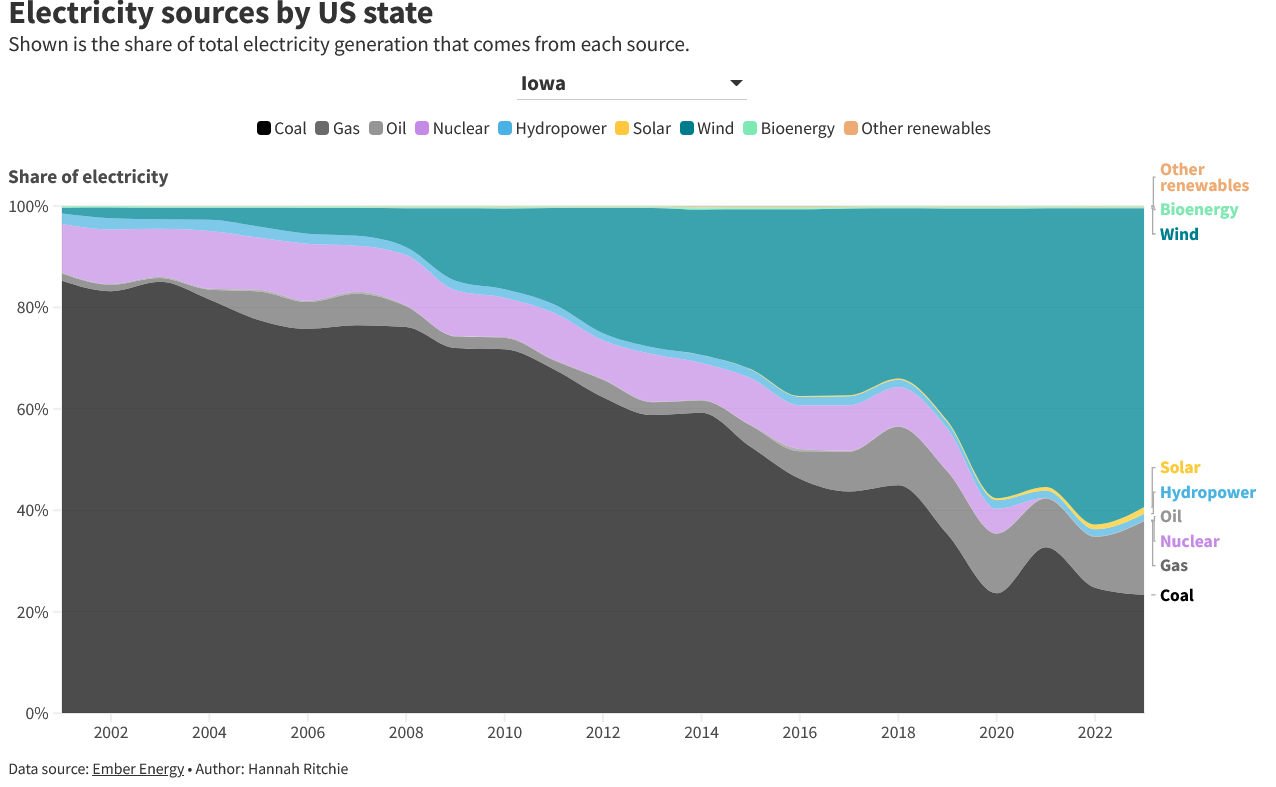
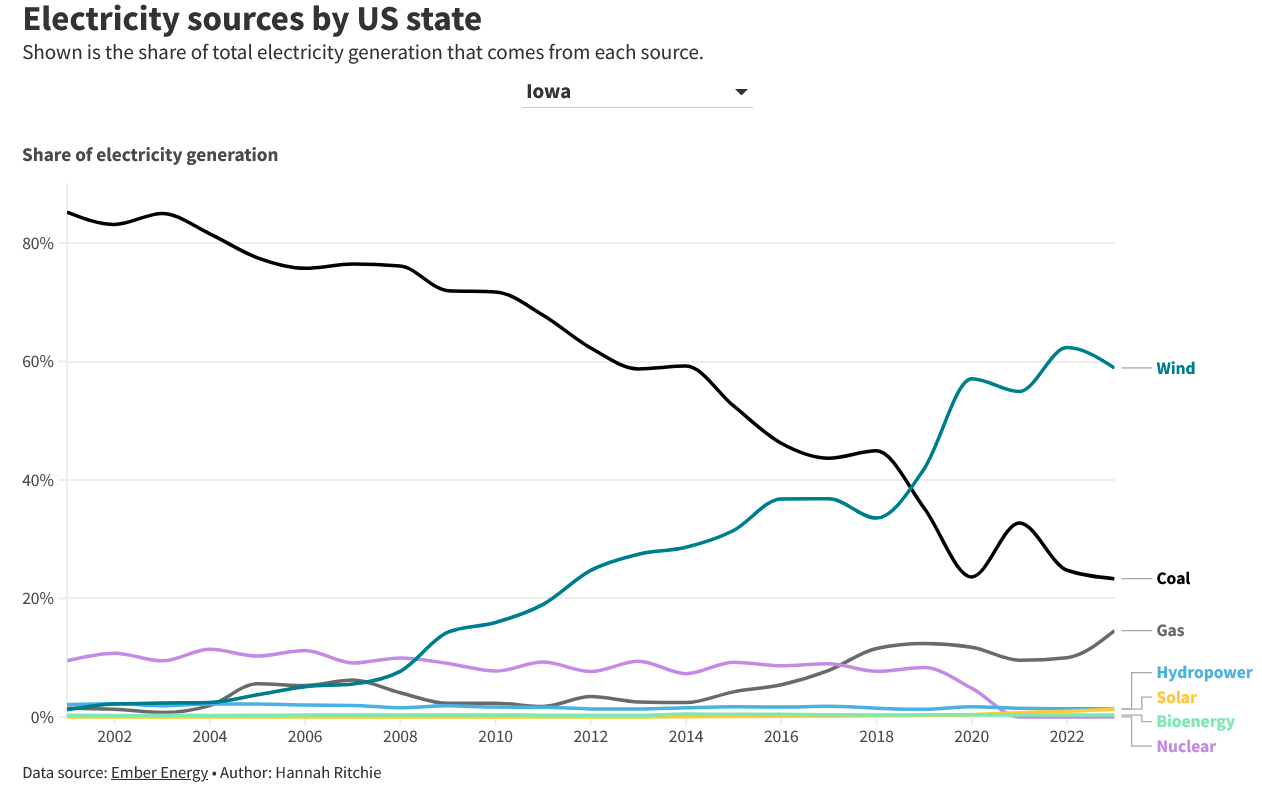
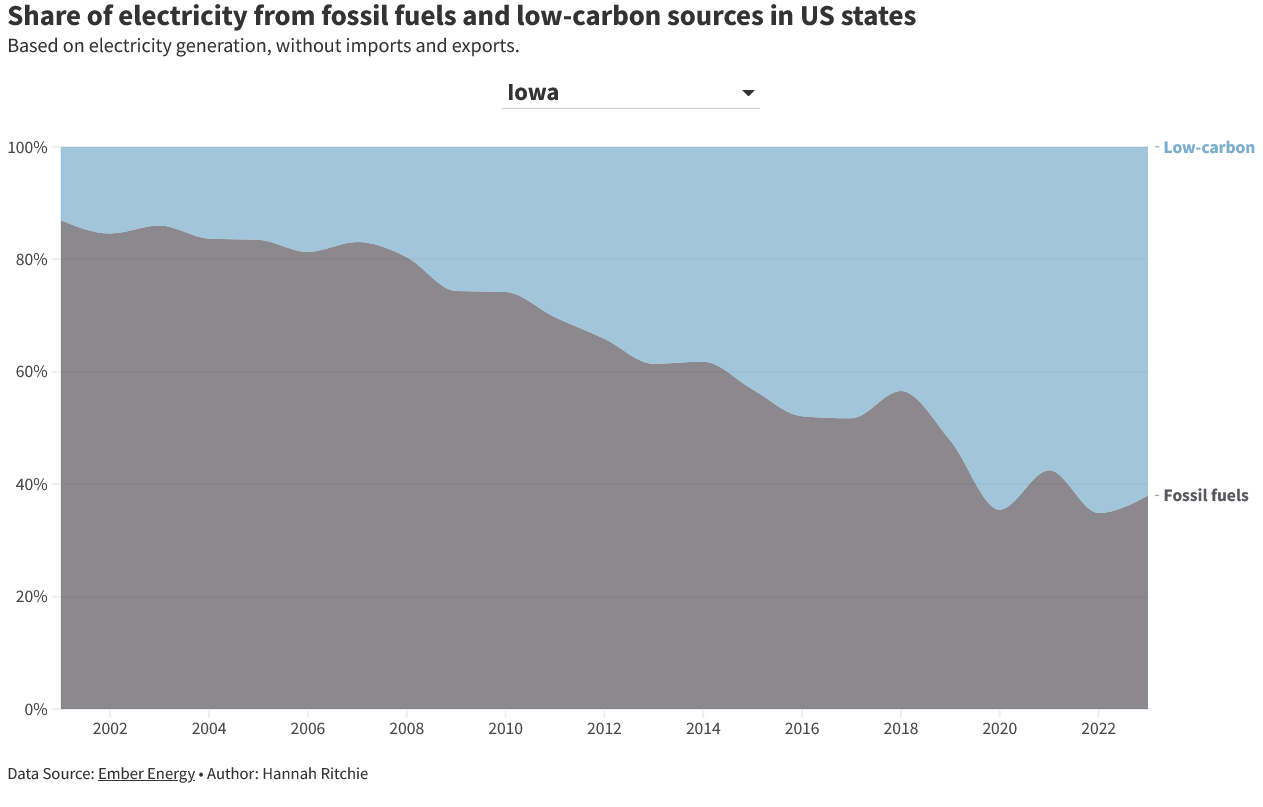
Iowa is a leader in wind energy and has plenty of room to improve our solar capacity. There are environmental issues with every form of electricity production, yet burning fossil fuels is our most immediate danger because of the role of carbon dioxide in enhancing the greenhouse effect. Despite today’s low temperatures, Iowa is simply too darn hot.
The trend on the following chart is the right one. As a state, we need to move more quickly.
It seems obvious to me that to get to zero fossil fuels used to generate electricity Iowa needs to install many more solar panels. There are issues with both wind and solar generated electricity.
The wind doesn’t always blow and the sun doesn’t always shine. They can be addressed. One of the key strategies to deal with intermittency, which is what this is called, is to improve the forecasting and planning of renewable power generation and demand. Another strategy is to invest in storage and integration solutions that can balance the supply and demand. A third strategy is to foster innovation and adaptation. This involves developing and deploying new technologies, designs, and practices that can enhance the performance, efficiency, and resilience of renewables. We need the will to solve these problems.
So the news about electricity generation in Iowa is positive. We just need more renewables and technological solutions to deal with intermittency so we can replace fossil fuels altogether. To a reasonable mind, this can be accomplished. Now we just need our regulatory and governmental authorities to get on board.
Friday I ran errands before the winter storm hit. Errands means filling the automobile fuel tank with gasoline, buying a lottery ticket, and driving south on Highway One to the grocery store in the county seat to purchase organic celery, frozen lima beans and sundry other items not available locally.
The storm hit between noon and 1 p.m. depositing a fluffy, four-inch covering of snow on everything.
It wasn’t a blizzard as one could easily see into the distance through the small, falling snowflakes. The wind wasn’t blizzard-bad. It gave me a chance to try out the electric snow blower I bought at the home, farm and auto supply store on Dec. 12., a concession to aging.
Our rural electric cooperative buys electricity from CIPCO (Central Iowa Power Cooperative). Their electricity generation fuel mix is coal, nuclear, hydro, landfill gas, wind, solar, natural gas, and oil energy resources, according to their website. They haven’t updated the breakdown by fuel source since 2016 which showed 38.3 percent coal, 33.7 percent nuclear, 27.0 percent wind, solar, hydro and landfill gas, and 0.5 percent natural gas. I could say we have a nuclear powered snow blower… or not depending on how I feel on any given day. Yesterday I was thankful I didn’t have to shovel as the work went quickly.
We need energy to fuel a modern lifestyle and there is not a lot of control outside our personal habits. We use electric appliances and there is no reason to change back to natural gas, the most recent alternative. Our home heating is a forced air, natural gas central furnace supplemented by an electric blanket in one bedroom and a space heater in my writing room. We have no fireplace and burning wood isn’t a sustainable option. We use an on-demand, natural gas water heater which has served us well. I learned about on-demand water heaters while visiting a friend in Vienna, Austria in 1974.
We got rid of incandescent light bulbs long ago and do our best to turn off lights when not using a space. I occasionally forget the light is on in my writing room and leave it on overnight. We consolidate trips to major cities in our vehicles, combining work days with shopping and other errands. We spent an average of $3.65 per day for electricity and natural gas in 2019 and $2.55 per day on gasoline to operate my car. When we upgrade my 1997 Subaru there will be an opportunity to change to electric or get a more fuel efficient vehicle. Same for the other car in the house, a 2002 Subaru. As we age I can see owning only one automobile.
I still use gasoline to power yard equipment including our mowers and trimmer. I tried a Black and Decker electric trimmer but it wouldn’t hold a charge long enough to finish the whole yard, even with two batteries. When it broke after years of service I got a Stihl trimmer with my discount at the home, farm and auto supply store. I didn’t use a gallon of gasoline for the trimmer in 2019. I don’t like mowing the lawn unless it is to collect grass clippings to use as mulch. In 2019 I filled up my 5-gallon gas can twice: once at the beginning of the season and once in July. It’s still half-full. I expect to purchase a gasoline-powered rototiller for the garden. Like with the snow blower it is a concession to aging.
A snow day is a chance to bunker in and get caught up on desk work. I wish I could report I had. Instead I read, watched snow fall, and wondered about our collective future in an environment where the weather event was unremarkable, but its late arrival this winter is an unmistakable sign about our warming climate. I need to get to work today, as do we all.
It’s a fact: Fossil fuels are driving a climate crisis and threatening our health. On Dec. 3 – 4, Climate Reality and former Vice President Al Gore will be joined by an all-star line-up of artists, thought leaders, and scientists for 24 Hours of Reality: Protect Our Planet, Protect Ourselves. Tune in and learn how we can make a healthy future a reality: https://www.24HoursofReality.org.
Image of Earth 7-6-15 from DSCOVR (Deep Space Climate Observatory)
A recent article at Nuclear News reminds us the world is on the cusp of an energy revolution.
“The cost of renewables like solar and cell batteries for electric vehicles are making the carbon-based economy obsolete, with the turning point only a few years away,” author Christina MacPherson wrote.
The age of centralized, command-and-control, extraction-resource-based energy sources (oil, gas, coal and nuclear) will not end because we run out of petroleum, natural gas, coal, or uranium,” Stanford University professor Tony Seba recently said. “It will end because these energy sources, the business models they employ, and the products that sustain them will be disrupted by superior technologies, product architectures and business models. Compelling new technologies such as solar, wind, electric vehicles, and autonomous (self-driving) cars will disrupt and sweep away the energy industry as we know it.
When we consider the use of coal in Iowa, there are many of us who remember the coal trucks plying the streets and alleys of our childhood, dropping loads of the black stuff down chutes leading to a basement coal bin and then to our gravity furnaces. Through the winter, people shoveled coal into burning embers to heat their homes. Coal ash was shoveled out and in the spring, it was tilled it into gardens and spread on fields. Coal ash was also sent to dumps. On the farm, coal was purchased with seeds, feed and grain. It was part of a background to life that did not consider the potential harm to human health we now know it represents.
Those born in the 1950s and before have living memory of how natural gas replaced coal for home heating. The conversion was driven by much lower natural gas cost compared to coal. Similarly, lower costs of renewables will drive the move away from fossil fuels. We are almost at that point, as MacPherson indicated, and the business community is recognizing the reality by investing in renewables.
A recent article by Eva Zlotnicka for Morgan Stanley reiterates this point.
Economics and improving technologies, not regulation, are the driving forces behind many of the sustainability trends in global markets today. Our energy commodities team’s fundamental analysis of power-generation economics shows that longer-term coal can’t compete with natural gas or renewables, even on an unsubsidized basis. In a recent report, the team cut its 2017 coal-burn forecast by around 4%, and now sees only a modest year-over-year improvement, with most of those gains lost by 2018, due to ongoing competition from natural gas and renewables.
The 45th president made much of reviving the coal industry during his election campaign. The trouble for him is the market is heading a direction that not even he and his fossil fuel friends can stop. He can roll back all the regulations he likes and the market will continue to drive the switch to renewable energy.
Many of us were disappointed when President Trump announced his decision to exit the Paris Climate Agreement. It was all hat no cattle.
There is almost no disagreement in the scientific community that fossil fuel use contributes significantly to planetary warming and related climate change. However, that’s not the point. What gave rise to the Industrial Revolution continues to work, and as renewable energy costs decline and become cheaper than the cost of fossil fuels and nuclear, bankers, manufacturers, and service industries will convert because it makes business sense to do so.
Add the public health, environmental, business and economic value of renewables together and a scenario where energy companies may start divesting themselves of coal and oil operations emerges.
How will the U.S. exit the Paris agreement? 45 didn’t say. Will his administration follow the four-year exit process outlined in the agreement, or will he remove the United States from the U.N. Framework Convention on Climate Change (UNFCCC), exiting in about a year? If the drivers of transformation in our energy system are economic, what whit of difference does his decision make?
The agreement posed no financial risk to the United States, according to Morgan Stanley. It seems doubtful other nations will follow the United States out of the agreement, although some may. The pursuit of the goals in the Paris Agreement by remaining countries, combined with the efforts of U.S. states and cities acting on their own, offer the best chance to reduce carbon pollution in the atmosphere.
Nonetheless, an energy revolution is going on and at this point little politicians do seems able to stop it.
Last week, Al Gore reflected on the ten years since he founded The Climate Reality Project. Following is an excerpt from an email he sent to the Climate Reality Leaders he trained.
Ten years ago, I trained the first group of Climate Reality Leaders in my barn in Carthage, Tenn. I asked them to join me in spreading the word about the urgency of the climate crisis, and I was impressed by the commitment and passion they demonstrated. I’m even more impressed now as the work they’ve done in their own communities and beyond has helped to spark a global movement for action on climate change.
In the decade since that first group came together, I’ve trained more than 10,000 Climate Reality Leaders who are just as committed to making the world a better place for future generations. The Climate Reality Leadership Corps is active in more than 130 countries around the world and represents people from all backgrounds and walks of life. I’ve enjoyed working alongside teachers, scientists, community leaders, business owners, students, and so many others who all share a dedication to promoting solutions to the climate crisis.
Ten years of concerted action by the Climate Reality Leadership Corps came together last year when 195 countries committed to working together to reduce greenhouse gas emissions planet-wide as part of the Paris Agreement. Now, it’s time for us to continue our work together and push countries to strengthen and implement their commitments so we can make the promise of Paris a reality.
Even as we look to the future, I want to make sure we take a moment to appreciate the last 10 years and all of the amazing work that you’ve done to help share the truth about the science and solutions of climate change with your friends, family members, colleagues, and everyone else.
I want to thank each and every one of you for what you’ve done in your own communities to bring attention to the most important issue of our time.
It is easier to play a role in the global effort to mitigate the causes of global warming and climate change when thousands of others are doing the same thing, each in their own way. That’s been my personal benefit from The Climate Reality Project.
I joined in Chicago (August 2013) and have no regrets. I learned the story behind Gore’s film An Inconvenient Truth, and the science behind it. Gore presented a broad mix of information about what is happening in our environment because of global warming and how it impacts communities.
Since then, I’ve presented my story to individuals and groups in the area and seek opportunities to do more. I served as a mentor at the Cedar Rapids training last year and have written about the need to act on climate change in my blogs, and in letters to the editor of our local newspaper. When I worked as a freelance correspondent, climate change informed my world-view and was a context in which I framed stories whether they were about farming or forestry, the school board or city council, or about new business openings or individual achievements.
Talking about global warming and climate change has become part of my life.
If the Paris agreement was the culmination of ten years of work, as Gore said it was, the work is not finished.
With a sharp focus on identifying the impact on our climate of CO2 emissions from burning fossil fuels, Gore and many allies made the point about seeking alternatives. As solar and wind-generated electricity reach price parity with fossil fuels (and they are doing so faster than anyone imagined) the coal industry is in disarray and nuclear power is waning.
There is a cloud on the hopeful horizon of renewable energy. Buoyed by exploration and discovery of oil and shale gas reserves, companies like British Petroleum, once green washing us with their interest in renewables, divested their interests in solar and wind energy this decade to focus on oil and gas.
I predict declining prices of solar power will help it dominate the future of municipal and regional electricity generation. Already companies like Central Iowa Power Company (CIPCO) are changing their tune. Not so long ago they were promoting nuclear power at their annual shareholder’s meeting. Today, they are building solar arrays.
If there is a blind spot in Gore’s laser focus on burning fossil fuels it is the impact of greenhouse gas emissions from other sources. He acknowledges them, but they have not taken the spotlight. There’s work to be done regarding manufacturing, agriculture, mining and other aspects of our industrialized global economy.
Every time I talk to an Iowa farmer Gore’s work can be heard in the conversation. Not so much from me, but from farmers. They’ll tell you the hydrology cycle seems different even if they dislike Al Gore and don’t acknowledge it is related to global warming. They don’t have to and I don’t need ratification of my own beliefs.
Like so many others I am focused on the work of mitigating the causes of climate change. You may not know it, but it is baked into everything I do.
What have you done lately to create a better environment for all of us to enjoy?
It would be great to just plug into a socket, use electricity and be done with it. There’s more to it than that.
We take lighting after sundown for granted, as we do preserving food in the ice box and proper functioning of the myriad of appliances in a modern home.
Since before the Christian Era, humans have attempted to understand how our universe works. I was reminded of this while doing research on tonight’s supermoon lunar eclipse, the mechanics of which were worked out by the ancients around 200 B.C.E., according to Robert Mutel at the University of Iowa.
Since the industrial revolution began, humans have increased development of community solutions to improve lives. The expansion of electrical usage is one of the great things to emerge, transforming lives where whale oil, then kerosene were the primary fuels used to illuminate darkness.
People continue to pay limited attention to electricity. Friday the Linn County Rural Electric Cooperative annual meeting was held at the Teamsters hall in Cedar Rapids.
The report from staff was that while the number of new connections was down in 2014, crews found plenty of maintenance work to do. The organization is financially sound.
The event turns out a lot of elderly couples who use the occasion to get out of the house, socialize with friends and neighbors, and take advantage of the free lunch, door prize drawing and gifts. Among this year’s gifts was a portable mobile phone charger, something even octogenarians might use.
LED – Incandescent Light Bulb Demonstration
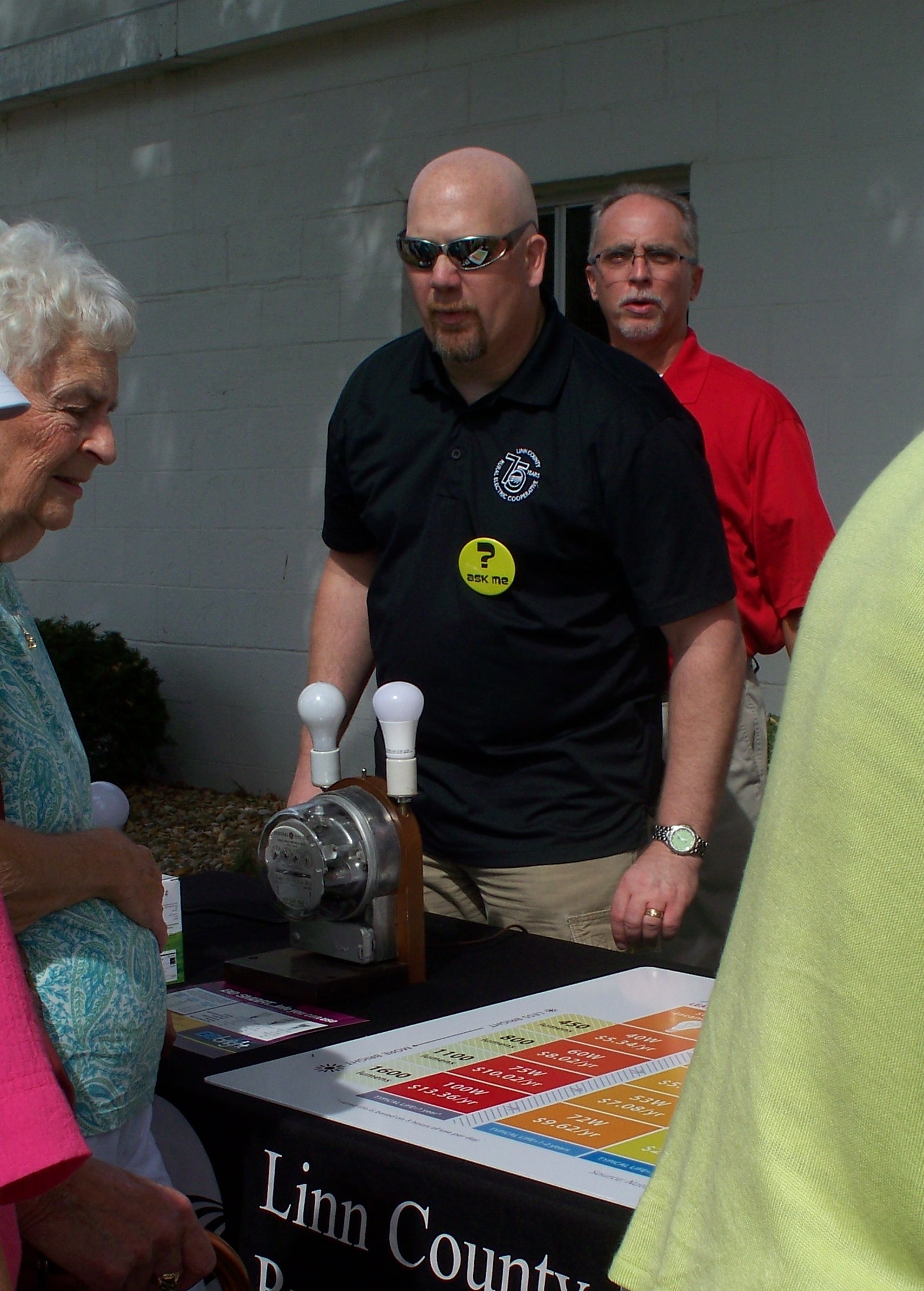
A demonstration comparing electricity usage of incandescent and LED light bulbs was set up outside. When the demonstrator threw a switch, changing which bulb was turned on, the change in speed of the rotating gear on the electrical meter indicating usage was obvious. The message was buy energy efficient light bulbs and when you do, look at the number of lumens rather than wattage when picking one.
While attendees ate lunch from their laps on folding chairs — choice of cheeseburger or chicken sandwich with sides of baked beans and potato salad — a slide show enumerated financial incentives for home owners and businesses to take advantage of to reduce electricity usage when installing new appliances or constructing a new home or business.
Would that life were so simple when it comes to electricity.
The REC has this statement about how their electricity is generated on its current website.
Linn County Rural Electric Cooperative is committed to providing electricity that is reliable, cost effective and sustainable. One hundred percent of our electric power needs are provided by Central Iowa Power Cooperative (CIPCO), a generation and transmission cooperative.
CIPCO meets our energy needs with a diverse fuel mix of coal, nuclear, hydro, landfill gas, wind, natural gas and oil energy resources. In 2013, approximately 95 percent of the power CIPCO provided to its members was generated right here in Iowa; and over 60 percent of its electricity is generated from carbon free resources that minimize the impact to our natural environment.
Specific generating capacity is listed on the CIPCO website.
CIPCO Map of Generating Sources 9-27-15
There is some political posturing here, in that CIPCO draws electricity from the NextEra Duane Arnold Energy Center, Iowa’s lone nuclear reactor. One assumes that is part of the “carbon free resources” mentioned, even though tremendous carbon-based resources are used in preparation for the moment heat is produced by nuclear chain reaction to boil water.
There’s probably more obfuscation here if one took the time for analysis. It’s not worth the time. Scientific evidence is clear that the ceaseless emission of CO2 pollution by electricity generation stations using fossil fuels is a primary cause of global warming. If people are distracted and assuaged by door prizes and flowery language, they won’t be for long. Global warming is impacting our climate in a pronounced, negative (to humans) way.
The Environmental Protection Agency recognized CO2 as a pollutant and this summer rolled out new regulations in the Clean Power Plan. As with all things governmental, there is a political aspect to the plan. Some states are resisting implementation.
Each state is required to locally implement the Clean Power Plan. In many ways the Clean Power Plan is an opportunity for democratization of how energy is produced and used, and we should take advantage of it, said historian and political economist Gar Alperovitz. He called for “an all-out mobilization with potentially far-reaching consequences,” as states adopt a plan.
In Iowa, Governor Branstad has been resistant to the Clean Power Plan, saying only that he would wait and see the final regulations before commenting. The future is well known as Iowa has consistently said the state will adopt no stricter regulations than those required by the federal government. One expects the state to take minimal steps in compliance, and only after hearing from the American Legislative Exchange Council, and waiting out initial litigation regarding the new rules.
The trouble is transition to renewable, carbon-free sources of electricity can’t occur fast enough to undo the CO2 pollution already emitted into the atmosphere. Urgency at our annual REC meeting only took the form of opening water bottles and cutlery packs with reduced physical capacity.
Topic of the moment at Linn Cty REC is “which dor prize did you enter for?” mMany struggling with opening cutlery pack in plastic bag.
A lot of good work is going on regarding development of new electricity sources that directly harness the wind and sun. Our future is to accelerate development and implementation of carbon-free, nuclear free electricity. That means a lot more than using the phrase on the REC’s website or in a blog post.
People don’t react well to non-imminent threats. Our future is raising awareness of the climate crisis without causing people to withdraw from society.
While looking up a link for this post, I saw a Bobby Jindal web ad on my article. Jindal referred to the negativity in our world and said, “It’s time to turn to God.” Maybe. For those of us already oriented that direction, there is plenty of work to be done on earth to improve the human condition. Mitigating the causes of global warming is an important part of it.
(Editor’s Note: This is a revised and updated post about solar power).
Climate Reality Leadership Corps founder and former vice president Al Gore gave his slide show, an updated version of the one used in the film An Inconvenient Truth, in Cedar Rapids on May 5.
It’s the third time I’ve seen him do so in person. There were differences in emphasis, but the big message of day one came from the panel on renewables and policy.
“Go solar,” said Warren McKenna, president of Farmers Electric Cooperative, Kalona.
In significant ways, these two words sum up what’s needed to meet world energy needs, replace fossil fuels, and move civilization toward sustainability.
In an hour, sunlight shining on Earth provides enough energy to meet our collective needs for a year. Whether we realize it or not, fossil fuels represent ancient sunlight stored for millennia in the ground. Which is more accessible?
According to multiple speakers at the conference, most of proven reserves of fossil fuels cannot be burned if we seek to retain Earth’s livability.
What makes solar an attractive solution to the climate crisis is the cost of installation is plummeting. At the point solar electricity generation reaches grid parity it will be an easy financial argument to make that fossil fuels should stay in the ground in favor of the less expensive alternative.
It’s not just me saying this.
The Way Humans Get Electricity is About To Change Forever is an article that appeared on Bloomberg Business last week. Author Tom Randall outlines shifts in electricity generation that will transform markets in the next 25 years. Randall predicts investments in solar will surge into the trillions of dollars, including distributed generation in the form of rooftop solar panels.
Companies such as Berkshire Hathaway Energy (BHE) already like solar, wind and other renewable energy generating capacity.
BHE accounts for six percent of U.S. wind electricity generating capacity and seven percent of solar according to Warren Buffet’s 2014 letter to shareholders.
“When BHE completes certain renewables projects that are underway, the company’s renewables portfolio will have cost $15 billion,” Buffet wrote. “In addition, we have conventional projects in the works that will also cost many billions. We relish making such commitments as long as they promise reasonable returns–and, on that front, we put a large amount of trust in future regulation.”
Solar is not without it’s problems. Natural resources must be exploited to make photo-voltaic panels, and the issue of conflict minerals continuously gets pushed aside. There are manufacturing, labor and transportation issues with solar. Problems notwithstanding, the argument for solar boils down to do we want a future, or not?
What we know is dumping 110 million tons of CO2 pollution into the atmosphere every day is not sustainable, and already we are seeing the impact of global warming and related climate change damage the lives of tens of millions of people.
There are no simple answers to solving the climate crisis. As industry demonstrates the viability of renewable energy, the only thing holding us back is a lack of political will to take unavoidable steps to mitigate the causes of global warming.
The economic argument provided by declining solar electricity generating costs will be a potent weapon in the political fight.
You must be logged in to post a comment.