Categories
Kitchen Garden

Nutrition and Exercise While Aging

Cooking Eggplant

The secret to aging well is no secret: maintain an active lifestyle and improve our diets with nutrient-dense foods. Of course, that assumes there are no mitigating factors such as poverty, cardio-vascular disease, cancer, and lacking the proper function of at least some of our teeth. This post is a listicle of conversations I’ve had about nutrition and aging.

  • Seniors often don’t have enough money to go grocery shopping. Concurrently, they earn more money than the federal poverty level, so are not eligible for SNAP, the Seniors Farmers Market Nutritional Program, or the Commodity Supplemental Food Program.
  • Mobility can be a problem. Our culture assumes mobility either through mass transit, or by driving a personal vehicle. Many people age without being able to continue driving. Even if one can take the bus to the grocery store, carrying capacity for the return trip is limited. Grocers will deliver or have a service deliver. It adds what can be a substantial charge on top of the groceries.
  • Dining alone is not always fun. The absence of children, or a spouse being deceased or away, has us reverting to a primitive state of avoiding cooking or making simple meals that don’t have the best nutritional content.
  • There is increased production and use of leftovers. For example, a pan of lasagna can make six servings.
  • If we are not heating up leftovers, prepackaged meals can be tempting. They can be more expensive and often contain high levels of salt and additives with unpronounceable names.
  • Even with a full pantry a person doesn’t always cook. There is a possibility to open a can or packet of something and call it a meal.
  • Leaving home for exercise can be a challenge. If one lived in the same place for decades, the neighborhood may have changed, making it more risky. Likewise, one has to pay more attention when outdoors for things like cracks in the sidewalk, and high traffic areas.
  • Inclement weather can keep us indoors. I know when it was below zero all day Tuesday, I did not leave the house except to check the mailbox.
  • Aging means we may not have the stamina we once did. Some days it is a lot to muster the energy for a thirty-minute walk.
  • Our strength can be diminished. There is no need to go to a gym for strength training when dumb bells or stretchy bands can do. We also have to take it easier than we did a few decades ago: no more bench lifting.
  • Fear of falls is real. If we lose our balance while exercising at home, we could be injured, unable to get to a phone, and trapped.

That’s what I am hearing about aging well. If you like, leave a comment you heard about the challenges of good nutrition and exercise while aging.

Categories
Kitchen Garden

A Cook Not a Chef

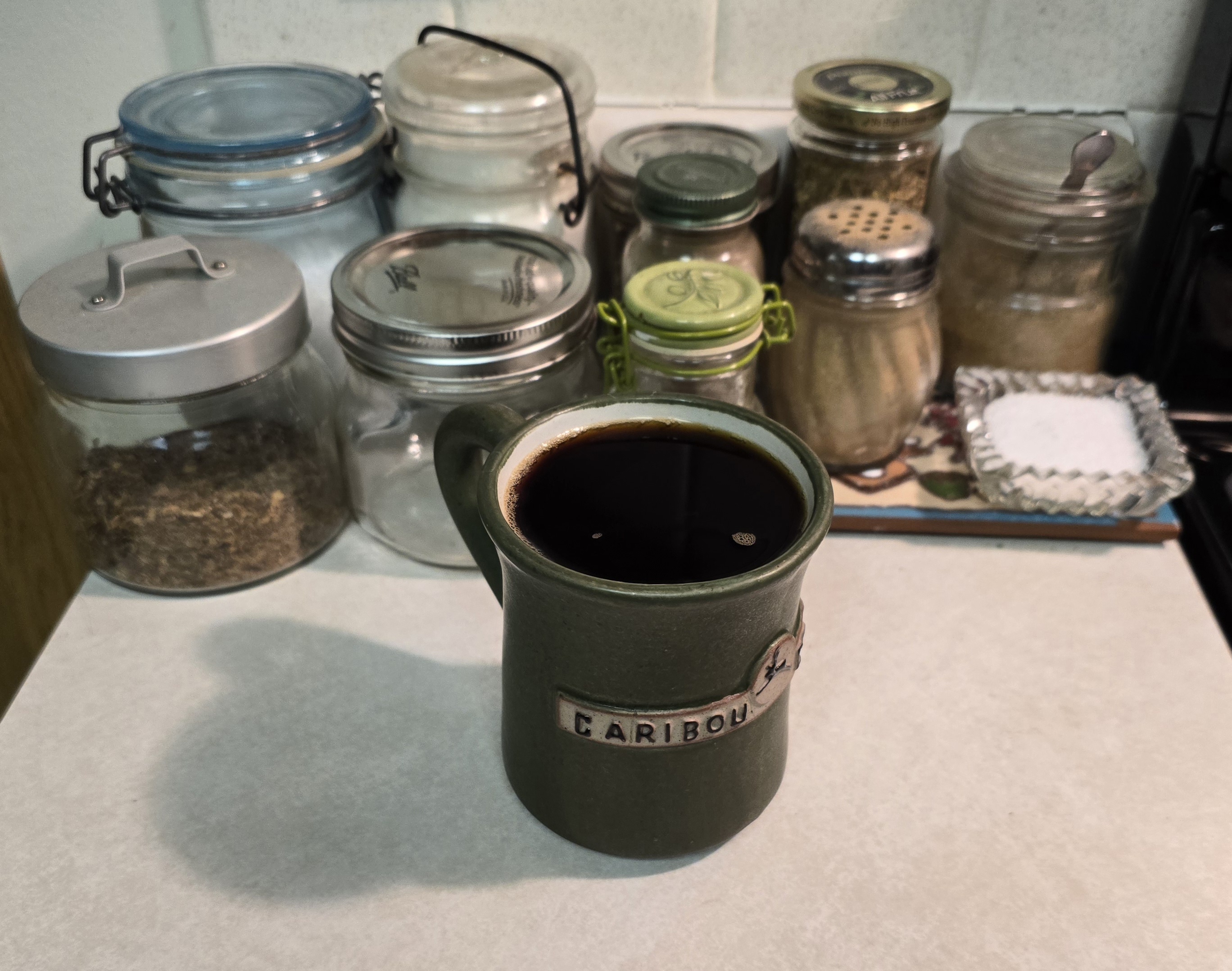
Morning coffee on Saturday, Jan. 11, 2025.

94 cookbooks rest within arm’s reach of my writing table. Hundreds more are stored in boxes in the next room. What do you do with them once your cooking technique moves beyond recipes?

Last year I donated several hundred cookbooks to Goodwill. I bought each one for a reason. Those reasons became obsolete. As a result, there are more cookbooks for disposition among what remains. (I sorted this cookbook thing out previously).

Obsession with cookbook recipes is not what I’m getting at when I write, “A cook not a chef.” It is a cook’s job to prepare food and get it on the table. Increasingly, if I use a recipe at all, it is the springboard for making something recognizable and nutritious for dinner. A cook’s work does not rely on an understanding of flavor, technique, or any of the fancy stuff of being a chef. A cook is the quotidian day worker in our lives preparing simple fare for plain folks. I am a cook, not a chef.

What brought all this up? I need more bookshelf space where I write and cookbooks seem like they are taking too much of it. Maybe I could get rid of some of them. It is pretty hopeless, however. I went through the shelves and found Colorado Collage by the Junior League of Denver. I scanned through it and determined almost every recipe could be a springboard for some other dish, yet none of them fit into the wheel house of my cookery. I put the book in the passenger car seat and will drop it off at the public library either to be put in their stacks or sold at the annual used book sale. My review sums up the situation:

For a community cookbook, this has high production values. It would be a fun book to use when developing a new dish, but it’s use would be to modify their recipes to fit the culinary culture of the cook. This was not a good fit for me.

Will be donating my copy to the public library.

93 remaining for disposition.

Categories
Kitchen Garden Writing

Food In Situ

Backyard garlic.

I recently read The Cooking of Provincial France by M.F.K. Fisher, et. al. It raised awareness of how cuisine can be rooted in specific locales, based not only on locally-grown food products, but on the soil, air, and water specific to a place. Local residents literally spring from the landscape and food grown there, according to the authors. Regretfully, French cooking is immersed in animal products. Separate the dairy, beef, pork, lamb, fowl, and fish and it would not be French cooking. It cannot exist except in situ.

What does in situ mean?

In the United States, we have a long tradition of destroying places and then building settlements as if on a blank slate. Natural vegetation, evolved over hundreds of years, was razed, and replaced with farms. Then, when the farm couldn’t make it — even with government subsidies — it was parceled off and sold for residential properties.

We built our home in such a farm conversion and prepare varied meals in the space we built. None of it is native except for the harvest from our backyard garden. Those seeds and seedlings come from elsewhere and not here. The phrase in situ, in this context, includes some aspect of food grown locally.

It seems ironic that as much “food” as is grown in Iowa and in the fields surrounding our residence, most of the corn, soybeans, wheat, hay, and other commodities are not grown for direct human consumption. Much of these foodstuffs are used either in animal feed or as an ingredient in industrial processes like distilling ethanol, or making biofuels or corn syrup. In Big Grove Township, there is no in situ.

That’s not to say our household lacks a cuisine. Clearly it has a distinctive one. Perhaps the most characteristic food we prepare is tacos. That they are made from raw tortillas from the wholesale club, greens and tomatoes grown at home, and produce we sometimes grow ourselves and sometimes don’t, makes them ours. The Mexican oregano we use also lends distinctness to the dish.

The important thing is when I make tacos, I’m not trying to copy a dish I saw elsewhere. I’m creating something unique, from scratch, with ingredients we grew or have locally available. I use tomato sauce that varies a lot (just as each tomato picking is different). How I use each jar makes a difference in the outcome of the tacos.

Rather than produce a certain kind of soufflé according to the science and rules of French high cuisine, I’m more likely to scramble an egg or make an omelet. Sometimes I’ll make another serving of tacos, perhaps with scrambled eggs in it.

While a few people I know grow shallots, chervil, and tarragon at home, the seeds to grow them did not come from here. They may be typical of French cuisine, yet are not of here. It is important not to get too precious about certain ingredients and where they come from. If I grow these, I use them until they are gone.

Over the years I posted many opinions about local food. Today I’m not sure that matters as much as I thought. What I learned was the idea of local food is constantly evolving. I continue to purchase groceries from a large, retail establishment on a weekly basis. That doesn’t make me any less interested in available local foods. Am I a purist? No, I am not. Being a purist about food does not make sense. It is challenging enough to keep track of what local food is available and where.

I leverage locally grown food when it makes sense. The dishes I prepare are not any less good. So, I’m here, I grow food, and I’m cooking. I am still a latecomer to the upper Midwest, one who is trying to get by. What else can I do besides enjoy what I make here?

Categories
Living in Society

Cook County Experience

Secretary of State’s office in Cook County, Illinois.

During the period 1987 until 1993, I spent a lot of time in Chicago. We lived in Lake County, Indiana just across the Illinois-Indiana line, yet for a while I worked in the loop for Amoco Oil Company. My work took me often to truck driving schools in Chicago and throughout the upper Midwest, where regular people attempted to work through changes in society originating in the Ronald Reagan administration.

I recently stayed overnight in a working class neighborhood in Cook County. The mostly younger folk who live there can’t afford to buy a home and apartment rent is very high. It takes multiple working people to make ends meet in a single apartment. It is difficult to see how today’s working class can get ahead.

I arrived in late afternoon and everyone in the household gathered in the kitchen as dinner was prepared. While attempting to help, our child told me twice, “I got this.” I stepped back and enjoyed the conversation and studied the meal preparation process. It seemed a very Middle Class experience, which I appreciated.

The purpose of the trip was to spend time with our child before the election. We didn’t talk politics much, yet I recommended a vote for Jan Schakowski in Illinois’ 9th Congressional District where they live. Schakowski seems like a solid Democrat and a reliable House vote where there is a narrow division between Republicans and Democrats. The rest of the political discussion had to do with the Israel Hamas War and the apparent lack of a spine among most members of government who work in Washington, D.C. Short version: We know where Republicans want to go. What will Democrats do to represent liberal values? Like many, I can’t wait for the election to be over.

Errands included a trip to the Secretary of State’s office in Deerfield. Taking care of business is easy there, from security standing outside the entrance screening arrivals, to an efficient way of processing customers. Richard J. Daley, the last of the big city bosses would have smiled at the efficiency. Of course, changing a voter registration was easy because, “this is Chicago.”

We made a trip to Costco where I paid for a cart mostly full of “protein items.” That means beef, pork, chicken, hummus, and sausages of indeterminate origin and recipe. I added one of the rotisserie chickens for which the chain store is well known. The purpose was to provide options other than simple carbohydrates for meal preparation. When money is tight, folks lean into pasta, rice and bread for meal calories. The shopping trip was designed to create options. One of the first tasks upon returning to the apartment was dividing everything between the refrigerator and freezer to spread out use of the items.

It was a bit weird for a vegetarian to buy so much meat. Our child was raised vegetarian yet became an omnivore upon exposure to the broader world beginning in college. I feel comfortable with the purchase for two reasons: I worked in a meat packing plant and am familiar with where meat comes from. In visiting our child in other apartments, I found meat items in the freezer and was able to prepare a meal for us with them (I know how to cook). I do a lot of meal preparation in our home, where one of us if vegan. Labels like vegetarian, omnivore, and vegan have lost meaning in my life. I should really say, “I am mostly vegetarian” yet that doesn’t really capture it.

From years of driving into and through Chicago, I am comfortable while driving. I continue to use WBBM AM Radio for traffic reports “on the eights,” and Google maps for directions. A driver must be attentive when working the Chicago interstate highways, yet they seem well-organized and efficient. Years of experience, combined with modern communications, makes it easy to find my way. There is value in that.

Categories
Kitchen Garden

Home Made Tomato Soup

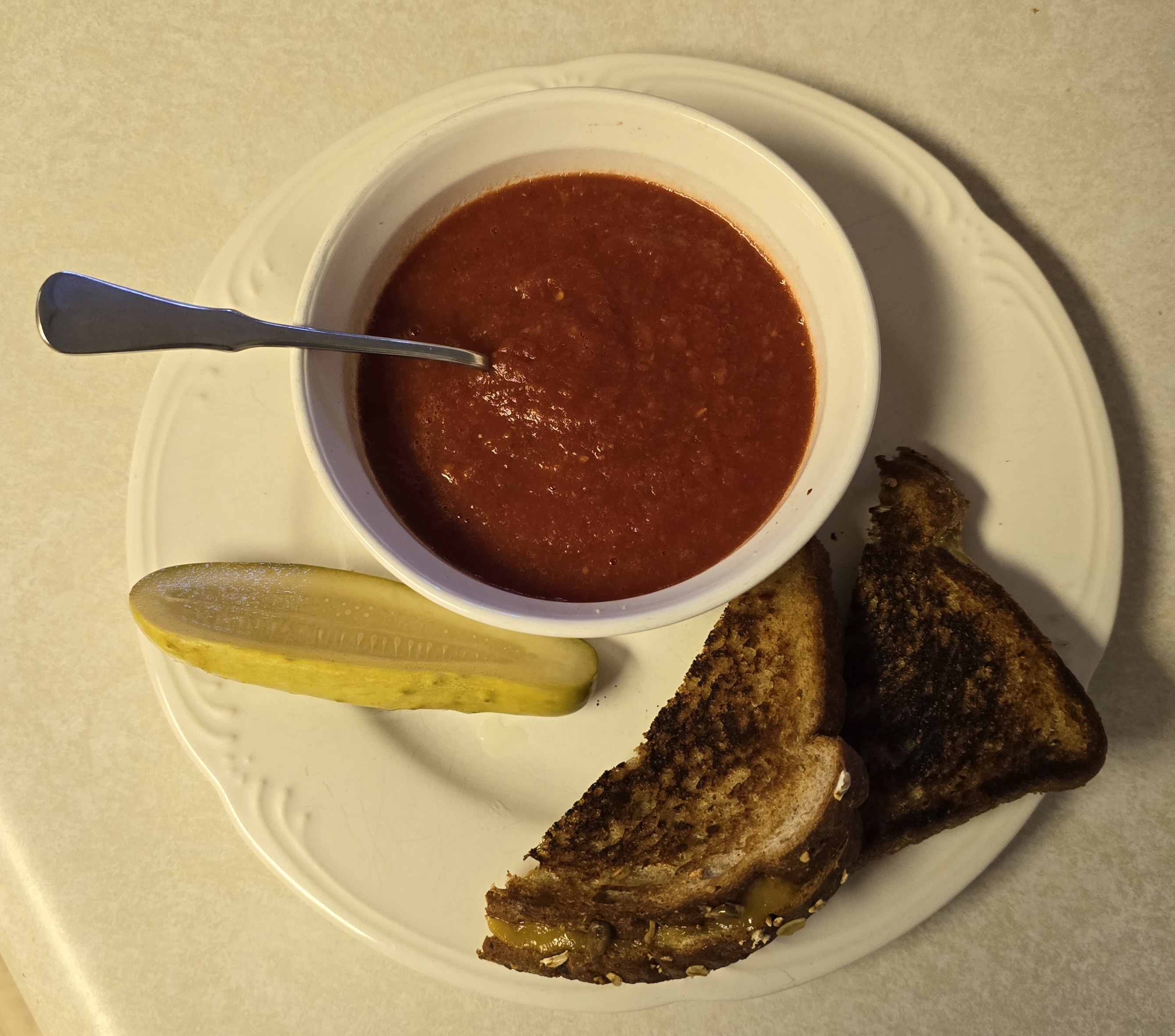
Grilled cheese sandwich with home made tomato soup and a home made pickle.

This tomato soup is much better than what Mother made from condensed soup out of a can. I’m confident if she were here, she would enjoy mine better than hers. This is a simple recipe, worth writing down.

Tomato Soup

When tomatoes are in from the garden, cut out any bad spots, halve them, and cook in a large stock pot for about 20 minutes until the skins loosen. No extra water is needed. Turn off the heat and let them sit for a while, maybe half an hour or the time it takes for a long walk on the trail. Extract as much of the tomato water as you an using a meshed funnel. Once it stops dripping, reserve the liquid. Use the wooden mallet to press the pulp through the screen, leaving behind the skins and seeds. The skins and seed go into the compost.

In a 3-quart saucier place roughly a half inch of tomato water. Once it is boiling, add two medium diced carrots and one medium yellow onion, also diced. Salt to bring out the moisture. Black pepper to taste. Add a generous tablespoon of Italian seasoning and incorporate. Cook until the vegetables are softened.

Add the tomato pulp. You will need about eight cups, but match everything to the amount of tomatoes you have. Bring it to a boil and then turn the heat down to a simmer. Cook until the carrots are tender, about 30-40 minutes.

Put the mixture in a blender and blend until the carrots and onions are incorporated. Return it to the saucier and it’s finished.

Optional: garnish with fresh basil, croutons, or a dollop of sour cream. A milk lover could add a cup of heavy cream to the saucier and incorporate before serving. Makes roughly four servings.

Categories
Kitchen Garden

Local Pasta Sauce

Pasta sauce made in the kitchen garden.

I went to the garden to see if there was any decent basil. There was. With it, plus garlic scapes, an onion from my plot, and the first harvest of San Marzano tomatoes, I made a traditional pasta sauce for dinner. There was just enough for the two of us because that is how many tomatoes there were. I look forward to this meal all year.

Without eight seasons of working on Susan’s farm, I wouldn’t be half the gardener I am. Garlic alone is a testament to the value of learning on the farm over successive years. Susan also taught me the value of a vibrant local food system. That said, my views of a local food system have evolved. What matters more is how we engage with the food system to provide nutritious meals year-around. It is important to know the face of the farmer, yet locale is not always the penultimate concern.

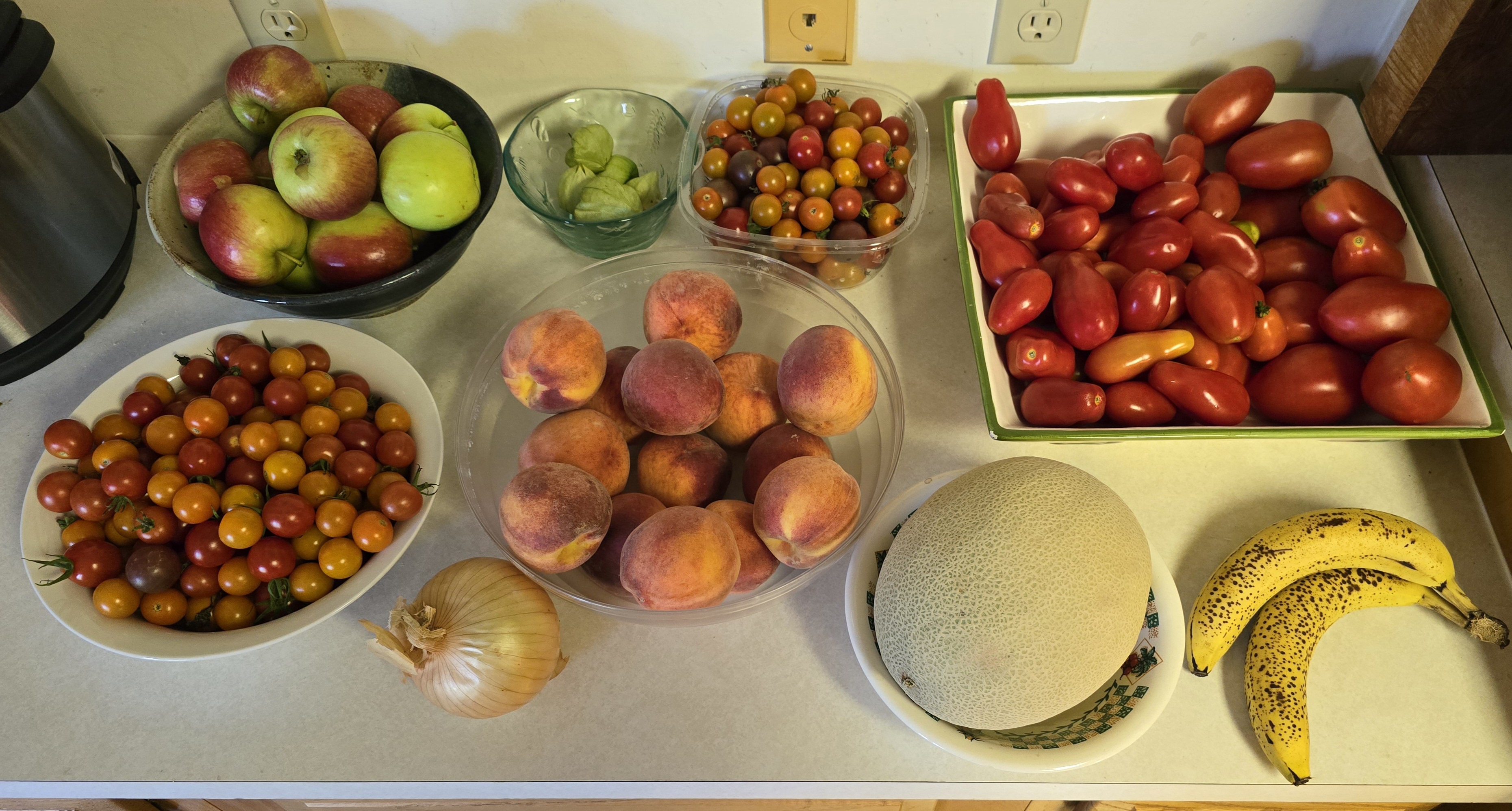
Bonner apples from local orchard; Red Haven peaches from Michigan; plum tomatoes for sauce; cherry tomatoes mostly for the food pantry; Cavendish bananas; local melon; tomatillos, Vidalia onion. Aug. 10, 2024.

When local farmer Paul Rasch gets Red Haven peaches from his relatives in Michigan, I’m likely to buy a bag. This summer treat is better than stone fruit I buy at the grocer, and part of a tradition going back to 2013 when I first worked at his orchard. These peaches have always been good, and they come only once a year. I’m okay with living with their season.

I have not been able to grow an adequate number of good-sized onions. I lean on the grocers because their produce is consistently available and good quality. We like Vidalia onions because of their sweetness. Buying them from a major grocer keeps us in supply. We also get yellow onions and probably should get white onions. When we do, it’s at the grocer.

It makes little sense to buy many apples at the store. We have a couple of great local apple orchards with a wide variety of fruit. During my eight seasons at Wilson’s Orchard I learned which varieties ripen when and our apple consumption follows the season. If we are lucky, I get a good crop at home for cooking, eating fresh and storage. When we don’t have a crop, I buy certain varieties to meet our needs, including a large amount of Gold Rush for storage into winter. We don’t eat many apples the rest of the year and when we do get them from a grocer, we buy organic.

There is no comparison to fresh, home grown tomatoes. When they are in season, we eat some daily. When they are out of season, we rarely buy them at the grocer. With tomatoes, it’s all about the flavor of home grown.

Life with a kitchen garden is a series of moments like the dinner with fresh, home made pasta sauce or from the bite of a Red Haven peach. These moments don’t go on forever, yet if we are lucky, they will repeat from time to time.

Categories
Home Life

Thistle Removal

First tomatoes of the season.

This year thistles grew near the east side of the house. While planting the garden, I let them grow. Now came the time to remove them and start a brush pile.

After morning reading, writing, and cooking, I took an old sweatshirt from the closet and put it on. Over that I wore coveralls. Socks, garden shoes, a ball cap, and heavy leather gloves completed the ensemble. The idea was to prevent the thistles from puncturing my skin. For the most part that was accomplished. Ensemble is a pretty fancy word for my attire. We don’t do much stylin’ around here.

These jobs seldom take as long as I plan. The idea is to do them well and do them once. While I had the lopper out, I cut back low-hanging branches I’ve been dodging all year while mowing. I cut back a total of five trees. By the time I pile up all the brush, it will be a decent stack. After I add the brush stored in a fallow garden plot, and conditions are good, I’ll burn it. I put the brush pile over the stump of a locust tree, having heard the fire will remove the stump. We shall see.

The first tomatoes ripened. Orange cherry tomatoes as is usually the case. The garden is a bit of a mess yet it is producing like crazy. The refrigerator is at capacity and there is no shortage of ingredients to prepare a meal. This abundance is complicated by the fact my spouse has been helping her sister for three weeks. I’m doing my best to prepare meals without leftovers, although that is hard to do dining alone.

When J.D. Vance was selected as the Republican vice presidential candidate I pulled down my copy of Hillbilly Elegy and read it. It hasn’t been a priority until now. The ivy league lawyer who grew up in poverty has a story to tell, yet, he makes generalizations that don’t ring true. I’ve known more than a few people, mostly family or kin, who are poor and live in Appalachia. To a person, the word hillbilly was never used to describe themselves. From there the book went downhill as having any broader application than his personal life. Vance’s story is engaging, yet it seems written to support his conservative point of view. When I went to Goodreads to declare I finished the book, the software wouldn’t let me rate the book. I got a message that said,

Do you suppose people are dunking on Vance now that he is running for high office?

Each summer I make iced tea a couple of times. I heat up the water and brew three black tea bags in a teapot purchased for our child’s long ago school project. I buy the cheapest black tea available and it serves. I drink it over ice, no sugar. It is one of the pleasures of summer. On a Saturday afternoon, there is little else more satisfying to a septuagenarian pensioner.

Categories
Kitchen Garden

Pac Choi Ramen

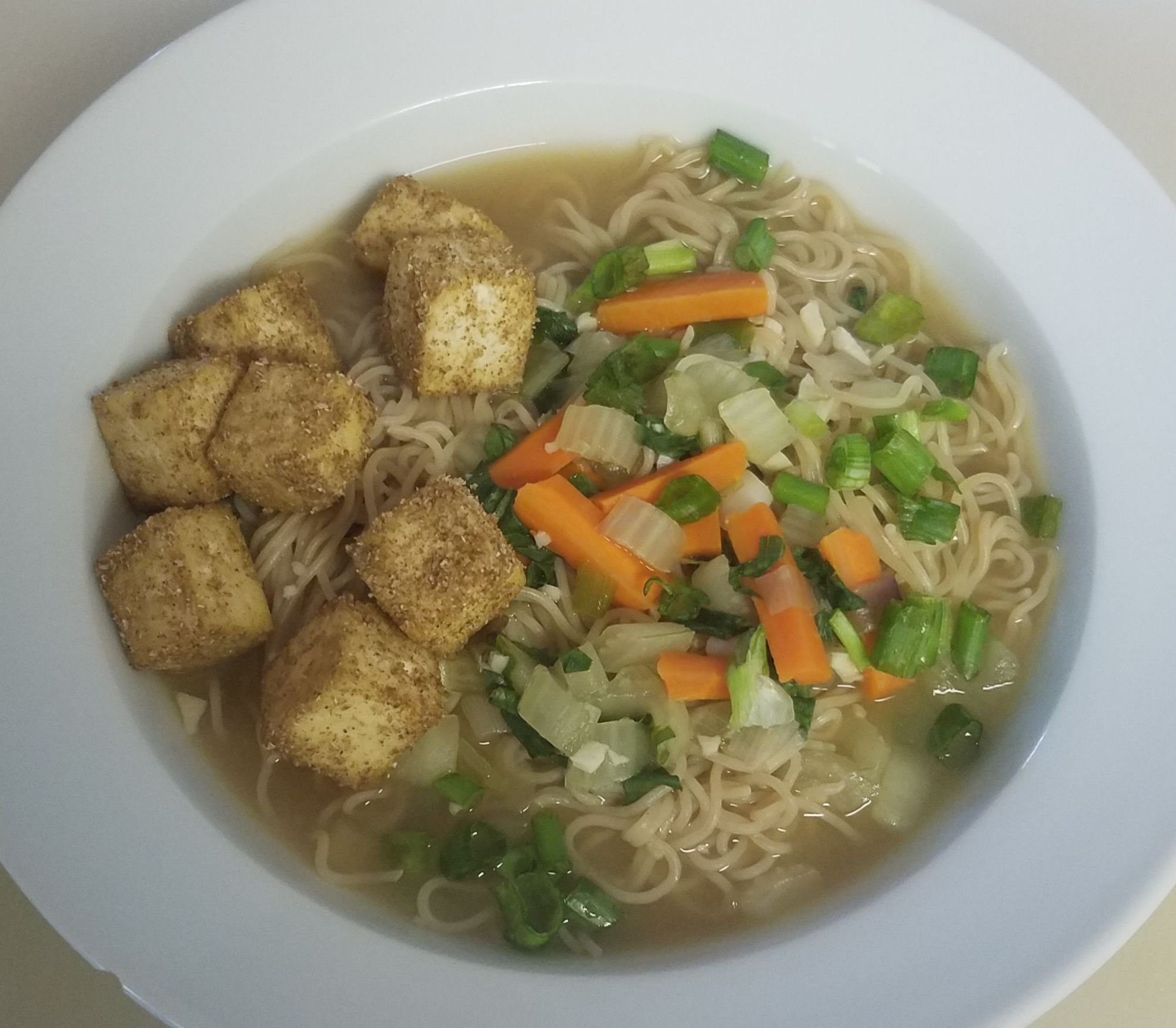
Pac Choi Ramen with tofu and spring onions.

The building blocks of our kitchen came into play at dinner time Monday. Canned home made vegetable broth, tofu from Iowa City, brown rice flour ramen and white miso paste from China, organic carrots from California, and spring onions, garlic, and pac choi from the garden. This is the American vegetarian kitchen garden at work.

It’s not really local food, is it? The ramen was suitable for vegans, and the flavor of the pac choi really came through. No wheat in this dish, and it is the first time in a while I used tofu for something other than stir fry. It is unlikely 20-year-old me would have prepared something like this.

I reserved some of the pac choi leaves, yet in retrospect should have added them all. The dish didn’t suffer from lack of greens yet there is no sense being frugal about leafy green vegetables. The world is full of them and in general Americans don’t eat enough of them.

There is no recipe for this dish. It was a product of that moment, my experience as a cook, and available ingredients. Mainly, I had to do something with the abundance of pac choi from the garden. We should cook like this more often.

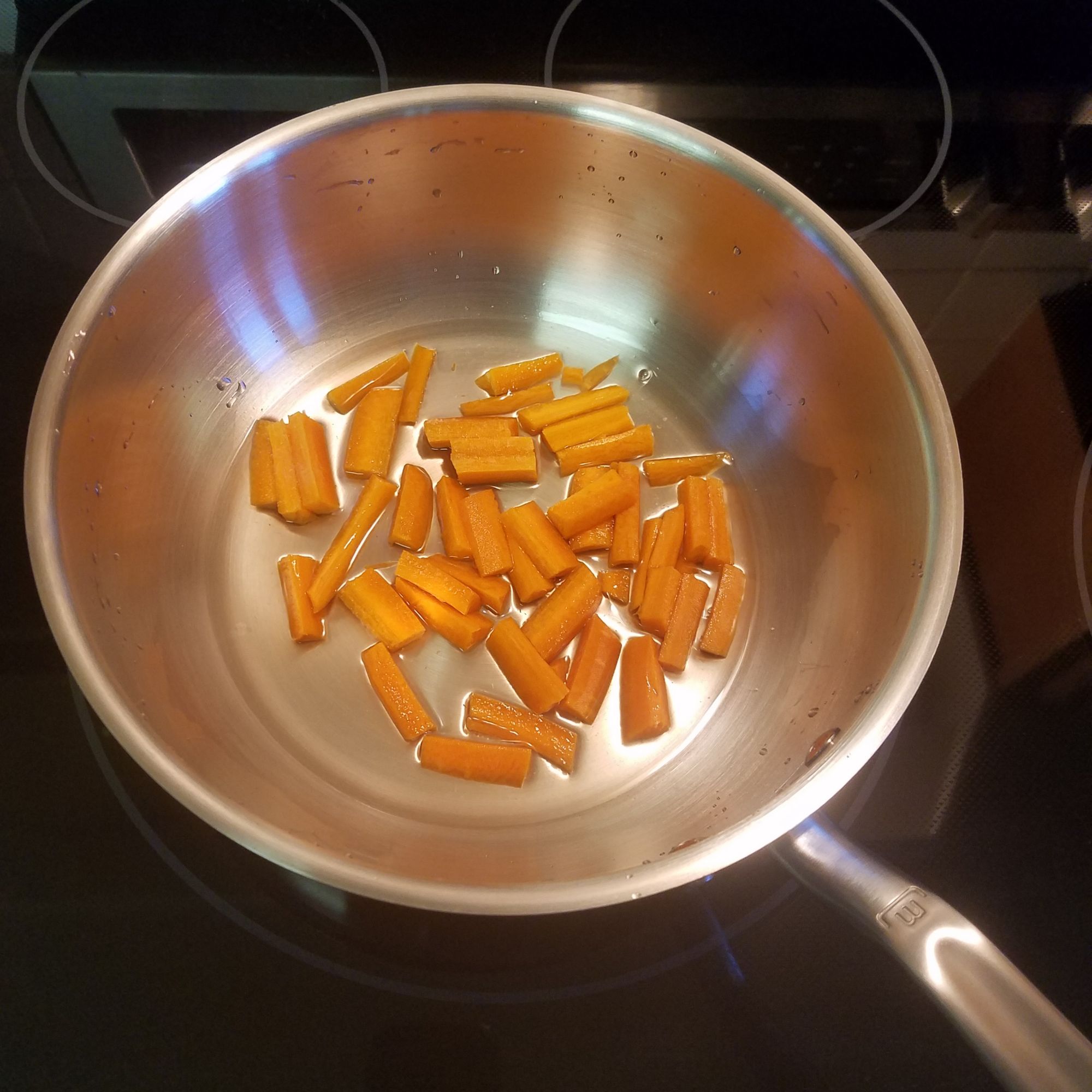
Cooking carrots first in my saucier.

The ramen was satisfying on multiple levels.

This was the first use of my new saucier, and I was happy cooking with it. At three quarts it is of a size to make dinner for four. I hope there will be many more uses of the pan.

It is easy to get behind using leafy green vegetables. The garden produces so many, and certain ones, like pac choi, are best used fresh. One more giant pac choi in the refrigerator then on to the smaller ones.

I’ve written about making vegetable broth before. Baked tofu has become our standard preparation. What set this dish apart was flavoring. Salt and white miso, highlighted the flavor of the pac choi. Likewise, there was enough garlic, but not so much to be overpowering. Making food that tastes good can be done. It is not as simple as it may seem.

Would I make this dish again. Probably something like it in the never ending meal that comes from a kitchen garden.

Categories
Kitchen Garden

Goal Posts Moved in 2024

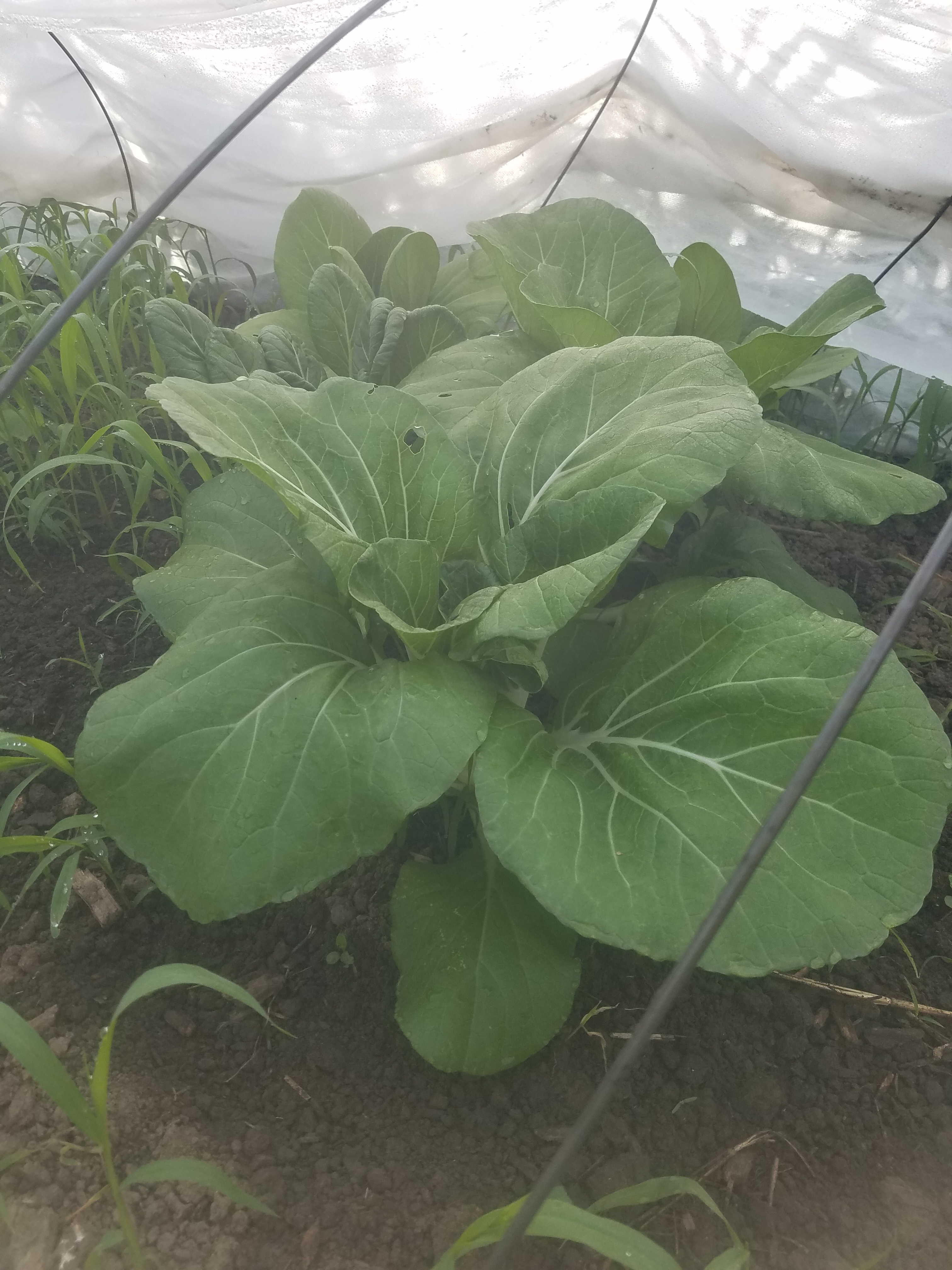
Pac choi under a covered row.

Instead of getting the garden in by Memorial Day, I moved the date to June 20 when summer begins. I have five plots laid out, plan to skip one this year, and may skip part or all of another. Large amounts of rain kept me out of the spring garden. The shelves in the greenhouse are slowly emptying, and soon initial planting will be finished.

We’ve been cleaning to make room for technicians to repair our washing machine. It generated a code which I couldn’t resolve, so I made an appointment. The service company telephoned and said I should contact Maytag about covering the repair under warranty. I did and they will. The code first appeared at almost exactly at the end of the initial warranty period.

It is surprising how much a modern household depends upon getting laundry done. I can’t imagine what it would be like to return to laundromats. The one in our small city closed years ago, so it would be a big to-do of traveling to the county seat or further to launder clothes. There is only so much time in a life. The less spent on laundry the better.

I opened the covered row and an abundance of pac choi, lettuce, and basil was ready. I brought the haul indoors, cleaned it, and put it away in the refrigerator. I made a sandwich with a generous amount of fresh lettuce for lunch. I don’t often buy lettuce at the grocer, so when I have it in the garden, I make the most of it.

There will be pac choi ramen. In January I bought a 24-pack of Maruchan ramen. When I make it, I throw out the flavor packet that comes with it and make my own broth. This time, I’ll make a vegetable broth using white miso, then saute onions, garlic and pac choi, mix them together, and cook the noodles in the resulting liquid. The abundance of fresh leafy greens is wonderful.

Also in the kitchen garden mix is pasta sauce using last year’s tomato sauce, onions, fresh basil and garlic. This first of the season sauce is also a chance to try out my new saucier. Basil doesn’t keep long, so by the time this posts, I may already have made it.

There is one head of romaine lettuce which I’ll roughly chop for a salad. Not sure what to do for dressing, but it will inevitably use extra virgin olive oil and home made apple cider vinegar. I can’t wait.

While I had to move the goal posts for finishing planting the garden, the harvest already begins. These are the good days for which we live during the long winter. It’s life, as good as it gets.

Categories
Kitchen Garden

Getting a Saucier

Made In three-quart, stainless steel saucier. Photo credit – Made In website.

I came into some extra money from my writing and ordered a Made In, five-ply stainless steel clad, three quart saucier. I saw the device on Olivia Tiedemann’s Instagram channel where she recommended it for sauces, grain cooking, one-pot dishes, and more. It is her go-to pan, she said. Tiedemann is a private chef with more than 4 million Instagram followers. She makes short cooking videos, curses a lot, and flips the bird at the camera at least once during each episode. The saucier sold out on the Made In website shortly after I ordered mine.

I am very excited to be receiving this saucier, tracking the shipment a couple times a day. As I type, it is at a warehouse in Iowa City awaiting delivery, presumably today.

Buying a saucier is a poor man’s extravagance. Did I need a special pan to make sauces? I was getting along just fine. Do I want to be like Tiedemann? Maybe, except she is definitely oriented toward using all the meat and dairy products, unlike what goes on in our household. Once one eliminates meat, fish, dairy, butter, eggs and the like from meal preparation, cooking becomes something else. I’m hoping the saucier will help me down a path of developing sauces and dishes for our hybrid vegetarian-vegan cuisine. If I had real money, I’d dine at a favorite restaurant multiple times a week. I don’t, therefore, saucier.

Will the saucier change my life? I hope so. I hope to be a better cook in my kitchen garden. Imagination and a special pan may be the way to distinguish what I do here. The anticipatory excitement is well worth the money spent on the saucier.