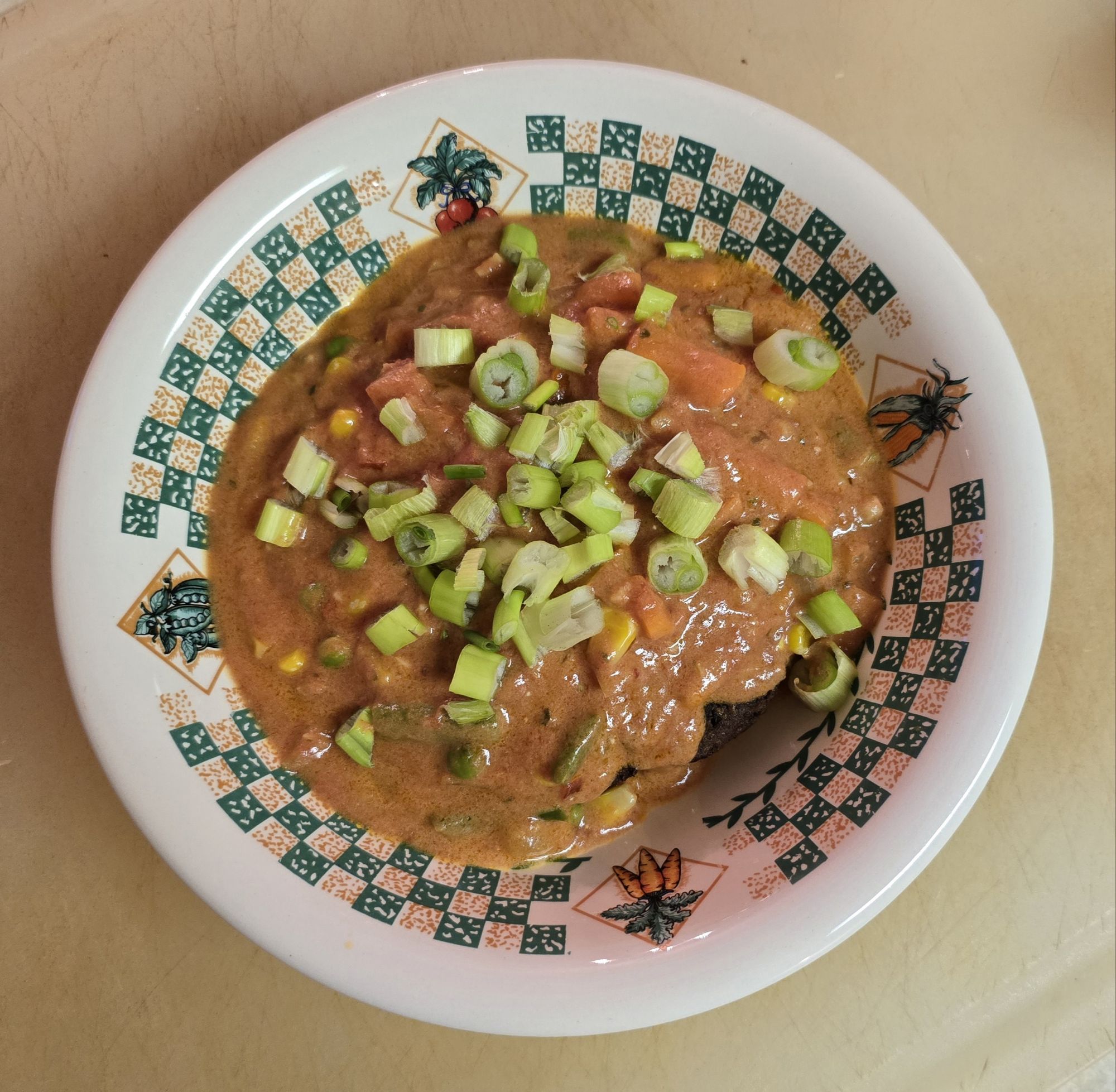
It began with opening the refrigerator and looking inside. I felt like cooking dinner for myself on Thursday night, yet wanted something different. I had a vague idea about cooking a frozen black bean burger and putting a sauce on it. I saw the half-used jar of tomato purée and a couple of tablespoons of sour cream on the top shelf. There was a partly used onion and bell pepper. Our kitchen always has plenty of garlic. I had just ground some cayenne peppers in the green state right before first frost. “I can make a dish out of that,” I said to myself.
Next came the mixing. I poured about a cup of tomatoes into a measuring cup, then scraped the remaining sour cream out of the container and added it. As the kids say, “Mixy, mixy.” It seemed too thin so I got out a jar of vegetable broth with miso paste and arrowroot dissolved in it, shook it up and added about a half cup. Finally, I added a scant teaspoon of cayenne pepper flakes and gave it a final stir.
I got out two frying pans, the smaller for the black bean burger and the larger for the sauce. Coating the bottom of each with extra virgin olive oil, I put the heat on. It takes about 10 minutes to cook the burger so I got the sauce going by sauteing the onion, bell pepper, and a diced jalapeño pepper until softened. Garlic next and as it cooked, it didn’t look like enough vegetables. I got a bag of mixed vegetables from the freezer and added a generous handful. I cooked the veg until everything was heated through and done. I added some powdered cayenne pepper to make sure the heat was at the right level.
Once the vegetables were ready, I poured on the sauce and cooked long enough to heat it through and let the arrowroot do its thickening work. There was some reduction yet that wasn’t the main feature of my cookery. I tasted it, and adjusted seasoning.
To serve, I put a spoonful of sauce on the bottom of a small bowl with the burger on top. I poured the rest of the sauce over it and garnished with sliced green onions. Not too much heat, and the plate stayed warm until it was eaten. This is what no-recipe cooking can look like.
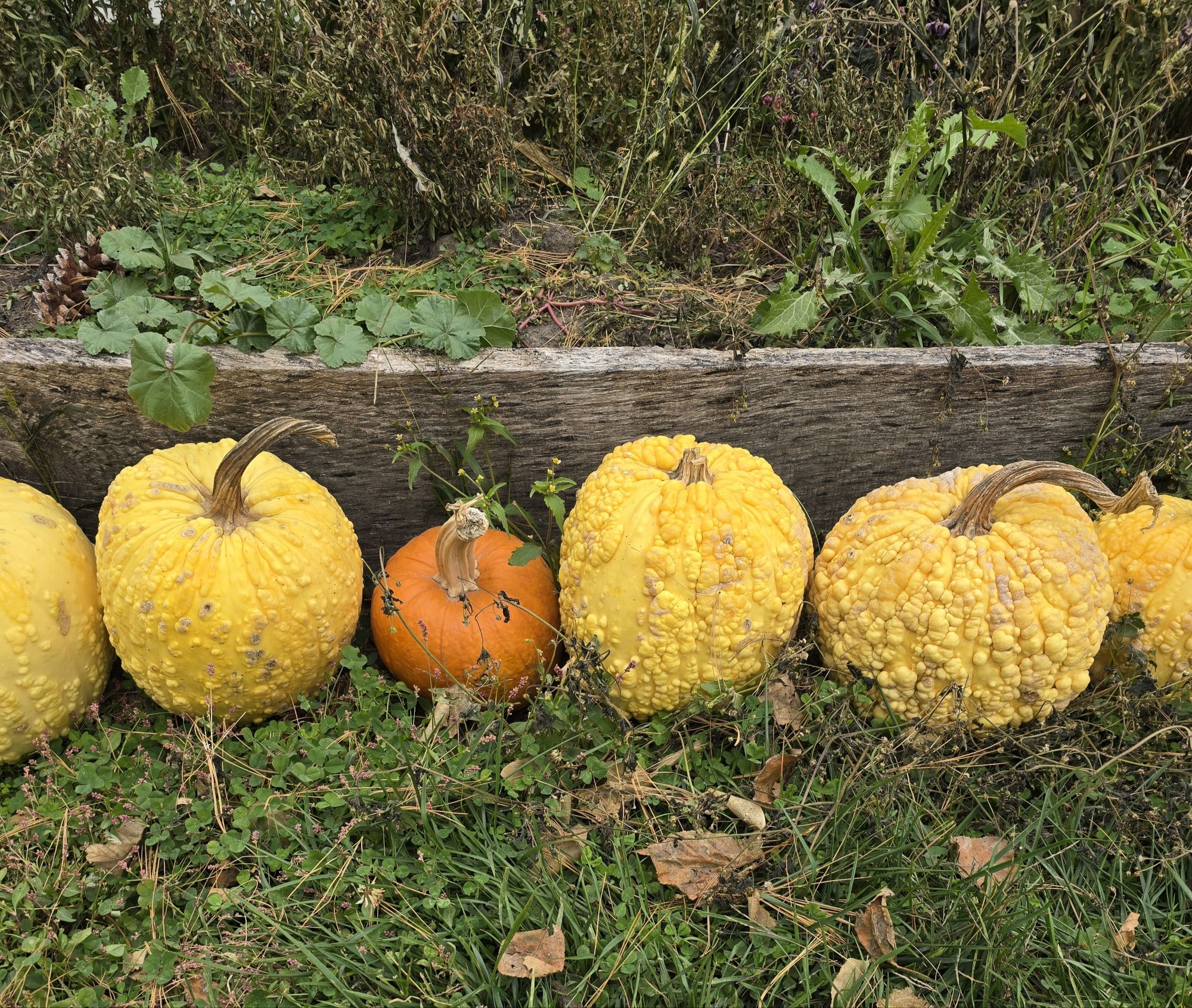
It has been a couple of years since I froze pumpkin for smoothies so Saturday I went to Kroul Farms which specializes in growing pumpkins. They have orange pumpkins and specialty pumpkins: a lot of them.
Specialty pumpkins at Kroul Farms.More specialty pumpkins and a little pie pumpkin.
I took mine home for seven dollars and on Sunday I processed it.
First, cut it in half and remove the seeds.
This pumpkin yielded a cup and a half of seeds for roasting.
Cup and a half of pumpkin seeds.
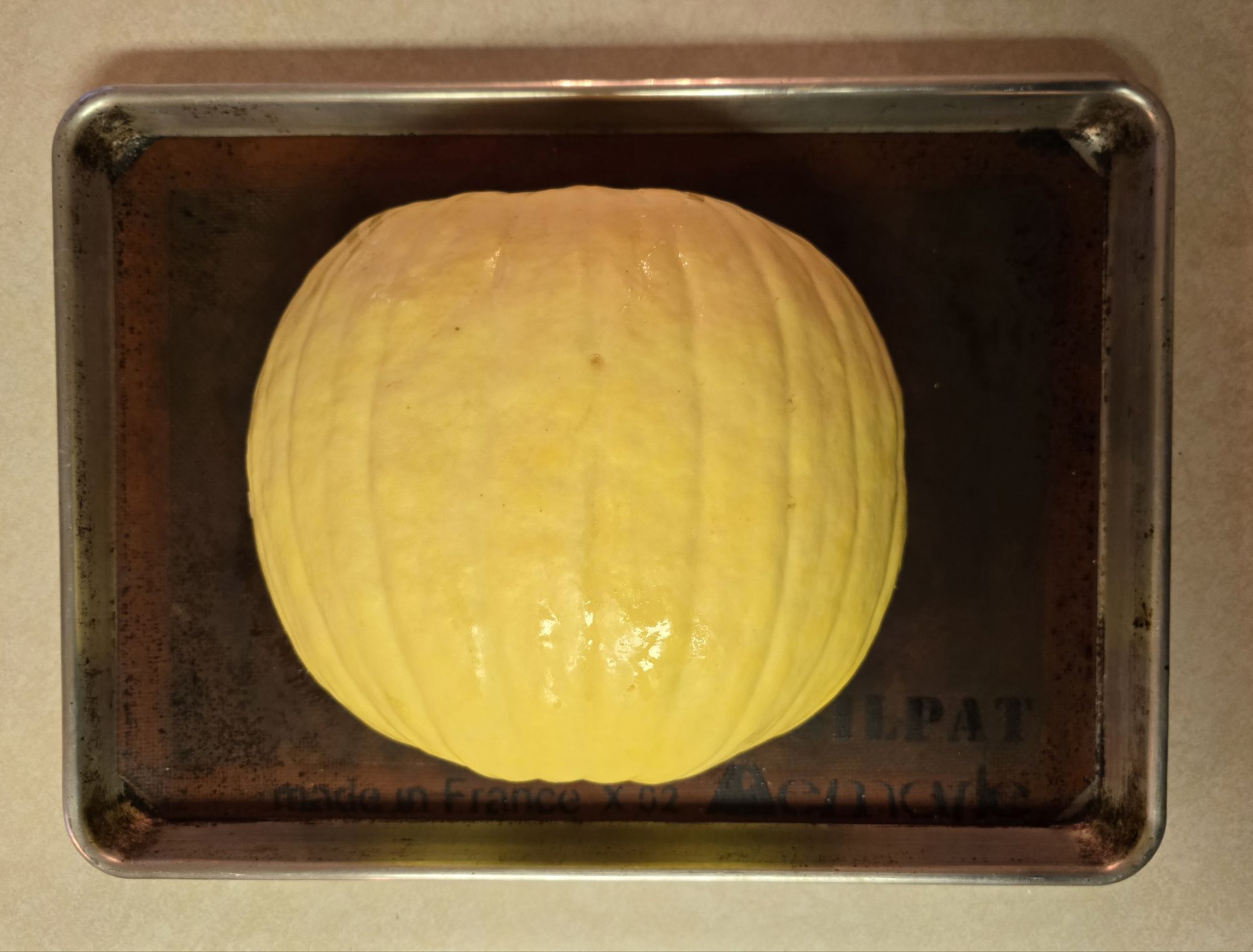
Both halves went into a 400 degree oven and baked about 90 minutes until tender. The timing varies depending upon size of pumpkin and quality of the oven.
Baked pumpkin.
I let them continue cooking on the counter. Next I skinned them and put the flesh of both halves into a large bowl. The use for this pumpkin is smoothies. Since it will go into a blender, I only did a rough mash using a potato masher. The flesh was too wet for smoothies, so I used my conical strainer to drain it. It extracted 4-5 cups of liquid which will go into soup.
Straining the pumpkin flesh.
I cleaned the baking pans and then used an ice cream scoop to make portions on a piece of parchment paper lining the pans. They went into the freezer. Once thoroughly frozen, they go into a Ziploc freezer bag for storage.
When my spouse is away, I haul a small boombox upstairs and crank the volume up. I find myself digging out old compact disks and audio cassette tapes, listening to Iowa Public Radio more, and tuning into the local classical music station. Classical music is more interesting on the radio than in other media because of the announcer. While I wouldn’t call it “going wild,” it’s as wild as I get regarding music these days.
How I prepare Mexican food is different when she is away. When cooking for two I avoid use of ingredients that contain capsaicin, a.k.a. 8-methyl-N-vanillyl-6-nonenamide. According to Wikipedia:
Capsaicin is an active component of chili peppers, which are plants belonging to the genus Capsicum. It is a potent irritant for mammals, including humans, for which it produces a sensation of burning in any tissue with which it comes into contact. Capsaicin and several related amides (capsaicinoids) are produced as secondary metabolites by chili peppers, likely as deterrents against eating by mammals and against the growth of fungi. Pure capsaicin is a hydrophobic, colorless, highly pungent (i.e., spicy) crystalline solid.
It’s hot. Lots of people don’t care for it or are allergic to it, including family members.
When we are together I get my spice by adding hot sauce as a condiment. When I cook and dine alone, I’m free to add it while cooking. Mexican fare is flexible in preparation so the lack of heat while cooking has not been an issue. My process for using chili peppers continues to change. I wrote about the basics in 2019:
The recipe for hot sauce evolved over time from one Juan San Miguel explained in 1977 when we both garrisoned in Mainz, Germany. Those were days before a four-foot section of assorted hot sauces became standard in supermarkets.
I lost contact with him yet the recipe persists. It is a rare day when there is no hot sauce in the ice box.
We carried the condiment in plastic milk jugs and put it on our army rations while on maneuvers in the Fulda Gap. It made our eyes water and changed regular food into edible fire. We laughed a lot in that peace-time army… and ate sandwiches of bread and hot sauce. I continue to make it mostly the way Juan taught me. (Meditation on Hot Sauce, Oct. 20, 2019, Paul Deaton).
This week included making hot pepper paste, dehydrating Cayenne peppers for red chili flakes, blending jars of powdered hot peppers from the pantry to use in shakers, and using a fresh jalapeno when making enchiladas. I found less is more: reducing the number of preparations to just a few that will be used. October is the month to do this as hot peppers are the most abundant late harvesting vegetable. Getting all this kitchen work done while she is gone is a plus. Even I had to wear a KN-95 face mask while mixing the powdered hot peppers. I should be wearing a pair of surgical gloves yet don’t and my hands sting for several hours after preparing fresh chilies. I know I’m alive.
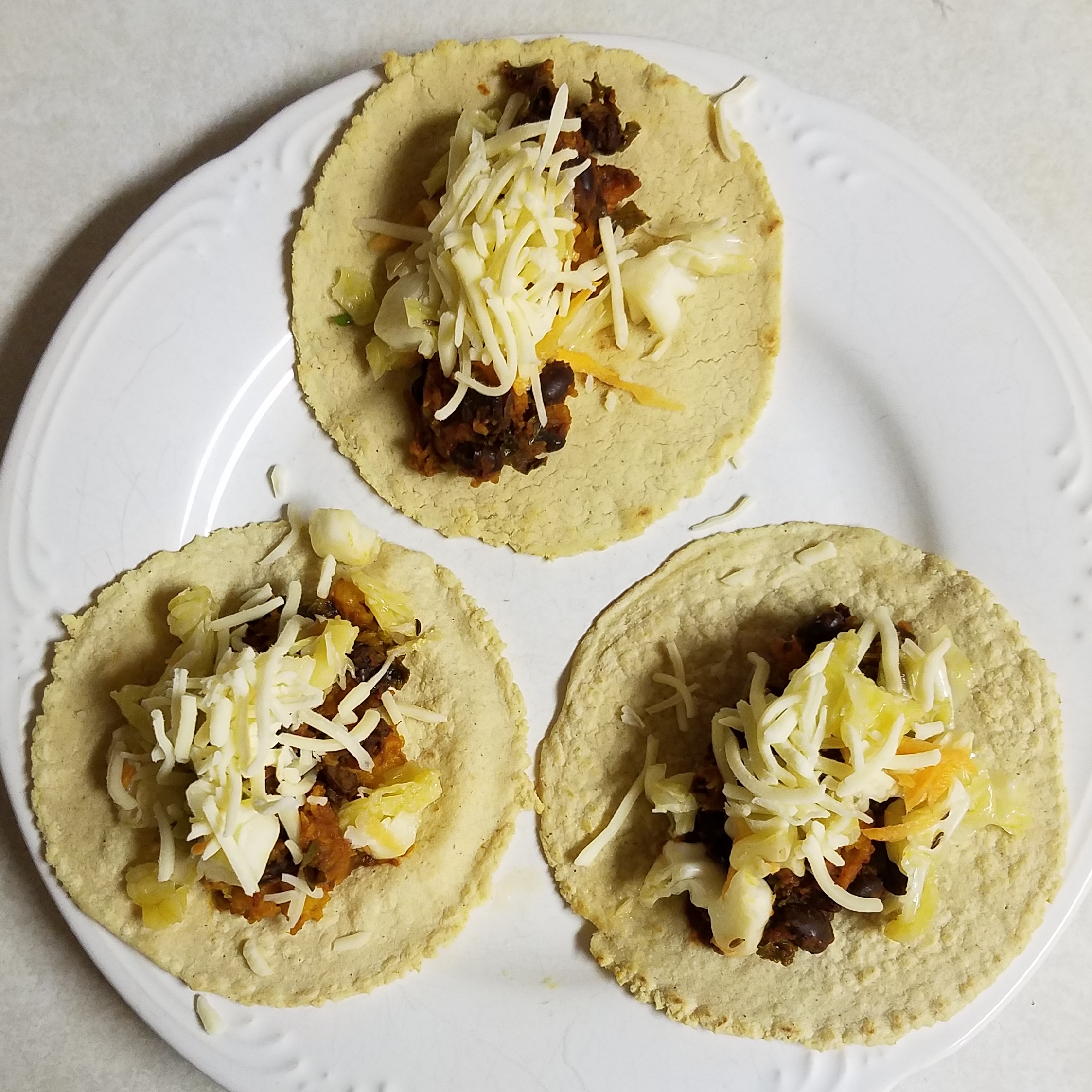
A typical difference when I am eating alone is taco filling. The main recipe I use is a blend of black beans, kale, onions, garlic, bell peppers, tomato sauce and Mexican oregano. When cooking alone, instead of tomato sauce, I make a sauce of dried guajillo chilies. These chilies are not that hot but when allergic to capsaicin, any amount is too much.
Enchiladas are in the refrigerator waiting to bake for dinner. Tuesday is for tacos when I’ll use fresh chilies. I am not a heat nut, yet have a more developed use of chilies grown in the garden than most Iowans. The use of chilies characterizes my kitchen-garden.
While returning from my sister-in-law’s home I stopped at the Casey’s convenience store in Colfax. Visits to Casey’s are my nod to Iowa corporatism. They sell stuff that is convenient. My usual purchases are lottery tickets, gasoline, coffee, salted snacks, and something from their warming/display ovens. Back in the day I used to buy a slice of their famous pizza to serve as a meal, yet I gave that up. Once in a while I buy a bottle of Yoo-Hoo Chocolate Drink as a throwback to when I lived in South Georgia. Tuesday I needed a lottery ticket, gasoline, and something to substitute for a missed dinner. I bought a fancy version of Tater Tots from the oven. It served.
I spend most of the time in the car alone. I do the majority of in-the-store shopping although trips to get groceries are outnumbered by trips to Casey’s to gamble. I spend about $24 per month on Powerball tickets. I usually don’t buy anything else when I want a lottery ticket. Iowa gambling is another concession to corporatism, this one run by the state through The Iowa Lottery Authority.
I ritualized my ticket purchases, taking into consideration what ticket I buy — always only one “Powerball, no extras,” the people who sell me the ticket, and the path I drive to run errands beginning with a stop at Casey’s. I don’t need to gamble. I enjoy the ritual. It’s kind of like going to church would be, only no one is telling me how to live my life. One day I asked about the prominent checkout display of small alcoholic drinks for a fixed price. They said most of their sales come in the morning when people are on their way to work.
I eat convenience store food alone. Sometimes parked in the Casey’s lot, and sometimes while driving. Rarely do I eat it outside the car. I enjoy it while it lasts. I understand most of what I buy is not good nutrition. “Everything in moderation, including moderation,” Oscar Wilde reportedly said. My main weakness for convenience store food is when I’m making a long trip.
As my recent use of the calorie counter app My Fitness Pal revealed, everything we put in our mouths adds calories. By being cognizant of caloric content, I have been successful in meeting the first half of my weight loss goal. The main change inside the convenience store is walking out immediately after buying a lottery ticket without a food purchase. I won’t be buying that Tater Tot item again now that my curiosity is sated.
I still drink one or two servings of Coca-Cola per year. I’ll likely get that at a convenience store.
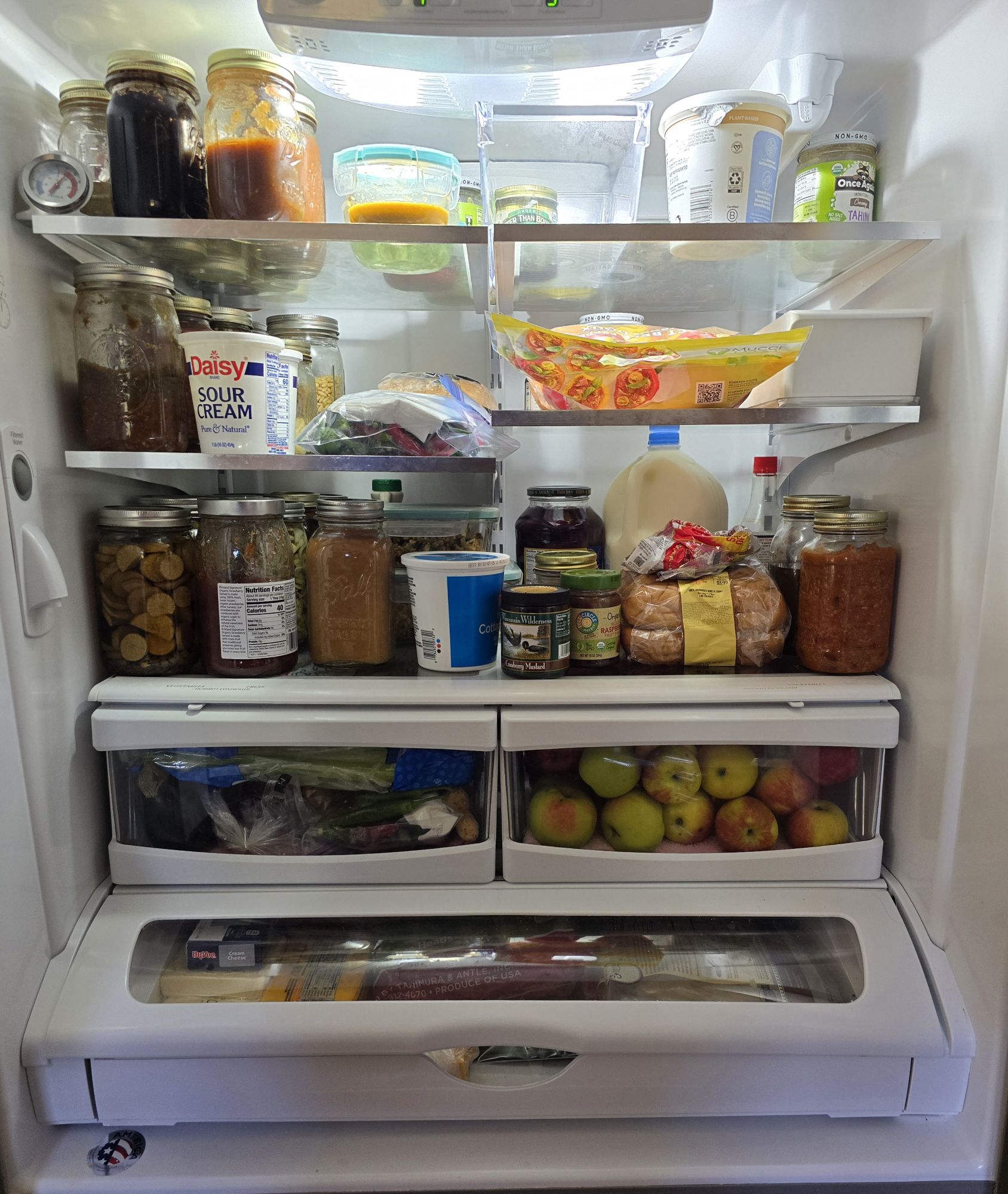
Refrigerator the day after my spouse left on a trip.
This week I am eating alone because my spouse left on a trip to visit her sister. The first thing to do was go through the refrigerator and study the contents.
There were two leftover servings of tofu-vegetable stir fry and a jar of chili. That’s three meals right away. I made both dishes to share for dinner, and leftovers should be equally good.
There are a dozen eggs, fluid milk, butter, sour cream, cheeses, pickles, three kinds of bread — a commercial loaf, sour dough, and locally baked burger buns. The two drawers have storage apples in one, and an array of fresh vegetables in the other. Nothing to compost here as we keep the veg moving. I need to use the last two garden eggplants soon.
The bottom drawer has loads of fresh greens, uncooked flour tortillas, and more cheese. The doors have a partly empty carton of oat milk, a gallon jug of skimmed cow’s milk, the rest of a half gallon of fresh apple cider, and countless jars of mustard, ketchup, sauces and condiments. We are well-stocked!
To sum it up, there are three easy meals of leftovers and diverse sandwich-makings. Eggplant lasagna or something similar is in the works. Tacos are always possible. I have three small heads of Romaine lettuce, so a big salad for dinner could be done. Without doing much of anything, I’m halfway through the solitary eating period. I needed to go to the grocer.
My shopping trip was typical. I spent time in the fresh fruit and vegetable section studying what was available and comparing it to what we need. I bought some grape tomatoes on special pricing, a bag of red radishes, and a bunch of green onions. I get organic celery here because celery is at the top of the list of pesticide-laden vegetables. Buying organic celery makes sense.
In the specialty cheese section I bought some Wisconsin-made Gruyère to melt on something. Next I went to the cereal aisle and added a small box of Post Grape Nuts to the cart. I had been reading about using it as a crunchy topping on salads and thought I would try it. I also got a box of store-brand Raisin Bran because it was on special pricing. (I know! Impulse purchase). I picked out a big bag of Halloween candy for trick or treaters and everything else I got was replenishing staples in the pantry.
My spouse is vegan, so the dairy is for me. That I remain an ovo-lacto vegetarian sets me on a deliberate path to separate us in eating. I learned to make delicious vegan meals we share. The difference is also part of why I sometimes cook for myself even when she is around.
So I have a plan to eat alone this week. It is essential work for the period of physical separation. Because this is no different from any other day, it suggests I eat alone often. I do.
Most of the meals I take are eaten alone. It’s just the way my spouse and my schedules work out. I am an early riser and have coffee around 3 a.m. with breakfast a couple of hours later. Lunch is not really a meal in our house. I graze bits and nobs throughout the day, maybe warm some leftovers or make a sandwich, and keep track of calories consumed. We plan and share dinner, which usually involves shopping, food preparation, and cooking. Sometimes I cook and sometimes we both cook a meal. Until I read Deborah Madison and Patrick McFarlin’s book What we eat when we eat alone, I had not given much thought to eating alone.
Healthy ideal or not, I feel set in my ways. As I age, it seems likely I will continue to eat more meals alone than together. Well, maybe until I move to a facility where residents take all of their meals in a group setting. We increasingly don’t like talking about those institutions as we age.
My spouse is heading over to stay with her sister for a week to ten days. This will give me an opportunity to consider all that eating alone means. From the gitgo some questions come to mind.
Do I cook a meal or grab something already prepared?
Are cooking alone and eating alone the same thing?
Why is what I eat different when eating alone?
What role do restaurants and food outlets play in eating alone?
Eating in the car. What’s that about?
How do I shop differently to eat alone?
What role do leftovers play in eating alone?
This could be a rich field of inquiry. As of this writing, I don’t know where I am going with this. Stay tuned to find out.
I’m getting to a place where I wrote the best of what I will about Labor Day. In 2022 I wrote this post, which covers the bases. No need to re-write it this Labor Day weekend. There is more to life than annual traditions.
It is no secret unions are in decline. In his new book, Coming Up Short: A Memoir of My America, Robert Reich points to the problem. The post-World War II economy was so affluent that unions did not seem necessary to most people in the wake of reforms that happened during the Franklin Delano Roosevelt administration. As a result, there was less impetus to form unions, and in right to work states like Iowa, a union could represent a workplace but workers were not required to join. The latest from the Bureau of Labor Statistics (2024) is, “The union membership rate of public-sector workers (32.2 percent) continued to be more than five times higher than the rate of private-sector workers (5.9 percent).” As we know from the administration’s move to invalidate union contracts among Veterans Affairs workers, the pressure will be on to diminish union strength among public-sector workers.
While summer is not over, the garden is winding down with leafy green vegetables, tomatoes, hot peppers, and apples remaining to be harvested. Instead of time off this weekend, I need to focus on work in my kitchen and garden, then digest what just happened. Short version: I withdrew from in-person society and reduced my contacts with people I know to focus on the immediate place where I live. I strove to make that life better.
Vegetables and fruit grew as well as they have ever done in my garden. The abundance produced from a small number of seeds and minimal cultivation is astounding. In particular, the green beans, cucumbers, and leafy green vegetables have been of good quality and mostly pest free. All five apple trees produced fruit. So did the pear tree. This year has been a bin buster.
As my concept of a kitchen garden matures, I have become a better meal planner and cook. One of the benefits of writing a meal plan has been a reduction in our grocery bill. If we write the meal plan to the garden, and then shop to the meal plan, the tendency is to spend less money, waste less food, and cook better meals. When I go to the grocer, my cart looks a lot different from other shoppers (yes, I look). More fresh fruit and vegetables and a small percentage of branded products. Life around the garden and kitchen makes more sense. I’m thriving in it.
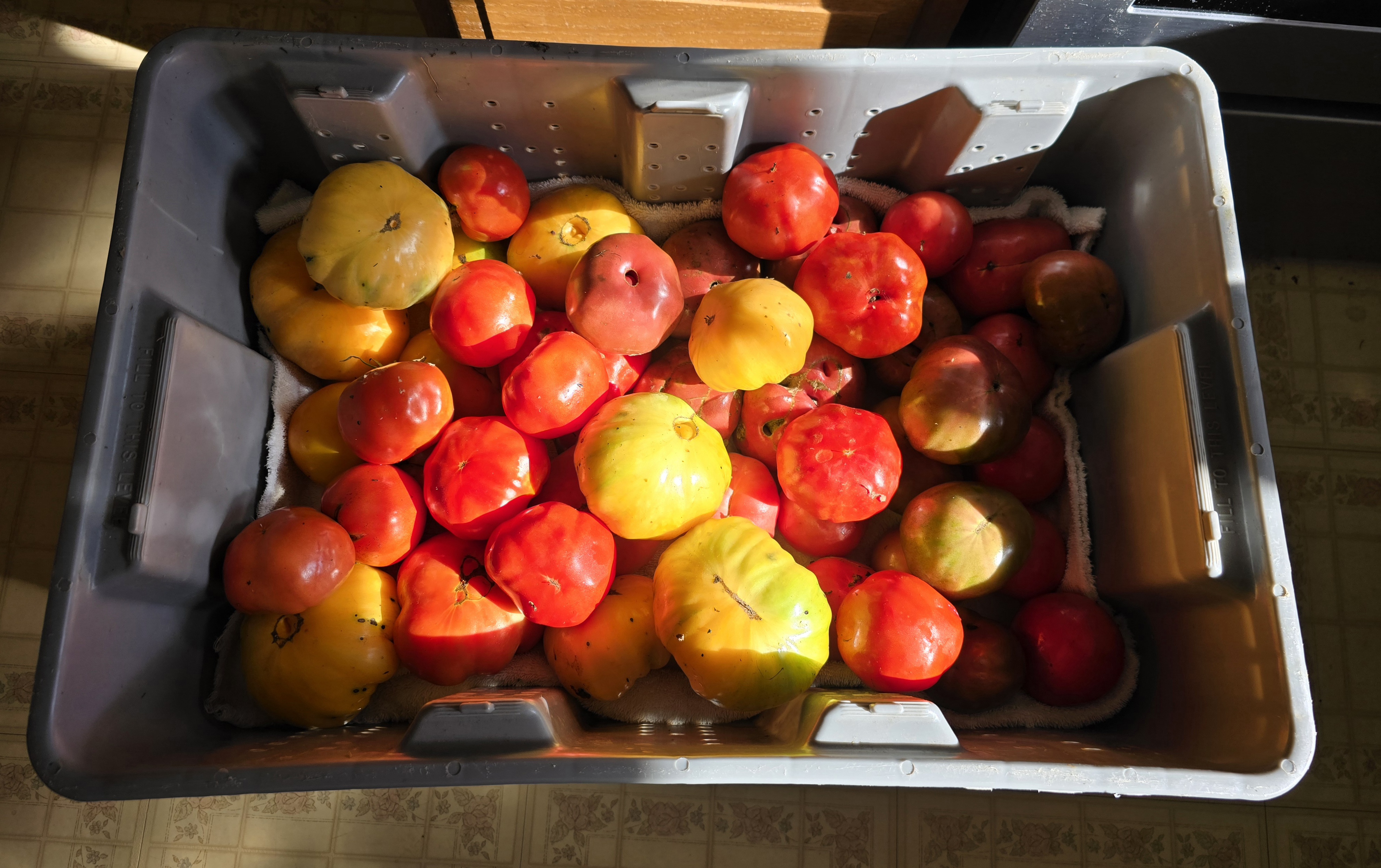
Right now I have three pots going on the stove: two tomatoes and one hot peppers. Learning to process these items took time, but I know where I’m going. I mostly can tomato puree from plum tomatoes. I pickle a couple of quart jars of sliced hot peppers and then make a hot pepper paste to use on tacos. I learned to can only what we need.
This summer I exercised daily, even when the weather kept me indoors part of the day. That, combined with counting calories, led me to lose about a pound of weight per week. I have a way to go to get my BMI below 30. However, I feel healthy and that is important.
It has been a summer of plain folk living our best life. There are challenges, yet it was a decent summer in a turbulent time. For that, I am thankful.
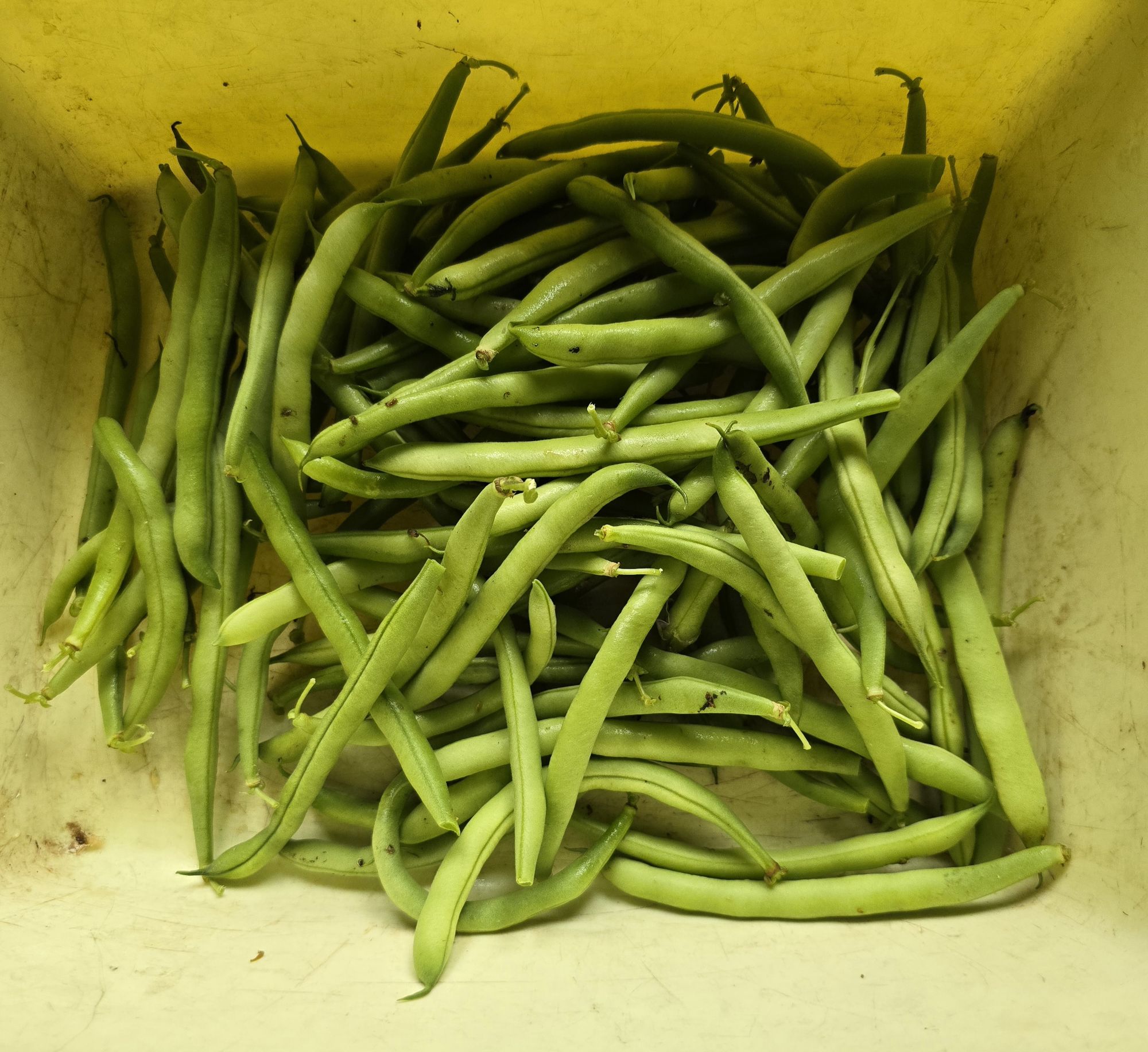
Sunday morning I picked green beans because they were ready. About 20 minutes into the task I was drenched in sweat. With a forecast high of 89 degrees it became clear it would be another indoors day. Once again, I escaped into my two favorite spots in the house: my writing table and the kitchen.
After finishing chores I sat at the desktop and finished my post for yesterday. I also exchanged emails with a friend with whom I am doing this event.
We met in person on Friday and have the idea of talking about why we write books at the end of the time. We are curious about how attendees get information about complex topics. Do they read books to do so? Should be a good conversation.
I am into the second volume of my autobiography and she is into her third, so that’s the origin of that. She sent along a quote about why we write from Nairobi Williese Barnes that said, “(we write) to shift the conversation, challenge harmful narratives, and encourage accountability in the ways we support and uplift one another.” I don’t disagree with that sentiment.
She quoted me back from my own writing from posts on this blog:
So we write, partly to clarify our thinking, and partly to satisfy our need to reach out to others and express the value of our lives, one life among the billions of people walking on the planet. Whether anyone reads or understands our writing is not the point, although we hope they do.
Why am I writing here, in public? Part of it is self-expression, a basic human need. Part is using language to understand complex social behavior. …. Defining a broader moral lesson is the challenge as the memoir progresses.
There are few finer things on this jumping green sphere than writing about writing, especially with a friend.
I made it to the kitchen at about noon and endeavored to get busy. I started with doing the dishes. More accurately, I started with the laundry. On the last Sunday of each month I launder my bed sheets and catch up on other laundry that accumulated. This took a bit of time out of kitchen work as I did five loads. I managed to make what I call “minced salad.” That is summer vegetables suitable for eating raw diced into one eighth inch cubes and mixed together with extra virgin olive oil and apple cider vinegar. I season with salt yet the seasoning possibilities are endless. It came out well.
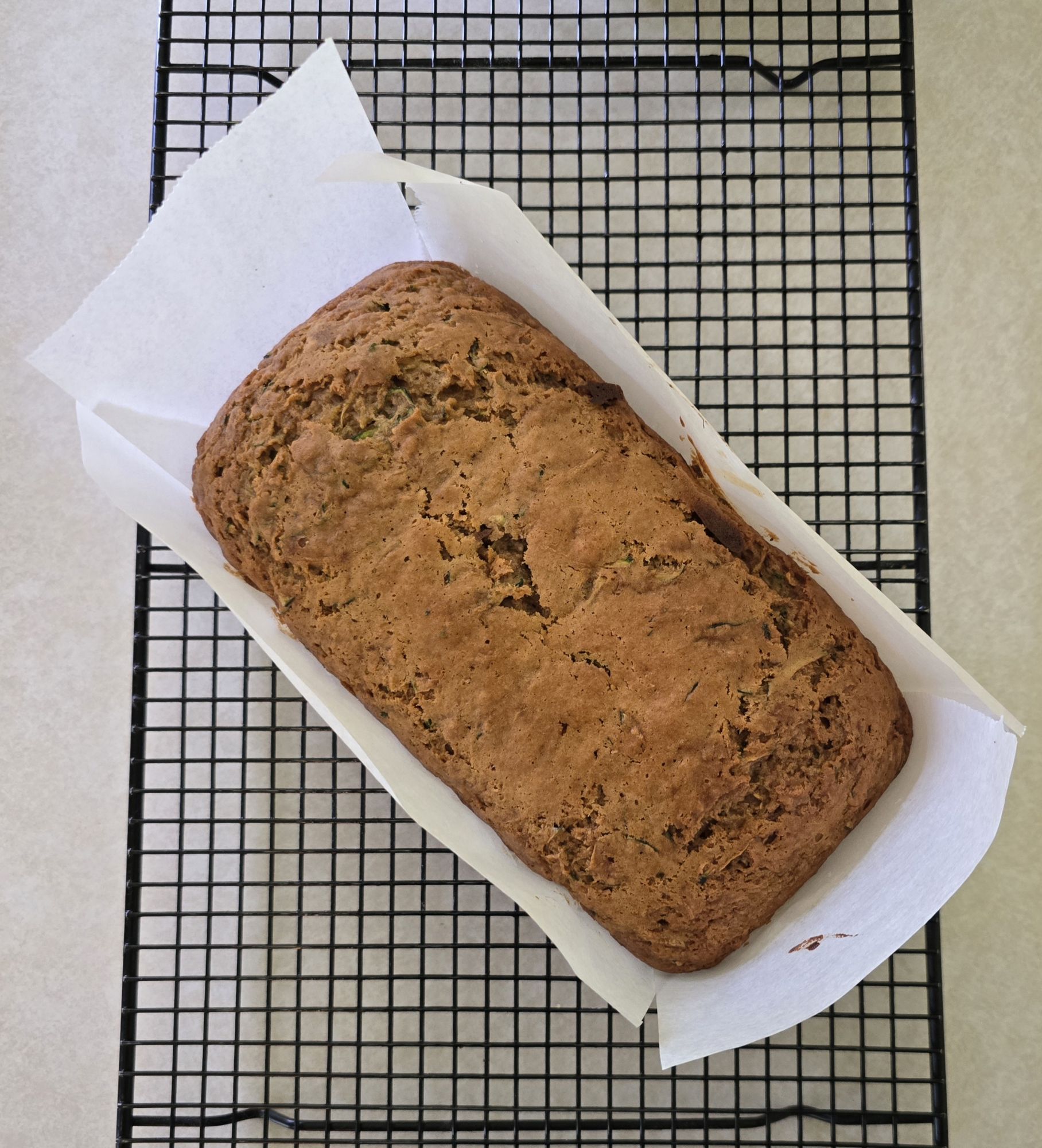
The garden is about finished with zucchini. I modified my zucchini bread recipe, substituting applesauce for the oil, and by wringing the water out of the zucchini with a towel. It is to set for 2-3 hours before cutting so I haven’t tasted it. It appears to have had the desired effect which was to decrease the moisture in the loaf and reduce cooking time. It should be good.
Zucchini bread baked on July 27, 2025.
The benefit of these activities is I can shut out the rest of the world and focus on our family. We need more time doing that. It is a way to go on living in turbulent times.
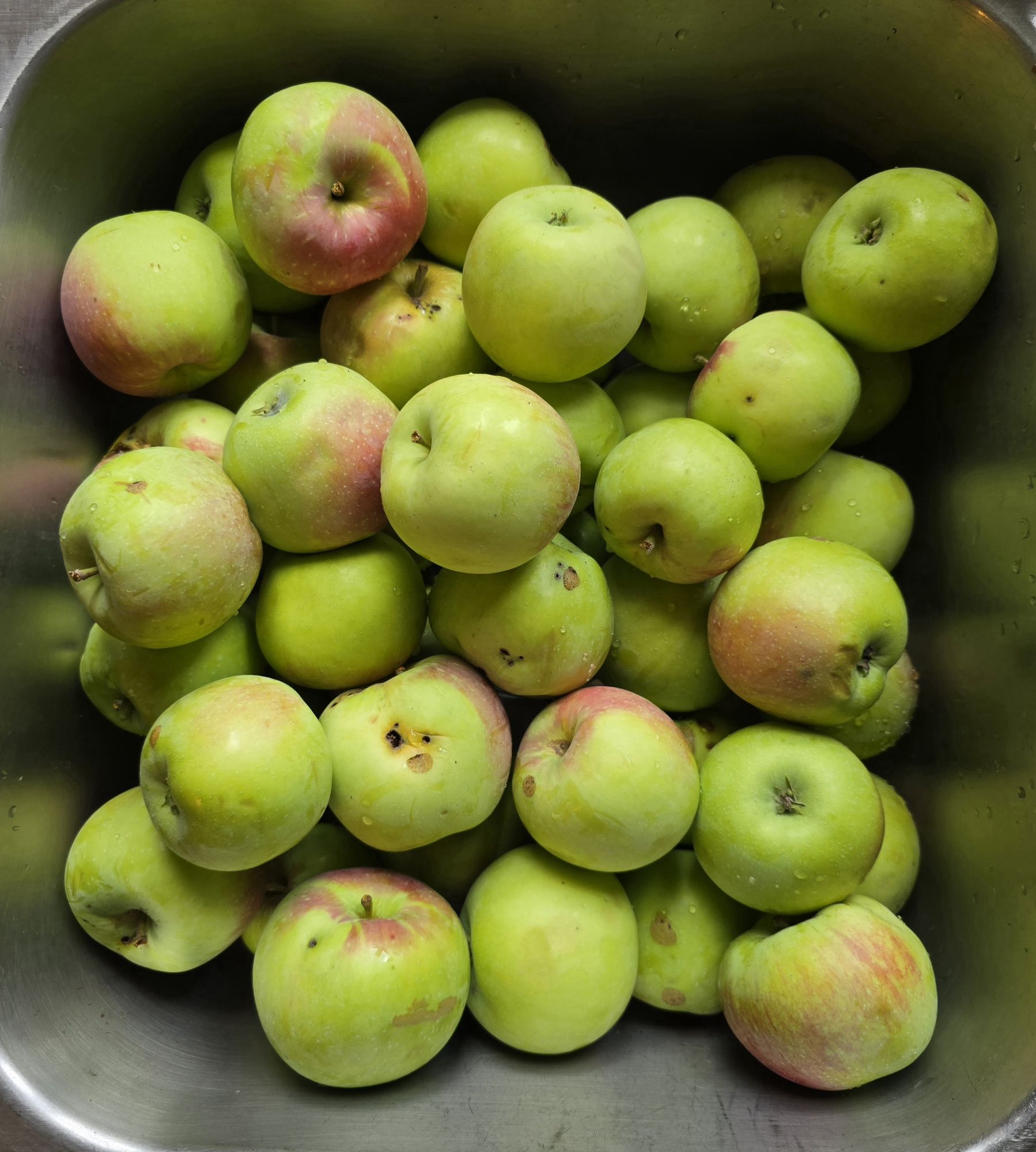
Zestar! apples in the sink before making applesauce.
Saturday cooking is one of the great pleasures of life. I use it to set aside worries and concentrate on preserving and making food for our family with an emphasis on taste and using the garden abundance. Rain was forecast all morning so I spent Saturday in the kitchen. This post is a slice of that life.
The day began with breakfast of cottage cheese and some cherry juice left from the recent visit of our child. Next I did the dishes to make space to get everything clean before making a new mess. Then I went through the refrigerator, which is packed to the doors. I pulled out everything that could go into a new batch of vegetable broth and laid the items on the counter. I also went through the cucumber drawer to make sure decaying vegetables were either used up or composted.
Cucumbers take the most management because there are so many of them when they come in and their shelf life is short. I noted the quart jar of pickles was almost gone, so I reused the brine, fortifying it with some new vinegar and seasonings, and refilled the jar. There are already three or four quarts of refrigerator dill pickles tucked away in the back but we have to make them while cucumbers are in season.
While cleaning the fridge, I made a cut vegetable tray for snacking. Celery, zucchini, cucumber, and bell peppers cut and ready to eat if I need a break from the action. This is for sharing, yet sometimes I am the only one who eats this convenience food. I typically like some kind of salad dressing with them.
Vegetable broth is an easy use of vegetables nearing the end of their life. I make it with standard mirepoix, bay leaves, and the oldest bag or two of leafy green vegetables from the freezer. This day, I used up a couple of bags of last year’s celery leaves to make way for new. One of the last gifts Mother gave me was a large All-Clad multipurpose stainless steel stock pot. If I’m working a full shift in the kitchen, I usually put a pot of broth on and water bath can it. I made six more quarts. At 42 quart jars in the pantry, I am good for most of the rest of this year into spring 2026.
This may seem like a lot yet it was preparatory of making apple sauce.
One of the few surviving photographs of our family in Appalachia is of Granny Reed at Stella’s funeral. Reed’s given name was Josephine, yet I only discovered that from searching the U.S. Census a few years ago. She was always called Granny Reed. She is our child’s great, great, great grandmother.
Granny Reed, along with other female family members worked at a canning plant where they put up apples. When I am picking, sorting, peeling and coring home grown apples for use, I inevitably think about those Virginia women. When in 1983 I visited the home places in Virginia, my Uncle Gene talked about apples.
Next, we went to Norton, another of the places Grandma and Grandpa lived. Uncle Gene talked about apples, how Grandma used to work on peeling and coring apples for one of the big companies. At one time, then, there were large orchards. But now, there is only the coal companies. They used to eat fried apples for breakfast. Later Aunt Carrie told us how to make them. Slice apples into wedges, fry in a little water, sprinkled with sugar. (An Iowa Life by Paul Deaton).
Uncle Gene talked at breakneck speed and I tried to get it all down.
Something that goes through everything is the presence of apples. Grandma worked in an apple cannery, had orchards. There is an apple tree on the old home place, Aunt Carrie served fresh applesauce for us, she said a day hasn’t gone by when she hasn’t had apples. Uncle Gene talked a lot about the apples and how he and the boys helped with them. And everywhere we ate them, the apples were good, the trees bearing fruit. The apple trees bearing lots, even the ones abandoned for years. Eat them green, cooked, fried, in applesauce. (An Iowa Life by Paul Deaton).
As Gene said, “That Granny Reed was always a smart one.”
My entry into Zestar! apples had me eating them fresh and making apple sauce. Before now, I had only every made applesauce from Red Delicious and Earliblaze apples. It turned out on Saturday the flavor profile of Zestar! apple applesauce was delicious (no pun intended). I am so glad that tree is now a part of our home orchard.
I was dog tired at the end of my six-hour kitchen shift. It was an inexpensive escape from the internet and everything on it. A time to live in the past with my forebears, if only for a few hours.
My intent was not to become a food blogger. Best intentions aside, I have written hundreds of posts about food — growing it, shopping for it, preparing and preserving it. I have a sense of keeping recipes and techniques on these pages, yet most of that information resides within me, or the little red book in which I write frequently used and locally developed recipes. I took the step of defining the term “kitchen garden.” What of all this food bloggery? I don’t know from where the urge to write about food came yet I persist.
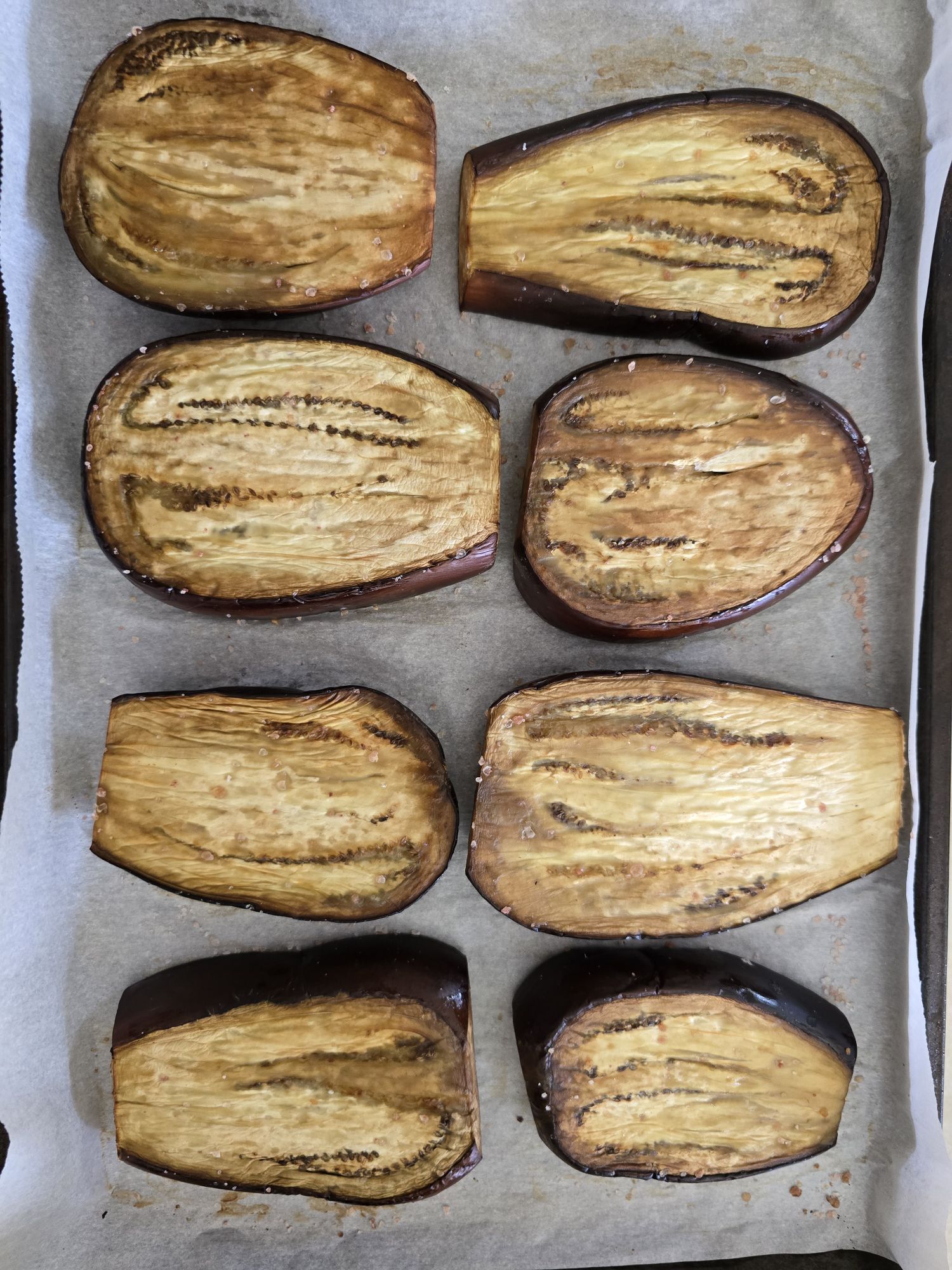
When the garden produces eggplant, there is a lot of it. I picked half a dozen small to medium fruit and cut them into one half-inch slices. I diced the scraps into quarter-inch cubes and placed them in a freezer bag for later use. After brushing the slabs with extra virgin olive oil, and seasoning with salt, I baked them at 400 degrees Fahrenheit for 25 minutes, flipping them halfway. From here, I serve on a plate, spoon some pasta sauce to cover, and sprinkle on grated Parmesan cheese. Any leftover slices of eggplant get frozen for a quick, tasty future meal. Eggplants are a lesson in how to use abundance.
Food writing is a creative outlet. The photograph and text are products of a creative life which represents more than survival. We live in a culture that denigrates the different, that seeks to remove social differences the way politicians seek to erase transgender citizens. Food writing is a way to express a life that falls outside social norms. It is a safe harbor to consider how we might live differently. That seems true whether we write about family food traditions or about a simple eggplant supper served from an abundant garden. We need types of expression that assert our uniqueness without fear of repercussions, without persecution. Food writing can be that. Most readers seem unlikely to recognize it as such.
I meant to write about how four Galine Eggplant seedlings produced so much abundance. This post turned into more than that, about affirmation and the freedom to be different. While my brief recipe for an eggplant dish is not unique, this moment, with these words I became as unique as I might ever be. That has value in a society with low tolerance for anything that is different.






 Journey Home
You must be logged in to post a comment.