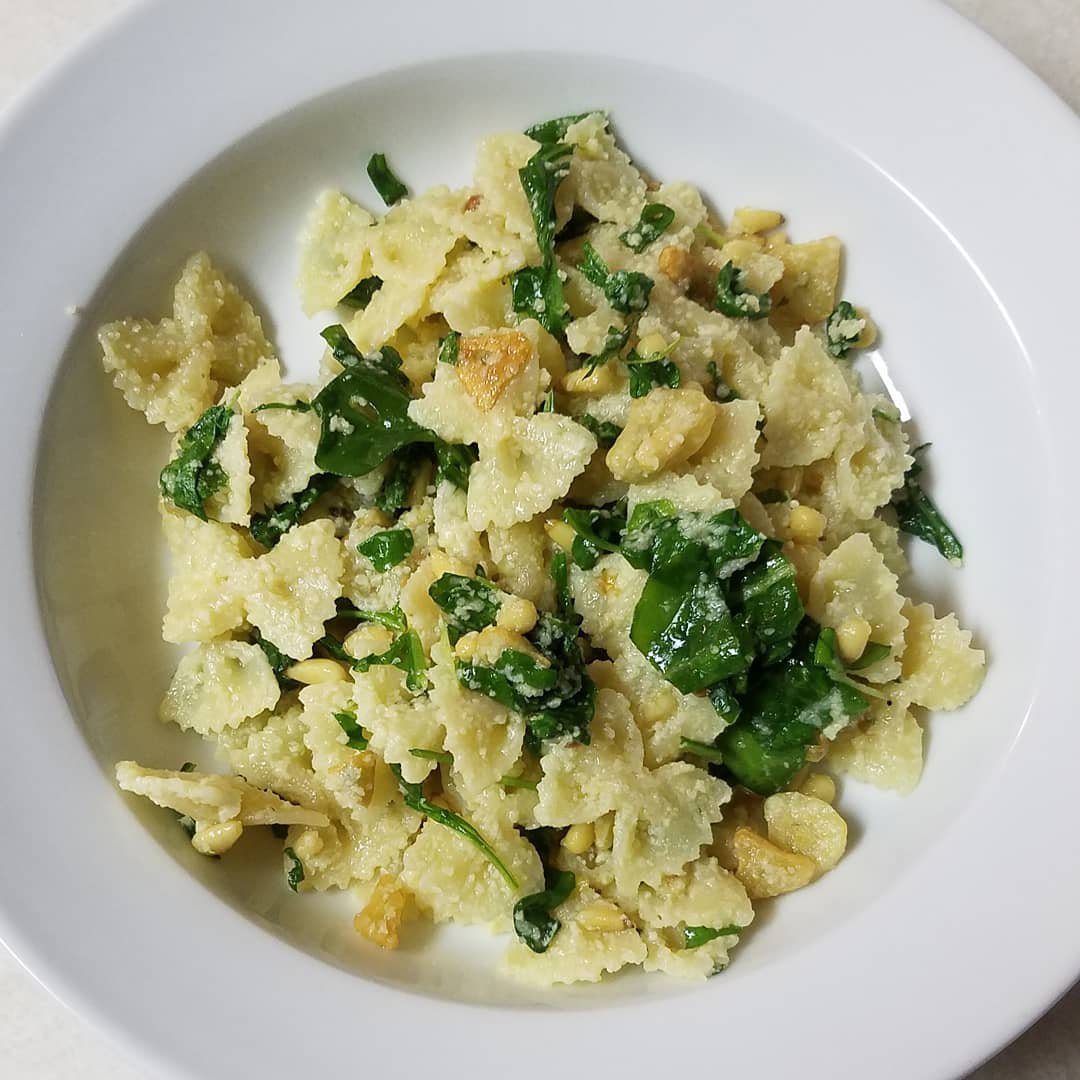
The arugula is top quality this year and I’m in a use it up mode. I spent more time preparing for this dish of bow tie pasta with garlic and arugula than usual. I researched recipes and thought a lot about it during the past two days. I used Parmesan cheese from a green can because of the coronavirus pandemic. It came out well but would be better with higher quality cheese. Here goes:
Ingredients:
Big bunch of arugula, half a pound, washed and roughly chopped
2 cups dried bow tie pasta
12-14 cloves of garlic
Quarter cup pine nuts
2 tablespoons extra virgin olive oil
2-3 tablespoons salted butter
1 cup grated hard cheese (Parmesan, Pecorino Romano)
Salt and pepper to taste
Process
Set a pan of water on the stove to boil for the pasta.
Peel and trim the garlic. Then slice finely (1/8 inch).
Once the water reaches a rolling boil, add the pasta and cook according to directions.
Once the pasta is down, bring the olive oil just to the smoke point. Add the garlic, stirring constantly. As the garlic begins to brown, add the pine nuts and cook for a couple of minutes.
Add the knob of butter and stir. Before the foam begins to subside, transfer everything to a mixing bowl. Drain the pasta and dump it in the bowl. Combine until they are incorporated.
Salt and pepper to taste.
Add the arugula and cheese and mix gently until the arugula wilts.
Since retiring on Tuesday there has been one good day to work outside.
Tuesday and Wednesday were cool and dark with scattered showers. I read two books, reworked the family budget, and spent most of my time indoors.
Thursday was a glorious spring day when I measured and cleared the remaining three garden plots and planned the sequence of events and layouts. Today looks equally nice and an opportunity to start direct seeding and planting from the greenhouse.
This year may be the best yet start to the garden. I’m hopeful even though a lot of weeding and combating pests lies ahead.
There will be spring garlic from the volunteer patch and arugula planted March 2 is ready to harvest. I’m reviewing cook books for ideas, seeking a spring pasta dish as a chance to combine fresh arugula and last season’s garlic. Repetition is anathema to having a kitchen garden so a key ingredient will be spontaneity.
Mario Batali has a recipe using fresh mushrooms cooked in sweet vermouth with ten cloves of garlic. It sounds good. I have the garlic, but no vermouth and only canned mushrooms from the wholesale club. A recipe I remember from television is Jaime Oliver and Gennaro Contaldo making pasta using wild rocket they found growing in London. The spontaneity of their process is more what I’m after. Deborah Madison has a recipe called spaghetti with overgrown arugula and sheep’s milk ricotta. It’s closest to the ingredients on hand. Where our ice box is lacking and could improve is by having some pecorino or any kind of ricotta cheese. I make this once a year, so I’m in no hurry to get into the kitchen. Because of the coronavirus pandemic, I’ll use whatever ingredients are on hand.
Another spring-use-it-up recipe is a quick version of eggplant Parmesan. When the eggplant harvest comes in, I cut large ones into half-inch disks, roast and freeze them. Every so often I get fresh mozzarella pre-cut in disks from the wholesale club. Canned tomatoes are always in abundance and these three things together make a dish.
Make a simple tomato sauce using canned tomatoes (reserving the juice for soup), basil, dried onions and dried garlic. Whatever you like is fine, even a prepared pasta sauce. Place a few tablespoons of tomato sauce to coat the bottom of the baking dish. Seat frozen eggplant disks in the sauce and cover them with more sauce. Next, a disk of fresh mozzarella on each piece of eggplant. Sprinkle Parmesan cheese over the top and bake in a 400 degree oven on the low-middle shelf. It’s ready as soon as the mozzarella begins to brown. I usually make individual servings in small baking dishes.
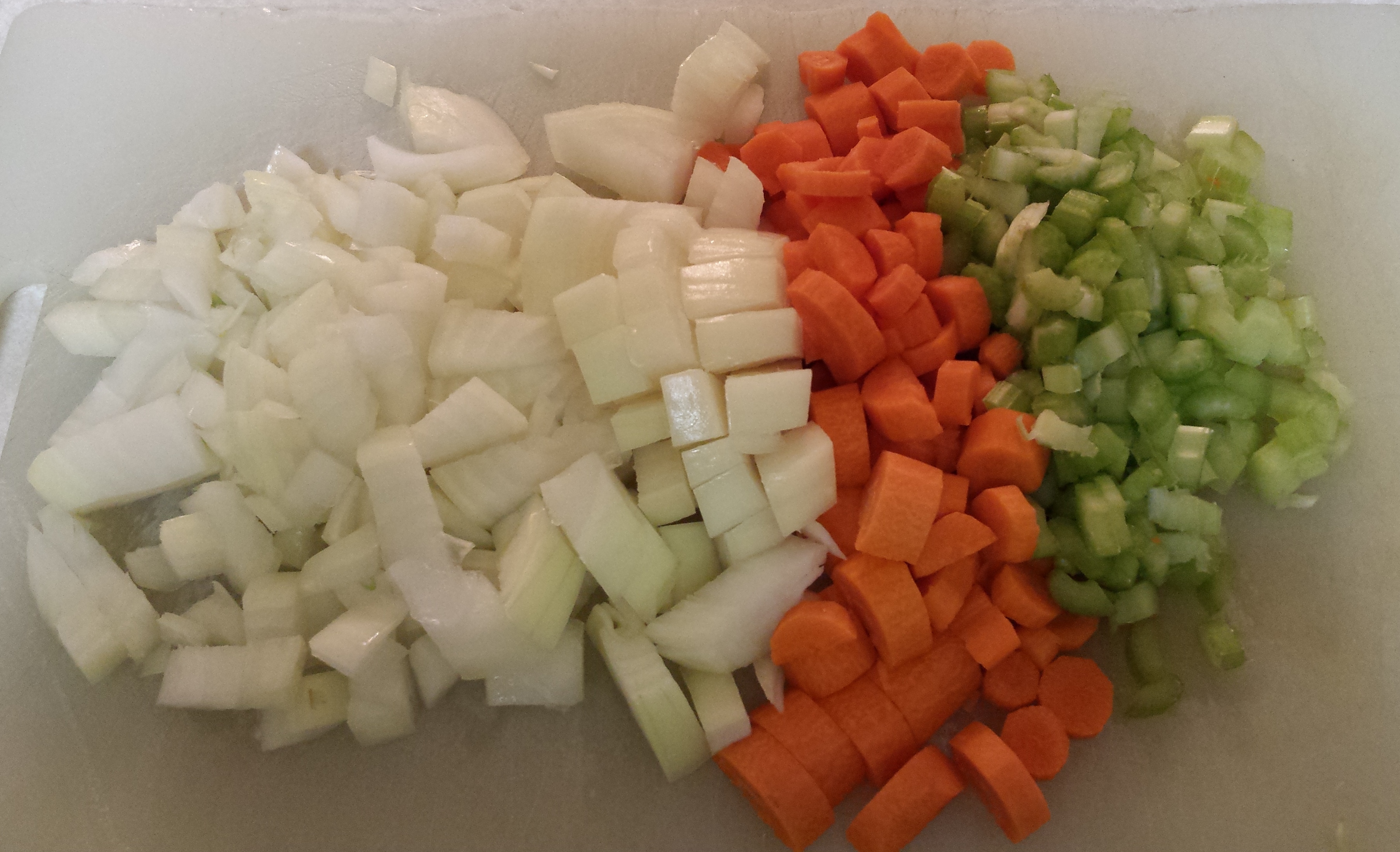
A last spring tradition for today is vegetable soup using fresh greens and whatever is in the freezer that needs using up. I always begin with onions, carrots, celery and bay leaves. Key ingredients were a bunch of fresh greens roughly chopped, a quart of canned tomatoes, two quarts of vegetable broth, frozen sweet corn, frozen grated zucchini, and a quarter cup each of dried lentils and barley. There are few rules other than starting with mirepoix and whatever diners like and needs to be used up. It made about a gallon of soup.
Living with a kitchen garden is the center of so much. When arugula, garlic and spring onions start to come in we are ready to break the long winter absence of fresh vegetables.
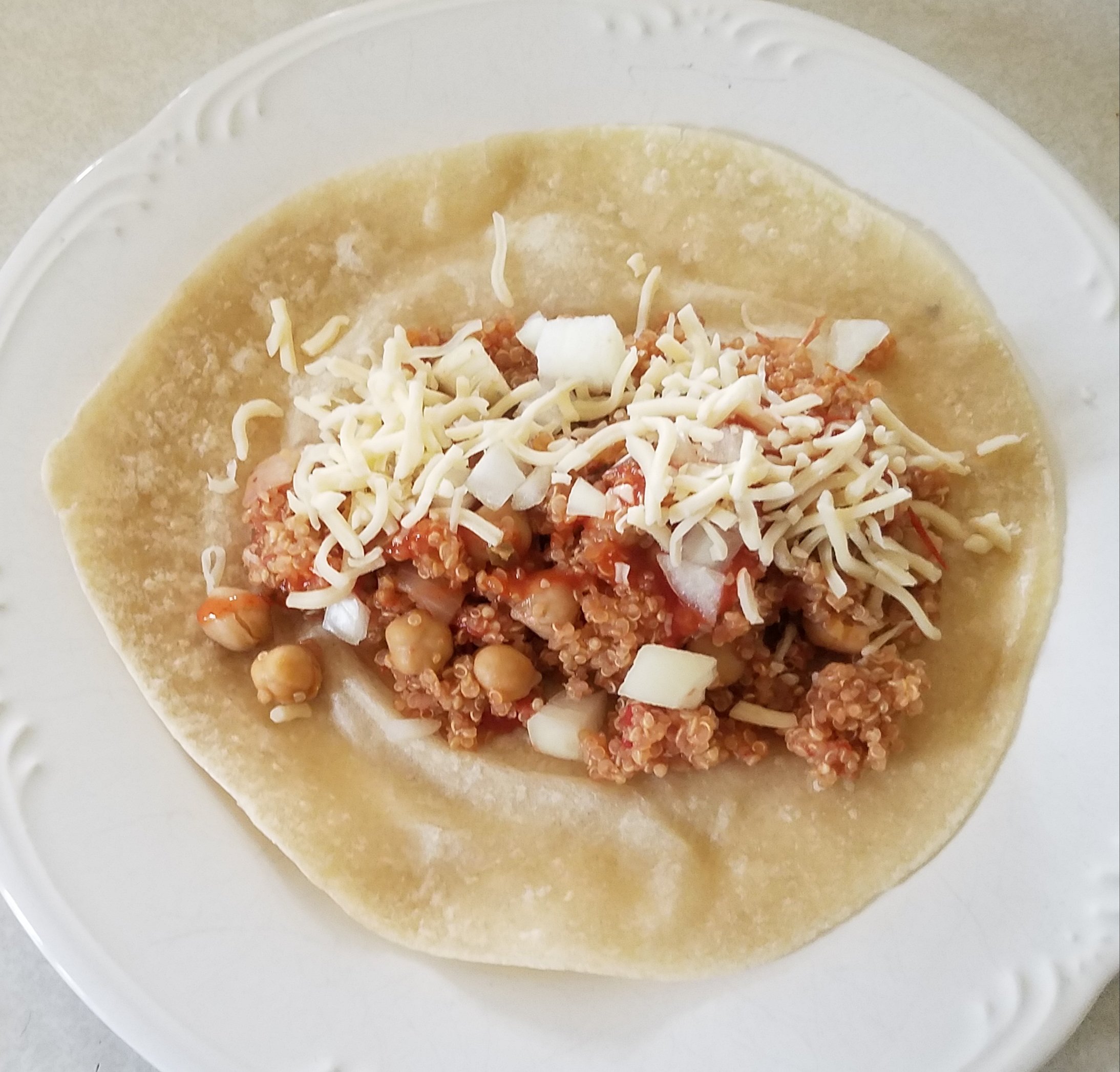
Taco with chickpeas, Spanish quinoa, raw onion, hot sauce and Mexican-style cheese.
Over the years quinoa accumulated in our pantry — jars and jars of it.
Occasionally I’d put a quarter cup in soups, yet the reality was none was being used. More came into the household via free giveaways at the home, farm and auto supply store, impulse purchases, and the like.
There was no answer to the question, “What does one do with quinoa?”
Now there is: Spanish quinoa.
I found a recipe for quinoa lentil taco meat on line. It required an ingredient called “Spanish Quinoa” and linked to a recipe. Spanish quinoa is what I call a “complex ingredient,” something requiring additional preparation before adding it to a main dish. I made a batch Wednesday and the results were satisfying. It will serve on it’s own as a side dish, or in combination with other ingredients as part of stir fry, taco filling or quick soup. Here’s the recipe:
Ingredients
1 teaspoon extra virgin olive oil
1/4 cup chopped onion
1 cup quinoa
1/2 cup diced tomatoes (drained)
2 cups vegetable broth
Process
Sautee the onions in a Dutch oven until translucent. Add the quinoa, tomatoes and broth, stirring until fully incorporated. Bring the mixture to a boil, turn down to a simmer, and cook until the moisture is absorbed, about 20-25 minutes.
Remove from the heat, fluff the mixture and it’s ready to serve on its own as a side dish. I made a double batch and stored the lot in a plastic tub in the ice box until needed.
Discussion
A person can make tacos of anything. For lunch I reheated the Spanish quinoa with leftover chickpeas and salsa in a skillet. Any taco topping would be good. In the photo I used with raw onions, hot sauce and Mexican-style cheese.
Possibilities are limited only by imagination. I’ll mix Spanish quinoa with beans, with frozen greens, with recipe crumbles, with eggs, with lentils, with anything that will give it more texture or protein. As the garden comes in there will be fresh arugula, beet tops, mustard greens and kale. This possible solution to a long-standing pantry dead-zone has potential to change things around in the taco-filling arena.
One more step in the culinary journey of a kitchen garden.
There is a 25 percent chance of rain beginning at 9 a.m., according to the weather application. I pulled the cars out of the garage so that space can be used for other projects if the forecast proves to be true. Despite the coronavirus epidemic the waste hauler is working today so I put the trash and recycling bins at the end of the driveway.
I made a taco for breakfast this morning and one of my go-to recipes is easy.
Nostalgic Breakfast Taco
When Mother began cooking tacos at home it was revolutionary. We hadn’t had that at home until the 1960s. The change was partly due to the rise of mass-produced, Mexican-style options at the grocery store. It was also a result of her work at the grade school cafeteria where they made dishes different from what we grew up with. Cafeteria work broadened our home food repertory. While we don’t eat beef in our home now, commercial soybean crumbles create a texture and flavor that reminds me of those early days when she made tacos for the first times. Here’s how it went this morning.
Two frying pans go on high heat. In one cook a pre-made organic flour tortilla. In the other heat a scant tablespoon of extra virgin olive oil.
Dice half a medium-sized onion and part of a frozen bell pepper. They go into the hot oil. You’ll hear the sizzle. Stirring constantly, season with salt, dried cilantro and powdered chilies. Cook until the onions and peppers are soft. Stir in a clove or two of minced garlic and cook until a garlic aroma rises from the pan. Stir for a minute or so and add one half cup of commercial frozen soybean crumbles. Stir until thawed and set aside.
Place the cooked tortilla on a dinner plate and garnish from the bottom up: a layer of Mexican cheese to taste, pickled sliced jalapeno peppers, salsa or hot sauce to taste. Put the fry up on top of the garnishes and serve with a beverage of choice.
I look forward to when garden cilantro and tomatoes are available. Tacos are a way to explore your palate and discover who you are. For me it’s a chance to remember standing around the kitchen in that American foursquare home with family while reflecting on how our lives have changed. Even on a rainy day that is positive experience.
A foundational aspect of our lives in Big Grove Township is reliance on others when it comes to food. We use the international supply chain which brings items closer to home so we can buy them at the grocery store.
At the same time, we spend 24 percent of our food dollars on products where we know the face of the farmer. That’s a lot more than most families and it results in a pantry full of staples like potatoes, onions, carrots, canned tomatoes, frozen vegetables, pickles and apple products.
Our regular habits prepare us for a month of quarantine without the coronavirus pandemic. We’d suffer for lack of milk and eggs, yet in a global society where millions go hungry each night, it’s more inconvenience than any kind of deprivation. We’ll get by.
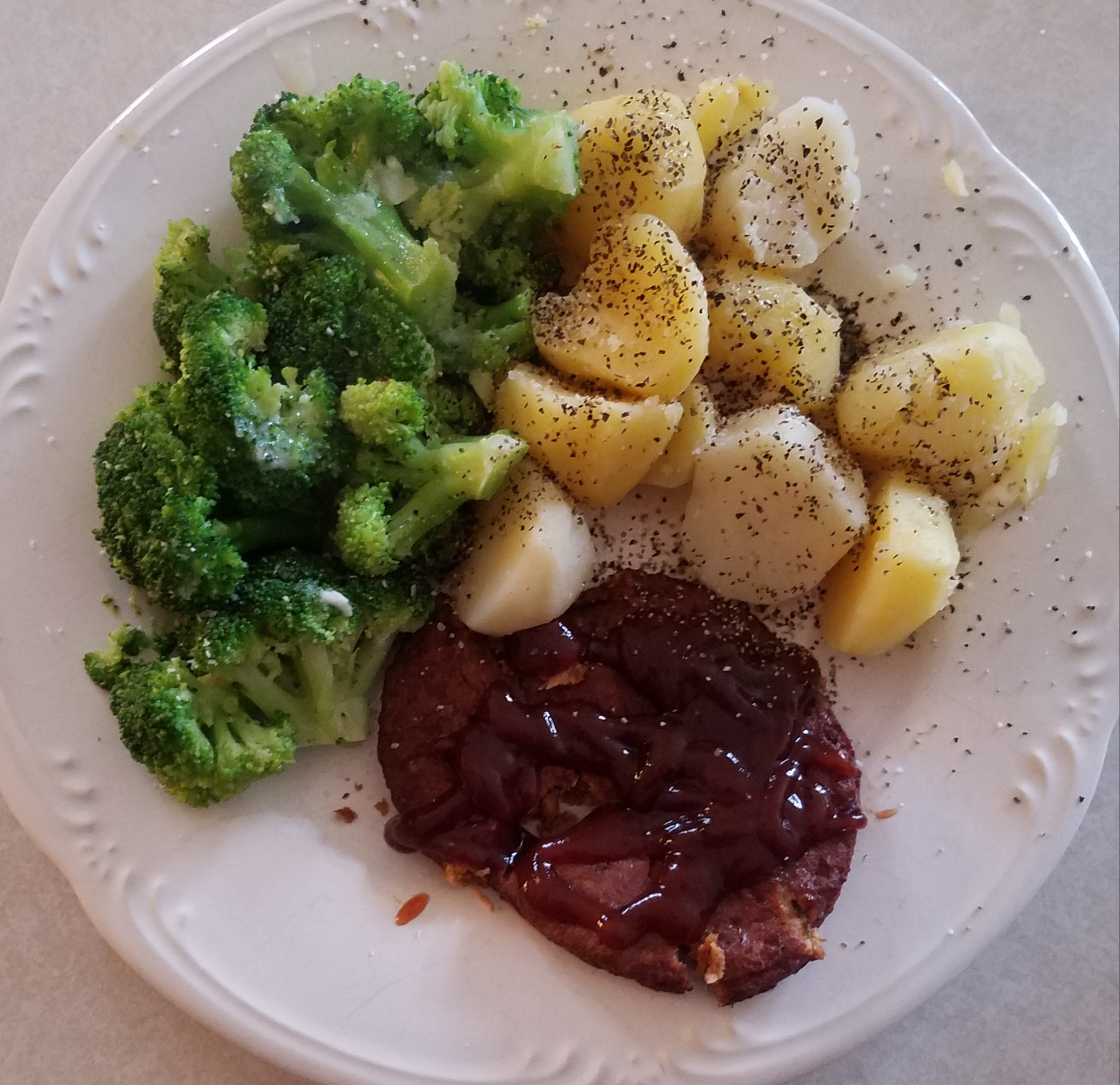
The meal in the photo is our home food story. One third Farmer Kate’s potatoes, one third frozen organic broccoli from the wholesale club, and one third a commercial, mass produced soybean burger from the grocery store. The garden broccoli crop wasn’t so good last year and we’ve depleted the freezer of our own. That’s where the food supply chain comes in handy.
I don’t know if I’ll venture to work at the home, farm and auto supply store tomorrow. After the management team arrives later this morning I’ll phone in and see what protections they offer employees. I work in the warehouse and am isolated from most customer contact. All the same, retail is a people-contact job and there is more risk there than in staying home. If I choose to stay home, there will be no compensation.
I’d feel better about the isolation if it were warm enough to work in the yard. Yesterday morning patches of snow remained on the ground. It should melt today as ambient temperatures are expected in the mid-forties this afternoon. Instead of working outside, I read and wrote in the usual places. About 5 p.m. I started peeling potatoes and making dinner. It wasn’t much, but will sustain us as we ride out the coronavirus pandemic over the coming weeks.
For a recipe I got out my copy of the Holy Family School PTA cookbook. I like this book for the familiar names of the recipe authors, some of whom I knew. Monsignor T.V. Lawlor served as the church’s second pastor from 1943 until 1961 and his photograph is printed inside the front cover of the book. This dates the cookbook in the 1950s most likely, after the school moved to the location I attended a couple of blocks south of the church on Fillmore Street.
I chose a banana bread recipe contributed by Mrs. H.A. Tholen. It called for shortening, although I substituted butter and kept everything else the same. Here are the ingredients as written:
1/2 cup sugar, 1/2 cup shortening, 2 eggs, 3 bananas mashed, 1 teaspoon baking powder, 1/2 teaspoon soda, 1-3/4 cup flour, and a pinch of salt.
Instructions are, “Mix in the order given and bake in a slow oven.”
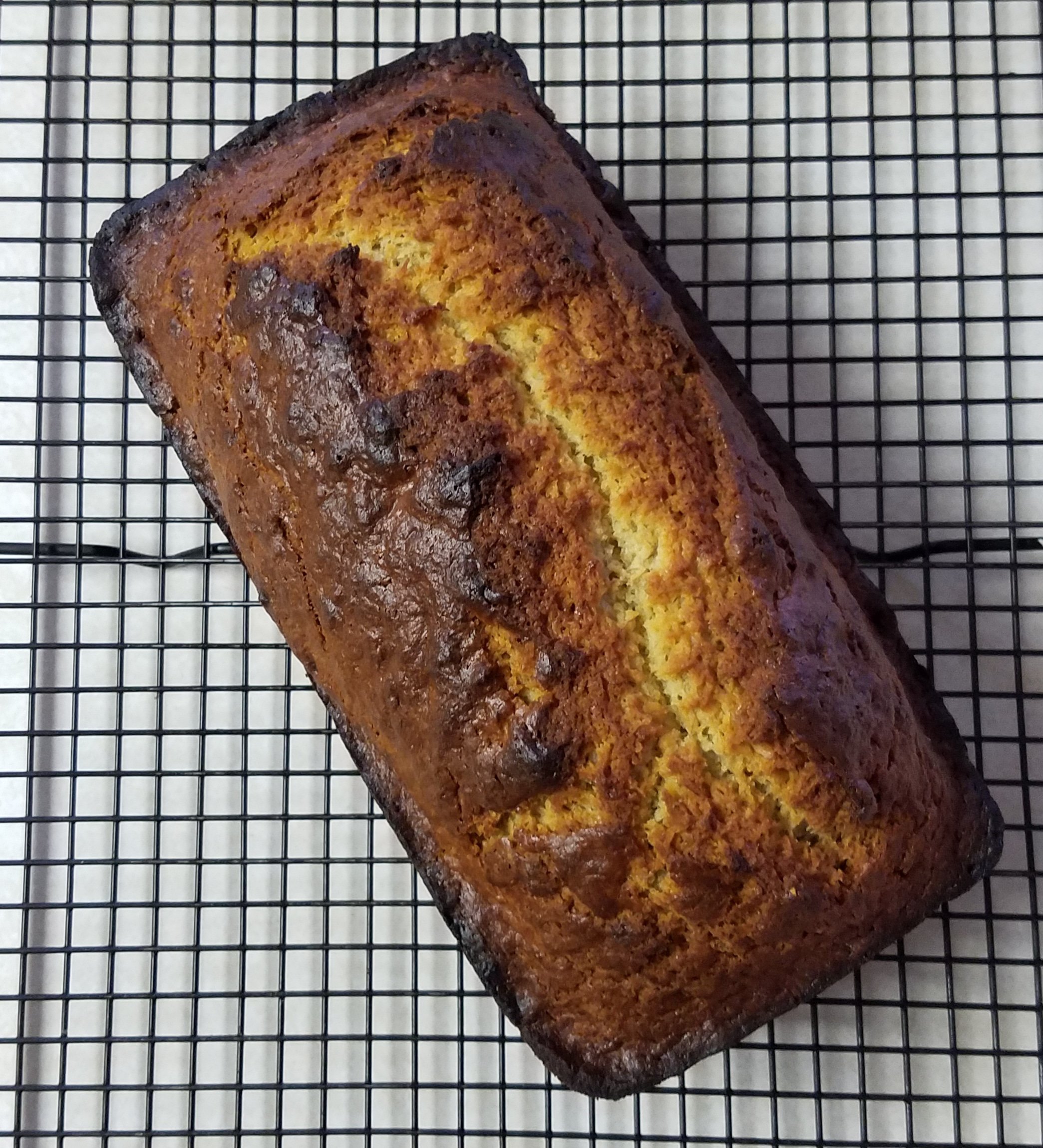
Well that won’t do. Looking at other sweet breads in the book I decided on a 350 degree oven for 50 minutes. It turned out great as you can see in the image.
Making banana bread from overly ripe bananas is a cultural inheritance not only from my mother and maternal grandmother, but from a broader society where fruit like the Cavendish banana is readily and cheaply available. However, like most mass marketed fruit and vegetables it is subject to change from climate and from other pressures, forcing old habits and patterns to change.
There was something positive in yesterday’s bakery. It was a warning too, that life is fragile and ever changing. We seek comfort in what we know, delaying the embrace of what is coming. I don’t just mean what’s coming for Cavendish bananas.
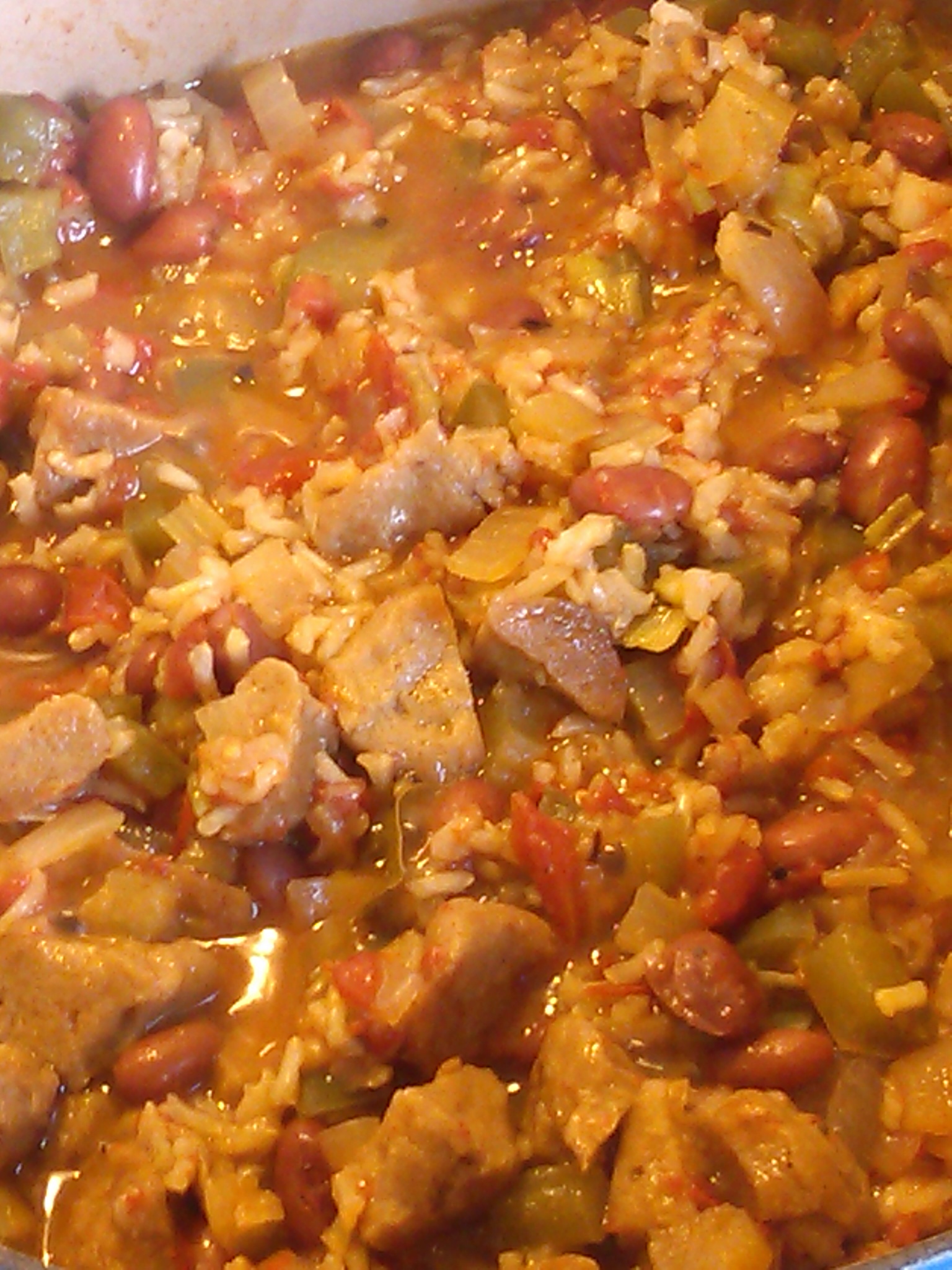
Preparing to cook red beans and rice has been a year-long process because most of the ingredients were produced in my garden or on farms where I work.
The garden produced red beans, okra, tomatoes and celery. Local farms produced onions, garlic and bell peppers. I also grew red pepper flakes and blended the powdered dry spices. Pantry staples of extra virgin olive oil, all purpose flour, and long grain brown rice were USDA organic but not produced in Iowa.
I invested several hours preparing a luncheon meal and time was worth it because of the flavor.
In the morning we discussed my 5-1/2 quart Dutch oven, the enamel of which is wearing off the inside. I’m don’t favor replacing it. Not because of the $350 price tag for a new one from Le Creuset. With a bit of cooking oil on the bottom to prevent rusting it will serve many more years. It is my go-to pan for making red beans and rice. It has been a reliable part of our kitchen.
Cooking is a ritual that evokes memory and skill in bringing a dish together. I soaked a cup of dried red beans in the Dutch oven overnight, then cooked them with half a diced red onion until tender but not mushy. I drained the beans and reserved the cooking liquid, letting them sit on the counter until ready to make the dish.
Around 10 a.m. I started work.
I fried a couple of home made vegetarian burger patties from the freezer and set them aside to drain. (Andouille sausage would be more traditional).
Heating the dutch oven, I added two tablespoons of extra virgin olive oil and cooked a generous tablespoon of red pepper flakes. I diced half a large onion, red bell peppers, and celery stalks and sautéed them in the oil-pepper mixture with a little salt. Once they began to soften I added two cloves of minced garlic and added home made seasoning — think powdered garlic, curry powder, paprika, and powdered hot, red peppers. I added a few dashes of prepared hot sauce from the refrigerator and stirred until everything was incorporated.
Next came additions. I deglazed the pan with a pint of diced tomatoes. Next, a cup each of sliced okra and long grain, brown rice. I stirred in two tablespoons of all purpose flour, then the cooked beans, until everything was incorporated. I tried not to bust up the beans.
What liquid to use was an open question. This time my answer was two cups of the bean cooking liquid (that’s all there was) plus two cups of water. Other options I considered were canned tomato juice and home made vegetable broth. The flavor of the bean cooking liquid made it a good decision.
Stirring everything together, I brought it to a boil then turned the heat down to a simmer, cooking until the rice was done and most of the liquid had been absorbed. Toward the end of cooking I crumbled the burger patties and folded them into the mixture.
It was ready to eat at noon, making four to five portions.
We seek opportunity to follow our creative impulses and cooking is primal. It provides an opportunity to shed anxiety from quotidian affairs, if only for a few hours. A recipe makes the experience replicable but not really. Cooking is a story of how we sustain ourselves in a turbulent world.
Three cups of mixed beans had been resting in a jar on the counter for a long time. To use them up I made bean soup.
I soaked the beans overnight, then rinsed them in a colander with cold water from the faucet. They went back into the Dutch oven where I covered them with home made vegetable broth and turned the heat on high. Once the mixture came to a boil, I turned the heat down to a simmer and let them cook until tender.
Next I strained the mixture through a perforated funnel and prepared two cups each of diced celery, diced onion and sliced carrots. Using some of the bean cooking liquid, I sauteed the vegetables in the Dutch oven, salting to taste.
When the vegetables began to soften I added three bay leaves. Dumping the beans on top I added the rest of the cooking liquid and covered with tap water. It became soup after an hour of simmering. Using the immersion blender I whizzed the soup until about a third of it had been pulverized.
Dinner was bean soup, a slice of buttered bread, some cheese curds, a cup of local apple cider, and dried fruit.
What seemed significant was I resisted an impulse to add some of everything in the ice box and pantry to the pot. Classic mirepoix makes this kind of soup, and it doesn’t need much else.
An acquaintance from the Climate Reality Project posted a photo essay depicting the process of making a “‘No-Tuna’ Salad Sandwich” on Instagram. I found the recipe on line and made the dish for lunch.
Mostly vegetarian, I long for food eaten at home with Mother. Because of over fishing, slavery in the Asian tuna business, and the negative impact of global warming on fish stocks there are plenty of reasons to eschew tuna and other seafood. If I don’t consume it, someone else will and that’s another problem of society on a long list of them.
The recipe produced a tasty meal, reminiscent of tuna sandwiches of my youth, but not. With a few tweaks the recipe will be a keeper.
Chickpea Salad (Modified from an original recipe by Dana Schultz)
Ingredients:
1 – 15 ounce can of chickpeas or 425 grams cooked, drained and rinsed
3 tablespoons tahini
1 teaspoon Dijon mustard
1 tablespoon honey
1/4 cup diced red onion
1/4 cup diced celery
1/4 cup diced dill pickle
1 teaspoon capers, drained
Salt and black pepper to taste
Preparation:
Mash the chick peas in a bowl, leaving the mash uneven with some peas left whole.
Add tahini, mustard, honey, red onion, celery, pickle, capers, salt and pepper and mix to incorporate. Adjust seasonings as needed.
Refrigerate to enable the flavors to meld together.
Scoop a generous amount on a slice of toasted bread and garnish with lettuce, tomato and Dijon mustard or as desired. Can also be used on crackers as a party appetizer.
Daylight remained as I drove into the driveway after a shift at the orchard.
If the garden appeared scorched by the previous night’s first frost, some tomato plants survived and the kale looked resilient.
The weather forecast is a couple of days without rain. I scheduled garlic planting for Tuesday when the ground should be dry enough. Fingers crossed I get a crop in this year.
I picked another bushel of fully ripened Red Delicious apples yesterday morning. This morning I used apples knocked down and damaged during the picking process to make an apple crisp for the county party’s fall fundraiser. In September I bought 30 aluminum food service trays for potlucks. This was the fifth one used.
We were busy at the orchard Saturday. Because of rainy weekends there is a pent up demand for the u-pick apple experience. I was tired at the end of my shift. I fixed eggplant Parmesan for dinner and could go no further. I was so tired I left the dishes to clean this morning. If there was any doubt, autumn has definitely arrived.




 Journey Home
You must be logged in to post a comment.