Categories
Writing

Once Upon an Oracle

Oracle Open World 2006

(Editor’s Note: This article was first posted Sept. 25, 2011 on my blog Big Grove Garden. It is about missing mainstream culture in the late 1970s and captures some of my life while living in West Germany and epiphanies while visiting San Francisco where I jogged on Market Street in the middle of the night, saw DEVO and Sir Elton John perform at the Cow Palace, and stayed in Chinatown while there to attend Oracle Open World in 2006. It is  presented unedited.)

By the time I returned from a Cold War West Germany in 1979, I had missed a lot of the music, movies and other artifacts of popular culture of the late 1970s. Jackson Browne, Bruce Springsteen, Talking Heads, Blondie, Sex Pistols, the Cars, the Clash, The Ramones and DEVO, never heard of them. In movies, Blue Collar, Star Wars, The Deer Hunter, Kramer vs Kramer, Norma Rae, Taxi Driver, F.I.S.T., Saturday Night Fever, All the President’s Men, and Dog Day Afternoon were all beyond the ken as instead, we viewed repeated screenings of Patton in forests near the Fulda Gap, our projector powered by generators.

Most of us did not even own a television while we were stationed overseas, preferring to get together at the officer’s club or go hiking and rock climbing in the nearby Taunus mountains during rare times when, for a few hours, we could get away from being a soldier. My vacuum of experience in popular American culture is between the bookends of Jaws, which I saw with house mates when living in Davenport and Annie Hall which I saw in Amsterdam subtitled in Dutch while on leave from my post in Mainz just before returning to Iowa. In retrospect, missing these shared popular culture experiences was a formative influence. Even missing the start up of Saturday Night Live was important.

Instead of music and movies, I took in the stuff of life. The politics of being an occupying force leftover from World War II was real. One of my buddies went on missions to East Berlin where he talked with Soviet soldiers to see what they were up to. Mostly, it appears, they were drinking vodka and we never worried about the threat they may have posed to the West. One time we chipped in and he brought us hats made in East Germany. I still have mine in the closet, as it is very warm.

Our battalion had a severe drug problem. Almost every soldier had some connection to use of heroin or hashish. It was so prevalent, and our enforcement capability so limited, that we would bust someone caught in the act more to ruin their Friday night than send them to jail. Often soldiers caught using drugs in the military were sent to the Community Drug and Alcohol Counseling service. Turned out the counselor supplemented his military pay by selling heroin to his clients. Heroin purportedly coming from Afghanistan through East Germany. Looks like both sides of the Cold War had their problems with substance abuse.

By dealing with existential realities in the military, I was spared the evisceration of everything I knew from growing up in a union household. Popular culture reflected that. The late seventies were a prelude to Ronald Reagan’s supply side economics, and notably the PATCO firings that were a continuation of the assault on unions that began under Nixon. It would have been tough to witness all of that. While I missed the first run of DEVO, I did finally catch up with them.

I got a chance to attend Oracle’s Open World in 2006 while working at a logistics company. It was a time on the cusp of the explosion of hand-held devices and cloud computing we are in the middle of today. Gavin Clarke wrote about the event in The Register, whose tag line is, “Biting the hand that feeds IT.”

More than 40,000 delegates will flood downtown San Francisco’s hotels, restaurants, and transport system, drawn from the developer, customer, and partner ranks of the 21 companies Oracle bought since January 2005 plus those using Oracle’s own middleware and applications.

Keynotes from […] AMD’s Hector Ruiz, Cisco’s John Chambers, Hewlett-Packard’s Mark Hurd, and Sun Microsystems’ Jonathan Schwartz, plus Dell chairman Michael Dell, and Network Appliance president Tom Mendoza who will no doubt pay some kind of homily to the power of their relationships with Oracle on servers, virtualization, and software […]

Even the entertainment is big: […] it’s the rocket man himself Sir Elton John.

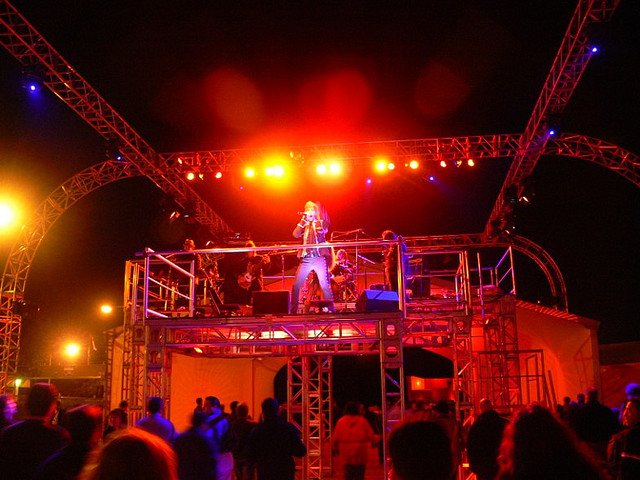
Somewhere on one of the numerous venues arranged by the conference organizers within San Francisco’s Cow Palace, along with Sir Elton John, a dozen bands, circus acts and contortionists, I saw the band DEVO perform for my first and only time. They played Secret Agent Man among others I did not recognize.  It made me glad I missed the 1970s culture of the De-evolution of American life that was tied so closely to corporations making things like Goodyear tires in DEVO’s home town of Akron.

I was still on Iowa time at my hotel in Chinatown near the Moscone Center. I went jogging on Market Street in the early morning, encountering an army of homeless people, socializing and sleeping in cardboard boxes and under blankets on the sidewalks. As I ran, I wondered how the popular culture of the 1970s became one more thing to be marketed and bought by consumers. In doing so, it bred a deep cynicism that penetrates our culture today. It also gave rise to today’s self purported “new revolutionaries” of the Taxed Enough Already party, who too have become one more thing to be marketed by the corporatists at Fox News and NBC Universal.

As the sweat built and I headed back to the hotel, missing the late 1970s popular culture did not seem so bad. It enabled me to hope that as a society we were better than this, and that life was about more than militarism, poverty, sex, drugs and rock and roll. For that I am grateful.
Categories
Writing

On Madison

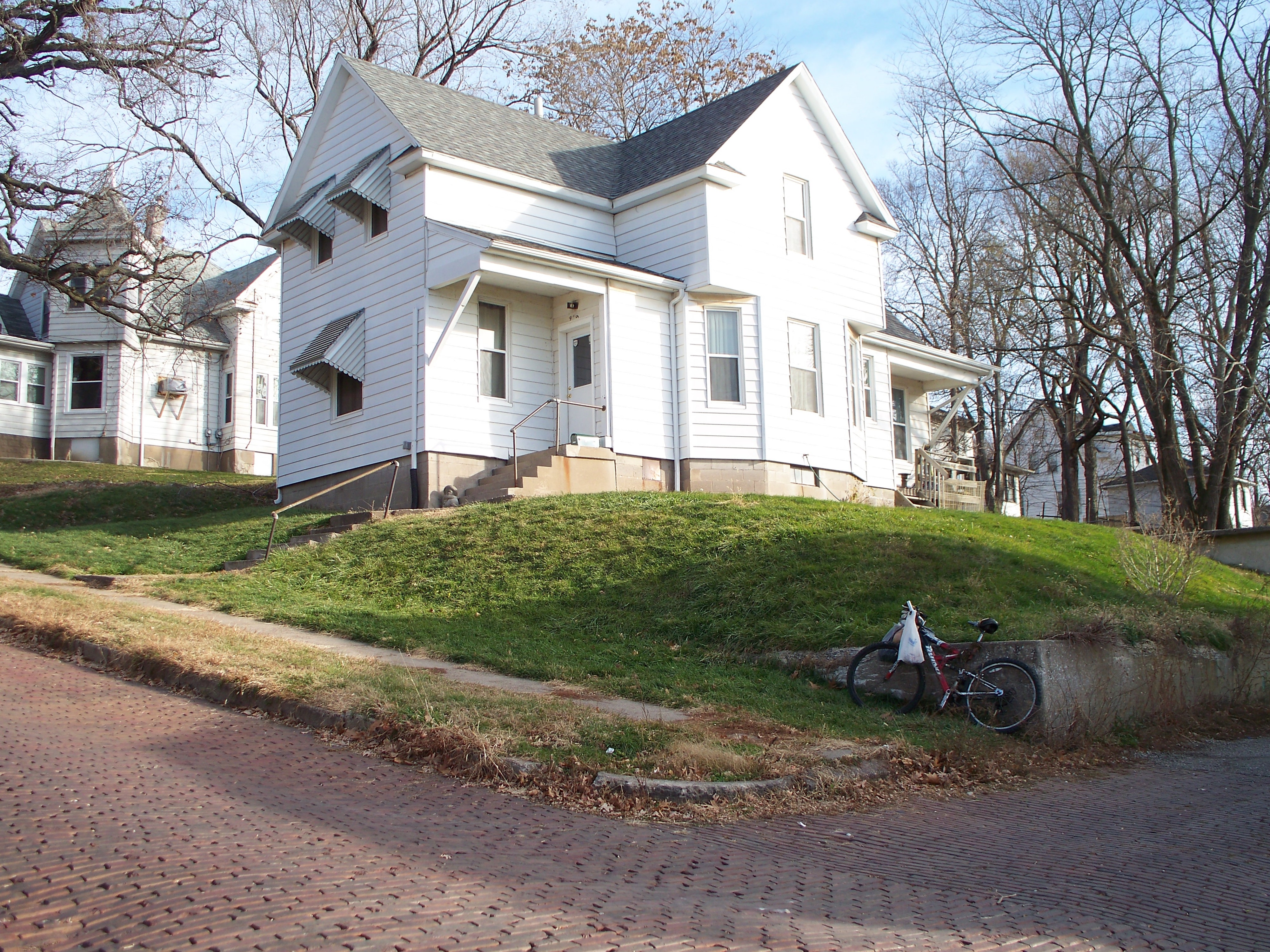
919 Madison Street in 2011.

This house is the second place I remember living. When I talk about the 1950s this place was seminal. It was recently on the real estate market with a gallery of photos. It remains inside and out much like it was when we lived there.

My sister and brother were born at local hospitals while we lived here. I started kindergarten from here in 1957. When Father went hunting or fishing with his buddies he brought back game to process it on the back porch. I learned about television, family traditions, and had my first and only pet dog named Lassie. I kissed a girl for the first time in the backyard. It was her idea. Memories return, of doing things in every part of the yard and indoors. A few photographs of the time survived.

Our maternal grandmother lived with us for a while and her ex-husband, our grandfather, visited from time to time. He was a demonstrator at the coal mining exhibit at the Chicago Museum of Science and Industry. He had coal worker’s pneumoconiosis from working mines in Cherry, Illinois. When he visited he would spend long periods in the bathroom coughing up phlegm. When he died of black lung disease I recall being in LaSalle, Illinois for the funeral but staying at my aunt and uncle’s home while adults attended services. Much later, during the Carter administration, Grandmother received black lung benefits from the federal government.

Father set up a swing set for me in the basement. It collapsed, resulting in my being rushed to the hospital for 50 stitches to sew my forehead back together. There are vivid memories about being injured and the time spent in the hospital. People don’t notice the scar any more yet it seemed prominent for many years.

I remember being with neighbors, sometimes inside their homes. We developed a sense of neighborhood. Not far away there were two parks: Fejervary Park to the west and Lookout Park to the east. We sledded on snow in the former and rode inside cardboard boxes down the steep hill of the latter. Occasionally I went wandering down Madison toward downtown and my parents had to come find me and bring me home.

As I revisit these years there are more memories than expected. How to approach them for an autobiography is an open question, one I need to answer. Part of me doesn’t want to organize these memories.

There is something to learn about how this pre-consumer society impacted who I am today. In the iconography of my life, this place remains important and merits consideration.

Categories
Living in Society Social Commentary Writing

No Class Reunion

40th High School Class Reunion, Summer 2010.

This summer marks 50 years since about 260 of us graduated from Davenport Assumption High School. As a group, we were never close and that makes organizing a class reunion difficult. There won’t be one this year.

It was a Catholic high school and parish loyalties continued through the four years. To some degree, those parish-nurtured social groups continue. I still read about cliques of friends who get together from time to time. When we graduated, social media didn’t exist as it does today. Information about classmates’ current activities would be unavailable without Facebook, LinkedIn and Twitter.

I helped organize our fifth reunion, hiring a band to play music during the event. I also helped organize the 40th reunion, a two-day event, working on building a database of contact information that put me in touch with many former classmates. The fifth seemed too soon, the 40th was enjoyable and productive given my role. I heard from people whether they attended or not.

I stay in touch with a few friends from high school. If there were a chance to get together it would be great. With the coronavirus pandemic even a small gathering seems unlikely. We are of an age where conditions of life are catching up with us and at higher risk of contracting COVID-19. Maybe we’ll get together in some safer, future year should we be lucky enough to live so long.

For now I wish my living classmates well. For the increasing number who died, the Catholic faith holds hope of a life after this one. I remember them here. As for me, I continue to put one step in front of the last and go on living. Such living includes spending time every year considering those youthful days and learning what classmates are doing now. What else is a person to do?

Categories
Living in Society

Getting Over the Kennedys

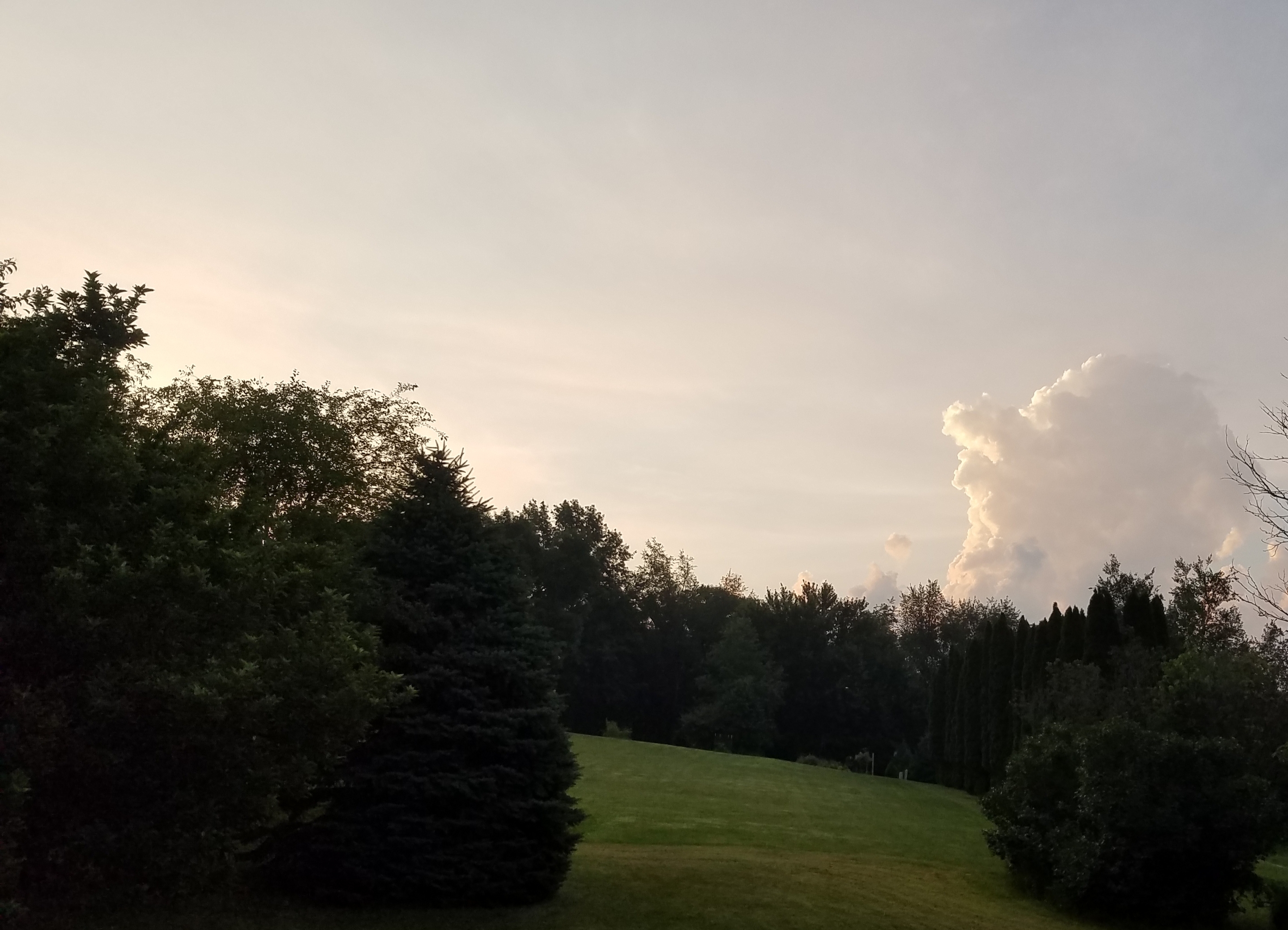
Sunrise, July 9, 2020

When I think of politics I think of the Kennedys. That is, I did. I’m over it now. This was first posted on Dec. 15, 2012. It’s been significantly edited.

The end of year holidays are something I associate with the Kennedy family. Our family wasn’t of the Kennedy clan, yet didn’t seem that far removed. My framework was formed while being Kennedy-like.

Our family moved into a new home the summer after I finished first grade. It was an American Foursquare built in the late 19th Century in Northwest Davenport. By the time of the 1960 general election we were beginning to have a sense of neighborhood and local culture.

Father worked diligently to organize our neighborhood and elect John F. Kennedy as president. I still have copies of the mimeographed 8-1/2 by 14 inch sheets he used, with generic city blocks marked in purple ink, waiting to be completed with the names of voters. Father was from Virginia, the part where politics is a daily passion. His political engagement was infectious. His work for the Kennedy campaign expanded to include neighborhoods besides ours where he took the purple sheets and helped organize the effort.

When JFK won the election, it was a big deal for our family. The oral history is Dad and Mom were invited to the inauguration. We followed the Kennedy Administration, as much as grade schoolers could. In that context my association of the holidays with the Kennedys was formed.

We understood patriarch Joe Kennedy had earned enough money for his children to be free of financial worry to devote their time to public service. We also knew we would not have any such freedom. We were a mostly Catholic family on my mother’s side, so we looked on the Kennedy lifestyle, particularly their family life in Hyannis Port, Massachusetts as framed through press coverage, as something to emulate as best we could. Perhaps it was a dim reflection, but it was there.

Mostly, life centered around school, family, neighborhood friends and television. We weren’t poor, but we weren’t rich either. We lived close to the means of production. We played touch football in the back yard, like the Kennedys did.

Television was a strong influence. After finishing our homework and outdoor play, we watched news, variety, westerns, and comedy programs, almost daily. In the 1960s television was viewed as a vast wasteland by FCC Chairman Newton Minow, and maybe it was. Life was not always about participating in the nascent consumer society.

That is where the connection between the Kennedys and the holidays came in. At Christmas, from Advent through the Epiphany, we set aside much of mass culture and re-enacted family behavior that was our connection to society. To some extent we emulated what we heard about the Kennedys: siblings in a large family looking after each other, and participating in a life in retreat from the broad concerns of society, at least for a while. For us, there would be discussions, meals and home entertainment. Family members would come in and out of our home with our lives intersecting with others during visits at our home and at theirs. We would attend midnight Mass on Christmas eve.

It was a tribal time of friends and family, removed from external pressures, and a dim echo of what we believed society should be. I look back on those times with the nostalgia only separation in time can create.

What I know now, and only am beginning to realize, is that the bubble of that family life was popped when Father died in 1969. It would never be the same. Whatever cultural resonances of a faux Kennedy lifestyle remained after that, proved to be vaporous in the long run.

I caucused for Ted Kennedy in 1980, and remember his concession speech at the Democratic National Convention. I heard Robert F. Kennedy Jr. speak in Iowa City one recent evening. Throughout my life, I continued to touch them, or thought I did, even if I realized there had been no Camelot. I read the newspaper article about them selling the Palm Beach home in 1995 and the disputes over the final disposition of the compound at Hyannis Port after Ted Kennedy’s death in 2009. As time passes, the Kennedys seem less relevant.

What I realize now is life has always been mine to live. I have been over the Kennedys for a long time.

Categories
Living in Society Social Commentary Writing

Being Racist

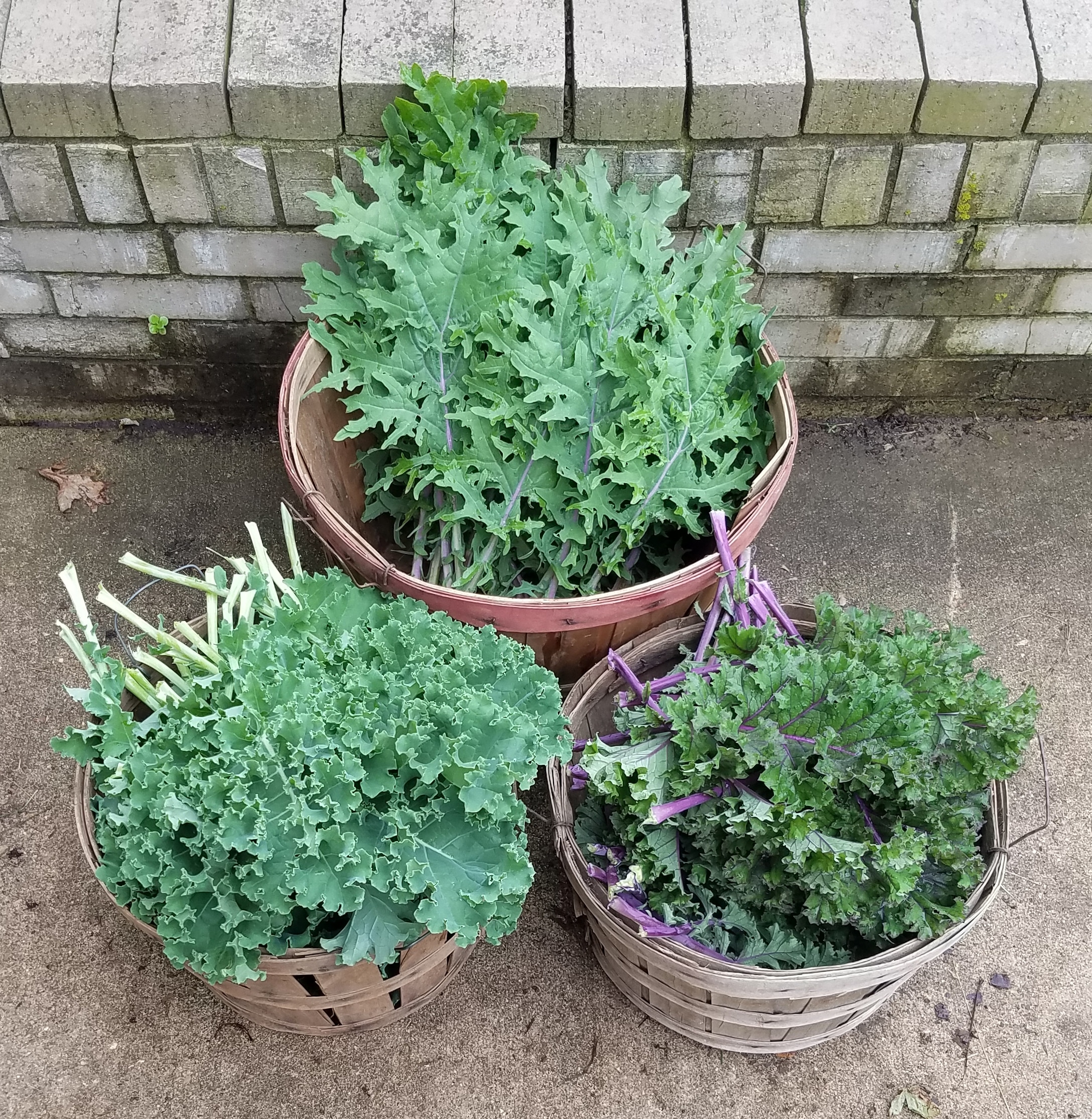
First big kale harvest, Spring 2020

We have to look at ourselves in the mirror and consider whether we are racist. It’s not easy to do in the best of circumstances.

Dictionaries consistently define a racist as someone who has a notion that one’s own ethnic stock or genetic makeup is superior.

Which is it, ethnicity or genetics that defines race?

The authority of dictionaries has diminished in society. There are few rules in the living language except we be understood. Haters gonna hate, as Taylor Swift noted, regardless what’s in the dictionary.

I was confronted with the idea there were different races as a child. It was and remains for me an idea. I knew I was different, but superior? I don’t think so. Diversity in the neighborhood in which I grew up meant defining whether one’s family was of German or Irish descent. Racism as we know it today, as in the Black Lives Matter Movement, wasn’t an obvious issue. We were shielded from racism and those blacks we encountered were in a context of their relationship with our father: plantation workers in Florida, co-workers at the meat packing plant, and fellow union members.

What are the genetic characteristics that define race? What cultural behaviors are specific to race? Should we care about race? These are the questions I’m asking while witnessing the resurgence of protests over race after the viral video of George Floyd’s murder.

Our family visited the Gettysburg battlefield when I was a grader. Which side of the Civil War was I on? I felt I had to be on a side. My maternal ancestors immigrated after the war and my paternal ones from Virginia fought on both sides. After a moving childhood visit to the battlefields I adopted the Confederacy as my own history and bought a Confederate flag in the museum gift shop.

We cannot disown our history even if we want or if our current values discredit the peculiar institution of 19th Century chattel slavery in the U.S. southern states. Thanks to the combined work of my fourth grade teacher and my mother I came to realize the racism inherent in embrace of the Confederacy, and that it was wrong. Before long, with their encouragement, I sought and found my own history.

I first encountered systemic racism while serving in the military. I paid little heed to the naming of military bases after notable racists Andrew Jackson and Henry Lewis Benning, where I trained in the U.S. Army. I was stationed at Robert E. Lee Barracks in Mainz, Germany. It was named after the World War II veteran with the same name as the commander of the Northern Army of Virginia. Racism in the military was about more than names.

Daily work was integrated, which is to say as an Army officer I paid little attention to race when giving orders or following them. All but one officer in the battalion was white and the lone black lieutenant and his family lived in a twelfth century castle off base. I visited them a couple times while we served together. In conversations, I came to understand he was held to a different standard because he was black.

When we lived in Indiana I managed an operation that recruited thousands of truck drivers. I became familiar with parts of Chicago and the suburbs because of this work. I hired the first black recruiter the company had and remember the surprised faces when we returned to the corporate office for a meeting. Race made no difference in this hire. I just wanted someone who could do the job.

We rejected an applicant from our new driver orientation and he threatened to call Bobby Rush because he felt we were discriminating against him because he was black. The claim bordered the ridiculous because more than half the group in orientation was black or Hispanic. I don’t recall why we rejected him but I said I’d like to have that conversation and provided my number. Several weeks later we received a letter from Rush’s office and I replied. That was the end of it.

That protesters in our county seat chose to shut down Interstate 80 in response to the murder of George Floyd was predictable, expected, and ineffective. It’s something, yet I’m not sure exactly what. In 1971 I was part of a group of protesters that shut down Interstate 80 near the Dubuque Street exit in response to the Vietnam War. We built a bonfire in the Eastbound lane feeling we had to do something to disrupt business as usual. What more usual thing is there than traveling on an interstate highway? Law enforcement attempts to keep the interstate open, although there was a report one of the Coralville exits was closed by them in anticipation of protests. Protesters have to do something to gain attention enough to create a fulcrum point for change. I support their actions and also believe there has to be a better way.

What does the Black Lives Matter Movement mean to me? In our rural subdivision the only time race comes to the surface is when it is scratched. If there is talk of a black family moving in neighbors assert property values will decline.What does one do with that? I point out to them the assertion is patently false and reject it. Most people here don’t scratch the surface of race to avoid such conversations.

If George Floyd’s murder was a turning point in how racism is viewed in the United States then some good will come of it once he is mourned dead and survivors heal. We must look ourselves in the mirror on racism. If we can’t then we probably are racist and don’t want to admit it. If so, Floyd becomes just another black man who died at the hands of police as white hegemony continues a while longer.

My religious education taught we are all equal in God’s eyes. That’s how it’s supposed to be in the United States. Yet slave owners sought to justify the peculiar institution using the same Bible I read today. In the end, we have to ask ourselves if we are racist, not because we seek an answer, but because in asking we open the possibility of a remedy to today’s long-standing problem. We seem so far from that now.

Categories
Work Life Writing

Writing About Work

Story Board

I began writing in grade school. The earliest remaining written document is a letter to my parents from YMCA Camp.

I reported having fun.

When reading those handwritten words, forgotten memories emerged. They reside in my brain like fossilized footprints from yesterday’s muddy garden. Such memories mean something. I can say with some certainty camp was fun.

When writing about worklife I seek several things. Partly I want to understand my own work history. It is more than a small chore to write a timeline of a life’s main events. Seeking that will aid telling my story.

More than a timeline I seek to understand why I worked and how it affected me. When I took my first job as a newspaper carrier the work was possible, something boys my age just did. I took a job in high school at a retail store called Turn-Style which was an entry into after school work life. It was possible and common among my classmates to have an after school job. Both of these early jobs funded activities that would have been less likely if I didn’t have income. The most significant activity Turn-Style funded was buying a used car and fuel to keep it going.

During the summer of 1971 I returned home from college. Like most of my male high school classmates I was able to find a summer job in industrial and manufacturing plants in the Quad-Cities. I landed at Oscar Mayer’s slaughterhouse working on the maintenance crew. It was dirty and hard work but in three months I made enough (at $4.04 per hour) to pay the sophomore year college expenses my scholarship didn’t cover. I learned how to clean a lard rendering tank among other valued skills.

After college the employment situation in Davenport seemed dire. Globalization was beginning to take hold, with some jobs moving to Mexico or overseas. It impacted the community with layoffs and those easy to find manufacturing jobs were less easy to secure three years later. I also did not want to get caught up in being a “shoppie,” working a career in manufacturing.

I didn’t have high expectations but after working a couple of low-wage jobs to make ends meet I enlisted in the U.S. Army and was gone for four years. Because of the G.I. Bill, I attended graduate school and got my M.A. in 13 months without other paid work. There were no good or exciting job options in 1981 after graduation so I applied and went to work at the University of Iowa.

After meeting my future spouse at the university, and getting married in 1982, I took a job in transportation and logistics with CRST Inc. in March 1984. I spent more than 25 years doing that type of work. I earned enough money so Jacque could work at home until she was ready to enter the paid workforce again.

Beginning in July 2009, I retired from CRST Logistics with a sheet cake and going-away gifts to enter a period of low wage work. In all I logged 24 different jobs and work activities since then — some paid and some volunteer. There was a lot of diverse experience in all that, about which I’ve written in this blog. What I’m left with today is being a blogger, writer, gardener and human.

While frequent blog posts are an important part of my writing, there is more. The coronavirus pandemic has been an opportunity to consider my writing and develop other projects including a memoir. I’m not finished working yet the number of paid jobs is close to zero as we enter the third month of the pandemic. It provides a perspective that might not have been otherwise possible.

As the sun rises on a forecast dry day I plan to work in the garden planting tomatoes, peppers and cucumbers. While I do, I will consider what’s next for me and the meaning of my years in the workplace. The pandemic isolation brings this into focus.

I hope what I write next is as meaningful as that letter to my parents written so many years ago. If it isn’t, at least we’ll have vegetables.

Categories
Work Life Writing

A 1960s Newspaper Boy

M.L. Parker Department Store

My first job in grade school was as a paper boy for the Des Moines Register.

I wanted a paper route. It was what boys my age did. After discussing it with Mother, she arranged the job by calling newspaper circulation desks. The Register route was available.

It was a long, morning route because the Register wasn’t as widely circulated as our home town newspaper, the Times-Democrat. I could ride my bicycle and get the papers delivered with plenty of time to get ready for school.

Before long, I changed to an afternoon Times-Democrat route located on Marquette Street between West Central Park and Locust Street. The Times-Democrat had morning and evening editions at the time. Less walking, more deliveries, and more money for me. I kept the route until high school when I was told it was time paper boys moved on to other things. Having a little money, maybe a couple of bucks a week, made a difference in my life and in the range of activities possible in grade school.

I made weekly collections from subscribers on Fridays. Some subscribers were the worst. They were never home on Friday and when I finally found them on other days they would deny they owed for multiple weeks. My collection pages had a coupon that indicated each week that was due so I knew where each account stood. I gave customers the coupon for a week after they paid. When they got four weeks behind and didn’t pay I called the newspaper to cut them off. My supervisor never wanted to do it because the newspaper had subscription targets. Statistically, the majority of my customers were nice and paid on time. However I do remember the deadbeats. In retrospect, my margins sucked but there was enough money to satisfy my nascent financial needs.

On Saturdays I paid my bill for the bundles of papers dropped on the corner of Marquette and Lombard Streets. I took a city bus from nearby Mercy Hospital to what was then a thriving downtown Davenport. I spent parts of every Saturday morning downtown, beginning at the newspaper office on East Third Street.

One of my favorite downtown places was the automat at the M.L. Parker Department Store where I occasionally bought a pre-made hamburger and warmed it under an infrared light bulb. We didn’t have such a heating device at home. I stopped at W.T. Grant, F.W. Woolworth and occasionally went to Petersen Harned Von Maur, inconveniently located across a busy Second Street. I also stopped at Louis Hanssen Hardware Store where they had a centralized cashier operation connected to the sales floor by a small trolley system.  There was a coin shop which was almost never open as early as I was downtown. The idea coins that passed through my hands on the paper route were worth more than face value was fascinating.

In 1964 a friend and I rode the bus downtown. After paying my bill we went to the local Democratic party office and stuffed envelopes for Lyndon Johnson’s presidential campaign. Our motivation was to trade labor for an LBJ for the USA button. After finishing with the Democrats we walked a couple of doors down to the Republican party office and did the same thing for a Goldwater button. The idea our families would vote Goldwater for president was ridiculous. Father had worked hard to organize for JFK and was doing the same for LBJ. It felt weird being in the Republican campaign office but I brought home a button which had “Au H2O” printed on it anyway.

My male schoolmates were also shoplifters at the downtown department stores. Having a steady income from my paper route, I never shoplifted. From time to time I met up with my mates at one of the movie theaters for a matinee. They compared the results of their thievery that morning. For a while they stole bottles of men’s cologne which they tried to sell me. What would I do with cologne? Retail managers wised up to what was going on and secured the products in display cases. That apparently ended such thievery.

My interest in meeting my friends was to see movies at a reduced price of 35 cents. Most of what we saw was related to World War II: The Longest Day, The Great Escape, The Bridge on the River Kwai, and others.  When the cost of a matinee went up to 50 cents, I felt we were being gouged.

One time we saw an ad for a movie in Rock Island about the Batman. Someone had compiled all 15 episodes of a Batman serial made in 1943 by Columbia Pictures. The Batman television show became a popular topic on the school playground, so we wanted to see the serials. We took the bus downtown and walked across the Centennial Bridge for the matinee. I told Mom what we were doing so she wouldn’t be surprised when I was gone for so long. I remember it was a very long walk across the Mississippi River although worth it because I now knew something others didn’t about the Batman.

In the mid-1960s working as a newspaper carrier expanded my horizons. I got to see how my customers lived and had a chance to explore a world outside the confines of our neighborhood. I found there was a broader world where everyone did not share the same values we did at home.

I felt the relationship with my manager was good, although my daily work was disconnected from him. I was always the last to know about sales promotions and newspaper policy that pertained to me. It led to an attitude that I would do my job as I saw best without worries about my supervisor or whether I was right or wrong in what I did. That proved to be a defining aspect of my character at the beginning of my work life. Being able to work on my own without regular, direct supervision became part of who I was and remained so for the duration of my work life.

My first work experience was positive and that made a difference as I progressed through life. Adapting to work in a positive manner was an important part of the working class home in which I came up. It prepared me for the challenges of a career yet to come.

Categories
Living in Society Social Commentary Work Life Writing

New Chances after a Pandemic

Apple blossoms ready for pollination.

It has been two months since the Iowa State Hygienic Laboratory in Coralville reported the first positive test results for COVID-19, the disease caused by the coronavirus.

We look forward to returning to a semblance of our pre-pandemic lives. We also know our lives won’t be the same as the pandemic could continue until there is a cure a year or two from now.

I could have continued to work at the home, farm and auto supply store. Because of my age I chose a voluntary COVID-19 leave of absence, then retired after the first thirty days ended. Not everyone has these choices.

One hopes a better society emerges from the chaos the virus and its inseparable economic depression have wrought. Our president’s reaction to the pandemic cost us the strong economy he inherited and caused preventable mass death. It is delusional to believe informed people will accept his work and re-elect him for another four years. We have to work to make sure someone else, presumably Joe Biden, is elected to stop the destruction caused by the current response to the pandemic.

There is also more to life than politics.

In a series of posts I plan to write about the worklife I have known and how it may change after the pandemic. There is a clear delineation of my personal work timeline into several periods.

When I began outside work in grade school as a newspaper carrier there were expectations of knowing what types of jobs were available and then securing them. After college graduation the workplace had changed, offering few positions in which I found interest. This led to frustration and then entering the military.

After returning from overseas I went to graduate school. When finished I found even less desirable opportunity than five years previously. When I eventually found work in the transportation and logistics field it was a compromise between what I wanted to do and producing enough income to support our young family. It was never the best, but it accomplished a degree of financial security.

When I took early retirement in 2009 I wasn’t sure what the future would hold. I used part of our retirement savings and entered a series of low-paying jobs that helped pay bills but did little else to advance us financially. I’ve written often about this and hope to bring a new perspective to it. During and after the pandemic there will be another phase of worklife. In some ways it is a journey home to being the person I was when this all began.

The president and governor say it’s time to reopen the economy and our lives. From my perch in Big Grove Township the economy never fully closed and the first wave of the pandemic is not finished. To understand how we can restructure our lives in society we must understand from where we are coming. That’s the hope of the next series of posts.

Categories
Home Life Writing

Don’t Cook Tonight

Great Grandmother in her garden.

When I was a grader, Mother would send me to the corner grocery store to secure provisions for the evening meal.

We had a corner grocery store. It was a block and a half away from home. There were no supermarkets within walking distance.

I don’t recall its name. A family owned it and the husband was the butcher. When it closed, run out of business by the multi-location Geifman Food Store that situated a block and a half away, they moved to the west end of town where the butcher was murdered in his store.

I was a paper boy for the Times-Democrat. The hyphenated name is from a 1964 merger into what eventually became part of Lee Enterprises and is now the Quad-City Times. I delivered the evening edition after school and the corner grocery was near the end of my route. At that time paper boys collected subscriptions directly from customers. When I finished weekly collections I’d stop at the store to buy a package of baseball cards or a candy bar. I remember a six-pack of 10 ounce bottles of Pepsi sold for 60 cents, the lesser known sodas bottled a few blocks away sold for 54 cents. Mother discouraged us from drinking soda.

The corner grocery store was an important part of our family life. Then it wasn’t.

Grandmother grew up on a farm and knew how to cook. She knew where food came from and how to prepare a live chicken. In our early years she lived near us, next door when I was a toddler, upstairs when I was in the first grade. After that she was a regular guest for Sunday dinners and special occasions like Easter when she checked in with her grandchildren and helped mom in the kitchen.

In the 1960s we began to eat more food prepared outside our home. Mom also began experimenting with different food preparations. We developed a taste for tacos and I recall the corner grocery didn’t carry some Mexican ingredients we liked, requiring me to walk to nearby Geifman’s. It was a sign of the end of the corner store.

In 1966 Joe Whitty moved to Davenport and ended up living with his young family in a rental the second house north from ours. It was across the street from a family that owned the dairy. He worked at the nearby hospital where I had been born, first as a baker, then as dietary director. He went on to establish a chain of pizza and ice cream stores. One of the ice cream stores ended up on the lot where the corner grocery store had been, although after I left Davenport.

On the other side of the church where I was baptized, about two blocks away from home and next to the Geifman Food Store, was a restaurant called Chicken Delight. They had a radio jingle, “Don’t cook tonight, call Chicken Delight.” The chain was founded in Illinois in 1952 and grew to have more than 1,000 locations. It was a take out and delivery only place and I don’t recall eating their chicken during the eleven years I lived at home there. Without the dining room we had little interest. If we had their product at home, I have no memory of it.

Chicken Delight was not known for its quality as each store followed their own cooking process, sometimes with their own equipment. That’s unlike the McDonald’s franchises which grew to prominence in the 1960s. McDonald’s prided itself on consistent quality in all their stores. They even had a “Hamburger University” near Chicago to train managers in how to operate with consistent results. Today there are not many Chicken Delight stores and most that remain are located in Canada. The women in our house knew how to make chicken and the family consensus was ours was better. Eventually one of the former neighbor’s pizza restaurants located in the Chicken Delight space.

That’s not to say we didn’t dine out in the 1960s, we did. We favored local, family run restaurants like Riefe’s Family Restaurant and Bell Eat Shop. Our parents knew both families. When McDonald’s built a restaurant on Brady Street we drove over there as a family once in a while. Their burgers and fries were different from Mother’s. They were cheap too. We ate in the car. We also drove to the A&W Root Beer stand where servers brought trays of food and drinks that hung on our car windows.  The rise of automobile culture made home delivery pizza popular and inexpensive.

Grandmother would take us to Bishop’s Buffet on special occasions. We enjoyed being able to pick what we wanted from a generous selection of items like Mom and Grandmother made at home. In some ways it was a form of nostalgia. Grandmother insisted on paying the bill. These family events were important to her.

That’s the range of our 1960s dining experience outside home. A lot has changed since then. When Grandmother was born in the 19th Century people cooked most meals at home or took a dish to a potluck for weddings, funerals or other occasions where they ate what others had prepared. Prior to the current pandemic food prepared outside home comprised more than half of American diets according to the USDA. When the coronavirus recedes I expect there will be a rebound in restaurant eating.

It takes work to remember these things. Memories are not always accurate. What is important now may not have been important then. In the end, it is up to the author to research and present each story leaning on known facts. We must resist the temptation to tell a story only because the narrative flows or with ideological intent. It is hard to listen to one’s own voice and ignore what others may have experienced or have to say about something. We each own our memories even though there are shared experiences. We must be true to ourselves.

I’d like to be writing more pieces like this. I hope I will.

Categories
Work Life

Retirement in the Coronavirus Pandemic

Detail of Garden Plot #4

I decided not to return to the home, farm and auto supply store after my voluntary COVID-19 leave of absence.

Whatever the cultural resonance of the word “retirement,” I’ll take my leave from the workforce without fanfare, without the customary sheet cake, and fade into the background of our life in Big Grove Township.

It’s been a good run. Whatever uncertainty lies ahead, I’m fortified by decades of experience in business and in living — the latter making the difference.

More than anything, our Social Security pensions make retirement possible. I made my first contribution to Social Security in 1968, thinking retirement was in the distant future. All along the way, in every job I held, I paid in. I paid in on my last paycheck on March 17. Of all the government programs that exist, Social Security, and its methodology of enabling even the lowest paid worker to save for retirement has been there. I hope it endures not only for my lifetime but for every American into a future as distant from today as is the teenage boy I was when I started.

What’s next? Subscribe to this blog or follow me on Twitter, LinkedIn or Instagram to find out.