The culprit is a long, engaging worklife. The crime? Diminished creative output.
Early on I realized, with a few exceptions, creative endeavor doesn’t pay. To support it I took work… for over 50 years. We raised a daughter, built a home, worked outside home, and lived an often exhausting life.
Older, I’m not sure I’m much wiser. I’m worn down and less productive than I hoped to be. Yet the creative impulse persists. I hope to write my way out of the current situation into new energy and creativity.
I haven’t given up.
The wellspring of creativity has been several things, most important among them is meeting and engaging with new people. If we are to be successful as artists we need an audience. I’ve been lucky to find one on this blog and in our community. Relationships with people are important.
Here’s my problem. For too many years reading and writing has been a way of processing society and the world around me. Such processing engaged me and produced two results: a good quantity of writing and distraction from more specific creative output. At age 66 there’s no time for distraction so I must renew focus on writing.
Like the compost bin in the garden I keep throwing life experiences in, hoping to get to something elemental and nourishing. It’s time to spread compost on the garden plots and see what grows. No doubt there will be some weeds… and hopefully a flower or two… and vegetables for nourishment.
Life, its beauty and ugliness, is all around us. An artist must be able to perceive it, process and make something useful of it. On a summer Tuesday that’s what I’m hoping to do.
It may seem late yet I declared the garden planted on Friday.
We’ve already had a bumper crop of vegetables and we’re not even started with tomatoes, eggplant, peppers, green beans and more. There will always be garden work to do but for now it’s planted.
Time to turn to other things.
What I mean is between now and Aug 4, when orchard work begins, there is writing, household repairs and cleaning, and loads of work to improve our home life. At some point I switched from being a consumer to a doer and that makes the difference in my mid-sixties. I just stay home and do.
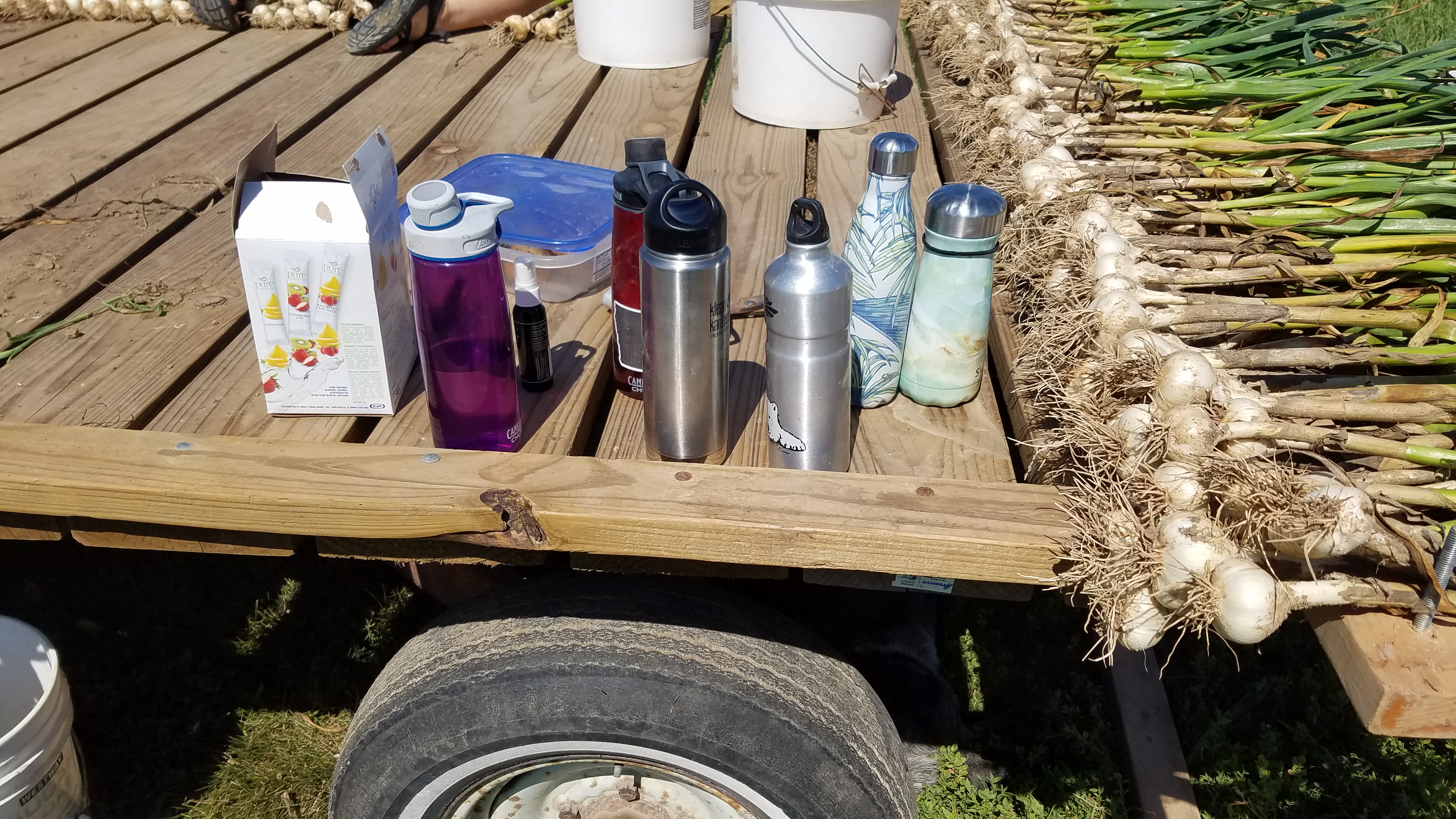
Water Bottles
Politics plays a role in current affairs and it’s much different than it was. My focus is to understand the complex world in which we live and work to make a positive impact. My themes haven’t changed (environment, social justice, economic survival, good governance) although my understanding of what needs doing has. During the re-election of George W. Bush I re-activated in politics. Each succeeding campaign was both learning and engagement. After seven campaigns, I enter my eighth with a deeper understanding of the role social networks play in determining winners and losers. I’m not referring to Facebook, Instagram and Twitter here, but broader social movements and the momentum they bring to an election.
The first Obama campaign, with its demographics analysis and targeted voter lists seems like ancient history. What Obama did can’t be replicated, even if we wanted. To better understand the electorate, we must knock on every door, hear every voter, and determine how to fix the broken politics endemic to our lives. Creativity and networking are important. We don’t know if what’s broken can be fixed in a generation. If we don’t start now, it may never be fixed.
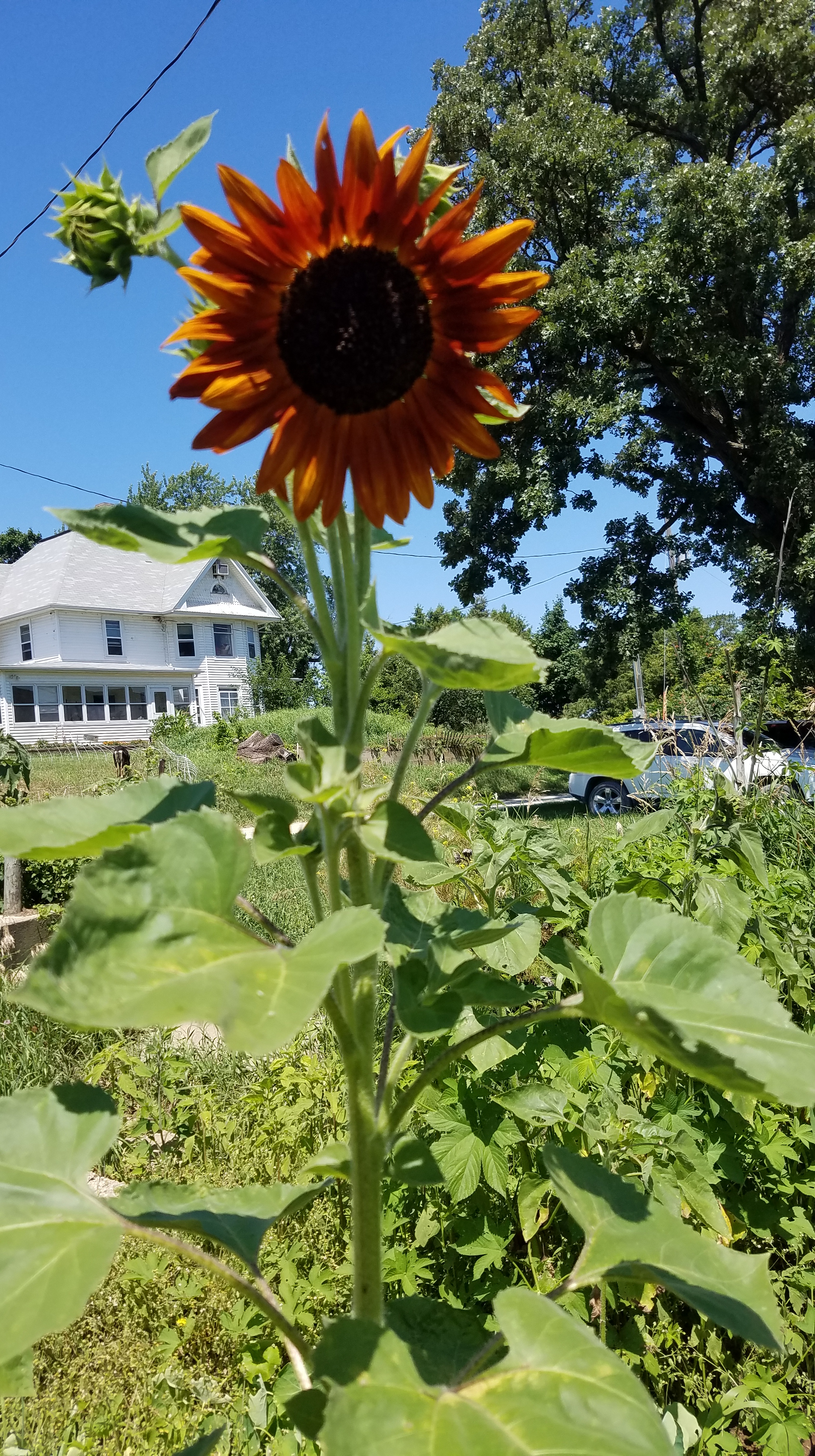
Flower at the Farm
Politics is not everything. After only three hours at yesterday’s garlic harvest at the farm I felt a bit dizzy, presumably because of hard work in the sun. It was a temperate day, nonetheless, I played it safe and called it early. My point is I’m not getting any younger. Working a six or eight hour shift in the sun doesn’t work as well as it did a few years ago. Working smart is replacing working harder.
The rest of the year goes something like this. July is a month to work at home: advance my writing projects, get space at home to be more livable, and work to get the yard into better shape. August through October is work at the orchard. This year I may be taking on additional responsibilities, but for sure I’ll be there weekends and on Friday Family nights. November and December will be focused on writing. While this is going on, I’ll continue to work at the home, farm and auto supply store two days a week. Every dime of income has a place to be used at this point.
Declarations like mine about the garden are ephemeral. What matters more is a process of continual improvement in which life goes on as best we can make it until the final curtain falls. In the meanwhile, we expect there will be garden vegetables to eat.
I worked as an admissions clerk at the University of Iowa Dental Clinic after graduate school. We saw patients from all around Iowa — wealthy patients with private insurance, indigents with limited means, and everyone in between. Anyone who came to my desk was accepted for treatment. What I knew then seems poised for change.
Cuts to regents university budgets combined with an Iowa Medicaid administrative disaster led the university to cut off new dental patients on Iowa Medicaid because of difficulty collecting fees and complicated new rules.
“The dispute pits state administrators at the university against their counterparts at the Iowa Department of Human Services,” Des Moines Register reporter Tony Leys wrote last Saturday. “It is the latest skirmish in the bitter controversy over whether Iowa should have private companies run its $5 billion Medicaid program.”
Over 600,000 poor and disabled Iowans are eligible for Medicaid and most adults are covered by its “Dental Wellness Plan,” according to the article. Existing patients will continue to receive treatment. People with pain or swelling will receive emergency treatment at the clinic. As for the rest, the future is uncertain. Read Leys’ article for more details.
The University of Iowa Dental School likely changed since I worked there. What hasn’t changed is Iowa’s poor and indigent populations need our help. Under Republican governance the state is creating obstacles to limited, reasonable dental care offered under Medicaid.
Governor Kim Reynolds is looking into the situation, according to the article. Since she’s all-in on Medicaid privatization, it may be a case of what you see is what you get.
Last Friday the Iowa Supreme Court overturned the 2017 law requiring a 72-hour waiting period before a woman could have an abortion.
Here’s the money quote from Chief Justice Mark Cady, writing for the majority:
“The state’s capacity to legislate pursuant to its own moral scruples is necessarily curbed by the constitution. The state may pick a side, but in doing so, it may not trespass upon the fundamental rights of the people.”
There are lawyers among Republicans who crafted this law. Either their leadership was grossly negligent in writing it or they just don’t care if they impose their morality on Iowans through legislation.
Republicans are bad at law making. They’re crazy. But are they crazy like a fox?
Associated Press posted an article about the ruling last Saturday. In it is exposition about the so-called conservative strategy of getting Roe v. Wade overturned, which some say is the endgame of Iowa’s bad laws related to a woman’s right to choose.
Chuck Hurley, an attorney for the Christian conservative group The Family Leader said the ruling makes it even more important to get the fetal heartbeat law passed by Iowa lawmakers earlier this year before the U.S. Supreme Court. It bans abortions once a fetus’ heartbeat is detected, usually around six weeks of pregnancy.
Hurley and others believe it’s their best chance at reversing Roe v. Wade but the legal challenges are based on the Iowa Constitution and most likely will go again to the Iowa Supreme Court rather than the federal court.
“Americans know that when a baby’s heart is beating, she’s alive, but our state judges aren’t willing to protect her life,” Hurley said. “That’s why we need the U.S. Supreme Court to hear this case.”
Will this strategy work? I don’t know. Regardless, the 45th president will pick a replacement for Associate Justice Anthony Kennedy, and may also pick them for Associate Justices Stephen Breyer (79) and Ruth Bader Ginsburg (85) should they die or retire while he is in office. People like the Federalist Society’s Leonard Leo have coached the president in how to approach Supreme Court nominations so as to dodge the gorilla Roe v. Wade represents. If the nomination and confirmation of Associate Justice Neil Gorsuch is an example, the president will be adept at getting his picks to the high court. Cynics among us say regardless of the merits of the case, by packing the bench with conservatives Trump will midwife the overturn of Roe v. Wade. The unanswered question is to whom do Supreme Court justices owe fealty?
Last Friday was a good day for Iowans’ constitutional rights. It gave hope all is not lost in the Hawkeye State. It could be a bellwether of good things in November.
Beginning Monday, I’ll be covering the editor’s desk for Trish Nelson at Blog for Iowa for the month of July.
Everyone needs a vacation and Trish works harder and more persistently than most to get a progressive message up every weekday.
That means a lot of writing for me. It also means I get better with the work. I’m looking forward to the renewal.
With work at the farms finished and the home, farm and auto supply store down to two days per week, There is more time for writing.
For today, it’s home repairs, cleaning and making the first batch of dill pickles with this morning’s harvest. It is expected to be a full day and for that I’m thankful.
Clouds broke while I watched it rain through the west-facing garage door. It was a slow, steady, gentle and soaking rain of the kind remembered from childhood.
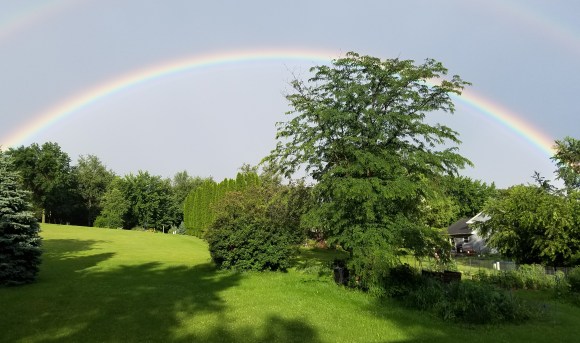
Realizing there might be a rainbow I rushed upstairs and looked out an east-facing window. I saw a double rainbow framing the garden plots and our back yard.
The colors were as intense as I remember ever seeing. A sign the shit-storm of American politics would eventually end and our lives might heal.
Earlier I’d been on the roof cleaning gutters. A tree branch had blocked one of them, collecting leaves and impeding water flow. The view of the nearby lake was obscured by trees and vegetation that had grown up since we moved here. In the beginning there had been a clear view of the lake from the roof peak. We, people and plants, are older now.
Refraction of light through rain is simple and powerful physics. Outside quotidian affairs of which lives are mostly made, a rainbow brings hope. For a few fleeting moments we marvel at the colors and reflect upon the role rain and recovery can play in our lives. We notice.
Rain clears the air and washes away dust created by simple lives. On days like that, a better life seems possible. We weathered the storm and that may be enough.
Beginning on Feb. 25, and 862 trays of soil blocks later, my 2018 farm work season ended today at Sundog Farm. I finished at Wild Woods Farm on Friday.
More than anything, farm work has been time with young people — doing the work and talking about crops, challenges, and everything else.
In my sixth year of soil blocking I kept up physically. I plan to do it again next year if able.
Now to take a break from farming until returning to Wilson’s Orchard for the fall season.
This will be the first summer in a long time we haven’t taken a share from the CSAs. Our garden is big enough to provide most vegetables and I’m confident of the yield. What we can’t get at home I’ll secure elsewhere. Getting enough to eat is never a problem when working in a local food system.
Next on the practical agenda is home repairs and cleaning. There is never a shortage of work for home owners.
It’s also an opportunity to resume writing. Each time I rejoin the project I lose track of everything else. Hours and days pass and like a coal miner I follow the seam wherever it goes. There is a lot more reading, thinking and organizing than writing at this point. I’ve forgotten more than I know about my own life and it can’t be re-lived, merely touched through a gauze woven of memory.
I began addressing the chronology. I’m not sure that will be the presentation. As I delve into the volumes of writing and artifacts collected since college a thematic approach seems better. It would be cultural aspects of growing up, education, work life, how we developed an ecology of living as a family, and my path toward social responsibility. It will also focus on what readers may find interesting.
Writing is exhilarating at a time when the rest of the world seems weary and worn down. What a great way to spend the rest of this summer.
I was born in a hospital established in 1869 by the Sisters of Mercy on Marquette Street in Davenport, Iowa. Marquette was one of the first streets laid out by city founder Antoine Le Claire.
I attended Kindergarten at Thomas Jefferson Elementary school at 1027 Marquette Street, and in 1959 our family purchased an American four-square home at 2025 Marquette Street, a block and a half from my birthplace on top of the hill, a block from the church where my parents wed and I was baptized and confirmed.
My parents married at Holy Family Catholic Church on Fillmore Street. According to Mother it was a quickly arranged ceremony with her brother serving as best man directly from work with butcher’s blood on his clothes. There were no photos of the newlyweds or wedding party.
The Sisters of Mercy and Le Claire provided an ever present background to life in my home town. I remember visiting the cemetery on River Drive where 1873 cholera victims were buried in a mass grave. Sisters of Mercy had tended the sick in a makeshift hospital at a downtown warehouse. That there was a “downtown” is attributable in part to the grid of streets Le Claire laid out in the old part of the city. Antoine Le Claire’s grave marker is prominent near the entrance to Mount Calvary Cemetery where many of my family members are buried.
Davenport was home until the death of my father in 1969 when I left to attend university in Fall 1970. I returned to Davenport for visits, for a couple of summers during college, after returning from an extended trip to Europe upon getting my B.A. in English, and after military service. Davenport was never again like it seemed during my early years. We don’t often have such brutal delineation in our lives as when Father died in an industrial accident. The times I considered returning permanently didn’t last.
Davenport and my life there defined who I am. It was not just the grid of streets where things were measured in blocks in the benevolent presence of nuns.
My earliest defining moment was the day, at age 3-1/2, when a swing-set set up in the basement of our Madison Street home collapsed and injured my head. My parents were horrified. I remember the pool of blood on the basement floor, holding the thumb of the ambulance driver on the ride to the hospital where I had been born, taking ether dripped into a funnel to anesthetize me for the stitches to mend my gashed head. I am lucky to be alive.
What I learned and came to believe through the injury and recovery in the hospital was that in a city there is an infrastructure of knowledge and caring to support us when things happen. I watched the routines of the hospital staff, the doctor checking up on me, changing room mates and bed linen, daily visits from my parents and the handling of my propensity to get out of bed and walk around. This experience assured me that although we are vulnerable, we are not alone.
Over the years, Doctor Kuhl would examine the scar on my forehead and talk about my recovery when I visited him in his office. Today, I don’t think of the scar, and suspect most people don’t even notice it. What I do think about is that while we are not alone, we must be part of a society that helps protect those who are most vulnerable.
When very young, I made a withdrawal from the bank of social responsibility and now the debt needs repaying. Who I became in life was partly attributable to my parents, however the influence of the Sisters of Mercy in a home town laid out by Antoine Le Claire is undeniable. It is also inescapable.
~ From a draft of a personal memoir about living in Iowa.
Yesterday I made 4,944 soil blocks which were planted in winter share. Leeks, broccoli and the like. It took four hours.
While driving north on Highway One I nodded off for a brief moment. After realizing it I sat upright, glanced in the mirror and concentrated on staying awake.
It’s not like I didn’t get a full night’s sleep Thursday… I did.
The combination of sun and repetitive work may have worn me out.
After arriving home I walked the garden, checked seedlings for moisture level, took a shower, and crashed into a two-hour nap. It’s become a Friday pattern.
Then I remember it was not soil blocking that wore me out but the news of Anthony Bourdain’s suicide in France.
Bourdain was a celebrity I liked. I read Kitchen Confidential a number of years ago and watched him on Food Network. In many ways, he is what I’d like to be as a writer, although with less inebriation. How little we know about celebrities. His suicide makes no sense. It may never make sense.
A memorable episode from Bourdain’s television work was when he returned to Borneo and got a chest tattoo on camera. He appeared to be drunk and uncomfortable. In a later CNN interview he recounted the process was much more painful than expected. We already knew that from the video. A reality came through in much of Bourdain’s work — one of his making. That’s why I liked him. The ability to depict a reality is essential to creative endeavor. Bourdain and his crew were masters at what they did. He’s gone too soon and will be missed.
I brought home a bag of groceries from the farm — lettuce, sugar snap peas, garlic scapes, kohlrabi, spring onions and kale. After napping I washed lettuce for salads and stored it in the ice box until supper time. I’m not sure what else got done. Maybe nothing, or something… whatever.
A couple of weeks ago our association held a community cleanup.
We own a well, a wastewater treatment plant, two vacant lots, 25 acres of woods, roads, and sundry open spaces which require attention from time to time.
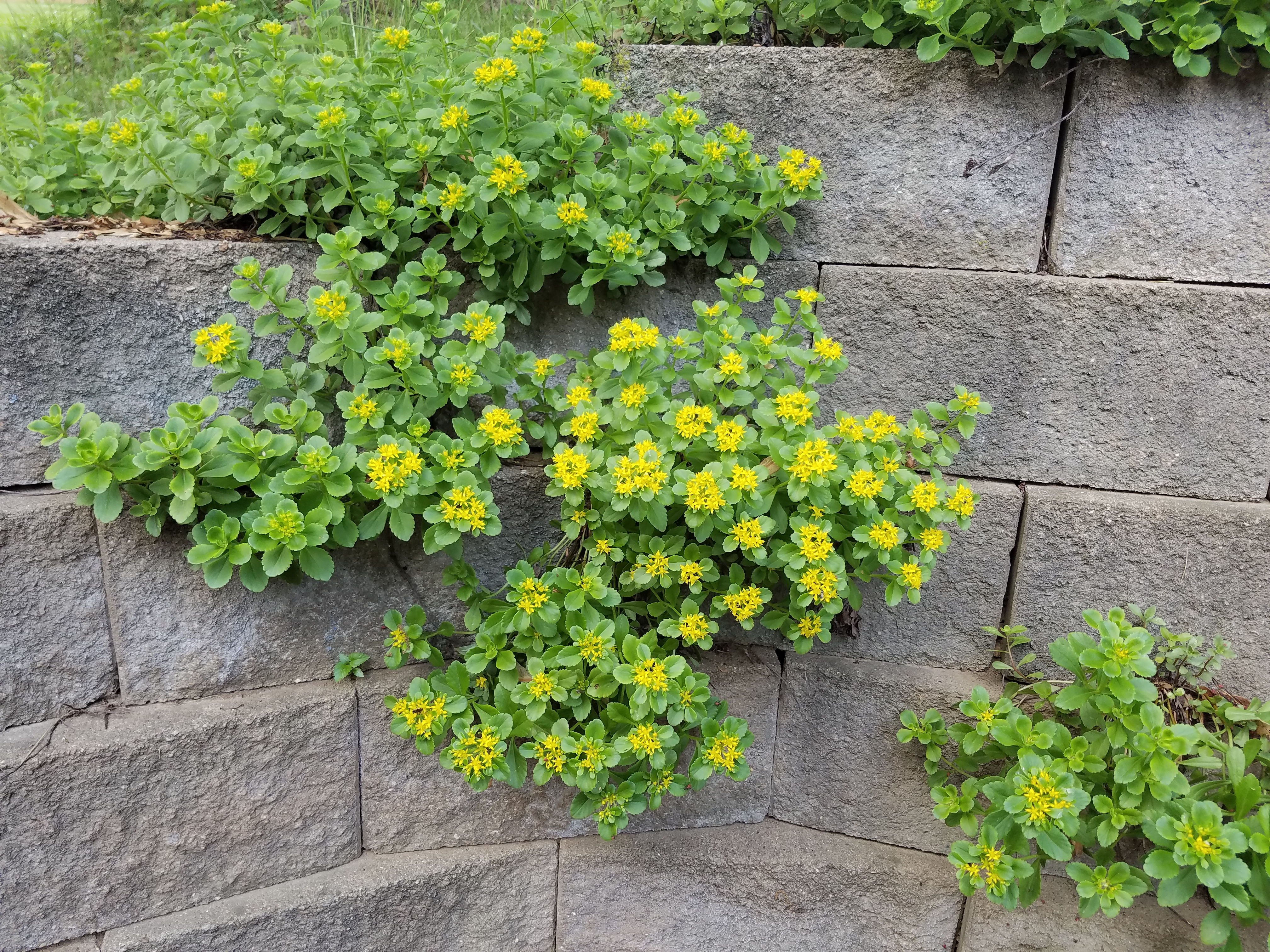
Teams policed up trash, landscaped near the well house, trimmed trees, inspected roads, and repaired a retaining wall around the community parking lot near access to the state park.
A group of us — men about my age — worked near an intersection where a tree blocked the view of oncoming traffic. We made quick work of the tree and piled the trimmed branches at the edge of the nearby parking lot. An adjacent retaining wall had fallen over and we couldn’t get the cement blocks to fit back into place. A retired contractor walked the short distance home and returned with a couple of paint scrapers to remove dirt built up along the joints of the blocks.
“It will only take an eighth of an inch,” he said.
We made short work of the wall and returned home for the rest of our day. As the African proverb says, “Many hands make light work.”
Our lives can be like these projects — they are our lives as we work them. We forget our origins and become crusted with habits accumulated in complex living to get by. To make a life work, we scrape off the residue of the past and make things fit in the present.
It rained yesterday and I went to town.
I recycled glass jars near the former grocery store on Dodge Street and drove into the county seat. En route I spotted a Charles Bukowski bumper sticker on a car not far from where John Irving lived and wrote during his early years.
There are always an abundance of construction detours in this UNESCO City of Literature. Parking in one of the ramps off Burlington, I walked past a construction site toward the jewelry store.
Wedding band in a pocket, I planned to resize it so it didn’t pinch and deform my ring finger more than it had. The jewelry store was gone… long gone from the look of it. I guess being a customer once every 36 years is not enough to sustain a local business. At first I didn’t know what to do.
I walked around the corner and found another jeweler. This one was established in 1854, 12 years after Iowa statehood. Staff was friendly and efficient. We determined one size larger would make the ring fit again. I’ll pick up the resized ring after farm work on Friday.
After waiting for an LTL carrier to back into the crowded construction site near the ramp I drove to Coralville.
This was my second shopping trip this month. The combination of adequate income, a worn out French press, and a wet, rainy day precipitated it. The fitting where the long rod of the plunger connected to the screen had become stripped with use. I researched on line and the Target store at the mall had what I wanted — something as close as possible to the French press I’d used for many years. It took me a while to locate it in the large box store.
I picked up a few items at other stores — necessities that fit our lives. I splurged on a bottle of Trader Joe’s organic ranch dressing. We usually make our own salad dressing but this is the season of spring salads and I craved something different. It cost $2.79. I visited the home, farm and auto supply store and bought three 16-quart bags of organic soil mix to transplant seedlings for further growth before planting. I appreciated the employee discount.
While rain kept me from gardening, the time was easy to fill with the habits of a creative life. We require a platform to create things the way my contractor friend kept tools to repair the retaining wall in his home workshop. Often that means fitting the bits and pieces of a seemingly random life into something stable and predictable — measured in fractions of an inch.

 I worked as an admissions clerk at the University of Iowa Dental Clinic after graduate school. We saw patients from all around Iowa — wealthy patients with private insurance, indigents with limited means, and everyone in between. Anyone who came to my desk was accepted for treatment. What I knew then seems poised for change.


 Journey Home
You must be logged in to post a comment.