Eventually I will snap out of this coronavirus funk.
For weather and productivity this was the best spring I remember. The garden is doing great and I have time to give it daily attention. Without work commitments each day is mine. I spend more time outside and at the state park. I’ve gotten my bicycle out and ridden for the first time in years. The weather has been drop-dead gorgeous. What is the matter with me?
I live in a broader society that is going to hell in a hand basket.
My response is stay positive, although negativity drags on my spirits. It takes a village to make a life and when we are each isolated because of the coronavirus, it’s tougher to do.
Here are some photos from early summer to cheer us up.
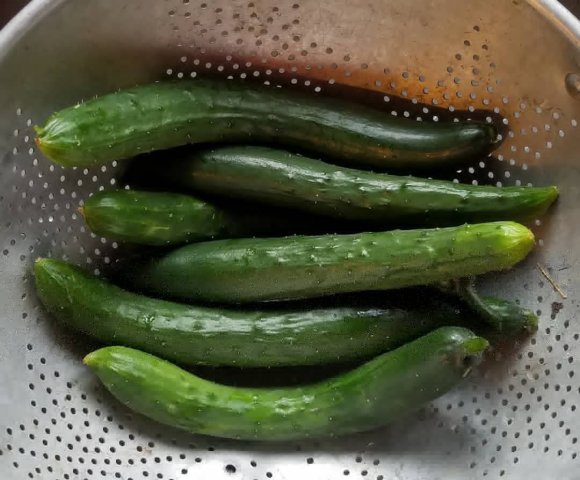
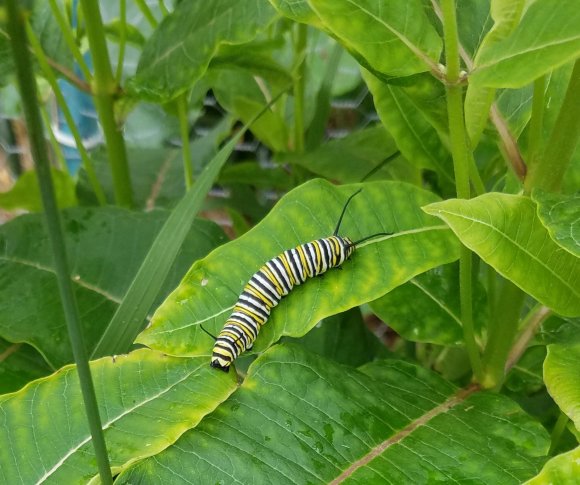
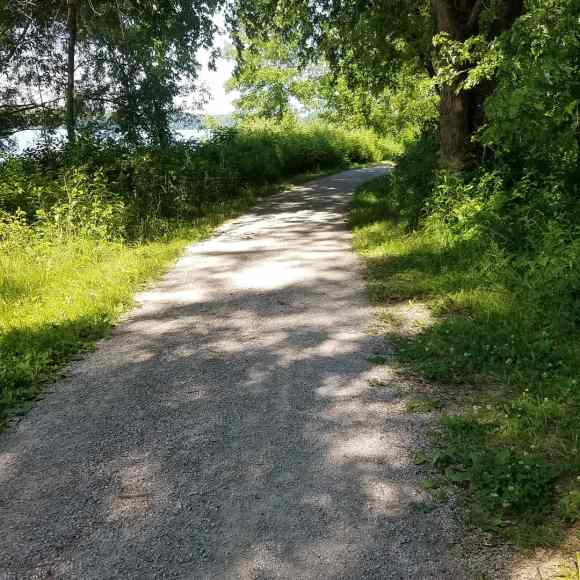
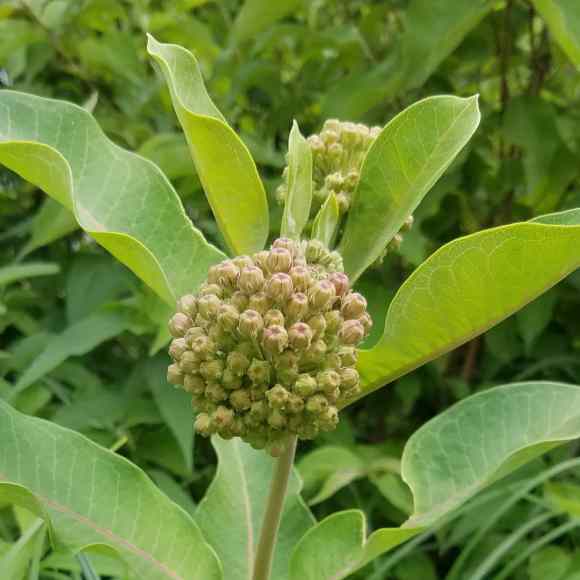
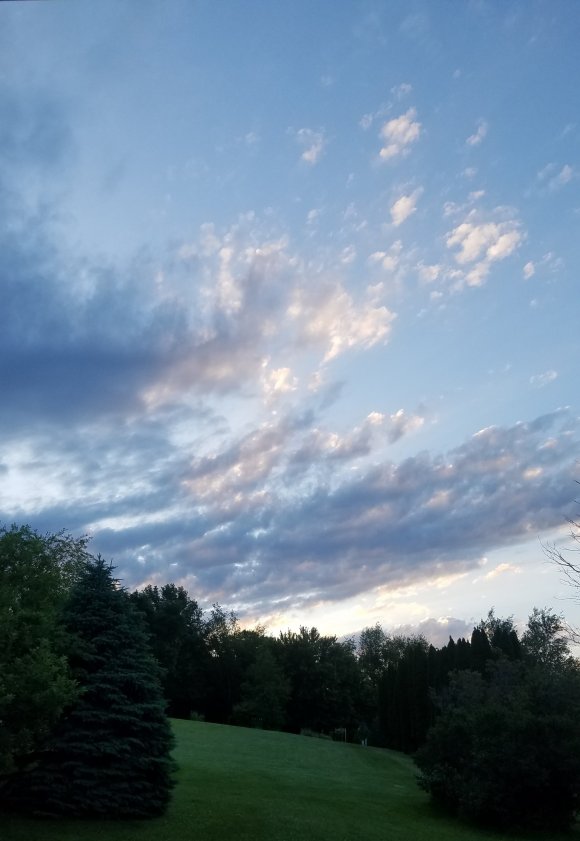
Tasty Jade CucumbersMonarch CaterpillarWild Section of Garlic, Milkweed, Iris and other plants.Sunrise above the garden, June 27, 2020.
Between showers I hope to accomplish some gardening tasks yet most of the day will be spent indoors: in the kitchen, garage, and at my work desk. There’s always something to do.
The Washington Post reported the White House is preparing for a fall resurgence of the coronavirus. My analysis: we couldn’t wear masks in public for 3 months so now we will have to wear them for a couple of years until a cure is identified and implemented.
The president held a campaign rally in Tulsa, Oklahoma on Saturday with 6,200 attendees. Some number of those were paid actors, campaign and White House staff, plainclothes security and the like. By the way, who pays people to attend a political rally?
In pages of commentary, few pointed out that people getting together for a big political rally during a pandemic would not be supported by those with common sense. The lower than expected turnout is evidence people continue to protect themselves first. Tomorrow he is holding another rally in Arizona where the number of diagnosed cases of COVID-19 spiked over the weekend. I don’t know much about who is running his campaign but these pandemic rallies can only reflect poorly on the president and raise the question, why is he holding them? There is no good answer.
I’m anxious to move on from writing about the coronavirus pandemic. The pandemic affected almost every part of my life and frames what I do going forward. All the same, the circle of people with whom I have contact is small. It includes my spouse, the farmer where I worked this spring, and neighbors I encounter at home and while trail walking. I tested negative for COVID-19 on June 16, but if I were positive it would be pretty easy to trace my contacts because they are so few. I don’t like the lack of broader contact with people.
Yesterday at the farm, Carmen came to the greenhouse and took a chair for a conversation while I worked. In the time before the coronavirus there would have been a seeding crew working alongside me. The greenhouse used to be a bustling place. With the pandemic it’s been just me with a couple of check ins from Carmen during my shift. The work gets done yet I yearn for the conversations with a variety of workers. We discussed a long list of farm and garden topics during my last shift of the season.
I spent one day in the field this year. My special project was learning to better grow peppers. Part of that was planting pepper seedlings with Carmen’s sister. The rest of the crew worked the same field and maintained social distancing while Maja and I worked and talked. It was a highlight of the spring.
The sound of rainwater falling in the drainpipe started. Maybe I won’t get out to the garden to check on broccoli, trim the tomatillo plants, and pick some greens. We’ll see how the day unfolds. Living in the actuality of it may be the best I can do on this stormy day.
In a couple of hours I’m heading to the farm for the last shift of soil blocking this year. After that the rest of the year is a blank slate.
I’ll be writing something on it, to be sure.
Yesterday was a quiet day in Big Grove Township. After working the garden, processing the harvest, exercising, and cooking dinner, I figured out how much of my pension would be left when the next check comes and donated to Democratic candidates Joe Biden, Theresa Greenfield and Rita Hart. A person’s gotta do something.
Some of the local grocery stores are recalling bagged lettuce because of contamination by the parasite Cyclospora. I’m picking up lettuce at the farm today, enough to hold us over until the next wave is ready in the garden. The crew takes appropriate precautions to ensure our food is safe, so I have little worry about what we eat when it comes from the farm.
2020 has been a hella way to transition. The coronavirus pandemic pushed me into retirement. With a pension that pays basic bills, I can test pilot a financial structure in which I no longer trade labor for dollars. It’s like universal basic income, only just for us in the disorganized mess U.S. society currently seems to be. For the longest time I directed my life to this place. I did not expect to make it here.
I think I forgot to take my prescription medicine before sleeping last night but feel okay this morning. Feeling good is an existential threat. It causes us to take risks we may otherwise not have taken. There is a four-day spike of COVID-19 cases in our county. Initial analysis by elected officials is most of the cases are young adults. In other words, people who live as if there is no tomorrow and they are invincible. They feel good now and cast aside recommendations by our public health staff (if they are even aware of them). I prefer to have a list of conditions which moderate my risk taking. I need to do something to remember to take my pill before going to bed.
Humans have no choice but to move forward. We cherish nostalgia yet it’s not enough to sustain us. We enjoy stories yet there is a difference between a narrative and what really happens. I believe it is possible to understand reality. When I suggested on social media I might view The Matrix, a friend posted a reply, “Jeezus, take the red pill already.” That’s fine, I think I did, but can’t remember. Instead of taking it again I’ll initiate the next step forward.
In these waning hours of spring I have no regrets.
There are challenges created by the coronavirus. There is a legacy of challenge from the before time. Many are substantial and require action. Summer starts at 4:43 p.m. today and with its new season comes hope of means and methodology to address what challenges us in a new paradigm.
Last night I had planned to escape into one of my favorite movies, The Matrix most likely, although Out of Africa or Blade Runner maybe. Instead, I listened to former Barack Obama campaign manager David Plouffe interview Joe Biden’s campaign manager Jen O’Malley Dillon. The podcast made me hopeful that Democrats could win the Nov. 3 election. For my first ever podcast, it was not bad.
I became familiar with O’Malley Dillon when she was Iowa State Director for John Edwards’ presidential campaign. I re-read some of her emails from 2007 this morning and don’t have a memory of meeting her in person. She became part of the 2012 and 2016 Democratic presidential campaigns. She knows who she is and what she’s doing.
While I listened through headphones that cover my ears, I began to walk about. I had to roll up the 12-foot cord and stick it in my pocket so I wouldn’t trip on it. I did dishes and started a load of laundry that included my used home made face masks. I’m not a pod person but might be if others are this engaging. What she said revealed where political organizing stands in the coronavirus pandemic.
O’Malley Dillon thought the entire presidential campaign would be conducted virtually. She reported how the rate of contact through text messaging was high, and that because of the coronavirus it was important to keep canvassers safe. I am reluctant to relinquish in person campaigning and adapt to text and phone banking. The podcast put me on the way to overcoming my hesitation and joining the campaigns of Biden, Greenfield and Hart as a canvasser.
The tradition of canvassing is long in my family. My father organized for JFK in 1960. Working with his union, he was part of a substantial effort to elect Kennedy. Even though Richard Nixon won Iowa with 56.7 percent of the popular vote, our family celebrated Kennedy’s election. After the assassination, I did a small part in helping elect Lyndon Johnson by a landslide. Taking the in person part of canvassing out because of the coronavirus goes against the grain.
So much is at stake in the Nov. 3 election we have to get involved. While I’m busy with our garden I’m also figuring out how I will engage to elect Democrats. O’Malley Dillon and Plouffe put me on the road to doing that before the Summer Solstice.
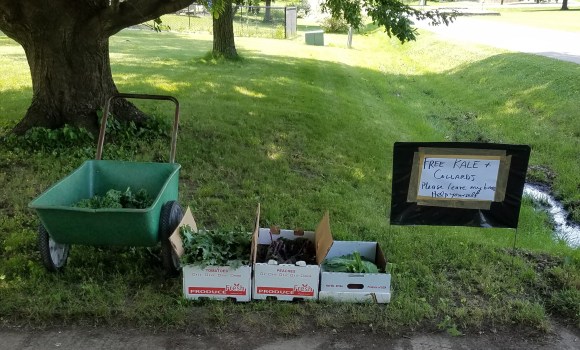
Neighborhood Kale and Collard Stand, June 15, 2020.
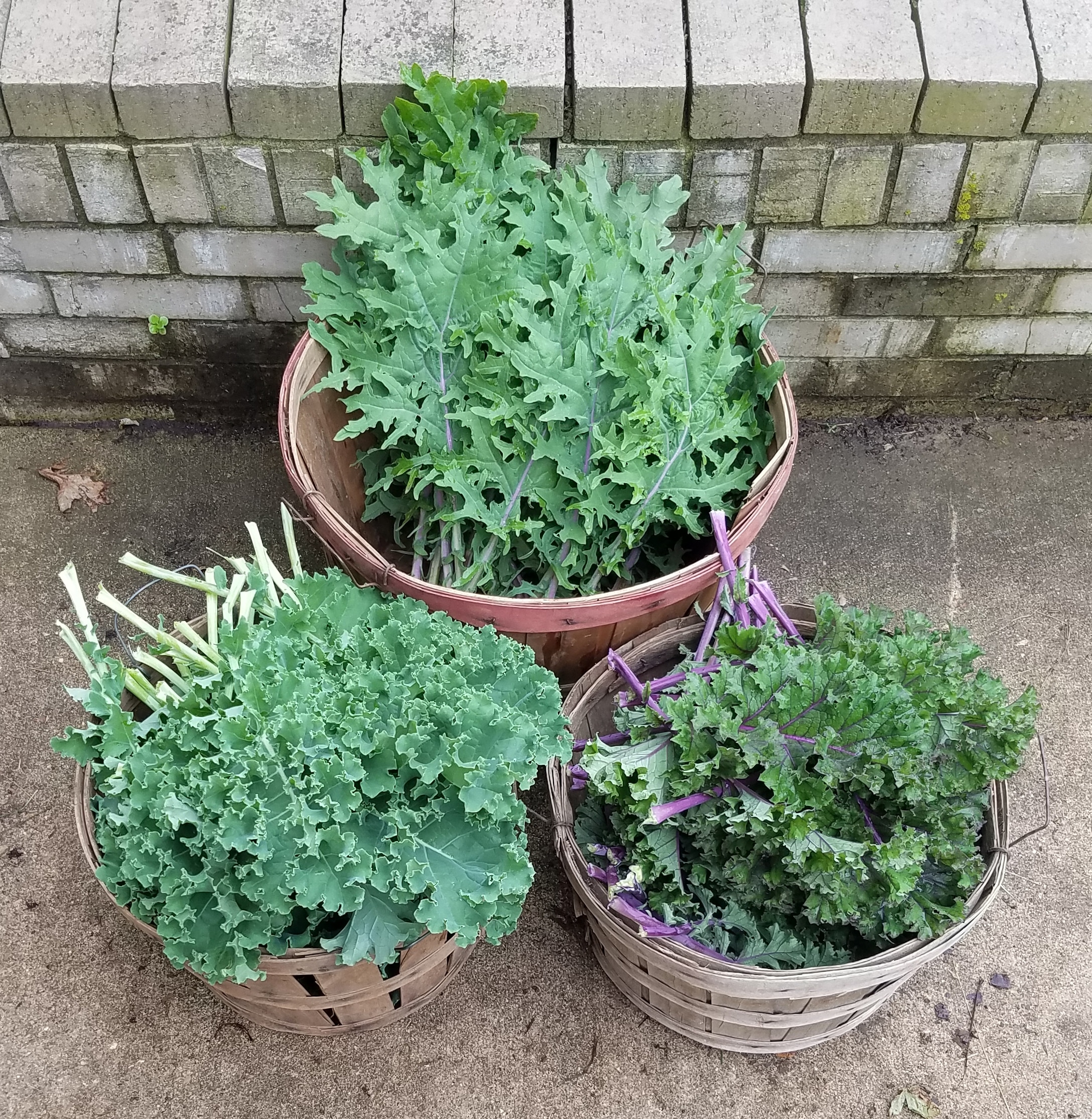
Yesterday’s kale harvest was big. To share the wealth I displayed some at the end of the driveway and posted the free give-away on Facebook.
Some of it was claimed, the rest returned to the garden via the composter.
Ten years ago I saved or preserved everything I grew in the garden. Any more I keep only enough to get us through to next year. I’ve visited root cellars filled with very old Mason jars of a garden’s preserves. That’s not who we should be. We take what we need and if we can’t give it away, leave the rest for compost.
Leafy green vegetables are not a favorite around here. I have regular customers who use it in smoothies or bake kale chips. Others prepare it traditionally as greens. The main use in our household is in tacos, soups and stir fries. When out of lettuce we make kale salad. Once in a while I add a leaf to a smoothie. I’m not a smoothie person. I tried kale pesto once and it was okay. Pesto with more flavor, like mustard greens, is better. For a gardener the main challenge is to grow just enough to meet needs. I cut back the space for kale to 18 plants this year. It is still too much.
Combine kale with kohlrabi, collards, mustard, spinach and chard and there is an abundance of greens this year. Next year I’ll use the planting space differently to more closely match what I grow with kitchen usage.
The last few days have been ideal. Rain let up, temperatures dropped to the 60s and 70s, and much about our time on earth is worth living.
These days are golden.
The garden is producing and it has already been an abundant year. Last night I made biscuits with fresh sage and cheddar cheese from my cookbook, split them into a bowl, and spooned homemade vegetable soup on top. It made a fine dinner. There were leftovers.
I’m ramping up for my summer stint of covering Blog for Iowa while our editor takes a break. My first post is scheduled for July 6. In the meanwhile, these days don’t last yet we enjoy them while we can. Or as James Russell Lowell wrote:
And what is so rare as a day in June?
Then, if ever, come perfect days;
Then Heaven tries the earth if it be in tune,
And over it softly her warm ear lays:
Whether we look, or whether we listen,
We hear life murmur, or see it glisten;
Every clod feels a stir of might,
An instinct within it that reaches and towers,
And, groping blindly above it for light.
There have been 7.3 million confirmed cases of the coronavirus worldwide according to this morning’s Washington Post. The virus has killed more than 410,000 of which 112,978 deaths occurred in the U.S. since Feb. 29.
Mitigation of the coronavirus is not going well here. Poorer countries have done much better handling the crisis. Absent leadership, incompetence, and a deliberate decision to treat COVID-19 like influenza for weeks in February and March, combined with a just ‘let it go’ attitude have taken their toll according to one public health official.
On Thursday the Dow Jones Industrial Average plunged 1,861 points when witless traders found out there wouldn’t be a quick recovery from the pandemic. How did they get the notion the recovery would be quick? Praise the Lord I got out of the market when I did.
In any case, the administration has thrown in the towel on their so-called fight against the pandemic and is moving on to the campaign trail. They are having rally attendees sign a liability waiver in the event there is COVID-19 spread at them. Their work has been about re-election since the day after the inaugural address and little else. In the Republican political playbook what’s another 100,000 COVID-19 deaths? F*ck it! Four more years.
Where does that leave bloggers, writers, gardeners and humans like me? We have to adapt to the coronavirus pandemic. Part of the adaptation was forced upon us.
Retiring from retail work on April 28 was an easy calculation. At age 68, with some health conditions and a reasonable pension structure which included Social Security and Medicare, I decided to do without the additional income and potential exposure to the virus. I won’t be going back to the orchard to work in the retail barn this fall either.
For the first time ever my medical practitioner prescribed a medication which I now have to take daily to reduce cholesterol. I asked him what circumstances may result in ending the medication. He said maybe toward the end of life. While it’s not unusual for Americans to be on medication, and I’ve been lucky to avoid it this long, my health and welfare needs more consideration.
Finally, a lot of people remain unemployed and some jobs closed by the pandemic have not re-opened. Many won’t reopen at all or will emerge vastly changed. In any case, other people need the work more than I do. If I generate income it won’t be working as a wage worker for someone else.
What are the possibilities?
Our household spending plummeted since leaving work. The retained value of our balance sheet increased by 3.25 percent since the pandemic began in Iowa. Our personal debt decreased by 50 percent in the same period. We have a possibility of paying off our debt by the end of the year, opening up spending on large projects in 2021. There is a long list of backlogged projects.
I’m already reading more books, 23 since the pandemic began. I don’t know if it’s possible to “catch up on reading,” but many books wait in my queue and I might actually get to a lot of them. This is a positive alternative to spending more time on social media.
The schedule of work outside home is minimal and that enables a focus on home life. Part of that is taking care of health, and part is going through and getting rid of unneeded possessions in preparation for refurbishing our living space. More attention can be paid to the kitchen garden so our diet can improve, providing better nutrition. All this is welcome and showing marked improvement since the pandemic began in Iowa.
How I might re-enter society, being among people I know, doing things together, is missing from adaptation. With continued spread of COVID-19 I won’t join others at events unless I know their social distancing practices. That seems like a lot to ask friends and neighbors just to spend time with them. Zoom meetings aren’t really a replacement for someone who has been very social for as long like I have been. Likewise, with more people at home on the internet our connection isn’t adequate for an uninterrupted Zoom event. How all this gets resolved remains an open question.
Until there is a vaccine with widespread distribution, or some acknowledgement by public health officials the pandemic is over, I don’t see how adaptation can resemble the past. There will be gatherings but for now I ask myself why risk it? That’s going to continue for some time.
Being at retirement age has made adaptation easier. Maybe the best adaptation, the most socially responsible one, is to just fade away into my family, my bloggery, my writing, and my kitchen garden. There are worse fates than that. Eventually an opportunity to re-enter society will present itself but not yet.
We have to look at ourselves in the mirror and consider whether we are racist. It’s not easy to do in the best of circumstances.
Dictionaries consistently define a racist as someone who has a notion that one’s own ethnic stock or genetic makeup is superior.
Which is it, ethnicity or genetics that defines race?
The authority of dictionaries has diminished in society. There are few rules in the living language except we be understood. Haters gonna hate, as Taylor Swift noted, regardless what’s in the dictionary.
I was confronted with the idea there were different races as a child. It was and remains for me an idea. I knew I was different, but superior? I don’t think so. Diversity in the neighborhood in which I grew up meant defining whether one’s family was of German or Irish descent. Racism as we know it today, as in the Black Lives Matter Movement, wasn’t an obvious issue. We were shielded from racism and those blacks we encountered were in a context of their relationship with our father: plantation workers in Florida, co-workers at the meat packing plant, and fellow union members.
What are the genetic characteristics that define race? What cultural behaviors are specific to race? Should we care about race? These are the questions I’m asking while witnessing the resurgence of protests over race after the viral video of George Floyd’s murder.
Our family visited the Gettysburg battlefield when I was a grader. Which side of the Civil War was I on? I felt I had to be on a side. My maternal ancestors immigrated after the war and my paternal ones from Virginia fought on both sides. After a moving childhood visit to the battlefields I adopted the Confederacy as my own history and bought a Confederate flag in the museum gift shop.
We cannot disown our history even if we want or if our current values discredit the peculiar institution of 19th Century chattel slavery in the U.S. southern states. Thanks to the combined work of my fourth grade teacher and my mother I came to realize the racism inherent in embrace of the Confederacy, and that it was wrong. Before long, with their encouragement, I sought and found my own history.
I first encountered systemic racism while serving in the military. I paid little heed to the naming of military bases after notable racists Andrew Jackson and Henry Lewis Benning, where I trained in the U.S. Army. I was stationed at Robert E. Lee Barracks in Mainz, Germany. It was named after the World War II veteran with the same name as the commander of the Northern Army of Virginia. Racism in the military was about more than names.
Daily work was integrated, which is to say as an Army officer I paid little attention to race when giving orders or following them. All but one officer in the battalion was white and the lone black lieutenant and his family lived in a twelfth century castle off base. I visited them a couple times while we served together. In conversations, I came to understand he was held to a different standard because he was black.
When we lived in Indiana I managed an operation that recruited thousands of truck drivers. I became familiar with parts of Chicago and the suburbs because of this work. I hired the first black recruiter the company had and remember the surprised faces when we returned to the corporate office for a meeting. Race made no difference in this hire. I just wanted someone who could do the job.
We rejected an applicant from our new driver orientation and he threatened to call Bobby Rush because he felt we were discriminating against him because he was black. The claim bordered the ridiculous because more than half the group in orientation was black or Hispanic. I don’t recall why we rejected him but I said I’d like to have that conversation and provided my number. Several weeks later we received a letter from Rush’s office and I replied. That was the end of it.
That protesters in our county seat chose to shut down Interstate 80 in response to the murder of George Floyd was predictable, expected, and ineffective. It’s something, yet I’m not sure exactly what. In 1971 I was part of a group of protesters that shut down Interstate 80 near the Dubuque Street exit in response to the Vietnam War. We built a bonfire in the Eastbound lane feeling we had to do something to disrupt business as usual. What more usual thing is there than traveling on an interstate highway? Law enforcement attempts to keep the interstate open, although there was a report one of the Coralville exits was closed by them in anticipation of protests. Protesters have to do something to gain attention enough to create a fulcrum point for change. I support their actions and also believe there has to be a better way.
What does the Black Lives Matter Movement mean to me? In our rural subdivision the only time race comes to the surface is when it is scratched. If there is talk of a black family moving in neighbors assert property values will decline.What does one do with that? I point out to them the assertion is patently false and reject it. Most people here don’t scratch the surface of race to avoid such conversations.
If George Floyd’s murder was a turning point in how racism is viewed in the United States then some good will come of it once he is mourned dead and survivors heal. We must look ourselves in the mirror on racism. If we can’t then we probably are racist and don’t want to admit it. If so, Floyd becomes just another black man who died at the hands of police as white hegemony continues a while longer.
My religious education taught we are all equal in God’s eyes. That’s how it’s supposed to be in the United States. Yet slave owners sought to justify the peculiar institution using the same Bible I read today. In the end, we have to ask ourselves if we are racist, not because we seek an answer, but because in asking we open the possibility of a remedy to today’s long-standing problem. We seem so far from that now.
The absence of definitive guidance on what society should be doing during the coronavirus pandemic led us to a path of individual choices.
When Iowa Governor Kim Reynolds proclaimed the disaster emergency on March 9 few of us knew what to expect. Sadly, three months later that continues to be true.
Our social behavior is developing around risk avoidance, some of it informed, some less so.
Jacque made us facial masks on the sewing machine. I carry three of them in a plastic bag on the car seat to use when in public. Most frequently I wear them while shopping for groceries, and at the drug store, convenience store and at medical appointments. When I return home I wash my hands, change clothing, and if I’ll be inside the rest of the day, take a shower. I wash the masks after each wearing.
At the farm I don’t wear a mask because the crew has been self-isolated together since the pandemic began. The risk of me being exposed there is minimal. Since I’ve been tested, limit my activity, and maintain social distancing, I seem unlikely to bring it in. They developed a social distancing method of share delivery and are doing everything they can to avoid getting sick. An outbreak would be disastrous for them, their customers, and the business.
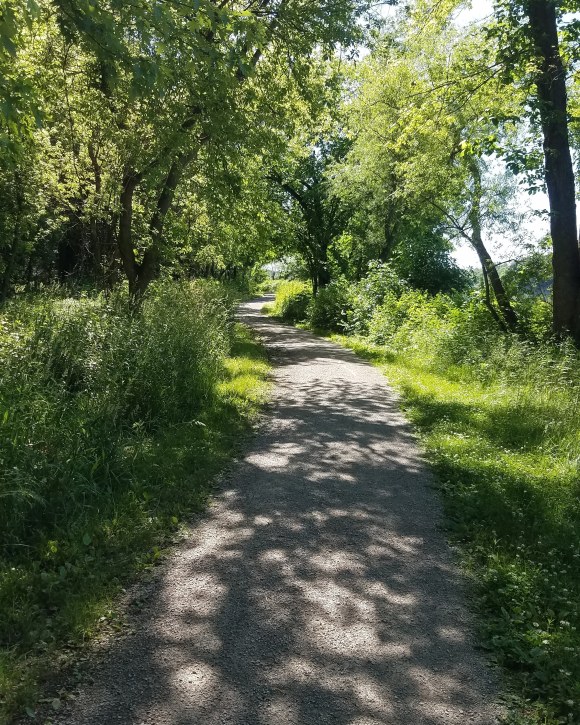
I don’t wear a mask to the state park trail and very few people I’ve encountered there do. Because it is outside and there is room enough to maintain social distancing the risk of contracting COVID-19 there seems minimal. I avoided going to the park for the first two months of the pandemic yet the need for exercise outweighed the risk of exposure to the coronavirus.
With more people home during the day the number of contacts with neighbors has increased. I don’t wear a mask while I’m with them because these encounters are pop-up activities of short duration. I have yet to see anyone in the neighborhood wearing a mask. The letter carrier and parcel delivery drivers are a source of potential contamination although a necessary service as our number of trips off the property has decreased. We sanitize packages and let them sit on the landing before opening.
Our main approach to risk management is reducing activity away from home and social distancing when we are out and about. It serves us well in that neither of us has been sick since the pandemic began. I don’t believe our experience and behavior is much different from any Iowan who takes the coronavirus seriously.
Clearly the pandemic will be of longer duration, so how should risk of COVID-19 spread be managed? There is little guidance from our government and public health guidance seems so universal it’s hard to figure how it impacts us in our actual lives. As a former career transportation and logistics professional I’m familiar with risk management. The pandemic is just one more layer added to risks already managed.
When I worked at the home, farm and auto supply store I got sick a couple of times a year. I caught something at work that caused runny nose, coughing, congestion or some combination of those ailments. The need for income outweighed potential health risks. When we entered the pandemic I reassessed and reversed my approach. I haven’t been sick since I walked out the door for the last time on April 2.
My point is we take risks in everything we do. During the coronavirus pandemic we must get better at doing so because the lives of our family and everyone with whom we come in contact depend upon it. The question never was “should we open up the economy?” The better question is what are the conditions upon which we can re-engage in society? How do we know it is safe enough to send our children to school, return to paid work outside the home, and participate in mass recreational events like concerts, sporting games, fairs and local festivals? If anything, we assumed those activities were safe before the pandemic, even though we knew, subconsciously at least, that safety has a broad spectrum of risk and no human activity is completely safe.
What are reasonable risks? Lacking appropriate guidance from experts each of us is making up our own rules, our own trade-offs between risk avoidance and participating in life. There is no going back to life before the pandemic. How do we restore enjoyable aspects of our lives with less risk of contracting COVID-19?
I don’t have definitive answers except that we are on our own. We are doing our best and for the time being, until we figure this out, that may be the best we can do.
If daily life took its course without our engagement we would be reading more words and fewer books.
With the rise of social media a lot more words are being published and many readers get “glued to their phones” as they take in all the words and video they can within a circle of friends and followers.
Long form reading in books is an essential part of staying informed. It took a conscious effort to stop my entropic slide to reading no books each year to include long-form reading in daily life. Ironically this began by using the social media tool Goodreads. By setting a low annual goal of 16 books per year in 2018 I surpassed it and have increased my book reading every year since. In the first five months of 2020 I read 26 books.
Reading short pieces, newspaper and magazine articles, and social media posts is an important part of securing new information about our lives in society. At the same time erosion of book reading leaves us the less.
The current book on my night stand is Save the Plums: My Gourmet Memoir by Ruth Reichl who spent ten years as editor in chief of Gourmet magazine. An intellectual masterwork? No. I found Reichl’s reference to William Carlos Williams annoying, yet the pace is quick, the chapters short, and the language a straightforward narrative. It’s how a person with a specific experience wrote autobiography. The more experiences of writing styles we have, the better writers we can be. If you forced me to put this book in a category, it is summer reading and a part of a broader universe of reading material.
We seek in reading, in any format, an understanding of the person behind the writing. When I review my social media feeds, some people I know personally and have done things with. Others I know by their writing. There’s a reason it’s called “social media.” There are people behind the posts or at least that’s what we hope.
That is less true of book reading where the author may be present in every page yet strive to minimize their personality or presence in the words. Can a book stand separately from it’s creator as a work of art? I don’t see how it’s possible to separate the work from the author’s social context. In that regard, historians are the worst. There is an ideology of history writing and to attempt to hide or diminish it is a disservice to the reader (Oscar Handlin). There is a politics and poetry of writing history. There are books on those subjects. It is possible, and I’d argue necessary, to both adore historians (Robert Caro) and despise them (Doris Kearns Goodwin) that has nothing to do with the information presented on a book’s pages.
I look at reading the way I view being a food consumer: I seek to know the face of the farmer and in the case of reading, the face of the author. That’s true of any reading I do. I am more likely to trust, read and comment on something an acquaintance posts because we physically met and I’ve followed them in social media long enough to understand something about their social context. The same is true for writers in mass media. I want to know who they are and what their history is rather than read a single sensational story. As a reader and human, I’m in it for the broader picture.
The rise of artificial intelligence is producing computer generated writing. I think we need to inoculate ourselves against this fake writing by spending time learning about authors and reading their published work. As the noted philosopher Taylor Swift wrote, “the fakers gonna fake, fake, fake, fake, fake.” We need to be able to shake them off. That requires us to be informed readers.
If we are going to read more at least some part of our lives should be engaging the authors of those words. Obviously it’s less possible for dead writers. Yet we are living now and should be spending part of our time reading full-length books both as a supplement to short form reading and as escape from it. Entropic decline in long form reading is something we must address in our lives. That is, unless we accept the mutation of humans will eventually include genes for mobile phone adaption.




 Journey Home
You must be logged in to post a comment.