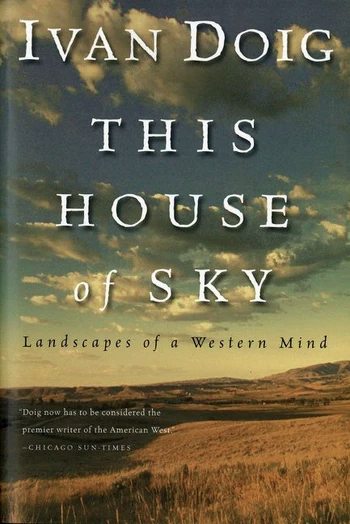
This House of Sky: Landscapes of a Western Mind by Ivan Doig is exactly what the title suggests. Descriptions of the author’s rural Montana life are vivid in their presentation of the hard-scrabble ranching life in which Doig came up. Out of that challenging youth — farming, sheep herding, haying, rural community — he became a writer giving voice to western life.
“In my Montana upbringing, I had worked in a lambing shed, picked rock from grainfields, driven a power buckrake in haying time and a D-8 Cat pulling a harrow during summer fallowing and a grain truck at harvest, herded sheep, trailed sheep, cussed sheep — even dug a well by hand and whitewashed a barn –and now I didn’t seem to be finding other people who had done any of that,” Doig wrote in the introduction.
I worked eight years on a farm that raised lambs, although not on the scale of Doig’s Montana. It was an entry point into a life I hadn’t known existed. My experience provided me a way into This House of Sky that many readers might not have. Life experiences can be a form a literacy regardless of how many books we read.
My grandmother grew up in farming communities in Minnesota and Illinois, and could likely relate to the grandmother in the book. Working from a home, while isolated on a farm, took a lot of knowledge, skills, and energy. Such women literally made a home from almost nothing. While Grandmother did not read a lot of books, I might have persuaded her to read this one.
When This House of Sky was published in 1978, many Americans still had farm connections. Today, far fewer do as that knowledge of hand work was eclipsed by mechanization. Today people don’t harvest hay the same way Doig describes before he left home.
Is there a modern readership for the book?
While I brought farm experience to the book, other readers might bring something else. This book can meet readers where they live. Doig’s detailed description of Montana has many common hooks, including the arc of his’ father’s emphysema, the culture of nine bars and saloons in White Sulphur Springs, and the role of women and men in western society.
Whatever a reader brings to This House of Sky, there is a thoughtful world to explore and briefly inhabit.
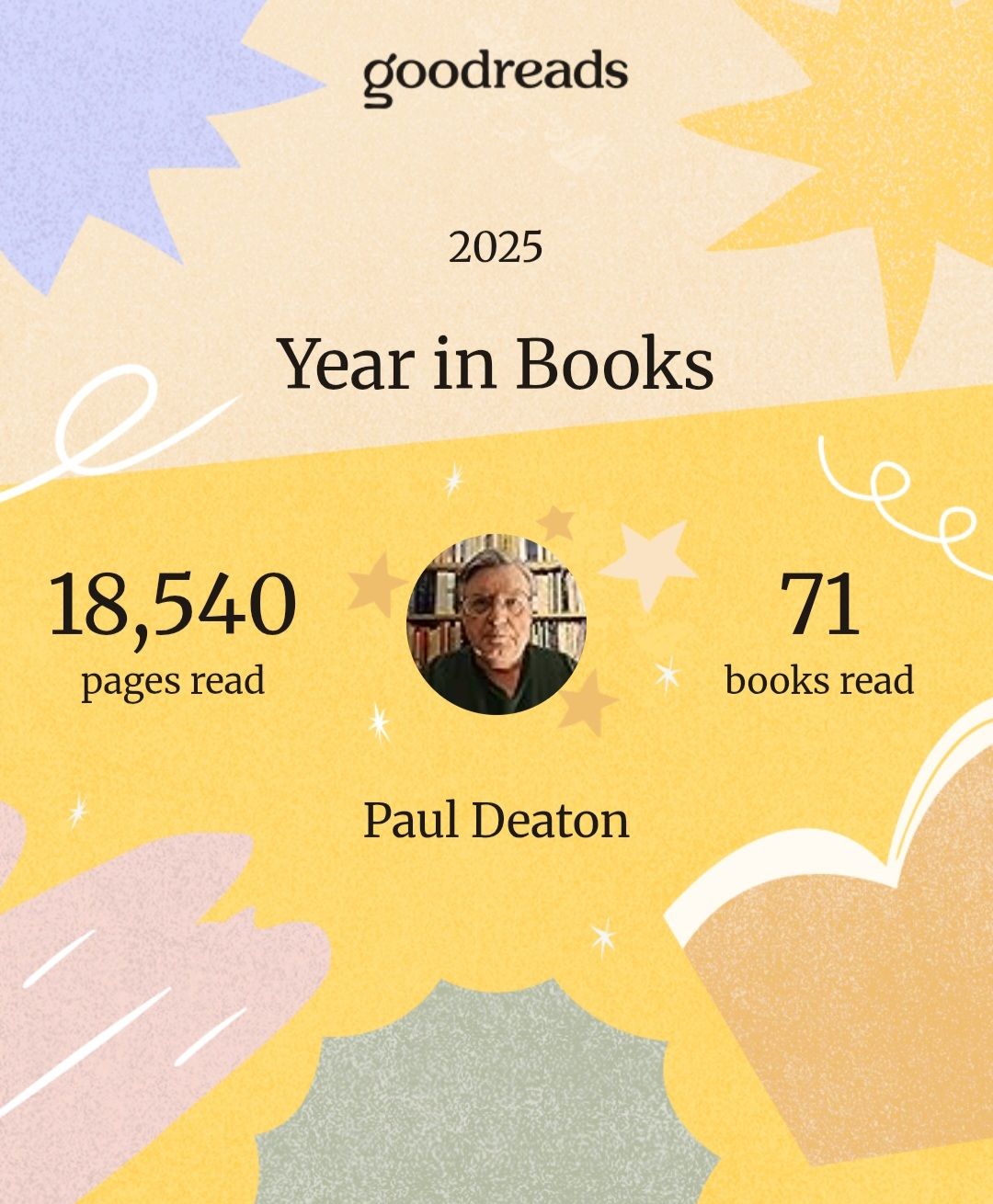
I decided to call 2025 finished with 71 books read. I set my goal at a book per week and exceeded it. Yay!
Goodreads is great for me because it provides satisfaction when I finish each book and rate it. Likewise, I refer to the historical information often. The above chart came via email last week and tells a story about which I hadn’t thought. June through August is the busiest time in the garden. Likewise September through November are taken up with kitchen work processing the harvest. Seems natural I would read fewer books during those six months. The seasonality just never occurred to me.
I post each book I finish on Goodreads and at the Read Recently page of this blog if interested. I also keep a spreadsheet.
Book reading appears to be a lost art in American society. I understand people are busy taking in information from the large number of sources that exploded after Tim Berners-Lee invented the World Wide Web in 1989. The web was popularized through the adaptation of web browsers in the mid-1990s. We bought our first home computer and logged in via dial-up on April 21, 1996. After that, it was Katie bar the gate with many more words than could be read by a single human. I think even artificial intelligence machines have trouble getting through all of it. All that said, I sort of understand it, yet believe individuals reading books is an important kind of experience that rewards us in tangible ways.
Online apps are not for everyone, yet if you are on Goodreads, I’d love to see what you are reading. Find me here and join my community!
By late Sunday night, I was ready for the deathly weekend to end. An acquaintance my age, with whom I worked at a transportation and logistics firm, died unexpectedly of a heart attack. His obituary was in the Sunday newspaper. There were the shootings in the news: Brown University in Rhode Island, and Bondi Beach in Australia. Then came the apparent murders of Rob Reiner and Michele Singer in California. It was public death overload.
It didn’t help the bitter cold kept me inside most of the weekend. I cleared snow from the driveway, but that’s about all the time I was outdoors. The saving grace was the visit of our child beginning Friday. They couldn’t make it home on Saturday because of the blizzard. They left Saturday morning, then turned the vehicle around, and headed back when the Interstate proved to be impassible. The extra night was a blessing for parents.
Despite the deaths, things weren’t all bad this weekend.
The bean soup and cornbread tasted good and was well-received Friday night.
I finished reading The Frozen River by Ariel Lawhon. It’s the kind of novel I enjoy reading, set in a time before electronic devices dominate society.
I read Adrienne Rich’s 1991 book of poetry, An Atlas of the Difficult World: Poems 1988-1991. I found it hard to access yet there was at least one relatable poem.
Preparing enchilada sauce began a process of re-thinking how I make it. I tried substituting a slurry of all purpose flour, vegetable oil, and spices for arrowroot as a thickener. This approach has potential. More to come.
Used an aging can of pumpkin puree to make pumpkin bread. The results were so-so. Next time, I’ll use pumpkin I preserved myself.
I drafted another chapter in my autobiography.
Boxed up a donation of books for the public library used book sale.
Ambient temperatures warmed to the upper-20s on Monday, which meant a break from bitter cold. I’ll work to make this week better than the bitter weekend just past. Hard to keep a positive outlook sometimes, yet we must.
In late November I’ve read 63 books this year. Not all of them were good, yet many of them were exceptional. This post is about books I am glad to have read this year.
The Politics of Resentment by Katherine Cramer
Cramer’s examination of rural political consciousness — and the resentment often directed toward “liberal elites” — is essential reading for any Iowan trying to understand where our politics may be heading. I remember the mass demonstrations in Madison during Scott Walker’s tenure, and Cramer uses his administration as a springboard for a broader exploration of government’s place in everyday life. Her account is grounded in the many conversations she held with rural Wisconsinites while conducting her research, giving the book both texture and credibility.
Queen Esther by John Irving
Beginning during my university days I had a small number of authors whose work I read with great anticipation shortly after a new book was released. First it was Saul Bellow, and then Joan Didion. When they died, that author became John Irving. Queen Esther is what I expect from an Irving novel.
The reason I enjoy reading Irving is when he writes about his time in Iowa City, it is the place I came to know. The Water Method Man was set there and he specifically mentioned 918 Iowa Avenue, with which I am very familiar. That feeling, along with other common experiences, gives me entree into the world he describes in his latest book.
There are some naysayers about Queen Esther, yet it is familiar fare which I am glad to access. Having traveled there myself, I particularly enjoyed the chapters about Vienna and Amsterdam. He describes the same Vienna I came to know and that draws me into the book. My review is here.
The Siren’s Call by Chris Hayes
There are other books about the attention economy, but Chris Hayes The Siren’s Call: How Attention Became the World’s Most Endangered Resource comes at a time when we need to hear his message. I hear the word “distraction” multiple times each day from friends and family. There is more there and Hayes gets to the heart of it. My review is here.
Source Code: My Beginnings by Bill Gates
Source Code: My Beginnings is a straight up autobiography of Bill Gates’ early years through development of Microsoft. The early coding he wrote was impactful in my life and in the broader society. To hear it directly from the source was a quick, informative read.
This is for Everyone by Tim Berners-Lee
Tim Berners-Lee is credited as being the inventor of the World Wide Web in 1989. His autobiography explains what happened. It is something that affects most people and worthy of reading.
Apple in China by Patrick McGee
The relationship between Apple and China is part of the news each day whether mentioned explicitly or not. I remember Iowa firms establishing a business relationship in China when I was in my 50s and found it curious that China would not let them own a majority stake in businesses they managed there. Apple in China: The Capture of the World’s Greatest Company explains the risk and what happened to the company because of it.
Breakneck by David Wang
While China is an engineering state, relentlessly pursuing mega-projects, the U.S. has stalled. America has transformed into a lawyerly society, reflexively blocking everything, good and bad. This book makes the case why China is so far ahead of the United States in manufacturing and in other areas of the economy. When we consider the United States, the concept of “lawyering up” is a negative for the betterment of society. Just look at our president and the number of lawsuits in which he is engaged.
The Devil Reached Toward the Sky by Garrett M. Graff
I previously read many of the stories in this oral history of the making and use of the atomic bomb. What sets Graff’s book apart is collecting first person accounts of that history. It brings a form of immediacy to a topic modern people tend to forget when discussing nuclear weapons and disarmament.
Nomadland by Jessica Bruder
I know many people looking for work without much success. Jessica Bruder wrote an autobiography about her experiences in a workforce unhinged from a predictable, daily schedule of work. She worked all over the country in seasonal or part-time positions, the most recognizable of which is the Amazon CamperForce program. Amazon leverages people displaced from regular work and have taken to living in recreational vehicles. They have a formal program to hire them in their warehouses during peak sales activity. This is just one example. This one is well worth your time for its window into a world most of us didn’t know existed. My review is here.
Eleven Days by Donald Harstad
The county sheriff recommended this book about a crime in the area where I live. I don’t read many crime novels, yet the local setting drew me in, and the tightly written narrative had me turning every page as quickly as I could.
2025 was a good year for reading. In retrospect, I should have read more poetry, so I’m making that a goal for 2026. To conserve resources, I expect to read more books from the public library and my own collection. I maintain my daily reading target of 25 pages, although that creeps up when I find a compelling book.
I’d be interested in what readers are reading in the comments.
Like every progressive activist, I want news from reliable sources — newspapers, newsletters, blogs, and social media. The question is always, “Who is active and can tell me something I haven’t heard elsewhere?” Heather Cox Richardson’s Letters from an American is the top Substack, with more than 1.3 million subscribers. It’s a must-read. There are others, less well known and on different platforms. Here are five to consider. Hopefully, this provides some value as we trek across the internet wasteland.
Olena Halushka is a Ukrainian politician and activist. Her daily posts on BlueSky keep the terrorist acts of Russia in Ukraine in front of me. She was a member of the Kyiv City Council and a contributor to Ukrainska Pravda, the Atlantic Council, EUobserver, The Washington Post, and Foreign Policy. Find her on BlueSky here: @halushka.bsky.social
Nina Elkadi is an Investigative Reporter at Sentient, and freelance writer from Iowa who reports on agriculture, water, and the environment. Her work also explores the manipulation of science and how corporate negligence affects consumers and workers. I had the pleasure of meeting Elkadi in Iowa City. She posts on BlueSky at @ninaelkadi.com
Alice Miranda Ollstein is a senior health care reporter for POLITICO, with a focus on sexual and reproductive health. She is often first to market with major stories on her beat. She also monitors social media and reposts articles I find valuable and leading edge. Subscribe to her posts at the POLITICO website or follow on BlueSky at @alicemiranda.bsky.social .
Hannah Ritchie is a Scottish data scientist, senior researcher at the University of Oxford, and deputy editor at Our World in Data. Her work focuses on sustainability, in relation to climate change, energy, food and agriculture, biodiversity, air pollution, deforestation, and public health. I read Ritchie because she brings a fresh voice to the subject of coping with the climate crisis. Her first book, Not the End of the World, was published in 2024. Find her on BlueSky at @hannahritchie.bsky.social
Ana Marie Cox I’m likely dating myself here. Cox is a frequent critic of the Substack culture and simply a very interesting person. I have been following her since the Wonkette days and yes that was a thing. In addition to media criticism, she posts frequently about her trials and tribulations in the gig economy. She is contributing editor at @newrepublic.com; co-host of Space the Nation (sci-fi meets politics); plus @pastduepodcast.com. Follow her on Buttondown at https://newsletter.anamariecox.com/ or on BlueSky at @anamariecox.bsky.social. Her BlueSky account is mostly reposts of stories that track her eclectic interests.
What are your favorite reads on the World Wide Web? Feel free to leave a comment.
Afternoon plans changed after the optometrist dilated my pupils. It was part of my annual eye exam, in which I seek to monitor whether or not diabetes is showing in my retina. I got an all clear diagnosis but the dilation persisted well into the afternoon. I could not bear working outdoors on a sunny day. That evening it rained for several hours.
Thursday morning I wheeled the recycling bin to the curb for pickup. It has been warm enough I dispensed with wearing a sweatshirt. A light breeze felt good on my skin as I contemplated the dark sky while walking back to the house. Simple things in a simple life.
Also on Thursday I began a five-day prep for a colonoscopy. The hospital would have me reduce the amount of fibrous food eaten, which is a chore since almost everything I eat by design has plenty of fiber. I asked them about it, yet they had no guidance about what I should eat, saying, “Do the best you can.” It will be a change during which I expect to drop a couple of pounds of weight. After the procedure I expect to gain it back.
Four paragraphs in and I’m not sure where this post is going. I don’t want to write about the political-media-government generated chaos available in my email and social media news feeds. I rely on email, newspapers, substack and BlueSky for most of my information in this category. Thing is, everyone has the capacity to access the same kind of information, so repeating it wouldn’t be adding much new to the fray. I guess I’ll write about my changing relationship with the public library.
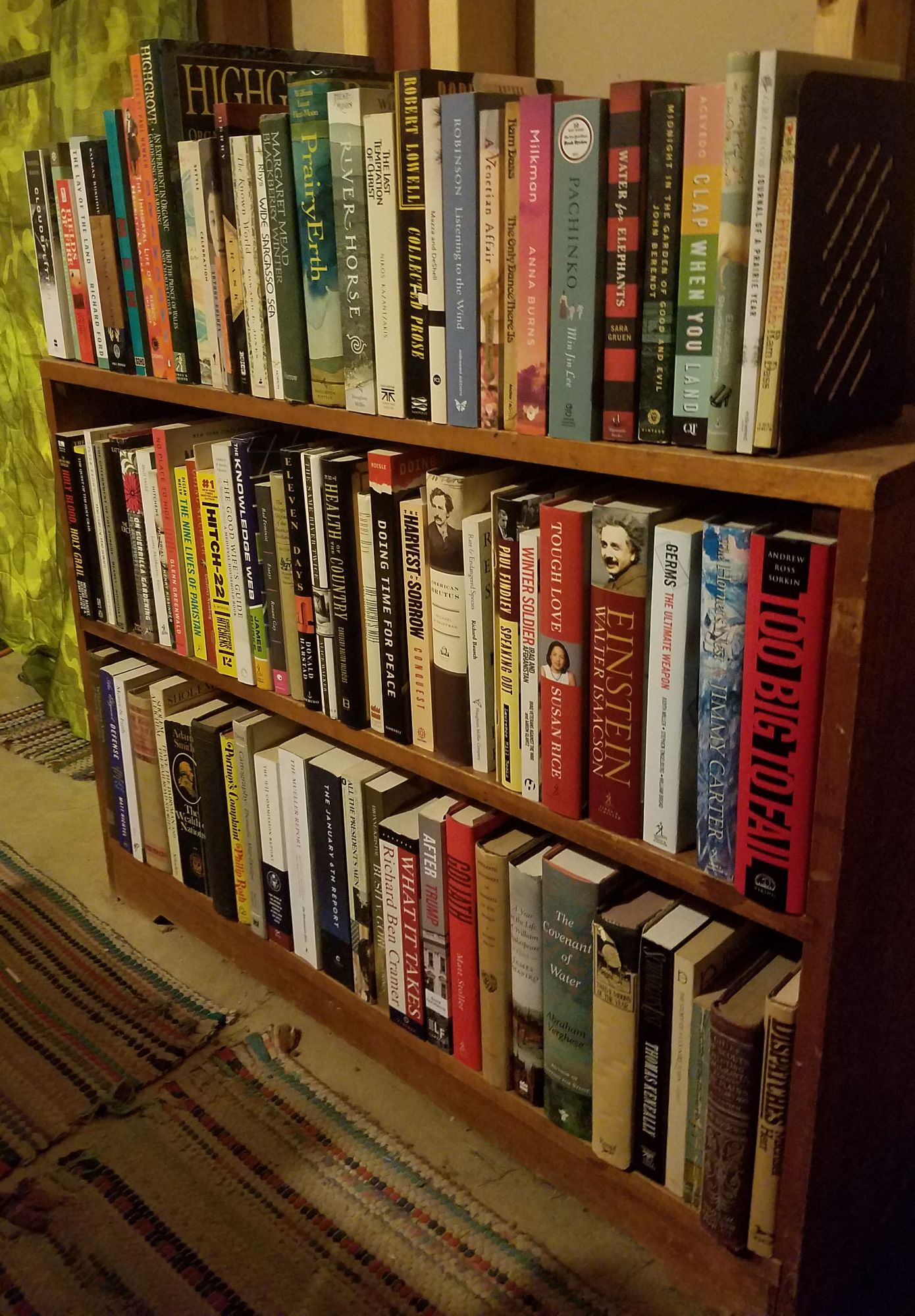
My writing space has thousands of shelved books. Organizing them is a work in progress. There are thousands more stored in boxes. I don’t need to add many more to my collection, so this year I started using the public library more. It started with a simple request.
I asked the library to order Chris Hayes’ new book The Siren’s Call and they did. Part of this process is the person who suggests a new book gets the ability to read it first. I read it and reviewed it. I am glad others in the community will be able to check it out and read it too. Then I asked the librarian to order Bill Gates new book, Source Code: My Beginnings. They have a process to make book suggestions online, which I love. They did order it, I read it, and wrote a brief review on Goodreads. After reading it, I have no interest in finding a spot on my shelves for it. Better the library keep the copy, as this book should be popular. By this time I was enjoying the public library again.
I began exploring the website, the hosting of which is currently paid by a grant from the federal government. They have a feature called “What’s New” which is a query form that calls up the titles added to the library shelves in the last week. I’m checking it out daily. Already I found several new books to read, books I might have missed in other places. In addition, my home page has this banner at the top: “In 2025, you have saved $434.00 by borrowing from the library rather than buying!” Now I was really hooked.
My philosophy of reading is pretty simple. Read some pages in a book every day. This habit is part of developing a way to live a good life. Some books demand more daily pages than my typical 25 per day. Once I get going on a good book, it is hard to stop reading.
If you haven’t been to the public library in a while, I recommend you check them out. Maybe you will find a way, like I did, to reinvigorate your reading. Plus, there is usually no cost to check out a book! Other advice: figure out your topic before writing an essay. It may keep your readers more engaged.
Like with so many other parts of my life, my reading was punk in 2024. I had to cut back on my goal to 52 books because I picked some long ones that weren’t that interesting. There were some real winners this year and a bit of ticket punching. Here is the best of the lot. I’m on Goodreads so you can find me here.
The best book I read was Lessons in Chemistry by Bonnie Garmus. I recommended it to others repeatedly, and would likely read it again once a bit more water goes under the bridge. The combination of discrimination against women in science, a single mother, a cooking show, and daring women who view her television program to change the status quo was irresistible. I don’t often read a book twice, but expect this will be an exception.
I read multiple books that attempt to write the history of our times and forecast our immediate future. The best of these was Ari Berman’s Minority Rule: The Right-Wing Attack on the Will of the People―and the Fight to Resist It. I’ve been following Berman since he emerged from his home in Fairfield, Iowa to become more prominent on the national stage. Few people have written about the Trump administration as he does in this book. It is worth reading just for that. Other books I would categorize with Berman include something lost, something gained by Hillary Clinton, Nuclear War by Annie Jacobsen, and Attack from Within: How Disinformation is Sabotaging America by Barbara McQuade.
Important memoirs and biographies I read this year include On Call: A Doctor’s Journey in Public Service by Anthony Fauci and The Art of Power: My Story as America’s First Woman Speaker of the House by Nancy Pelosi. All told, I read ten books in the memoir/biography category in 2024. None of them was a dog.
I read a number of books from my “To Be Read” pile. Noteworthy are the ones that serve as historical artifacts: In the Spirit of Crazy Horse by Peter Mathiessen, Narrative of Sojourner Truth by herself, Starved Rock: A Chapter of Colonial History by Eaton G. Osman, Wakefield’s History of the Black Hawk War by John Allen Wakefield, and Chief of Scouts, As Pilot to Emigrant and Government Trains, Across the Plains of the Wild West of Fifty Years Ago by William F. Drannan. While the to be read pile is not as glamorous as getting new books, it is valid work to be done. These were all worth the work.
Not the End of the World: How We Can Be the First Generation to Build a Sustainable Planet by Hannah Ritchie is a new book by what I would call a young person (She was born in 1993). Ritchie brings a new perspective to environmental and nuclear weapons issues that has been wanting in the current literature. To say the book was refreshing would be an understatement.
The Cooking of Provincial France by M.F.K. Fisher discussed the cuisine of French provinces and provides many traditional recipes from these regions. More than that, it made the case for cuisines that rise up from the geography of soil, water, terrain, and animal husbandry to create foodstuffs, and by association, people, distinct to a region. This stands in sharp contrast to homogenized food ingredients as are available in grocery stores, or whose seeds are planted locally even though the environment has not nurtured them as if they were native to the region. The lesson from this Time-Life book was unexpected: when people are tied to food produced in a specific, local region, they gain a resilience some in the United States find wanting in our food culture.
I also read from my close circle of friends and acquaintances. Thom Hartmann published The Hidden History of the American Dream: The Demise of the Middle Class―and How to Rescue Our Future. Maureen McCue published Dancing in a Disabled World in October. I believe we have a duty to read books written by people we know. The conversations I have with Hartmann and McCue about their books inform my own writing.
The whole list of books I read this year is posted as a Reading Challenge on Goodreads. If you are on that platform, I hope you will follow me so I can follow back to see what you are reading.
At a time when conservative political activists tell us what we can and can’t read and learn in public spaces, summer reading programs at public libraries continue to thrive. In the City of Solon, population 3,018, 261 kids attended the public library’s May 30 Summer Reading Program kick-off event.
Most have heard of Dolly Parton’s Imagination Library which mails free books to children from birth to age five. Each month Parton’s organization mails books to one million children around the world with one in seven American children receiving her books. Any parent can sign their child up for the service from Imagination Library.
Young children seem on board with reading. It’s the adults among us that need to do better. According to the website Wordsrated, the average American adult reads five books per year. 51.6 percent of Americans don’t finish a single book in a year. Here are some books where progressives can start improving our book-reading. Call it a progressive summer reading program!
I recommend starting with my March 31 post titled Women to Read and Follow. These authors are essential to understanding the progressive viewpoint in contemporary society. Don’t yap about dark money in politics or Citizen’s United unless you have read Jane Mayer’s Dark Money: The Hidden History of the Billionaires Behind the Rise of the Radical Right. Following women’s health care rights post-Dobbs? Read Alice Miranda Ollstein’s articles at Politico. Concerned about misinformation and disinformation in the media? You should read Barbara McQuade, Attack from Within: How Disinformation is Sabotaging America. All eight women I covered are worth reading.
There are some men writing on progressive topics who are also worth reading. I recently reviewed Ari Berman’s latest book Minority Rule: The Right-Wing Attack on the Will of the People–and the Fight to Resist It. Berman’s previous book, Give Us the Ballot: The Modern Struggle for Voting Rights in America is a must-read. I’ve been following Thom Hartmann’s Hidden History series and any of them is a good starting place. My recent review of The Hidden History of American Democracy: Rediscovering Humanity’s Ancient Way of Living is here. Warning! Once you get started with Hartmann you may become addicted. Blog for Iowa weekend editor Dave Bradley wants to read Barons: Money, Power, and the Corruption of America’s Food Industry by Austin Frerick.
How do disabled people become political activists? You owe it to yourself to read Year of the Tiger: An Activist’s Life by Alice Wong who tells her story. What is a main issue? Free and open access to the internet.
Worried about the climate crisis? Hannah Ritchie’s new book Not the End of the World: How We Can Be the First Generation to Build a Sustainable Planet offers a fresh and refreshing perspective. Helen Macdonald’s Vesper Flights is about bird migrations and our interaction with nature, suggesting we should not be using nature as a metaphor at all.
It has been so long since Hiroshima and Nagasaki, people tend to forget nuclear weapons should be eliminated and the major powers all agreed to do just that. Annie Jacobsen recently published Nuclear War: A Scenario to remind us. This book deserves distribution beyond folks who work for nuclear abolition.
Who We Are Now: Stories of What Americans Lost & Found during the COVID-19 Pandemic by Michelle Fishburne is a unique story of her 12,000-mile journey with her children in an RV during the pandemic. Her story captures something about the pandemic it is difficult to find elsewhere.
Blog for Iowa editor Trish Nelson passed along some summer reading recommendations. The Life and Times of the Thunderbolt Kid by Bill Bryson is one person’s stories of growing up in Iowa, many places and things we all remember come and gone. A Woman of No Importance by Sonia Purcell and Wolves at the Door: The True Story of America’s Greatest Spy by Judith L. Pearson are two different books with the same topic: an infamous female spy from America who was a key player in the French resistance during WWII. Trish also recommends Cassidy Hutchinson’s Enough and Underground Railroad by Colson Whitehead.
A person needs escape through reading from time to time. Novels I recommend are A Gentleman in Moscow by Amor Towles, Lessons in Chemistry by Bonnie Garmus, The Map of Salt and Stars by Jennifer Zeynab Joukhadar and Whose Names are Unknown by Sanora Babb. It was hard to put each of these books down as the subject was compelling and the story masterfully told.
I turn to poetry when I need a break from prose, reading new and old poetry from my personal library. In the new category, I recommend Plantains and Our Becoming by Melania Luisa Marte, a debut poetry collection about identity, culture, home, and belonging. In the old category, someone on social media convinced me to read the poetry of John Betjeman. His collected poems is on my summer reading list. I am also a fan of Lucia Perillo’s The Oldest Map with the Name America. My recommendation? Go to the nearest public library, find the poetry section, and pick something that interests you.
There you have it: a progressive summer reading list. Happy summer reading!
According to the website Wordsrated, the average American adult reads five books per year. 51.6 percent of Americans don’t finish a single book in a year. Therefore, I am pretty optimistic when I say we should be reading these eight female authors. Don’t get me wrong. Men can be fine writers. It’s just that these women are particularly relevant to this moment in history when authoritarianism is knocking at American’s door.
Jane Mayer If you read only one book this year, make it Dark Money: The Hidden History of the Billionaires Behind the Rise of the Radical Right. From the dust jacket: “…a network of exceedingly wealthy people with extreme libertarian views bankrolled a systemic, step-by-step plan to alter the American political system.”
Nancy MacLean Ever hear of James McGill Buchanan? Maybe not but you should learn about his influence in altering the rules of democratic governance. MacLean tells this story in Democracy in Chains: The Deep History of the Radical Right’s Stealth Plan for America.
Naomi Oreskes Beginning with Merchants of Doubt: How a Handful of Scientists Obscured the Truth on Issues from Tobacco Smoke to Global Warming, Oreskes and co-author Erik M. Conway analyzed issues related to advertising and deceiving the public for private gain. Their latest book, The Big Myth: How American Business Taught Us to Loathe Government and Love the Free Market is timely and relevant. Oreskes also wrote Why Trust Science?
Alice Miranda Ollstein Ollstein is a health care reporter for POLITICO, covering Capitol Hill. Her beat includes women’s reproductive rights and she is at the top of the game in covering the issue. Follow her here.
Anne NelsonShadow Network: Media, Money, and the Secret Hub of the Radical Right. From the dust jacket: “This chilling story of the covert group masterminding the radical right’s ongoing assault on America’s airwaves, schools, environment, and, ultimately, its democracy.”
Dahlia LithwickLady Justice: Women, the Law, and the Battle to Save America is the story of women lawyers from around the country, independently of each other, fighting the good fight to hold the line as Trump, McConnell, and the Republican party did everything in their power to remake the judiciary in their own conservative image.
Barbara McQuadeAttack from Within: How Disinformation is Sabotaging America, comes at a perfect time for this presidential election year. It is relevant, engaging, and necessary in its discussion of misinformation and disinformation in American society. It is part explainer and part map for addressing these issues. You’ll want to read this one straight through.
Elizabeth Cronise McLaughlin One of the co-founders of Indivisible, McLaughlin is a former New York Attorney (a federal court securities fraud litigator) who is covering the Trump trials and other relevant legal news from her home in Southern California. A main activity is her daily 30-minute YouTube broadcast called #ResistanceLive. Find it here. Not only does she report and interpret the news from a progressive viewpoint, she is funny, energetic, and intelligent. She encourages viewers to get involved with the 2024 election.
Please enter a comment with authors you believe progressives should be reading. You may be tempted to read some male authors and that’s fine… after you read these women.
To get involved with the Iowa Democratic Party, click here.
I threw in with a group of readers, writers, artists, and photographers when I joined Threads to replace my X account. There is a lot of discussion about books to be read stacks. You know what I mean: that pile of acquired books that grows and eventually might be read. What is the right number to have? 100? 200? More? Less? There is not a right answer. I have a completely full bookcase in one of the passageways leading to my writing room. When it’s time for the next book, I browse it like I am in a personal book store. To be read stacks got me thinking about how to select the next book.
Book selection is a hodge-podge process in my world. I diligently read at least 25 pages per day. When it’s time for the next book, sometimes I know what to pick up ahead of time and sometimes I don’t. I can be like a dog chasing a squirrel. There is little interest in being disciplined here. Less than there should be. I tend to pick recently acquired books for next.
At the same time, there are books I own I want to get to. For example, I’m building a collection of books about Florida, Virginia, Minnesota and other places important to my family history. Those are maybe 50 books organized on shelves for easy grabbing for research. Somehow those need to be worked into the rotation.
Referrals are the most important part of the process: referrals from friends, social media (Threads and Facebook mainly), from the footnotes of other books, and from what my pals on Goodreads are reading. I used to just buy those books and find a spot for them.
While I have more than a thousand books in my library to be read (maybe two thousand, who’s counting?), I slowed the purchasing process. When I find a book to read from any source, I put it in my Amazon shopping cart and remove it to save for later. That builds a reading list without buying a book. In the past, when I filled my cart, I used to just place the order. No more.
I have a Goodreads account with a few friends. The Goodreads to be read list exists yet I don’t find it as useful as the Amazon list. I use them both when I’m stumped.
When the next book is up, from any source, and I don’t have a copy, I check availability on the online catalogue at the public library. This is a new process. We are in a small community so sometimes they have it and sometimes they don’t. If they have it, I place a hold and pick it up on the next trip to town.
I keep nine shelves of more than 400 books of poetry. I use them to palate cleanse or for inspiration. There are so many unread poems they could keep me busy for a long time.
In terms of filling my life with reading, I would never have to leave the house for the 14 years left according to government life expectancy tables. Nonetheless, I want to stay current and as an avid reader of online publications I frequently encounter a new book I should read.
My bottom line is I like the hodge-podge of my to be read stack and its extensions online. With so many good books in the world, I don’t want to miss many. I don’t have enough perspective to know whether I have and a to be read stack is no answer to that problem.






 Journey Home
You must be logged in to post a comment.