Categories
Reviews

Nomi’s Asian Restaurant

Nomi's Asian Restaurant
Nomi’s Asian Restaurant

SOLON— The first stop on our restaurant crawl was Nomi’s Asian Restaurant, 101 Windflower Lane in Solon. Nomi is the cook, and most nights her husband is the server at this Asian fusion restaurant. Nomi’s incorporated on Feb. 10, 2009, and by restaurant industry standards, having made it past year one, it seems well on their way to becoming a permanent fixture in town. Our family and friends have been regular customers since Nomi’s opened. It is one of the few restaurants in town that offers vegetarian entrees on the menu, and it is the only Asian cuisine in the area. They have an active take-out business, with a drive through window.

Both my spouse and I currently work on Saturdays, so when we don’t feel like cooking, Nomi’s is our first choice. When we arrived around 7:30 p.m., we were the only customers inside, although the drive-up window was busy. She ordered Vegetable Tofu, a mixture of broccoli, snow peas, mushrooms, green peppers, onions, carrots and tofu priced at $9. I ordered the traditional Korean dish, Chap-Chae, which is clear sweet potato noodles tossed with celery, carrots, green onions and pork, with steamed rice on the side, also for $9. Nomi’s offers a small selection of bottled beers and saki, and I ordered a Tsingtao to accompany the meal. A Golden Dragon® fortune cookie was served when the bill came.

The dining area is simple tables and chairs with three large flat panel television screens positioned in corners of the space, each tuned to different sports programs or stories about fishing and pawn shops. The restrooms were clean and handicapped accessible. The space is efficiently organized given the constraints of a strip mall space. What makes the restaurant is Nomi and the great food she prepares.

For more information about Nomi’s Asian Restaurant, check out their Facebook page, which includes a current menu, here.

Categories
Environment Home Life

Storm Cleanup Continues

Work Station
Work Station

LAKE MACBRIDE— After completion of the Sept. 19 storm cleanup, the monetary cost will be $230.50, including hiring an arborist to tend to two trees and a construction company to repair the fascia on the southwest corner of the house. It was not much, and a lot less expense than others in the neighborhood experienced.

I avoided the cost of disposing of the fallen branches by cutting them into two types: firewood to be sold, and brush to be burned. The cost is in time, with one or two more four hour sessions of cutting ahead, and at least two more burns when the wind dies down. We’ll evaluate the condition of the damaged trees and lilac bushes and make adjustments after the burning is finished. With pruning, the lilacs can be saved.

Burn Pile Site
Burn Pile Site

Beside our checking account and labor, and a share of the bill for the damage in our subdivision, another toll from the storm lingers— the idea that this worst in 20 years weather event, coupled with recent severe drought and terrible flooding, is just the beginning of the effects of climate change on our lives. Whatever severe weather we might have had was intensified by the effects of global warming. That a monetary value can be assigned is a sign of things to come.

Farm and newspaper work continues over the weekend, so the cleanup will wait until next week. Cleanup displacing other things to be done to advance our socioeconomic status in Big Grove. The storm cleanup reinforces the idea that climate change is real and happening now. We need to do something to protect what we hold dear, we can’t be effective alone, and the time to act is now.

Categories
Kitchen Garden

Occupy the World Food Prize

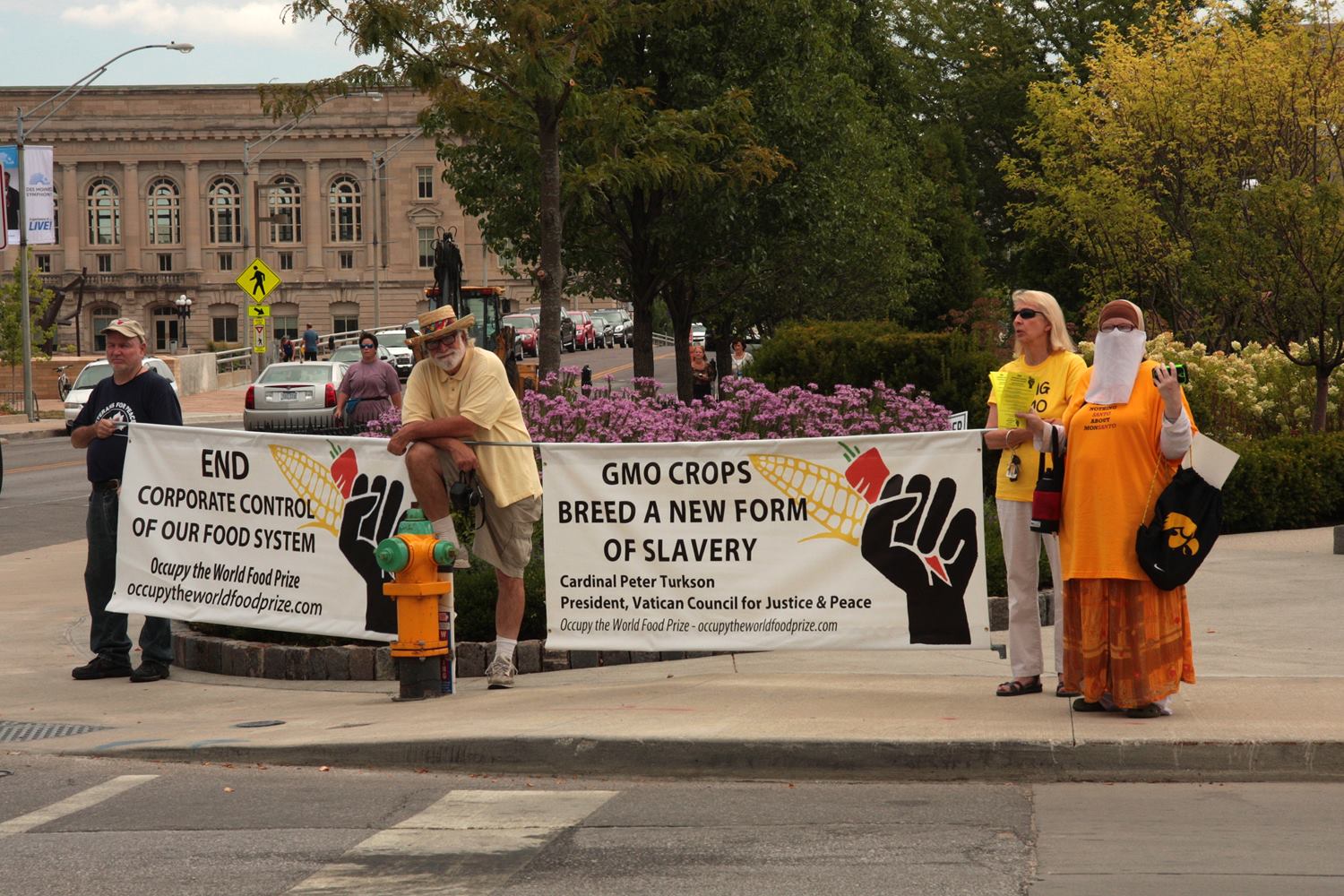
Occupy the World Food PrizeJim Hightower and his speech, From Factory Farms to GMOs, The Upchuck Rebellion Is Taking Root, has top billing at the Occupy the World Food Prize event on Wednesday, Oct. 16, at 7 p.m. at First United Methodist Church in Des Moines. Maybe that position should have gone to the special guest, Ghanaian Cardinal Peter Turkson.

Leave it to the Roman Catholic Church to point out one of the evils of the agricultural revolution that is genetically modified organisms (GMOs): over-reliance on corporations during third world development. In an article in the National Catholic Reporter, Rich Heffern quoted Cardinal Turkson, “making growers reliant on proprietary, genetically modified seeds smacks of the ‘usual game of economic dependence,’ which in turn, ‘stands out like a new form of slavery.'” Few people I know are talking about GMOs in terms of slavery, but the type of dependency U.S. corporations seek to create in Africa and elsewhere is tangible, and a normal part of development. Cardinal Turkson is at the center of this issue. (For more information, click here).

Cardinal Turkson is president of the pontifical council for justice and peace, a member of the Roman Curia, and potentially the first black Roman Catholic pope. He will be part of the World Food Prize Borlaug Dialogues, and has accepted the invitation to speak at Occupy the World Food Prize. As the National Catholic Reporter pointed out on Oct. 7, he will be talking to both sides in the GMO debate.

During an interview with Des Moines activist Ed Fallon, Occupy the World Food Prize organizer Frank Cordaro said, “our lessons from the occupy movement have taught us that the global financial system controls everything… and lo and behold, we discovered this World Food Prize, and when you look under the covers, it is completely owned and scripted by corporate ag.” “It’s not a world food prize, it’s a corporate world food prize,” Cordaro told National Catholic Reporter in a separate interview.

This year’s World Food Prize laureates are three individuals who have been instrumental in the development of GMOs used by Monsanto and Syngenta Biotechnology, and their companies underwrite a substantial part of the costs of the World Food Prize. Their election to the hall of laureates appears to be self-serving of corporate interests.

Cardinal Peter Turkson is expected to speak against the use of GMOs during the Borlaug Dialogues, which are another attempt by corporations to control the message about their business through so-called opposing views. The dialogues are another in a series of corporate attempts to create a false sense of rational discussion, when, like this year’s laureates, it is self serving at best.

The event flyer for the Occupy the World Food Prize is here. The World Food Prize website is here.

~ Written for Blog for Iowa

Categories
Home Life

Autumn Days

Turnip Green Soup Stock and Tomato Juice
Turnip Greens Soup Stock and Tomato Juice

LAKE MACBRIDE— As cleanup from the Sept. 19 storm continues, the weather has been almost perfect for outdoors work. The plants in the yard have come alive, and the garden generated a burst of food (collards, Swiss chard, turnip greens, arugula, herbs, tomatoes and peppers) as the first frost approaches. Days like these are as good as it gets.

Roof Damage
Roof Damage

Slowly… systematically, evidence of the storm diminishes. Yesterday I cut up the locust tree and spread the branches in the back yard for easier final cutting. Today a construction worker comes to repair the corner of the house. All that’s left is to finish with the locust tree and replace one of the downspouts damaged during the storm. Then to glean the garden, mow the lawn, and collect the clippings for mulching the garden over winter.

What then?

Much as we relish our moments of sunshine in brilliant autumn days, there is work to do before the final curtain falls and we join the choir invisible.

Writing About Apples

My writing will continue. It has become subsistence, a part of me, like blood production in the marrow, a way to breathe life sustaining oxygen in an unsettling and turbulent world. It is not expected to contribute much financially.

Farm work and gardening, participation in our local food system will continue at a subsistence level. There is inadequate income to be generated in working for someone else, and farm work will always be lowly paid.

There is family life, but little role for that in the blogosphere. We depend on our families, and little more need be said here.

Mostly, life will be living as best we can during moments of brilliance and trouble. Like these days in early October, when worry seems far away, and life so abundant.

Categories
Environment

The Cost of Carbon – 24 Hours of Reality

the-climate-reality-project-logoOn Oct. 22 and 23, The Climate Reality Project will connect the dots between carbon pollution and climate change with the global live-streamed broadcast “24 Hours of Reality: The Cost of Carbon.” here’s the link:

http://www.24hoursofreality.org.

In Iowa, men and women in the agricultural community are talking about the likelihood of four or five more years of continued drought. Harry Hillaker, Iowa state climatologist, indicated 2013 was the wettest spring on record. He confirmed this summer’s drought conditions in Iowa. Like this year, the prospect for coming years is wet springs combined with long summer periods of little or no precipitation.  There is no doubt human activity is contributing to this extreme weather, and that carbon pollution is the driving force behind it.

Not only are extreme weather events happening in Iowa, they are happening throughout the world. Extreme weather has a tangible cost in dollars, and in its impact on human society. 24 Hours of Reality will bring a global perspective to the climate crisis.

There are a lot of reasons to participate in 24 Hours of Reality, and here are three topics of interest in the program:

Chances are, you’re exposed to the cost of carbon pollution in ways you may not even realize— and the bill just keeps getting more expensive. 24 Hours of Reality will provide a tool to calculate the cost of carbon to individual communities.

Climate change can lead to rising food prices in wealthy nations, but in some regions, the consequences can be much more severe, threatening basic food security and leading to political instability in Somalia.

One of the greatest costs of climate change is what it means for our health. The broadcast goes to towns across Australia to witness the consequences of carbon pollution in terms of fire and flooding, and address what such changes mean for the health of ordinary people there and the world over.

24 Hours of Reality will address two key issues: protecting what we hold dear from the effects of climate change, and doing something to address the causes of our carbon pollution. Click here for a link to the 30 second trailer about 24 Hours of Reality.

I hope you will consider viewing part of 24 Hours of Reality on Oct. 22 and 23.

Categories
Work Life

Starry Morning

Apple Harvest
Apple Harvest

LAKE MACBRIDE— The sky was a dome of stars as the newspaper delivery truck made its way down the street. Outside to take the trash and recycling bins to the street for pickup, it was hard not to stop and gaze into the limitless space above. My clothing fit loosely from working low wage jobs this year, and the cool air found its way under the cotton knit and invigorated me, awakening possibilities. It lasted only a few moments, after which I grabbed an apple and ate it in Eve’s bower— forbidden fruit no more. The stuff of dreams and hope.

The remaining apples fall into five categories. A bowl of Cortland for apple crisp later today, a bushel of apples collected after the Sept. 19 storm blew them from the tree for apple sauce, a bin of the best apples for out of hand eating, and another bin of less perfect apples from the final pick, for a variety of purposes. A lot of the lesser Golden Delicious apples on the tree. They are available, but one suspects they will end up food for wild animals and insects, or as compost. The end of this year’s apple season is in view.

The plan for today is more chainsaw work in the yard. At least two more eight hour shifts will be required to finish cleaning up the fallen branches. A contractor is stopping by to estimate the roof repair from the Sept. 19 storm. The plan is to harvest the turnip greens and make soup stock, and finish gleaning the first garden patch, maybe the second. All of this is subsistence work, unpaid except that there is a buyer for the firewood I make, and food for our table.

As dawn begins to break, it’s time to leave the comforting glow of the computer screen and get to work. Just a few more keystrokes, and then off into the garden, seeking life, and redemption.

Categories
Social Commentary

Navigating Health Insurance Change

Wellmark PhotoLAKE MACBRIDE— As a self-employed writer and farm hand, having health insurance means buying an individual policy in the marketplace. The implementation of the Affordable Care Act’s (ACA) health insurance exchanges and initial open enrollment beginning Oct. 1 was a precipitating event for me and for others. There will be changes and some of them have little to do with the ACA.

There is a pent up demand in business to shed the cost of providing health insurance for employees, or to make it a fixed financial benefit. Already after Oct. 1, there is anecdotal evidence that small businesses are pulling the plug on group policies, and large businesses, like Mercy Medical Center in Cedar Rapids, are changing the rules for insurance benefits to exclude part time employees who are currently covered. If there is a way to stabilize or reduce the cost of having employees, businesses will find it, and the ACA appears to be providing the whipping post for moving forward to meet this long-standing want. Corporations and small businesses appreciate the opportunity this major cultural event represents. The days of employers providing health care to employees as a basic benefit are ending, if not over.

Wellmark Blue Cross and Blue Shield, Iowa’s largest health insurance provider, decided not to join the Iowa health insurance exchange during the first year. The expectation is the company will apply to be part of the exchange beginning Jan.1, 2015. In an interview with the Cedar Rapids Gazette last July, Wellmark CEO John Forsyth said, “the company was concerned about the lack of information available and the roll out of the exchange in Iowa.” Forsyth was skeptical of the federal government’s ability to implement the ACA smoothly. In addition to some website glitches in early October, some of the rule-making is incomplete. Wellmark’s decision is understandable from a business perspective, and the impact is that the network of health care providers available in the exchange during 2014 may be significantly reduced without Wellmark’s participation.

What’s a person with an individual health insurance policy to do? Wait. First, wait until December to look at joining the exchange on Jan. 1, 2014. Perhaps some of the details like provider coverage will be better identified to make the consequences of changing more understandable. Second, someone who has a grandfathered plan (no changes in policy since President Obama signed the ACA), may not want to change until there is more certainty about the outcome. The open enrollment period goes through March 2014 during the first year. Take advantage of that extra time. Third, resist the efforts of Wellmark and other providers to rush a decision to remain the same, or lock in rates. Whether or not the Iowa insurance exchange will offer lower rates for equal coverage is uncertain. No reason to make a decision until one gets enough facts about the rates and coverage, and compares apples to apples.

There were five insurance company sales representatives in a health care reform seminar last week, compared to yours truly as the only member present. Organizations who sell health insurance have a lot to lose with implementation of the ACA, and the move to a marketplace. These insurance agents answered all of my questions, and the information provided will help in making a decision about health insurance. Getting facts and working through them, as I did, is essential in navigating change in health insurance, and there is no hurry to make a bad decision.

Categories
Home Life

Caesura

Silhouette on Parched Ground

LAKE MACBRIDE— It’s 50 degrees at 4:30 a.m. with a slight chance of precipitation around lunchtime. There is a break in the narrative— caesura.

Intense activity with local food producers during recent months engaged me fully. Suddenly, expected, it is over. The pause is welcome. It’s time to reflect, catch up on neglected work and renew efforts to sustain our lives on the Iowa prairie.

Today will be a day of building a to-do list. When the sun rises, it’s outside to cut up the locust tree and fallen limbs from the Sept. 19 storm. The garden gleaning needs completion. The house needs repair. The list builds already. During this pause, there is much to do to prepare for winter, and before long, life will reengage my energy and attention. Already it leaks in. I’ll resist for another hour, and then embrace it again… until the next caesura.

Categories
Work Life

Attire at Work

Work Clothes
Work Clothes

LAKE MACBRIDE— There was a time when wearing a suit to work was de rigueur. While commuting to the Chicago loop I wore and wore out countless suits purchased to fit into the corporate culture of 200 East Randolph Street, the Illinois Center and the Prudential building. Those days are over. Silk ties hang on a rack in the back of the closet, lined up behind woven plaid shirts purchased long ago. There are only one or two decent dress shirts on hangers until a funeral or formal presentation wants the attire.

My work clothes on the farm have become blue jeans, a T-shirt and a pair of Justin boots purchased while working in west Texas. No collar, indicating the meaninglessness of so-called blue or white collared work. Most of the people I know in the local food system are either working on a degree, have a bachelors, or have done postgraduate work and have a masters or doctorate. Some wear collars, and some do not. Clothing is functional and long lasting if it is anything— less a symbol of an arbitrary status or social class.

While writing, it’s the same attire, sans shoes with white socks. After buying cheap tube socks for decades, I switched to a heavy cotton sock purported to be for wearing with steel-toed shoes. They are deluxe. The cost of one of my Chicago suits could have purchased a lot of them.

Categories
Writing

New Blog Feature – Restaurant Crawl

Restaurant CrawlLAKE MACBRIDE— During the next few months I’ll be making a restaurant crawl to every eatery in our area. The results of this activity will be written about and linked on the circled page above. Click on the image to find the beginning list of restaurants with links.