My supervisor at the home, farm and auto supply store unexpectedly called me to the office and offered a salary commensurate with the work I do.
“Commensurate with the work,” means closer to the average wages for the position as defined in the Bureau of Labor Statistics Occupational Outlook Handbook, which lists a job closely matching what I do.
He would convince me to either stay or continue working part time. I said I’d consider the offer and respond this week.
In every job I’ve held since leaving for military service, I’ve become a valued member of the team. In many cases, mostly when I worked for a large transportation and logistics company, I was replaced with two people after resigning. I understand the value of my work.
People have reasons for taking lowly paid work. This is especially true in my county, where there are numerous job opportunities for anyone willing to work. People take a low-wage job to generate income then move on to something better. We all have our reasons.
I took work at the home, farm and auto supply store and stayed because they offered a family health insurance plan to cover us until Medicare. Now that both of us are on Medicare, that reason was eclipsed by a desire to do other things. We have delayed gardening, talking, writing, reading, repairing and retooling our home for too long. That’s reason to retire March 16 while still young enough to accomplish some of that.
Opening the question whether to leave is also about security. Financial security partly, but physical health, being accepted in society, and the ability to live a life free from worry. The offer moved security to the front burner after simmering from the initial math of planning our retirement.
We are never completely secure. If a catastrophe happens in a life, people will invest everything they own to recover and return to a semblance of normal. Such normality is the endgame, especially in Iowa. Complete security does not appeal to people like me. I’m still a risk taker and know my limits.
I don’t know my answer and will mull it while soil-blocking at the farm. I did the math and the extra income would help pay down some of our debt. It is a bird in hand against the unknown of how could we generate extra funds in retirement. It would come with a cost I’m not sure is worth the price.
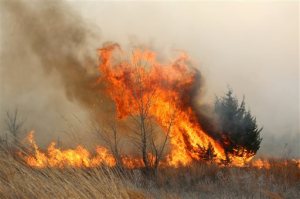
Kansas Grass Fire. Photo Credit: Travis Morisse/The Hutchinson News via AP
I’d go back to Kansas for a visit.
More specifically, I’d like to see the Eisenhower Presidential Library in Abilene.
Not that I like Ike or have many memories of his administration. He was president at a time when our family was unsettled. After we moved to a permanent home in 1959, my neighborhood friends were consumed with talk about World War II, including Eisenhower, because so many we knew had been in the war. Eisenhower was of that era which was eclipsed by John F. Kennedy, Lyndon Johnson and Richard Nixon. I don’t recall Nixon speaking much to Eisenhower as the aging soldier faded into history in 1969.
In 2007 I traveled to Kansas on business. It was a hopeless sales call that mustered some of our logistics company’s best talent for a whim. During nights in Parsons and Wichita I posted about Kansas and the demise of coal-fired electricity there. Political uncertainty about greenhouse gas emissions was killing capital investment in new coal plants in Wyoming and Kansas.
I’d return to Wichita to see where the Kochs came up. I doubt I could walk up to Charles Koch’s front door and find him home, but I’d make a special side trip enroute to Abilene to see Wichita through that frame.
Today, “Kansas” and “the Koch Brothers” have become talismans for too many Democrats.
I don’t see positive value in comparisons of legislation Iowa Republicans are considering to what happened in Kansas. Iowa is not Kansas and that is exactly how Republicans will use this comparison against our Democratic candidates.
The people of Kansas elected and re-elected Governor Sam Brownback knowing his history better than we do. His tenure is described on Wikipedia:
Brownback was elected governor of Kansas in 2010 and took office in January 2011. As governor, Brownback initiated what he called a “red-state experiment”—dramatic cuts in income tax rates, intended to bring economic growth. He signed into law one of the largest income tax cuts in Kansas history. The tax cuts caused state revenues to fall by hundreds of millions of dollars and created large budget shortfalls. A major budget deficit led to budget cuts in areas including education and transportation. While Kansas’s economy has performed reasonably well since the cuts were passed, the economies of neighboring states have done as well if not better. In the run-up to the 2014 gubernatorial election, over 100 former and current Kansas Republican officials criticized Brownback’s leadership and endorsed his Democratic opponent, Paul Davis. Brownback was reelected in a close race with a plurality, a margin of 3.7 percent. In June 2017, the Kansas legislature rolled back Brownback’s tax cuts and enacted tax increases.
In a repudiation of the federal Patient Protection and Affordable Care Act, Brownback in 2013 turned down a $31.5 million grant from the U.S. Department of Health and Human Services to set up a public health insurance exchange for Kansas. Also in 2013, he signed a bill that blocked tax breaks for abortion providers, banned sex-selection abortions, and declared that life begins at fertilization.
Are there comparisons to be made with Kansas? Of course.
However, Iowa Democrats should be ever cognizant the budget problems in this state were created by the largess of Governor Branstad, Republicans and Democrats in handing out tax credits that contributed to the last two years’ revenue shortfalls. In addition, Branstad enacted a sales tax exemption for many businesses. In retrospect, he must not have had a clue how large a decrease in tax revenue it would create. My point here is Iowa made its own problems before Republicans controlled the governor’s office and both chambers of the legislature. In that respect, we are not like Kansas. As gubernatorial candidate Ross Wilburn keeps telling us, “Let’s be Iowa.”
Regarding the Koch Brothers, Iowa Democrats need to give it up. Every Iowa Republican who has been attacked for taking Koch Brothers’ money has credibly denied it, even members of the American Legislative Exchange Council and Americans for Prosperity, two Koch-backed entities. That’s not to say the influence is absent, just that Democrats are losing this messaging struggle. Jane Meyer’s recent book, Dark Money: The Hidden History of the Billionaires Behind the Rise of the Radical Right tells the story of dark money in politics, including the role Charles and David Koch play. It is way more complicated than a single family advancing its agenda. To create a totemic relationship with the Koch Brothers or Kansas is the wrong framework to win voters and elections in Iowa politics.
The people I know who live in Kansas, including family members, don’t have issues with the state. Like all of us, they are working to sustain their culture in a turbulent world.
I get the fact raising “the Koch Brothers” and “Kansas” is a form of confirmation bias among Democratic activists. However, as Senate District 37 candidate Zach Wahls posted on twitter last night, “It’s a reference that, in my experience, tends to work among Dem activists – but it’s a head scratcher among non-activists.”
Driving through ranch and mining country along Interstate 76, large square bales of hay are stacked four high as a windbreak around feedlots. The harvest is in and irrigation rigs idle.
On the distant horizon are wind turbines, It’s difficult to see if their blades are turning. Empty coal trains are on the move and motor traffic was light. Cloud formations played against an azure sky coming into Colorado.
As we exited to the Denver bypass, an enormous flock of birds descended onto a surface of water. We too were intending to settle for the night in Colorado Springs.
The Antlers was opened a couple of years after the founding of Colorado Springs in 1871, situated with a view of the mountains and close to downtown. It was and is a resort designed to be away from the rough and tumble of the mining community and daily life. There were not a lot of cars in the adjacent self-park garage, and the hotel staff has been personable and helpful. It has been quiet during our stay.
At the end of 2008, the patterns of our lives feel played out.
Getting through the year marks us as survivors, pragmatists, realists and as individuals pitted against a society that rebukes our endeavors to rise above the trivial and petty. There are powerful interests at work.
As individuals we can cope through focus on family and friends and by renewing our efforts to take actions that result in improvement of our life in society. Our hope is that after the family retreat, and we head back home through rural Colorado, Nebraska and Iowa, there will be a new opportunity to repair the society in which we have been participants for much longer than there have been retreats in the Colorado mountains.
From this mile high view, it does not look like we will miss many of the events of 2008. It was a year of reality staring us in the face, and was not always pretty.
Will we make something of the coming days, or will we resemble revelers at a ball, donning a mask to look through the rigid certainties of the maker’s design. We must work toward the former with all of our energy as we return home to the next work.
~ An earlier version first posted December 31, 2008.
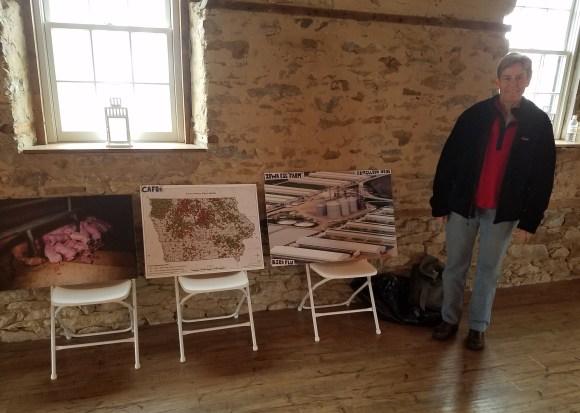
Lynn Gallagher with her posters about CAFOs at the Rep. Bobby Kaufmann town hall in Solon
SOLON, Iowa — What you see is what you get. Politics is more meaningful with experience and a proper lens. Our view of things is imperfect.
A political Saturday began with a meeting of the county party arrangements committee in North Liberty where members went around the table to introduce ourselves and tell how we got active in politics.
My first political campaign was for Lyndon Johnson. After taking the bus downtown and paying my weekly carrier newspaper bill, I stopped by the Democratic party office to help out. I wanted an LBJ for the USA campaign button and asked for one. They had me stuff envelopes for a while then gave me a button. The 1964 election built my expectation as a Democrat that we would win every election by a landslide. Imagine my disappointment when Richard Nixon was elected in 1968. Imagine my outrage as he dissembled about the war in Cambodia. Imagine how I feel now.
A fluffy, wet snow was falling as I left the arrangements meeting. I swept a couple inches off the Subaru with a broom and made my way across the lakes to Solon where Rep. Bobby Kaufmann was holding a town hall meeting at 1 p.m.
The town hall venue was the Palmer House Stable built in 1838. It has a turbulent recent history as it was bought for cheap and remodeled in a way that forced the owner to declare bankruptcy. A local Republican owns it now and holds some events there. He donates use to Kaufmann a couple times a year. Covered in snow, it looked very picturesque as I walked up to the door.
The setup was clean but uncomfortable with cheap plastic folding chairs. Local resident Lynn Gallagher brought posters with information about Concentrated Animal Feeding Operations and lined them up on chairs along the wall in the main room. Someone else brought a couple of trays of mini-cupcakes. When the town hall ran long, half a dozen attendees stood up from the chairs to alleviate back pain they caused. Despite the discomfort, I didn’t see anyone leave until the question and answer period was over.
In all 23 people plus Kaufmann attended the meeting, about double the normal number for a Kaufmann town hall in Solon. Most of the faces were familiar and most attendees had a prior relationship with Kaufmann. Whenever he took a note to get back to someone, he did not ask their name. He called on many of us by name to ask our question. To say attendees were supporters is not true. At the same time everyone had an interest in government, a relationship with the representative, and more interest than usual demonstrated by venturing out on slippery roads to attend. Based on attendance and level of engagement, interest in politics continues to run high in the 2018 midterm election cycle.
I found the town hall to be valuable because Kaufmann gave a glimpse into his work in the House and the environment in the Republican caucus. His view was surprisingly insular and focused on the House, not Republicans in general. For example, according to his response to the Republican who asked the question, he didn’t know that the Senate had advanced the embryonic heartbeat bill until someone from Cedar County pointed it out to him. The takeaway is the heartbeat bill is unlikely to get 50 votes in the House because Republican members believe that when it is struck down by the courts, it will be done in a way that makes it difficult to appeal to the U.S. Supreme Court. Getting another abortion-related issue to the Supreme Court is the endgame of the flawed bill.
A good mix of Democrats and conservatives attended the meeting, although the group leaned somewhat Democratic. It seemed ironic that a current Iowa City School board member asked about his pet projects rather than school funding, and a former Solon school board member was more interested in the heartbeat bill than school funding. To characterize the meeting, school funding was not raised as an issue with the current legislature.
Kaufmann gave about ten minutes to answering my question about Governor Reynolds’ proposed tax cut, which I felt was generous. The new federal tax bill is forcing the state to do something to avoid a dramatic increase in taxes, according to Kaufmann. Governor Reynolds wants to delay addressing the $500 million in tax credits going out the door each year until next year. Kaufmann and other house members want them addressed this session.
Mental health got the biggest part of the discussion based on time and number of participants. I appreciated the woman who coached Kaufmann on mental health messaging. His statement, he was waiting to see the revenue estimate before action, seemed like a dodge of the need to do something to fix the mental health regions Republicans previously designed. Why wouldn’t the legislature determine what is needed to fix the mental health system and only then determine how to pay for it?
We talked about gun control beginning with a neighbor’s suggestion county sheriffs register assault weapons like the AR-15. This kicked off a long, albeit civil discussion about gun control that bordered on a skirmish. It had me wondering who might be packing. Kaufmann let the discussion get out of control and it degenerated into a pointless endeavor of confirmation bias.
The strong attendance at the town hall was a sign that people are engaged in politics more than in previous years. My conclusion afterward was that even on a snowy day people can come out, be civil, and learn about our government. This group was definitely not a flock of sheeple. People are engaged in politics more now than I can recall since 2012. An electorate for change in November is beginning to come together.
Mad Hatter’s Tea Party – Photo Credit Wikimedia Commons
I favor tax relief.
The relief I favor is from worry that the state can pay its bills.
Each year the Iowa Legislature and Governor are required by law to create a balanced budget. The last two years, they couldn’t support their own budget as there was a revenue shortfall and mid-fiscal year cuts had to be made. These cuts equate with our government inadequately understanding the tax revenue stream.
In this environment it makes no sense for Governor Kim Reynolds to propose cutting taxes:
“The plan is projected to cut income taxes by $1.7 billion by 2023, while maintaining expected growth rates in revenue,” according to the governor’s web site. “Even assuming no dynamic effect (economic stimulus) from federal or state tax reform.”
Everyone who believes that stand on your head.
A revised tax policy may be needed. Before Republicans get carried away with the idea some basic housekeeping is required.
Let’s go a complete fiscal year without having to amend the state budget.
Let’s understand how the agricultural economy impacts tax revenues.
Let’s pay back the rainy day fund that was tapped to make up for revenue shortfalls.
Let’s understand the impact of the business sales tax cuts Governor Branstad made.
Let’s understand the impact of business tax credits given to the Iowa Fertilizer Plant, Apple and others.
Let’s do as a state what we should have been doing with our budget all along.
Reading the governor’s tax proposal is like entering the Mad Hatter’s tea party. The March Hare offers wine to Alice, only there is no wine.
“It wasn’t very civil of you to offer it,” Alice said.
~ Submitted as a letter to the editor of the Solon Economist
Can low income workers and retirees afford social media?
The conclusion I’m coming to is no.
Social media has served to engage me in writing brief posts, in collecting news, and from time to time, in chatting with friends and acquaintances. It helps pass time during breaks at the home, farm and auto supply store. Social media posts have been the subject of conversations at home. A few clicks and I can view what friends from the old neighborhood are doing. I can follow news reporters to tailor my feed and quickly match stories with my interests. As I approach retirement and feel the suck of a vortex into the pit of aging these uses seem less relevant.
I don’t think of myself as old although my frame reminds me I’m not as strong as I was ten years ago. Something’s got to give and I’m pretty sure it will be my time on social media.
What will I do instead?
I’ll keep writing, turning my blog into a primary way for people to follow me and keep up with I’m doing. I’ll get back to journaling and work on bigger projects I have discussed on this site.
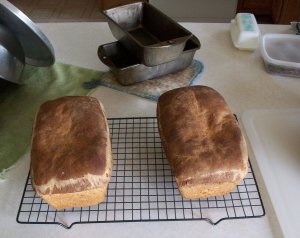
I’ll do the unpaid work at home that helps people of limited means get by: baking bread, gardening, preserving food, making our meals more from scratch, home exercise, exploring home remedies, learning how to fix things around the house, and useful chores.
I’ll decrease my driving to keep a smaller carbon footprint — I don’t really enjoy driving as I did. Maybe get the car out once a week to pick up supplies, twice if I need unexpected parts while fixing something around the house. There will be occasional social outings.
I’ll read books and magazines in addition to internet articles, mostly to serve my writing.
I’ll downsize and organize in preparation for when the final curtain falls.
Today is Ash Wednesday and Valentine’s Day — an odd coincidence. Rose Monday is past, Mardi Gras finished. It’s time to contemplate our mortality in light of love, hoping spring works it’s magic again. A rekindling of hope to get us through this ashen world.
Democratic Committee Volunteers Meeting in North Liberty, Iowa
In September I asserted we should be working to stop nuclear weapons and protect the environment. A year into Trump’s first term it’s clear I understated this need.
The Trump administration rolled out it’s nuclear posture review and oh brother. Obama was bad enough with the $1 trillion modernization plan he negotiated with Arizona Senator Jon Kyl to get the New START Treaty ratified. Our new president is off the charts mad regarding the nuclear complex, or as Rolling Stone‘s Matt Taibbi described him, “insane and ignorant.” There’s a lot to do to resist.
On the environment, it’s as if the Trump administration handed the keys to the front door to the wolves who have been howling and trying to get inside where we live. Ryan Zinke at Interior has reduced the size of some national monuments to make way for exploitation of oil and gas deposits; Scott Pruitt at the Environmental Protection Agency seeks to roll back regulations that protect us to loosen the regulatory chains he claims bind business; Rick Perry at Energy seeks to change the paradigm of growing renewable energy resources to one of increasing stockpiles of coal, oil and uranium. The plan was preconceived and executed with dizzying speed.
What to do to resist?
The focus has to be on electing Democrats in the 2018 midterm elections. Reason doesn’t matter to the Trumpkins. They understand political power. All efforts for the next eight months should be toward re-taking the U.S. Senate and/or House of Representatives, and to make inroads in the state of Iowa by electing a Democratic Governor and re-taking the house or senate or both.
It’s really that focused, that simple. Will a Democratic government get us what we want? The Obama administration nationally and the Culver-Judge administration in Iowa stand as examples it won’t. Regaining political power will re-establish our dominance and hold the wolves at bay, and that may be the best we can hope for this year.
It would be something positive in a government currently overrun with pirates seeking to loot the treasury and pillage the commons. As a society we can do better than this. We must pick our battles carefully and from today’s vantage point there is a lot to bring us together to stem the tide against reason. Nuclear abolition and protecting the environment are both worth our efforts. There are broader currents to bring us together during this election cycle.
In a throwback to my work at a major logistics company I made a batch of vegetarian jambalaya for this week’s lunches.
The dish was born in Thomas County, Georgia as I was sequestered in a hotel for four months implementing a logistics project at a clay mining and processing plant. I had access to what was then called the TV Food Network and Emeril Lagasse. I made the techniques I learned my own.
Here’s a recreation of today’s recipe:
Ingredients:
2 tablespoons high smoke point oil
4 tablespoons butter
4 six-inch vegetarian sausage links sliced 1/4 inch on the bias
1/2 pound frozen sliced okra
2 cups diced onions
1 cup diced bell pepper
1 cup diced celery
4 cloves garlic minced
1 15 oz can red beans drained and washed
1 cup long grain brown rice
1 pint diced tomatoes
1 quart prepared vegetable broth
Salt, red pepper flakes, curry powder, prepared hot sauce to taste
In a Dutch oven, brown the sausage in cooking oil. Remove and set aside.
Melt the butter in the same pan and heat the red pepper flakes until aromatic.
Add the onions, celery and bell pepper. Saute until soft.
Add the garlic and stir together. Cook for five minutes over medium heat.
Season with salt, pepper, curry powder and hot sauce.
Add the pint of diced tomatoes and rice and stir together.
Add the quart of broth and bring to a boil.
Add the okra, beans and cooked sausage and mix everything together.
Cover and bring to a boil. Turn the heat to medium low so the liquid bubbles gently through.
When the rice absorbs the moisture, stir and serve with fresh, sliced green onions on top.
Makes six generous servings.
Across the lakes in North Liberty, the first meeting of the county party’s arrangements committee will convene today at 10 a.m. Having served on platform, and with limited interest in credentials, rules and nominations, it’s the only one for me if I want to engage in local politics.
Caucuses are over with a bit of afterglow. According to our data management/membership chair John Deeth, Johnson County turned out 973 caucus-goers, tripling the previous record for an off-year caucus.
We are now in the primary phase of the 2018 midterm election campaign and it’s time for candidates to start their first canvass if they haven’t. Today, few primary voters even know who the heck some of these people are. It will be best if one of the Iowa gubernatorial candidates wins the primary with 35 percent of the vote. If no candidate wins that primary and it goes to convention, expect more division among Iowa Democrats. The key for personal survival is to pace ourselves if we want to be useful.
It is early to make primary picks as the filing period has neither opened nor closed. At the same time, it’s hard to imagine anyone else jumping into the governor’s race. After two conversations, including an in-person one last night, I’ll be supporting John Norris for governor.
I found him near the sign-in table at a house party in Coralville and asked my question. There is a bill in both chambers of the legislature to deregulate public utilities. As former chair of the Iowa Utilities Board, I expected Norris to have some insight. He wasn’t familiar with the bill but said that deregulation would hobble Iowa’s renewable energy program. He obviously enjoyed talking about the subject and gave me a new perspective. We covered MidAmerican Energy, Bill Fehrman, vertical integration of Iowa wind farms, merchant sales of electricity and its relationship to public utilities, the nuclear plant in Palo, the impossible idea of building new nuclear power plants, and his work with energy policy and climate change in the Obama administration. There’s not much daylight between us here.
That was generally true about Norris’ policy discussion in a 17 minute speech for about 50 attendees. I felt déjà vu as I had been in that room before with another candidate and campaign. Norris laid out the issues the way I would, in similar language, emphasizing what I also felt was important. This was particularly true with the discussion about mental health services for children, and reversing the damage done by the 87th Iowa General Assembly to collective bargaining, women’s reproductive rights, and voter rights. With so many of my political friends already supporting John Norris, adding my name to the volunteer list became easy.
I haven’t gotten too deep into other statewide Democratic primaries. I expect to support Deirdre DeJear for secretary of state and the rest are undecided. In the three-way primary for Senate 37 I’m supporting Zach Wahls. Jodi Clemens has not drawn a primary opponent in House 73 and she’ll get my support after the primary.
I haven’t been paying enough attention to even know who-all is planning to run for county supervisor, although it’s already more people than the two seats up this cycle. Incumbents Mike Carberry and Janelle Rettig are both expected to run for re-election with Carberry already announced. Pat Heiden is making her second attempt at a supervisor primary win. Based on scuttlebutt that’s always circulating among township trustees, someone else could throw their hat in the ring. We’ll see how that race develops.
The other part of being useful in politics is knowing where one stands on the wicked problem of flipping the statehouse. Saturdays like today help iron out where things stand. Politics Saturdays are essential to personal balance and moving the ball forward.
Caucus attendees are activating to do something in November for a better politics. I’m with them and plan to help get the rest of the electorate activated as well.
We’re prepping for our annual inventory at the home, farm and auto supply store.
That means counting and labeling everything in the warehouse, and getting every possible item to the sales floor where hired staff can count it and customers can find it to buy it.
Inventory occupies a big space in the life of a retail outlet.
So it is with everything at home while getting ready for full retirement in 36 days.
We benefited from building a new home in 1993 by having to do very few major repairs. We changed the roof once, repaired the garage door, and that’s it. We’ve cycled through major appliances — refrigerator, dishwasher, washer and dryer — but have had very little work on the structure itself. A lot of little things require attention now.
In a flurry of emails this week I confirmed four part-time, seasonal jobs this year. One is writing for Blog for Iowa this summer, and the others are farm-related. Combine home repairs, these four jobs, my community organizing work, and political work during the midterm election cycle and there will be plenty to keep me busy in 2018.
Last night I ran into my former state representative Ro Foege at the warehouse club. I automatically shook his hand then apologized for spreading germs from my recent illness.
“I just came from the capitol,” he said. “I was exposed to a lot worse up there.”
I have a different view of political engagement this year. Mainly I want to be a helper of younger people who are engaging in politics. That means volunteering where I can, encouraging people, and contributing in ways people ask.
The metaphor of WYSIWYG, taken from the advent of computer graphical user interface, is an apt model for what I’m doing. The operative function of building an electorate presumes nothing and is rooted in a belief the 2018 general election electorate is not pre-made. It is being formed as we proceed through time and events toward election day. We have to pay attention to what is happening in real time and modify our activities to create a successful process.
It began with this week’s off-year caucus and engages voters with our many primary candidates for statewide and local offices. I see four remaining milestones for building the electorate: the June 5 primary, summer parade season, the fall campaign beginning on Labor Day, and the final week before the election. If we work early and smart, we should know where we stand as election day approaches. We should not freak out, just do the work.
Tonight after a shift at the home, farm and auto supply store I plan to meet Iowa gubernatorial candidate John Norris at a house party in Coralville. He may be the one for whom I’ll vote in the primary. More importantly, I want to see who is turning out for Norris and ask one or two questions if there is an opportunity. It’s not about my single vote, but about understanding the process. It’s not about me or him but who we are as Democrats in a state Donald Trump won by more than nine points. It’s about taking stock of our lives and effecting change in our government.
As some caucus-goers said Monday night, “we have to do something in November.”


 Journey Home
You must be logged in to post a comment.