Categories
Living in Society

Slaying a Foreign Government Official

Dr. Maureen McCue speaking for the Iran Deal at Rep. Dave Loebsack’s Office Aug. 31, 2015

The politics of Iran has been on my radar since the Iranian Revolution when Mohammad Reza Pahlavi was overthrown in 1979 and an Islamic republic replaced the monarchy.

I lived in Mainz, Germany that year. I was a mechanized infantry battalion adjutant in the Eighth Infantry Division, which, as part of V Corps, was training for a war in the Middle East over oil. Across the Rhine river from us was Wiesbaden, the evacuation point for American citizens fleeing Iran in the wake of the revolution. Our unit provided support to the Wiesbaden operation during the evacuation.

One of the choices I made during that time was which of my peers in the battalion would be sent to Iran during the aftermath of the Shah’s overthrow. I picked someone whose family wasn’t with him in Germany. My friend was never deployed to Iran and we were all grateful for that.

In this context it is natural that the United States assassination of Iranian Major-General Qassem Soleimani, head of the Iranian Revolutionary Guard Corps Quds Force would catch my attention. What I wasn’t prepared for was spending so much time following developments. When I write “developments” what I really mean is the slow, uneven release of information about what happened and what it means. Yesterday’s post is a list of the main questions raised early on in the discovery process. Answers have proven complicated and elusive.

I was reading the news right when I wrote Soleimani was a target of opportunity. That means the U.S. intelligence community had long been tracking his movements and after President Trump gave the order to slay him, when his movements at the Baghdad airport exposed him and his entourage, there was an opportunity to take action and our military did. While our president seems impulsive, in this case there was a developed plan to assassinate Soleimani.

Two things make this different. First, Soleimani was revered in Shia Muslim culture. His death by unmanned drone attack elevated him to martyrdom and could bring a ruptured Iranian society together in opposition to the United States. Second, he was part of the Iranian government the way Chairman of the U.S. Joint Chiefs of Staff, Army General Mark Milley is. It is important to note Soleimani’s status was distinct from a figure like Osama bin Laden who was a rogue, non-state actor. People who make a proportional comparison between Soleimani and bin Laden are wrong to do so.

The politics of this have been predictable as Heather Cox Richardson pointed out in her daily Letters from an American:

Last night’s news about the assassination of Iran’s military leader Qassem Soleimani has today turned into a predictable split. Defenders of the president insist that Soleimani was an evildoer and the United States absolutely should have taken him out. They have no patience for anyone questioning Trump’s decision, suggesting that those questioners are anti-American and pro-terrorist if they do not support the killing of a man they insist has been one of our key enemies for years.

Those questioning the president’s decision to assassinate a member of a foreign government as a terrorist freely acknowledge that Soleimani was a dangerous man. But they are concerned that Trump appears to have ordered the man assassinated illegally and has, in the process, ignited a firestorm.

If you are reading this post, you should consider subscribing to Richardson’s daily emails.

Whether President Trump had constitutional or legal authority to assassinate a member of the Iranian government without consulting the Congress remains an open question. The administration claimed it was free to act under the 2002 Authority for the Use of Military Force enacted by congress in the wake of the 911 terrorist attacks. The U.S. named the Islamic Revolutionary Guard Corps, of which Quds Force is a part, a terrorist organization. Friends Committee on National Legislation has been lobbying the Congress to repeal the 2002 AUMF. The incident yesterday in Baghdad highlights the pressing nature of Congress reasserting its authority over the executive branch of government in matters of war and peace.

In today’s Iowa City Press Citizen, Zachary Oren Smith posted the reactions of three people running for congress. Smith’s framing was “early reactions to the U.S. military strike that killed Iranian Gen. Qassem Soleimani fell along party lines in Iowa’s 2nd Congressional District.

Democrat Newman Abuissa, a native of Damascus, Syria, reacted to the assassination, “If the goal of the U.S. is a regime change or to negotiate a better deal, this attack makes both goals impossible to achieve. It strengthens the government of Iran and makes it impossible for them to sit down with the U.S. president.”

Both Republicans supported the president and Schilling was quoted at length, parroting long-debunked talking points.

What makes easy media narratives like Smith’s difficult is the decades-long context in which Thursday’s assassination took place. Simple comparisons serve little purpose and push a struggling news outlet closer to irrelevance.

My questions from yesterday aren’t answered. After spending too much time following the news, my work on other projects lagged behind. I need to keep moving. 2020 is here and there is much I want to accomplish.

I did make time to visit a friend whose spouse died Wednesday. She said of him, “at least he got out of here before all this shit happened.” It remains for those of us living to deal with it and carry on.

Categories
Living in Society

Questions About Our New War With Iran

Photo Credit: Des Moines Register

At 3:15 a.m. CST my phone rang. It was an international call from Jordan. I don’t know anyone in Jordan and the caller did not leave a message.

I know a few people who travel in the Middle East from time to time. None of them stood out as a person who might be calling the morning our country assassinated Iranian Major-General Qassem Soleimani, head of the Iranian Quds Force, as a target of opportunity at the Baghdad airport.

I had not heard of Soleimani so I found and read Dexter Filkins Sept. 23, 2013 New Yorker profile. However this decision was made, intentionally or not, the U.S. Government kicked the beehive of Shia efforts toward hegemony in the Middle East. We will likely be stung by this extrajudicial exercise of American military force.

There is not enough information despite the rapid response of social media. The vacuum generates questions:

Why didn’t the president inform the gang of eight of the imminent assassination? Given the prominence of the target in Iranian and Middle East society he should have. House Speaker Nancy Pelosi was clear he hadn’t.

Why didn’t the administration seek an authorization for the use of force from the U.S. Congress? According to Pelosi, there is no existing authorization relative to Iran.

When will the president address the public on what he did and why?

Was this assassination retaliation for the recent attack on the U.S. Embassy compound in Baghdad or part of a long-term plan to enter war with Iran?

What will be the consequences for U.S. interests in the region? Iranian officials have already stated publicly there will be revenge for the slaying. We can expect them to act with thoughtful reserve and to think outside the box.

Who will replace Soleimani in the established and future operations for which he was responsible?

What was the benefit to U.S. interests of elevating Soleimani to the status of martyr?

There are a lot of questions, few answers, and a grim pall has been cast over this Friday in Iowa.

Categories
Kitchen Garden

Challenges in a Local Food System

Work Clothes at the Farm

My 2013 decision to develop a barter arrangement with my friend Susan Jutz helped resolve a couple of issues.

I needed the cash income plus a share of the vegetables she grew. More importantly than income, I wanted to become a better gardener and needed a mentor.

By almost any measure our relationship was successful and endured even as Susan sold her farm and moved out of state.

On Feb. 1, 2013 I sent this email proposing an arrangement at her Local Harvest CSA:

Susan:

Hope you are staying warm. I have an interest in developing a deeper relationship with producing local foods. While our kitchen garden is doing well, I want to explore the possibility of doing more with local foods to provide a source of income. This is a long range project, and if you offer it, I would like to exchange my labor for a share of your CSA this season.

I think you would find this a cheap and reliable source of farm labor, and what I would get out of it would be a deeper knowledge of how you do your work.

What do you think?
Regards, Paul

We worked through details that lasted not only that season but established a continuing relationship now entering its eighth year. I expect the conversation about local food to continue this month with Carmen, Susan’s successor. Greenhouse work usually begins in February.

The Community Supported Agriculture model is the workhorse of the local food system. Instead of producing a few fungible commodities, CSA farms produce many types of vegetables in many varieties, providing a weekly share for members who buy in at the beginning of the season. They also leverage other producers to provide eggs, meat, bread, jellies, jams, and other items they don’t produce for their customers. On Carmen’s farm she produces grass-fed lambs and goats. The presence of livestock on a farm is an important part of reducing reliance on chemical fertilizers. Some CSA farms are more diverse than others but the salient feature is that the main consumer model is changed to include a share the farmer provides.

Operating a small farm is challenging. It requires hard work and specific knowledge about a wide variety of issues. It seems like more work than people with a big job at a large-sized employer are used to. There is also more risk during a growing season. Most local food farmers I know do something off the farm to supplement farm income. Every one of them has a positive disposition despite the challenges.

There is an ongoing discussion about alternatives to the CSA model.

Chris Newman of Sylvanaqua Farm in Virginia posted an article on Medium in which he wrote, “The romance of neoliberal peasant farming blinds us to our collective power.” Newman’s assertion is small family farms are not competition for, or a sustainable answer to burgeoning consolidation of agriculture. He touched on a number of obvious points, beginning with farmers markets.

Farmers markets are nice for consumers, but expensive to participate in. If some local food farmers produce for the seasonal markets they compromise their flexibility and scalability, he said. I don’t know about the operational advantages of a local food cooperative because many farmers already coordinate activities with each other. A farmer of meat, vegetables, flowers or the like can do better to avoid such markets. At a minimum one requires additional outlets to extend sales beyond the farmers market season.

Newman lays out the challenges small family farms face regarding workforce in a labor intensive business. Putting together a workforce that accomplishes weeding, cultivation, planting, harvesting, pest control, and everything else isn’t easy when the operating assumption is some percentage of workforce will volunteer or work for very low wages. Newman’s idea of forming a cooperative addresses the wage issue but also seems overly idealistic.

In his book The New Farm: Our Ten Years on the Front of the Good Food Revolution, Ontario farmer Brent Preston tells the story about how he and his spouse found sustainability in the local food movement by transitioning away from farmers markets to wholesale production and sales. This book is a must read for people interested in the local food movement.

Michelle Kenyon, executive director of Field to Family, is establishing a food hub in Johnson County. She’s been featured in the local newspaper. The idea is simple from a farmer’s perspective. Got too much basil? Bundle it to specs and sell to the food hub.

Having an outlet for a farm’s produce is important. Few local farmers follow the traditional CSA model of sharing the farm produce exclusively with members. That would mean all of the extra basil in my example would go to members who would presumably become rich in pesto and pasta sauce. Separating food production from CSA membership provides options for additional revenue streams such as selling to a food hub, to restaurants and to retailers.

A smart farm operator won’t put all their eggs and produce in single basket. They manage a portfolio of revenue streams based on farm production, but include variation in how customers are approached. So often, just having an item when others don’t makes a big difference in exploiting some types of “pop-up” marketing opportunities.

I would like to establish independence from the farms on which I’ve worked since 2013. Controlling everything would free me from outside responsibilities and enable re-designing my garden to expand and produce extra crops that could be sold to others. That has always been a small part of my garden operation but as I progress through my transition to “retirement,” any income generated could help supplement our structure of pension, Social Security and savings. For the time being, I look forward to returning to the farm for another spring of soil blocking. Looking back at this email to Susan, it’s clear I was not wrong to pursue the opportunity.

Categories
Writing

Poetry in the New Year

Moon Rise Through the Locust Tree

The end of year holidays seem to go on forever.

With Christmas and New Year’s on a Wednesday, from Dec. 20 until Jan. 7 I will have worked only two days at the home, farm and auto supply store. Yesterday I needed to get out of the house.

I found a box and filled it with discards for the public library book sale, the second such box this winter. As soon as it was filled, I drove it in, donated the contents, and socialized with friends. There will be more donations by the time I get organized for 2020 writing projects.

Afterward I stopped at a convenience store to buy a lottery ticket before finding my way home. Restlessness abated.

Who reads poetry? Why do we read it?

These are not a random questions. I have a few hundred books of poetry I’m either going to read, re-read, or get rid of. I’m interested in the 21st century case for reading poetry in a time of social media. I believe there is one.

I read poetry. When I do it’s mostly because of how I connect to the poet.

I’m thinking of Lucia Perillo who taught at Southern Illinois University during the time I was regularly visiting the Shawnee National Forest. I’m not sure I met her but the creative community there was small and tightly knit. Her poetry resonates of that time.

I’m thinking of Donald Justice who I encountered at the UPS terminal in Coralville. He was shipping books to himself in Chapel Hill, N.C., leaving Iowa.

I’m thinking of Robert Laughlin, William Carlos Williams’ editor at New Directions, who spoke about his last times with Williams at an event at the Lindquist Center in Iowa City.

I’m thinking of poets who visited and stayed at our rental on Gilbert Court in Iowa City: David Morice, Darrell Gray, Pat O’Donnell, Jim Mulac, Sheila Heldenbrand, Alan Kornblum, and the rest.

I’ve noticed there are many bad poets and plenty of good ones. If we can find ways to connect with poets, it makes time engaging and worthwhile. It smooths off the rough edges. Poetry can give us a different way of seeing our lives. We can get lost in the words, conjured images, and emotions. We need that from time to time.

As we begin a new year filled with tumult and uncertainty, I am reading again. I’m not ready to give up on the imagination. It’s there we may find relief and salvation.

Best wishes for a happy new year from On Our Own.

Categories
Home Life Writing

Last Days of 2019

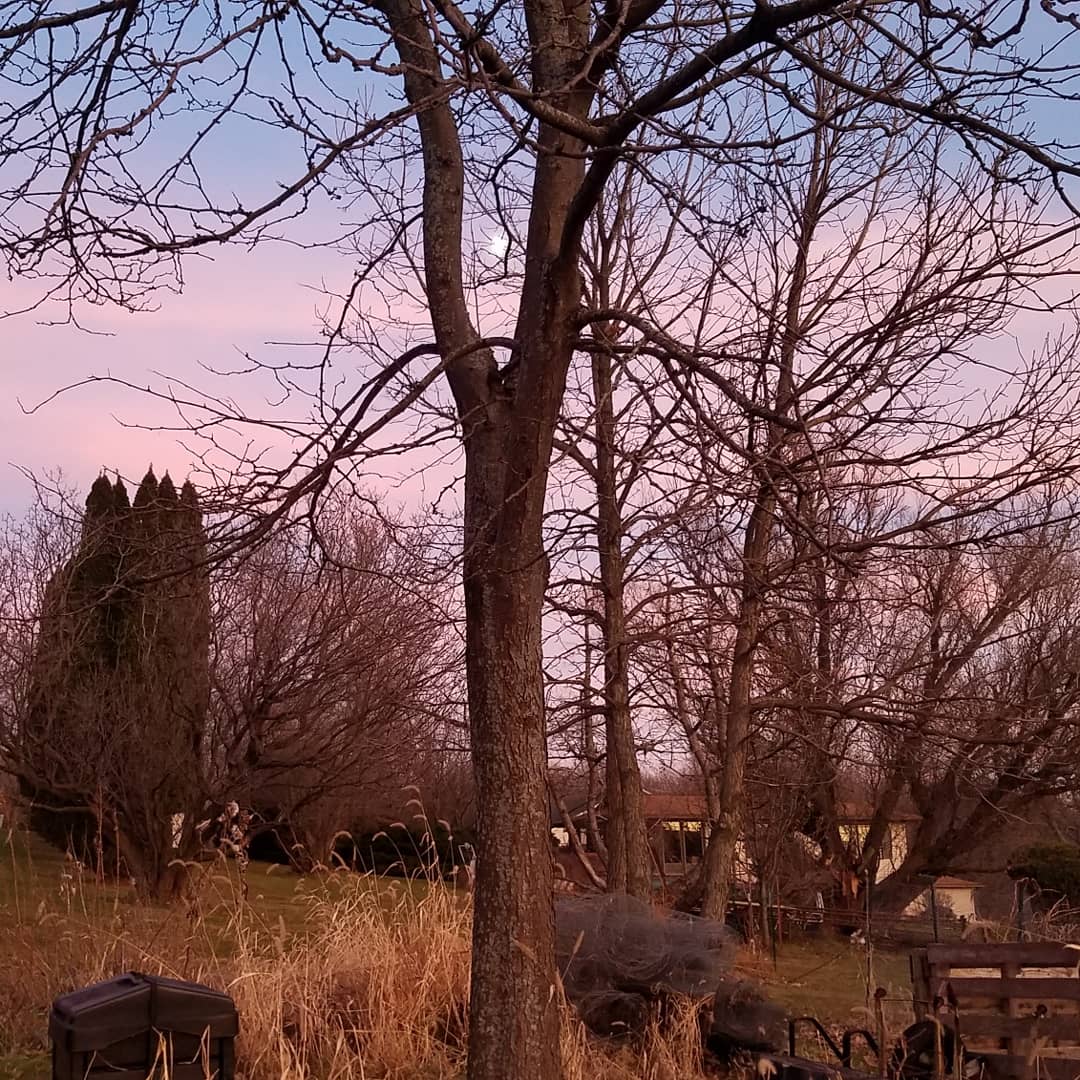
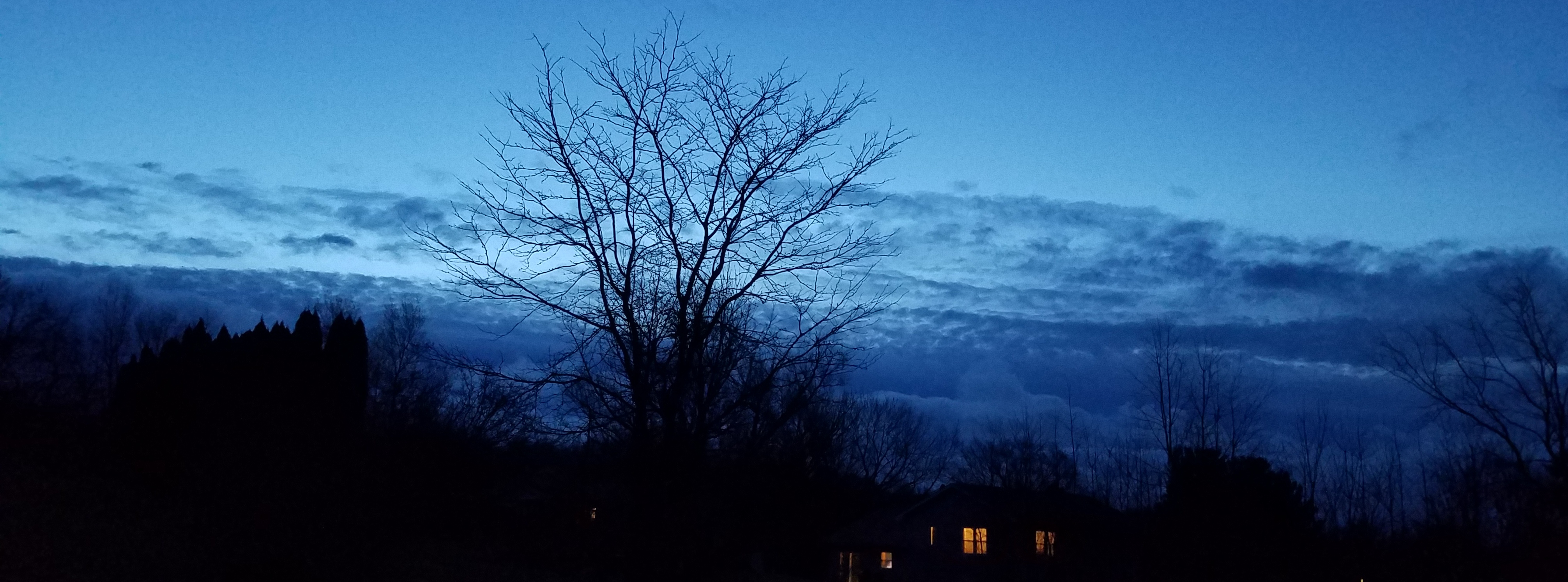
Front Moving East at Sunrise on Dec. 29, 2019

Snow flurried outside the dining room window for a while. I thought we might return to normal winter weather. The thought passed and snow stopped without accumulation.

We need a good streak of very cold days to prune the fruit trees. Last year it was difficult to find such a streak yet I’m hopeful this year. I’m not going to wait for ideal conditions. I’ll take what we get in our evolving climate.

This year’s reckoning with the past and planning for the future is taking more time and effort. It’s not because I did more. The process has been more organized and thoughtful than in recent years. I’m conscious of my age and weighing carefully which projects and activities will get my attention. At the end of it I want a definite plan with time lines. It’s a better process.

While our personal lives went okay in 2019, our participation in broader society was like the wafting odors from nearby feedlots. It was hard to stay separate from the international shit storm.

As Julian Borger pointed out in The Guardian, 2019 was the year U.S. foreign policy fell apart. “Donald Trump’s approach to the world is little more than a tangle of personal interests, narcissism and Twitter outbursts,” he wrote. That’s no way to run a country, even if a majority seeks to isolate American interests from the rest of global society. We can do better than this.

Steven Piersanti wrote on DCReport.org, “Under the bankrupter-in-chief, the national debt is skyrocketing while economic growth is lagging.” Trump is running the country just like he ran his failed businesses, according to Piersanti. “The country’s economic resources are being wasted and our economic health is endangered.”

“The next 12 months will determine whether the world is capable of controlling nuclear proliferation, arresting runaway climate change, and restoring faith in the United Nations,” Stewart Patrick wrote at World Politics Review. Those things matter to everyone and positive outcomes on any of them are dubious without American leadership. President Trump, ditcher of nuclear arms control agreements, critic of the need to address climate change, and bad-mouther of the United Nations does not appear to have an appetite or the capacity to lead at home or abroad. The prospects are bleak on these fronts and more until government changes hands.

It comes back to personal planning for next year. What amount of time will I devote to addressing these problems? The overarching motivation is to remove our current federal elected representatives from office and replace them with people who understand the importance of foreign policy.

At the same time, I can’t let politics be a single thing that absorbs all my time. Regardless of the Republican shit storm, we each need balance in our lives.

It’s taking a little longer to plan this year but the premise of it comes back to my tag line. How shall we best sustain our lives in a turbulent world?

A toast to 2019, an aspirin and vitamin for 2020, and off we go into an uncertain future with the potential for great things.

Categories
Home Life

Holiday Gift Cards

Christmas Coffee

Our family holiday season begins with our Dec. 18 wedding anniversary and continues until New Year’s Day. Two weeks of slowing down, eating more traditional food, reading, reviewing the past, writing, and planning.

2019 was a difficult year. It was a pivotal year. It was a year of coming to terms. There were gift cards.

The first gift card came from the home, farm and auto supply store in the amount of $125. Receiving a gift card in lieu of a salary bonus is a leftover from when the family that founded the retail chain was more involved. The founder’s son continues to make rounds of the stores and knows me by name. He sent a personal birthday card with some bad information about how long I’d been employed. It’s the thought that matters. They also provide a paid holiday on our birthday which in my case falls during this end of year period. I made it to age 68!

The second gift card was re-purposed by my spouse. She spent the $100 gift on herself, but didn’t use the card. She gave it to me and I considered it a welcome birthday present since it was the only one.

Where does one spend this kind of gifted money? At grocery, hardware and other retail stores mostly.

Major purchases included some premium bay leaves ($8.99), a fifth of Jack Daniels No. 7 ($27.55), a Craftsman screwdriver set ($29.67), a 24-bottle case of Stella Artois ($26.63) and a set of storage bins for garden seeds ($29.67). I also got a bottle each of low-dose aspirin and B-12 at the pharmacy, jars of organic seasonings clearanced at the home, farm and auto supply store, some Boetje’s mustard (a local specialty that used to be made in Rock Island, Ill.), a package of roasted chestnuts for New Year’s Eve, and a new Craftsman box cutter to place near the recycling bin. We’re lucky to be able to afford these luxuries.

We received a screwdriver set from the best man at our wedding. Some of them had gone missing over 37 years. It was a purchase of hope as in I hope to spend more time organizing the workspace in the garage and shedding some of the duplicated and unnecessary tools accumulated at dozens of household and farm auctions. Something just feels good about having new tools. They match the ones we got as a wedding present exactly.

The price of the whisky was shocking as I hadn’t bought any for more than a decade. A recent newspaper survey showed Iowans prefer cheaper varieties like Black Velvet Whisky and Hawkeye Vodka. I don’t drink spirits very often and the gift cards were the reason I even considered getting a bottle, it’s like free money and Jack Daniels is a personal holiday tradition. Besides, the local small batch spirits were too expensive at $50 for a fifth.

I bought the beer at the wholesale club, another luxury. My favorite is Pabst Blue Ribbon beer, which my father preferred. PBR is not available there. The plan is to drink a bottle when we have pizza or chili for dinner while reminiscing about my several trips to Belgium. The case should last into spring. At that time my memories will likely be worn out and I’ll get a case of something else to ice down in a cooler for after yard work. Had it not been for the gift cards I would likely have gone without beer at home until summer.

The bins for seeds were an impulse purchase. I examined them and found there was enough space in each drawer for the packets to lay flat. It will go a long way to clean up the workspace where I sort seeds for my weekly planting sessions at the greenhouse. Now the bins need to be labeled so I know what’s in them. More work to do this holiday season.

No one got rich off my shopping spree. I feel better for the fun of unexpected shopping. Whatever anxiety I had about whether the gift cards would work was offset by the adventure in spending them. It was just enough of our consumer society to recall what it is and sate my desire to shop. That done, I can better consider what 2020 will bring.

Categories
Living in Society

Get ‘Political’ for One Night

Caucus-goer

Voters should attend the Democratic or Republican precinct caucuses on Feb. 3, 2020 if they prefer either party.

The main attraction is the presidential preference. Plus, there is more! It’s a good way to hear what’s going on inside each party without filters. Good heavens! No filters! We need that.

I live in Big Grove precinct in which the number of registered Democrats dropped by about 20 percent since 2008, with Republicans remaining about the same. According to the Johnson County Auditor’s office, Democrats currently have more voters than Republicans with 32.6 percent compared to 31.7. No preference voters are the largest group at 35.3 percent.

Our precinct voted for President Obama in the 2008 and 2012 general elections, for President Trump in 2016. What that says is a lot of no preference voters do have a preference; it’s just not for a political party. They prefer to vote for candidates they feel will address the country’s most pressing needs regardless of party. That likely remains the same for the 2020 election.

No one knows how the general election will turn out. I’m willing to bet people will continue to say they are “not political” as they did during the recent school board election. Still, there are parties; there have to be in our form of government. The precinct caucuses offer the best opportunity to find out what politics is like in a welcoming environment.

I hope voters will consider being “political” at least this one night.

~ Published in the Solon Economist on Jan. 2, 2020 and in the Cedar Rapids Gazette on Jan. 5, 2020.

Categories
Writing

A Sense of Place on Christmas Eve

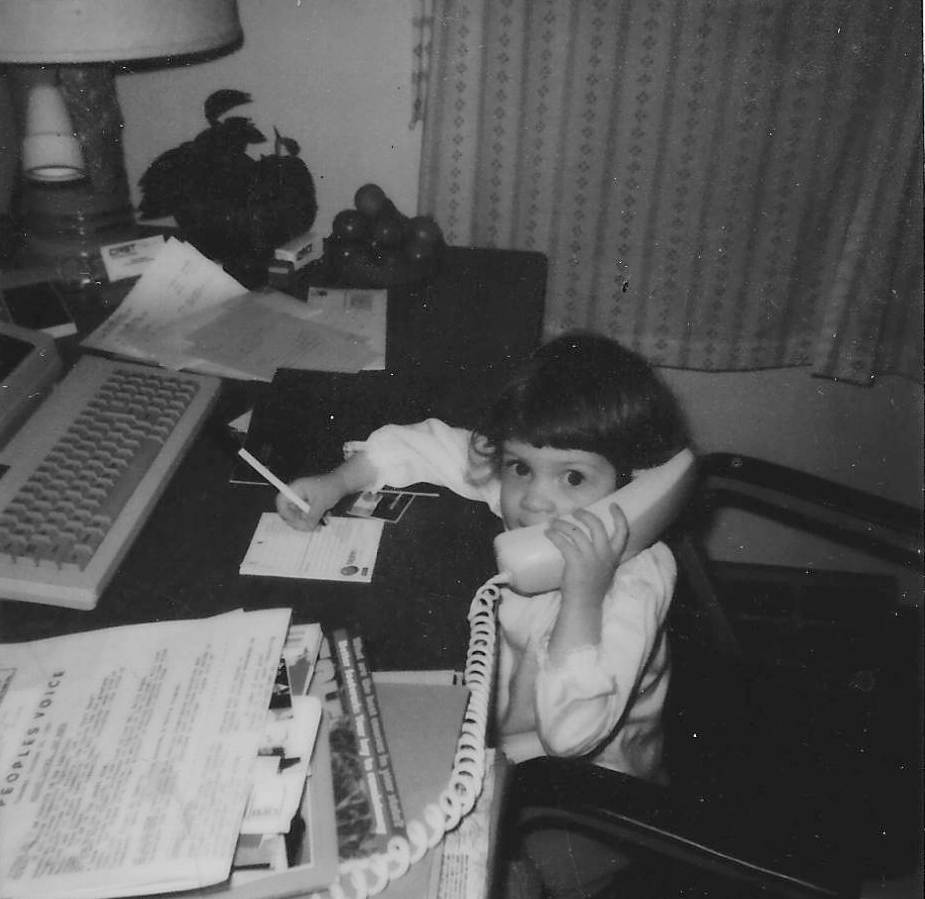
Life without internet, Cedar Rapids, Iowa. 1986-1987

It’s been a quiet day in Big Grove where ambient temperatures were in the 50s and remaining snow melted.

I spent most of the day organizing material for a longer piece.

The idea is to organize documents and artifacts, dating from before I was born until the present, that are currently stored in a hodgepodge manner, using three-ring binders. Having lived a stable life, such documents survive. Once organized, I’ll write and pin a timeline to a bulletin board where I can hang stories, maybe twenty of them. It sounds straight forward, but the documents and artifacts are spread everywhere in the house. I relish the work.

A sense of place will help organize the stories once written. In presenting family history, I see a couple of narratives first.

The first place will be Lincoln County, Minnesota where my maternal great, great grandparents settled in the 19th Century. I visited there only once yet while there I collected a thick sheaf of documents, artifacts and experience.

I’ll write our history coming up in Southwestern Virginia. A published family history mentions the first presence of our ancestors in mid to late 17th century. I made three or four trips to the home place, including some as a child. I have a banker’s box of documents I collected from a man in Saint Louis who spent his retirement researching the Deaton lineage. I’m not sure how much of that is relevant but it needs review. If needed I’ll make a trip back to Virginia to research important missing pieces.

The culture of Northwest Davenport played an important role in my K-12 years. I will focus on the time immediately after my parents wed until I left grade school. It was a time when the Irish and German immigrant culture was in transition to something else, although we wouldn’t see what it would become until the time Mother moved to live with my sister toward the end of her life.

In addition to family history, I expect a brief remembrance of the late 1960s and early 1970s in Davenport and Iowa City.

There will be a story about the three years I lived in Mainz, Germany while in the U.S. Army. More than anything after schooling, military service helped me learn to live on my own and exposed me to a variety of people and experiences.

I’ll tackle my transportation career and our nascent family life in two places, in Iowa City after getting my masters degree and meeting Jacque, and in Merrillville, Indiana where we lived for six years.

Other places that seem important at this writing are Colorado Springs, Thomasville, Georgia, Orlando, Florida, Cedar Rapids, Iowa, Chicago, and our more than 25 years here in Big Grove.

There will be stories focusing less on a sense of place and on a broader, subject-specific narrative. It seems easiest to begin writing by understanding the collected artifacts and memories, by crafting a narrative about the place where they were significant.

I’m a long way from getting stuff organized. For now, it’s time to gather and finish making our traditional Christmas Eve dinner of chili and cornbread.

Categories
Writing

Philosophy of Stuff

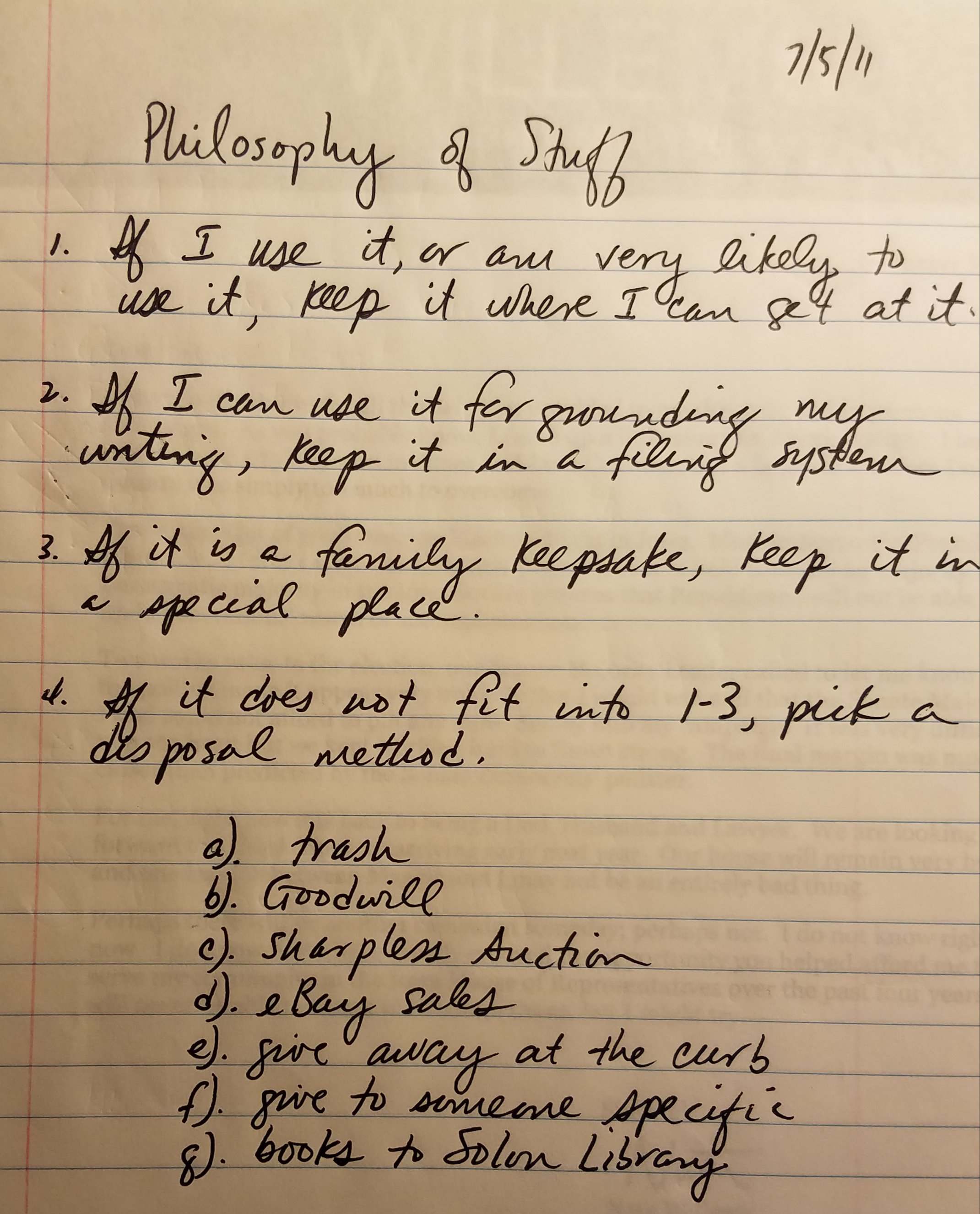
Philosophy of Stuff – July 5, 2011.

We have more stuff than we need in our home.

Turns out I developed an entire philosophy of stuff back in 2011, soon after the realization we had too much stuff.

New stuff continued to pile up but we’re over that now. Culling has begun. I took a load of books to donate to the Friends of the Library book sale last week.

The impetus has been recent awareness of mortality, highlighted by the death of Mother. She did things right and disposed of much of her stuff during the years before she moved in with my sister. Many of us would emulate the best qualities of our parents. We can’t take stuff with us when we die, and what reasonable person wants to leave the trouble of sorting it to others?

We have a duty to reduce, reuse and recycle all the stuff our consumer society has wrought. These days I’m working more on the reduce part of that.

I’ve long felt an urge to go shopping when my calendar is blank. When I lived in Mainz, Germany, if I had a free weekend, I felt I should cross the Rhine River to Wiesbaden and visit one of the big box stores. Living in that large community provided different options for food and clothing from what I could find at the Kaserne’s Post Exchange. Last Saturday, after a political event, I drove straight home, resisting the impulse to head to the home, farm and auto supply store or the warehouse club without a specific shopping list. It felt pretty good.

It’s time to put my philosophy of stuff into action.

1. If I use it, or am very likely to use it, keep it where I can get at it.

2. If I can use it for grounding my writing, keep it in a filing system.

3. If it is a family keepsake, keep it in a special place.

4. If it does not fit into 1-3, pick a disposal method.

Now begins the hard work: carving out time to reduce the amount of stuff before late winter gardening prep begins. Maybe easier said than done, but this year there is hope.

Categories
Living in Society

Winter Solstice 2019

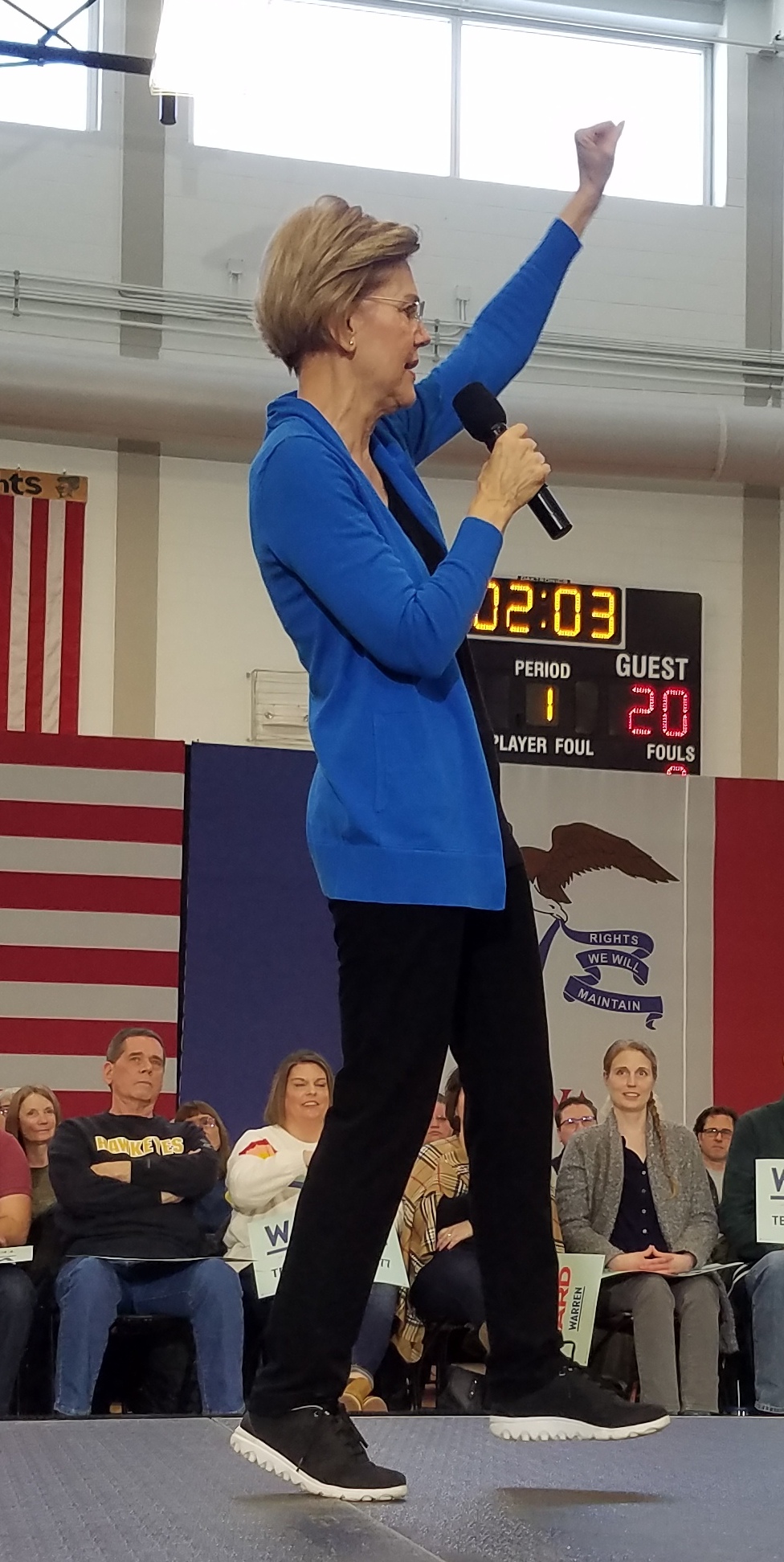
Elizabeth Warren at North Central Junior High School, North Liberty, Iowa. Dec. 21, 2019.

On a clear, beautiful day when ambient temperatures reached into the 50s, I drove across the lakes to North Liberty where Elizabeth Warren held a town hall meeting.

James Q. Lynch of the Cedar Rapids Gazette estimated 500 attended. There was not a lot of other action in the area to occupy us the Saturday before Christmas.

It was Warren’s first town hall meeting since the Dec. 19 Democratic candidate debate.

Warren’s campaign staff will be released for the holidays on Monday so the weekend was a busy time for them and staff of several candidates touring Iowa, notably Amy Klobuchar, Cory Booker, Pete Buttigieg, Michael Bennet and Joe Biden.

This was my fourth Warren town hall this cycle. I know the pitch well. Her presidency would focus on the long-standing issue of corruption in government. Corruption has been present since the founding, although is more visible today, blatantly so. That Warren makes addressing corruption the centerpiece of her campaign and potential presidency is most of what attracts me.

Each time I’ve heard her speak I learned something new. The first question was what to do about the media environment that contests basic truths and contributes to a lack of legislative progress. Warren pushed back on this, using her family as an example.

She has three brothers of which one is a Democrat and two are Republicans. She and her siblings debate politics yet often agree on issues, she said. She expanded that to say there is much agreement among people in society regardless of their politics. What puts the brakes on solving problems, especially big problems like the climate crisis, environmental quality, finance, and excessive student debt, is corruption by powerful and moneyed interests. She has a plan to address that. Having such plans is a hallmark of her campaign.

The recent Solon School Board election highlighted how right Warren is to push back on the media as the main problem confronting us. Our election was hardly covered by news media outside our local newspaper and me. It is easier to find common ground when our children’s education and future are at stake. I knew the political party registration of the six candidates but that played only a minor role is picking two for whom to vote. Somewhere in the wilderness between relevant local politics and the national government things get lost.

Warren talked about how a toaster oven caught fire in her kitchen when she was a young mother. Eventually regulation solved the problem by requiring an automatic shutoff switch in such small appliances. The same basic principal of problem identification, scientific investigation, and working through potential solutions until one could be found and regulated has other, more profound applications. It is a common sense approach at a time when common sense seems sorely lacking in our politics and government.

I drove home immediately after the event, retracing my route. Neighborhood families were out walking on the trail and working in their yards in the mild weather this Winter Solstice. It was great to hear Elizabeth Warren again in Iowa. I’ll miss it when the Democratic National Committee eventually removes our first in the nation status. That is not today.