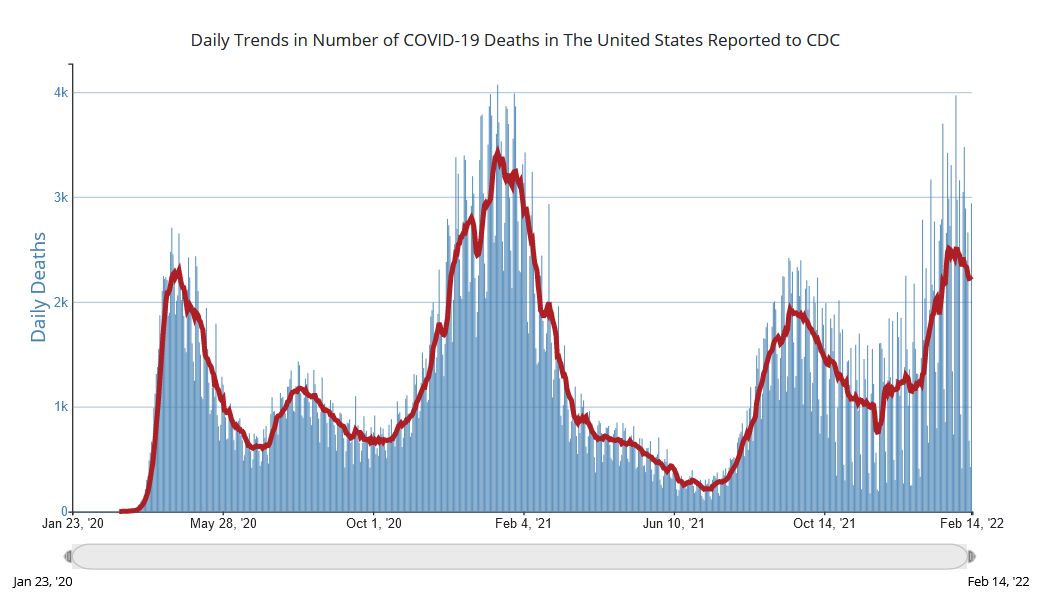
Chart from Centers for Disease Control and Prevention, Feb. 15, 2022
As we enter the third year of the coronavirus pandemic, no end is in sight. The United States is proving to be less competent than we thought in managing this pandemic. I lost track of how many people I know contracted COVID-19 because there are so many. The virus is penetrating my close circle of family and friends more deeply and effectively this year than it did in 2020 and 2021. Fortunately, my spouse and I have been able to avoid it.
The total number of COVID-19 deaths reported to the CDC as of yesterday was 920,097. The number of excess deaths since the pandemic began already exceeds one million, they reported. With climate change and degradation of our environment, we expect other viruses presently unidentified to affect humans. It was not helpful that the Trump administration dismantled and hobbled the mechanisms we had in place to monitor and mitigate new infectious diseases. The coronavirus seems likely to persist among other viruses and diseases.
In February 2022 we are ready for the pandemic to end. The pandemic continues unabated. We made adjustments.
The main impact personally is we seldom leave the property. When we do, we wear a mask and clean up thoroughly when returning home. I’ve been starting the automobile once or twice a week. When I have been outside the house in winter it has been to take compost out to the bin, work in the yard, take a walk, or head into the retail centers for provisions. The restaurant food I’ve had was delivered by a service, and only when I helped move our daughter from central Florida last summer. Local restaurants have gotten no business from us since March 13, 2020. I picked up vegetables last spring at the farm using a pandemic protocol. We attended no in person meetings, except with our daughter. I severed relations with most of the groups to which I belonged. Combined with my retirement, the pandemic brought substantial change.
What is next? I haven’t done a deep analysis of the COVID-19 death march, although I know enough to see it targets the elderly, people with compromised immune systems, and people who have not been vaccinated. We must remain vigilant so as to avoid getting COVID-19, and that means continuing to make do on our property as much as is possible. There is plenty to do. That the pandemic coincided with the beginning of our pensions and retirement from paid work means it impacted us less than younger people who must work for a living.
March 11 is the two-year anniversary of the World Health Organization declaration that COVID-19 is a pandemic. Yesterday the Iowa governor ended her proclamation of disaster emergency. Today, the death march continues.
I broke through 65,000 words on the current draft this week. What’s different this time is completion of the narrative from the beginning through 1970 without breaks in the text. It actually reads like a story.
There is a lot of editing to do. There is nothing to edit unless words get on paper. The writing went well and about a third of the main text has been drafted.
Once I established the process and got going, the words flowed. The section just finished, about where I lived with my family for the final eleven years, is by far the longest. I compressed many potential stories into fewer to make the key points of the autobiography. I wrote smaller inserted parts to set up some of the major themes.
I’m interested in dealing with a couple of themes.
When I was injured and hospitalized at a young age, I learned how interdependent we are in society. It helped me realize how much besides myself is going on. Learning about and leveraging our interdependence has been a part of my life for a long time. My outlook is what I call Cartesian, and I’ve written about that before. Is there anyone else out there? In the context of my hospitalization, the answer is definitely yes, and they can be helpful. We also have an obligation to give back.
My early experiences discussing ethnicity with Father led me to believe I was “American,” whatever that was. What I came to know through life experiences and research is there is a gaping hole in the oral history or what I’ve been calling “family lore.” My focus has been on the coal mining culture. Yet there were enslaved humans in Wise County, Virginia where the family came up, and a climate of racism that was never mentioned among family. The way I learned about Virginia and the Civil War, the enslavement of humans, post-Civil War racism, and the rosy portrait of Robert E. Lee and other southerners in school books, was problematic. Today I recognize being born into white privilege. How I came to that awareness is a major theme.
Lastly, in the first part of the narrative is a discussion of losing Father in an industrial accident when I was age 17. That affected my decision to leave home to attend university. It shaped my life ever since. Having a father and then suddenly not, was traumatic. There were no guideposts on how to handle it. Tracking the change and how I learned to cope is another theme.
What is new to me as a long-form writer is how setting these themes in the narrative is done. Simply put, I had no idea before now. Now that I am figuring it out, and as I do, the pace is snowballing. After writing thousands of blog posts, the challenge of writing in longer form is a voyage of discovery. I’m liking what I see.
It looks like it will be cold again this week, and a chance to stay indoors to write. The pace of social engagements is picking up and somehow I need to blend everything in and stay the course to finishing the main part of the narrative this year.
Kyiv, Ukraine on Feb. 12, 2022. Photo Credit – Matthew Luxmoore, Wall Street Journal.
Long-time readers of this blog know I could care less about the annual Super Bowl. The rest of the world is much more engaging.
Before the coronavirus pandemic, I would use the time as people made final preparations to view the game for shopping in almost deserted retail establishments. This year, I already provisioned for the next two weeks, so there’s nowhere to go. It’s one change among many in my post-pandemic behavior.
A reporter posted a photograph on Twitter of an almost deserted square in Kyiv, Ukraine. Ukrainians do not seem concerned with Russian troops massed at the border. The United States, European Union, and NATO are on high alert, waiting to see what happens in the way countries do when war seems imminent. The two situations are difficult to reconcile.
President Biden is planning a phone call with Russian President Vladimir Putin today. There may be a readout of the call and we’ll just have to wait to confirm there is and what it says. There is more to worry about if there is no readout or public statement. (The readout is here).
Ukraine’s exports have increased since 2016. It is a regional leader in production of wheat, corn, sunflower oil, and other agricultural products. They also export iron, steel, mining products, chemical products and machinery. If Ukraine is annexed by Russia, then it’s possible such exports could be directed internally rather than being sold in global markets. I believe the foodstuffs production is the main prize here.
It’s difficult to forget the Russian wheat crisis of 2010 when Russia stopped exporting wheat due to poor production made worse by climate change. Restricting wheat exports disrupted global markets and the food shortage was a contributing factor in the Arab Spring uprisings that followed. Annexing Ukraine would be good for Russian food supplies.
When we consider Ukraine in the context of the 2013 Chinese Belt and Road Initiative, a cornerstone of Xi Jinping’s foreign policy, annexation is a way for Russia to gain access to Ukraine’s production capacity without all the fuss of formal agreements. Russia is no China. The idea that the United States and European Union can rely on open markets to meet internal needs seems quaint in light of the direction Russia and China are taking.
As tensions rise in media depictions of evolving events, we wait. It’s an occasion to consider the broader world and how what happens in it affects our daily lives. It is a chance to gain an understanding of whether American pursuits are sustainable. Because of a media that serves corporate interests, we citizens are receiving a much distorted picture of what is going on in the world. We can’t be distracted by annual, meaningless rituals like the Super Bowl.
The North Liberty Leader, a local newspaper with about 300 subscribers, announced today will be their last issue. If that’s all the subscribers they had in a city with a population of more than 10,000 they deserve to go out of business. Harsh assessment, yet true.
The Dubuque corporation that bought them, Woodward Communications, Inc., likely knew this fate was coming before the acquisition. Today they informed readers of the Solon Economist unless something is done, they are on the chopping block as well.
Folding the Economist seems inevitable when community leaders surveyed felt ambivalent or indifferent about the newspaper’s future. I sent a note around to the Facebook group of neighbors to which I belong, encouraging them to subscribe. It may be too little, too late. Facebook is likely part of the problem causing a decreased subscription rate.
I’ll do my part by encouraging people to subscribe, providing free content if we can work something out, and advertising if I have need. In the transition of local culture, the demise of local newspapers is just one more unwelcome step.
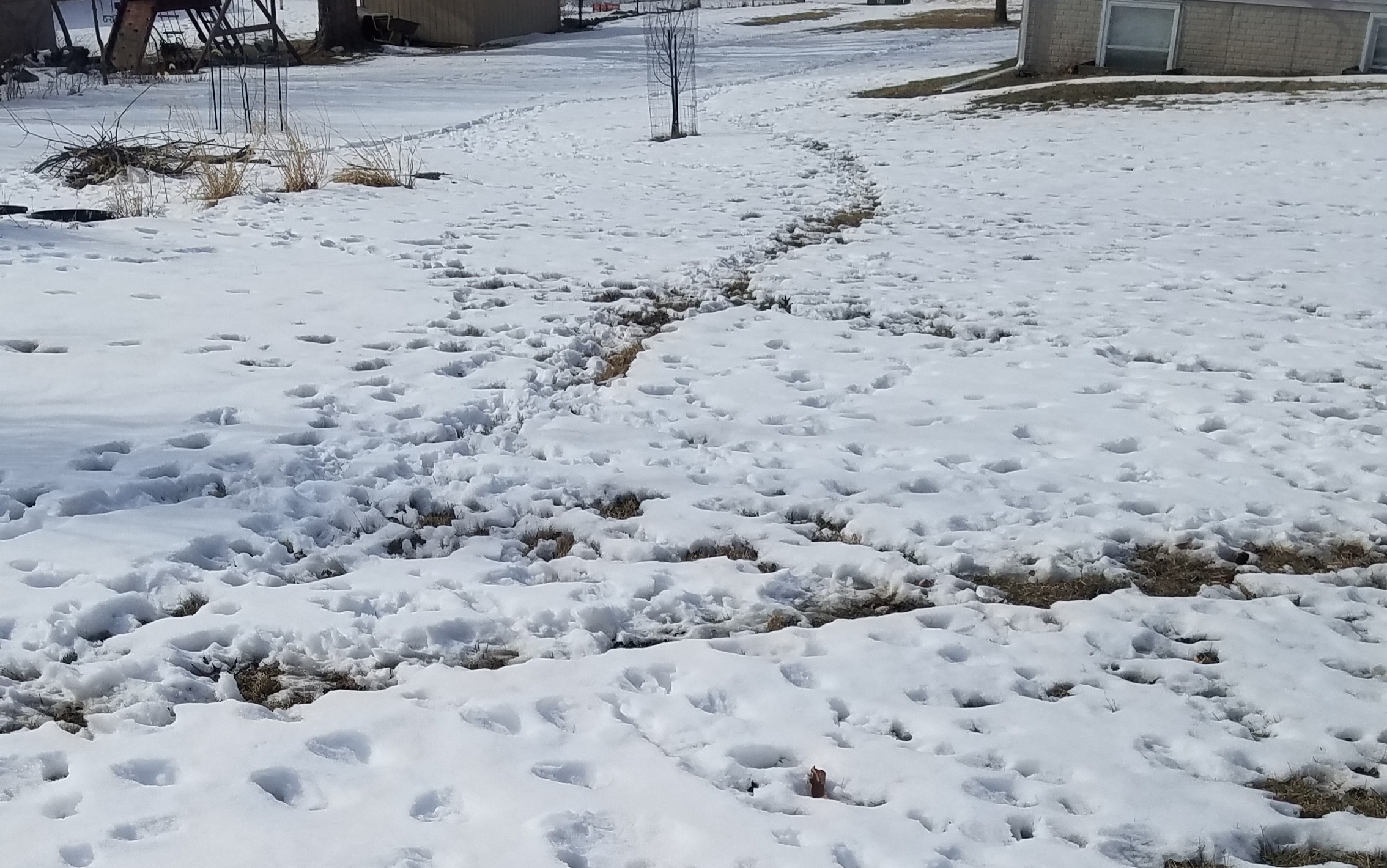
Ambient high temperatures are forecast around 40 degrees the next couple of days. If that bears out, most of the snow should be gone. It has been a welcome time for cocooning yet this week’s weather indicates it won’t be long before working outdoors.
Onions and shallots need a trim. Broccoli seeds planted Sunday have begun to germinate. It’s good to see the older seeds are still vital. I’m thinking of setting up the greenhouse yet it’s too early.
We’ll see what Iowa’s weather does. For the moment, hope of spring is not far away. That’s enough to encourage me to get to work on everything.
The late Bob Handley signing nominating petitions at the 2010 Democratic caucus.
When the alarm to take my pill went off at 7 p.m., 263 accounts had logged in to the 2022 Iowa Democratic virtual caucus in Johnson County. Some accounts had multiple household members named or in video feeds that were shown. Throughout the main part of the caucus, the number wavered between 290 and 300. It was a reasonable turnout given the persistence of the coronavirus pandemic combined with a more general lack of interest in party politics.
It was nice to walk upstairs to retire when it finished instead of driving half an hour from some godforsaken corner of the county while watching for deer crossings and drunken drivers. My takeaway is as some long-time legislators and officials step back from public office, not enough new names were on the roster of attendees. Democrats have a tough row to hoe in the midterms. When don’t we in Iowa? We chose Richard Nixon instead of John F. Kennedy for Pete’s sake.
Last Obama Campaign Rally, Des Moines 2012.
The main business of the caucus was twofold: learn who is running for office and elect folks to do party work going forward. I self nominated to be a delegate or alternate to the county convention. I also self nominated to be an alternate central committee member. I hope the two central committee members we chose in 2020 sought re-election, although I didn’t see their names on the roster of attendees. No committee work for me this year.
The single person I recognized from my precinct had contacted me earlier in the day for our traditional pre-caucus chat. Our main relationship is related to county politics and we both have opinions about what is going on. We began working together on campaigns in 2004 and attended Barack Obama’s last political rally in Des Moines together, just before election day in 2012.
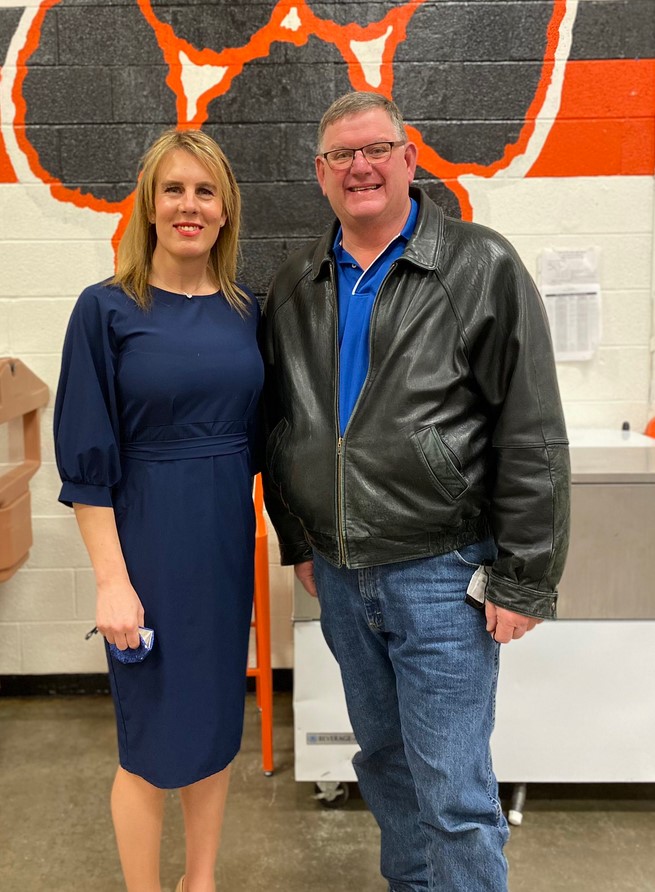
Elle Wyant and Kevin Kinney at the Feb. 7, 2022 Iowa County caucus in Marengo.
A slideshow displayed on a shared screen while we waited for caucus to begin. One slide showed State Senator Kevin Kinney is running for re-election in the new District 46. Elle Wyant had a slide as well. She is running for House District 91 in her first-ever run for political office. She gave a one-minute speech in her allotted time. These Republican districts will be tough to win for any Democrat. Best of luck to the two candidates.
Five U.S. Senate candidates had slides on the presentation, although my only question in this race is whether retired Admiral Michael Franken will win the June primary. It is between him and Abby Finkenauer, although Dr. Glenn Hurst is actively campaigning. Franken, Hurst and Satro Narayan gave one-minute speeches at our caucus. Until the primary, I’m keeping my activism powder dry in the U.S. Senate race.
I dialed in early and the caucus ended shortly after 8 p.m. Much less of a time commitment than attending an in-person event. I liked that aspect of it. Democrats have to get organized in an election year and the caucus format serves this purpose. We now have the framework from caucus to the election, a timeline upon which to hang our plans.
Onions and shallots planted Jan. 6 were ready to come off the heating pad. The only note is shallot seeds from 2020 did not germinate this year. Because I also planted new seeds, everything is fine. I replaced onions and shallots on the heating pad with a flat of kale, broccoli and collards on Feb. 6.
It doesn’t require much work at this point. There is soil mix from last season. Making and planting a flat of soil blocks took about an hour. The worst part was the garage was pretty chilly. I was able to stand the cold and finish the work.
About a dozen seed catalogues arrived since Jan. 1. I went through them yesterday and believe I have what is needed. I’ll take another look and order what may be lacking in my seed collection this week. I started older seeds on Sunday. There is plenty of time to see if they germinate. Once they do, I’ll plant the next flat of early seeds.
Snow remains on the ground. Since provisioning last Thursday, I haven’t left the house except to retrieve the mail and deliver the recycling bin to the street. I’m thinking by late March I can plant cruciferous vegetables in the ground. Once the snow melts there will be a lot of outdoors work. I’m ready for it. It’s time to garden.
January has been good for my writing. I organized an approach and it served to reduce stress. I’m better able to sit down, write, and feel like I accomplished something.
I eliminated a daily targeted number of written words. I mean, there is no deadline. It would be great to finish the book so I could begin the next project, yet I’m in no hurry. I want to be true to myself, not to an artificial writing goal.
Instead of a specific daily goal, I make sure to do something related to the project each day. Some days it’s hours, and some days it is minutes. I feel I have a grip on what was an unmanageable project.
I stopped writing and that enabled me to write. It’s the way a lifeguard overpowers a drowning victim to save them. I stopped writing and organized. First I developed a chapter list, or as I call it, the “big sections” list. There are 31 sections and seven appendices. I typed them all in a new document and as I find previously written sections or write new ones I hang them on the framework. The same with fragments located in folders or audio tapes of interviews. It is less hodgepodge than the way I wrote last year. Last year’s work can be plugged into the new framework and rewritten. The whole thing works.
The writing divides into some clean big parts. After the dedication and preface there are five sections where I combined my personal experience with whatever artifacts I could locate or had in my collection. These sections involved historical research and probing my memory. The working titles are Minnesota, Illinois, Virginia, Davenport and 1951.
The next part is written mostly from memory beginning with my earliest ones in the duplex where my parents brought me after being born. We lived there and three subsequent places before Father died and I left home. I don’t have much documentary evidence from these times: report cards, a few letters written to parents, and a small folder of school papers. The 1960s were the beginning of an explosion of home photography, so I have albums and extra photos from that time. I also scanned copies of Mother’s photographs before she died. While documentation is scant, there is plenty to prompt memories. I find it remarkable the detail with which I remember things long hidden in my brain. The working titles of these sections are Madison Street, Starting School, and Marquette Street. I’m a few thousand words into the latter and have to get through grade school, high school, music, work experiences, and leaving for college. This section ends with the Kickapoo Creek Rock Festival I attended with high school classmates the day after graduation.
The next sections are better documented. Leaving Home is about my conversations with my parents about going to university, and after Father died, about whether I should give up college to stay in Davenport and help Mother. I have many letters received from friends, university papers, photographs and newspaper clippings. There are also a few pieces of ceramics I made, some musical instruments, and memories of my time at the University of Iowa. I began writing a personal journal after graduation from university. This section also includes my 12-week tour of Europe in the Fall of 1974, and the year I spent in Davenport afterward.
There is a gap in recent writing during the period when I left for military service, returned to Davenport, and then moved to Iowa City for graduate school. That takes the narrative through four sections titled, Military Service, Homecoming, Iowa City and Graduate School. By this time, I was a regular journal writer and had published a small number of pieces, including travelogues for the Belgian Society in the Quad Cities. I was still taking photographs with film cameras, I had begun to write letters to the editors of newspapers. This section ends with the job search to find something to enable me to stay in Iowa City after graduate school.
A good part of the next section was drafted last year. It takes us from finding a job at the university, our marriage, beginning a career in transportation, the birth of our daughter, and moving to Cedar Rapids, then to Indiana. These sections are titled My Spouse & Me – 1982, Career, A Daughter – 1985, and In the Calumet (1988). By now I’d developed an extensive document collection method producing financial records, photographs, journals, letters, and all the raw material to turn into something. These were years before we adopted email or owned a home computer other than a word processor. When I worked at the oil company, I was introduced to email around 1990.
The final big section is of our return to Big Grove Township in 1993, where we currently live. Because this section has the most documentary resources, I saved it to write last. There are currently 11 sections and the organization and titles of them is fluid. No point writing them down because they are sure to change. I lived here longer than any other place, more than twice as long as I lived on Marquette Street with my family.
The difference this change in organization and methodology made is I have a sense of purpose when I’m writing. When I write something, I know where it goes, or whether it goes. I started a complete rewrite from the beginning and am now on section 10 of 31. It lets me know where I am. I can sleep at night knowing I won’t lose the thread.
We know Republicans are feeling pretty good about the way the state is going when the normally reserved Matt Windschitl includes a joke in his legislative update. “If a car uses wheat-based ethanol, does it qualify as a hy-bread vehicle?” The newsletter was about ethanol, and Republicans feel good when they address it to support corn-growers and the product from which it is made.
The Iowa House got its way with last week’s HF2128 regarding E15 ethanol in the state. It passed with many Democrats joining the Republican majority in favor. What didn’t get told in Windschitl’s newsletter was it was Democrat Mary Wolfe of District 98, ranking member of the judiciary committee, who wrote the language to help gas station operators in small towns deal with changes the new law would bring by increasing the blend of ethanol.
As has been expected for many years, especially since Republicans gained control of the Iowa Senate in 2016, each year brings more crazy legislation. Among the topics that have been broached in the early days of the final session of the 89th General Assembly are eliminating state income tax, eliminating all Iowa Code (yes, all) a bit at a time until it is revised by the legislature or deleted, putting surveillance cameras in virtually every K-12 public school classroom so parents can watch, sending teachers and librarians to jail for making unapproved classroom materials available, qualified immunity for police officers, and there will be something about taking away the rights of women to manage their health care once the U.S. Supreme Court issues a ruling that may impact Roe Vs. Wade later this year.
With all of these and more, Republicans are feeling pretty good about themselves. Don’t break your arm patting yourselves on the back people.
It looks like Democrats have a long road toward regaining a majority in either legislative chamber. Republican Governor Kim Reynolds rules the roost and is expected to cake walk into another term after the November election. Democrats ran one of their biggest donors against her in 2018. He came up short on charisma if not on money. Only Democrat Deidre DeJear, the losing 2018 Secretary of State candidate, is in the running against Reynolds. DeJear’s campaign hasn’t been able to achieve lift off. Being well-liked among Democrats hasn’t translated into a successful campaign for DeJear.
As I wrote yesterday, the pandemic is being normalized, even if it is not over. What hasn’t been normalized, or even adequately addressed, is how Democrats dig out of the grave they dug for themselves since Tom Vilsack was governor.
Like many Democrats, I’m willing to do my part. I also have stuff to do before I’m ready to enter my own grave. As a new septuagenarian, there is no time to wait for Democrats to get organized. That I can write that sentence does no justice to how disorganized we are as a party. The fear is there is no hope of digging out in the foreseeable future or in my lifetime.
I’m not encouraged by people who say we should wait until the campaign season is upon us. That means the 89th General Assembly adjourned sine die, summer is behind us, and the election is within shouting distance. The long-term structural change Iowa Democrats need lies outside any single election.
Some positive things have been accomplished by our leaders, especially by my state senator and senate minority leader Zach Wahls. What Ross Wilburn, Zach and the gang are doing is okay, yet not enough, and too slow in evolving.
While good people try to organize the circus we Democrats tend to be, Republicans are telling jokes and enjoying good times promoting corn ethanol during the Republican romp of which they can see no end.
It had been 13 days since I started the automobile. Luckily, it turned over and was ready to go across the lakes to the wholesale club for provisioning. The trip there and back took less than two hours. I won’t leave the house again until mid month if all goes well.
All of the staff and about half of the customers at the retail outlet were wearing masks to protect against the coronavirus. No one bothered me as I wore my KN95 and went about my business. I worked as efficiently as possible, staying away from the unmasked as much as I could. It seemed a bit weird because absent were many of the well-dressed, Chinese-speaking folks who frequent the place, replaced with scruffy-looking white folks shopping without masks and heatedly discussing shopping choices among themselves.
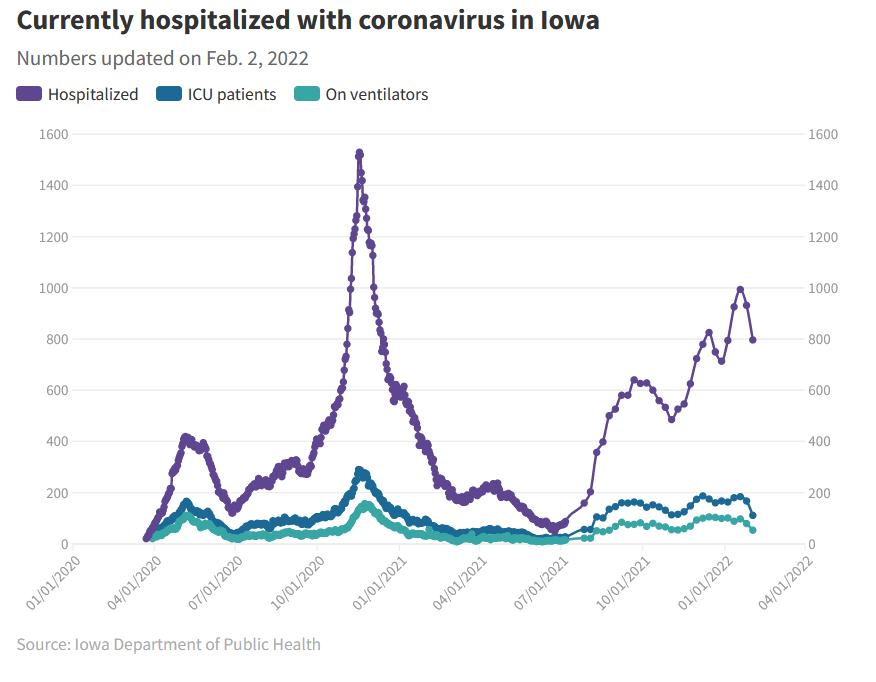
The governor’s press release arrived after I returned home. It indicated there is no ending the coronavirus pandemic. She is extending the state’s Public Health Disaster Emergency Proclamation on Feb. 3, announcing it will expire at 11:59 p.m. on Tuesday, Feb. 15. After that, the coronavirus becomes normalized in daily, routine public health operations. I’m not surprised.
Here is the press release in full:
OFFICE OF THE GOVERNOR Governor Kim Reynolds ★ Lt. Governor Adam Gregg FOR IMMEDIATE RELEASE: February 3, 2022 CONTACT: Alex Murphy, 515-802-0986
Gov. Reynolds announces expiration of Public Health Proclamation, changes to COVID-19 data reporting
DES MOINES – Governor Reynolds signed the final extension of the state’s Public Health Disaster Emergency Proclamation today, announcing it will expire at 11:59 p.m. on Tuesday, February 15, 2022. The signed proclamation can be found here.
The proclamation was first issued in accordance with the Governor’s executive authority on March 17, 2020, to enable certain public health mitigation measures during the state’s response to the COVID-19 pandemic. Over time, it included hundreds of provisions assembled in the midst of an emergency to quickly address a pandemic the nation knew little about. Today, the remaining 16 provisions focus primarily on lingering workforce issues exacerbated by the pandemic that are best addressed outside of emergency executive powers.
The State of Iowa is working with stakeholders in an effort to address pervasive workforce issues through more permanent solutions like legislation, rule changes, and grant programs.
“We cannot continue to suspend duly enacted laws and treat COVID-19 as a public health emergency indefinitely. After two years, it’s no longer feasible or necessary. The flu and other infectious illnesses are part of our everyday lives, and coronavirus can be managed similarly,” stated Gov. Reynolds. “State agencies will now manage COVID-19 as part of normal daily business, and reallocate resources that have been solely dedicated to the response effort to serve other important needs for Iowans.”
The expiration of Iowa’s Public Health Disaster Emergency Proclamation will result in operational changes related to the COVID-19 response. The most noticeable change will be how data is reported publicly. The state’s two COVID-19 websites, coronavirus.iowa.gov and vaccinateiowa.gov, will be decommissioned on February 16, 2022, but information will remain accessible online through other state and federal resources.
“While our COVID-19 reporting will look different, Iowans should rest assured that the state health department will continue to review and analyze COVID-19 and other public health data daily, just as we always have,” stated Kelly Garcia, director of the Iowa Department of Public Health (IDPH). “The new format will include data points that Iowans are used to seeing, but moves us closer to existing reporting standards for other respiratory viruses. This new phase also assures that our teams, who have been deeply committed to the COVID-19 response, can return to their pre-pandemic responsibilities, and refocus on areas where the pandemic has taken a hard toll.”
IDPH will report relevant COVID-19 information weekly on its website, similar to how flu activity is reported. Data will include positive tests since March 2020 and in the last seven days, cases by county, an epidemiologic curve, variants by week and deaths since March 2020. Vaccine information, including total series and boosters completed, demographics for fully vaccinated Iowans, and vaccination by county, will also be reported. Aligning the agency’s reporting processes will create greater efficiency for its staff while continuing to provide important information to Iowans. The new report will be available starting February 16 at idph.iowa.gov.
The State of Iowa and its health care providers will also continue to report COVID-19 data as required by the Centers for Disease Control and Prevention (CDC). The CDC’s COVID Data Tracker reports state-level data for cases, deaths, testing, vaccination and more. The site is available at coronavirus.gov or covid.cdc.gov/covid-data-tracker.
The State Hygienic Lab will continue to operate the Test Iowa at Home program. As testing supply increases and more options for self-testing become available, the state will reassess the need for the program. For more information or to request an at-home test, visit testiowa.com.
States are not required to have a disaster proclamation in place to be eligible for federal coronavirus-related funding or resources. Iowa will continue to receive vaccine and therapeutic allocations as normal after the proclamation expires.
Nearly half of U.S. states have already discontinued their public health proclamations, and several more are set to expire in February if they aren’t renewed.







 Journey Home
You must be logged in to post a comment.