An inch or two of snow fell overnight indicating winter is not finished.
There is not enough trash and recycling to roll the carts through freshly fallen snow to the street for pickup. I’ll wait until daylight to blow snow from the driveway, without cart tracks and my footprints. With our intent to stay home, I could let it go and natural warmth would clear the driveway within 24-48 hours. I’m ready for some outdoors activity.
Despite snowfall, one senses a pivot toward spring.
The ten-day forecast is for ambient temperatures to begin climbing above freezing tomorrow. After that, highs are forecast in the upper thirties to mid forties going forward. I’m reminded some of our worst Iowa blizzards have happened during March. It may not be the end of winter, yet one can’t help but think of spring. The ground remains frozen.
We hope for spring, even if another thing that fell overnight was Russian missiles on Kyiv, Ukraine.
I try to shut out commentary and focus on news of the Russian invasion. There is plenty of news available, although one needs a filter to separate wheat kernels from the chaff. A cook can’t make bread from opinions. It is ironic that U.S. companies maintain large grain export operations in Ukraine and Russia when Iowa grows 50 percent of its corn to make ethanol. Ethanol should be eliminated due to its impact on the environment. That is commentary readers may not welcome.
While stationed in Germany as an infantry officer, I prepared to fight a European land war against the former Soviet Union in the Fulda Gap. A soldier should know that if Russia planned to lay siege to Kyiv, it would begin this morning at dawn. There is no satisfaction from seeing my prediction come true as it did. Spring is not the best time for tanks to navigate through the countryside. One presumes Russia will make quick work of the invasion and occupation of Ukraine, while the ground remains frozen, before spring thaw and planting time arrives.
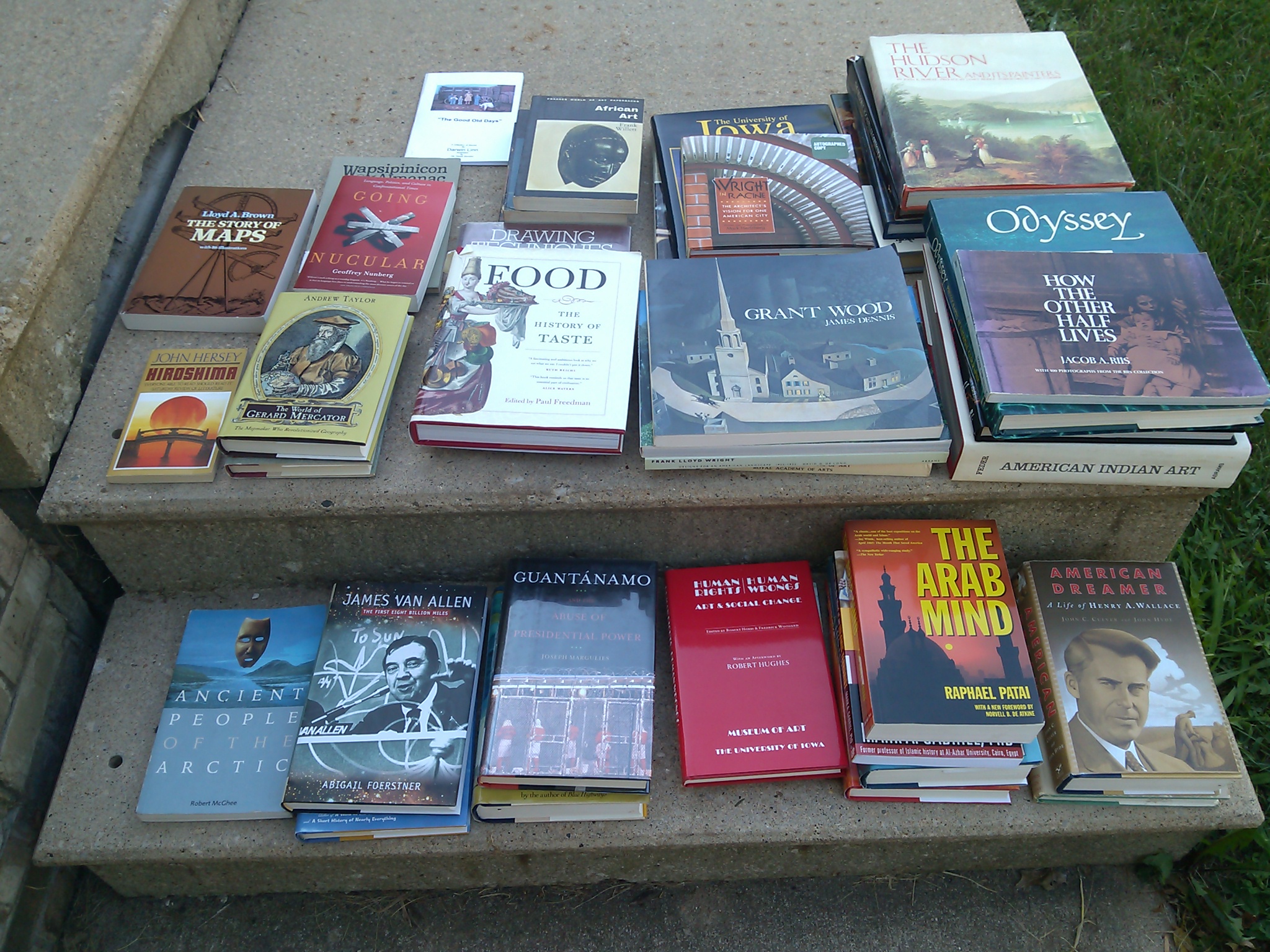
I have reading and writing to do and welcome a couple more days of cold weather. I’d like nothing better than to browse a bookstore for a while to see what is available. Instead, due to a lingering coronavirus, I’ll stay in and follow the news of the Russian invasion while keeping my eyes on imminent spring. The pivot has already begun.
The crisis in Eastern Europe could become a regional and global humanitarian catastrophe if war involving nuclear-armed nations erupts in Ukraine. IPPNW hosted an emergency briefing on 19 February with a distinguished panel of experts to examine the terrible human cost if diplomacy fails. The experts’ remarks are outlined below, topics include:
Conventional war – Possible direct and indirect impacts of a conventional war in Ukraine on health, human rights, and the environment. Presented by Barry Levy, M.D., M.P.H.
Damage to nuclear power reactors – The risk of large radioactive releases from one or more of the 15 nuclear power stations in Ukraine that are vulnerable to deliberate or accidental destruction or meltdowns due to loss of power through cyber attacks. Presented by Linda Pentz Gunter
Escalation to nuclear weapons – The catastrophic regional and global consequences if nuclear weapons are launched intentionally or by accident or miscalculation. Presented by Ira Helfand, M.D.
Watch the event recording and learn more about the panelists at www.ippnw.org/no-war.
Conventional War – Barry Levy, M.D., M.P.H.
During war, civilians are often injured or killed directly — sometimes accidentally — by the indiscriminate use of weapons. They were in the wrong place at the wrong time. But increasingly, civilians are targeted — attacked on purpose, as part of a strategy of war. Men are taken from their homes in the middle of the night, never to return. Women are raped and often killed. Even children are sometimes targeted and killed as a strategy of war.
However, most deaths during war are not caused by direct attacks, but indirectly. Many of these indirect deaths result from damage to infrastructure. After farms and the food supply system are damaged, people become malnourished and more susceptible to respiratory infections, like COVID-19. Water treatment plants are bombed, and people develop cholera, dysentery, or other diarrheal diseases. Hospitals and healthcare workers are attacked, public health agencies are not able to function, and people are unable to receive clinical care or public health services. And power plants, communication networks, and transportation systems are damaged, leading to disease and death.
Population displacement is another major cause of indirect deaths during war. People can be displaced within their own country or as refugees to other countries. Internally displaced persons are generally worse off because they have inadequate food, water, health care, and security — and therefore are at increased risk of disease and death. And if war continues, people may be displaced for long periods of time.
Indirect deaths far outnumber direct deaths during war. Since 1990, the Uppsala Conflict Data Program in Sweden has recorded an average of about 50,000 direct deaths per year in state-based armed conflicts. In a separate analysis for the same period of time, Mohammad Jawad and colleagues estimated about one million indirect deaths occurred per year, on average – 20 times more indirect deaths than direct deaths. Even if the estimate of indirect deaths is too high or the number of direct deaths recorded too low, indirect deaths far outnumber direct deaths during war.
Noncombatant civilians most frequently suffer from the following diseases during war:
Malnutrition — with young children and pregnant women at greatest risk
Communicable diseases, including diarrheal diseases such as cholera, acute respiratory infections such as COVID-19, and other diseases such as measles and tuberculosis
Mental disorders, such as posttraumatic stress disorder, depression, and suicide
Adverse effects on reproductive health, including higher rates of maternal mortality, infants born with low birthweight, and infant mortality.
Noncommunicable diseases, with greater occurrence and exacerbations of heart disease and stroke, chronic lung disease, and cancer — and less available treatment for these diseases.
While everyone is at risk, some populations are especially vulnerable: women, children, displaced people, older people, people with chronic diseases and disabilities, and ethnic and religious minorities.
How many people will suffer from the health impacts of a war in Ukraine? No one knows.
But there could be large numbers of civilian deaths, widespread damage to health-supporting infrastructure, millions of people displaced, many people with post traumatic stress disorder and depression, widespread violations of human rights, and substantial damage to the environment — all of which occurred after the U.S. invasion of Iraq 20 years ago.
Ukraine today is similar in some ways to Iraq in 2003 and different in others. Ukraine has 42 million people, Iraq then had 26 million, but was more densely populated. Life expectancy in Ukraine today (72 years) is about the same as it was in Iraq in 2003 (69 years). But the population of Ukraine today is much older than the population of Iraq in 2003; 17% of Ukrainians are 65 years of age or older, compared to about 3% in Iraq — the percentage of older people is five times higher in Ukraine than in Iraq. Therefore, they have higher rates of chronic disease and disability, more dependency on ongoing medical care, less mobility, and increased vulnerability to COVID-19. Therefore, the death rate in a protracted war in Ukraine could be even higher than in the Iraq War.
War and its health impacts can be prevented. There are four levels of prevention that can be applied:
Primordial prevention addresses the root causes of war.
Primary prevention addresses the precipitating causes of war and aims to resolve disputes nonviolently.
Secondary prevention attempts to end war and reduce its impacts
Tertiary prevention rehabilitates and restores the health of individuals and communities after war has ended.
But soon, it was be too late for primordial or primary prevention, and efforts may need to focus on protecting civilians and civilian infrastructure, providing humanitarian assistance, and working to end the violence as soon as possible.
Damage to Nuclear Power Reactors – Linda Pentz Gunter
The 15 nuclear power reactors at four sites in Ukraine both face and create a series of risks should a war or escalated conflict break out there. Even if the reactors sites —which deliver 50% of Ukraine’s electricity needs — are not embroiled in the conflict zone, they are still vulnerable to catastrophic outcomes.
The Chernobyl nuclear site and the Exclusion Zone are also potentially at risk.
The presence of 15 reactors in Ukraine, or any nuclear reactors anywhere, automatically adds to the medical risks for the surrounding populations should something else major happen. And that something else need not be a war.
We are already seeing the ravages of the climate crisis and how this can knock out
essential power supplies. Nuclear power plants are already vulnerable. They are more so if caught up in a war that could cause the grid to go down.
There are 15 reactors in Ukraine grouped at 4 sites and providing 50% of the country’s electricity needs. They are Russian VVER reactors of 1,000 megawatts each, similar in design to our traditional light water reactors.
And there is the closed Chernobyl nuclear plant in the north, which were RMBK graphite moderated reactors.
If a war takes out the electric grid, whether by accident or deliberate sabotage—including even through a cyber attack, the nuclear plant operators will try to shut the reactors down. But if they lose onsite power as well, should that backup power fail, as it did at Fukushima, things can get far more dire with similar outcomes to an actual attack.
Are any of Ukraine’s reactors likely to be within the battle zone? Rivne and Khmelnitsky in the far west, are probably out of harm’s way. South Ukraine is also less likely to come under direct attack. Of most concern, given its size and location is Zaporizhzhia. It’s the largest nuclear power station in Europe, with a net capacity of 5700 MW. The Zaporizhzhia reactors were already vulnerable during the Crimea invasion in 2014 when a far-right Ukrainian group tried to gain entry. They are about 200 kilometers from the Donbas conflict zone.
If any of these reactors are embroiled in the war zone but not attacked or hit, the nuclear plant workers, may fear for their lives and the lives of their families. They would want to — and should — evacuate with their loved ones.
But what happens if they do? The answer is they can’t. Or not all of them. Nuclear power plants, even under normal circumstances are never walkaway safe. Some workers would have to stay behind. If the nuclear workforce evacuates, you set in motion a cascade of meltdowns at that site, whether or not it is directly attacked.
If one or more of these reactors takes an accidental hit from a bomb or missile or even just artillery fire, we could be talking about another Chernobyl or, actually, multiple Chernobyls.
The worst of all possible outcomes is that a direct hit destroys the reactor immediately. But even if the reactor is severely damaged or disabled, then you start to lose coolant and the reactor heats up, the fuel rods are exposed, and explosive gases are created. One spark and you could see an explosion as we did at three of the Fukushima reactors.
Some of the workforce may be injured or killed, or struggling to shut down the remaining reactors. Added to that, if the spent fuel pools boil and evaporate, exposing the rods, these could catch fire. A fuel pool fire is even worse than the reactor exploding because spent fuel pools contain a far hotter radioactive inventory than the reactor itself.
Those radioactive releases would be dispersed across thousands of miles. We have already had a glimpse of what that would look like for human health after Chernobyl. The plume pathway for just radioactive cesium-137 resulting from the 1986 Chernobyl explosion hit Belarus, Russia and Ukraine the worst. But it went all across Europe. Not all the hot spots were concentrated closest to Chernobyl.
If any of Ukraine’s 15 reactors were hit, it would be much worse than Chernobyl. All of them are older than Chernobyl Unit 4 was in 1986. They have bigger radioactive inventories. And they are all multiple reactor sites. People all across Europe would be affected.
But what if there was a deliberate attack on the reactors, an act of sabotage to disable them, or even a cyber attack? We know nuclear sites are vulnerable to cyber attack. We’ve seen it before with the 2010 Stuxnet cyber attack on 15 of Iran’s nuclear facilities including the Natanz uranium enrichment plant.
Would Russia — or any country or even rogue group —really use reactors as weapons of war, allowing them to deliberately melt down and potentially contaminate wide portions of Europe?
This would seem like a scaled down exercise in mutually assured destruction, given prevailing winds would likely blow much of the radiation across Russia and Belarus. A deliberate attack on a nuclear plant would have much the same outcome as an accidental one. It would release a massive plume of radioactivity and would be a medical and humanitarian disaster of monumental and likely completely unmanageable proportions.
What would that mean for human health?
We should have a guide from the example of Chernobyl. But there was a scandalous and even heartless international effort, by agencies like the IAEA, with vested interests in minimizing the disaster, to do just that. We must look to independent sources to get a truer sense of the numbers. And here we must remind ourselves that, with Chernobyl, we are talking about just one, relatively new reactor not the multiple ones now in Ukraine containing far more radioactivity.
Looking at a specific sample of Chernobyl victims, Dr. Wladimir Wertelecki, a physician and geneticist, who conducted post-Chernobyl research in Polissia, Ukraine, found birth defects and other health disturbances among not only those who were adults at the time of the Chernobyl disaster, but their children who were in utero at the time and, most disturbingly, their later offspring.
So if reactors are breached during a war in Ukraine, that war, in a medical sense, will never be over.
But what about the Chernobyl Exclusion Zone? Could it, and the nuclear site itself, get caught up in a war?
Russian troops could choose to cross into Ukraine from Belarus, the shortest route to Kyiv, taking them through the Chernobyl Zone. But it is marshy and difficult terrain, in addition to being radioactive, so certainly not the ideal entry point.
The destroyed Chernobyl Unit 4, along with 200 metric tonnes of uranium, plutonium, liquid fuel and irradiated dust, are encased in a sarcophagus completed in 2019. But that sarcophagus, which is only supposed to last 100 years, could collapse under the vibrations of explosions in a war zone. That would loft radioactive dust into the atmosphere causing yet another major health crisis.
And there is one more huge threat to this area, as well as to any war zone involving nuclear plants, and that is fire. We’ve already seen literally hundreds of fires in the Chernobyl Zone, sadly many started deliberately. Under ever more extreme climate conditions, wildfires will get larger and more frequent. In 2020, a forest fire that broke out within the Chernobyl Zone threatened to reach the plant site.
Forest fires reloft and redistribute radiation trapped in the soil. The 2020 fire increased radiation levels to 16 times higher than they had been previously. War clearly raises the risk of fires. And the Chernobyl Zone is a tinder box.
Dr. Tim Mousseau and his team discovered that dead wood and leaf litter on the forest floors is not decaying properly, likely because the microbes and other organisms that drive the process
of decay are reduced or gone due to their own prolonged exposure to radiation.
Equally, wildfires triggered by war close to any of Ukraine’s operating reactors could have dire consequences. Even under just normal reactor operating circumstances, fire is considered the bulk of the risk for a core melt.
Wars in regions where there are nuclear reactors raise the dangers to almost unimaginable heights. All of this, in my view, strengthens the argument to permanently close and dismantle the world’s nuclear power plants as soon as possible.
Escalation to Nuclear Weapons – Ira Helfand, M.D.
A large scale conventional conflict in Ukraine will create a catastrophic humanitarian crisis. But the parties to this dispute, NATO and Russia, are armed with enormous nuclear arsenals, and so it is important to consider also the consequences if the conflict escalates to the use of nuclear weapons since both NATO and Russian military doctrines allow for the use of tactical nuclear weapons to fend off defeat in a major conventional war.
Despite reductions in nuclear forces over the last several decades, Russia still has 1900 tactical nuclear weapons and 1600 deployed strategic nuclear weapons. On the NATO side, France has 280 deployed nuclear weapons and the UK, 120. In addition the United States has 100 B 61 tactical bombs deployed at NATO bases in Belgium, Germany, Italy, the Netherlands and Turkey and an additional 1650 deployed strategic warheads. (Ref)
If even a single 100 Kt (kiloton) nuclear weapon exploded over the Kremlin, it could kill a quarter of a million people and injure a million more, completely overwhelming the disaster response capability of the Russian capital. A single 100 kiloton bomb detonated over the US Capital would kill over 170.000 people and injure nearly 400,000. (Ref)
But it is unlikely that an escalating nuclear conflict between the US and Russia would involve single warheads over their respective capitals. Rather it is more likely that there would be many weapons directed against many cities and many of these weapons would be substantially larger than 100 Kt. For example, Russia’s 460 SS-18 M6 Satan warheads have a yield of 500 to 800 Kt. The W88 warhead deployed on US Trident submarines has a yield of 455 Kt.
Major cities like New York or Moscow are probably targeted with at least 10 to 20 nuclear weapons each 30 to 50 times more powerful than the Hiroshima bomb. To describe the destruction they would cause we can use the model of a single 20 MT (megaton) bomb. The total megatonage in an actual attack would be less, but, because the explosive force would be spread out more efficiently across the metropolitan area, the actual destruction would be even greater.
Within 1/1000th of a second, a fireball would form reaching out for two miles in every direction, four miles across. Temperatures would rise to 20 million degrees Fahrenheit, and everything–buildings, trees, cars, and people–would be vaporized.
To a distance of 4 miles in every direction, the blast would produce pressures of 25 pounds per square inch and winds in excess of 650 miles per hour. Forces of this magnitude can destroy essentially anything that we build including reinforced concrete and steel structures. Even deep underground bomb shelters would be crushed.
To a distance of six miles in every direction, the heat would still be intense enough to melt sheet metal. And to a distance of 10 miles in every direction, the blast wave would create pressures of 7 to 10 pounds per square inch and winds of 200 miles per hour.
To a distance of at least 16 miles in every direction, the heat would ignite all easily flammable materials–paper, cloth, wood, leaves, gasoline, heating oil–starting hundreds of thousands of fires. Fanned by blast winds still in excess of 100 miles per hour, these fires would merge into a giant firestorm 32 miles across and covering 800 square miles. Everything within this entire area would be consumed by flames. Temperatures would rise to 1400 degrees Fahrenheit. And everyone would die.
If just 300 warheads in the Russian arsenal got through to urban targets in the US, 75 to 100 million people would die in the first half hour and tens of millions would be fatally injured. Huge swaths of the country would be blanketed by radioactive fallout and the industrial, transportation and communication infrastructure which we all depend on would be destroyed. The internet, the electric grid, the food distribution system, the public health and banking systems would all be gone. In the following months the vast majority of those who survived the initial attack would also die, from radiation sickness, epidemic disease, exposure and starvation. A US attack on Russia would cause similar devastation.
But these are just the direct effects. In addition, the large scale use of nuclear weapons would also cause catastrophic climate disruption. When a nuclear attack causes a city to burn, enormous amounts of soot are lofted into the upper atmosphere. If all of the deployed weapons in the US and Russian arsenals were used against urban targets some 150 Tg (terragrams or million tons) of soot would be generated, blocking out the sun and dropping temperatures across the planet an average of 100 C. In the interior regions of North America and Eurasia temperatures would drop 25 to 300 C. The Earth has not seen temperatures this cold since the last Ice Age. In the temperate zones of the Northern Hemisphere there would be 3 years without a day free of frost—the temperature would drop below freezing every single day. Under those conditions the ecosystems which have evolved since the last Ice Age would collapse, food production would plummet and the vast majority of the human race would starve. (Ref)
Even a much more limited nuclear war would cause catastrophic global climate disruption. As few as 250 100 kiloton bombs could generate 37 Tg. of soot dropping temperatures 5.5 0 C and triggering massive crop failures and catastrophic worldwide famine that would put hundreds of millions, possibly billions of people at risk. This would not mean the extinction of our species; if would mean the end of modern civilization. No civilization in history has survived a shock of this magnitude and there is no reason to assume that the delicate, complex economic system on which we all depend would do any better.
These cold, windy days have been invaluable for writing. There have been some warm spells, yet the ground remains frozen, and desire to stay indoors is strong. Highs are forecast in the teens the next couple of days.
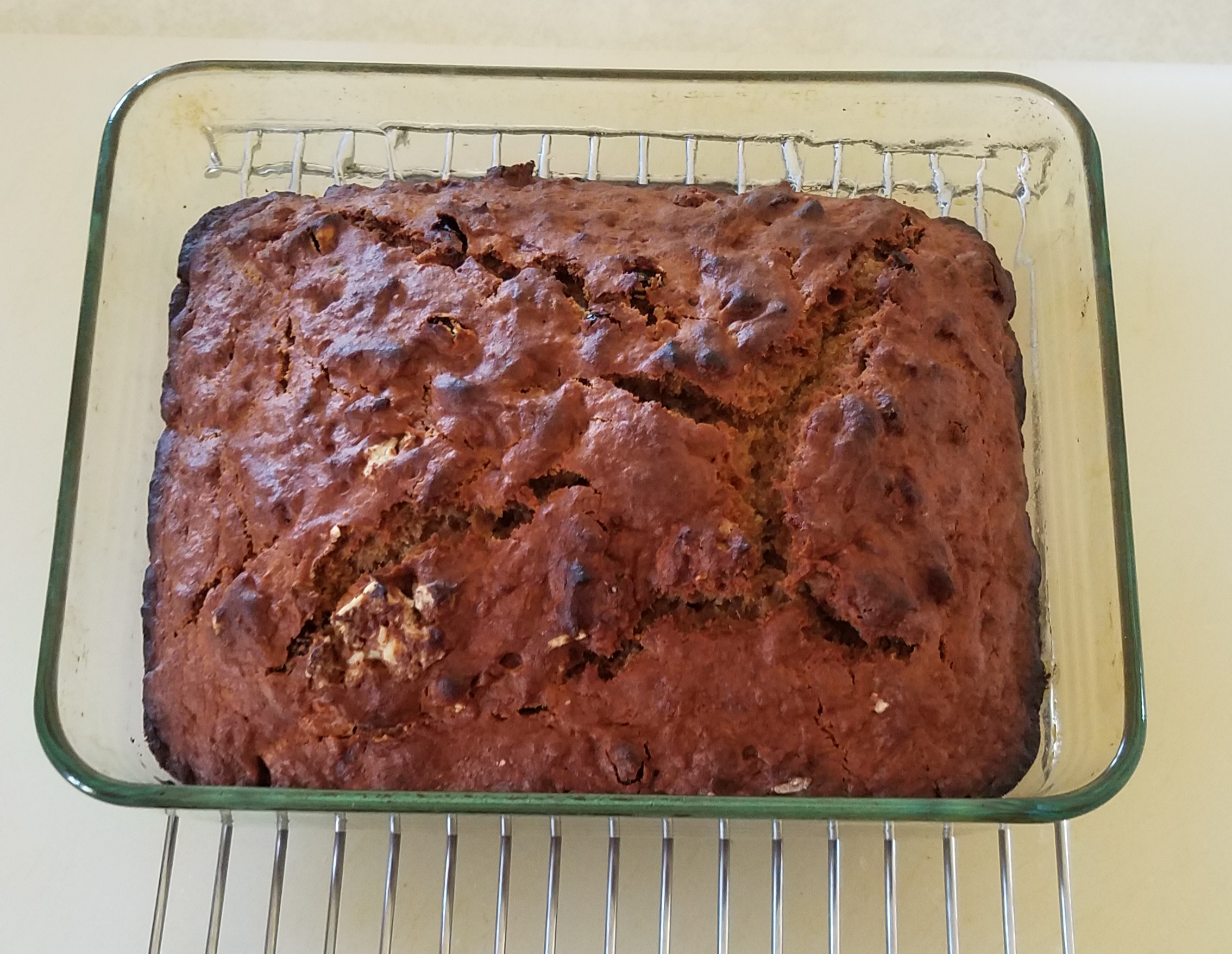
I found an old jar of applesauce, tasted it to make sure it was good, and baked an applesauce cake. This dense, slightly sweet cake could be split into two loaf pans and made as bread. Who wants to wash the extra dish? Topped with homemade apple butter, it is a mid-winter treat made from pantry staples.
A lot is going on in the political world. Reports say there is a high level of engagement among Democratic activists. Activists are one thing. Voters are another. More work is required on the latter. The field of candidates won’t be known until the filing period closes on March 18 for federal and state offices, and March 25 for county ones.
In the state senate district a bicycle ride away, Molly Donahue and Austin Frerick are in a primary for the Democratic nomination to replace state senator Liz Mathis, who is running for the U.S. Congress. I like Molly a lot and have attended her public outreach sessions held in nearby Ely. Frerick may be better known state-wide, and is expected to be better financed. It’s a race to watch. In the meanwhile, I am expecting a formal announcement from incumbent Kevin Kinney in my senate district in early March.
At the beginning, I didn’t think there would be much about which to write regarding my four-year stay at the University of Iowa. It turns out I was wrong.
The first third of my current project was written mostly from photographs and memory with a few history references scattered in. Now that I’ve entered the part where there is more written record, the story got complicated.
The period from Kent State on May 4, 1970 until May 1972 encompassed most of the anti-war activity at the University of Iowa campus. Both former university president Willard Boyd, and former dean of the Graduate College D.C. Spriesterbach wrote of the events in their memoirs. In addition, the Daily Iowan newspaper stores archived editions online at no cost for users. I have been able to re-read newspapers from the spring of 1971, my freshman year. Combine that with my personal documents and memory, there is a lot to go through and distill.
Music was important during university. I learned to play guitar and participated in the local music culture which included countless appearances by bands touring the country. There were big venue offerings like The Grateful Dead, Grand Funk Railroad, The Allman Brothers Band, and Leon Russell. There were smaller venue offerings with Muddy Waters, Luther Allison, and Ravi Shankar. I can’t recall all the long-time blues artists who performed in downtown Iowa City. My mates from high school and I started a rhythm and blues band about 1973. My record collection grew considerably at university. All that experience needs some clarity and compression, yet not too much.
When I moved to Forest View Trailer Court, I started cooking and have some memories of early experiments to share. I recall using the first loaf of bread I baked as a door stop because it was so dense as to be inedible. Food will be a major theme later in the story. I’ll be planting some seeds here.
I was able to graduate in four years, debt free. Things didn’t cost as much in the early 1970s. In light of the $120,000 expense our child incurred at a private college, there is a point to make about student loans and the cost of higher education.
The choice a writer has to make is whether to do all the work in the present, or to write one version today and add to it later. I’m likely to write my autobiography just once, so this is it. That makes the process longer than cranking out a 100,000-word work of fiction in a year. Progress was made this week. For that, I am thankful. Plenty of additional work lies ahead.
The Republican elected officials who represent me have forgotten the most important thing about education: its purpose is to educate children.
On Nov. 9, 2021, Rep. Mariannette Miller-Meeks introduced the CHOICE Act (HR 5959) which is a bill that takes federal money from public schools for private schools in states like Iowa. This bill is going nowhere if Democrats hold the majority.
I asked a group of parents and educators whether they had heard of the CHOICE Act. They had not. It is a distraction from the main goal of educating our children. What is the congresswoman up to?
Miller-Meeks seeks to acquire some more Iowa Republican extremism in education to garner a few votes in the midterm election.
Iowa Republicans support discrimination against a class of young children (HF 2416), seek to lock up teachers who don’t do what they want (SF 2198), and play three-card monte with childcare by doing nothing except raising the number of children each provider can serve (SF 2268).
No public dollars should go to private schools. We should focus on educating children, not playing political games with their future.
~ Published by the Cedar Rapids Gazette on Feb. 24, 2022
Vote board at the Iowa House of Representatives on Feb. 21, 2022
During last night’s Iowa House of Representatives debate on HF 2416, regarding eligibility for girls’ athletics, Rep. Jeff Shipley (R-82) repeatedly referred to supporting LGBTQ students as “affirming a mental illness.” He also compared being LGBTQ to “spreading cancer that will continue to grow.” He voted for the bill, which said in part, “Only female students, based on their sex, may participate in any team, sport, or athletic event designated as being for females, women, or girls.” The usage of “sex” means sex at birth as it pertains to trans-gender girls.
Shipley’s Republican colleague, the bill’s floor manager, Rep. Skyler Wheeler (R-04), said the purpose of the bill was protecting “biological females” from “biological males.” HF 2416 passed the House 55-39 and was messaged to the Iowa Senate, where it is expected to be approved. Governor Kim Reynolds was willing to sign the bill into law, although she wanted to see the final version before committing. Last night, Iowa made mockery of its motto, “Our liberties we prize and our rights we will maintain.”
Should the bill be signed into law, there is likely to be a lawsuit. Janice Weiner, candidate for state senator and current Iowa City City Councilor, posted on Twitter, “Expect at least one lawsuit to be filed as soon as it passes. And likely will request a preliminary injunction. This is federal legal territory, not a state legislative culture wars playground.”
I have a t-shirt that says, “Love is Love.” Well not in Iowa where being LGBTQ is a malignancy, and trans girls are discriminated against, and potentially bullied. Why won’t Republicans leave children alone?
I wrote a post “Republicans Sweep Big Grove” after the 2020 election, in which I laid out my beefs with the Iowa Democratic Party. Since then there have been multiple announcements of Democratic legislators departing the Iowa legislature at the end of the 89th Iowa General Assembly. According to Laura Belin at Bleeding Heartland, nearly 40 percent of current Iowa House Democratic lawmakers are either retiring or running for a different office. While legislators like my State Senator Zach Wahls, House Minority Leader Jennifer Konfrst, and Iowa Democratic Party Chair Ross Wilburn have not given up, the consensus is Democrats will be unlikely to build a coalition to defeat Republicans in the 2022 midterm elections, or even in the 2024 presidential election.
The plain truth is Iowa politics is so toxic, few voters want to engage and even fewer are willing to volunteer in campaigns. Legislative capers of the patriarchy like HF 2416 don’t add anything positive to the political climate. Republicans seek to divide the electorate and have been relentless in the pursuit of prejudice against LGBTQ citizens.
We can’t let HF 2416 stand. It is a long, difficult road to overturning the Republican agenda, although try, we must.
Fiction usually serves a specific purpose in my reading life: it functions the way a palate cleanser prepares us for flavors ahead, or in the case of reading, the next serious book. It is not that fiction writers are trivial in their efforts, it takes the same hard work to produce decent fiction as it does any other type of writing. Fiction is not the main event for me, so there are different expectations.
A novel must be paced quickly to hold interest. While fans of Tolstoy and Dostoevsky exist, their books have been difficult reads. I’m willing to suspend disbelief, yet only for so long.
I don’t like it when the mechanics of assembling a story are visible in the narrative. Yes, the author has to end a novel, although arbitrary resolutions of plot, ones in which the author’s hand is clearly visible, are particularly annoying. I’m thinking of Richard Powers novel The Overstory, an otherwise engaging tale.
Reading the first chosen novel of an author is almost always better than the next. I’m comparing Amor Towles books A Gentleman in Moscow and The Lincoln Highway. I was enraptured by the former and the latter seems forced and vapid. Towles seems full of himself and we don’t read fiction because of that. The same applies to Zeyn Joukhadar’s The Map of Salt and Stars and The Thirty Names of Night. The former is memorable, and the latter, not so much. All of them helped pass the time, so what am I complaining about?
Time was I wanted a novel to teach me something. Michael Crichton’s State of Fear cured me of that. One needs no further thinly veiled and polemicized presentations of a political argument. That Crichton was required reading to work in a logistics company rubbed salt into the wound. I seek to engage in a good story, follow it through to the end, and move on. Spare me the polemics, please.
When I consider past reading, there are only a few novels I would read again. Among them are The Great Gatsby by F. Scott Fitzgerald, Tolkien’s books The Hobbit and The Lord of the Rings, The Adventures of Augie March by Saul Bellow, and On The Road by Jack Kerouac. I enjoy reading John Irving, who is an exception to the rule about next books. Before I’d re-read one of his, I’d finish reading what I haven’t. My favorite was A Prayer for Owen Meany.
Give me a good novel, one that reads quickly, encourages me to suspend disbelief, and is a narrative for the sole purpose of telling the story. Do it well and you’ve got me hooked… at least until I move on to the next main reading event.
I arrived at Hillcrest dormitory in the fall of 1970 and decided I didn’t like my roommate and his clutch of friends from Western Iowa. I quickly moved into the Quadrangle dormitory with a high school classmate I didn’t know well. During my brief stay at Hillcrest, I met Jim, who would become my brother-in-law in the 1980s.
Construction of Quadrangle began during World War I. It was to be used as a training barracks to support the war effort. Work was completed in 1920 well after the armistice. It was a serviceable place to live with a big room, high ceilings, and a closet big enough for me to live in for a while – which I did.
We ate in the Quadrangle dining facility. I had been reading about macrobiotic diets and for a while adopted a no-meat diet. This may have been partly a reaction to the quality of dormitory food. Many complained about cafeteria food, yet once I went “macrobiotic” it was easy to find something to eat in the line. Macrobiotics caused me to lose weight, weighing less than 160 pounds for a while.
My grades were lackluster at university, achieving a 2.93 grade point average on a 4.0 scale. My approach after washing out of engineering was to graduate with a non-teaching degree in English and to take a varied assortment of classes to give breadth to my education in the humanities. The classes and instructors I remember most were Chaucer with Stavros Deligiorgis, Shakespeare with Sven Armens, American Folk Literature with Harry Oster, Modern Fiction with David Morrell, American Indian Signs and Symbols with Hyemeyohsts Storm, and Anthropology with June Helm. In addition, I took French for three years, enough to gain a basic level of fluency. There was philosophy, linguistics, engineering, art history, ceramics, anthropology, literature, and physical education. The classwork prepared me to become a writer, yet that wasn’t a specific outcome I sought. My attitude toward university was typified by the fact I skipped the graduation ceremony and spent the time listening to it on the radio while I tie-dyed some t-shirts in the basement of our rented house.
Tuition and fees in 1970 were $310 per semester. Room and board added $1,040 for the academic year. My $1,250 per academic year scholarship from the Oscar Mayer family, secured by Father’s friends at the labor union after his death, paid most of my expenses. I funded the rest with my savings from high school, summer jobs, and my share of the settlement with Oscar Mayer and Company over Father’s death. Occasionally Mother sent a check to help pay my U-bill. There was no presumption of going into debt to attend a state university.
My life at university was likely not typical. During freshman year I tried things out. Shortly after classes began, we went to a scrimmage of the University of Iowa Hawkeye football team. We spent most of our time there making fun of coach Ray Nagel. It was the only time I remember attending a sports event during the four years. I visited a couple of student organizations and didn’t feel enough connection to join. During sophomore year I went on a date with a female student. We didn’t click and that was it for dating during the four years. When I interacted with women after that, neither of us considered it to be dating. I did my share of studying and walking all over campus. I stayed busy with classwork even if I wasn’t that good at it.
Through my friend Dan from grade school and high school, I got involved with the Commission for University Entertainment. The university was a stop for touring bands in the early 1970s. My first year I ran a Trooper carbon arc spotlight for musical acts at the University Field House. I heard or worked on acts, including The Grateful Dead, Leon Russell, Freddie King, Albert King, Laura Nyro, The Allman Brothers Band, Neil Diamond, and Grand Funk Railroad. I also got a chance to hear musicians elsewhere in the region, including Ravi Shankar at Coe College in Cedar Rapids. It felt like we were part of what was going on in the national music scene.
I studied Renée Descartes at university and spent substantial effort considering his first principle, cogito, ergo sum, or in English, “I think, therefore I am.” I wrote about my Cartesian outlook toward life. We are isolated beings, wrapped in a veil of humanity, closer to God, or its divine essence than we realize. Such veil, metaphorical or not, is woven of delicate threads, like the lace of Morbihan, or silk from China. We could spend a lot of time marveling in its delicate needlework or shimmering surface. Yet we are compelled to reach out beyond the veil. A Cartesian view of life if there is one. Some say we should live our lives in the presence of God and perform all works for its honor and glory. The Sisters of Mercy taught us this and had us inscribe it on each sheet of schoolwork, “All for the honor and glory of God.” If God is reading this writing, my offerings may not be living up to divine standards.
University was a period of trying to figure out how I would live in society. During my freshman year I was introduced to R. Buckminster Fuller. The book, I Seem To Be a Verb by Fuller, with Jerome Agel and Quentin Fiore, blew apart my desire for consistency and predictability in life. “The most important fact about Spaceship Earth: An instruction book didn’t come with it,” the authors proclaimed. Chaos ensued.
These were the times of Marshall McLuhan, The Last Whole Earth Catalogue, James Baldwin, Joan Didion, Phillip Berrigan, Richard and Mimi Farina, Ken Kesey, Tom Wolfe, Hunter S. Thompson, Norman Mailer, and Bob Dylan. I read them all. They were in the wake of Jack Kerouac, Allen Ginsberg, and William Burroughs, whom I also read. If there were few female influences, it speaks to my education and upbringing. There was learning my first year at university. There was little consideration of what I might do with it after graduation.
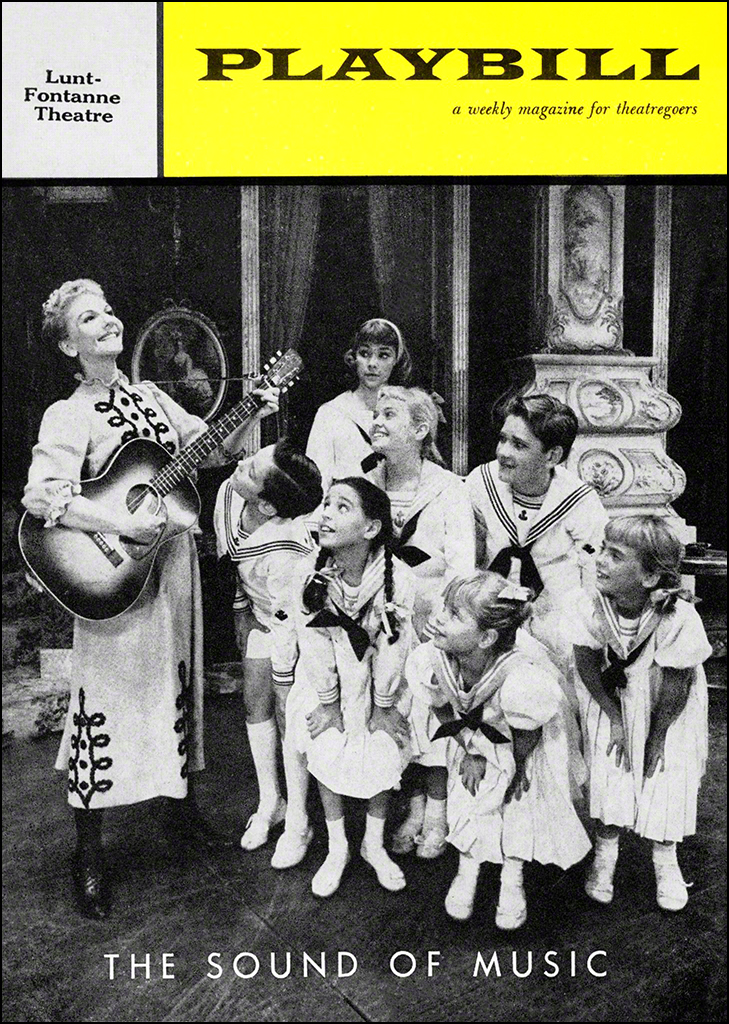
Folks may not recall Mary Martin and Theodore Bikel starred in the Rodgers and Hammerstein Broadway musical, The Sound of Music, which opened on Nov. 16, 1959.
Maria Von Trapp published her memoir of 1938 before the Anschluss in 1949. It was immediately recognized as having commercial potential and two German films were made of the story, The Trapp Family (1956) and Die Trapp-Familie in Amerika (1958). While the Broadway production began without music, it was the songs, many of which have become standards, that engaged people. The play won five Tony awards in 1960, including best musical.
The Sisters of Mercy in my grade school had become enamored of music from the play, from the beginning. We performed several of the songs at the former Jackson School when I was in sixth grade. I had never seen nuns so enthusiastic about anything before. When the film version came out, it was a sensation among nuns, grandmothers, and parents who had lived through World War II.
The film starred a 20-year-old Julie Andrews as Maria and Christopher Plummer as Captain Von Trapp. It opened on March 2, 1965. My grandmother had heard about the movie, and in a rare instance took us all to see it at the Coronet Theater on Harrison Street in Davenport. She insisted on paying. The music of the play, and the character Maria spoke to her. The Coronet had been remodeled that year and the Sound of Music ran for over a year.
In school we sang and played the many recognizable songs repeatedly. The whole thing was a phenomenon for us Catholic school children.
There were other plays and films that came from the World War II experience, yet nothing like the Sound of Music.
Marengo, IA — LGBTQ+ activist Elle Wyant announced her campaign for the Iowa House of Representatives today in House District 91, representing both Iowa County and the northwest portions of Johnson County.
“I’m proud to announce my campaign for the Iowa House in House District 91,” said Wyant. “Like many Iowans, I’m tired of our politics getting in the way of our progress. It’s time to open back up the dialogue. If you have an open ear, come with an open mind. I’m ready to run a campaign for all Iowans.”
Wyant was raised in Marengo and attended Iowa State University, graduating with a communications degree. She is a born and raised farm girl, who previously managed 160-400 acre farms consisting of grain crops such as corn and soybeans in Marengo. Her family owns two Iowa wineries– Ackerman Wine in the Amana Colonies and Fireside Wine in Marengo. Professionally, Wyant has spent almost two decades as an account executive with UPS where she also served as chairwoman of the company’s LGBTQ Business Resource Group. She currently works in Air Cargo Sales at UPS Airlines.
“I’m running because I believe in equity for all, not for some,” added Wyant. “I believe in equity in our schools by funding them fully, in our economy by championing a fair tax plan that gives Iowa families a fair shot, and by living up our reputation for being ‘Iowa Nice’ by building communities where everyone has the space to be fearlessly authentic.”
Being part of the LGBTQ+ community herself, Wyant is passionate about giving a voice to Iowa’s LGBTQ+ youth. Along with advocacy in her own community, Wyant is currently on the Board of Directors with OneIowa. She is the proud parent of two daughters, an aviation enthusiast, and foodie.
##
Learn more about Elle and her campaign at elleforiowa.com. Follow her on social media at twitter.com/elle_wyant and instagram.com/elleforiowa.
Two days of ambient temperatures in the 40s and 50s drew back snow cover to reveal a well-beaten deer path. Their droppings are scattered all over the ground. They hadn’t yet eaten tender young branches growing above the six-foot fence protecting two new apple trees. Maybe they won’t. Deer have become a regular animal in the yard. I don’t always look when I see them running down hill from the corner of my eye.
I walked around, picking up branches pruned from the fruit trees and placed them in a brush pile for spring burn. The ground didn’t give at all, remaining frozen. With temperatures today and tomorrow back in the single digits and teens, we are a distance from spring thaw.
I went to a grocery store. You know the kind. One that sells lots of different things. The organic kale looked great so I bought a bunch for stir fry and soup. I picked through the cauliflower for a clean head. Can’t remember if I ever bought kale in a store before. I don’t think so. Previously its been grown by me or my farmer friends. Frozen kale is used up, so a person has to do something to secure greens for winter meals.
One of the varieties of kale seeds didn’t germinate. The seeds are from the 2019 season, so it’s not a surprise. I’m putting together another order from my main seed vendor and expect it to be the final seed order for the 2022 garden. Seed catalogues are piling up next to the reading chair in the living room. Any more, I don’t spend much time looking at them as I know most of what I want.
A neighbor is planning an extended visit to relatives this summer. They offered me their garden plot, which is a nicely fenced area adjacent to our property. I’ve been thinking I could use more space. I’m considering it. I’d plant it with a uniform variety of vegetables, maybe fall crops of broccoli or cabbage, and adopt it for the season as the eighth plot. We’ll see.
It was good to get outside and exercise. It’s too early to begin turning dirt, so we wait. Parsley looks like it will over winter. It’s time to finalize plans for the garden.








 Journey Home
You must be logged in to post a comment.