Coffee mug made by Alea when we worked together at the orchard.
I will spend my two Friday afternoon work blocks getting ready for the arrival of our child. Mainly, that means cooking. Great Northern beans soaked overnight and are heading for a traditional bean soup made with carrots, onion, celery, and bay leaves cooked in homemade vegetable broth. There will also be homemade cornbread. I am debating whether to make applesauce cake or pumpkin bread for dessert. We’ll see what happens. It goes without saying, supper will be completely vegan.
Ever since the fire ran them out of their apartment building, first to temporary quarters and then to a new rental in a western suburb, our home became a storage depot for stuff not needed now, but was worth keeping. More storage items are enroute as I type these words. I created a storage platform with the loft bed I made for their college dormitory. It serves.
This is a tribal time. We don’t spend time together at the end of year holidays, so this is what we do. Have a bean soup supper two weeks before Christmas Day. Life is good.
While dropping off four fire extinguishers for recycling in the county seat, nature called. The nearest public restroom was in the county administration building. The parking lot was almost empty, so I pulled in and did my business. On the way back to the car, I ran into the sheriff in his dress uniform. We exchanged pleasantries.
I’ve known him since he was elected to the city council in 2008. When he and his family moved outside city limits, I advised him as he started a garden. I worked on his campaign for sheriff. During the 2024 precinct caucuses, he, his spouse, and I were the only people attending on that cold, snowy evening. He is one of the good guys. If it matched his uniform, he would wear a white hat.
The encounter served me to ask, “What’s going on with my life?” That’s a rhetorical question because I know quite well what’s going on. I retired early so I could have some kind of creative life before I get infirm. As I exited the parking lot and turned west toward the warehouse club, I wondered how many more sunrises will I get?
A fierce urgency consumes me, or as Dr. King put it, “the fierce urgency of now.” There is much to accomplish, and given my good health and time left, more than a few things can be done. I need immediate, vigorous, and positive action in my life. The brief conversation with the sheriff informed me there is no reason to wait. The time for good works is now.
Each day I walk on the state park trail I observe my world. Because of when I walk, sunrises are a main feature. Not only can the sky be beautiful at that hour, it reminds us of the promise of a new day. Sunrises are more than enough reason to go on living. And so, I shall, as long as there is another.
After I finished the work table, I sorted stuff in the workshop. In other words, I filled the table with stuff thrown hodge-podge in every nook and cranny. This will be a long process, yet I am heartened by having another surface to use for this work. It is beginning with tools.
The table project was easy, with the radial arm saw and power drill being the main power tools. There were a few hand tools, but all of them are frequently used, and easy to find. That’s not the case with things tucked away in the workshop today.
I brought home a lot of tools when my father-in-law died. That was almost 30 years ago. I never really incorporated them into my workshop. As a result of this neglect, I don’t have visibility of every tool I own. When I’m starting a project I’m running blind. I hope to remedy that.
This tool visibility project began with my red Craftsman toolbox. It has three drawers and a compartment in the top. I took everything out of the drawers and rearranged it.
All the fixed wrenches went into their own tool box. I don’t use them as often as crescent wrenches and I’ll know where to find them when I need one. Crescent wrenches and pliers filled a drawer. One drawer has gripping tools. Most sizes of screwdrivers are on a pegboard, so the ones in the toolbox are either specialty drivers or extra. Screwdrivers get their own drawer, which isn’t enough space to accommodate them all. The solution to that will wait until I see what else I have. When I replaced some tools with others, the idea was to keep thosek most frequently used in the red toolbox.
There are also what I’ll call specialty toolboxes. One is full of drill bits of many kinds. I keep a separate drill bit holder on the bench so I can quickly find common sizes. There is a toolbox with woodworking tools. There are all kinds of them, although I am hardly a woodworker. One toolbox has a set of metric and imperial sockets. In the cabinet, there is another whole set of Craftsman sockets. This is just the beginning.
The main goal of this project is to gain visibility of what I have. I am tempted to acquire one of those tall movable toolboxes with many drawers. I hope that is a passing infatuation. For now, just knowing what I have should be enough to get started on new projects. The new table led to this, and who knows where the forking paths ahead will lead? Being aware of what tools I have is a good start.
Everyday I am out in the weather for at least part of the day. This December has been weird with heavy snowfalls coupled with spells of above freezing ambient temperatures. The talk on the trail is about how the trail surface varies with snowfall and temperature. We are all of retirement age so our concern is testing new muscles and stress on our ankles and joints. Thus far I have been able to navigate rough surfaces without mishap.
The outdoors temperature was 37 degrees Fahrenheit when I woke. By the time I was ready to walk on the trail it had dropped to below freezing. As I entered the state park, the wind picked up and snow began to fall. The trail surface had frozen unevenly around snowmobile, wildlife, and pedestrian tracks. I had to be careful to preserve my joints and ankles. I knew the weather forecast before I left home.
I’m not the only one who takes accurate weather forecasts for granted. My resource is the Weather Channel with its hourly forecasts and radar images. Mostly I seek short-term weather forecasts in order to do something like mow the lawn, take a walk, or work in the garden. Existing technology gives me accurate forecasts that facilitate what I want to do.
Hannah Ritchie is a Scottish data scientist, senior researcher at the University of Oxford, and deputy editor at Our World in Data, according to Wikipedia. Her work focuses on sustainability, in relation to climate change, energy, food and agriculture, biodiversity, air pollution, deforestation, and public health. She recently wrote the following about weather forecasting:
The potential for AI to improve weather forecasting and climate modelling (which also takes a long time and uses a lot of energy) has been known for several years now. AI models have been tested for one- and two-week forecasts with promising results. Scientists will often need to wait weeks for a complex, high-resolution climate model to run; AI might be able to do this hundreds, if not thousands, of times faster. (Email from Hannah Ritchie on Oct. 27, 2025).
Naturally, I asked ChatGPT about this, “When scientists like Hannah Ritchie say weather forecasting can be much improved with artificial intelligence, what do they mean.” As is usual for artificial intelligence, the answer was very long. Here is the crux:
When scientists say weather forecasting can be dramatically improved with artificial intelligence, they usually mean something more specific than “AI makes everything better.” They’re referring to concrete technical bottlenecks in current forecasting and the ways AI can overcome them. Hannah Ritchie, and researchers at ECMWF, NOAA, Google DeepMind, NVIDIA, the UK Met Office, and others, are all pointing to similar developments. (ChatGPT query result, December 2025).
More specifically, in explanation, the machine listed multiple bullet points:
Weather prediction is limited by physics-based models.
AI models can “learn the atmosphere.”
AI lets scientists blend physics and data.
AI makes weather forecasting more democratic. By that, it means cheaper and more broadly available than on expensive, physics-based computers.
AI enables longer-range and global risk forecasting: seasonal climate forecasts, agricultural and drought planning, energy-grid load forecasting, and catastrophe-risk modeling.
But: Scientists emphasize that AI is not a replacement for physics.
The machine summarized: forecast faster, forecast at higher resolution, run at vastly lower cost, improve extreme weather warning lead times, complement physics with learned patterns, and democratize forecasting globally.
According to the machine, consumer-scaled artificial intelligence models might be available by 2032. In the meanwhile, I’m just glad I didn’t turn an ankle on the trail this morning.
There was a time when I attended estate and farm auctions and bought things on the cheap for later projects. The years since then can be measured in decades. At a point in my life when I have to either do something with stuff, or otherwise dispose of it, I got out the top and legs of a table I bought for a buck at auction. It was time to make something. Since I rearranged the garage, I have space for a work table that is shorter than the custom-height workbench I made when we lived in Indiana.
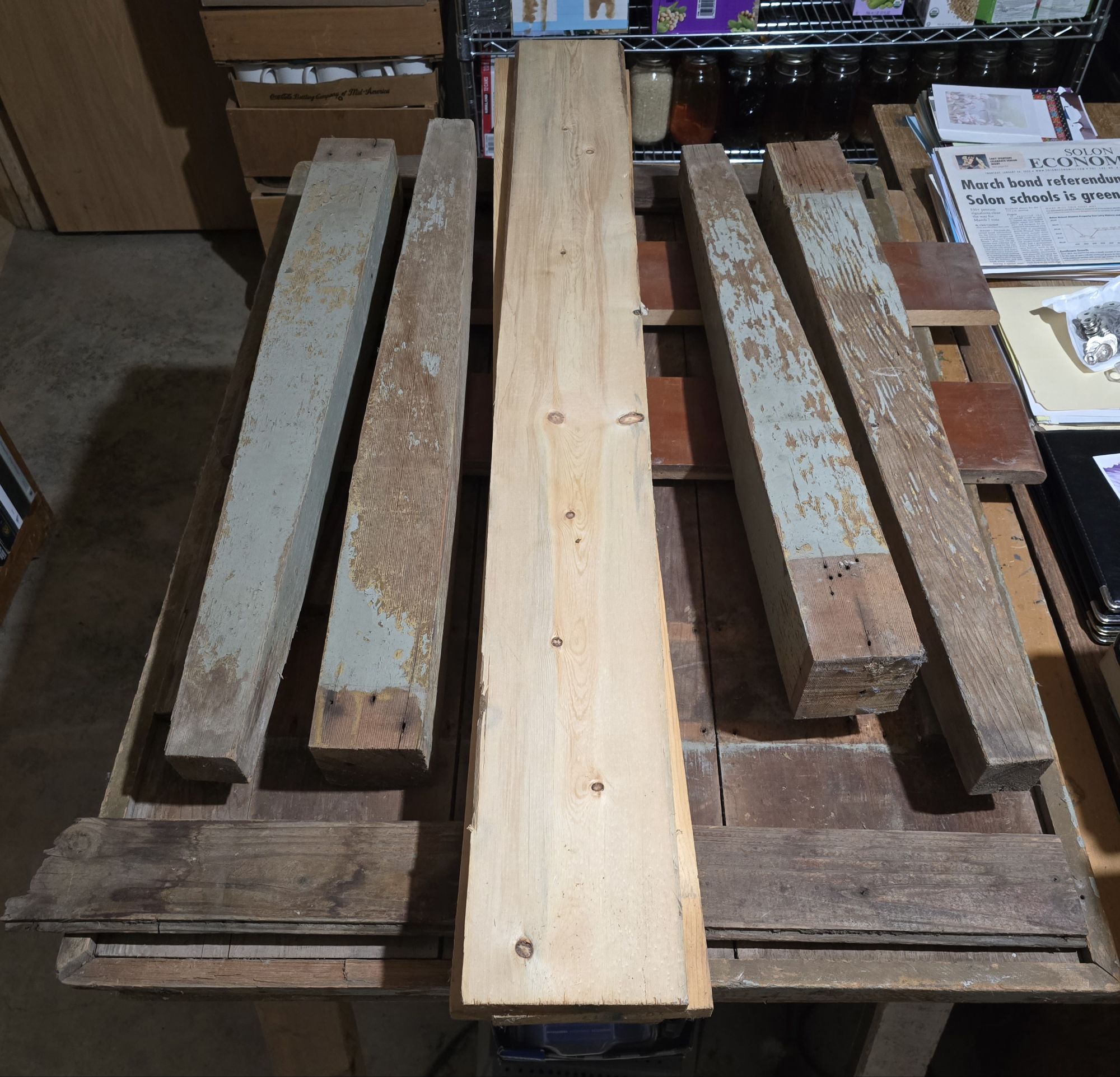
I went through the woodpile and found planks to make an apron and five of rescued lumber to reinforce the top. I laid the materials out on this workbench made of sawhorses and thought about what I would do for a couple of weeks.
After looking at local hardware stores and large online retailers, I finally found a packet of figure 8 steel desk top fastener clips with screws. They are not commonly available. To make a recess in the apron for the fastener, I got a 20 millimeter forstner drill bit. $20.12 all in.
After 12 cuts on the radial arm saw, I was ready to assemble. I spent about three hours on the project before my attention began to wander. I am better at recognizing when that happens, so I knocked off for the day. If everything goes together as planned, it will take an hour or two to finish assembly.
After a few hours of furniture building I had to take a break.
I don’t plan to refinish the wood. Inside the garage it will be protected from the elements. I expect it to get scuffed up with heavy use, so what’s the point of a coat of paint or finish? The wood it’s made of has been around for a long time, based on the assembly techniques my predecessor used to build it.
Fingers crossed the final assembly passes muster and I can begin using the new table immediately. One never knows about these things until the work is done and the piece is in operation.
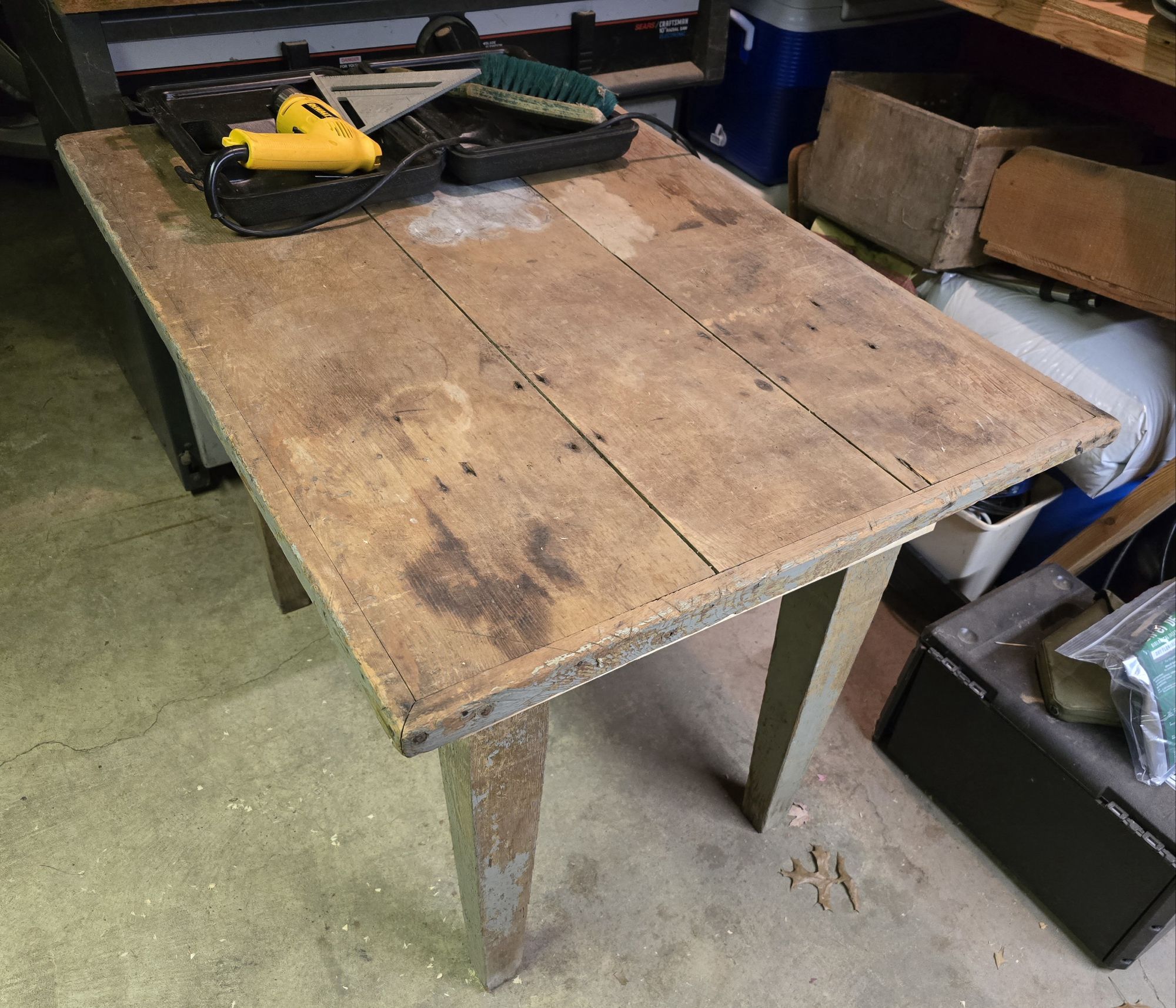
Here is the finished product in the garage.
Table made from a top, four legs and salvaged lumber.
It’s bigger than I thought, but I will adapt. No adjustments were needed.
My veterans group asked about having a social hour at the Hilltop Tavern in Iowa City last Friday. I don’t visit many taverns yet I like folks in our group and it was located across the street from the grocer from which I needed provisions. I drove the 14 miles to the county seat, parked in the grocery store parking lot, and walked across the street to get there.
The hill in “hilltop” refers to what was known as Rees’ Hill. This is from the Our Iowa Heritage website:
The area was generally known as Rees’ Hill – reflecting the winery and wine garden owned by Jacob and Agatha Rees across from the Hilltop Tavern location. The wine garden was well known and popular with Goosetown residents during the 1880s (and likely earlier). Jacob’s death in 1889, and Agatha’s (and son Frank’s) deaths in 1893 likely resulted in the closure of the winery. For many years, the property was either unused or planted for strawberries or general nursery. This property is where the Hy-Vee grocery store and gas station exist now at the corner of North Dodge and Prairie du Chien and occupied two acres. (The Origins of Iowa City’s Hilltop Tavern by Derek (D.K.) Engelen, Our Iowa Heritage).
The tavern opened after prohibition ended and has been in operation ever since. When I entered through the door in the photo, the bar was right there on the right, maybe 20 feet from me. People behind the bar immediately recognized that I entered and inquired what I wanted. I found my friends in a large, adjacent room with three pool tables and ordered a draft beer.
My friend, a banker before retirement, brought a roll of quarters so we could play eight ball. I hadn’t played since grade school but we formed teams and racked the balls twice. None of us were talented at the game, yet it helped pass the time by encouraging conversation.
What do aging septuagenarian veterans talk about on a Friday afternoon?
One of us recently had hip replacement surgery, and that took a bit of time. I obviously know hip surgery exists, but haven’t discussed it with someone who had it. I had questions. It turned out someone else had knee replacement surgery, so that led to a discussion of the differences between the two procedures.
About that time, someone walked up to ask if we minded if he played music on what in earlier years would be called a jukebox. We didn’t mind, and one of our party asked him to play some Kenny Rogers, which he did.
Being veterans, we discussed the extrajudicial executions of people suspected of being drug runners in the Caribbean Sea, and whether Admiral Mitch Bradley, the commander of U.S. Special Operations Command, would be the scapegoat for the president and secretary of defense to avoid responsibility for two specific killings that were clearly illegal. We drew no conclusions.
The prior day, the Iowa Legislative Services Agency released the first county supervisor redistricting plan. The Iowa Legislature earlier voted to require certain counties that elected supervisors at-large to divide into districts. Their idea is that creates an opportunity to elect some Republicans, although the logic is based on deceptive arguments. A lawsuit was filed to stop this process. Our group agreed the court system had little time to make a decision because of the long lead time to plan an election. We were in a wait and see mode until the lawsuit is resolved.
We talked some organizational business, finished our beverages and game, and headed out. It was a pleasant way for aging peace warriors to spend an afternoon in these trying times.
This post is about social media and blogging. My perspective on these two technology tools is they both require a creative process of putting together meaningful words and photographs in a way that provides insight to readers. When I use them, I am a content creator, although those two words don’t really capture my vision for what I’m doing. I seek to bring understanding to the complex and ever changing world in which we live.
I joined Facebook March 20, 2008 to follow our child. They had graduated college and moved to Colorado in 2007. While I could easily drive in a single day to visit, it was a long trip to spend much time together. My reaction to Facebook? Yikes! Here is my blog post about joining:
Tonight I joined Facebook. Yikes! Facebook connects us to people we have not thought of in years. In some cases we haven’t made contact in over a quarter of a century. All within a couple of hours. From moment to moment, the number of “friends” builds. What to say on the site? What elements to show? What pictures to place? How much time to spend? When a friend accepts the invitation, it feels good. The wave has broken, now I’ll ride it in. (On Facebook, Big Grove News, March 20, 2008)
In the end, our child quit posting on Facebook and while I developed a Facebook life, it was not good for me. Social media introduced loneliness in my days, something with which I had little experience. It reinforced loneliness. As I mentioned in yesterday’s post, I am aware of being alone yet don’t experience much loneliness. I feel connected to the whole of society. If I continued with Facebook, even with all of the familiar faces and common experiences, I would feel how much apart we are. I deactivated my account in February this year.
After much experimentation, I ended up with an account on BlueSky, which is a text-based social media platform where it is easy to connect with like-minded people. My posts there have been hit or miss, yet I need the creative outlet. BlueSky is my only social media account.
My first blog post was on Nov. 10, 2007. I first titled the blog Big Grove News, then Big Grove Garden, Walking There, On Our Own, and now Journey Home. The purpose was always the same: provide an outlet for creative expression and pull in pieces I wrote for other purposes to make a record of them.
When I began blogging I had no idea where it would go. I wrote at least 5,600 posts since beginning. For a long time, it was the only writing I did each day. It has become a writer’s workshop to test ideas and how to express them. Some days the posts are cringe worthy. Some days I touch the sky. Part of me would return to handwriting paper journals the way I did before 2007. I may yet do that, but not in 2026.
In writing my autobiography I find I repeat topics often. For example, the story of the apartment in yesterday’s post has been written and re-written with different details and posted on my blog at least a dozen times. An early reader of my autobiography commented about my propensity to repeat myself. All I can say is I’m working on that.
I used to write blog posts in the early morning. Lately, especially since I began learning about circadian rhythms and tuning my physiological life to them, my best creative time is in the afternoon work blocks. I still work on creative writing in the morning but it is more the next chapter of my autobiography until that work is finished. I am more alert when I write blog posts. The quality of writing seems better. Like everything, it is a work in progress.
People do read my blogs. It is hard to believe the number of people in real life who identify me as a writer. A lot of this is due to letters to the editor and posts on Blog for Iowa. That type of feedback is rare and precious to me. It helps me feel like part of a community.
Is there a limit to the creative expression I put into my writing? If I have to get a job to make up for the percent of Social Security that will be absent after the trust fund runs out, there will be a loss of time for writing. For now, though, I’ll continue on.
My apartment on Mississippi Avenue was on second floor, far right window.
My experience living by myself in my first apartment after university was formative in how I approach loneliness. The one-room apartment was located in this building on Mississippi Avenue in Davenport. I would lie in bed and feel my heart beating before falling asleep. While I was alone, I didn’t feel lonely. Because of an active youth, it took no effort to fall asleep and stay asleep until morning. I wrote about this apartment multiple times:
This new apartment already begins the rebirth which is so much needed by my soul at this time. The neighborhood is quite quiet and the apartment that I rent is at the end of a small hallway off the main one. Across the street is another large house which has been subdivided into apartments and it is quite a ways away. Further up the block there is a Jewish synagogue Temple Emmanuel. The river is about three or four blocks away. It seems there are some well-to-do neighbors to the south of this building who at this time are having a dinner party of some sort. But at the same time I believe that the area is on the fringes of the poverty area which is mostly to the West and the wealthy area of town, the Heights, which is to the East. The landlord’s brother lives upstairs in the attic and he mysteriously comes and goes. The landlord said. Sometimes he’s there, sometimes he’s not. Ask him if you need anything, said the landlord. Time will tell as I ask God to manifest his will. My major tasks at this time are to set up my own household for what is to be the first time. (Personal Journal, Sept. 11, 1975)
On Dec. 29, 2010, I wrote a post titled A Normal Winter. It expanded on this time of my life:
It has been so long since we had a “normal” winter in Iowa that we forget what that means. Snow and cold, dry weather are de rigueur and what we have had thus far has been relatively normal. No repeated blizzards, no continuous sub-zero temperatures. A “white Christmas” that was almost storybook in the appearance of the landscape. We could do with snow cover to reflect the heat of the sun back into space.
This week I have been thinking about the first time I lived without a room mate in late 1975. I was working at the Carroll’s Dairy Store at Five Points in Northwest Davenport. While working part time, I earned $0.85 per hour and somehow could pay the rent, and other bills while I figured out what was next in my life. It turned out that what was next was joining the Army, enlisting to attend Officer Candidate School at Fort Benning, Georgia and serving for almost three years in Mainz, Germany after a year of military schooling.
I lived in an large house that had been divided into apartments on Mississippi Avenue. My vehicle was a 1961 Chevrolet Impala, bought from a woman from whom it had been stolen and then returned. Occasionally, I walked the three miles from my apartment to work to get exercise, but to avoid burning fuel as well as even in 1975, it was a struggle to make ends meet on minimum wage. Seven Eleven started opening up convenience stores in Davenport and I used that as leverage to get a raise at Carroll’s.
Google map of Mississippi Avenue in Davenport, Iowa.
The single room apartment had a stove, refrigerator and sink, with a shared bathroom was down the hall. Somehow I crammed my book collection, vinyl records and all my possessions into that small space. My mother came for dinner for one of the few times I have cooked her a meal, making tuna casserole of dubious quality. We took a walk to nearby Prospect Park that evening. Cooking and entertaining were skills to be developed later in life.
Laying on the single bed I could feel my heart beating. That feeling is drowned out when there is a room mate. For the first time, I realized what it meant to be alone in the world, although I was not particularly lonely. Being alone drove me to seek out others and work on a life of my own. I started writing a journal, heard Chaim Potok speak about his then new book In the Beginning at the synagogue across the street and pursued what I believed to be the life of someone who had graduated from college. I was living a life, but driven to make something more of it. In many ways, I am pursuing that same life thirty five years later.
What I didn’t know in 1975, was how unique that time of my first apartment would be. That I would set patterns of behavior that would follow me until the present. Knowing now, what I didn’t know then, I look fondly to those few months on Mississippi Avenue, close to the river and on the edge of economic viability. While that life was unsustainable, it became a platform from which I took a bigger leap into life. I never looked back to say I would have chosen things to have been different. (Blog post on Dec. 29, 2010).
As I age, my loneliness has not changed. It may be there, yet it does not dominate my awareness. In recent years I have been sleeping through the night less often. My current project is to increase awareness of my biology and circadian rhythms. By doing so, I have been sleeping better.
Loneliness is something to deal with. I recently found this in the Washington Post.
An increasing number of middle-aged and older adults — especially those in their 40s and 50s — are lonely, according to a report released by AARP, a nonprofit advocacy group for older Americans. Among the loneliest are adults 45 to 49 years old (49 percent identified as lonely), as well as respondents who never married (62 percent); are not working (57 percent); or whose household income fell below $25,000 a year (63 percent). (Washington Post, Dec. 3, 2025).
I served on the county board of health for six years from 2005 until 2010. Of all the volunteer work I have done, this was the most engaging. When I applied for the position, Johnson County had, and still has, a strong medical community. There were those who felt members of the board should be physicians. I secured my position because I was in fact different from others with my experience in managing rural water and wastewater systems for my home owners association.
Volunteer governmental boards and commissions are what a person makes of them. For example, when I was in my first term on the board in 2006, more than a hundred students from Longfellow Elementary School in Iowa City called off sick with stomach flu symptoms. The department activated its process for disease containment. One way for a board member to handle this is to educate themselves about the situation, study data, and discuss whether any change in process was warranted. My approach was to drive down to the department of health and field phone calls from concerned parents and try to handle their concerns in real time. This hands-on approach characterized my time on the board.
Department members weren’t always used to my approach. After my first year, I requested to get involved with operations, including shadowing the food inspectors at the county fair. After hearing about it, one employee responded, “Would someone please fill me in as to who this person is, what is the goal of the request to shadow…” Being different has consequences. Once I got to know this employee, we developed a good relationship. I found food inspections to be something. Let’s just say, I’m glad the health department does them. This kind of hands-on experience seemed essential to my understanding public health in the community.
I was surprised by the attitudes of some of our staff. For example, one person was opposed to the new casino being proposed in Riverside. They felt it would encourage alcohol and tobacco use, and associated health problems. We don’t hear any of that talk with the new casino today in Cedar Rapids.
The most impactful thing I did during my tenure was to recruit a replacement for the department head. The board supervises this position and writes performance reviews. When a replacement is needed, that job fell to me as board chair. I formed a committee of ten people from different walks of life: elected officials, attorneys, physicians, and people from health-related non-governmental organizations. The committee we recruited included some of the smartest people I have known. The lesson I learned is that if you have talented people doing this work, the job gets done well. The replacement we hired was a keeper who lasted long after my tenure on the board ended.
In my home town, board of health members tend to stay on the board for a long period of time, in some cases, for decades. I didn’t feel that way. My plan was to stay on the board for a single term. Once I dove in and found how important and engaging the work was, I agreed to a second term.
My advice is simple. Find a way to help on governmental boards and commissions. The work is rewarding and needed. Having citizen input to governmental departments is as important now as it was 20 years ago when I began my time on the board of health.
The idea of a routine is anathema to my way of life. All the same, one of the most significant struggles during and after the coronavirus pandemic has been making my days productive. While economic concerns have not disappeared after retiring on Social Security, I don’t want to be locked into a routine. Personal preferences aside, there is a scientific reason to develop and follow a routine.
Routines are linked to better health, academic success and even resilience. We can all take simple steps to synchronize our activities with our circadian rhythms and biology. Small tweaks in the timing of things can pay off. (As a doctor, here’s my simple, science-backed schedule for a healthier day, Dec. 1, 2025, Washington Post by Trisha Pasricha, M.D.)
That damn biology! How limiting!
Working with ChatGPT, I developed a daily plan to help structure my time at home. I had not thought about compartmentalizing routine activities, yet this plan does so and has produced better results that free me of worry about how I spend my time. The three morning and two afternoon work sessions with a short break between them has been revolutionary.
I began developing this Daily Plan a few years ago. Then, it included only items in the first three bullet points. By expanding it to encompass the whole day, and implementing some basic science about circadian rhythms, my life has been better. It’s a never-ending process to refine this. My daily plan will get its first major test as I finish my second book this winter.
In general, I take Sundays off a plan and let my life free-form for a while. That has proven to be a useful break from regimentation.





 Journey Home
You must be logged in to post a comment.