Categories
Writing

Toward Local Food Policy

Farmers Market Food

To prepare for my first meeting as a member of the Johnson County Food Policy Council, I read council recommendations for the Uniform Development Ordinance. There were two things:

Ag-Exemption should be available for local farmers with less than 40 acres.

Agritourism enterprises need zoning regulations that allow for innovation and creativity on farms in the unincorporated areas of the county.

After what seemed like a never-ending series of public hearings, comments, and input gathering from multiple constituencies, the Board of Supervisors accommodated these recommendations in the UDO, if not in a way county farmers expected or fully appreciated.

A group dissatisfied with accommodation on the 40-acre rule sought relief from the legislature in the form of preemption of local control on the ag-exemption. This landed in the Iowa Farm Bureau’s lap where it remains for the time being. The first agritourism application was heard in Planning and Zoning Feb. 10. The idea of chip and sealing two miles of gravel road to improve access was predictable, but unexpected by the land owner. The same group introduced HSB650 for state preemption of local control regarding agritourism. That bill cleared subcommittee Feb. 12.

These things will work through the legislative process, but having made the recommendations, having the board of supervisors accommodate them as they saw fit, and now with bills being proposed in the legislature and agritourism applications working through county departments, what is next for the Food Policy Council? That is my question.

After one meeting I’m not sure. Answering that question will be part of what the remainder of my term, which ends in June, will be about. If we come up with good answers, I will apply for a full, four-year term. If not, I have a garden.

The recent example of Grinnell Heritage Farm, which withdrew from wholesale grocery store sales and from a community supported agriculture project, is instructive about the needs of local food producers. Farm operations are a balancing between producing enough to meet customer demand and finding customers who are willing to do business at levels that meet the realities of harvest, quantity, delivery, and seasonality. Andy Dunham of Grinnell Heritage Farm provided the following to Cindy Hadish who blogs at Homegrown Iowan:

The reason for scaling back is primarily due to the lack of any larger retail and wholesale outlets. We have tried for years to get into Hy-Vee stores with very limited success. When individual stores do buy, they usually only take $30-50 in product, which doesn’t even cover delivery costs in most circumstances. We have had more than one instance in which the store would buy a case of kale, put our name on the produce case, and then stock conventional kale out of California under our name. Whole Foods is still buying, but at lower prices than five years ago. New Pi is shrinking. Food hubs are folding or not scaling up fast enough. We were in the strange position of being able to grow more than the market seemed able to bear; a position that I would have laughed at as being impossible five years ago.

What policy should the 15-member Food Policy Council recommend and support this year?

We need to return to the reasons we even make policy. Maybe the council has been doing that already.

Our county’s local food system, including a robust network of local food producers, a food hub, farmers markets, and wholesale business with restaurants and grocery stores, is not well organized. Our policy doesn’t exist that I have been able to find. It is too similar to the de facto national policy, which according to Ricardo Salvador, director of food and environment for the Union of Concerned Scientists, goes something like this: “Exploit people and nature for agribusiness profit.” We are better than that now and need to improve.

Any policy recommended must serve the public interest. There are significant issues that could be addressed, including policies related to hunger, obesity and Type II diabetes, environmental degradation for food production, land stewardship, labor exploitation, fair compensation, and appropriate farm labor regulation. The council must learn from best practices of local operators and consider a broader source of input that includes public health, preventive medicine, dieticians, other communities with a local food system, and accommodation for residents who need it.

People hate government folk and volunteer councils like ours telling them what to do. A friend advised me to, “avoid colonialism.” Where I come from, that means “putting on airs of superiority.” I’ll do my best as we discover what the council wants to do.

~ The author is an appointed member of the Johnson County Food Policy Council. Opinions herein do not represent the council.

Categories
Writing

Winter Lament

Onions and shallots

January and February are usually months to read books. I’m working on my fourth but it seems like I’m running behind.

Political work has taken a bite out of my time.

Ambient temperatures have been warm. Absent a cold spell of temperatures below zero, I’m planning to prune our fruit trees this coming cycle of days off. As I lean into retirement I work two days at the home, farm and auto supply store with five days in a row to do what I please. The days are filled with activity.

Sunday I’m scheduled to soil block at the farm, the first time this winter. I bought a small soil blocking tool for home use and planted onions and shallots. It’s the first time doing it at home and what the future holds as I wean myself from greenhouse use over the next few seasons.

Our ice box is getting down to carrots, turnips, bread, dairy and pickles. There are mostly jars of things. Light permeates the glass shelving, revealing what’s in the bottom drawer. Growing season is a couple of months away.

Our cooking is from the pantry and freezer. We have storage onions and potatoes and lots of garlic. Apples from our trees and the orchard have been gone a few weeks. There are plenty of canned goods. We have enough to last us until spring arrives, supplemented by weekly trips to the warehouse club and grocery store.

Winter in Iowa has changed. It’s weird. It’s not consistent from year to year. I try to adapt and still find the new experience a bit sucky. Are you winter or not? No response.

As I finish this post, a prelude to getting ready for work, I feel ready: ready for what’s next, ready for something different, ready to move on. In this winter morning I’m ready to emerge from my book-lined writing space and ascend to the kitchen, and all that happens there, midst a winter lament.

Categories
Writing

Who Am I?

Paul Deaton

I had a chance to introduce myself to a new group of people last night, so I thought I would share it here before the paper goes into the shredder. Here’s what I said to the Johnson County Food Policy Council last night:

I am:

  • Native Iowan living west of Solon.
  • Ten years since retiring from a 25-year career in transportation and logistics.
  • Two terms on the county board of health with four years as chair. Familiar with air and water compliance issues.
  • Blogger with 234 posts tagged “local food.”
  • Farm worker. In 2020 on Carmen Black’s farm and at Wilson’s Orchard. Eighth season at each.
  • Avid gardener with a large kitchen garden integrated with local food producers, grocery stores and other retail outlets.
  • 24 percent of our food dollars are spent on local food, not including my garden.
  • Mostly ovo-lacto-vegetarian.

These mini-autobiographies are getting easier to write as I age.

Categories
Home Life Living in Society Writing

Pivot From the Caucus

Palmer House Stable, Solon, Iowa, Feb. 8, 2020.

While the Iowa caucus news cycle lingers, I am already gone.

After a Saturday of political engagement — an interview with Michael Franken of Sioux City who is running for the Democratic nomination as U.S. Senator from Iowa, and a town hall meeting with my state representative Bobby Kaufmann — Michael Wines of the New York Times contacted me about my experience at the Big Grove precinct caucus. I told him the story… which is metastasizing.

The narrative is repeated so much I might resurrect a circus like Ringling Brothers and Barnum and Bailey to take it on the road. As locals know, circuses are an Iowa thing and four of the Ringling brothers were born in McGregor, Iowa. What more fitting outcome for the caucuses?

Nontheless I am pivoting away from politics. I’m in a position to do so because of great caucus turnout. I’m confident our four delegates to the county convention will show up. Two volunteers stepped up to participate as precinct representatives on the county central committee. Despite lingering interest in what we did, the news cycle will eventually move on. It’s time for me to go.

I unsubscribed from the county party weekly newsletter, thanking the public relations chair, and saying, “I have less need to stay abreast of what party insiders are doing.” There is life beyond politics.

Toward what will I pivot? Will a divot of politics follow?

Our big family news is on Feb. 5 we made the last payment on our daughter’s student loan. Including loan interest, our contributions, and her work study and scholarship, the cost of her four-year education was about $140,000. In the box of letters I sent Mom during college, I wrote my monthly bill at the University of Iowa was $50. Add in the scholarship I had and my college expense was about $6,800 for four years.

My freedom from politics will be used to become a better citizen. Monday I start a brief term on the county Food Policy Council. If that proves to be engaging, I’ll volunteer for a full, four-year term. I’m writing more for Blog for Iowa, have written up one interview, two more are done, and there may be more. I hope to have a better garden this year. I invested in an electric tiller, bought some rolls of mulching, and began planting onions on Friday. There are plenty more projects in the works. There are also the farm jobs, which have been reduced from three to two this season.

A group of us were sitting around a table in the break room at the home, farm and auto supply store on Wednesday. The discussion was about retirement as a couple of us have retired but continue to work because of the social engagement a job involves. Our store manager was there and he told me, “If I were you, I’d retire as soon as possible.” Depending on how the next couple of months go, I may take his advice and help on one of the federal election campaigns.

For now, I’m on to what’s next while sustaining ourselves in a repressive national political environment. Life will be better, at least I hope so.

Categories
Writing

Note from Ravenna

In 1974, when I arrived in London, I had a short list of European places to visit.

Most of my list was the result of an art history class taken the fall semester of 1973 in the then new art museum of the University of Iowa. The art collection was removed during the 2008 flood and never came back to that building.

I wasn’t a good art student, and elected a pass-fail grade versus A – F. My teacher was disappointed when he discovered my choice. I passed the elective course.

Despite my chary engagement as an undergraduate student, there I was in London beginning a 1970s version of the Grand Tour. It was a rite of passage to elevate myself from the blood, slop, bacteria, and gore of two college summers working in a slaughterhouse. It was the same plant in which Father died in an accident. I had rejected the post-college job the company recruiter offered me that spring. It was time to break loose from my local moorings. Once I got to Europe it became clear there were hoards of young people doing the same thing.

A wad of American Express travelers checks was tucked inside the baby blue bag Grandmother made for me, about $2,000. The money came from selling the band equipment and the Volkswagen micro bus used to haul it around. It turned out to be enough cash for the trip.

On the list were the Byzantine mosaics in Ravenna, Italy. Our art history teacher marveled at them and inspired enough enthusiasm to pique my interest. It was that way for many of the places I visited. It was also an easy side trip enroute to Vienna, Austria where a student I met in Stratford at a performance of Twelfth Night had invited me to stay.

Ravenna was significant for more than mosaics. On the train rides from Barcelona to Rome, along the Mediterranean coast, I met several Italians. They insisted I learn to speak Italian if I would visit Italy. I studied French in college and had reasonable fluency. Learning another Romance language wouldn’t be too hard, I thought. I searched a book store in Genoa for an English-Italian phrase book and found none. I settled for a French-Italian phrase book which served. By the time I got to Ravenna I was able to check into the hostel, order meals, and converse on a limited level without speaking English a single time.

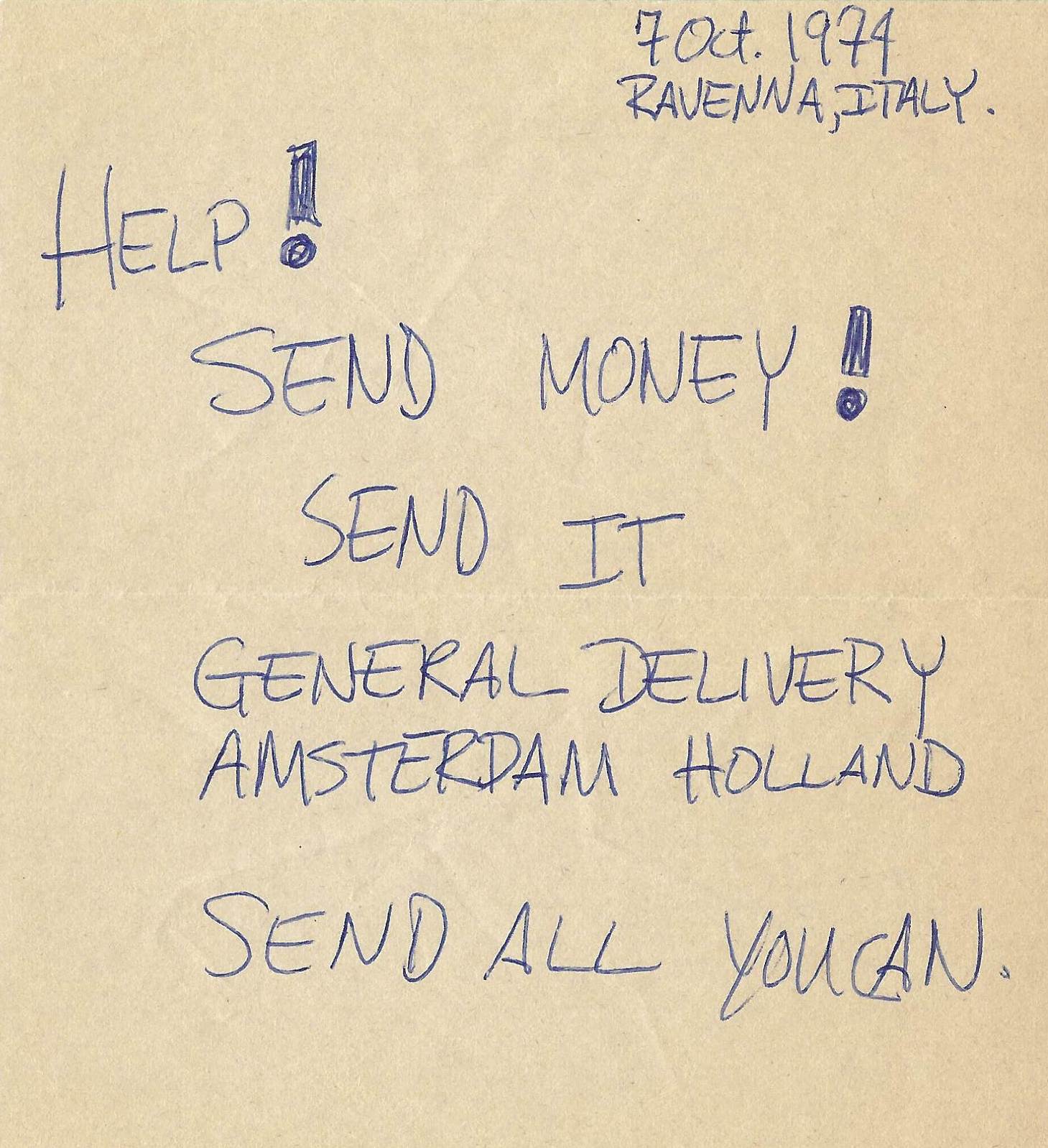
I was concerned about funding the rest of my European trip while in Ravenna and sent the pictured note to Mother. She came through with an American Express travelers check which was waiting for me when I arrived in Amsterdam. It turned out I didn’t need the cash. I don’t recall whether I gave it back to Mom when I returned to Iowa. She kept the note.

No regrets about spending most of the money I had in 1974 on a trip to Europe. A return to the continent seems unlikely today. At least I escaped the slaughterhouse. That will have to be enough.

Categories
Writing

Challenges of a Local Food System

First Spring CSA Share, 2015

Eight years ago I attended a local food summit in Iowa City with more than 80 people. It was an event designed to connect local meat and vegetable growers with customers.

Among the speakers was Andy Dunham of Grinnell Heritage Farm. He spoke about the challenges of scaling his carrot production to meet consumer demand at New Pioneer Food Coop in Iowa City. It made no sense at the time they couldn’t produce more, although eventually they did.

Yesterday Dunham revealed New Pioneer and other grocers weren’t buying as much organic produce as they had. Because of decreasing grocery sales and Iowa’s unpredictable weather made worse by climate change, they are exiting their community supported agriculture business and what they characterize as a broken local food system.

It was a surprising decision from a farm many considered to be vibrant and sustainable.

For the full story about changes at Grinnell Heritage Farm read Cindy Hadish’s post on Homegrown Iowan here.

The idea there is a functional “local food system” is a story we tell ourselves to get through the challenges of raising and marketing locally grown meat, vegetables, fruit and flowers. The challenges of sustainability for a community supported agriculture project don’t go away be saying these three magical words. It’s hard work, subject to the vagaries of weather, cultural adaptation, marketing, and endemic farming challenges.

Each farm runs differently with unique revenue streams from CSA shares, meat sales, restaurant and grocery store sales, farmers market sales, government programs, pasture rentals and more. In the world of big agriculture operators carve a niche of customers and product lines to keep themselves financially sound. It doesn’t always work.

Grinnell Heritage Farm is a USDA certified organic fruit and vegetable farm. Most local food producers are not certified organic because of the expense. Many follow organic practices but can’t afford, don’t want, or don’t feel a need to get certified. Most consumers can’t tell the difference in farm products. For Grinnell Heritage Farm to downsize is a bad sign for the future of organic farming in Iowa. If they can’t make it, who will?

Climate change is real, it is happening now, and we haven’t seen the worst of it. The last two years were hell for local food farmers used to predictable growing seasons. Variation from year to year is expected, but not like this. Larger operations like Grinnell Heritage Farm feel the brunt of changing climate.

Consumers are a fickle lot. Yesterday I calculated spending about 24 percent of our 2019 food budget on locally sourced fruit and vegetables. We buy more local produce than most regional consumers. We also have a large garden not included in my calculation. A bag of locally grown carrots is stored in the crisper drawer of our ice box yet I buy USDA certified organic carrots at the wholesale club as well. I haven’t been able to grown enough carrots to meet our needs and the ones from the store are cheap and serve culinary purposes. I know the face of the farmer on the local food I buy but they and I combined can’t supply our household with enough carrots.

The changes at Grinnell Heritage Farm were surprising, but not completely unexpected. With growth in the market share of organic produce, large corporations are getting involved and comparatively smaller operations are being pushed out. Whatever arguments one might have with Dunham’s characterizations of the marketplace or his assessment of the impacts of climate change, he and his family are doing what they believe will save their farm. That’s what all insurgent local food producers do.

As consumers we need to be ready to support local food farmers or decide we don’t care. Either choice has ramifications for our local food environment. I can’t call it a system today because a big part of it will be lost with the exit of Grinnell Heritage Farm from the marketplace.

We had hoped for and worked toward a local food system and could imagine it. The dream hasn’t proven to be sustainable yet.

Categories
Writing

Food Policy Council

On Thursday, Jan. 23, the Johnson County Supervisors appointed me to fill a vacancy on the Food Policy Council.

There were eight applications for the position according to county records. Supervisor Janelle Rettig  made the motion to approve, with Supervisor Lisa Green-Douglass seconding. All five supervisors voted for my appointment.

I accepted and look forward to my first meeting. Now my part of our work begins.

The Food Policy Council was established in 2012. The county website explains its purpose:

The purpose of the Council is to improve dialogue and discussion and provide necessary advice on food and agriculture issues to the county, municipalities, community boards, local agencies, nongovernmental organizations, businesses, and other interested groups. The Council will address food system issues in the county, including the development of the Council’s Governing Principles and strategic goals, data-gathering, research projects, and policies to address food system issues.

On my Aug. 30, 2019 application I listed my reason for applying, “Have long been interested in this voluntary position and there is an opening. I have time and interest sufficient to serve. I have financial resources to be able to do so.” That seems pretty boring, a comment others have made about some of my posts here.

The contributions I hope to make by serving on the council include, “I am particularly interested in learning about and taking action to meet hunger needs in the county. I am also interested in the relationship between food, Type 2 diabetes and poverty.” We’ll see where the work takes us.

What I’ve learned on the county board of health, as a township trustee, and as an officer of our home owners association is listening is the key skill required to get anything done. I approach this new project with an open mind and a bias toward doing the most good for the largest number of people. As soon as the caucuses are done I plan to dig in.

Categories
Work Life Writing

Two-Day Work Week

Soft shell taco, Spanish Rice, and refried beans. Midwestern staples.

Yesterday was my Monday and today is my Friday at the home, farm and auto supply store.

A two-day work week suits me.

I’m ready to call it quits from an operational standpoint. Spring is coming with its multitude of outdoors work. The two days could readily be used for more productive endeavors. It’s the paycheck that keeps me there. There is always a use for the income.

The Iowa precinct caucuses are Monday, which leaves four days to prepare for my role as temporary chair. I’m pretty well along but little else will get done in the run up to Feb. 3. After that I can focus on pruning fruit trees, getting our income taxes prepared, spring gardening, and everything else that has been delayed by winter.

Spring isn’t here, but it won’t be long.

Categories
Writing

Filling the Gaps

Wise County Virginia Civil War Group

The boxes of letters written to Mother over 55 years fill gaps in my life’s story. Things I didn’t remember came to life as I began to read them.

I hadn’t thought there was a record of some parts of my life. Now I see a lot was shared with her, more than expected.

The work of opening more than 200 letters is a big task. Reading and considering them will occupy time. Reflecting on what I said will be the crux of an autobiographical work, especially in the period from 1965 until 1974 when I began to keep a journal. When I was in Europe I wrote home a lot.

What about the period between my birth in 1951 and seventh grade when we started at the new school in our Catholic parish, after that first letter from camp?

I remember things from an early age, including visits to my maternal grandmother when she lived on Fillmore Street. Mother took enough photographs to provide a meaningful chapter or two of those early times.

Likewise, there are enough census records and genealogy snippets of public documents to piece together the earliest times. There are a few photographs from those early days, including one of Aunt Stella in her coffin and one of Granny Reed. I remember an explanation of those pictures, although I’m not sure who gave it. The photographic record of my maternal ancestors is equally thin. There is the photograph of Maciej Nadolski on a fishing trip to South Dakota, and that’s pretty much it. However, there is plenty between census records, public documents and snippets of memory to create a narrative of my forebears. There are also legions of shirt tail relatives living in both Minnesota and Virginia if I want to visit.

A question: To what extent do I write about a broader society and how it influenced me? I don’t have a good answer yet.

A case can be made for letting life’s artifacts tell the story. The census records show my grandfather worked as a coal miner, and there is oral narrative of how he started a retail business to compete with the company store. It didn’t work out, and eventually he was convicted as a draft dodger during World War II. He served prison time during which his children were split and went to live with relatives. My uncle explained the charges were a result of a “misunderstanding.” Do I need to broaden the story of mid-20th Century Appalachian economies, resistance to the draft during World War II, and dig deeper into the public record of those times? Do I just need to clarify and tell what I know? Telling what I know is straightforward. Awareness of what I do know and what I can yet learn is a separate issue.

People also have things that are personal and private. My default position is to let those lay. The end result of these efforts will be to create a narrative suitable for a broader audience, something interesting enough to read. Importantly, it will be something our daughter can read to know her own history without reviewing the thousands of documents and artifacts sitting in boxes and albums around our house.

That Mother kept my letters is remarkable. Reading and digesting them will be a welcome experience. I look forward to gaining insight into who I was then and how today’s version came to be. The number of gaps in the narrative has been significantly reduced by this find.

Categories
Writing

More Letters Home

Camp Letter

Our daughter and I drove to my home town on Sunday to visit my sister. The conversation ranged across many topics and toward the end of the visit she asked if I wanted to take the second of two shoe boxes containing letters I wrote home.

Of course I did.

I wrote a lot of letters home and to friends before email became a widely adapted replacement.

The earliest letter I found was written while attending YMCA camp as a grader. There was at least one more camp letter, followed by a couple while I was in high school, more in college, and in every stage of life afterward. There were some recent holiday cards and letters.

We logged on to the internet from a home computer for the first time on April 21, 1996. As soon as Mom got an America On-Line account we began communicating via email. She had already been using email in her work at the Corps of Engineers, just as I had been using email when I worked at for the oil company from 1989 to 1991. Over the years I saved as many personal emails as I could and there are a few between me and her from the late 1990s. The last email I sent her was dated March 7, 2014. It was about putting a photo on her Facebook account.

While it seems unlikely the others to whom I sent letters will return a similar archive, I have their letters and what is turning into a substantial trove of documents, partly written by me and partly by Mom and my friends about what my life was about. Combined with my hand-written journals beginning in 1974, and 14 years of this blog, I should be well prepared to relearn who I was and what I became.

The question becomes how shall I organize everything? There are no good answers as new documents are discovered and processed.

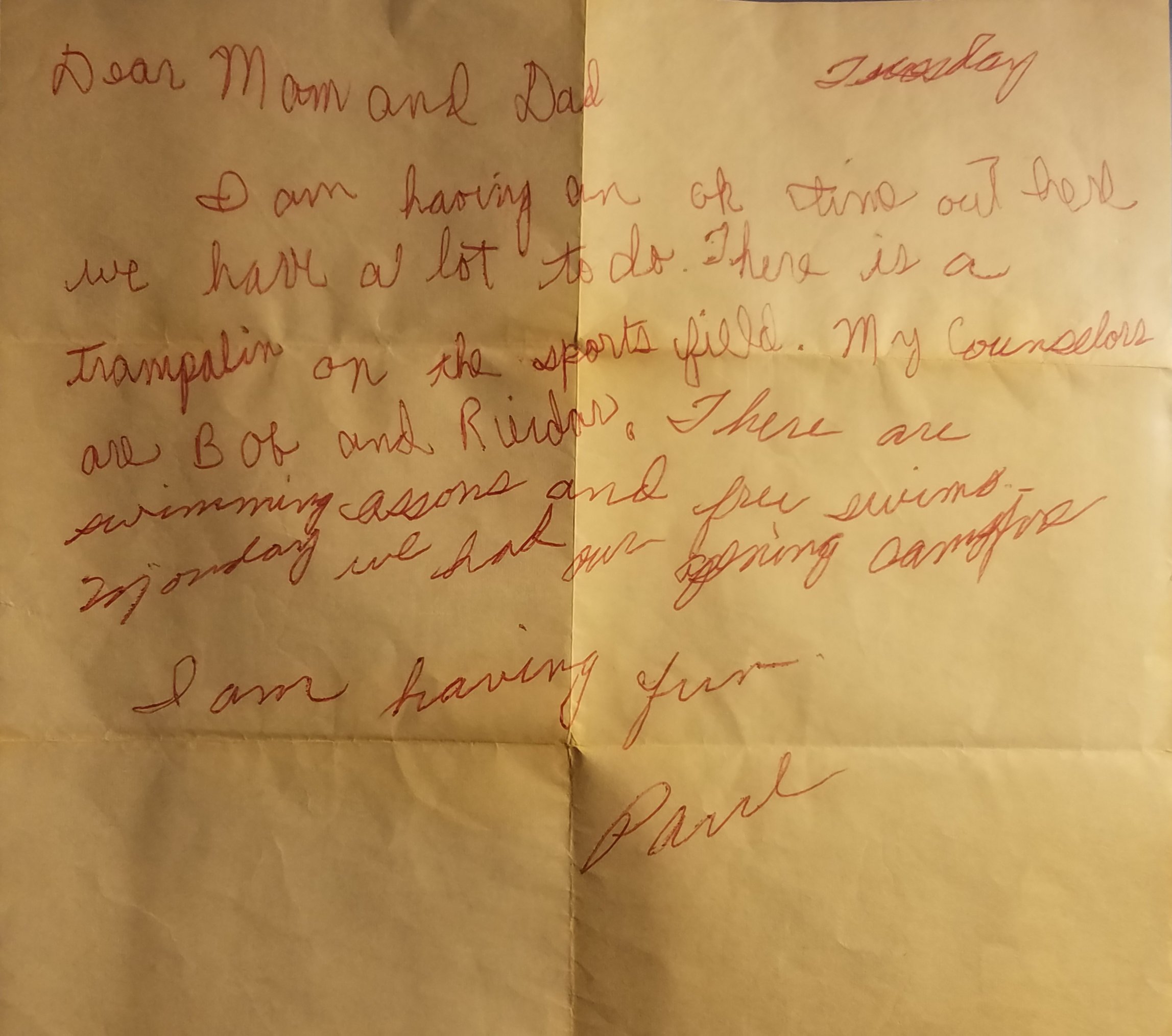
Artifacts like the camp letter pictured above lead me down a path of memory I had forgotten. It’s about canoeing on the Mississippi River, about campfires, and summer free swims, and having fun away from home and telling my parents all about it in a letter. Now that they are both gone the memories are welcome.

Letter writing, then email, journal writing, blogging, and now texting has become a part of who I am. I believe I’ve become the better for it.