Each week of the coronavirus pandemic is anchored by a few things.
Monday I make a to-do list and get things done remotely using the computer and telephone. Things like coordinating the community road repair, checking with kale customers, lining up garden tasks, and scheduling projects. I rarely finish everything on the to-do list.
Other weekly anchor points are grocery shopping on Tuesday or Wednesday, pizza for dinner Friday night, and garage work on Saturdays. The week ends on Sunday with a nap in the afternoon and a simple dinner. It is not much of a schedule but it helps keep me sane.
While there isn’t a “week” per se, the convention makes it easier to divide endless days into renewable chunks. It’s an endeavor of constant renewal, something humans need.
I’ve been more engaged in insect life in the yard and garden. The diversity and specialization is astounding. If chemical treatments reduce the volume of insects in farm fields, their absence in my garden attracts them. I thank the pollinators and murder some pests like the Colorado Potato Beetle, cabbage worms, and squash bugs.
The presence of insects, combined with open space and plenty of perches, attracts birds. The birds attract loose cats and other predators. The cats control the rodent population in the garden, although we don’t like it when they capture birds or ground squirrels. Rabbits like the quiet when I’m gone and fencing keeps them from chewing on vegetable plants. Occasionally we get other predators, like hawks and foxes. Neighbors reported coyotes although we’ve not seen one here. All of this means there is a local ecosystem and we do our part to fit in and provide diversity.
The sun is rising so I’d better finish and get on to what’s next. No rain is forecast and ambient temperature is expected to reach a high of 88 degrees. Exercise and gardening need doing before it gets too hot.
Letting go begins with acceptance that life now has the potential to be better. It’s hard to let go of the fact the coronavirus forced me into retirement from outside work. Resentment lingers.
I recently declared on my Twitter profile I am a “blogger, writer, gardener, human.” Writing that description was a first order organizer. It is accurate in how my time is spent each day: I’m focused on creating better writing and being a decent human. However, habits persist from the before time, before the coronavirus pandemic. I want the diversity of my creative output to increase. Continuing old habits will produce the same results therefore they must improve through conscious change.
My daily process of waking, making coffee, and descending the stairs to my writing table was built on the premise creative work had to be done before the day’s activities began. Until July 2009 that meant before working a high profile, energy-consuming job. When I started blogging in 2007, a majority of the hundreds of thousands of words written since then were created before sunrise or immediately thereafter. They were written before going to work.
Now that work outside home has been eliminated there is an opportunity to break past habits and embrace a new writing paradigm.
Today, light coming around curtains on the east-facing window is a reminder to finish and get on with the day. Habits built around working persist. Habits can be broken and re-shaped into something more suited to today and provide a positive influence on writing. How does one do that?
At the core of my working career in the before time was the impulse or urge to separate my creativity from the work I had taken on to buy a house, spend time with family, and pay the electricity, gas, sewer, transportation and communications bills. Some measure of creativity was devoted to paid work, yet until recently I had not been able to bring everything together. Work remained separate, something about which I felt I shouldn’t write. Whatever efforts I made in the interim period to blend these aspects of daily life, after the coronavirus everything changed: it is a clean break.
What life will be is unclear.
For now I know few other ways to start my day and feel I have accomplished something positive. I can’t envision private time — leisurely breakfast, exercise, coffee, house cleaning, conversation — before going to work at writing by mid-morning. I am not now a night person. I feel uncomfortable with big changes although what may be best is blowing up the before time habits and letting life fall where it may. Worse things could happen.
The opportunity is to design a writer’s schedule with writing more at the center, less based on habits formed over decades. While habits play a role in life, we’d go crazy without them, from time to time self-awareness is needed and can be a positive force. There has been no time like now.
Morning writing will be ongoing while I sift through this. In summer it’s hard to stay indoors so desire to finish and get outside continues. By winter though, careful thought about new habits is in order. I doubt my writing will be successful without a change. I expect it will be better.
Eventually I will snap out of this coronavirus funk.
For weather and productivity this was the best spring I remember. The garden is doing great and I have time to give it daily attention. Without work commitments each day is mine. I spend more time outside and at the state park. I’ve gotten my bicycle out and ridden for the first time in years. The weather has been drop-dead gorgeous. What is the matter with me?
I live in a broader society that is going to hell in a hand basket.
My response is stay positive, although negativity drags on my spirits. It takes a village to make a life and when we are each isolated because of the coronavirus, it’s tougher to do.
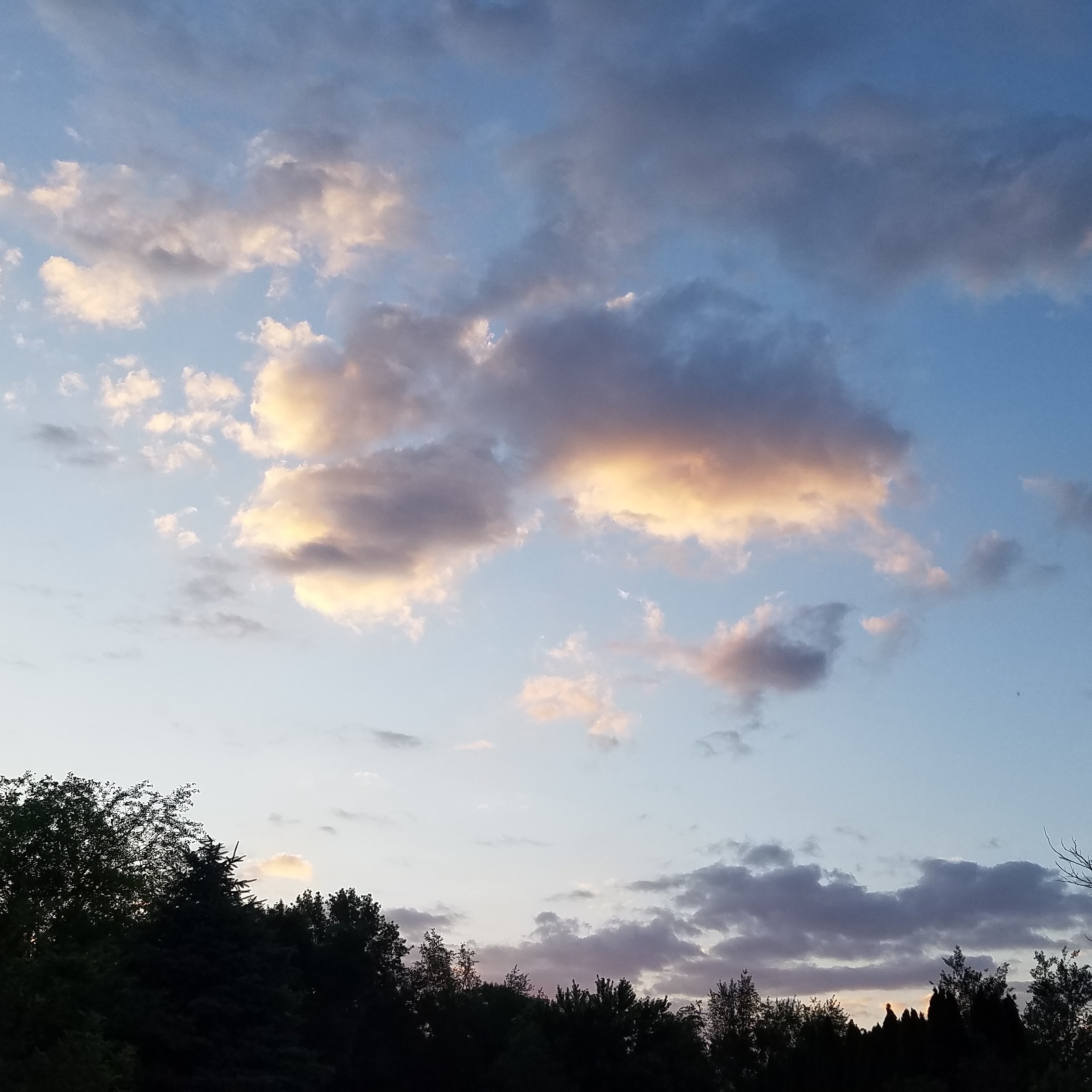
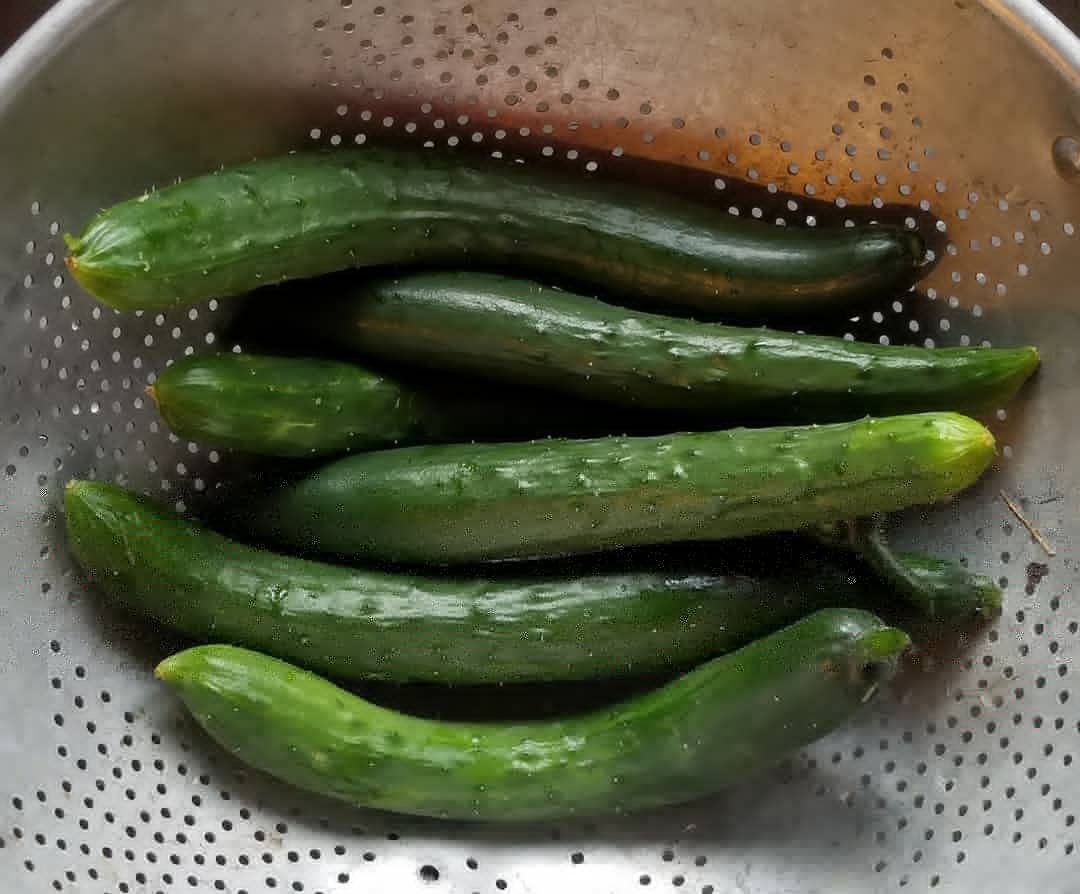
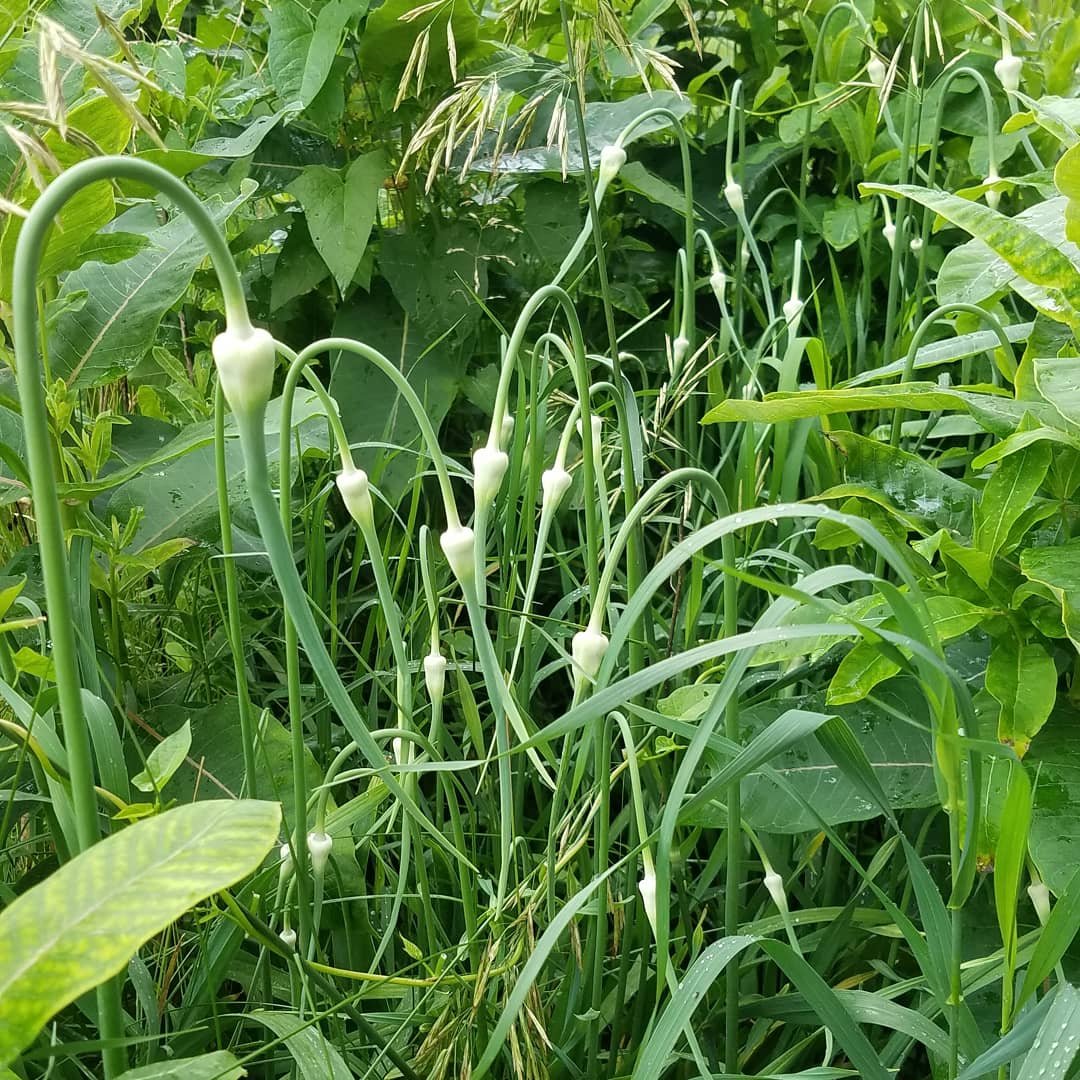
Here are some photos from early summer to cheer us up.
Tasty Jade Cucumbers
Monarch Caterpillar
Wild Section of Garlic, Milkweed, Iris and other plants.
On Jan. 30 I received email notice of my appointment to the Johnson County Food Policy Council. My application was chosen by the board of supervisors to complete a term ending June 30.
I declined to re-apply at the end of my term.
The idea of having a food policy council may have been good when it was organized. During my brief tenure, each meeting seemed a random conglomeration of thoughts, statements and opinions heading down a dead end street. To a person, everyone I met while serving was talented, including the county-paid coordinator Ilsa DeWald. So what was wrong about the food policy council?
The goal of fostering relationships between farmers, buyers and government in the Iowa City-Cedar Rapids region is important. For their part, non-conventional farmers are a well-organized group of entrepreneurs that take advantage of networking within Practical Farmers of Iowa, the Iowa Farm Bureau, the Farmers Union, and other organizations. If you know some of these farmers, they seem to all be talking to each other about everything, all the time. That’s really no different from any successful farmer, regardless of what they grow.
The challenge of a local food movement is establishing enough mass to be a meaningful presence. The kind of changes needed in our food system are complicated and require engagement by many organizations, businesses, and individuals. That includes entities beyond vegetable, meat and flower producers.
By far, large corporations dominate food sales in our region. Reducing their presence or market share is not a point of discussion for the Food Policy Council. Even if it were, there are not enough local food producers to compete with or challenge them. The basic tenets of consumer participation in financing the growing season on a farm, knowing the face of the farmer, and understanding how our food is grown are main attractions for people who choose local food for their kitchen. As recently as last week, many community supported agriculture projects continued to accept new members this summer: demand has not been enough to significantly disrupt grocery operations.
The highlight of my tenure was participation in an annual forum titled, Land Access and Beyond: How Can the Johnson County Historic Poor Farm Support Beginning and Current Farmers? By participation I mean I made lemonade, helped set up, and led a couple of discussion groups. The forum was well-attended by a diverse group of people.
The board of supervisors decided to develop the Historic Poor Farm and this has been part of discussions of the Food Policy Council. Access to land is important and the Poor Farm has enabled some beginning farmers along a path to land ownership. Supporting the Poor Farm is a worthy endeavor for the Food Policy Council.
Part of the inability to engage in a single direction was the coronavirus pandemic. It affected council members both those who farm and those who don’t, and threw a monkey wrench into the machinery of effective policy planning. While we met via video conference, that’s not the same as being together in person with all of the possible side conversations. If not for the pandemic, I might have a different view of the council’s work.
I was happy to do what I could to advance the cause of local food in our food system. I value my time on the Food Policy Council.
The last few days have been ideal. Rain let up, temperatures dropped to the 60s and 70s, and much about our time on earth is worth living.
These days are golden.
The garden is producing and it has already been an abundant year. Last night I made biscuits with fresh sage and cheddar cheese from my cookbook, split them into a bowl, and spooned homemade vegetable soup on top. It made a fine dinner. There were leftovers.
I’m ramping up for my summer stint of covering Blog for Iowa while our editor takes a break. My first post is scheduled for July 6. In the meanwhile, these days don’t last yet we enjoy them while we can. Or as James Russell Lowell wrote:
And what is so rare as a day in June?
Then, if ever, come perfect days;
Then Heaven tries the earth if it be in tune,
And over it softly her warm ear lays:
Whether we look, or whether we listen,
We hear life murmur, or see it glisten;
Every clod feels a stir of might,
An instinct within it that reaches and towers,
And, groping blindly above it for light.
We have to look at ourselves in the mirror and consider whether we are racist. It’s not easy to do in the best of circumstances.
Dictionaries consistently define a racist as someone who has a notion that one’s own ethnic stock or genetic makeup is superior.
Which is it, ethnicity or genetics that defines race?
The authority of dictionaries has diminished in society. There are few rules in the living language except we be understood. Haters gonna hate, as Taylor Swift noted, regardless what’s in the dictionary.
I was confronted with the idea there were different races as a child. It was and remains for me an idea. I knew I was different, but superior? I don’t think so. Diversity in the neighborhood in which I grew up meant defining whether one’s family was of German or Irish descent. Racism as we know it today, as in the Black Lives Matter Movement, wasn’t an obvious issue. We were shielded from racism and those blacks we encountered were in a context of their relationship with our father: plantation workers in Florida, co-workers at the meat packing plant, and fellow union members.
What are the genetic characteristics that define race? What cultural behaviors are specific to race? Should we care about race? These are the questions I’m asking while witnessing the resurgence of protests over race after the viral video of George Floyd’s murder.
Our family visited the Gettysburg battlefield when I was a grader. Which side of the Civil War was I on? I felt I had to be on a side. My maternal ancestors immigrated after the war and my paternal ones from Virginia fought on both sides. After a moving childhood visit to the battlefields I adopted the Confederacy as my own history and bought a Confederate flag in the museum gift shop.
We cannot disown our history even if we want or if our current values discredit the peculiar institution of 19th Century chattel slavery in the U.S. southern states. Thanks to the combined work of my fourth grade teacher and my mother I came to realize the racism inherent in embrace of the Confederacy, and that it was wrong. Before long, with their encouragement, I sought and found my own history.
I first encountered systemic racism while serving in the military. I paid little heed to the naming of military bases after notable racists Andrew Jackson and Henry Lewis Benning, where I trained in the U.S. Army. I was stationed at Robert E. Lee Barracks in Mainz, Germany. It was named after the World War II veteran with the same name as the commander of the Northern Army of Virginia. Racism in the military was about more than names.
Daily work was integrated, which is to say as an Army officer I paid little attention to race when giving orders or following them. All but one officer in the battalion was white and the lone black lieutenant and his family lived in a twelfth century castle off base. I visited them a couple times while we served together. In conversations, I came to understand he was held to a different standard because he was black.
When we lived in Indiana I managed an operation that recruited thousands of truck drivers. I became familiar with parts of Chicago and the suburbs because of this work. I hired the first black recruiter the company had and remember the surprised faces when we returned to the corporate office for a meeting. Race made no difference in this hire. I just wanted someone who could do the job.
We rejected an applicant from our new driver orientation and he threatened to call Bobby Rush because he felt we were discriminating against him because he was black. The claim bordered the ridiculous because more than half the group in orientation was black or Hispanic. I don’t recall why we rejected him but I said I’d like to have that conversation and provided my number. Several weeks later we received a letter from Rush’s office and I replied. That was the end of it.
That protesters in our county seat chose to shut down Interstate 80 in response to the murder of George Floyd was predictable, expected, and ineffective. It’s something, yet I’m not sure exactly what. In 1971 I was part of a group of protesters that shut down Interstate 80 near the Dubuque Street exit in response to the Vietnam War. We built a bonfire in the Eastbound lane feeling we had to do something to disrupt business as usual. What more usual thing is there than traveling on an interstate highway? Law enforcement attempts to keep the interstate open, although there was a report one of the Coralville exits was closed by them in anticipation of protests. Protesters have to do something to gain attention enough to create a fulcrum point for change. I support their actions and also believe there has to be a better way.
What does the Black Lives Matter Movement mean to me? In our rural subdivision the only time race comes to the surface is when it is scratched. If there is talk of a black family moving in neighbors assert property values will decline.What does one do with that? I point out to them the assertion is patently false and reject it. Most people here don’t scratch the surface of race to avoid such conversations.
If George Floyd’s murder was a turning point in how racism is viewed in the United States then some good will come of it once he is mourned dead and survivors heal. We must look ourselves in the mirror on racism. If we can’t then we probably are racist and don’t want to admit it. If so, Floyd becomes just another black man who died at the hands of police as white hegemony continues a while longer.
My religious education taught we are all equal in God’s eyes. That’s how it’s supposed to be in the United States. Yet slave owners sought to justify the peculiar institution using the same Bible I read today. In the end, we have to ask ourselves if we are racist, not because we seek an answer, but because in asking we open the possibility of a remedy to today’s long-standing problem. We seem so far from that now.
The absence of definitive guidance on what society should be doing during the coronavirus pandemic led us to a path of individual choices.
When Iowa Governor Kim Reynolds proclaimed the disaster emergency on March 9 few of us knew what to expect. Sadly, three months later that continues to be true.
Our social behavior is developing around risk avoidance, some of it informed, some less so.
Jacque made us facial masks on the sewing machine. I carry three of them in a plastic bag on the car seat to use when in public. Most frequently I wear them while shopping for groceries, and at the drug store, convenience store and at medical appointments. When I return home I wash my hands, change clothing, and if I’ll be inside the rest of the day, take a shower. I wash the masks after each wearing.
At the farm I don’t wear a mask because the crew has been self-isolated together since the pandemic began. The risk of me being exposed there is minimal. Since I’ve been tested, limit my activity, and maintain social distancing, I seem unlikely to bring it in. They developed a social distancing method of share delivery and are doing everything they can to avoid getting sick. An outbreak would be disastrous for them, their customers, and the business.
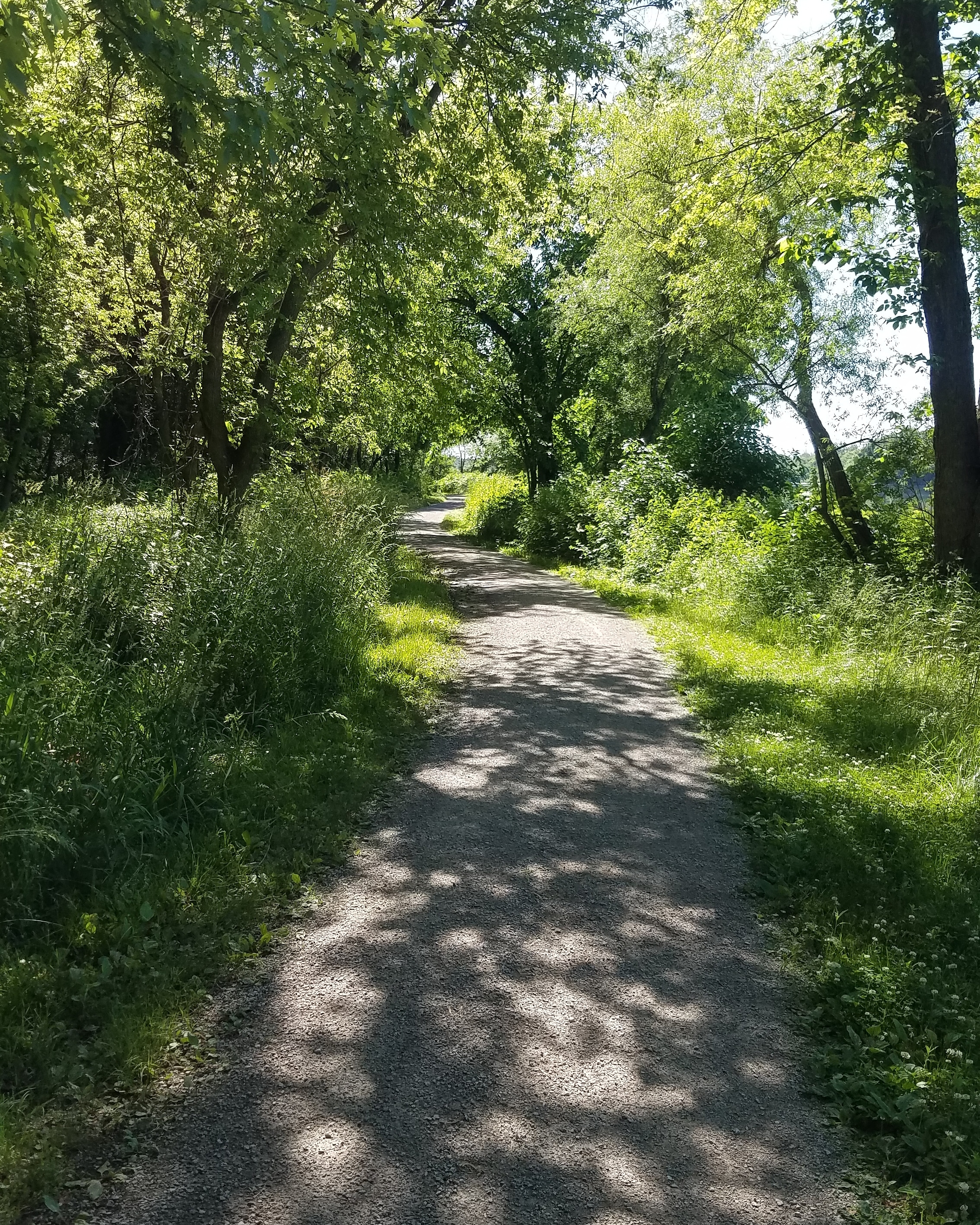
I don’t wear a mask to the state park trail and very few people I’ve encountered there do. Because it is outside and there is room enough to maintain social distancing the risk of contracting COVID-19 there seems minimal. I avoided going to the park for the first two months of the pandemic yet the need for exercise outweighed the risk of exposure to the coronavirus.
With more people home during the day the number of contacts with neighbors has increased. I don’t wear a mask while I’m with them because these encounters are pop-up activities of short duration. I have yet to see anyone in the neighborhood wearing a mask. The letter carrier and parcel delivery drivers are a source of potential contamination although a necessary service as our number of trips off the property has decreased. We sanitize packages and let them sit on the landing before opening.
Our main approach to risk management is reducing activity away from home and social distancing when we are out and about. It serves us well in that neither of us has been sick since the pandemic began. I don’t believe our experience and behavior is much different from any Iowan who takes the coronavirus seriously.
Clearly the pandemic will be of longer duration, so how should risk of COVID-19 spread be managed? There is little guidance from our government and public health guidance seems so universal it’s hard to figure how it impacts us in our actual lives. As a former career transportation and logistics professional I’m familiar with risk management. The pandemic is just one more layer added to risks already managed.
When I worked at the home, farm and auto supply store I got sick a couple of times a year. I caught something at work that caused runny nose, coughing, congestion or some combination of those ailments. The need for income outweighed potential health risks. When we entered the pandemic I reassessed and reversed my approach. I haven’t been sick since I walked out the door for the last time on April 2.
My point is we take risks in everything we do. During the coronavirus pandemic we must get better at doing so because the lives of our family and everyone with whom we come in contact depend upon it. The question never was “should we open up the economy?” The better question is what are the conditions upon which we can re-engage in society? How do we know it is safe enough to send our children to school, return to paid work outside the home, and participate in mass recreational events like concerts, sporting games, fairs and local festivals? If anything, we assumed those activities were safe before the pandemic, even though we knew, subconsciously at least, that safety has a broad spectrum of risk and no human activity is completely safe.
What are reasonable risks? Lacking appropriate guidance from experts each of us is making up our own rules, our own trade-offs between risk avoidance and participating in life. There is no going back to life before the pandemic. How do we restore enjoyable aspects of our lives with less risk of contracting COVID-19?
I don’t have definitive answers except that we are on our own. We are doing our best and for the time being, until we figure this out, that may be the best we can do.
If daily life took its course without our engagement we would be reading more words and fewer books.
With the rise of social media a lot more words are being published and many readers get “glued to their phones” as they take in all the words and video they can within a circle of friends and followers.
Long form reading in books is an essential part of staying informed. It took a conscious effort to stop my entropic slide to reading no books each year to include long-form reading in daily life. Ironically this began by using the social media tool Goodreads. By setting a low annual goal of 16 books per year in 2018 I surpassed it and have increased my book reading every year since. In the first five months of 2020 I read 26 books.
Reading short pieces, newspaper and magazine articles, and social media posts is an important part of securing new information about our lives in society. At the same time erosion of book reading leaves us the less.
The current book on my night stand is Save the Plums: My Gourmet Memoir by Ruth Reichl who spent ten years as editor in chief of Gourmet magazine. An intellectual masterwork? No. I found Reichl’s reference to William Carlos Williams annoying, yet the pace is quick, the chapters short, and the language a straightforward narrative. It’s how a person with a specific experience wrote autobiography. The more experiences of writing styles we have, the better writers we can be. If you forced me to put this book in a category, it is summer reading and a part of a broader universe of reading material.
We seek in reading, in any format, an understanding of the person behind the writing. When I review my social media feeds, some people I know personally and have done things with. Others I know by their writing. There’s a reason it’s called “social media.” There are people behind the posts or at least that’s what we hope.
That is less true of book reading where the author may be present in every page yet strive to minimize their personality or presence in the words. Can a book stand separately from it’s creator as a work of art? I don’t see how it’s possible to separate the work from the author’s social context. In that regard, historians are the worst. There is an ideology of history writing and to attempt to hide or diminish it is a disservice to the reader (Oscar Handlin). There is a politics and poetry of writing history. There are books on those subjects. It is possible, and I’d argue necessary, to both adore historians (Robert Caro) and despise them (Doris Kearns Goodwin) that has nothing to do with the information presented on a book’s pages.
I look at reading the way I view being a food consumer: I seek to know the face of the farmer and in the case of reading, the face of the author. That’s true of any reading I do. I am more likely to trust, read and comment on something an acquaintance posts because we physically met and I’ve followed them in social media long enough to understand something about their social context. The same is true for writers in mass media. I want to know who they are and what their history is rather than read a single sensational story. As a reader and human, I’m in it for the broader picture.
The rise of artificial intelligence is producing computer generated writing. I think we need to inoculate ourselves against this fake writing by spending time learning about authors and reading their published work. As the noted philosopher Taylor Swift wrote, “the fakers gonna fake, fake, fake, fake, fake.” We need to be able to shake them off. That requires us to be informed readers.
If we are going to read more at least some part of our lives should be engaging the authors of those words. Obviously it’s less possible for dead writers. Yet we are living now and should be spending part of our time reading full-length books both as a supplement to short form reading and as escape from it. Entropic decline in long form reading is something we must address in our lives. That is, unless we accept the mutation of humans will eventually include genes for mobile phone adaption.
When the news goes to hell, like it did on Friday, I retreat.
In an on line chat about poetry I wrote a follower, “Hope things are going better in Canada than they are here.”
“They are, very much so here in B.C.,” he responded. “I’m not a flag waver type but this present moment produces a real sense of refuge.”
On Friday moving to Canada was not out of the question.
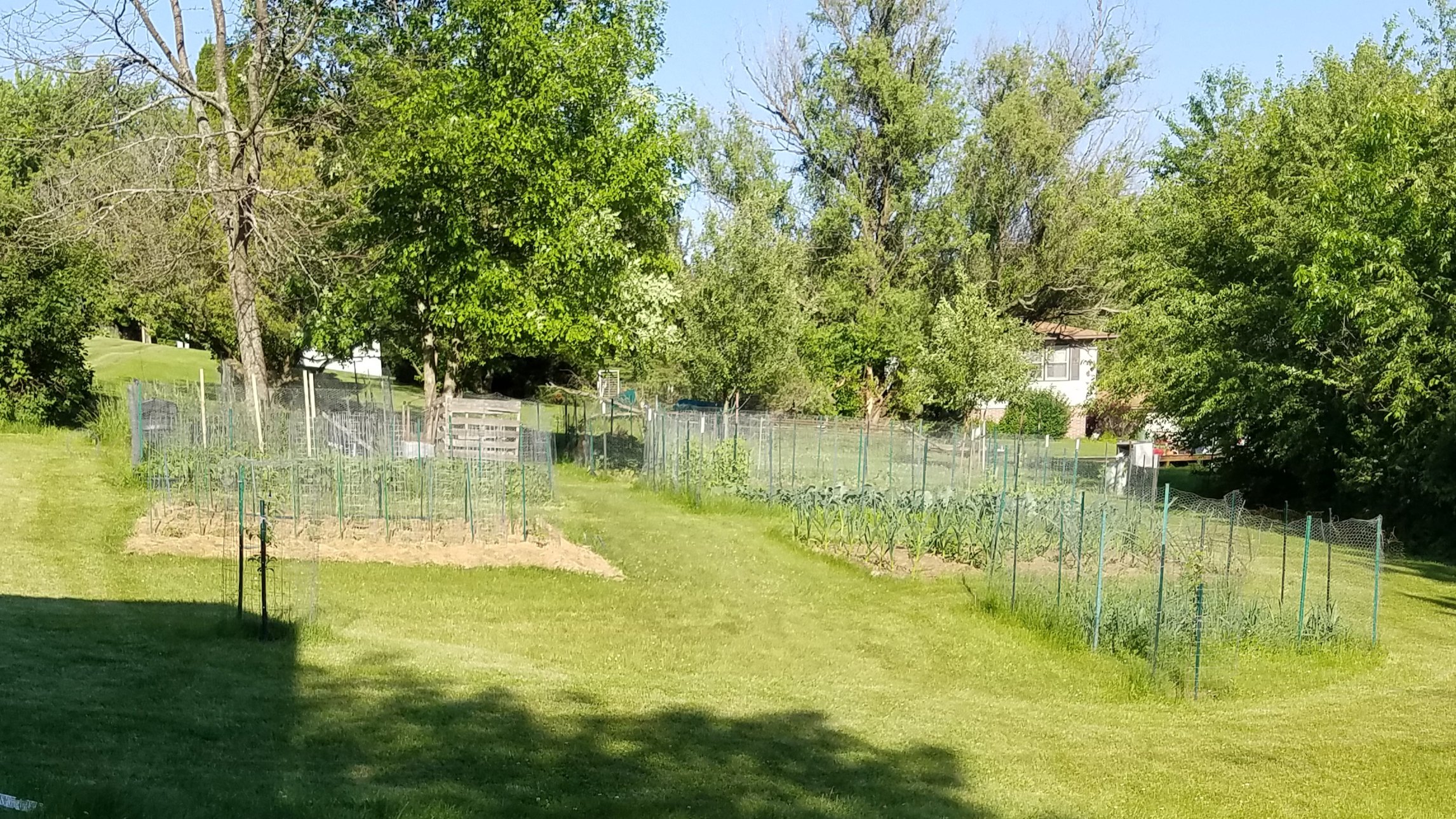
To where did I retreat? I worked outdoors from 7 a.m. until 4 p.m. on Saturday. I harvested grass clippings for mulch, put in the seventh garden plot, and called initial garden planting done.
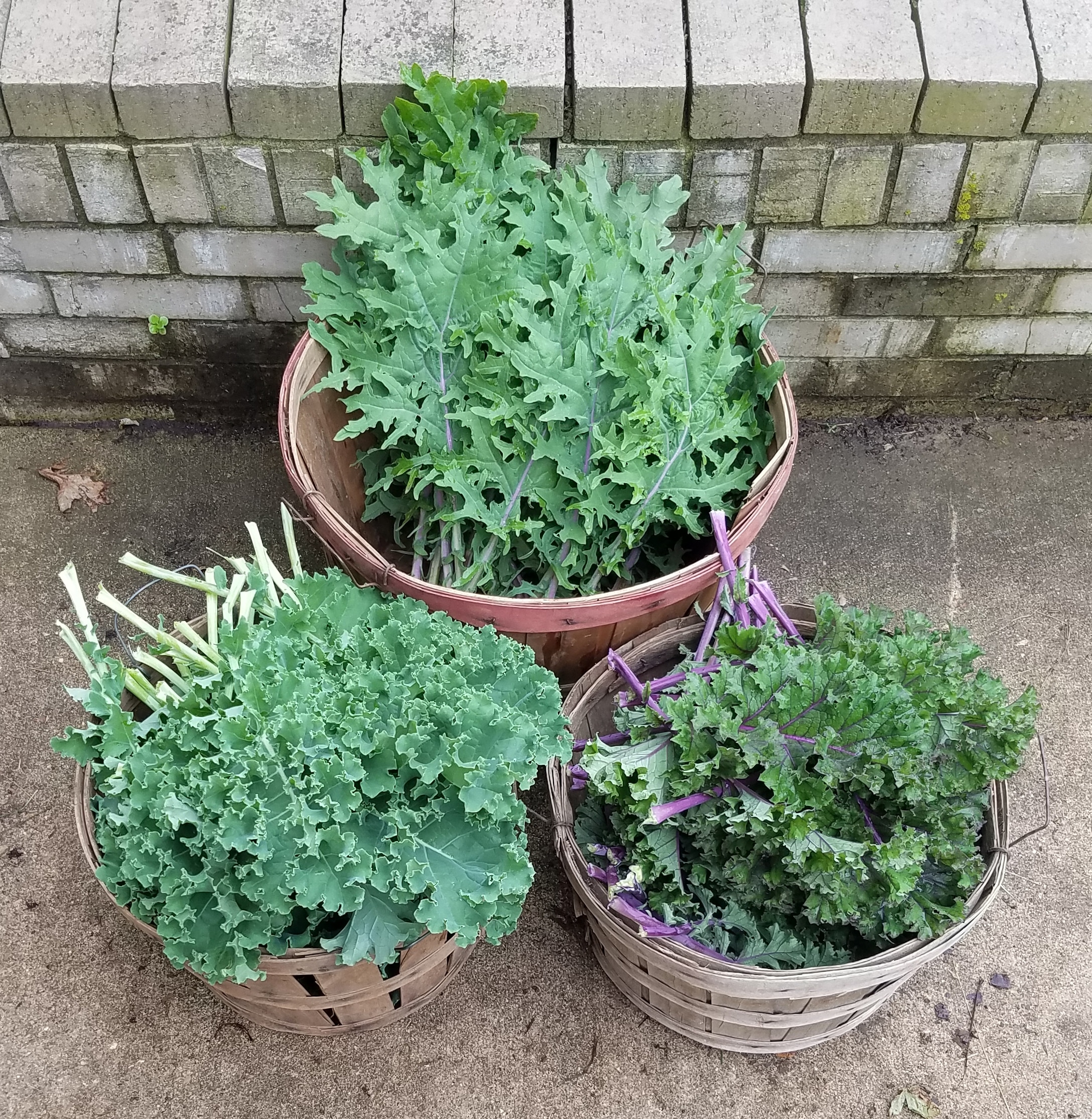
I picked kale and delivered it to one of the library workers. Our public library remains closed because of the coronavirus pandemic yet they continue to run limited operations behind locked doors. Next week they begin curb side materials pickup as they determine how best to reopen. The local newspaper featured a photograph of the librarian wearing a mask in from of the building. Our library is the most obvious local indicator of the progress of the pandemic and economic recovery.
Once again, a video shared in social media — the May 25 murder of George Floyd by a police officer in Minneapolis — sparked demonstrations and violence broke out in cities around the United States. Coverage dominated the news, eclipsing every other story, including the coronavirus pandemic which has now resulted in more than 100,000 U.S. deaths according to official statistics. It is a sign of the times I didn’t hear of Saturday’s demonstrations in the county seat, or in nearby Cedar Rapids until after working in the garden. There were no demonstrations where I live.
The thing about a retreat is it has a fixed beginning and end point, leaving us with the question what do we do next? It’s not complicated.
Above everything else, addressing the lack of leadership in our current government is a priority. That means voting the Republicans out of office in the 2020 and 2022 election cycles. It is difficult to see how any substantial change will be possible, in any area of society, until that is done. I’d much rather be writing about the climate crisis, income inequality, and social justice. For that to have meaning, we need leadership to set different priorities and move the country toward solutions. We can point out solutions to the climate crisis and income inequality, and that black lives matter all we want. To make a difference, our only hope is to change our government.
My last paycheck from a job was in April after retiring from the home, farm and auto supply store. Our expenses came down dramatically during the pandemic so there was money left from our pensions to pay down debt and donate to political campaigns. We’ll be doing more of that. Better than that will be to develop a positive message about who we are as Iowans and as Americans and to share that broadly. Living with a demagogue as president has been frustrating. We have to believe our best days are ahead of us and take action to work toward that end.
No one wants to die early of COVID-19. This morning Johns Hopkins University reported there have been 1.7 million diagnoses of the disease in the United States and more than 100,000 people died because of it in less than four months.
May the souls of the departed rest in peace. May their families and friends find comfort as we go on with our lives.
I participate in TestIowa, the State of Iowa’s on line COVID-19 testing program. On Monday I was approved for testing and made an appointment at a drive-through test site 11 miles from home. Yesterday I arrived early for my appointment and there was no waiting. The site was well organized with lots of staff, including a half dozen uniformed Iowa National Guard soldiers directing traffic and maintaining security. The site could handle lot more tests than they were. The deep nasal swab used to take a culture was uncomfortable yet tolerable. The results should be posted to my on line portal by Saturday. This post is not about me.
I’m thinking about George Floyd who died after a Minneapolis policeman knelt on his neck while he was being arrested. In a time of ubiquitous cameras and recorders the incident was captured on video multiple times and posted on the internet. It rightly provoked outrage. Four police officers were fired after Floyd’s death yet that shouldn’t be the end of it. Why weren’t they arrested? We know the answer. There was no justice for George Floyd. He did not deserve to die.
While passing the milestone of 100,000 deaths from the coronavirus garnered attention yesterday we cannot forget the systemic racism that permeates our culture. Americans are not free unless all of us are free. The death of another black man in the hands of police is evidence we are bound to racism that shows itself only rarely. Its roots run much deeper.
How do we address that? I don’t know but unless we recognize racism for what it is in our lives there will be no addressing it. We have to do more than react when another black man dies. That death tally is not being closely followed yet it is as important and more enduring than the coronavirus.






 Journey Home
You must be logged in to post a comment.