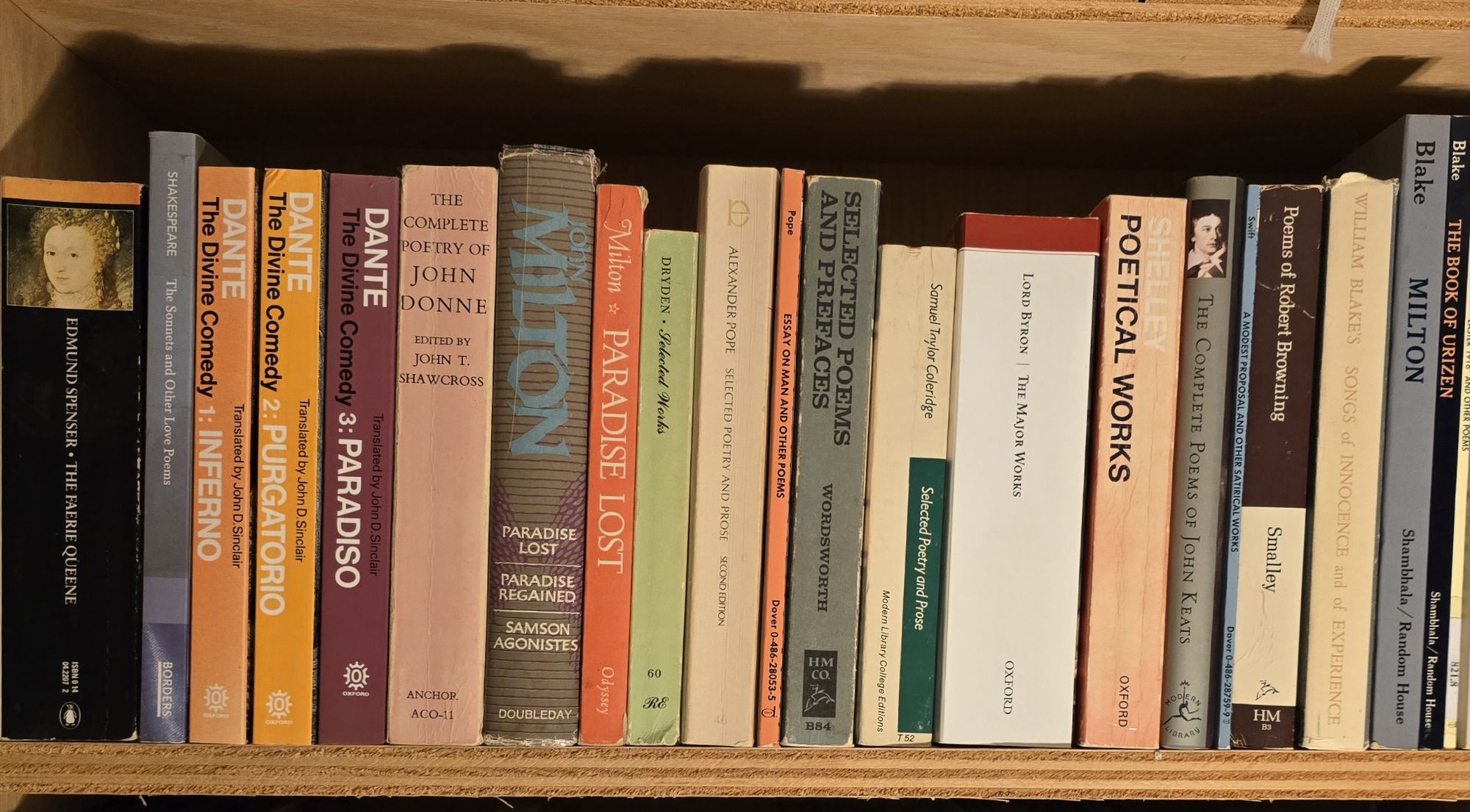
I spent two hours rearranging poetry books in my stacks. I decided eight 23-inch shelves was enough poetry and some had to go. Now there is an eight-inch stack of poetry books awaiting disposition. Poetry measured in inches.
I rearranged the poetry so more in which I have interest rest at eye level. On top are the smaller-sized books and below that is the canon. You know, Chaucer, Shakespeare, Dante, Donne, Milton, Dryden, Pope, Wordsworth, Coleridge, Byron, Shelley, Keats, Swift, Browning, and Blake. The exception is Chaucer and Shakespeare’s plays are across the room because the poetry shelves weren’t tall enough.
The other exception, or rather objection to the canon, is where are the women? You know, Charlotte Smith, Felicia Hemens, Mary Robinson, Anna Laeticia Barbauld, and maybe others. They were largely erased by the male authors of the canon. I don’t own any of them or I’d fit them in.
Don’t get me started on an American canon. Somewhere in the 20th Century that broke down and can never be repaired.
This is my current life when I am not writing. Opening about 100 boxes of books and deciding which to keep and which to donate. Already I’ve taken a dozen boxes to the library’s used book sale. There will be more.
I used to stamp my name and address in every book I bought. My hands have been on books from every place I lived this month. Some of the fifty year old paper has changed. Books from the 19th century crumble in my hands. I took one old book to a used bookshop to consult about the damage. This is a practical task that should involve logic. It’s more emotional than expected.
There is material for multiple posts in this project. I have to wait and see what I get into before knowing what their subject will be. I hope you are along for the ride.
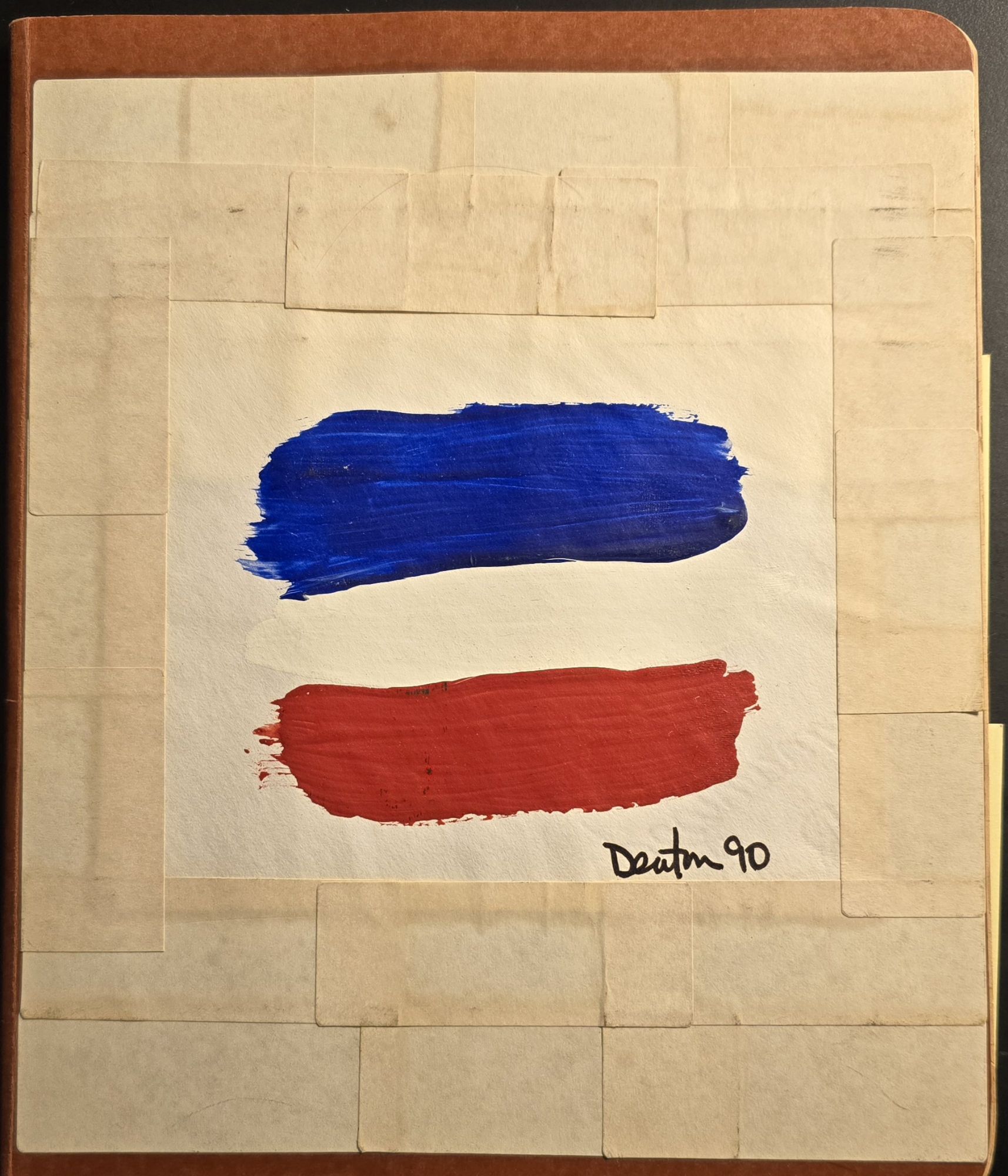
Booklet filled with automatic writing, September 1990.
2025 has been a decent year for my writing. I added 26,000 words to my autobiography, posted 20 times on Blog for Iowa, and produced more than 300 posts here, including cross posting my letters to the editor. It’s hard to digest everything, especially when I’m in the middle of writing more. This post is some links to posts I believe are significant.
On January 5, I wrote Right to Repair. This post starts with a high school friend and hot rodder who was building his own car to ride the ones in Davenport. It includes my maternal grandmother repairing her stove, and ends with her parents and grand parents settling land bought from the railroad in the late 1800s. Can we get back to a situation where people know how everything in their home works and repair it themselves? This post explores that idea.
If It’s About Workforce was posted on January 7. It’s about the Iowa Legislature restructuring the regents universities to purge diversity, equity and inclusion programs in education. Among the things they did was eliminate the American Studies Program from which I have a degree. There was talk about improving the workforce, yet I don’t believe higher education is about placing people in work. I also have a modest proposal.
2025 is a year I gave increased attention to photography. On July 24, I posted A Life of Photos, which serves as my introductory process. There was a time when popular photography was used primarily in two ways: it recorded memorable “moments,” and it provided a method and technology for creative expression. A third purpose has come into being and the series that began with this post explores what that is.
My 55th high school class reunion took place in September. Afterward, I posted In the Shadow of Hotel Black Hawk on September 28. This year’s reunion was better than others I attended in that by eliminating any formal program, the planning committee furnished a venue for classmates to socialize. I found the format refreshing and actually had a number of memorable conversations. This post remembers some of them.
Are people mixers or layerers? Eating Alone — Mac and Cheese, posted on November. 10, explores the difference and in doing so created a repeatable main course dish head and shoulders above the dozens of available boxed mac and cheese meals. I have become a layerer.
When I worked at the oil company I had no idea what was behind their big move to consolidate records in Oklahoma. Time to Change Hats, posted November 12, is about that and more. I wrote, “With increased visibility of my history, I should be a better family member, citizen, and writer. It should be easier to navigate through the stuff of memories.” I’m not yet on a single platform with visibility, yet that’s where I am heading. That’s what makes this post significant.
These posts only scratch the surface of my writing. I appreciate everyone who follows along here.
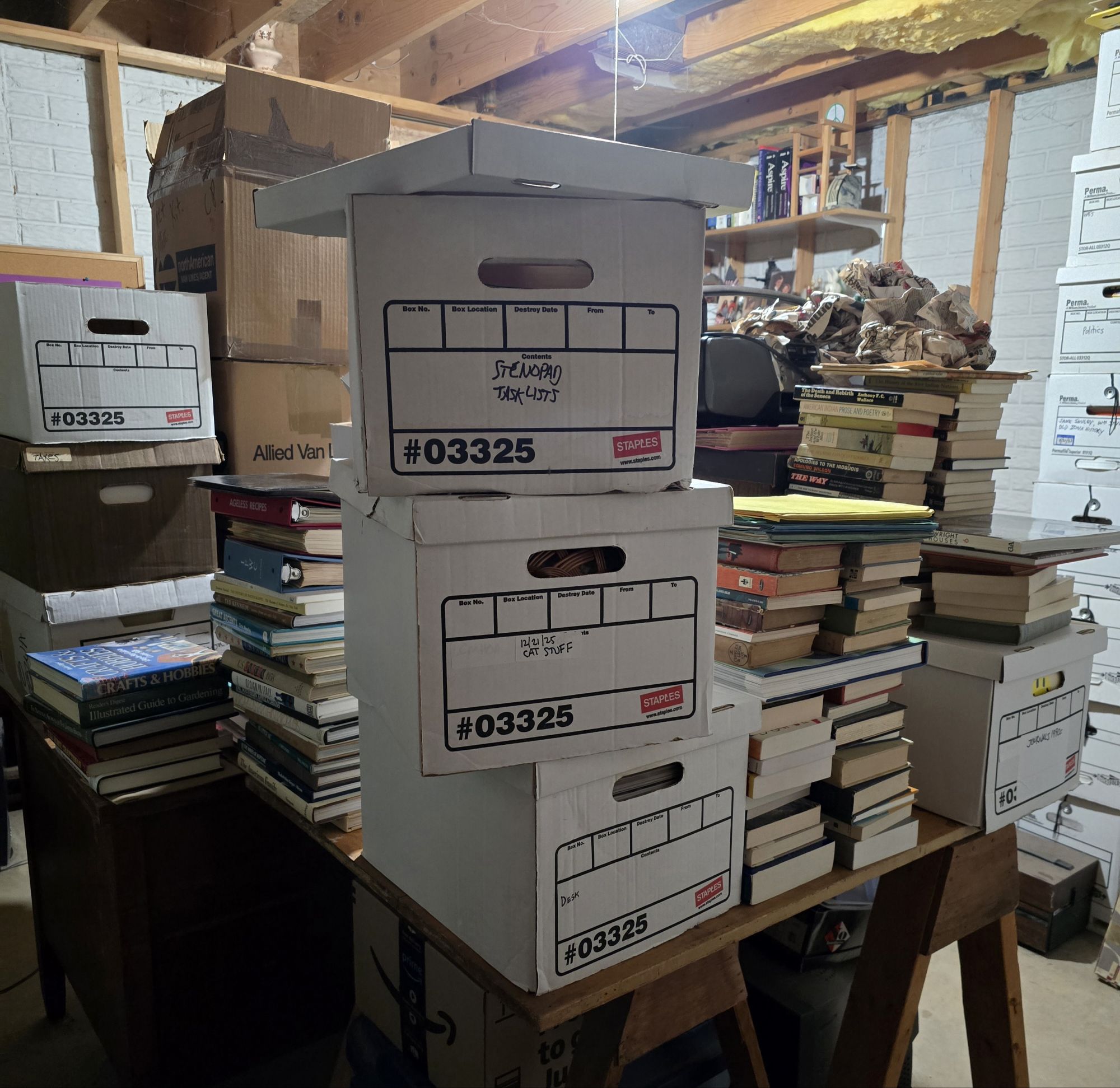
Our child brought home some unused bankers boxes which I quickly put to work storing all the stuff piled on these two tables. This is a place to layout projects. Importantly my writing project as I head into the final stretch of book two, but also a place to empty boxes and go through contents for disposition. A person needs surfaces like these.
The back surface is the oak desk I bought when I returned to Davenport after military service. It has been resting in this spot since 1993 where I assembled it after moving into our home in Big Grove Township. The front one is what appears to be the top of an old drafting table I bought at auction, standing on two saw horses I built. They have not been this cleaned off since we lived here.
With the sorting surfaces I’m ready to get back to writing.
I edited the outline for Part II of my autobiography yesterday and determined the break in the narrative will be when our child leaves home for college, and then leaves Iowa altogether after graduation. This decision has been hanging over me all year and for where I am in the narrative it is the right choice. So, chronological narrative through becoming empty nesters, and then being left behind by our progeny.
I’m still fussing with the order of chapters after that, yet it will include; development of the kitchen garden, community volunteer work, board of health, bloggery and social media, my first retirement, the year 2010 (which I believe was pivotal in multiple ways), newspaper writing, the environment, farm work, and maybe other chapters ending with new beginnings after the coronavirus pandemic. My problem is support documents and artifacts are mixed in with everything, with limited visibility. Enter the sorting tables.
I’m working on the same type of organizing surface throughout the house. In the garage I put everything on existing surfaces and set up a folding table. Now I need to organize. It’s the same thing: I want visibility of what I have so I can effectively use things. The major bedroom project was similar with the bed serving as the organizing surface. My clothing is now sorted and put away. Outdoors, I have a couple of places that serve as sorting places. Those change each season as the garden gets planted. Having a sorting station or surface made my life better.
It rained Monday night. We need rain. Indoors I’m ready to go with my newly cleared sorting surfaces.
The crops were mostly in along the interstate highway during a Saturday trip to the state capitol. It seems a shame to grow corn and soybeans on so many acres, yet that’s what Iowa farmers do. A few were tiling their fields, another unneeded intervention designed to marginally increase land outputs. Next year, they will do it all again.
At home, the major land preparations are finished on my 0.62 acre. I mulched the leaves from deciduous trees and let the mealy textured product fall where it might to put minerals back in the soil. I suppose it could be bagged and put into compost, yet decided against it. Whatever else I get done in tearing down the garden this year is not urgent.
When I returned from Des Moines, the two main seed catalogues had arrived by U.S. Postal Service. Between now and January I will plan the 2026 garden and place big orders for seeds. The basics are known — tomatoes, hot peppers, cruciferous vegetables, squash, celery, fennel, and cucumbers — of course, garlic has been planted. It’s the variations in genetics and extras that are most interesting this season. I’m of a mood to try new things.
Our family does not celebrate Thanksgiving. The way our child put it, there is too much bad information around what it represents. They have a friends gathering around that time, and the two of us are deciding how we will spend the day which was drilled into us as custom since youngest memory. If we are home, there will be a special meal of wild rice, a butternut squash, Russet potatoes, baked beans, and a freezer full of vegetables. Plans are not settled and if we are not home, everything will remain good until we are.
There is a caesura in home life activities as work shifts indoors for winter.
In addition to taking care of health and surviving, there are three main activities planned for colder months. The daily work block for writing is my first priority. I continue to want to finish the second book before spring. Next is what I will call the “Big Sort.” That means going through all the boxed belongings to gain visibility of what is available for the autobiography as well as for living our life in Big Grove. Some downsizing to clear clutter seems appropriate. Maybe next spring there will be a yard sale. Finally, on warmer days which seem more frequent during this time of global warming, I want to go through the garage and make a better organized work space. I have a start at it, but come spring I want a place ready to make stuff. If I can complete these projects, that would be enough for one winter.
2025 has been a positive year despite the politics. As we turn toward winter, a lot remains to make this a better life. I am working toward that end.
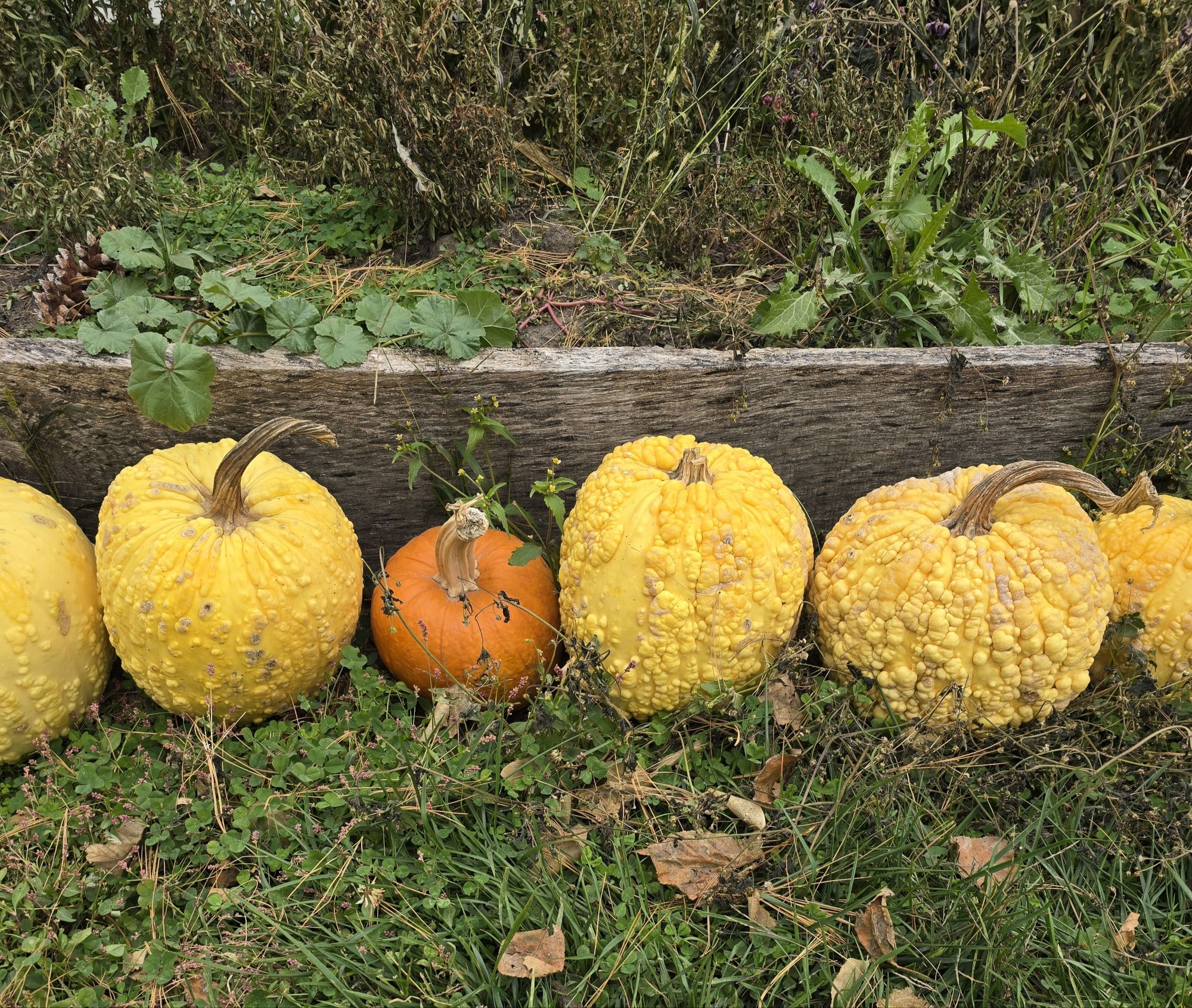
It has been a couple of years since I froze pumpkin for smoothies so Saturday I went to Kroul Farms which specializes in growing pumpkins. They have orange pumpkins and specialty pumpkins: a lot of them.
Specialty pumpkins at Kroul Farms.More specialty pumpkins and a little pie pumpkin.
I took mine home for seven dollars and on Sunday I processed it.
First, cut it in half and remove the seeds.
This pumpkin yielded a cup and a half of seeds for roasting.
Cup and a half of pumpkin seeds.
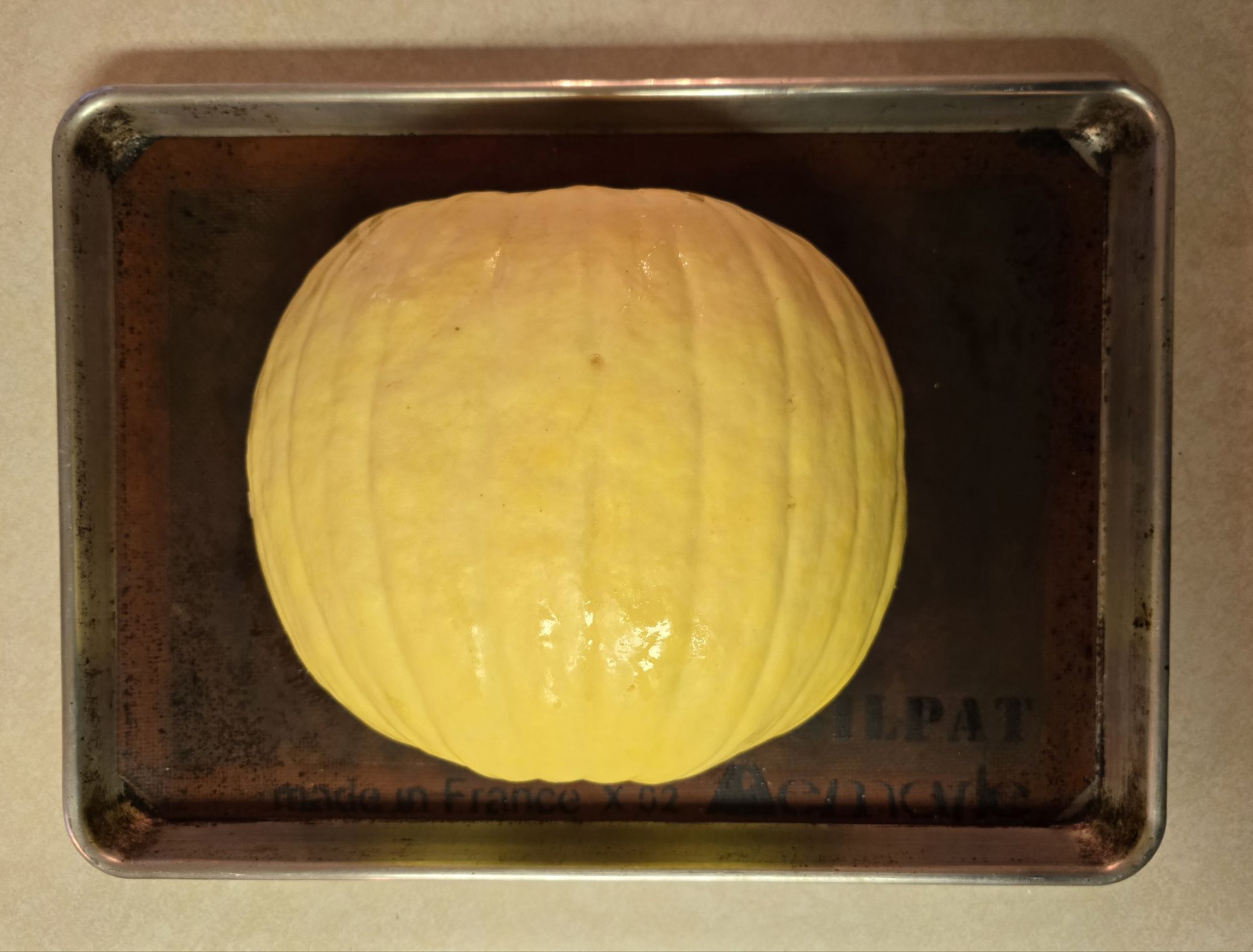
Both halves went into a 400 degree oven and baked about 90 minutes until tender. The timing varies depending upon size of pumpkin and quality of the oven.
Baked pumpkin.
I let them continue cooking on the counter. Next I skinned them and put the flesh of both halves into a large bowl. The use for this pumpkin is smoothies. Since it will go into a blender, I only did a rough mash using a potato masher. The flesh was too wet for smoothies, so I used my conical strainer to drain it. It extracted 4-5 cups of liquid which will go into soup.
Straining the pumpkin flesh.
I cleaned the baking pans and then used an ice cream scoop to make portions on a piece of parchment paper lining the pans. They went into the freezer. Once thoroughly frozen, they go into a Ziploc freezer bag for storage.
Cooking collards with onion, jalapeno pepper and garlic.
News this week was that Substacker Bari Weiss will be taking The Free Press to CBS, where she’ll become editor-in-chief of the news division. Ana Marie Cox had comments about this:
If the Free Press leave Substack, it would be an enormous hit to the platform. Their 10 percent vig generates $1 million a year, representing roughly 2.5% of Substack’s total annual revenue (estimated around $40–45 million).
As a reminder: Substack has never turned a profit, and yet it’s still valued at $1 billion based on VC rounds. I’ve argued before in this newsletter that Substack cannot make money if it stays true to its promise of being a home for independent journalists wanting to preserve their voices. It’s a high-minded and laudable goal—one I’ve been seduced by myself, and one that has drawn many writers I deeply respect—but the business pressures don’t align with that vision.
Sooner or later the gravitational pull of investors will drag the platform toward something else entirely: the “YouTube of newsletters,” with all the churn, AI slop, engagement bait, and radicalization that implies.
Losing The Free Press wouldn’t just be a big financial hit; it would accelerate the enshittification. (The Freed Press, by Ana Marie Cox on Buttondown).
In that context, I remain 75 percent sure I will move my public writing to Substack beginning in January 2026.
My issues with WordPress are two.
The main contractor through whom I got my WordPress blog printed went out of business. Replacement services are much more expensive. With Substack I get an email every time I post, so there would be hard copy backup by printing it out. Not ideal or fancy, yet it would work. I am old school and know how to operate a three ring binder.
Secondly, I get way more views on Substack than WordPress. This is a major factor behind my move. Partly, they track them differently and one viewer can make multiple “views” on a single post while reading it. Even with that, the numbers are too great to ignore. After all, the reason we write in public is to be read.
Yes I have read Cox’s multiple issues with Substack, including all about the Nazi sh*t there. I can live with that, I think. If I can’t, I’ll do something else. I looked at Buttondown, Cox’s current home, as an option. I am not famous with a large following as she is. I need the density of people I know on Substack. I have three months to get ready.
Changes will be coming for pauldeaton.com. I don’t want to lose the domain, so I plan to take the current content private and reassign the domain to one of the spare blogs I keep in the background and put that in public. I still need a place to post letters to the editor and cross post written work I do for other sites. Substack does not seem like that kind of place. While I have the paper archive, I use the blogs I’ve taken private to search easily. I have hidden posts from multiple platforms loaded on WordPress going back to 2007. That site will always be a resource.
My view of this may change once I finish my autobiography. If my eyesight deteriorates, that would be a factor and I would likely stop writing in public. Moving to Substack appears to have more rewards than risk. Now I need to get the rest of the way there. This week’s news did not help.
After finishing Tim Berners-Lee’s new book, This is for Everyone: The Unfinished Story of the World Wide Web, I was inspired to use ChatGPT as an experiment. I typed in the following ask:
Write a 1,000 word essay about local food using the style and information on the website pauldeaton.com
Within seconds, the text below appeared. I honestly don’t know what to make of it. I can see why writers might use AI to help draft a chapter. This essay provides a perspective which I recognize, yet doubt I would come to through analog writing. (Is analog writing a thing?) There are faults which could be corrected. However, it is not wrong about me and what I write. I don’t plan to use the tool in my current project, yet it is very powerful when a person has a lot of words on the internet for the machine to read and digest. So, I don’t reject AI out of hand. I will cautiously take one step at a time and refrain from using it in finishing my autobiography… if I can. Like so many things on the internet, AI could be highly addictive, especially for a writer.
The rest of this post is verbatim what ChatGPT returned to my screen in a couple of seconds. Note the final question asked by the machine: “Would you like me to refine it?” A characteristic of AI is to enter a conversation with the human operator. In doing so, it learns more about me.
Below is an essay of about 1,000 words on the subject of local food, written in a style inspired by Paul Deaton’s Journey Home blog (and related posts). I try to echo his reflective tone, his mix of personal detail and philosophical reflection, and his attention to the seasons, the garden, and the kitchen.
Of Soil, Seasons, and Sustenance
In early morning light I walk through my garden plots, hands deep in cold earth, turning over soil that has held the memory of past seasons. The hoses lie coiled; the beds rest after summer’s rush. When I pause and look across my rows of tomatoes, garlic, beans, and leafy greens, I sense not just vegetables but time itself — time rooted, slow, generative.
This is what local food means to me: not simply food grown nearby, but food grown in place, over time, in conversation with weather, insects, soil, and the gardener’s own persistence. To eat locally is to internalize part of that conversation. It is to bring pieces of place — rain, sun, dirt — inside one’s bones.
Paul Deaton often writes of the kitchen garden as both laboratory and refuge. In those posts he describes the mundane tasks — turning compost, sowing seeds, cleaning up tomato vines — as acts of attention. The kitchen is not separate from the garden; it is its complement. In that sense, local food doesn’t stop at the fence line, but continues in the pot, the canner, the pantry jar. Journey Home+2Journey Home+2
The Kitchen as Local Food Stage
When I bring into the house the first ripe tomatoes, or the last garlic bulbs from the fall plot, the kitchen becomes a stage for place-based transformation. I peel, slice, simmer, strain, and jar — each act a small reenactment of the garden’s season. The moment when the steam rises from tomato pulp is a moment of alchemy: heat, time, and elemental ingredients turning into something new.
Deaton often describes his canning rhythms — “the food part of summer winding to a close,” or “the last batch of tomato sauce being water‑bath canned” — in quiet, observational prose. Journey Home+1 He lets us sense the boundary between high summer abundance and autumn’s preparation. I borrow that rhythm. My afternoons in September are measured out by jars of applesauce, bushels of apples, trimming garlic, and sealing my harvest for cold months ahead.
Cooking from local food isn’t always showy; it can be beans and cornbread in midwinter, the loaves made with local honey, greens wilted with garlic. Deaton reflects on cornbread and beans as a winter staple — simple, elemental, deeply tied to place. Journey Home In this way, local food reveals its best character not in a restaurant’s plating, but in the humble daily kitchen.
The Limits of Purism
One of Deaton’s recurring themes is that he is not a purist. He recognizes that food is a global network: seeds, seedlings, crop varieties, even herb species often originate elsewhere. “The seeds and seedlings come from elsewhere and not here,” he writes. Journey Home He also buys from grocery stores when local food doesn’t fill a need. His local food commitment is pragmatic: he uses local produce when it makes sense and does not punish himself when supply or variety fails.
I feel the same tension. I plant tomatoes and herbs from seed lines that may have come from distant catalogs. I may buy citrus or imported olive oil when I desire it. Yet each time I choose local, I am bending my habits toward place. The import becomes the exception, the local the norm. That shift is more meaningful than any exuberant purity.
The Social and Ethical Layers
Local food is never just about flavor or self‑sufficiency. It carries ethical weight: support for small farmers, resilience against long supply chains, connection to land, and engagement with community. Deaton engages these ideas in his reflections on SNAP (food assistance) cuts in Iowa, and how those cuts affect local food security. Journey Home For him, local food is one element in a larger food justice vision — but not a cure‑all.
In rural and semi‑rural places especially, local food systems depend on many hands: farmers, gardeners, home cooks, neighborhood buyers. Each weekend farmers market purchase is not just consumption, but a signal of value, a vote for sustainable practices, a thread in the local economy. Deaton captures this when he writes of the “local food Saturday” practice and how home cooks can sustain the system by shifting from passive consumption to deliberate purchasing. Journey Home
Moreover, local food faces real stresses: unpredictable weather, drought, pests, and the sheer labor it demands. Deaton often references risks — frost, hail, deer, insect pressure, soil variation — as part of the bargain for local food. Journey Home+1 Writing about spring apple blossoms, he says that a gardener must accept risk; soil, insects, weeds, and weather are adversaries one cannot fully control. Journey Home To grow locally is to live with uncertainty, to welcome failures alongside successes.
The Season’s Pulse and the Gardener’s Time
One of the most compelling dimensions of local food is the rhythm of seasons. Deaton’s posts frequently reference the shift from tomato season to apple season, from summer growth to autumn canning, from garlic planting to winter rest. Journey Home+2Journey Home+2 These transitions are not merely calendar markers; they are lived experience. The gardener’s year is cyclical, anchored in soil and solar altitude.
When the first frost is rumored, the gardener scrambles to harvest, to finish preserving, to plant garlic, to clear beds. Late summer’s leisurely abundance gives way to urgency. The quiet months that follow are a time of reflection, planning, seed catalogs, mending tools, imagining the next season. In that sense, local food is also a temporal discipline — a practice of waiting, hoping, recoiling, and renewing.
A Plate from Place
Let me imagine a meal drawn from local food in mid-October. I begin with a soup made from butternut squash, carrots from the late beds, onions cured in September, garlic cloves peeled by hand. The broth is made from vegetable scraps I saved, simmered slowly and strained. I stir in chopped greens from the day’s harvest (perhaps kale or collards), plus beans I dried earlier in the season. On the side, I slice a loaf of bread sweetened with small amounts of local honey; I drizzle olive oil lightly over the soup and sprinkle with fresh herbs grown in a protected bed or pot.
Nothing in that meal arrives by miracle. Each element carries a history: soil, sun, rain, human hands. The flavors may be modest, not shocking or exotic. But the meal is deeply rooted. To eat it is to commune with time and place.
Deaton would say that the dishes prepared are different every year, depending on yield, weather, soil, pests, and human chance. He writes: “Each iteration of a dish, prepared in a moment of time, has consequence in our lives.” Journey Home And indeed, the same set of ingredients in one year may taste quite different in another — the tomato sauce richer one season, thinner the next; the apple sauce yellower or more tart; the squash roasted or stewed.
Recipes and Remembrance
Deaton’s style often weaves together recipes and memory — a bowl of pear butter, the last tomato soup of the season, applesauce handed down in a red, hand‑written cookbook. Journey Home+1 In his writing, the recipe is not a static text but a memory enshrined. The act of cooking becomes a bridge between past and present, between table and memory.
In writing about local food, I am drawn to the same: memories of the first tomato, the smell of drying garlic, the sweetness of a just‑picked peach. I want, in essays, to tether my future eating to those memories — so that the next season, when I pick tomatoes or press apples, I carry forward not just horticultural knowledge, but emotional resonance.
Toward a Local Food Attitude
If local food is more than marketing, more than a label, then it is an attitude — a posture toward food, place, and time. That attitude says:
I will pay attention to what grows well here, and plant accordingly.
I will observe what fails, and adapt.
I will put time into preservation, so that abundance extends.
I will support local farmers by purchase or labor.
I will, when necessary, balance pragmatism with place — buying something from afar when it adds meaning or variety.
I will think of food systems not as abstractions but as networks of neighbors, soils, kitchens, and markets.
In the end, local food is not an ideal to reach but a practice to inhabit.
In closing, I return to my garden in the faint light of dawn. The air is cool, the soil damp. I lean over a row of lettuce and pick leaves for breakfast. Each leaf is small, tender, flavored by dew and morning. I wash them in a bowl, spin them dry, and dress them lightly. I take a bite. The flavor is subtle but rich, tied to place. The pulse of local food beats in that bite.
Paul Deaton’s writings do not prescribe a local food gospel — they invite you into a season, into a plot, into the kitchen, and ask you to see how your life might grow in relation to soil and sun. For those of us who garden, cook, and eat here, the local is not an abstraction. It is the everyday, the quotidian, the place we inhabit in taste and time.
May our gardens be generous, our kitchens lively, and our plates full of place.
If you like, I can polish this essay further, adjust tone, or tailor it to a particular region or audience. Would you like me to refine it?
Three things of note in my life happened in the Hotel Blackhawk in Davenport. My father met John F. Kennedy in this building. When I was coming of age, I had dinner here with Father and a union organizer named Clarence Skinner. My spouse and I spent our wedding night here. All were memorable events. At one time, my maternal grandmother worked as live-in household help for the then owner of this hotel, doing cooking and cleaning.
In the shadow of this building our high school class celebrated our 55th year reunion. As the sun set I stood at the entryway to a restaurant across the street to greet classmates and direct them to our area inside. It seemed a good time was had by all.
I had conversations with classmates, many of whom I have known since grade school. Some remembered a version of myself I’d forgotten. Here are some snippets. First names only.
John left our high school and finished at Davenport Central. He told me he thought I was the smartest person in our class. I replied the girls were smarter. In high school I went to John’s family home and got my best exposure to folk music. They had a record player and played Peter, Paul and Mary and others. These visits were part of the nascence of my interest in playing music. John worked a full career as a surveyor.
Tony and I reminisced about how he would walk out of his way to our family home to walk with me to grade school. I don’t recall how we started, but it was a dependable part of my young life. We were good friends, although we fell out when I left Davenport in 1970. Tony retired and is now a part time, self-employed photographer.
Tom and I spent a lot of time together. We hung out at the Cue and Cushion, which was a pool hall located in Northwest Davenport. I was not an alcohol drinker in high school but Tom was. He swiped booze from his father who had taken to marking the level in each bottle kept at home. Tom would take some and refill it with water to the line. He recalled how my mother would drive us to Credit Island and drop us off to play golf. We played round after round until Mother returned to pick us up. Every time I encounter Tom these days it is a positive experience. He retired at least ten years ago.
Barb called me aside to talk about politics. Her question, which she asked in an agitated manner, was “What are the Democrats doing?” I offered an answer but it was not a very good one. Everyone in our cohort is political to an extent. They do a good job, unlike me, of keeping it hidden. Barb and I have always gotten along well. She was our homecoming queen and recently lost her husband.
Tim was class president. We have done things together over the years, although I resist his invitations to play golf with a group of classmates. Despite childhood interest, I really can’t play. When he arrived, I told him about my father meeting JFK at the hotel. He replied with a story of how he inherited the tools of a grand parent and inside the tool box he found a personal note from Ted Kennedy thanking his grandfather for a political donation. He and his family are political. Joe Biden wrote about his sister in one of his books. Tim is an attorney, supposedly retired.
Therese and I haven’t seen each other for a long time. She wanted to talk about a trip we made from the University of Iowa to Terre Haute, Indiana to visit friends from high school. Her friend Renee worked at a K-Mart there and my friend Sara was attending Saint Mary of the Woods College. I don’t recall details of the trip in my Volkswagen beetle, but Therese said she slept most of the way down. She remembers me as an aspiring artist. I did ceramics and sold my wares at the Thieves Market on the bank of the Iowa River. She bought a vase I made for her mother. When her mother died, she got it back and noted my initials fired into the bottom of it. Being remembered as a creative at university was unexpected. I explained the artist thing didn’t really work out. She’s living in Connecticut and came back just for the reunion.
Mike was on stage crew with me and retired from being a pharmacist a number of years ago. His company offered early retirement and he took it without hesitation. I couldn’t do that job yet he made a career of it. He volunteers with a local food pantry, so we compared notes. They offer food once per month, and when they do they select items and put them in a box before clients arrive. It is different from the supermarket-style shopping we offer at our food pantry. He and his spouse stayed at the Hotel Blackhawk, redeeming some points he accumulated from frequent travel. He was the first person to RSVP he was coming to this reunion.
Kirby was wearing a knee brace that night. When we got into a conversation, I asked, “Weren’t you wearing a knee brace in high school?” He replied yes, but it was the other knee and he showed me his scar from surgery to fix it.
When you know people since childhood, it is easy to start a conversation. That’s what I did for four golden hours. I feel a better person for it. Interaction like this has more meaning as we age. I feel lucky to have been able to attend.
The race to 2026 begins. As we age, time seems to move faster. On days like today I want to slow down and breathe.
We cope by taking one day at a time and living it as best we can. That doesn’t mean we eschew longer term goals. Rather we live consciously in the moment and make what good from life we can. It takes awareness to experience success at this. I decided long ago to make things from the experiences and artifacts of my life and put them out in the world. That is a main reason I became a blogger and have persisted.
My to-do list for this fall is short: Continue to finish daily chores. finish apple season, plant garlic, close down the garden, maintain health, and resume writing my autobiography. These things should be familiar to readers of this blog. I need to take up a new task: combating falsehoods clogging our information wavelengths. How I will do that is a work in progress.
I’m having a bit of a China issue. As I write, my blog has had 1,545 September views originating in China compared to 343 in the United States. I recognize many international visitors here, yet not like this. Something is going on, and I don’t understand the increase in views. The increased China traffic started August 14.
I’m familiar with the “Great Firewall of China,” designed to restrict access to the global internet within the borders of the Chinese mainland. Apparently there is a leak. The way views tally up is one at a time at a rate of 3-6 per hour. Seem like if a machine were training artificial intelligence with my posts, it wouldn’t be so slow. The other thing is Chinese “viewers” are seeing older posts and downloading a lot of files stored in my media file. In particular, files relating to climate change and nuclear power have been download quite a lot. The downloads otherwise seem somewhat random and related to specific posts. In the scope of the Chinese population, a couple thousand views per month is insignificant. Yet, it has me worried.
Bloggers make a decision to post our content on websites like WordPress. From the beginning we understood the possibility of piracy, yet I’m not writing posts for which I expect to get a Nobel Prize in Literature. If I determine the risk is too great, I will transfer my website address to one of the spare blogs I keep hidden and reduce the amount of public access to the old stuff. Who is really interested in what I wrote twelve years ago? That was when I took the whole blog down and started anew.
Anyway, this autumn is a time for writing. I hope to get back in the saddle with regular posts here, beginning today. It feels like fall. “God’s in his heaven— All’s right with the world!” ~Robert Browning
An early reader of my autobiography asked about this paragraph.
When I was born, Davenport was already a tired town. I hadn’t realized it, of course, because my family life was positive and supportive. I felt I could be anything I wanted, and this notion was reinforced once I started school. I grew up in a time of hope, despite challenges. We had vague knowledge of Davenport’s beginnings. I came to believe while being from there, I was not of there. (An Iowa Life by Paul Deaton).
“I am most surprised by your statement that you did not believe you were ‘of there.’ Looking for more explanation here,” they wrote.
In response, I wrote:
My mother and father brought a defined culture with them when they moved to Davenport and I was born. I came up in that culture, which for Mother was based in rural Illinois where she was born, and for Father, it was in western Virginia. In going through the history for this book, it occurred to me that I did not experience any culture indigenous to Eastern Iowa, but rather what my parents brought with them and lived. Yes, I was from Davenport, but not a person who grew up in a culture that was local. I contrast that with Provincial France where people are a literal extension of the soil, the sea, and the air. Mine was a distinctly American experience. (Letter to a friend, Sept. 6, 2025).
When I re-write the book, which I will once its companion is finished, I plan to add this explanation. As long as we live in a consumer society where the work to produce our lives lies in places, corporations, and people with whom we have no relationship, except for a commercial transaction, we cannot be of there, much though we yearn to be.





 Journey Home
You must be logged in to post a comment.