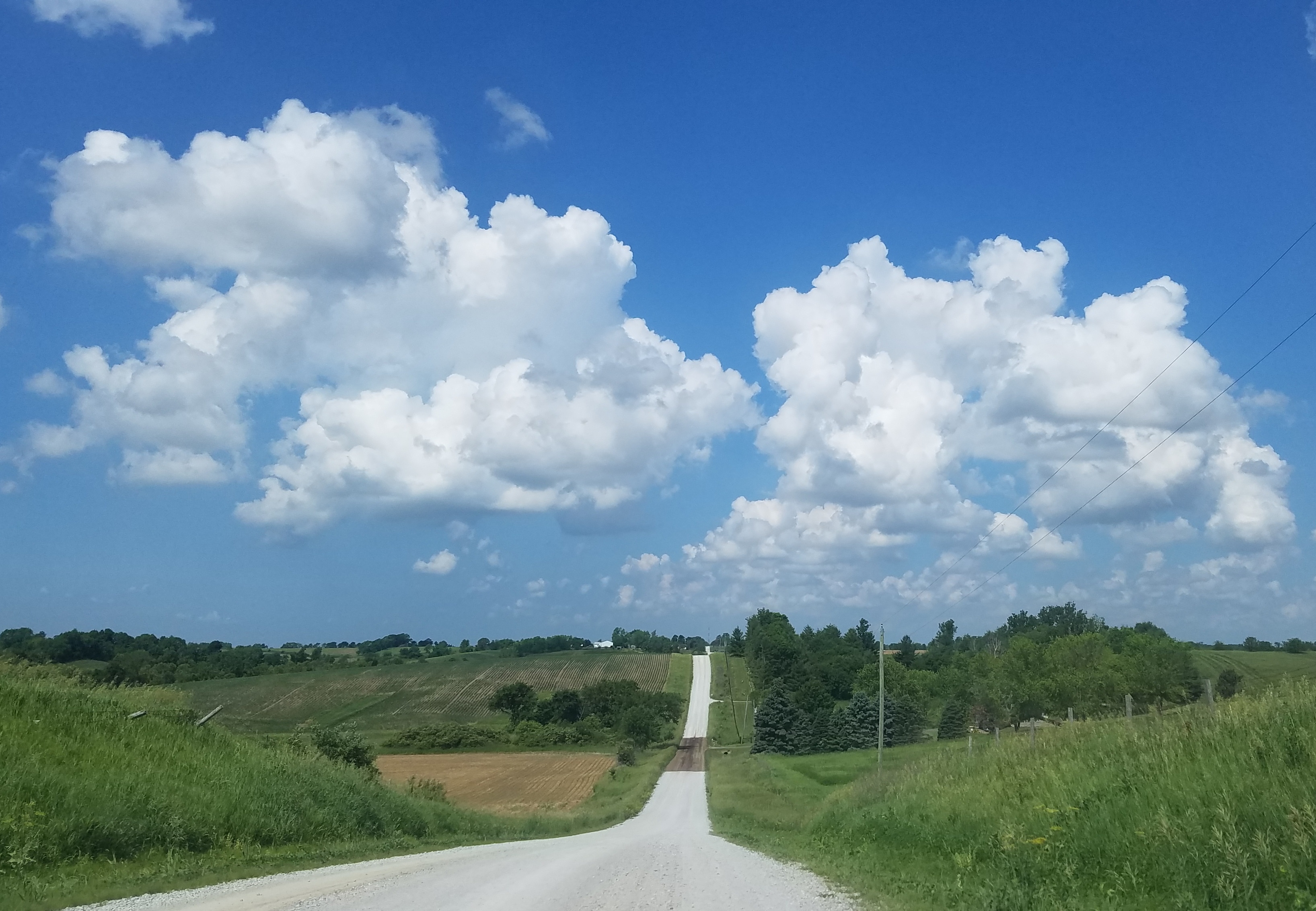
We rely on the county secondary roads department to keep farm-to-market routes in good shape. Each spring, gravel roads need grading and gravel application. While they are not well-traveled, people notice if they are in disrepair. Secondary Roads did a great job on those I use, like the one in the photograph taken after my shift at the farm.
My soil blocking at the CSA is winding down. Yesterday I started early because of mid day heat. I showered afterward and went to the wholesale warehouse to get provisions. That’s my work for the week so the next scheduled trip off property is not until Monday to deliver produce to the food pantry. That is, unless she calls ready to come home.
Having the house to myself is a little weird. I set up a music station on the dining room table. The three-in-one device plays radio, compact disks or audio cassette tapes. We keep things pretty quiet most of the time, so it is evidence of temporarily letting loose. Last night I played my Greg Brown CDs. Brown tells a story I’d like to believe about Iowa.
The menu I wrote for the both of us is out the window. There was leftover rice so I used it with other bits and pieces from the ice box to make a dish: leftover beans, kale, onions, bell pepper, and seasonings. That served as breakfast and dinner on Wednesday.
In addition to drinking a Coca-Cola on Tuesday, last night I drank the first beer since March 13, 2020 at the beginning of the pandemic. I bought a case of Stella Artois at the wholesale warehouse and with temperatures in the upper 80s, I relished the first taste.
There is a big bowl of limes to be used up. I have something mixed with vodka in mind, although I am no mixologist or hard-liquor-drinker for that matter. For complicated reasons I am reluctant to open the bottle of Stolichnaya Russian Vodka purchased at the Me Too grocery store in Cedar Rapids around 1986. I hauled it out to Indiana and then brought it back to Iowa. The label says, “Imported from the USSR” and that’s half the story of its travel. Once I open it it’s a matter of time before it will be gone. I’ll probably hang on to the unopened bottle a while longer. In all this time, only about an ounce has evaporated through the sealed cap. I’m not keen on vodka consumption anyway.
Peas are ready to pick in the garden, so that’s first up when the sun rises. Some kind of stir fry will follow. There will also be soup today. Ambient temperatures are forecast for the 90s this afternoon, so garden work will be finished early, and most of the day will spent indoors.
It seems too hot for early June. The drought in Western states is horrific. The Colorado River basin is disastrously low on water and it seems doubtful rain will come in needed amounts. My worry is the drought is creeping eastward. I lived through the 2012 drought and worked outdoors in it. I don’t want to repeat that experience, yet may have to. Fingers crossed we get back to normal weather before long.
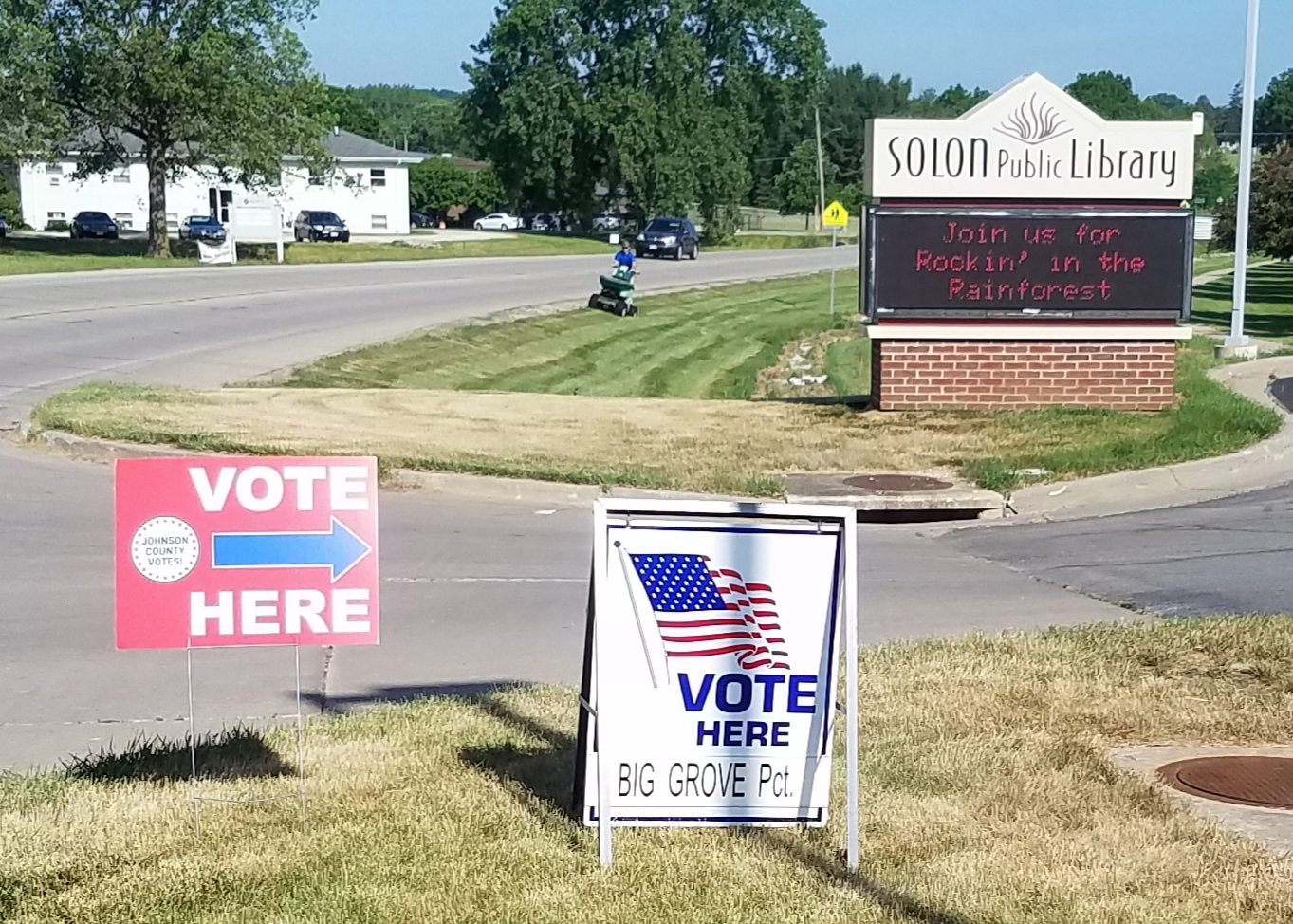
Big Grove Precinct polling place at 9 a.m. on June 8, 2021.
Tuesday was the day to take Jacque to her sister’s home in Boone. We began by voting in the special election for county supervisor. Our candidate, Jon Green – Democrat, won with 66 percent of votes cast. Voting together is an excellent way to start the day. It’s not really a date, but the experience was better than an actual date. After almost 40 years of marriage that’s how we are evolving.
We drove past the Atherton Wetland, up through Ely to Highway 30, which was the first transcontinental road for automobiles, dedicated in 1913. There are historical markers along the way, although I’m not sure the current Highway 30 is the actual Lincoln Highway. In fact, I’m sure it is not in some stretches. I hadn’t been out west on 30 since my in-laws’ estate was settled in the late 1990s.
I used to appreciate the drive, and seeing the patchwork of farms that make up rural Iowa. Yesterday’s weather, mostly clear skies with cumulus clouds, was perfect for travel. My observations were different this time.
The first thing I noticed was how large the acreages had become. There were so few homes, silos and other structures on so much land. It’s reflective of the need for less people to farm in 2021. Grain storage capacity had increased considerably.
As before, the diversity of crops was limited. I noticed corn and beans, and hay bales in abundance. Due to the drought, it is a good time to harvest hay. There was likely oats mixed in the fields, but my eyes aren’t trained well enough to differentiate it.
Maybe they were there 20 years ago, but I noticed a number of concentrated animal feeding operation confinement buildings. In the vast landscape they don’t look like much, yet livestock produces six of ten of Iowa’s top agricultural commodities. I did not see one hog, cow, turkey or chicken during four hours on the road. They were all indoors.
If I once thought the scenery bucolic, I no long do. It is a landscape of extraction, well organized and with purpose. While a natural process produces commodities, it is hardly nature or anything close to it. The lack of diversity among crops and the biome is remarkable once one is acculturated to recognize it. The unseen disaster is the flow of agricultural chemicals, manure and topsoil runoff into Iowa’s watersheds. Farmers say they want good water quality and rely on rain to produce it for corn and beans. However, the industry also relies on disposing of their waste downstream at no cost or responsibility to them. The current landscape and the farm operations on it are unsustainable.
We stopped for a rest break at the Meskwaki Travel Plaza in Tama. They have clean restrooms, clean everything. The signs on the entryway read “masks recommended.” No one, including us, wore a mask. There were no mask monitors and we are fully vaccinated against COVID-19 so are not concerned about contracting the coronavirus. We had our vaccination records with us, but preferred not to show them because of the brouhaha about “vaccine passports.” No one questioned us.
I’ve not been inside the nearby Meskwaki Casino and have no desire to experience it. Later in the day I did buy a Powerball ticket so I’m not a gambling purist. “Loose slots” has little intrinsic appeal.
Noteworthy is the Meskwaki Organix Store inside the travel plaza. It is the first tribal-owned CBD dispensary located on tribal land in the state of Iowa. The Meskwaki Nation set their sights on developing a hemp economy in which they would control the product from seed to shelf. The store is intended to pursue retail markets and will also play a role in market research and product development for CBD. The store opened in November 2020. We didn’t stop there either.
Boone is the birthplace of Mamie Eisenhower. There is signage about her along the main street through downtown. After dropping Jacque, I bought gasoline at a Casey’s store. I went inside and bought a regular Coca-Cola. I don’t recall the last time I drank a Coke, and despite the labeling “original taste,” high fructose corn syrup was used as a sweetener. It was nothing like my memory of going to the corner grocer and buying a 10-ounce bottle of ice-cold Coke after delivering my newspaper route. In Iowa, we are all about appearances, less about substance. We should keep our memories about good times to ourselves.
I will return to Boone to bring her home. I won’t be buying another Coke. It was a mistake to get it, although one that can be quickly forgiven. We’re in Iowa. High fructose corn syrup is what we do.
Box of Redbor kale picked June 7, 2021 for donation to the local food bank.
Most people believe learning is important. Yet “learning” is such an all-encompassing word its meaning get muddied. I’m not sure how much actual learning goes on in said people’s lives.
I hope to be a life-long learner and assume I will be. As a gardener, learning comes with the avocation so there is a process of getting better in producing vegetables, caring for the soil, and controlling harmful to humans inputs. As a writer, most of my time is spent editing words to determine what captures intended meaning, what sounds best, and figuring better ways to say more with less words. In December I reach another decennial milestone and enter septuagenarian status. In response, I’ve been considering what it means to be a learner in 21st Century society.
This post frames up a longer discussion of what learning means in the years ahead.
As young children we learn by nature and gain an understanding of how life works. Things like where food comes from, rules of behavior, when to expect a spanking, and from whom receiving a spanking is appropriate. As we age, we learn there are other options from what we learned as a toddler. It is possible to eat a healthy diet different from the culture in which we came up. Children can be raised without spanking. I find this kind of learning pretty dull because it is ubiquitous and necessary.
While there is significant learning once formal schooling begins, that too seems less interesting. I chose not to become a teacher early on, and that decision made the mechanics of pedagogy of fleeting interest. I had a long formal education, which includes Kindergarten through high school (1957-1970), college (1970-1974), a formal tour of Europe (1974) military service (1976-1979) and graduate school (1980-1981). While I had several paying jobs during these years, I considered everything part of my education. Learning is assumed during a formal education, it’s not the reference I am making in this post.
Learning occurs as a result of conscious intent. When I approached my friend Susan about working on her farm, in addition to financial compensation, I hoped to become a better gardener. As I planted the garden this year, I reflected on how much specific knowledge and technique I acquired since that initial engagement. My relationship with a community supported agriculture project made learning possible.
Over the summer I plan to set a new course for learning. Now that I retired from paying work, much of my time has been spent learning how to cope with my new status. Napping has been involved. That adjustment aside, I plan to review how I spend my time, what I have been working on, and what I should be working on. After doing that, I expect to embark on a new journey with learning at its core, one to carry me into my eighties.
I ran into one of my octogenarian friends at the food bank yesterday. She was the key organizer who started the food bank, found a permanent home for it, and continues to manage it. She is a living example of what it means to stay active in the community. My hope is I’ve learned enough to emulate her approach to living and learning. There are additional role models in life. Seeking them out will be part of the rest of my 2021.
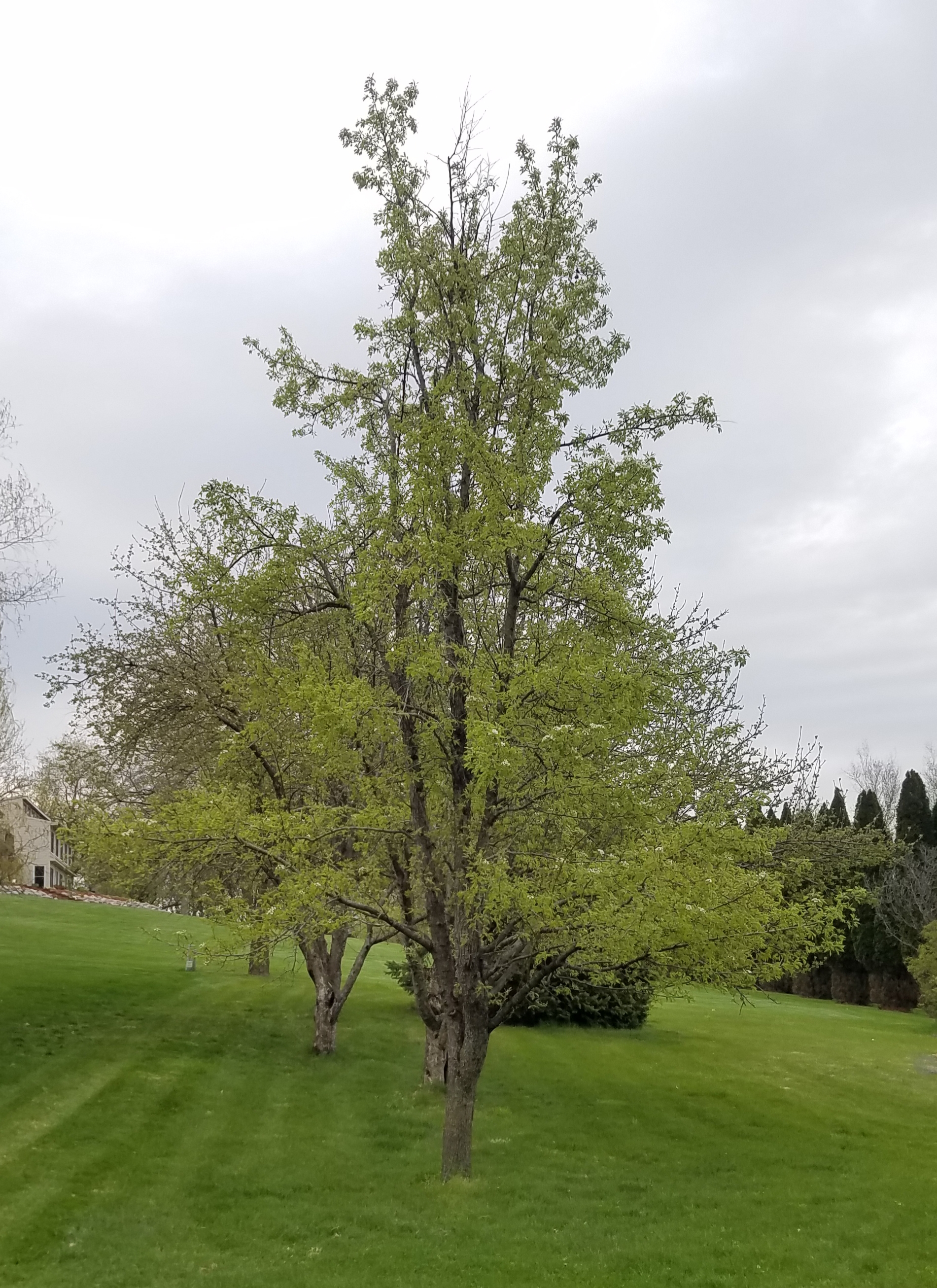
I can relax. Pollinators showed up at the apple and pear trees Monday. The relief is palpable.
Ambient temperature soared to 83 degrees and the warmth brought insects drawn to the pollen of open flowers. It’s expected to be warm again today. Hopefully it provides an opportunity for fruit to set.
I woke around midnight with moonlight coming through the blinds on the windows. It was very bright. I couldn’t get back to sleep. I went downstairs and got the copy of N. Scott Momaday’s new book Earth Keeper: Reflections on the American Land that arrived on Monday and read its 66 pages cover to cover.
Momaday strips language describing the earth to essentials. There is scant mention of cultural aspects of American society. His focus is on native oral traditions. It is different from other works by less experienced authors who use certain objects to make a point.
For example, what does it mean to invoke the image of the Piazza San Marco in Venice? For me, it is about art. Here’s what I wrote in my Oct. 9, 1974 journal:
These art works abound in poses like I’ve never before seen. It makes Dejeuner sur l’herbe seem trivial. A sketch book could be filled with writing the numbers of figures. And scores filled with drawings. Yet the true art is seldom, if ever, derived directly from other artists., but through nature. We must remember that art history plays but a small part in the dynamic, changing integrity of life. I seem to be a verb.
Personal Journal, Venice, Italy, Oct. 9, 1974
I’d already studied Momaday, and R. Buckminster Fuller (obvious from the last sentence) by the time I made it to Venice. The main justification of my trip was to see works of art around Europe. I remember Piazza San Marco and walking inside grand buildings that were virtually abandoned. They were preparing for a concert that evening. I remember the piazza flooded while I was there, a shallow pool of water broaching the banks of the Venetian Lagoon. I don’t know if that memory is real.
I wrote the names of 16th Century artists in my journal and compared them to other experiences. In the end, Venice provided an epiphany about the role of art in society. What we write can be more like Momaday: sparing in societal reference points with a focus on traditional narrative driven by the land.
When someone references “Piazza San Marco” it distracts from the point an author is making. Cultural artifacts inserted into poetry or prose don’t always have the same meaning to readers. That can be problematic.
I’m not sure what to make of this. For now, I’m glad pollinators showed up yesterday. I’ll get outside after sunrise and chew on it while planting more of the garden.
Easter was a time for us grade schoolers to don special clothing and attend Mass with Grandmother and our parents. There was a special Easter dinner, an egg hunt, a basket of treats, and Grandmother’s insistence on photographs of us dressed in our special outfits. We anticipated Easter throughout the year, which for me modeled the liturgical year.
Easter celebrated the Paschal mystery and was a special time, equal in its celebration to Christmas. Its main subject is the passion, death, and Resurrection of Jesus Christ – the work that God the Father sent His Son to accomplish on earth. Easter is central to being Roman Catholic.
What I didn’t realize then, but do now, is celebration of Easter with Grandmother was a cultural heritage derived from peasant life in Poland and carried to the United States by her grandparents. I wrote about the settlement of the Wilno, Minnesota Polish community and the bargain of establishing Saint John Cantius Catholic Church there. In a rich cultural life, Easter played an important role on the Minnesota prairie. Church life was also central to my growing up. It was a cultural impetus that eclipsed everything else in my life for a long time. In college, I even considered studying to be a Catholic priest.
Father attended Easter Mass with us but was not baptized Catholic. His interest, he told me, was in associating with the church community to locate patients for his nascent chiropractic practice. He was in process of conversion at the time of his death and neither made it to a chiropractic practice nor Catholicism before he died in the meat packing plant accident. Even so, the church was packed to the rafters at his funeral Mass celebrated by the Right Reverend Monsignor B. L. Barnes.
It is hard to shed the culture in which I came up, nor would I want to. Although Easter doesn’t mean as much these days, and I may go to hell because of it, I continue to note the occasion if only by celebrating the spring renewal of life all around us. Our grasp on today is tenuous and the well of our experience is both thirst-quenching and a potential drowning site. On Easter Sunday we must find renewal where it lies and work toward the potential for good rather than doom. The Pascal mystery teaches us there is hope and that’s a fit lesson for this time of contagion.
I decided to watch the sun rise. There was an urge to grab my mobile device and take photographs. I resisted.
Not everything needs recording.
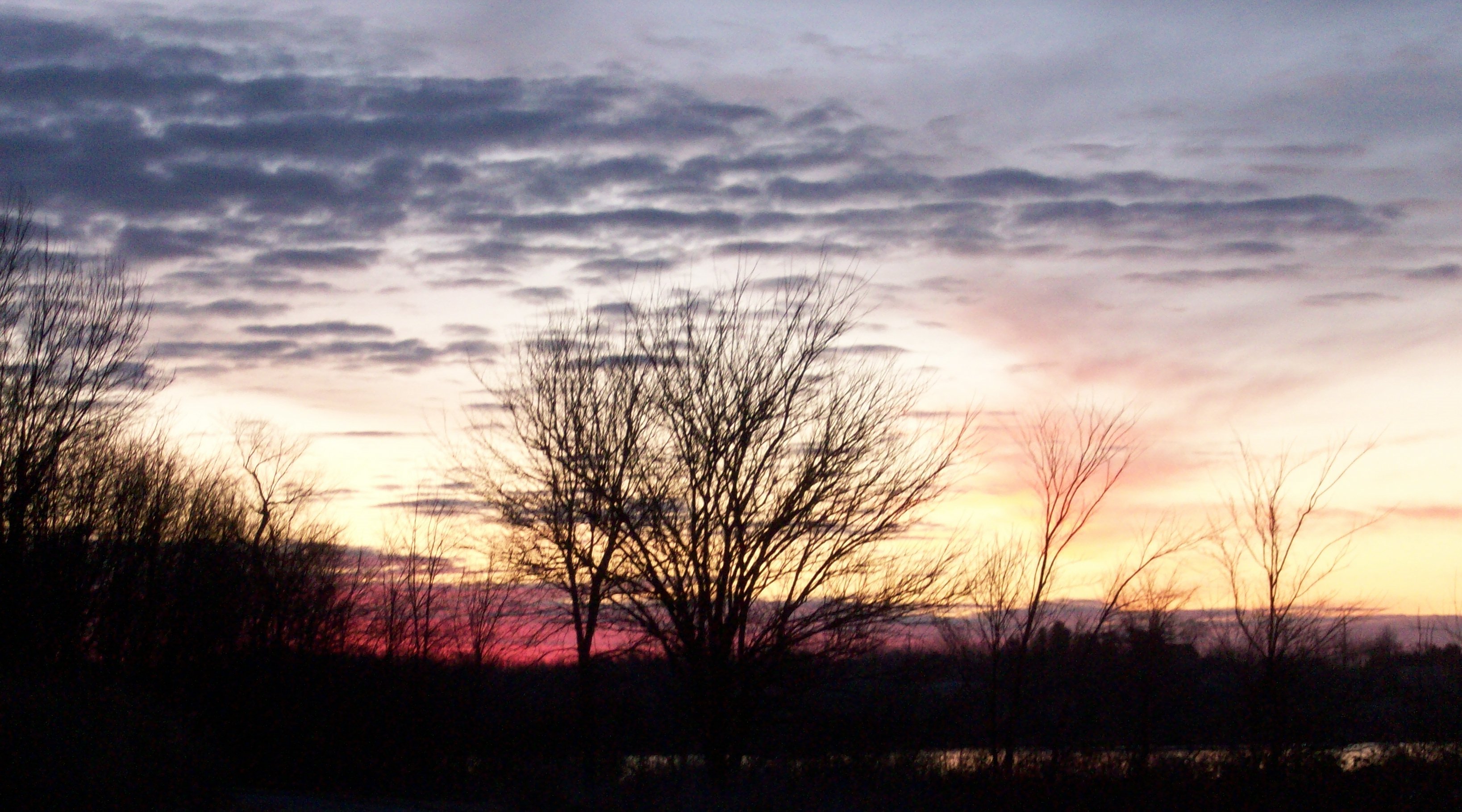
The sun rose east of the kitchen through the 25-acre woods. I made breakfast and viewed its changing colors. Another day’s beginning in Big Grove Township.
During the coronavirus pandemic my posts have become a diary of contagion. It wasn’t intended. Yet here we are, more than a year into the pandemic and despite the shipments of vaccines, there is a resurgence of cases of COVID-19.
These are uncertain times. We don’t know how a sunrise will play out, only that it’s the moment in which we live.
A lone concertina-player walked on a darkened stage playing single notes of Love Makes the World Go ‘Round to begin the overture to the Michael Stewart and Bob Merrill musical Carnival. Because of the close relationship between the schools, our high school stage crew helped Saint Ambrose College produce the musical a few years after its release on Broadway.
I feel like that concertina player during these beginning days of spring. I must get my notes out before the rush of spring’s portending promise leads to a bustling season. While the arrival of the coronavirus vaccine may not have been “direct from Vienna” like the carnival in the musical, there is hope enough people will get vaccinated to move on from the dull winter of contagion.
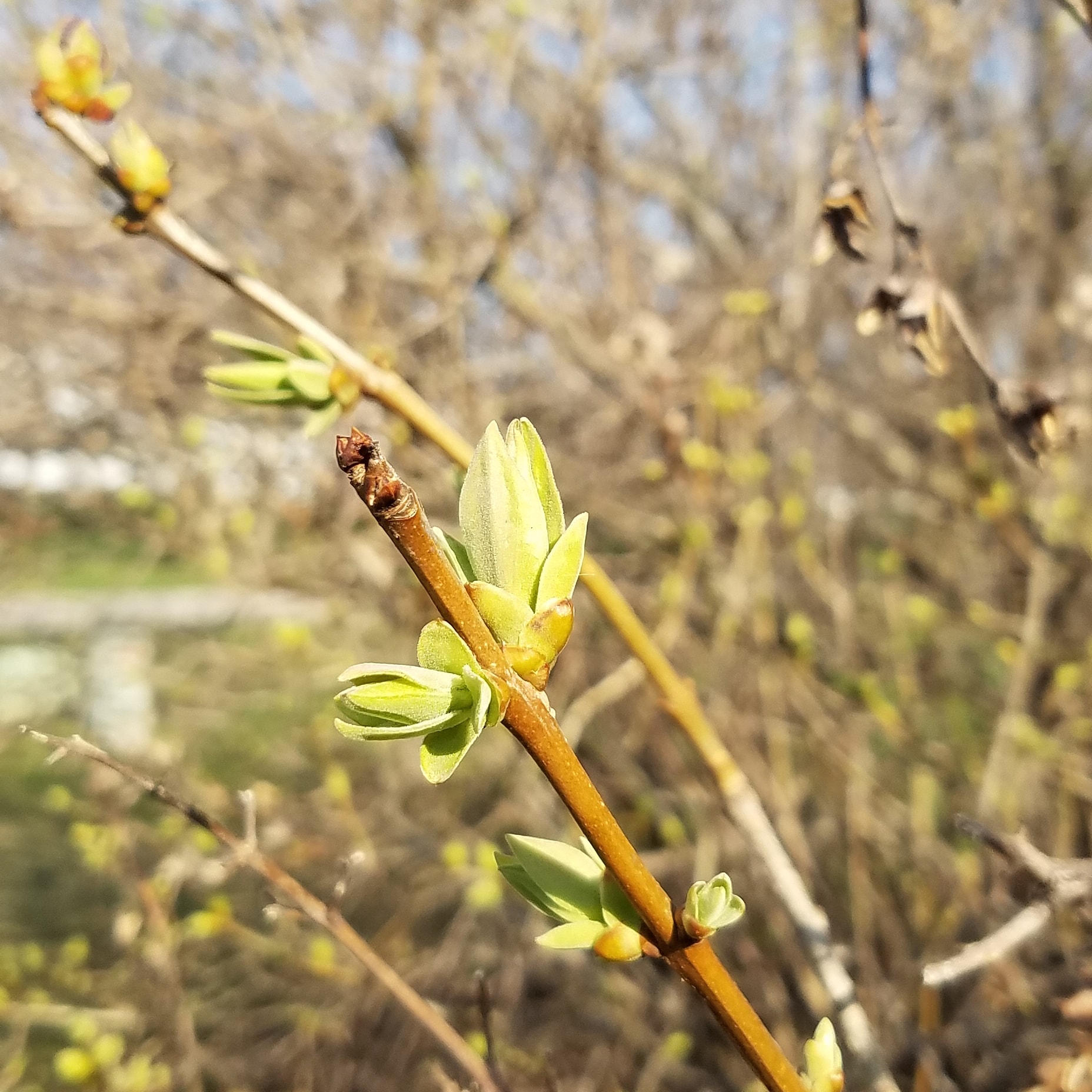
Already lilacs are budding, grass is greening. While it was exceedingly dry the first months of 2021, today’s forecast is rain. I’m torn between needing rain and wanting to work the soil enough to get early lettuce and peas in the ground. Such is spring.
I planted a tray of 50 beet seeds in soil blocks and moved them from the greenhouse to the heating pad under a grow light. They are germinating. The purpose is to get them started and have more success when they go into the ground. Beets grow when direct seeded, yet by starting them in blocks and planting them evenly there are less complications. I have big beet plans this year.
Spring is a time to increase outdoor exercise. I met with a dietician yesterday and she reinforced the importance of exercise in regulating glucose. I don’t know that what she said was new to me, but it finally sank in. Exercise uses sugar stored in our muscles and liver. As our body rebuilds these stores, it takes sugar from our blood. This is a good thing when it comes to living with diabetes without taking medicine.
Grandmother was about ten years older than I am now when she was diagnosed with diabetes. While living in Mainz, Germany, a package arrived from her unannounced. It contained all of the gelatin and instant pudding boxes from her pantry along with a note. With diabetes, the doctor said she shouldn’t eat them any longer. Her frugality insisted upon finding them a home. My A1C is below seven percent, yet having the diagnosis now will help me live longer with it. Since there isn’t a cure, that may be the best I can do.
Also this spring I began listening to internet radio. I found a station in Hanga Roa on Easter Island that plays blues, reggae, and progressive rock… the good stuff. It’s here if you want to listen during the pre-dawn hours of an early spring day.
Editor’s note: This was gleaned from a March 20, 2009 post on my Facebook page. My work in transportation and logistics exposed me to the deepening relationship between Chinese manufacturers and American markets during the 1990s. It was in Louisville I attended some Elite Eight basketball tournament games while attending the truck show. I also attended concerts arranged by show management with Alabama, Kenny Chesney and Reba McIntire. While geared more toward independent contractors and small companies, I was able to meet with staff from our company’s major suppliers.
During our descent, I saw the white flowering dogwood spread over the city. Grass was green and skies clear, a great day for flying and learning about the culture of trade shows. Our host sent his concierge to pick us up at the airport and deliver us to the Mid-America Truck Show.
This trade show is a chance for manufacturers, insurance companies, massage therapists, truck stops, software companies, advertising outlets and everyone who seeks the dollars found in trucking to show up. Back in the 1990s, we bought a copy of the attendees list, and discovered that the vast majority of attendees come from within a 250 mile radius to the show. It is a big event, and local in focus.
Some folks plan to buy their new truck here. Hawkers demonstrate how to reduce knee and back pain. Recruiters hope to take a driver application. Truck stop operators hope to meet up with clients. There are too many booths to take it all in.
What I did notice was a number of booths set up by Chinese companies. In one, I found Buzz, a ten-year acquaintance, introducing the Chinese manufacturers to his American contacts. In others, five or six Chinese sat in small circles in the booth in front of their wheels or oil seals, looking like they were isolated from this sea of truckers, tattoos, and facial hair. That they were here is a sign of the times, and if their behavior seemed odd this time, I am confident that they will learn how to work this crowd. One of my traveling companions said that he was surprised to see the Chinese here, instead of working the OEM (Original Equipment Manufacturer) crowd: that is where their best impact could be made.
The Louisville Truck show is our industry writ large. It was okay to see it yesterday, for what may be my last time. Louisville in Spring is, for me, more about the dogwood.
The schools and most of the neighborhood are on spring break so I’m taking one as well. I’m not sure when I’ll return to posting, and to be honest, I’m not concerned about that now.
I’m worn down by the coronavirus pandemic and need to give writing a rest. Friday we get our second dose of the Pfizer COVID-19 vaccine. By April the antibodies should have formed and I’ll be ready to go again.
As always, thanks for following and reading Journey Home. May this post find you well and strong.
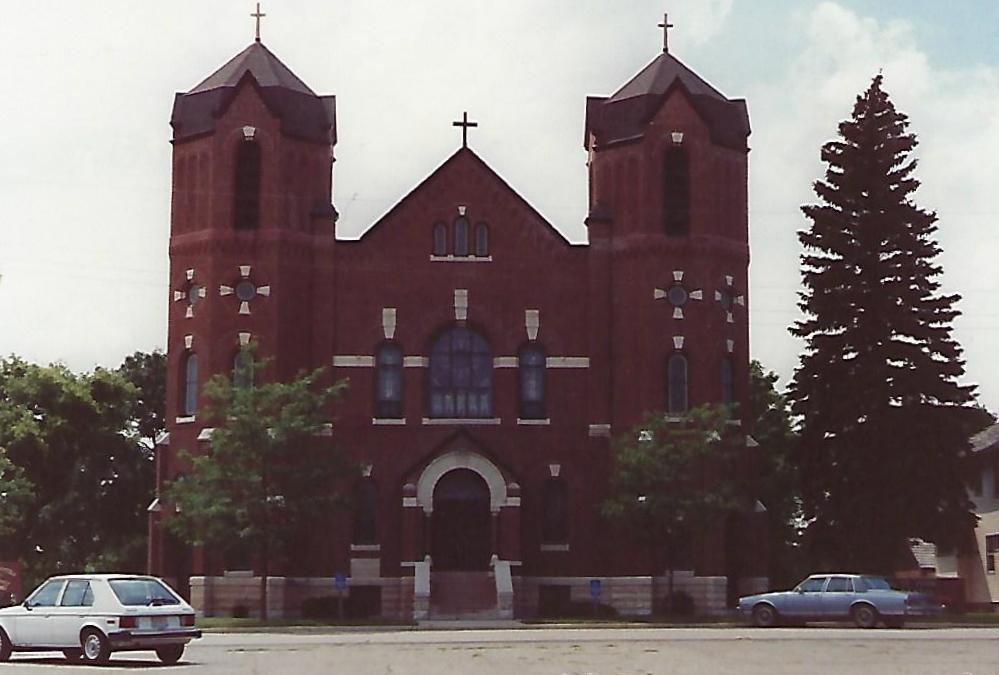
Saint John Cantius Catholic Church (rebuilt), Wilno, Minnesota, July 1991.
Editor’s Note: This is an excerpt from a memoir in progress during the coronavirus pandemic of 2020-2021.
The river between two hills, where a house would have been on either side, looked just as Grandmother described it. It was more stream than a river, though, and the land forms were rises in the prairie rather than hills. Nonetheless I recognized the place.
On an overcast rainy day in July 1991, I made my first and only trip to the Nadolski family home place in Royal Township, Lincoln County, Minnesota.
Maria Nadolski, Grandmother’s aunt, lived on the far side of the stream that separated the two houses. Maria owned a piano. Grandmother, Mae as we called her, wanted to learn to play that piano. Maria said no. Mae carried that story of rejection with her until the end of her life. Maria’s house and the piano are long gone.
On another rainy day in Davenport, not far from where I was born, Mae told a story about the stream flooding after a heavy rain, cutting the houses in Royal Township off from each other. She repeated the story from time to time, as she did the story about her aunt and the piano. I believe the remaining house I saw in 1991 is where Mae was born Salomea Nadolski on June 24 or 25, 1898.
After she died on Feb. 7, 1991, I made the trip to her birthplace. The trip was a form of summer vacation when we lived in Lake County, Indiana. After we had lunch in Davenport, we drove to Ames. We spent the rest of the day visiting our daughter’s maternal grandparents.
I provisioned up in Ames. Early the next day I drove to Pipestone National Monument where I toured the site and bought souvenirs, including a small turtle carved of pipestone. They were intended as gifts from near where the Nadolski branch of the family settled. I’m not sure if there was an actual connection between my family and the quarry.
“I drove into Ivanhoe about 1:30 p.m., to the county recorder’s office first,” I wrote. I discovered my great, great grandparents Maciej and Franciszka Nadolski had been landowners, and had two acreages in Royal Township.
Upon reviewing my trip notes for this book, I found I got a lot done those two days.
“From past trips I realize if I do not write down what happened soon, years from now I will not remember what happened,” I wrote. It was prescient. I would have forgotten much of the trip without the notes taken.
In Ivanhoe, the Lincoln County seat, I located the Roman Catholic priest who served the Wilno Church where Mae had been baptized. Father Paul Schumacher was at his church in Ivanhoe and we had a conversation outside the rectory. He was preparing to go somewhere. I wrote of our meeting:
The priest took a $20 stipend to say Mass for the members of the Nadolski family – living and deceased, and to defray postage costs, if any are needed, if he found any record of the wedding (of Frank and Katie Nadolski) or my grandmother’s baptism. He said he was very busy, and these things take time, but there may be nothing. I guess priests have much to do with the living, and the genealogist’s concern must seem a frivolous inconvenience. We’ll see if anything comes from him. Bread upon the waters.
The next day, July 11, 1991, Father Schumacher mailed Mae’s Certificate of Baptism by the Reverend J.F. Andrzejewski dated July 10, 1898 at Saint John Cantius Catholic Church in Wilno. The original church was built in 1883.
The certificate showed Mae’s birth date as June 25, 1898 and her parents as Frank Nadolski and Kat Sowinska. Godparents were Ladislaus Kuzminski and Maria Nadolski. Consistent spelling of names and event dates were not the strong suit of Nineteenth Century rural Minnesota. Great grandmother’s name has multiple spellings in different documents. Mae’s birth date and name have multiple variations as well. There was no mistaking who they were, despite the discrepancies.
Maciej and Franciszka Nadolski first settled this land. When I arrived, the current owner showed me the barn he had recently built and let me use his boots to walk around in the muddy fields. He clearly had plans for the property, and while he didn’t say it, I believed he was preparing to raze the old house. I walked in the field as far as the creek and took photos. Somewhere along the way I lost the lens cap to my camera. I picked up some smooth stones — brought there by a glacier.
The farmer let me go inside the house, which was one large room in the original structure and two bedrooms upstairs. At some point a kitchen had been built on. By any standard it was small for a family that produced many daughters and a son in a three-generation home.
More than anything I marveled at the small size of the home and wondered what kind of life they led. I don’t know, but assume their lives included family, church, farming, and relationships with people living near the unincorporated hamlet of Wilno. History shows they were part of a colony of Polish immigrants in 1883.
The name of Mae’s grandfather, Maciej Nadolski appears on a copy of an undated plat map I made during the visit. The road to nearby Wilno is evident on the map. A family story is Maciej traveled to Wilno for church, and was known to drink adult beverages and socialize in town. On occasion, when inebriated, he would fall into the wagon afterward and the horse would take him home.
Historian John Radzilowski wrote about the Polish community in Wilno in the Spring 2002 issue of Minnesota History:
Polish immigrants transformed their environs into places they and their children could call home. In addition, they created an inner cultural and spiritual realm filled with drama and emotion that helped them make sense of their new world. Far from home, amid Poles they hardly knew and strangers from other ethnic groups, they formed communities and a hybrid culture that blended American and Polish customs into a coherent whole.
During my trip I stopped at the Lincoln County courthouse and photocopied five different warranty deeds in his name concerning two parcels in Section 19 of Royal Township and four warranty deeds for two lots in the City of Ivanhoe. It is said Maciej Nadolski moved from the farm to Ivanhoe soon after buying the two properties.
Beginning in February 1882, 40 Polish settlers bought land from the railroad in Royal Township. Great, great grandfather bought his parcel on Sept. 22, 1883. Radzilowski puts these land purchases in context:
The Wilno colony in southwestern Minnesota’s Lincoln County was typical of Polish settlements in Minnesota. It was formed by brothers Franciszek and Grzegorz Klupp with the support of the Archdiocese of St. Paul and the Chicago and North Western Railroad. The archdiocese provided approval for the colony’s Polish parish and Polish-speaking priest, and the railroad sold land to prospective settlers and provided plots for a church and cemetery.
Colonists were recruited through newspaper ads and by agents who received commissions for the settlers they signed up. Franciszek Klupp canvassed the streets of Chicago and LaSalle, Illinois, and Pennsylvania’s coal-mining towns for Wilno recruits. Unlike settlements formed gradually by chain migration from the Old Country, planned colonies like Wilno were created almost overnight from immigrants living in American urban enclaves.
Maciej Nadolski was born in Poland. He emigrated through Philadelphia and took wage work as a coal miner in Allegheny, Pennsylvania. He was recruited from there to be part of the new colony near Wilno. In 1887, Marcin Mazany described the area in Winona’s Wiarus newspaper:
The Polish colony of Wilno, Minnesota, consists of 200 Polish families who work as farmers. The soil here is extraordinarily fertile, the water healthful and clear as crystal and the people are free; the land provides easy sustenance to those who are willing to work on a farm and who wish for clear air and a life that is more agreeable than in the great, overcrowded cities.
By 1888, the Wilno area was described in Wiarus as “a happy Polish settlement.”
When my maternal ancestors emigrated from Poland to Minnesota, Poland did not exist. It had been partitioned three times beginning in the late 18th Century and completely dissolved for more than the century before 1918. Serfdom had been abolished on May 3, 1791, yet the partitions mostly nullified abolition. Serfdom’s vestiges persisted into the mid-Nineteenth Century. My ancestors came from the cohort of former Polish serfs. Our stock was peasant subsistence farmers for whom life in Europe, especially after the end of serfdom, made them want something better.
Most of the Polish settlers in the new Wilno colony didn’t know each other before moving there. The organizing principle of the colony was for the Winona and St. Peter Railroad Company to deed land in Wilno for a Roman Catholic Church and cemetery to support a new, Polish-speaking community to whom they hoped to sell land. St. John Cantius Roman Catholic Church was built in 1883 and served to bring the community together. In this these Polish immigrants began a new, American life.
Lincoln County was one step out of the frontier in 1883. The first white child was born there in 1869. The first newspaper was published in 1879. In 1874 there was a grasshopper infestation that continued for a couple of years. The presence and perceived threat of Indians was real. There were wolves to contend with. If the Poles were coming to Royal Township to become subsistence farmers, the county had not previously seen a lot of success in it.
As I studied this period and culture, a couple of things were on my mind.
The historical accounts make scant mention of women. While writing about Nadolski land ownership and the Wilno colony for this book, I had an epiphany that Maciej was married to Franciszka Nadolski and her name appears on some of the deeds. It would be a mistake to leave women out of the story. After considering what artifacts survived from that time, the historical narrative makes more sense: there was a rich cultural life embedded into the hard work of subsisting on the Minnesota prairie.
Until writing this book, I did not understand there was a Wilno colony and what it was. When I visited Wilno in 1991, the place did not seem like much. That’s partly because automobile culture had been dominant for a long time since settlement. Early settlers just made do with what they had. The rise of mass marketing and consolidation of business and wealth was yet to come.
The colony developed indigenous solutions to common problems of commerce and agricultural cooperation. While the railroad said they might run the line through Wilno when the original plots were sold, they ended up platting a new town of Ivanhoe (a.k.a. New Wilno) to the south because there would be more land sales to benefit the railroad. As an inland community it is remarkable the hamlet of Wilno survived at all.
The Polish immigrants’ connection to the Catholic Church was a main part of the settlement. If the railroad had not given land to the church, there would have been no colony. While there were established settlers in the county in 1882, they were not Polish. As the Poles arrived, their common language and culture created insularity as they farmed, congregated, and socialized among themselves. Over time that changed, yet it was a cultural trait that persisted through my grandmother who was born there, and in some form was passed down to me.
As I wrote these paragraphs, I began thinking about how few cultural connections we have today. Anyway, we don’t have them the way the original Polish settlers of the Wilno colony did. We have many friends and some family. During the coronavirus pandemic we email, text, telephone, and video conference with them a lot. It’s not the same. Broader community connections especially like the church, although other cooperative ventures as well, have been broken by mass communication, consolidation of business, and concentration of wealth. While my ancestors may have escaped post-serfdom life as wage earners in partitioned Poland, in the United States today, with wages stagnant, unemployment high, and jobs that create a sense of community scarce, we may be returning to our serfdom roots.



 Journey Home
You must be logged in to post a comment.