It’s a scary article with frightful truths circulating on social media.
Half truths according to Michael E. Mann, director of Earth System Science Center at Penn State. Mann wrote onFacebook:
Since this New York Magazine article (“The Uninhabitable Earth”) is getting so much play this morning, I figured I should comment on it, especially as I was interviewed by the author (though not quoted or mentioned).
I have to say that I am not a fan of this sort of doomist framing. It is important to be up front about the risks of unmitigated climate change, and I frequently criticize those who understate the risks. But there is also a danger in overstating the science in a way that presents the problem as unsolvable, and feeds a sense of doom, inevitability and hopelessness.
The article argues that climate change will render the Earth uninhabitable by the end of this century. Extraordinary claims require extraordinary evidence. The article fails to produce it.
If we are clicking on New York Magazine for our information about the threats of climate change then now, more than ever, it’s clear mental health care is needed in whatever healthcare bill Congress passes this year.
Taking action on climate (or anything else) based on fear would be as scary as Wallace-Wells’ article.
On Sunday, Al Gore was in the news about his climate work.
“Those who feel despair should be of good cheer as the Bible says,” Gore told Lee Cowan of CBS News. “Have faith, have hope. We are going to win this.”
The need to act on climate is all around us according to Gore.
“It’s no longer just the virtually unanimous scientific community telling us we’ve got to change,” he said. “Now Mother Nature has entered the debate. Every night now on the television news is like a nature hike through the Book of Revelation. People who don’t want to use the phrase ‘global warming’ or ‘climate crisis’ are saying, ‘Wait a minute. Something’s going on here that’s not right.'”
Gore is right. Don’t despair. Act on climate.
If you don’t know what to do, The Climate Reality Project provides an action kit to get you started. Click here to find it.
We survived U.S. failure to ratify the Kyoto Protocol to limit greenhouse gas emissions and will survive if Republicans drag us out of the Paris Agreement after the 2020 general election, as was announced June 1 in Washington, D.C.
Make no mistake: it is a disappointment that Republicans plan to exit the agreement.
Outside the symbolism for their political party — which I can only characterize as a finger-involved and not-safe-for-work gesture to the rest of the world — the engine driving greenhouse gas reductions is picking up velocity and will not be stopped by any one person or group.
The United States is not the only country on Earth. 194 countries remain in the agreement as the U.S. joins Syria and Nicaragua as the only states outside it. China, India and the European Union have said they will step up to fill the leadership void the U.S. created by its announcement.
Here’s the bottom line: even without the federal government involved, cities, states, businesses, colleges, and citizens across the US are driving a shift to clean energy and bringing down emissions. Just like the Paris Agreement intended.
With Republicans stepping back, it’s up to the rest of us to step up in a big way and keep this momentum going if we want to protect our environment.
Earth is our only home. Consumerism, irresponsible development, environmental degradation and global warming have negatively impacted where we live.
Our work goes on. The Republican decision to exit the Paris Agreement is not the end of the world. Not even close.
~ Published in the June 8, 2017 edition of the Solon Economist
The green up arrived as summer approaches and society wakes up in the season.
Trees leafed out and pasture grasses presented something new and hopeful.
Yesterday we drove south of Iowa City on Highway One. Despite a landscape ravaged by 19th century settlement and 20th century expansion, pleasant scenery appeared in every ditch and around each corner — spring at its best.
That said, the best of spring will yield to summer heat and industry.
Early spring has been a success. Our garden is two-thirds planted and already we have an abundance of greens and radishes. Fruit tree pollination went well. Apples and pears are about a half inch in diameter. I mowed the lawn, producing enough grass clippings to mulch the kale patch. Potato plants have grown almost three feet high. Our garden is producing well.
Spring Vegetable Broth
Because of barter agreements with farmers spring brought enough lettuce to make a salad every night, enough cooking greens to put up 15 quarts of vegetable broth, and rhubarb sauce for garnishment. Labor turned into food in a practical way.
Memorial Day weekend was a time for reflection and homelife. Our yard is alive. A domesticated cat attempted to catch birds. A deer lay in the grass by the broccoli patch leaving a pile of excrement as evidence of its presence. One of the two squirrels was hit by a vehicle on the road in front of our house. I found a new type of bug dining on spinach leaves. There is more action in nature just beyond my consciousness. I played my role as a human — bringing culture in the form of a fence to protect the summer squash I planted. I hung a flag above the garage door and honored our war dead.
The cycle of life is being disrupted by global warming. How climate will change in my lifetime is to be revealed. We’ll work to adapt if possible. Even so, for one long moment, the green up was evident.
I took it in, comforted by its arrival and wondering if it is sustainable.
While in Europe, Pope Francis and the G7 leaders bent President Trump’s ears about climate change.
The Pope presented a copy of Laudato Sí: On Care For Our Common Home, his encyclical on consumerism, irresponsible development, environmental degradation and global warming to the U.S. president. He told Pope Francis he would read it.
Reports indicate the six other G7 leaders presented arguments for the United States to stay in the 2015 Paris Agreement on mitigating the effects of climate change. Trump would not commit to doing so by the time he boarded Air Force One for the trip home.
“The entire discussion about climate was very difficult, if not to say very dissatisfying,” German Chancellor Angela Merkel said. “There are no indications whether the United States will stay in the Paris Agreement or not.”
That Trump failed to be part of the G7 consensus on climate may or may not be a sign of his intent. One never can tell with this president.
“I will make my final decision on the Paris Accord next week!” Trump tweeted.
That Trump was willing to listen to his European peers and the Pope indicates he may have an open mind about the accord. However, late yesterday, Jonathan Swan and Amy Harder of Axios reported, “President Trump has privately told multiple people, including EPA Administrator Scott Pruitt, that he plans to leave the Paris agreement on climate change.”
Despite the advocacy workshop for exiting the agreement EPA has become, the result of the president’s decision-making process may be more complicated than making a simple announcement.
Exiting the Paris Agreement would take at least four years. The agreement does not permit states to exit until three years after entry into force (Nov. 4, 2019). It would then take at least a year to finish the process. In that time, Trump could change his mind.
If Trump decides to exit, he would be “willfully, nonchalantly vacating leadership of the world,” former U.S. ambassador to the United Nations Samantha Power said. Another country will step in to fill the leadership vacuum, presumably China with the world’s second largest economy.
A bone of contention with Pruitt and advocates in the hydrocarbon business is the existence of the Clean Power Plan first published by the EPA in the Federal Register Oct. 23, 2015. On March 28, President Trump signed an executive order mandating EPA review the plan. Unraveling the Clean Power Plan is not as simple as signing an executive order. Whether or not the U.S. exits the Paris Agreement, the regulation may stand.
It is significant the first nation Trump visited in his presidency was Saudi Arabia. Saudi Arabia has almost one-fifth of the world’s proven oil reserves and ranks as the largest producer and exporter of oil in the world. Despite concerns about human rights and the treatment of women in the kingdom, Trump seemed elated about the arms deal he made during his visit. His rhetoric isolating Iran may be no more complicated than wanting to take their oil. Iran ranks fourth in proven oil reserves behind Venezuela, Saudi Arabia and Canada.
That 195 states could enter the Paris Agreement was remarkable. Whether it will hold if the U.S. exits is uncertain. Regardless of politics the science on global warming has been identified since the 19th century.
On the morning after the 45th President’s first foreign trip the direction of his administration on climate change is obvious. Government climate change web sites and regulations are officially “under review” in multiple agencies. At the same time the hydrocarbon business is moving to roll back regulations that seek to reduce carbon emissions. The idea of leaving fossil fuels in the ground is not embraced in this White House.
“I think there is a better than 50/50 chance that the Trump administration will stay in the Paris agreement,” Nobel Prize winner Al Gore said. “I think odds are they will stay in.”
We can end the witch hunt because it’s been found in the person of Iowa House Speaker Linda Upmeyer.
I had hoped our first female speaker would be different from other politicians. Those hopes were dashed as she proved herself otherwise in pandering to the sizable Iowa veteran population.
In her May 19 legislative newsletter she wrote as if it were for FOX News,
With Memorial Day right around the corner, I encourage everyone to take a moment to reflect on the service and sacrifices that our veterans and active duty members of the military make each and every day. Please also take some time to recognize those that protected us and kept us safe who are no longer with us. It truly takes a special kind of person to put their country and others above themselves and for that we thank each and every member of our armed services, past and present. Thank you for your service and I wish everyone a safe and happy Memorial Day.
Nuts to her. It’s not Memorial Day.
Had Upmeyer made her statement in support of Armed Forces Day, which was the next day, it wouldn’t have caught my attention. President Truman led the effort to establish a single holiday for citizens to come together and thank our military members for their patriotic service in support of our country. In that context, Upmeyer’s statement may have been appropriate. Instead she politicized military service.
I take offense to Upmeyer’s thoughtless muddle because it casts a polite if patriotic fog over the fact of increasing militarism under President Trump. Not only is our country considering ramping up our 15-year war in Afghanistan, fighting a proxy war in Yemen through Saudi Arabia, and working to isolate Iran, we have forgotten the fact that real people serve in the military and put their lives at risk for this failing foreign policy. Under the 45th president there will be more war dead.
The purpose of Memorial Day is to honor men and women who died while serving in the U.S. military. It’s not to thank veterans for their service. It’s not to thank currently serving military staff. It’s not to reflect personally about highway safety or being happy. Those are political calculations. Memorial Day is to participate as part of a community in honoring our war dead.
One hopes that is something most Americans can agree upon.
It’s been a struggle to get a grip on the presidency of Donald Trump. There’s nothing he’s done to give us hope.
Just give me a handle — anything to grasp onto as normal! Nothing.
Like many who care about the environment, nuclear abolition, and the commons, there seems little hope of advancing a positive agenda during the first term of the 45th president. What some settle on is giving up on 45 doing anything positive, resisting his degradation of our previous work, and working toward the 2020 presidential election and a Democratic president. In other words, create a political climate more receptive to our initiatives.
“I think we have to use the coming four years to create an understanding in the general public and amongst (sic) the security community that we need a fundamental change in nuclear weapons policy,” Ira Helfand, co-president of International Physicians for the Prevention of Nuclear War, wrote yesterday in an email. “Our goal should be that the new administration that takes office in January 2021 is fully committed to this change in policy, and staffed with people who share this vision.”
I respect Helfand’s sense of urgency to use the time we have to accomplish something. At the same time we can’t afford to shelve our priorities until the political climate is more likely to support them. What’s right is right and our work on the environment, nuclear abolition, and the commons must continue even if the odds are against us. There may never be a political climate receptive to the change we seek.
It’s time to turn the page on our reactions to Trump and do what’s right. For me that means joining together with others to work on preserving an environment where humanity can live out its next era in dignity and relative peace. That’s something to grasp onto.
If the evolution of homo sapiens is to eventually become extinct, there is little we can do about that. Whether it is the return of the Imam Mahdi before the end of the world, or the second coming of Christ, we can’t place all our hopes on a life after this one. We live here and now and must act to mitigate the damage we humans have wrought on the planet.
Earth is our only home and we must make the best of what we inherited.
All around us Spring is regenerating the biosphere as it has done for millennia. To be a part of that, especially with others, can only bring us good. Even if the political climate runs against our common sense, hope remains.
This spring we must re-dedicate ourselves to that hope.
Rain began mid-morning and is expected to continue until sunset.
Let it rain.
It’s an opportunity to work on inside chores before spring planting.
I’ll tackle a long-neglected inbox and use produce in the ice box and freezer to make soup. There’s plenty to do in the jumble the garage has become since winter — moving the lawn tractor toward the door, organizing the planting tools and cleaning shovels, rakes and bins for the season. I’m antsy about getting the garden planted — I accept it won’t be this weekend.
A few friends are participating in the People’s Climate March today. CNN and the Washington Post covered the District of Columbia march. There are several marches in Iowa and elsewhere. The key challenge for participants and other climate activists is determining what to do in a society where the importance of action to mitigate the causes of climate change garners slight interest.
“Surveys show that only about one in five adults in the United States is alarmed about climate change,” Jill Hopke wrote in The Conversation. “This means that if climate activists want this march to have a lasting impact, they need to think carefully about how to reach beyond their base.”
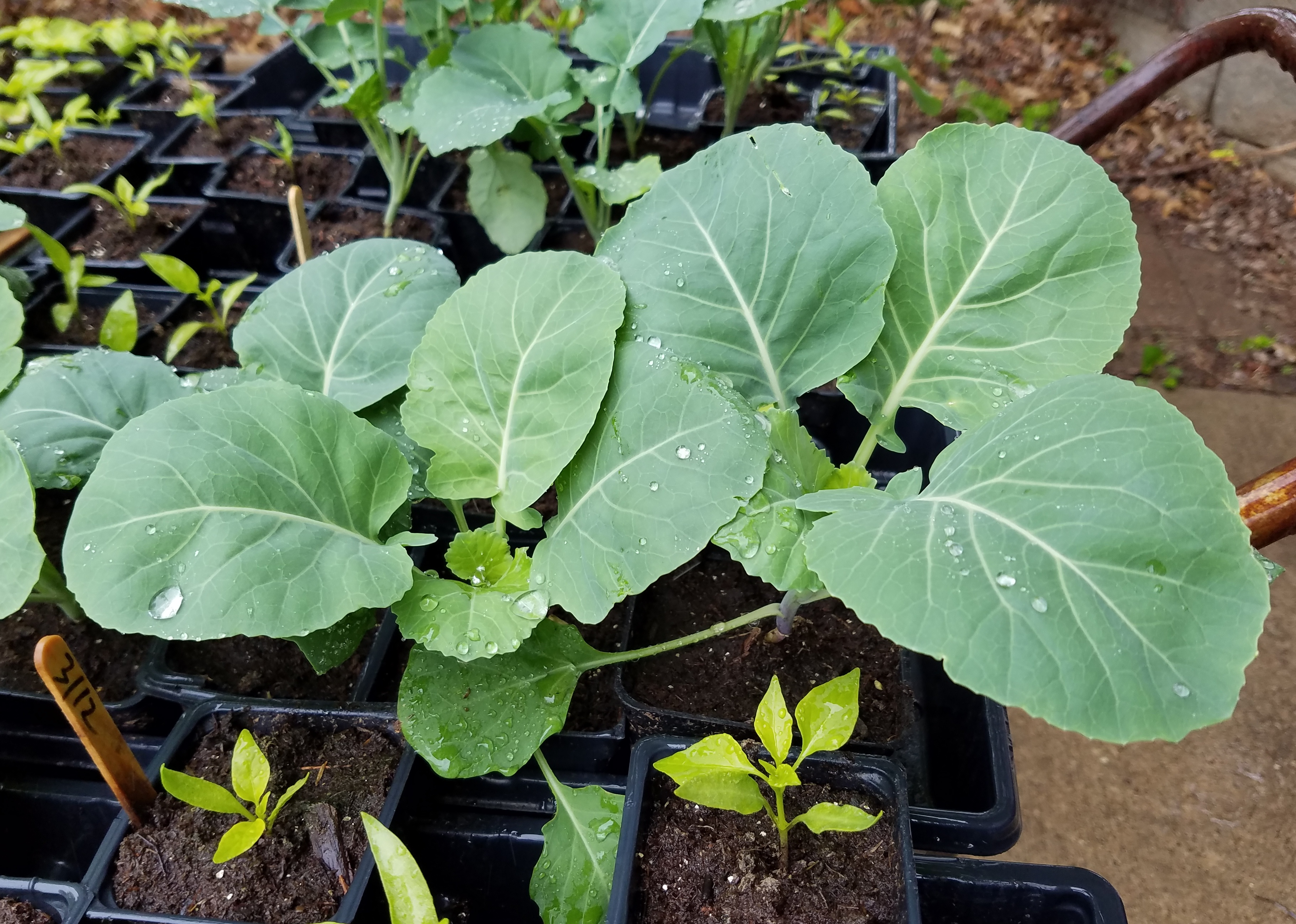
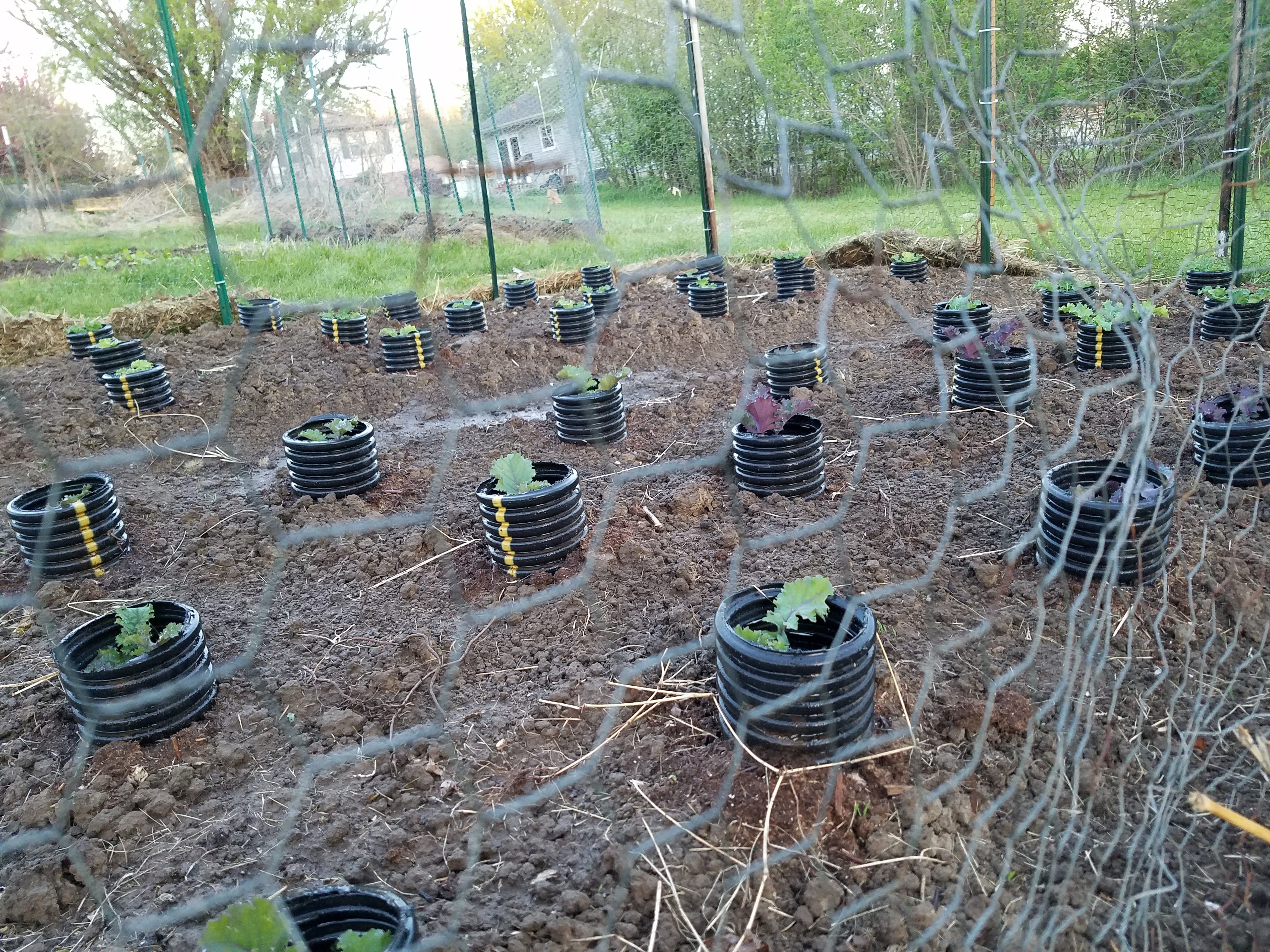
Collard Seedlings in the Rain
The unanswered question is how shall people outside the activist community be recruited to take climate action and by whom?
There are no good answers and no reason for climate activists to lead the effort. However, we can’t give up if we value society’s future.
The main issue is the increase in atmospheric greenhouse gases since the beginning of the Industrial Revolution. The good news is there are renewable sources of energy for transportation, manufacturing and electricity. How will society make climate change action ubiquitous with a majority of the world population?
Mass demonstrations can play a role in an effort to raise awareness about climate change. So can articles written by journalists, scientists, bloggers and organizations. At a minimum we can each strive to live with as light an environmental footprint as possible. We can explain to our friends, family and neighbors. Everyone has the potential to do something.
Today’s cool weather and gentle rain is a reminder.
“Staying out of the cold and warm inside? So are we,” Richard Fischer of Bernard wrote this afternoon via email. “Due to the weather we’re moving the event over to Convivium Urban Farmstead and Coffee shop, 2811 Jackson St., Dubuque.”
We must consider our lives in the built environment and let it rain. Have faith in today’s potential and adjust, knowing as long as rain comes and sustains our gardens and farms we too will be sustained.
There is much we can do when it rains. We can act on climate before it’s too late.
Pelicans left Lake Macbride this week. They were gone when I drove across Mehaffey Bridge Road on Monday.
Have they depleted the fish stocks and gone to better hunting grounds?
Did they detect something in nature that triggered migration?
I don’t know, but hope they will return in the fall.
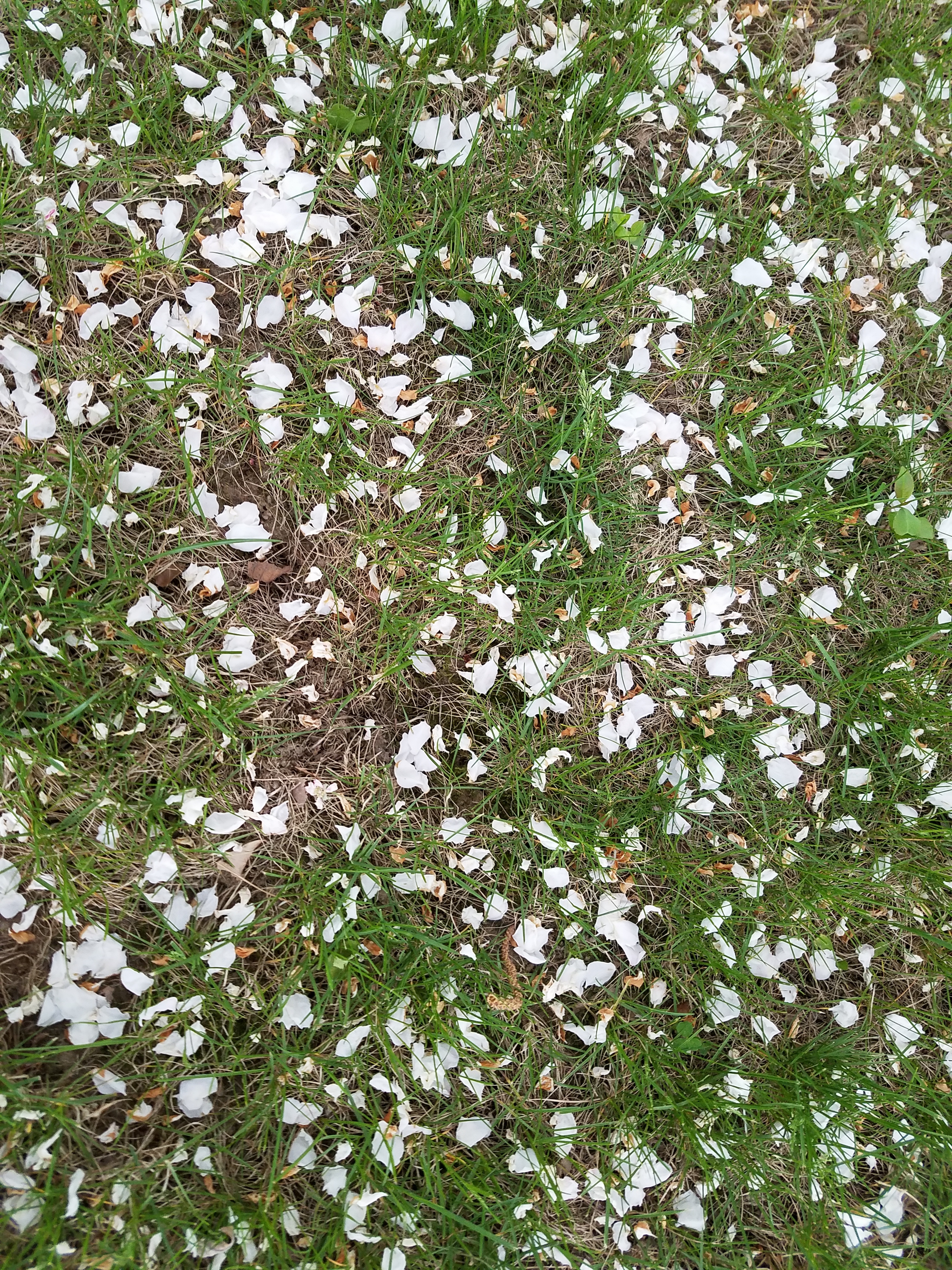
Pollination of fruit trees appeared to go well. Apple blossom petals are falling as fruit sets. We enjoyed the flowers for so brief a time. They served their purpose and are transformed by pollinators buzzing through the trees.
Rain began Wednesday and is expected to continue through the weekend. Tomato and lettuce seedlings remain at the greenhouse and the cart of seedlings at home is ready to plant if the ground dries out. I move the cart outside the garage in the morning and back inside as the sun sets. A transient ritual of gardeners who grow their own seedlings. Only a few more weeks and the cart will be re-purposed to other garden tasks.
A sense of transition is palpable as pelicans leave, blossoms are deflowered, and we take next steps on our walk through this season. We smell, touch and look at the wonder of life around us understanding it can’t be held — only lived.
The first session of the 87th Iowa General Assembly adjourned sine die on Saturday morning after pulling an all-nighter to wait for Republican leadership.
The decision was about improving Iowa water quality and reauthorizing use of medical marijuana. They did nothing positive on water quality and may as well have let the current medical marijuana law expire, saving everyone the trouble. However, harassment by Iowa Republicans has become de rigueur.
The best part of this year’s adjournment is legislators won’t be in Des Moines doing more damage to family and friends. The dark cloud hanging over the capitol is they are just getting started and the second session could be worse.
“The final straw came this week when lawmakers decided that if my daughters become pregnant the state can force them to continue the pregnancy and give birth,” she wrote. “It’s a decision that sickens me to my very core, and not just theoretically.”
“I will not encourage my daughters to return or stay here, and I will hasten plans for my own escape,” she concluded. “Thanks to the General Assembly, Iowa is no longer a safe place for women or families.”
I’ll make my stand in Iowa. Unlike Lynda, I was born here and have nowhere else to go without being a refugee. At the end of this legislative session, we’ve weathered the storm and are beaten but not down.
It is fitting the session ended on Earth Day.
Around the world people rallied to support a scientific method in solving problems. Except for the Dunning Kruger effect, I’d recommend state legislators pay attention.
Apple Tree in Bloom
As has become custom on Earth Day, I minimized my carbon footprint and spent time in our garden. The calm winds and abundance of pollinators made conditions nearly perfect for setting apple blossoms. Small white petals already had begun to fall, giving hope that the new apple crop will eclipse all of the bad news from Des Moines.
I gardened. Except for collards, all of the cold weather vegetables are planted. There is plenty of remaining space for crops to be planted after the last frost. I transplanted peppers into larger soil blocks to provide nutrients before going into the ground in a couple of weeks. I cleaned up four soil block trays to take back to the farm on Sunday.
I wasn’t alone. While Jacque was at work I did some neighboring and heard the sound of children playing, birds singing and bees buzzing. People took advantage of perfect spring weather to get outside. Social interaction enabled me to stop thinking about politics and I could focus on simple garden problems which were eminently solvable. It’s easy to see that the support for the pea plants was off center, exposing them to predators. Adjusting it took only a few minutes.
Corn-Rice Casserole, Peas and Pickles
Our garden and interaction with local food sources make the kitchen part of the garden. I made a simple supper of corn-rice casserole, steamed peas and a dish of home made pickles (onions, cucumbers and daikon radishes). Such meals go well in our household because they taste good with leftovers to be heated up for another meal.
As I entered the world of low wage work in 2013, I stepped back from most social commitments. It’s time to re-engage. This week I re-joined the home owners association board and was elected president. Comes a time for people to step forward and get involved in community. If we seek a better society, our work begins locally.
It’s part of what sustains us in a turbulent world.
Progressives, farmers and environmentalists heard there is movement in the Iowa legislature to fund water quality and ears perked up — a natural impulse to interpret new events as supporting something we already believe or are working on, also known as confirmation bias.
56 percent of Iowans support increasing the state sales tax three-eighths of a cent to pay for water quality projects and outdoor recreation, according to a Selzer and Company poll reported by the Des Moines Register on Feb 12.
On March 14, Rep. Bobby Kaufmann (R-Wilton) introduced such a bill: the WISE (Water, Infrastructure and Soil for our Economy) bill House File 597.
After a three year implementation the tax would generate $180 million to fund Iowa’s Natural Resources and Outdoor Recreation Trust Fund, which was created by a 2010 amendment to Iowa’s constitution. It sounds pretty good. However, we shouldn’t let our confirmation bias help Republican efforts to tax the poor, cut the general fund, and support the failed Nutrient Reduction Strategy.
Rep. Chip Baltimore (R-Boone) had previously introduced a water quality bill (HSB 135) addressing structural issues related to the use of water quality funds. Baltimore favored spending funds on watershed programs such as the governor’s Nutrient Reduction Strategy. Kaufmann’s bill mandates 60 percent of funding be directed to “a research-based water quality initiative (that) includes but not limited to a practice described in the Iowa nutrient reduction strategy.”
When Governor Branstad created the Nutrient Reduction Strategy, in response to a federal requirement to address water quality, it was the least he could do. It was a way of tinkering around the edges of a water quality program, leveraging wide-spread concern about the need to act without changing the underlying structure of the system that creates excessive nitrate and phosphate loads in our water.
Branstad’s approach sucked up media attention and political will while doing little to address the root cause of the water quality problem.
“I welcome any legislative effort regardless of party that looks to protect the environment,” a progressive voter posted on Facebook. “While I agree that it is not fair that we have to take on the burden of trying to clean up after the farmers, I also know that they are a stubborn lot that hold great political power in Iowa. Therefore we need to be pragmatic and take whatever we can get while the Republicans are in charge.”
A lot of people would agree with this sentiment.
It’s clear solutions proposed in the Nutrient Reduction Strategy could work. They won’t work until either the strategy is compulsory, or there is funding to support broad participation.
“Republicans sometimes get accused of not being pro-environment, of not being pro-water quality,” Kaufmann said. “Well, this is our way of taking that bull by the horns and putting forth a good, tax-neutral water quality bill that puts guarantees in it that we can make sure dollars go to water quality.”
Despite Kaufmann’s work on the bill there are issues with the WISE approach to water quality.
Sales tax is regressive, which means it would be applied uniformly to all situations, regardless of the payer. Some might argue that everyone uses water so why shouldn’t everyone pay through sales tax? It is a straw man argument. A sales tax takes a larger percentage of income from low-income earners than from people causing this problem.
What’s worse than the regressive nature of sales tax is the Republican position any new tax must be revenue neutral. That means cutting the general fund budget. Where will the legislature find an additional $180 million in budget cuts after a year with three successive revenue shortfalls?
“Kaufmann admits there (are) still some questions about how the bill would affect other state programs,” Rob Swoboda reported in Wallaces Farmer. “But, he says, the only way the Republican-led legislature will pass a water-quality funding plan would be if the plan is revenue-neutral.”
Proposed budget cuts should be defined before advocating for the WISE bill.
There is no need to hold the agricultural community harmless in the pursuit of clean water. In 2013, when developing the Iowa Fertilizer Plant (a.k.a. Orascom) in Wever, Governor Branstad said, “the plant would create 2,500 temporary construction jobs and 165 permanent jobs and save farmers $740 million annually by cutting the price of fertilizer.” Whether or not there was a windfall in fertilizer savings farmers can afford to put skin in the water quality game.
“Where public money is needed (to fund water quality initiatives), consider an obvious source: the sale of farm fertilizer,” former state senator David Osterberg wrote in a May 25, 2016 column in the Des Moines Register. “If an urban person buys fertilizer for the lawn, there is a sales tax on the purchase. Farmers are exempt from the normal sales tax on fertilizer and a lot of other things. There is no reason for this exemption. Put the sales tax on fertilizer, earmark it to water-quality strategies and you have, conservatively, about $130 million a year to work with.”
While a majority of voters agree something must be done to improve water quality, political capital to act shouldn’t be diverted to supporting failed Republican policies just because they sound good or appear to support what we all believe.
You must be logged in to post a comment.