It’s a crash landing after the apple harvest and a summer working almost every day at the orchard or the home, farm and auto supply store. Time to sleep, read and rest.
Four days off work is not enough to fully recuperate but it’s what I have.
Saturday was mostly at home resting, then cooking. Sunday was several long sleep sessions, reading and staying indoors. Today and tomorrow turn toward stuff I want to do and stuff I have to do, mostly the latter. There’s more on my list than will fit in the remaining 48 hours so it’s not really a vacation but more a time to do other kinds of work.
The most important things I do are related to full retirement. Specifically, submitting my application for Social Security benefits to begin after my birthday and changing our health insurance from my work to Medicare. I expect to spend much of today doing just that.
What matters more is figuring out how we want to live going forward. I am already up to my armpits in community organizing so there’s that for the time being.
Once our financial situation reveals itself after Social Security and Medicare, I want to change things around. I expect to slow down or quit at the home, farm and auto supply store next year to focus on writing, gardening and preparing our home for a long retirement. I expect to continue to work in the local food system — at the farms, and at the orchard — but the focus will be on our homelife. It’s been neglected for too long.
Needed work toward sustaining a life in our turbulent world.
Financial inequality is impacting society by making men protectors of what limited resources each family has.
I know few people who are increasing their wealth in the post-Reagan era. The rich get richer and the rest of us pay for it as dollars systematically, relentlessly find their way to the richest one percent of the population. Families struggle to get a share of societal wealth and if they do, feel privileged enough to say, “I’ve got mine.”
The struggle to provide for a family is getting harder with the transformation of American business to globalization, government efforts to eliminate regulations, and the current administration’s tampering with healthcare, defense, foreign policy, energy, education, immigration and more.
The impact of financial inequality on the role of men in society has been to make it more difficult for them to provide for their families. That said, I don’t know many families where a male is the sole provider. Women began moving to the paid work force in large numbers decades ago. The idea women wouldn’t seek paid work is a social legacy of male dominance. The male narrative lacks proper consideration for the value of work by women. That seems obvious in workplaces where women earn a fraction of a dollar men do for the same work, and also in homes where a male provides money and resources for the family and women work unpaid.
Men are challenged to be providers so their role shifted to being protectors of what they have. The rise in gun ownership in the United States is directly related to income inequality and the diminished role of men as providers. Let’s talk about that.
Some of my friends and acquaintances are women who carry handguns.
It’s no big deal. The banal and ubiquitous presence of guns is part of living in the United States.
I’m not worried about getting shot over lunch or at an event. I also don’t feel any more secure knowing she has a handgun in her purse. It used to be a bit jarring to see weapons unexpectedly in everyday places. Not any more. I’m confident in studies that show women are not the main problem with gun violence, it’s the men.
Data shows gun violence is disproportionately a male problem. Of the 91 mass shootings in which four or more victims died since 1982, only three were committed by women, according to a database from the liberal-leaning news outlet Mother Jones. Men also accounted for 86% of gun deaths in the United States, according to an analysis by the non-partisan non-profit Kaiser Family Foundation.
Men are more likely to own a gun — three times more, according to a 2017 survey from the Pew Research Center. This, despite marketing from gun manufacturers and groups such as the National Rifle Association to lure women.
Fast forward to Dastagir’s conclusion that to understand gun violence we must examine the cultural forces that equate being a man with violence. Read her information-packed article here.
What is it to be a man? It’s no secret having a Y chromosome is less important than the culture in which boys are nurtured to adulthood. There remains a significant, lingering perception that procreation is part of being a man even though wombs are more important than sperm. Only primitives continue to believe having a large family is a sign of manhood. At the same time male sexual dominance often trumps a woman’s right to choose. We read news daily about sexual predators, soldiers raping villagers, and widespread sexual harassment. Even so, something more powerful than traditional views about the role of men in procreation is at work.
After my first year in college (1971) I went home for the summer. I met with a number of male friends from high school and we each had been able to apply for work at manufacturing plants in the Quad Cities and find a summer job. Some literally went from business to business until they found a job and everyone who wanted one got one. It was easy. That changed.
The jobs environment has gotten very scrappy in Iowa and well-paid jobs with benefits are difficult to find and secure. Such jobs exist, however, the rise of professional human resources consultants has businesses seeking employees who meet very specific “profiles.” Don’t meet the profile or offer something unique to the position? Applicants will politely be sent on their way. If an applicant is lucky enough to be hired, human resource consultants have structured pay and benefits to meet the company’s minimum needs more than the needs of employees. Under the guise of taking inefficiencies out of business operations well-paid jobs with benefits are hard to get for almost anyone. It is worse with large companies who have the capitalization and scale to hire human resources consulting firms.
The transformation from manufacturing jobs to service jobs has not gone well from the standpoint of men seeking work. Retail, lawn care, janitorial, restaurant, banking, accounting, health care, sales, and other low-skill level employment performs necessary work in the economy. Such jobs are far from adequately compensated. Our education system increasingly fails to prepare students for jobs in a service economy. I’m not talking about adding a STEM curriculum in K-12 classrooms, but simple things like how to make a decision to start a business, work for a service company, or get a government job. Provider males are increasingly on their own when it comes to crafting a career, if that’s even possible in the 21st Century. Most I know get by, just barely.
In a society of income inequality, limited resources, women’s rights, and unsatisfactory job options, men get stymied in traditional roles of procreation and providing. They turn to protecting what they have, and that often includes buying guns. It is a predictable reaction in a society with a legacy of male dominance with no outlet.
A focus on resolving gun violence in the United States without considering the changing role of men in society isn’t going anywhere.
My mobile device lived in this locker for 3,960 hours since I began working at the home, farm and auto supply store.
Carrying our devices with us while at work is not allowed and that’s fine with me.
There is no need for a human to be constantly connected to social media, email and news, especially when engaged with people at a job site or other location in the real world. I don’t suffer from lack of connection.
What matters more is the security of my lunch until I eat it. Marauding teens and twenty-somethings have been known to pillage the shared ice box while hungry, eating anything found. The locker resolves that concern.
While I’m gone from work, the locker is home to a radio earpiece, ink pen, box cutter, name tag, padlock keys, tape measure, duster, hat, aspirin tablets and a few other work items. Those might disappear if the locker wasn’t locked.
It’s a flimsy locker and anyone who wanted to break into it easily could. Suffice it the padlock discourages people from looking inside. I’ve had no issues since I began working there about two years ago.
I won’t get the time spent at the home, farm and auto supply store back. I took the job to avoid taking loans for living expenses. I stayed because of the reasonably priced group health insurance plan. It fills the gap between failure to start a viable business after my transportation career and Social Security.
Time spent there is fit bookend to my part time high school job in retail. The company I work for now bought the building where I worked almost 50 years ago and opened a store. I hope to visit before long, before fading into the oblivion of an ultra local life writing, gardening and living from a perspective built on the shore of a man-made lake.
This week is the biannual vendor show at the home, farm and auto supply store. We’ll be short staffed today and tomorrow while associates from Iowa and Wisconsin travel to Dubuque to attend seminars and discuss products and process with our vendors.
If it’s like last year, my work queue will build up and I won’t dig out until Thanksgiving. The days will pass quickly and my aura may be colored in shades of grumpiness.
Coffee helps.
This weekend — Labor Day weekend — is the unofficial end of summer and I’m ready to glean most of the garden leaving only kale and peppers until first frost arrives in October. I secured seed garlic from one of the farms and will plant in September. The garden has been successful, the most successful in memory. It has been encouragement to plan for next year.
Saturday and Sunday I made a large pot of vegetable broth with items mostly from the ice box: kale, collards, chard, celery, three kinds of summer squash, carrots and onions. The resulting product was dark and rich.
I made rice with the broth, poured some in canning jars, and made a big batch of lentil-potato-barley soup for work lunches. I used eight or ten leeks in the soup which made it slightly sweet. Growing leeks creates a wonderful availability for the kitchen.
Last night I picked tomatoes, peppers, celery and leeks while the water bath canner came up to temperature on the stove. I ate a Red Delicious apple from the tree. It was slightly sweet and mostly starchy. It is time to begin monitoring the fruit’s progress. The pear tree is close to ripe and will be picked this week.
There is plenty of kitchen work ahead.
So begins another day in the final lap of a working life. I’m heading to the kitchen where I’ll make a second pot of coffee before work. The hot beverage doesn’t resolve our challenges. It makes them more tolerable.
Just as the election of Barack Obama encouraged me to leave a 25-year career in transportation and logistics, the presidency of Donald J. Trump is stirring winds of change.
Where they will take our small family is uncertain.
Each year presents its challenges and successes. We’ve been able to hold on financially — by the skin of our teeth. There is more to life than money.
Because of a decades-long plan I rely on Social Security and Medicare, to both of which I began contributing in 1968. Whether they will be there for us long-term is uncertain. We are too deeply invested to back out now. We can’t let an unknown future stymie hope and aspirations.
The cycle of our lives is around work, gardening and health. Take paid work out of the picture and there should be an opening to do something different next year.
In 2009, when I retired from transportation and logistics, I took a path of civic engagement. I joined organizations and spent time working with people in society. The next retirement — beginning in spring — is expected to be one of reading and writing much more than I am able to do in hours stolen from days of hard work. There must be some form of civic engagement, but this time I expect it to be much closer to home.
Regardless of outcome, I’m repairing my mast, mending my sails, and ready to put the winds of the national culture to work at home.
Today begins a long stretch of work shifts on weekdays at the home, farm and auto supply store, and on weekends at the apple orchard — 96 days in a row.
I’m not ready but both jobs help pay bills. Work I have been doing on weekends will get shoved to weeknights and early morning. I’ve been here before. There’s nothing else to do but let go and fall into the rush.
The garden is doing reasonably well and my barter agreement will make work canning tomatoes and freezing bell peppers. Last year it was impossible to keep up with the garden and I lost more tomatoes than we harvested. With sunrise getting later, I’m also losing some of my early morning time outdoors. I’m not complaining. Just figuring out the best way to cope. The expectation is this year will be better than last.
At the end of the rush comes winter and a window for retirement. I reach full retirement age in December and my spouse reaches Medicare age in January. If we successfully negotiate these milestones, signing up for Medicare and Social Security, a financial burden will be lifted and we will be able to breathe easier for a while.
For now, it’s a rush toward familiar butunkown times. Hopefully there will be some fun and accomplishment along the way. Here we go!
The campaign to survive after a transportation career turned the bend and is heading into the home stretch.
Economic realities we face as a family continue to exist, but the effort to cope — including 12 lowly paid jobs since 2012 — will find some relief as I reach full retirement age in December and with it eligibility for Social Security benefits.
Independence Day marked the halfway point of the year and I can see the finish line from here.
What does that mean for the future? Less time worrying about how to cover each month’s bills accompanied by more and better writing.
Later this month I return to daily writing for a couple of weeks. I’ll be covering Blog for Iowa weekdays from July 17 to 28. I’ve got something different to say about politics so stay tuned.
I assumed it was the long day, split between two farms, getting tired after making 57 trays of soil blocks.
As I placed the last tray of 72 blocks on the table for cucumber seeding, I washed my tools and headed for the car. Something was up.
It took three days to winkle it out: I caught some kind of bug that kept me from working at the home, farm and auto supply store.
On Monday morning I was dizzy and nauseous. I brushed my teeth, shaved, showered and dressed, then headed to the car for the drive across Mehaffey Bridge. Just after I crossed the south arm of Lake Macbride I stopped, too nauseous to continue. I called off sick and turned around. Near the old barn north of the lake I stopped again and vomited twice. I spent most of the rest of the day sleeping. I did pick up our vegetable share at the farm — probably not my best decision.
Determined not to take a second of my five annual sick days today, I woke, got dressed and tried it again. I made it to the parking lot, went in and found my supervisor. After preliminary pleasantries told him I felt too sick to work and went home and back to bed.
In all I clocked 25 hours of sleep in a 36 hour period. As the sun moves lower in the western sky I’m on the mend. I don’t recall much about the last 48 hours.
I woke this morning about 9 a.m. just when Governor Terry Branstad’s hearing at the Senate Foreign Relations Committee was beginning. Branstad is President Trump’s nominee to become ambassador to China. The Des Moines Register live-streamed it, so I watched on my phone in bed. He looks to be a shoe-in because of his service as governor of Iowa and his long relationship (since 1985) with Chinese President Xi Jinping. I posted on Twitter, “Branstad seemed present, cognizant, schooled and mannered at his hearing today. Much different from person who nominated him.” It was a sign I was feeling better.
This week is the anniversary of President Nixon’s 1970 invasion of Cambodia and the protests that erupted around the country. At Kent State four students were killed by national guardsmen during the protests. My reaction to the news was to participate in my first-ever protest march. I carried one corner of one of four mocked up coffins to the National Guard Armory on Brady Street in Davenport. I felt participation would raise awareness about the war. When our photo appeared in the local newspaper, it confirmed my belief.
This week’s hope is that the ground will dry. The farming community is waiting for the ground to dry to begin planting. After a Rip Van Winkle style nap, what I winkle out is the need to focus on today because we never know what tomorrow will bring or what may disable us.
In several ways, 2017 will be my final season as a working person.
That’s not to say I won’t continue to work hard in life. According to the Social Security Administration I have a lot of life to live —19.2 years on average. Longevity’s secret is no secret: as long as life holds, engage in it and don’t stop until the final curtain.
By year’s end, my spouse and I will be in a position to slow down and work on projects better aligned with our interests. We won’t be rich, but that was never a goal.
A constant theme is embedded in the thousands of posts I’ve made over the last ten years: Radix malorum est Cupiditas, money (or greed) is the root of all evil. We managed cash flow well during our lives together with almost never a bounced check. Yet currency has been little more than sunlight, reasonably available if one is willing to join in society. Its value is as part of photosynthesis in the botany of our lives.
On the final workingman’s lap some things are clear.
My work at the home, farm and auto supply store is needed to provide health insurance until we both are on Medicare. Health insurance has been the biggest and most unpredictable expense since leaving my transportation career in 2009. I compare my experience to co-workers from Mexico. When they need significant healthcare, they travel home to take advantage of Mexico’s free clinics. In the United States health insurance is pay to play. Premiums contribute to many jobs: physicians, nurses and lab technicians, of course. But also to corporate entities with their executives, sales representatives, manufacturing staff, actuarial workers and legal counsel. By my calculation, monthly premiums for an individual health insurance policy are roughly ten percent higher than Medicare’s cost of service. My lowly paid work will continue at least one more year.
I hope this year’s growing season will produce in abundance. If last year created one of the best gardens ever, I plan to make this one even better. What I don’t or can’t grow will be acquired from two barter arrangements with Community Supported Agriculture projects. If my execution of garden work isn’t flawless, decades of experience should serve us well. Knowing what to do and when makes a big difference.
Our logistics system needs attention. Downsizing possessions, maintaining the house and its mechanical systems, and ensuring cost-effective transportation enter into this year’s plans. Because of the low cost of storage (i.e. loss of usable space), and the value of having built a new house needing few repairs, these tasks have been delayed.
Writing will continue to be important next year, both here and on social media. Writing has been a way to work through problems and relieve stress. When I write a fixed piece — a guest column for a newspaper — I write with confidence. When I start with a blank Microsoft Word document, ideas rise from a deep well of experience. As I mature as a short-form writer, increasing readership will be important.
I feel a sense of limited opportunity as the final months before great change come into focus. There are only so many days to get things done. The feeling is encouragement to make the most of my time. A sense of hope pervades everything and for that I am thankful.
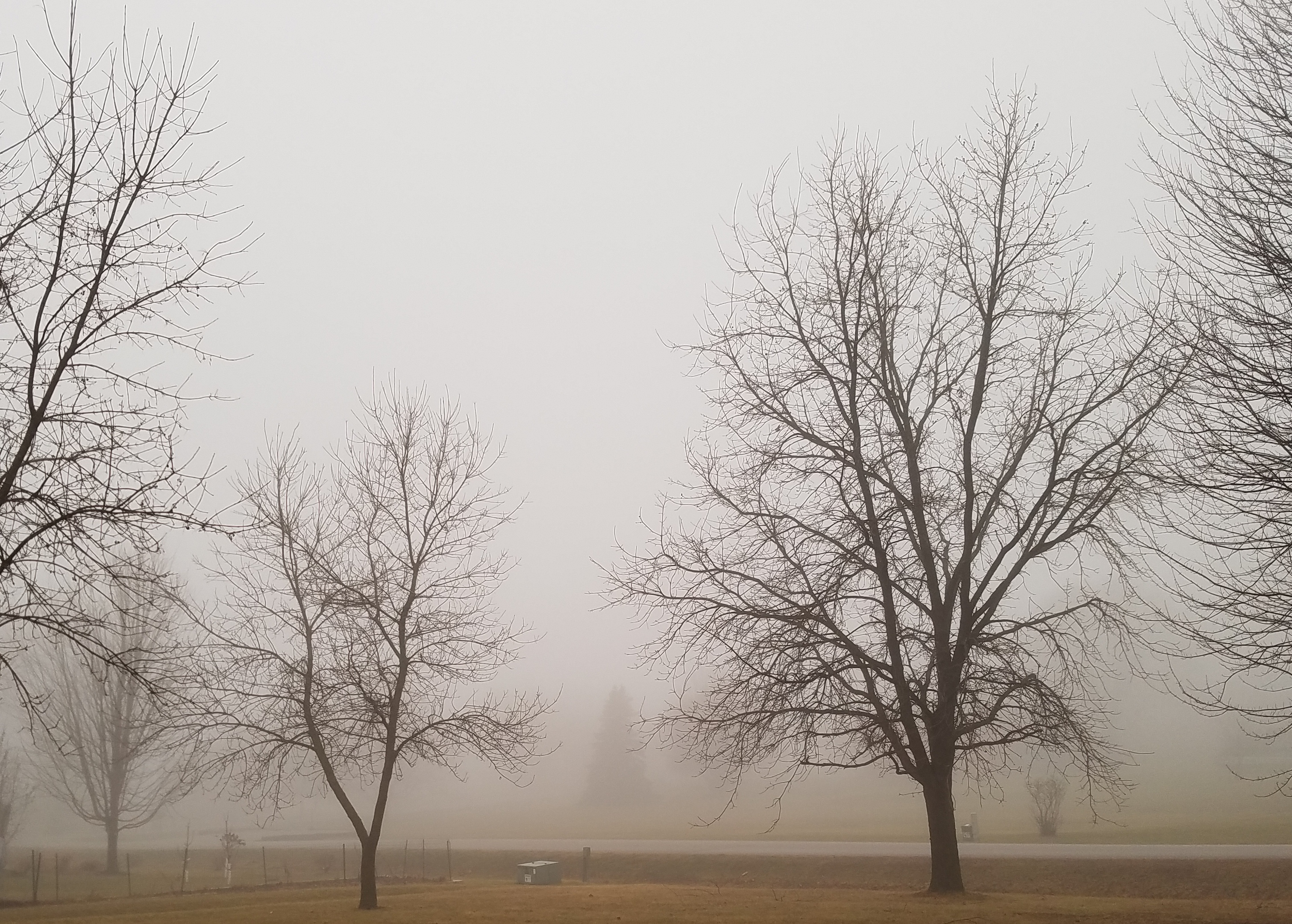
Last Saturday began with a car trip through fog to visit Mother.
Rising from the Cedar River Valley at reduced speed, when I hit Walcott the sun came out.
It was clear this morning. Geese honked overhead, flying to open water where they landed.
The weather is warm and weird. It’s human nature to leverage what we have, so I’ll be working outside part of today and tomorrow.
A week into the new administration things are a bit foggy. Either 45 and his team don’t know what they are doing, or they are doing it so well no one can keep up with him. (It’s the former).
Good news is the sun will eventually burn off the clouds coming from Washington, D.C. enabling us to establish how we best mitigate the damage done by the billionaire in the White House and his associates.
45’s focus will be on jobs because that’s what got people to set aside what they abhorred and vote for him. Jobs was the main topic of his first weekly address.
On Friday the White House announced a manufacturing jobs initiative that includes many companies who took advantage of the Ronald Reagan years to restructure, reduce costs, and outsource jobs in a way that created what 45 described as “American carnage.” He feebly tried to pin the loss of manufacturing jobs on President Obama, whose financial recovery after the 2008 recession has been competent, but not stellar. For those of us who’ve worked for or with some of these companies, it’s a joke to think they have well-paying American jobs at heart when they are the co-creators of the decimation to which 45 referred.
The list includes U.S. Steel and Nucor Steel. The latter benefited from the high costs of the former and took market share with technology that replaced workers. I’ve been to the former U.S. Steel Works in Fairless Hills, Penn., Cleveland, Ohio, and Chicago, Ill. I’ve also been to Nucor plants in Tennessee. It is as if these two companies were predators whose sole purpose was to wreak havoc on union steel jobs. Notably missing from the list are the international steel companies ArcelorMittal, Nippon Steel & Sumitomo Metal Corporation, Hebei Iron and Steel Group, and others that each in its own way contributed to the downfall of U.S. steel companies. ArcelorMittal is the poster child for globalization and its impact on workers. In terms of the initiative’s potential effectiveness, it’s notable that Lakshmi Mittal is absent from the list.
General Electric, Whirlpool and others were participants in the great post-Reagan restructuring of the American workforce. All of the companies on the list, with the exception of two token AFL-CIO representatives, are very large companies. What I expect is corporate leaders will reach consensus about what they need, present it to 45, who will work with the Congress to improve the environment for manufacturing within our borders. Ideas related to reducing environmental regulations, the government picking up cleanup costs, tort reform and removing what little power remains in the private sector unions will be de rigueur.
Job creation is the Achilles heel for 45 because so much of his victory was based on the promise of increased American jobs — manufacturing jobs particularly. It seems doubtful he can pull it off in a sustainable way.
This is one area of the new administration we should follow closely.






 Journey Home
You must be logged in to post a comment.