Categories
Living in Society Social Commentary Writing

Brief Respite and T.V. Culture

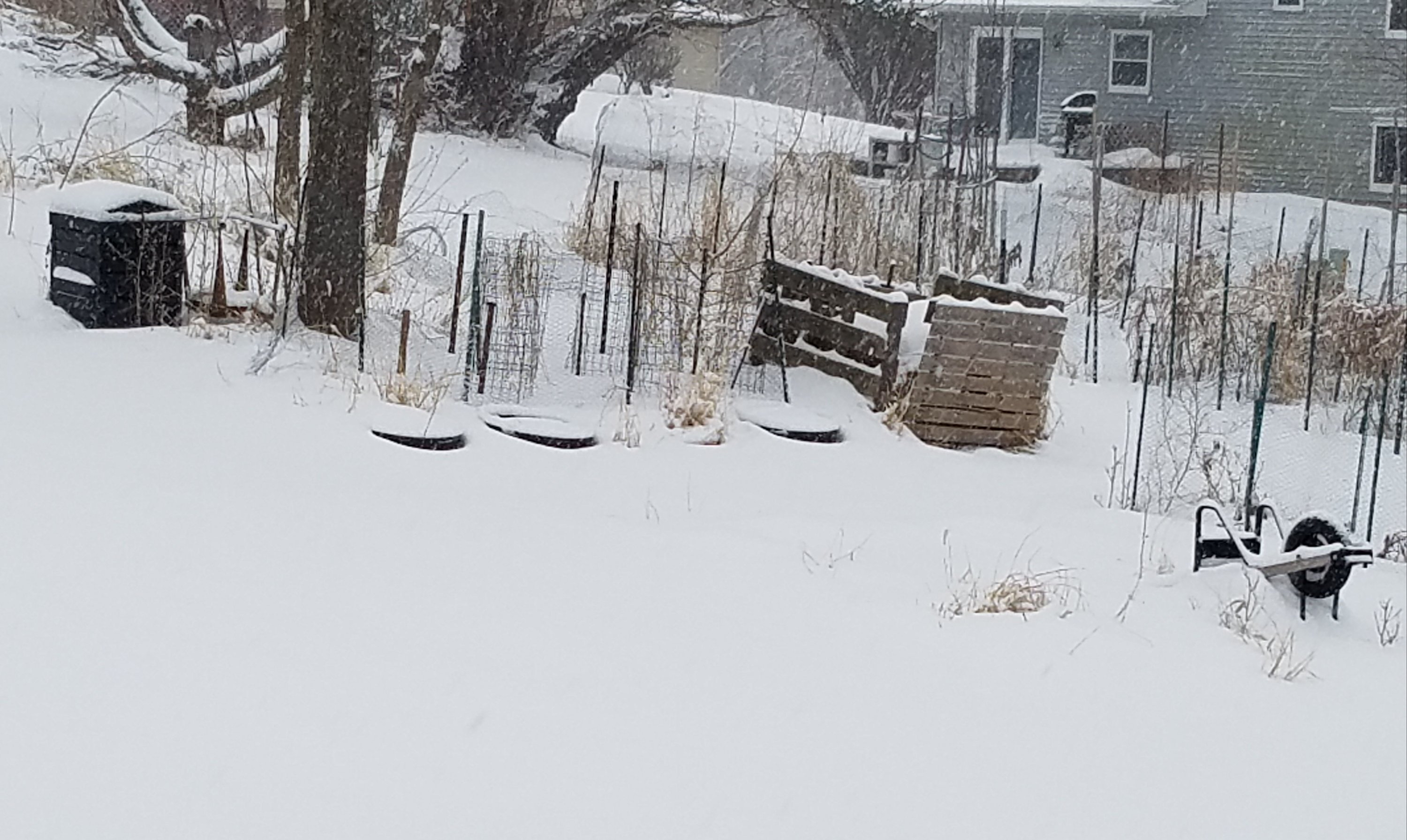
Snowy Sunday in the Garden

The farmer sent a long text message. We delayed soil blocking because the forecast is cold overnight temperatures for the next week. The seedlings we might have planted would be at risk.

Lambing at the farm added a complication. Her sister posted a photo of a blanketed newborn near the furnace vent inside the house. If you didn’t know, farmers continue to bring livestock inside the house when needed and lambing is always a stressful time.

My Sunday schedule is now open and it is snowing.

Between two and three inches fell with more coming. I had planned to secure provisions in the county seat, but now I’m not sure. Even if I go, errands can wait until snow stops and roads are cleared in a few hours.

For breakfast I made an omelette using leftover taco filling. Except for the prep work it takes 20-30 seconds to cook an omelette. It’s so easy anyone can do it. On my first cup of hot cocoa, showered, shaved and nourished, I’m ready to turn to another day.

Unintentionally, I spend an early morning hour watching a 2003 documentary titled, Inside the Marx Brothers. The white-washed story recounted historical facts about the six brothers, leaving out the racism inherent in much of their work. I was a fan of the Marx Brothers before I left home to attend university. It wasn’t until later I realized the prejudices toward blacks and women contained in their films. I have VHS copies of most of their films, beginning with Cocoanuts and Animal Crackers, written by George S. Kaufmann and Morrie Ryskind. These were adaptations of the Marx Brothers successful Broadway shows with the same name. I can hardly stand to view them today. Like many of the acts that emerged from vaudeville, neither the actors nor the audiences were cognizant of their biases the way we can be today.

Marx Brothers films aired on television Sunday mornings in the 1960s. We watched the newspaper guide to see when the next one would air and looked forward to them. It was during that ten-year period from 1960 until 1970 that we became a T.V. family, with everything that meant at the time. On the playground before school my friends and I would play marbles or four square and discuss what was on television the previous night. It was formative in a way that moved us from the physicality of neighborhood play to an intellectual approach to abstractions in the world. It made part of who I am.

We didn’t think much about network commentary on current events. The Huntley-Brinkley Report was our daily source of news and we tried not to miss it. Fifteen minutes seemed an adequate amount of time to present the news. Our focus at home was more on the style of the co-anchors and the closure we found in their signature sign off each night, “Good night, Chet. Good night, David. And good night, for NBC News.” The report expanded to thirty minutes on Sept. 9, 1963, following the CBS Evening News with Walter Cronkite which did it first. At the time we didn’t understand how they were going to fill an extra fifteen minutes.

A couple hours after sunrise and snowfall stopped. Time to chart the rest of the day while cultural memories of the Marx Brothers, Walter Cronkite, and the Huntley-Brinkley Report circulate in the tribal background. Considering the role television played in the 1960s, I wonder why we abandoned it, almost never turning a T.V. on, except to watch the weather during a storm.

Food for thought while I dig out a lane to get to the county seat and complete errands.

Categories
Work Life

Cold For Now

Winter Travel

A colleague at the home, farm and auto supply store is itching to get on the road.

Last year he drove for a local asphalt company making pretty good dough. When the seasonal job wound down he returned to retail.

“I can’t do this for ten years,” he said, referring to both his age and the retail work he had undertaken.

He asked my advice about working for a large truckload common carrier driving over the road. I told him it’s a hard life.

Because of his type of driving experience, the firm to which he had applied required he attend a company-approved truck driving school for two weeks. It’s been 20 years since I recruited men and women for that type of school to work program but I provided advice nonetheless.

There will be an agreement. Make sure to read it before signing, I said. During my tenure in driver recruiting, attending a company driving school before employment was not free. Typically the written contract is for a period of employment, up to a year, after which liability to repay the schooling was forgiven. If one quits, for any reason before the term is up, the former employee would be responsible to repay the entire amount. Back in my day it was $5,000 although that likely changed since then. Creditors will dog debtors relentlessly, so the agreement is not to be taken lightly.

Second, do you really want to be gone from home for three weeks at a time? Driving is tedious, sedentary work for van drivers with hours to think about things. There is more physicality in being a flatbed driver, with tarping, chaining and strapping loads, but at a certain age who wants that? Time off changes forever for over the road truck drivers. That’s its nature and it is uncompromising. Most good drivers have a compliant social style, so being assertive doesn’t come naturally, especially with their dispatcher. They sometimes fail to realize that in addition to doing a good job as a driver, one has to be assertive to get time off. I don’t know what my work buddy will decide but I wish him well.

During winter we’re all itching to do something. A few weeks of isolation during bitter cold spells is welcome. There comes a point when we’re ready to do something else, something less confining. It’s cold for now but the economy of spring has already begun to ramp up with garden seeds and fertilizer finding their way to retail outlets. There is a yearning to break loose the limits of four walls and reach for our potential. It begins mid-winter and makes us restless. Making good decisions rolls up into the wintry mix of unrealized ambitions and present challenges. Friends make it easier to sustain our lives in this turbulent weather.

Categories
Work Life Writing

Digging Out, Getting to Work

Home Made Hot Cocoa

After four hours digging snow in the driveway wind came up and I shut down the operation.

Mid-dig I made a cup of hot cocoa and took a break.

I made it to the road, gaining access for when I leave for a shift at the home, farm and auto supply store in a couple of hours.

The retail store is doing inventory. I expect a day of counting and recounting items with discrepancies between what was found by the scanners and what our computer system shows on hand. The recounting work will take several days.

I texted the farm where I’m scheduled to soil block on Sunday, saying the weather forecast looked dire and asking whether work would continue. The hydrant in the germination shed is usually frozen at this point so we would move soil blocking to the sheep barn where there is running water. It was uncertain she could keep the temperature in the germination shed warm enough to prevent the blocks from freezing at night. She’s researching cold and germination and will make a decision about pushing the schedule back a week by Saturday. The farm published the spring share schedule so the clock is ticking on these starts. The other farm where I work is scheduled to start soil blocking on Feb. 26.

We are having a real winter this year. A winter featuring wild variations in temperature. Variations that make weird noises in the house.

For now, with snow covering the garden, there is little else to do besides work indoors. We draw from the pantry, freezer and ice box for meal ingredients to use food as it nears the end of its storage life. We have a couple pounds of potatoes, a couple of apples, and vast amounts of onions, noodles, canned tomatoes, apple sauce, apple butter, pickles, sauerkraut, and dry goods. We aren’t wealthy but we won’t starve for a couple of months.

This year will be one of transitioning to full retirement. We have our financial structure in place and are gliding into the end of a worklife in society. In many ways, this is what I’d hoped for back in the day of the Whole Earth Catalogue and arguing with conventional farmers in undergraduate school about the efficacy of organic growing. While not in a hurry to complete the transition, we make changes with purpose. Each day taking us closer to what’s next with hope for a brighter future.

I believe we’ll make it.

Categories
Living in Society

Hot Chocolate on a Snowy Afternoon

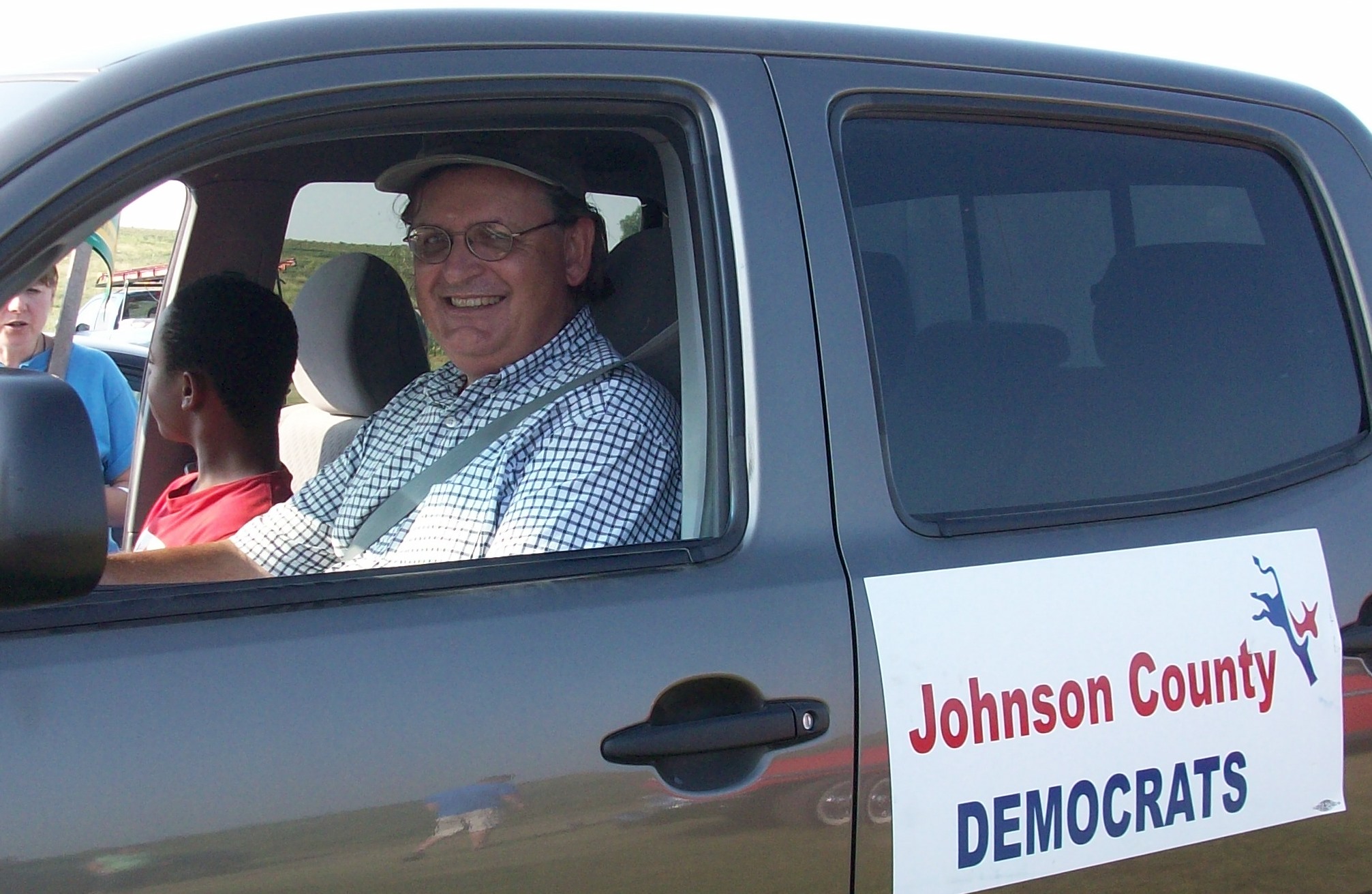
The author driving a parade vehicle in Morse, Iowa.

Four and a half inches of snow rests on the driveway waiting to be removed.

I like snow and don’t mind shoveling. I’ve gotten better at it since beginning work at the home, farm and auto supply store — a moderately physical job.

While fluffy snowflakes fell yesterday afternoon I made a batch of hot chocolate mix using ingredients from the pantry, enough to last until spring. I had to grind the granules of powdered milk in the blender because they would not dissolve as they were.

The warm, steamy drink is comforting and the best option after fresh apple cider from the orchard was used up.

Local political news was dominated by the Iowa Democratic Party’s release of proposed changes to the 2020 Iowa precinct caucuses.

“The Iowa Democratic Party has always sought ways to improve our caucus process, and today, we are setting the stage for the 2020 Iowa caucuses to be the most accessible, transparent, and successful caucuses in our party’s history,” Iowa Democratic Party Chair Troy Price said in a press release. “Starting almost immediately after the 2016 cycle, this party took a holistic look at how we can make the Iowa caucuses more accessible and transparent. These proposals are the result of thousands of hours of conversation and years of hard work.”

I read the 65-page proposal, which is open to public comments for the next 30 days, and believe it is what Price said, a move to make participation more accessible and transparent. I also believe the Democratic National Committee forced Iowa to take these kinds of steps to remain first in the nation. Let’s face it, getting any group together for a meeting at a specific time in February is a challenge. By adding what are called “virtual caucuses,” the proposal provides a method for people to participate if they are unavailable to venture into a cold February night to hang with other residents of a precinct for an hour or so. I’m all for it.

The Iowa national delegate selection process seems arcane to those in the media who follow the presidential horse race and report on it. They build up to the caucus and need to report a “winner.” When viewed in terms of winners and losers it is hard to say what winning delegates in Iowa means to a Democratic presidential candidate. The first month of the primary and caucus calendar has the early states, Iowa, New Hampshire, Nevada and South Carolina, about a week apart. They will be followed by Super Tuesday during which nine states hold presidential votes, including Texas and California. What traction candidates may get out of Iowa is dampened by the close proximity of these other contests. To make sense of the horse race, all 13 early states should be viewed through the same frame.

It is hard to say if the caucuses are important. Political scientist David Redlawsk asserts the Iowa caucuses remain important and wrote a book about why. Last night on Twitter Redlawsk posted, “Caucuses are about party building & organization as well as voting.” For those of us who have been trampled by a mass caucus exodus immediately following precinct delegate selection, the merits of Redlawsk’s assertion about “party building” are dubious at best and border the ridiculous.

In our precinct we’ve mostly struggled to fill our committee assignments to the county party convention with caucus-goers who will show up. We have even nominated people not present to fill the two county party central committee seats rather than let one go empty. This is the main organizing that goes on at the Iowa caucuses. With the notable exception of 2008, participation is mostly by people who have been very active in party politics.

The pre-caucus publicity and outreach of campaigns helps activate voters. In an electorate where more voters register no preference instead of for one of two major parties, it serves the general election more than any political party. I’m sure discussions about what happened at caucus circulate among dinner tables and community social events where the mix of party affiliations is diverse. That’s something. It is hardly being organized.

We’ll see how the 30-day comment period on the new process goes. I’m guessing there will be tweaks rather than major changes by the time it is finished.

My beef about politics is everyone wants to be a strategist and few will be tacticians. For most of my adult life I’ve been more interested in tactics than strategy, so I find the attitude annoying. A first distinction among strategists usually has to do with sorting. Is one a party insider or a rank and file Democrat? Are you a hardcore activist or one of the normal people? I don’t accept such sorting and believe we Democrats are all rank and file. Or, as Walt Whitman wrote in Song of Myself, “For every atom belonging to me as good belongs to you.”

Now that Iowa Democrats developed a reasonable plan to make the Iowa caucuses more inclusive and transparent, the next step is working to flip my precinct and our state from Trump to Democratic in the general election. I don’t subscribe to a paternalistic notion that our Democratic presidential selection process beginning with the caucuses is rigged by the party. Just read the plan and explain how it favors someone. It doesn’t. Let Democrats nominate who they will and chips fall where they may. We should all be working for the eventual nominee whoever it is, beginning now.

Categories
Living in Society

Zach Wahls Solon Listening Post

Snow Tracks

SOLON, Iowa — Snow began to fall about 10 a.m., an hour before the scheduled legislative listening post with our State Senator Zach Wahls. By the time I got to the community center, about three inches of fluff was on the ground. We live in Iowa. We began on time.

It was a small gathering, affording everyone who wanted to ask questions or discuss issues adequate time. On points where there was disagreement — resolving opioid addiction and boat motor size on Lake Macbride — the topics advanced in a civil and straightforward manner. Credit to the senator for the way he moderated those conversations.

The mix of party affiliation of locals appeared to be half Republican and half Democratic. Of the people I knew, there was a retired firefighter, a chiropractor and the school board president. As is usually the case, several people from outside the district attended with their own agenda. By now, we’re used to that. The Center for Rural Affairs was a co-host of the event and had a display with literature available.

My question was about discussion of female genital mutilation in the legislature and news media. Senator Wahls said he hadn’t read a bill on the subject, and that no one he knew was in favor of the procedure. After the listening post I found both the Senate and House have versions of a bill making it a felony to perform genital mutilation or transport a minor out of state for the procedure. (Bill numbers are HF63, HF299, HSB115 and SF212).

Cedar Rapids Gazette columnist Lynda Waddington, who won an award on Friday for her editorial writing, laid out expectations for the legislature in a recent column:

  • Send a strong message that female genital mutilation will not be tolerated.
  • Give prosecutors the tools and resources to bring perpetrators to justice.
  • Signal to state prosecutors that this practice is a crime that must be prosecuted.
  • Provide education and outreach to at-risk communities and professionals likely to encounter girls at risk.
  • Include measures to specifically prevent girls being trafficked across state lines for such procedures.

“A federal judge said it is up to the states whether or not girls undergo female genital mutilation,” Waddington wrote. “Iowa lawmakers must make a statewide ban on this unnecessary and heinous practice their first priority.”

That’s why I felt it necessary to raise it with Wahls. The issue was known last session but a bill did not advance out of committee. Read Lynda’s article at the link for more background about why Iowa is even talking about female genital mutilation.

We covered a lot of topics in an hour. It was time well spent.

Tim Brown, president of the Solon School board, attended. Brown is an engaging conversationalist with a wealth of knowledge about what’s going on in the community. He was interested in the legislature’s plans regarding school funding. Wahls recapped the bills on which he expects to vote, maybe as soon as next week. There is plenty of ink out there with details, including James Q. Lynch’s Cedar Rapids Gazette story from this morning’s newspaper.

After the formal part of the meeting, a group of us discussed a variety of topics, including the fact that the school board election will be combined with other elections in November. Two seats are up. Since our school district straddles counties, there will be an additional election cost to the board for about 20 homes in the Solon Community School District located in Linn County. Johnson County Auditor Travis Weipert has not released detailed election plans according to Brown.

Even though the turnout was light, it was good to circle up with Senator Wahls on a snowy day in Solon before the first funnel.

Categories
Environment Living in Society

Freezing Rain and a Green New Deal

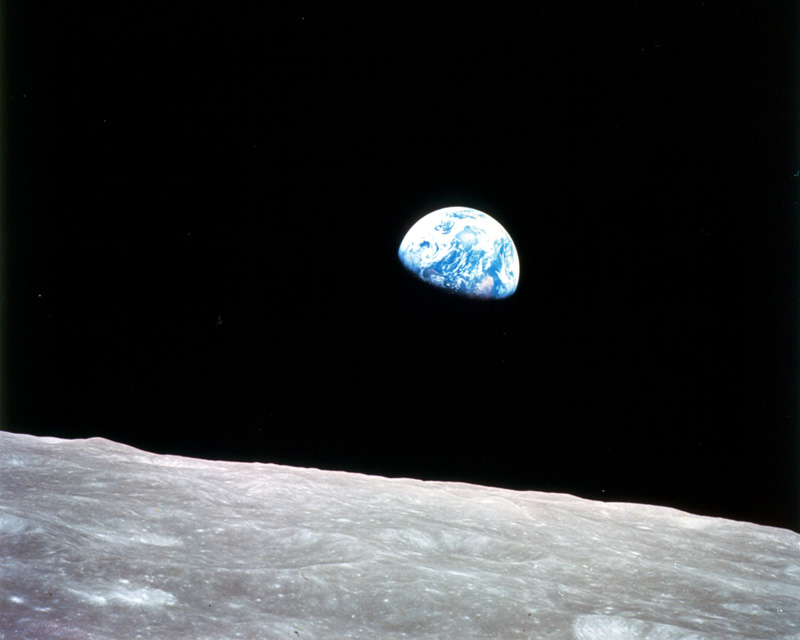
Earthrise by Bill Anders, Dec. 24, 1968

Ice turned to mush as rain fell Thursday morning. The surfaces of Lake Macbride and the Coralville Lake appeared to remain frozen as I drove on Mehaffey Bridge Road.

When I arrived at the home, farm and auto supply store it continued to rain. By the end of my shift a layer of ice had formed on my windshield and morning slush had frozen.

I started the engine and chipped at the ice. It took half an hour to gain enough visibility to drive. I decided to skip a monthly political meeting, emailed the secretary of my absence, and headed home.

Iowa is a red state now. Voters had an opportunity to return balance to state government in 2018. Instead they chose Republican control of the governor’s office and state legislature. Taking advantage of their mandate, Republicans plan to take more control of the appointment of judges by changing the composition of a commission that selects nominees for Iowa courts. We’re a red state now, and we don’t like it.

We’re not leaving the state. To even consider it would be an anomaly in lives we’ve come to accept. In the end, politics is something, but not everything. It is definitely not important enough to get stuck in the county seat as the world freezes.

I’m interested in what the Congress does to mitigate the impacts of climate change. Yesterday New York Congresswoman Alexandria Ocasio-Cortez introduced a resolution recognizing the federal government has a duty to create a Green New Deal. A draft of the resolution indicates the following goals for a Green New Deal during a ten-year national mobilization period:

  1. to achieve net-zero greenhouse gas emissions through a fair and just transition for all communities and workers;
  2. to create millions of good, high-wage jobs and ensure prosperity and economic security for all people of the United States;
  3. to invest in the infrastructure and industry of the United States to sustainably meet the challenges of the 21st century;
  4. to secure for all people of the United States for generations to come—
    (i) clean air and water;
    (ii) climate and community resiliency;
    (iii) healthy food;
    (iv) access to nature; and
    (v) a sustainable environment; and
  5. to promote justice and equity by stopping current, preventing future, and repairing historic oppression of indigenous communities, communities of color, migrant communities, deindustrialized communities, depopulated rural communities, the poor, low-income workers, women, the elderly, the unhoused, people with disabilities, and youth (referred to in this resolution as ‘‘frontline and vulnerable communities’’).

Who wouldn’t like these goals? Senator Edward Markey introduced the same resolution in the U.S. Senate.

It doesn’t take an advanced degree to understand a Green New Deal is dead on arrival in Mitch McConnell’s senate. While such goals need to be met to slow global warming, politics has ceased to be an endeavor of doing what needs to be done to ensure our mutual survival. Success of any legislation designed to advance a Green New Deal depends on recognizing the threat the climate crisis poses to society. Today, more people recognize there is a climate crisis. Our politicians, not so much.

Al Gore remained positive in his press release supporting the resolution:

The Green New Deal resolution marks the beginning of a crucial dialogue on climate legislation in the U.S. Mother Nature has awakened so many Americans to the urgent threat of the climate crisis, and this proposal responds to the growing concern and demand for action. The goals are ambitious and comprehensive – now the work begins to decide the best ways to achieve them, with specific policy solutions tied to timelines. It is critical that this process unfolds in close dialogue with the frontline communities that bear the disproportionate impacts today, as this resolution acknowledges. Policymakers and Presidential candidates would be wise to embrace a Green New Deal and commit to the hard work of seeing it through.

Failure to act on climate is the same as denial. I’ll support a Green New Deal while recognizing we can’t place all our hopes on a single, political solution. As we discovered during negotiations leading up to the Paris Agreement under the United Nations Framework Convention on Climate Change, political solutions are far from perfect. They may be inadequate. Yet they are something and have value if they can be achieved.

Categories
Living in Society

One Year from Presidential Delegate Selection

Iowa Caucus Goer

One of the first things we did after moving to Lake County, Indiana was register to vote. Being a Democrat, I voted for Michael Dukakis in 1988, which was our first general election as Indiana residents.

I remember complaining about Iowa and the other early states for giving us Dukakis, whose nomination ultimately gave us George H.W. Bush. Indiana is one of the last states to vote in the presidential primary system so we had little say in the matter.

Dukakis placed third in the Feb. 8, 1988 Iowa caucuses with 22 percent of delegates. Dick Gephardt won the most with 31 percent and Paul Simon was second with 27 percent. As the contest illustrates, Iowa isn’t the decider here. We couldn’t even winnow the field of Dukakis.

We are one year away from the 2020 Iowa precinct caucuses and a lot of Democrats are running for president, the winner being determined by number of delegates, not votes. County Supervisor Rod Sullivan posted his top 25 candidates and that’s not even everyone. I don’t intend to spend much energy learning about them this early, mostly because I will vote for the Democratic nominee whoever it is.

I’m low on the strategy totem pole to have much to say about big picture Democratic politics anyway. My role as a member of the county central committee will be to help run our precinct caucus. Increasingly that means making sure the event is accessible, efficient and fair. It’s not about party building because after delegate selection, people want to get the heck out of there. Whoever manages it must create a welcoming environment where people are treated with respect. We had new attendees and a good discussion in 2018. I kept the contact information for everyone who showed up in case we need volunteers in 2020.

I have opinions about presidential candidates and here are a few of them.

We don’t need or want a septuagenarian billionaire. That’s what Republicans are expected to run and former New York City mayor Michael Bloomberg at the top of the Democratic ticket could be disastrous.

Being a current U.S. Senator is not a positive resume point. The biggest challenge Democrats face in 2020 will be regaining a majority in the Senate. We need as many experienced hands there as we can get. The last election in which we won a Senate majority was 2008 and even then, every legislative initiative Democrats pursued was challenging. There are good people among the senators running or considering a run. The only one I have ruled out is Vermont Senator Bernie Sanders who lost the primary in 2016 and is not a registered Democrat. The one I like the most is Minnesota Senator Amy Klobuchar who has not thrown her hat into the ring.

The only potential candidates I met besides some of the U.S. Senators are Joe Biden, John Delaney, Tulsi Gabbard and Julián Castro. Of these I like Castro, former mayor of San Antonio, for president. He sat with us in a darkened room during a power outage to talk policy a couple of days before his formal announcement. The rest of them are okay. Biden seems unlikely to announce a third campaign for president, Delaney has been campaigning in Iowa for a year and has not gained traction, and Gabbard is having problems during her campaign launch.

I don’t know much about the rest of them yet a couple are interesting.

I spent a lot of time in South Bend, Indiana where Pete Buttigieg is now mayor. The city was decimated after Studebaker closed its plant in 1963. There continues to be cultural detritus from that event. I spent time at the former Studebaker proving grounds during my transportation career and recruited truck drivers in the city. I’d like to learn what Buttigieg did to create a more positive cultural and economic environment in South Bend. My interest in economic and cultural change in the rust belt is probably not a reason to support him for president.

The other candidate I find interesting is Marianne Williamson. She talks and acts nothing like a politician. Williamson has her own following after being a New York Times best selling author. In her announcement speech Williamson mentioned proximity to Alan Watts and Ram Dass which places her in an era I thought was long gone. About 70 people attended her Iowa kickoff event in Des Moines last night, which wasn’t covered by our local newspapers. “People sang along with the final song of the opening band and introduced themselves to the people sitting around them.” wrote Des Moines Register reporter Robin Opsahl. I don’t know if caucus-goers will have the patience for the many discussions Williamson proposes we have. She’s likely right we need to have them, but that’s no reason to support her for president.

There is no question the presidential primary season is upon us. The field will hopefully shake out by the end of summer so there will be less homework to do. The fact I’m engaged at all a year out is about living in Iowa again.

Categories
Work Life

Working in the Yard

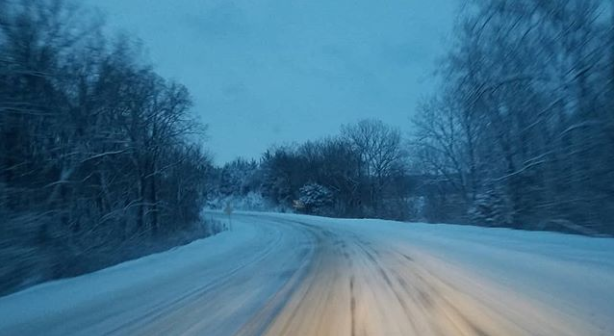
Mehaffey Bridge Road in Winter

Crews were removing about 10 inches of snow from the parking lot at the home, farm and auto supply store when I arrived for my shift.

Part of my work was hand shoveling the areas around the dock so trucks could get in to deliver. There was a lot of snow.

Around 1 p.m., a trailer load of “contractor trailers” arrived from the western part of the state. My job was to unload the five-high stacks from the flatbed truck. It is always tricky business and the snow packed pavement made it more so.

This job is a three person team. The truck driver climbs the stacks of trailers loosening tie down straps and securing the ones I’m lifting with a chain to the forklift mast while a trusted associate ground guides. It took three and a half hours to unload trailers into drifted snow around the edges of the parking lot.

It’s all in a day’s work, the most challenging thing I do.

At the end of the process I felt something had been accomplished.

Categories
Living in Society Writing

Legislative Priorities – IPERS Edition

Iowa State Capitol

This is part of a series about political issues that garner interest, but maybe too much or for the wrong reasons.

Main events occurred today at the Iowa State Capitol in the second week of the first session of the 88th General Assembly. Among them was a meeting of the State Government Committee about IPERS.

In a 5:22 a.m. email to my state representative and committee chair Bobby Kaufmann I wrote,

Good luck with the IPERS hearing today. I believe Iowa Policy Project and Progress Iowa are foolish to continue to hammer away at Republicans about IPERS. I agree it was problematic a couple of years ago to bring in the Reason Foundation to “evaluate IPERS,” however, the governor and Republican leadership got the message from Iowans not to mess with it. Time to move on.

A few hours later, I continue to believe that is true.

At the meeting Kaufmann reiterated his Dec. 6, 2018 assertion that under Republican leadership, and as long as he chaired the State Government committee, no changes would be made to IPERS. I’m sure today was meant to be the final word since everyone, including the governor, house speaker and senate majority leader said the same thing.

During the committee meeting, State Representative Mary Mascher, one of my favorite politicians and human beings ever, was mentioned by reporter Caroline Cummings in this tweet:

Cut to chase. Messaging the senate is not going to happen. Kaufmann would not have said what he did without Republican leadership support. After the 87th Iowa General Assembly, in which Republicans were noted for last minute bills Democrats barely had time to read before voting, any trust between Democratic and Republican members broke down. As Bobby Kaufmann’s father Jeff told me at the Solon Public Library on Jan. 21 2012, “There is no longer a Daniel Webster moment where people’s minds are changed in floor debates.” The “trust issue” to which Mascher referred is real and not going away.

At 1:01 p.m., shortly after the meeting, I received an email from Progress Iowa about it, confirming what was said, with a surprising addition, “We won’t be bullied by Bobby Kaufmann.”

IPERS is an important retirement program for many Iowans. It is right to stand up for it as was done the summer of 2017. However, it seems unlikely to be changed this session and maybe next because of the negative impact change would have on Republican chances in the 2020 general election. At what point do we move on to issues that matter as much or more?

When there is no imminent threat to IPERS the posturing, misrepresentation and hyperbole of groups like Progress Iowa seems misdirected. The cliche in politics is follow the money. Who is financially backing them? Why IPERS? The organization’s financial reports would likely provide answers.

It is important to watch the progress of IPERS in the legislature. It is simmering on a back burner and the governor said in 2017 she would like to evaluate changing the program to a hybrid with a defined contribution instead of a defined benefit for new members. She said she would protect the defined benefit workers were promised. Wealthy libertarians behind Dark Money in politics are playing a long game. Waiting a couple of years so house members can get re-elected is not an issue. Vigilance is required to make sure the IPERS pot doesn’t boil over unexpectedly. For now, the committee chair who would have to pass a bill has declared, “Not on my watch.” Democrats will be keeping watch.

It is time to set this one aside and focus on other, better, equally important things this session.

Categories
Work Life

Meat Packer Narrative

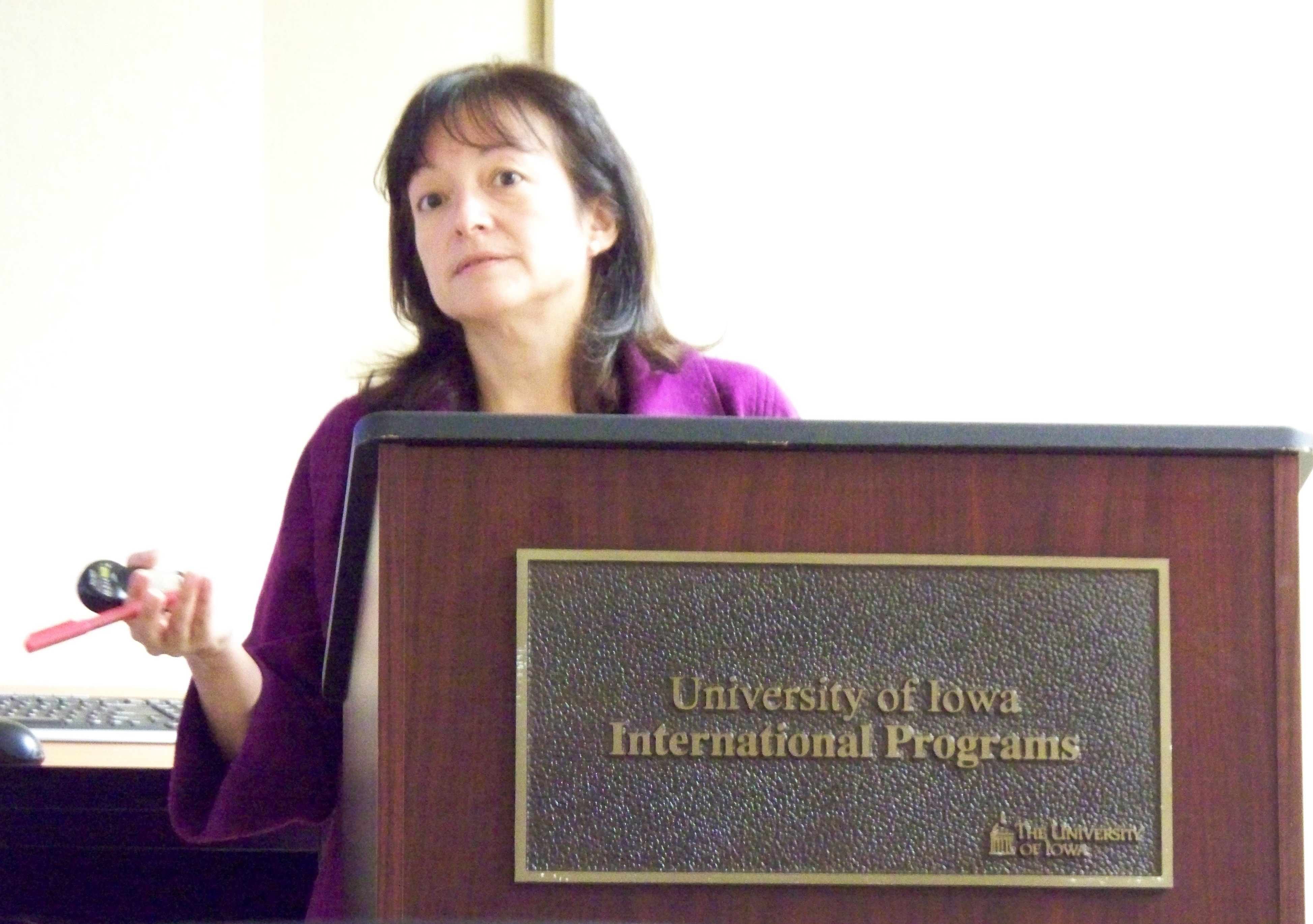
Ana Avendaño, November 2010

Editor’s note: An original version of this post appeared on Nov. 13, 2010. It has been edited because my writing wasn’t as good as I thought back in the day.

Clarity surfaced during a talk by Ana Avendaño, assistant to President Obama and Director of Immigration and Community Action for the AFL-CIO.

She was in Iowa City, talking about the meat packing industry. Her narrative struck me:

Back in the 1970s, meat packing workers were among the highest paid in the country, more highly paid than some auto workers. Multinational corporations, with a strategy of busting unions, began consolidating meat packers, creating a perfect storm for labor and a perfect outcome for themselves. Union workers were replaced with a continuous stream of lowly paid immigrant workers.

“The narrative of the meat packing industry is important to remember,” she said. An emblematic consequence of consolidation has been the immigration raids in Marshalltown and Postville.

Corporate advocacy to break labor unions is a global phenomenon, Avendaño said. “What corporations can’t do in a free market, they are doing through governance,” putting pressure on law makers to make labor law more favorable to their interests. She spoke of the International Monetary Fund and the World Bank as co-conspirators. They hold out loans to countries and “specifically require them to change labor laws in a way that hurts workers,” Avendaño said. “It is the hypocrisy of what we are living through today.”

I worked in a meat packing plant two summers while an undergraduate. It was easy to get a job there. I belonged to a union, the Amalgamated Meat Packers and Butcher Workmen of North America, and at $4.04 per hour, made enough money to get through the next school year. As Avendaño’s narrative suggested, wages were good.

The plant conditions were dangerous and work was physically challenging. My maternal grandmother and father had both worked in the plant and my father died in a plant accident. I never felt in danger, working as a millwright’s assistant in 1971 and on third shift cleanup crew in 1973. I got to see most of what went on throughout the plant and warehouses. It was not pretty.

Avendaño missed something. It’s true low cost operators like Iowa Beef Processors could perform the work cheaper and re-invent how meat processing was done. It’s true unions gave concessions until many of the jobs, especially slaughterhouse jobs, were consolidated in a much smaller number of places. It is also true that at a lower rate of pay, many Iowans no longer wanted to do this work. Enter immigrants.

As Avendaño spoke, adjusting her glasses, and pointing at the PowerPoint on the screen, it hit me. After my father’s death, while rummaging around in his basement workshop, I found a pay stub from his work at Oscar Mayer. He made less than $90 per week.

It was a different world then. How we acquired and made our food was different. Dad shopped at the company butcher because meat was fresher and less expensive. The rise of highly processed foods, farm subsidies that keep prices low, and the invention of a consumer society where we spend more than we earn using credit, had not begun. We made more food from scratch because many of the food items in today’s grocery store aisles did not exist. We lived close to the means of production and $90 per week was a living wage. We were working poor, but didn’t call it that. We had a decent life.

That is where the narrative unravels. Life was not about pay and benefits. It was about what else we did with our time. Even at those wages we couldn’t wait to get out of the plant. We knew we could do better with our lives than work on a production line. Avendaño was advocating improvements in a status quo that while needed for the betterment of workers were no solution to larger problems of corporate hegemony in our lives. It is as if we have stopped trying to improve society, so we can cling to the remaining dregs in a barrel of prosperity long drained by the wealthy class.

That morning, in the darkened room, it seemed a fool’s errand and that was my epiphany.