We don’t know anything new about the 45th president after Thursday’s release of the 448-page Mueller Report. I haven’t taken the time to read it, you?
There may never be time to read the report as it is expected to confirm what we already know: Donald J. Trump and associates are crooked as a three dollar bill.
U.S. Rep. Jerrold Nadler (D-N.Y.), chair of the House Judiciary Committee, subpoenaed a copy of the unredacted report within hours of Attorney General William Barr’s Thursday press conference. In Washington, the move was expected.
In July 1974, a high school friend was interning in Washington, D.C. when the U.S. House filed articles of impeachment against Richard Nixon. He brought a copy of the documents back to Iowa to show us. Key Republicans met with Nixon and convinced him to resign before he was impeached. The difference between 1974 and today is Republican leaders Senator Mitch McConnell (R-KY) and Representative Kevin McCarthy (R-CA) seem unlikely to call for Trump’s resignation. If the U.S. House of Representatives impeaches President Trump, as long as McConnell is Senate Majority Leader there will be no conviction, even if there is a trial as there was with President Bill Clinton.
The American people will determine the fate of the president at the polls during the Nov. 3, 2020 general election if he’s not removed from office before then. Despite his shady activities and transgressions of political norms he could be re-elected.
What’s a gardener to do? Make sure the Congress follows the constitutional process.
What makes this tough is the likelihood the process won’t reach the desired result of removing the president and everyone knows it. What does make sense is following the constitutional process, which begins with hearings in the U.S. House of Representatives.
Much as I dislike it, I need to refresh my memory on the constitution.
Congressman Dave Loebsack in the Solon Beef Days parade
On Wednesday, Feb. 27, 2008, this note came:
Paul:
Dave is interested in stopping by the Fish Fry at the Legion on Friday.
Would you be interested and available to introduce him to a few folks that night?
If you can’t, can you think of someone else who might like to? Probably around 6:00.
Thanks-
David Leshtz
District Representative
Congressman Dave Loebsack
I worked on Dave’s campaign in 2006. During the summer, after the office was first open, I was often the only volunteer making phone calls. There were a lot of calls to make and often the recipient of the call said “Dave who?” The night of the election, I was able to work through the crowd after Dave’s acceptance speech and shake his hand before he went with the press. He said “I’ll be back to talk later.” That night was something else and I guess tonight is later.
Dinner was just Dave and me talking about stuff: the weather, Joensy’s restaurant, RAGBRAI coming through Solon, the Big Grove Caucus and the Minneapolis airport. I introduced Dave to one of our neighbors who ran the 4-H club our daughter joined. She was there with her son. Jean Stinocher stopped by with a 3 by 5 card asking what questions were on the immigration test. She was researching the topic for a presentation. Dave passed it to Dave Leshtz for follow-up. Jean’s husband’s uncle is the person after whom the Stinocher American Legion Post is named. He was among the first in the area to be killed in WWI. We talked about John Edwards and Barack Obama and the hope that if Obama is elected, he could do for the Democrats what Reagan did for the Republicans: go over Congress’ head to the American people and get things done. We hope a Democrat is elected President in November. Jean caucused for John Edwards in Big Grove. Dave supported Obama at his caucus.
I asked Dave why Congress was choosing to spend resources on prosecuting the contempt citations against Harriet Miers and Josh Bolten. He said he favored holding them in contempt and that a lot of Democrats wanted to hold the Bush administration accountable. House Speaker Nancy Pelosi announced that she has given the Judiciary Committee authority to file a lawsuit against Bolten and Miers in federal court. I expressed my concern that there were other, more important areas where the Bush administration could be held accountable.
I finally asked Dave who was running his campaign. He said he was still trying to get things done in Washington and that most of the activity is fundraising. With three Republican opponents, he would let them fight it out for now. I told him I would contact Melanie to help.
And that’s that. One of the good thing about life in Big Grove: dinner with your Congressman.
~ First published on Feb. 29, 2008 in an earlier version of this blog.
The worst kept secret in Johnson County is Veronica Tessler is running for the open seat in Iowa’s Second Congressional District in the June 2, 2020 Democratic Primary.
Six distinct sources have told me as much… and there are public Facebook posts, one of which includes a date for her announcement.
On April 12, incumbent Dave Loebsack announced his retirement, making this an open seat. My interest in Tessler began March 17, when I asked a friend, “Who is the progressive woman raising money and recruiting staff for a primary challenge to Dave Loebsack? I don’t see an entry on the FEC website.”
I found out it was Veronica Tessler.
If I met her, I don’t remember it. It turns out she has been on periphery of my life for more than ten years and I didn’t know it. This post is about what I found while searching for her on Google and in my email files.
I was an early adopter of Gmail, and still maintain records back to 2006. A search for Veronica Tessler yielded a couple dozen hits, all of them items where she was mentioned but not the author or recipient.
The earliest hit was the 2008 Second District Delegate list where Tessler was for Obama. She also ran for national delegate, according to the April 26, 2008 email from the Iowa Independent. I don’t know if she made it as I was in the Edwards camp at the convention, where we sent Dave Redlawsk and Ro Foege. I re-circulated this delegate list to various campaigns over the years, so there are other hits as well.
After that, my emails about Tessler are related to her work at the Stanley Foundation. I don’t remember her, even if I met her. When I reached out to David Shorr at Stanley, to help with the Comprehensive Test Ban Treaty ratification campaign, there was no suggestion or mention of her. She did write an Op-Ed to the Des Moines Register advocating for ratification of the CTBT on Feb. 21, 2010, according to an email from our public relations firm.
We were to bring Tessler in to a monthly meeting of Physicians for Social Responsibility in February 2011 to address nuclear proliferation. She was still at the Stanley Foundation and I don’t recall if I attended. In this case, Dunbar’s Number is likely coming into play as I met so many people when I was active with PSR it’s hard to remember.
In the March 22, 2015 issue of the Washington Post Tessler indicated she was politically inactive between 2008 and 2015.
In the basement of the Cedar County courthouse in Tipton, where (Martin) O’Malley spoke to about 40 Democrats, two young women offered Warren signs, buttons and stickers at a “Run Warren Run” table at the back of the room.
One of them, Veronica Tessler, 29, didn’t recognize O’Malley when he arrived but said he gave a decent presentation. Asked if she could see herself supporting him if Warren doesn’t run, she demurred.
“I think it’s way too early to be talking about that,” said Tessler, who owns a frozen yogurt shop in Iowa City. “Right now, we’re 100 percent focused on getting Senator Warren to run. I haven’t seen anyone who inspires me the way Senator Warren does. She’s real. She’s authentic. She’s powerful.”
Tessler said she had not been politically active since Obama’s run for president in 2008 and was drawn back in only because of Warren.
There are multiple news articles where Tessler was quoted about Johnson County’s minimum wage ordinance.
“I agree a raise is the right way to go,” she said. “The challenge for small businesses like mine is that all my employees are part-time and mostly dependent on their parents and don’t have the same financial demands on them as people with children have.”
Tessler said she supports a livable wage, but a higher minimum wage is not a one-size-fits-all solution.
“I am the only full time employee at my shop,” Tessler said. “All of my employees are full time students and part time workers.”
Tessler said her ten employees do rely on paychecks to help pay tuition and bills, but are still dependent on their parents.
“It’s different than an employee with dependents or children, that are looking to make a living wage and really support themselves,” Tessler said. “The difference being they’re still on their parents’ health care.”
Whatever equivocation might appear in the two press statements about minimum wage, Tessler later addressed minimum wage in her frozen yogurt shop in a YouTube video. When you look at everything, it’s clear she supported or came to support the Johnson County increased minimum wage.
Here’s what Johnson County Supervisor Rod Sullivan wrote on Dec. 21, 2016 when he awarded a Salvos Salute to Tessler:
Veronica Tessler: Johnson County has a fantastic group of young professionals on the rise. I am anxious to see what they will do when they take charge! When that happens, I expect Veronica Tessler to be in the center of it all. As the owner of Yotopia, Veronica has put her beliefs into action as a key part of her work. As an activist, Veronica has organized many successful events in Iowa City. Keep your eye on Ms. Tessler; her future is bright!
Tessler launched an Iowa City door knocking event for 2018 gubernatorial primary candidate John Norris from her apartment according to an invitation I received. She was quoted in a below the fold article in the March 31 Cedar Rapids Gazette about the teen gun protest in Iowa City.
On Wednesday, April 3, she lobbied in Des Moines with a group of young farmers. They had a photo taken, including her, Mary Mascher and Bobby Kaufmann. They also met with members of the Iowa Senate. This lobby trip was about the bill to re-write state law regarding who’s eligible for the ag exemption. I had to ask who the person was as I didn’t recognize her. “Someone trying to help,” said a farmer who named her.
So that’s what I found in my files. I recently posted,” To find our way, we need something different, and better. Our hope lies with the thirty-somethings who have arrived — like it or not.” I was thinking in part about her.
If Veronica Tessler does run for congress, she will be doing so against seasoned political veterans in the primary and in the general election. I didn’t see any serious appetite to replace Dave in 2020, but he announced retirement. Given the leaky bucket of rumors this county has become, the surprise will be if Tessler doesn’t announce for congress this month.
After reading Shortest Way Home: One Mayor’s Challenge and a Model for America’s Future I’m not sure South Bend, Indiana Mayor Pete Buttigieg should be the 46th U.S. president. I learned something different from his book.
My cohort, the baby boomer generation, should let go the reins of power, stop clutching our torches of freedom and snub them out.
As next generations take up leadership in our country — something that’s already going on, like it or not — we may fear younger citizens will become excessively tattooed vaping addicts. It’s not about us and that’s the hardest part of letting go.
The famous American torch speech was made Jan. 20, 1961 by John F. Kennedy.
We dare not forget today that we are the heirs of that first revolution. Let the word go forth from this time and place, to friend and foe alike, that the torch has been passed to a new generation of Americans–born in this century, tempered by war, disciplined by a hard and bitter peace, proud of our ancient heritage–and unwilling to witness or permit the slow undoing of those human rights to which this nation has always been committed, and to which we are committed today at home and around the world.
Mayor Pete is no Kennedy, even as he was a summer intern for Senator Ted Kennedy in Washington, D.C. while attending Harvard. If there is a torch, or a race at all, the relay broke down and the transition became anything but smooth or noble. America today seems less committed to the vision JFK elegantly espoused in his inaugural address. We are getting to the point in our history where young people don’t remember the politics of the late 1950s and 1960s.
Buttigieg’s book is well written, the narrative easily understandable. Shortest Way Home is a story to which almost anyone can relate. While reading I thought of Michelle Obama’s memoir Becoming. I wrote about Obama’s book,
What surprised me was the clarity with which Obama depicted a life on the South Side of Chicago and how it influenced her both while coming up and once she had means to be on her own. The first two sections of the book are by far the strongest. That’s partly because as First Lady events in the third part got plenty of previous play in the media creating a background noise that interfered somewhat with her meticulous and thoughtful narrative.
What makes Buttigieg’s book different is Iowans saw little public history of his work in South Bend, even those of us who spent time there before he came up. Unlike Michelle Obama, about whom we know a lot from her time as First Lady, what you see is what you get with Pete Buttigieg. I don’t doubt the veracity of the facts in his memoir. What worries me about picking him as our next president is there is nothing else there.
There are few things Americans can come together to support any more. We are increasingly on our own as regions, as communities, and as individuals, concerned with making our way as best we can. All the inter-generational torch-passing seems so 1960s.
My advice about Shortest Way Home is read it. Not because Buttigieg should be president but because he illuminates the example of South Bend and what’s possible in creating a more sustainable life in urban centers. If we are to build a new vision of what life here could be, stories of places like South Bend represent something positive. At the same time Buttigieg holds up a torch in his memoir, it is not bright enough to lead us out of the darkness of the post-Obama era by itself.
Yesterday afternoon, when Congressman Dave Loebsack announced his retirement beginning at the end of the 116th Congress, the reality of it hit home.
Dave and I briefly discussed retirement, his and mine, over the last couple of years. He talked with everyone he met about almost anything. Last summer it became clear his days as a U.S. Congressman were numbered. I posted about it here. To put the date Jan. 3, 2021 on it brings to a conclusion an important part of my political life.
Few political events changed me as much as the Nov. 7, 2006 general election which repudiated the George W. Bush administration, changed the tone in Washington and Iowa, and paved the way for Democrats to elect Barack Obama president two years later.
That’s not to say Republicans didn’t become energized. With losses in 2006 and 2008, and after the Patient Protection and Affordable Care Act was signed into law March 23, 2010, they came back. Republicans successfully pushed back the Democratic tide and re-elected Terry Branstad who went on to become the longest-serving governor in U.S. history. Under the leadership of Jeff Kaufmann, who became chair of the Republican Party of Iowa in June 2014, Republicans built a political machine that’s proven hard to beat. Through all of this, Dave Loebsack persisted, continued to win re-election, and remains undefeated.
So what’s next?
Within hours of the press release, people were thanking Loebsack on social media, with some already moving on to the topic of the horse race to replace him. Four names raised yesterday are worth discussing.
Rita Hart (D-Wheatland)
If Rita Hart is interested in running for Congress, she could likely win the June 2, 2020 Democratic primary election. As our candidate for lieutenant governor in 2018, she campaigned throughout the state, including the second congressional district. This experience, and her contact list of district Democrats with whom she has worked, gives her a leg up in fund raising, gaining support, and experience to focus on what matters most in a campaign. She served as state senator in Senate District 49 before accepting a position as Fred Hubbell’s running mate.
Bobby Kaufmann (R-Wilton)
I asked my state representative, Bobby Kaufmann, whether he would challenge Loebsack during the 2016 and 2018 election cycles. He told me he wouldn’t. Yesterday he told Erin Murphy of Lee Enterprises,
“I’ll look at it, but I’m in middle of legislative session and my first responsibility is to my House district,” the Cedar County farmer and business owner said. “It definitely changes the landscape.”
The Republican Party of Iowa will need new blood if they hope to be competitive in the district, rated a toss up by the Cook Political Report without Loebsack in the race. Three-time loser Mariannette Miller-Meeks (R-Ottumwa) went on to become a state senator in District 41. When contacted by Murphy, she said she would give the matter of running consideration. Murphy also contacted two-time loser Christopher Peters (D-Coralville) on vacation in Italy. Peters deferred comment until he returns to Iowa. In an open seat, Republicans would be foolish to run one of these two repeat candidates. The other non-Jim Leach opponent over the years? I met John Archer (R-Bettendorf) in Tipton in 2012 and felt creepy for a couple of days afterward. I doubt he’s interested, and Jeff Kaufmann would likely stop him from running again if he were.
Zach Wahls (D-Coralville)
My state senator Zach Wahls gets mentioned a lot as a potential replacement for Loebsack. Few politicians have as bright a future ahead of them as Wahls appears to. I’m not privy to his plans, although I spend a little time with him at political events like I did with his predecessor, Bob Dvorsky. If one follows Wahls via legislative newsletter, on Medium, on Facebook and Twitter, it is clear he is learning the ropes of being a politician. He has political credibility, beating three opponents in the June 5, 2018 Democratic primary election with 63 percent of votes cast. Janice Weiner ran a serious primary campaign against Wahls, garnering 32 percent. Eric Dirth and Imad Youssif were on the ballot, but not competitive.
Veronica Tessler (D-Iowa City)
Tom Carsner, Group Representative for Our Revolution Johnson County, posted the following on Facebook yesterday: “Veronica Tessler would be a great congresswoman for the Second District.”
I know Tessler only by name and that because of watching her North Liberty operation of Yotopia, Iowa City’s Original Froyo, open then shutter on Pacha Parkway as I drove by to retail jobs in Coralville over the last few years. The Iowa City location has been successful, having opened in 2011. The single time I stopped at the Clinton Street location, I had a frozen yogurt with Carsner. The snack was efficiently delivered and tasty.
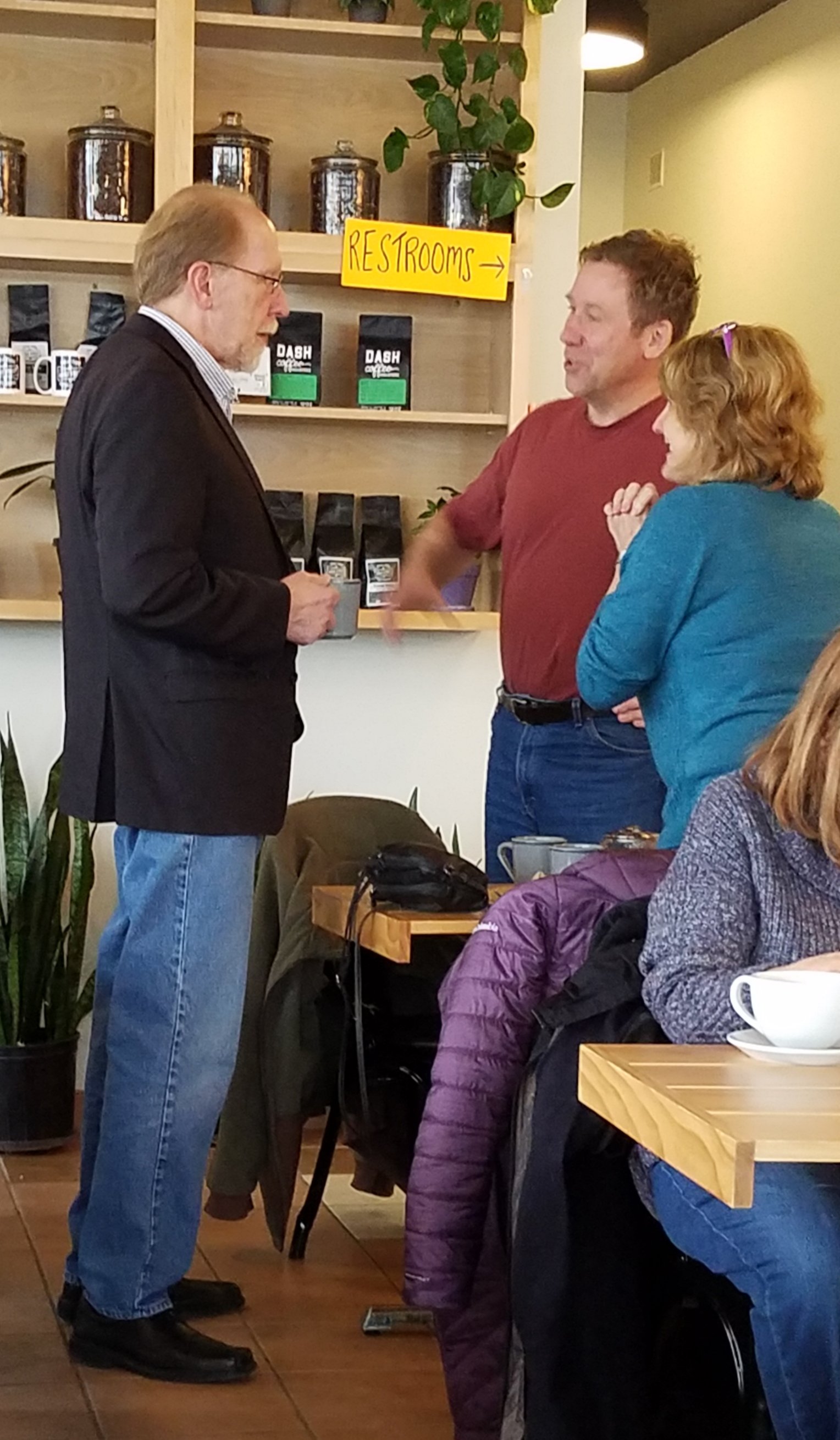
Congressman Dave Loebsack chatting with constituents at Dodge Street Coffee, Iowa City on March 9, 2019.
I was an early adopter of Gmail with records going back to 2006. I searched for Veronica Tessler and came back with 23 distinct hits dating back to when she was a delegate to the 2008 Second District Convention. A google search shows plenty of activity, including support for an Iowa City gun violence protest where she was quoted in a March 31 Cedar Rapids Gazette article. If she announces for Congress, some of that may become relevant.
Other potential candidates have been mentioned in social media since Loebsack’s announcement. Right now, I’m processing what Dave’s departure from the Congress will mean personally and to the district. Loebsack did constituents a favor by timing retirement so there would be an open seat. I expect that if the four mentioned candidates jump into the race, more will follow.
Dave Loebsack has been a dependable part of my life since I first started our dialogue via email in 2005. Seems like I should be saying something besides Woody Guthrie’s line, “So long it’s been good to know ya,” but that’s what I have for now.
Detail from the Internet Headline of the Monmouth University Poll, April 11, 2019
Our county-wide newspaper reported more than 900 people turned out to see and hear U.S. Senator Kamala Harris (D-CA) speak at the Iowa Memorial Union in Iowa City Wednesday night. Harris is running for president.
She is one of roughly two dozen presidential hopefuls courting Democrats in the run up to the 2020 Iowa precinct caucuses, which are first in the nation among presidential preference polling. In Iowa we don’t call it voting because we don’t want New Hampshire, which has a law requiring them to hold the first in the nation primary election, to get mad. According to the Des Moines Register, there have been about 300 candidate events like Harris’ this election cycle.
Vice President Mike Pence is scheduled to be in the Hawkeye State today, visiting the emblematic disaster wrought by government policy in the form of extreme weather and severe flooding made worse by global warming. Pence and his boss are also running for president and today’s disaster walk also serves as a campaign stop, that’s how base our politics has become.
I’m more interested in Democrats.
Iowa has not dealt with political hugster in chief, Joe Biden, who leads Democrats in the recent Monmouth University poll of 350 prospective caucus-goers.
I don’t see the support for Biden. While his 27 percent puts him in front of this murder of crows, it may be a ceiling, subject to being overtaken as the field consolidates. I also don’t believe my cohort wants someone our age as president. That polling calls were split 50-50, landline – mobile, favors a certain kind of sixty- or seventy-something. The kind that likes what is familiar whether Biden or Sanders. But what do I know? I didn’t ask 350 people and am limited by Dunbar’s Number. If curious about the horse race or this poll, click the image above.
Local elected officials seem to be chasing the presidential candidate selfie with gusto. A few electeds have declared for a single candidate, most have not. The sensible plan is to wait until another 300 candidate visits to Iowa have passed and decide by end of summer. Declaring too early can prove to be problematic, especially if the chosen one drops out early. If Iowa is to remain first in the nation, multiple candidate selfies make things seem welcoming and unbiased during the early days of the campaign.
I don’t feel a need to chase candidates to meet with or hear them in person. I understand how video services on the internet work and for the most part, adequate candidate video becomes available after key events. My personal interaction with candidates is important to personal story-telling. I’d like one or two more encounters to add to my repertory of hearing Julián Castro speak bathed in the light of mobile phones during a power outage (click here for my post on the Castro visit). Deciding by Labor Day allows plenty of time to work in my precinct for a chosen candidate. My current post about the Iowa caucuses can be found here.
All this candidate chasing is fine, but the main prize in 2020 will be the U.S. Senate seat currently held by our junior senator, Joni Ernst. According to news reports, she has $2.8 million campaign cash on hand for the election. Democrats haven’t picked a candidate to challenge Ernst and aren’t expected to finalize a decision until after the 2020 summer primary. We’re starting the race with shackles binding our ankles, but that doesn’t mean we can’t pull an upset. Regaining control of the U.S. Senate is essential to hopes of implementing a Democratic agenda in the federal government under a Democratic president.
When I look at the 24 candidates identified in the Monmouth University poll there are only a few about which I’m interested in hearing more. In no particular order, they are Castro, Elizabeth Warren, Pete Buttigieg, Amy Klobuchar and Jay Inslee. The ten with less than one percent support in the poll should read the writing on the wall and gracefully make their way to the exits. As for me, I’ll be seeking opportunities to post about the campaign as I attend more events, midst a life of staying active in society. Staying active is about a lot more than politics.
By July 3, the tenth anniversary of my departure from the logistics company, I hope to have my exit from the workforce defined.
I continue to work for pay and barter and am concerned with a loss of income those five jobs currently provide, although, not that much.
I’m ready to focus on work closer to home which pays in ways other then monetarily. Our needs have changed and so have I.
The reason our household is in this position is Social Security and Medicare. At 50 years into the workforce I continue to contribute to both, and the benefits provide a livable financial structure. The fact we’ve been responsible citizens helps as well.
It is time to move on.
That said, I enjoy my five jobs and the people I meet. The home, farm and auto supply store provides insight into low wage workers and the challenges of retail. The two farms where I soil block are quite different if my work is the same in both. I enjoy the farmers, workers and volunteers in each setting for different reasons. Work at the apple orchard has changed since my friend Jack first referred me there. The operation has gotten bigger, the number of revenue streams expanded. I’ve learned a lot about apple culture and the work appears to have run its course for me. My summer coverage of Blog for Iowa has been a time where I am required to put a post up five days a week. It has always provided a chance to think more about contemporary affairs and what it means to be a progressive Democrat.
The long goodbye from all of these jobs is already in process.
What will I do besides slow down my work outside home? That’s an open question, the answer to which depends on continued good health. For now, I am mentally active and undamaged by life’s stresses. Another human working to sustain a life in a turbulent world.
On Saturday the Iowa Democratic Party Central Committee addressed the complaint national media and other states have had about an opaqueness of our first in the nation precinct caucuses.
“This year we proposed the most significant changes to the Iowa Caucuses since 1972,” according to the IDP website. “We are confident that these proposed changes will make the Iowa Caucuses the most accessible, transparent, and successful caucuses ever.”
It looks like the state party will release raw support tallies (i.e. not votes) for the first time since Iowa rose to prominence in the wake of the disastrous 1968 Democratic National Convention in Chicago. The Chicago convention brought us Hubert H. Humphrey of Minnesota, the last nominee to emerge from a smoke-filled room.
My friend from the 2007-2008 John Edwards campaign David Redlawsk wrote the book (with others) on the Iowa Caucuses, Why Iowa? People don’t always buy the authors’ answers. I land with my friend and fellow Democrat John Deeth who settled for 10 percent and accepted the IDP changes.
As an Iowan more active than most in Democratic politics, I acknowledge the decreasing significance of what we do in the presidential horse race. While we get to see a number of presidential hopefuls, and garner media attention in the run up to caucus night, the early presidential nominating process includes not only the four early states — Iowa, New Hampshire, South Carolina and Nevada — but Super Tuesday (this time on March 3, 2020) when a number of states and U.S. territories hold their presidential primaries. The idea that Iowa would winnow the field of presidential hopefuls is less true than it was because of this.
Clearly there are more than two or three tickets out of Iowa this cycle as smart candidates are already campaigning in California, Texas, and other Super Tuesday states. If viable, they will continue at least that far. It is an easy prediction that the nomination will be winnowed down to two after Super Tuesday, and this year, maybe even to The One.
It’s also true that winning Iowa alone is not enough. John Edwards put almost all the chips on the table to win Iowa and when he came in second in delegate count, he had to scramble to cover South Carolina and Nevada with organizers. Whatever the tallies in the four early states, whatever number spinning takes place, a rationale for continuing has to be credible even with new momentum toward Super Tuesday.
I don’t know if any of them will be my final choice on caucus night.
The Democratic National Committee did the first funnel for us already by requiring participants in the first summer debate to secure at least 65,000 unique donors of any dollar amount. Some may grumble about money in politics or “insiders” controlling who’s viable and not, however, number of donations is a fair and transparent measure of viability. I gave small donations to eight candidates I’d like to see on the debate stage. I don’t know if any of them will be my final choice on caucus night.
The 2008 caucus, the closest to level of participation we might see in 2020, was a nightmare from my perspective. The room wasn’t big enough and I chose to both be a precinct captain for John Edwards and help my friend Bob run the event. Doing both proved to be impossible. We had only about 260 attendees.
We put the Edwards group in the hallway, partly because we had so many infirm and elderly in wheel chairs, but also because there wasn’t enough room in the main room to count. I had to count attendees multiple times, which got everyone mad at me, with accusations that my true purpose was to recruit more people for the Edwards camp. In the end, after the final alignment, Obama had 85 people, and Clinton and Edwards split the rest equally, requiring a coin toss to see who got an extra delegate. (Hillary won the coin toss). Once delegate assignments to the county convention were finished, the mass exodus left Bob and me struggling to fill our precinct’s allocated committee positions.
The Iowa caucuses in presidential years are not as much about organizing the party. There is a legitimate issue with finding enough rooms to adequately accommodate caucus-goers, so it would be great if people caucused virtually instead of showing up to name their candidate, then go home without further ado. To say the actual caucus helps organize the party is inaccurate, it doesn’t. If there wasn’t a shortage of people interested in training to run a caucus, I’d participate virtually and let go the reins.
Iowa retained first in the nation status this year partly because IDP was forced to listen and make the caucuses more inclusive and transparent. Having done that, we have an avalanche of presidential hopefuls arriving in the state. My main goal is to keep focus on what I believe is the prize (the contest for U.S. Senator) and avoid getting trampled by the donkey stampede. In my favor is experience, which will hopefully prevent me from picking unnecessary fights.
I had an epiphany while reading Mayor Pete Buttigieg’s memoir, Shortest Way Home, the March release of which coincides with his presidential campaign.
In the first chapter he described growing up in South Bend, Indiana, a place I frequented while working in transportation at about the same time.
It was a stretch to understand Buttigieg’s new narrative of something I knew well during the late 1980s. My conclusion after finishing the first chapter was I feel too comfortable with people closer to my own age with similar experiences. Like it or not, aware of it or not, a new generation of Americans has arrived and is already making change in a society I increasingly recognize only in memory.
I don’t know Buttigieg’s presidential chances among a large field with many experienced politicians, but I know this: I’d better join younger people in their efforts to improve society or get out of the way.
I’ve written about the struggle of young farmers regarding land use in our county. Some of them have been addressing the county board of supervisors since 2013 about the 40-acre rule which defines a farm. If a farmer farms on less than 40-acres here, by definition, it is not a farm, and therefore, the financial remedies of the Iowa agricultural exemption are unavailable. Having advocated with the supervisors during the run up to the most recent five-year land use plan, they are making an end run around them for lack of accommodation, seeking a remedy from the state legislature. Whether they will be successful this year is uncertain, but eventually they will reshape the law to better fit their vision of contemporary farming.
Congressman Dave Loebsack is in the same cohort as me, about a year younger. A relatively small group of us joined together in Iowa City to open his first campaign office for the 2006 election. Together we beat a 30-year incumbent Republican in the general election. Over time there have been complaints that Loebsack is not progressive enough. If one looks at his actual positions and votes, and hears it from him personally as I’ve been able to do because of our long relationship, that seems ridiculous. However, the new generation will have their way, maybe not now, maybe not in an orderly way after Loebsack retires, but their patience with perceived grievances won’t be bottled up for long. As Buttigieg’s narrative of South Bend in the late 1980s instructs, there is a different way of seeing things and it is not the view of white guys like me.
After the decennial political redistricting in 2010 Bobby Kaufmann won the first election in newly formed House District 73. He has dominated the district ever since, despite efforts by Dick Schwab (2012), David Johnson (2014), and Jodi Clemens (2018) to win the seat. Like him or not, he is the face of the new Republican party in Iowa and a popular figure in the district and around Iowa. That’s not to say he’s popular among Democrats and progressives because he mostly isn’t. Because he won four back-to-back elections he rose in the legislature and became the gateway for constituents to get things done. Will he support all of our initiatives? No. Will he listen? I found the answer to be yes.
I no longer see life through the eyes of a thirty-something. However, I’m willing to set aside my biases and predispositions if I can and spend time with men and women in their 20s and 30s to work on common issues. It’s the lesson I’ve learned from Pete Buttigieg’s candidacy.
There is so much needed to improve our lives and old solutions no longer work. To find our way, we need something different, and better. Our hope lies with the thirty-somethings who have arrived — like it or not.
It felt good to be outdoors on Friday. The sky was clear and temperatures warmed enough to shed my coat. Green-up has begun.
We filed our income taxes with the Iowa Department of Revenue and the Internal Revenue Service. Earlier in the week I paid the second half of our annual county property taxes.
This morning I plan to walkabout our subdivision, inspect roads, and address concerns about water and sewer leaks. With the hard winter and significant ambient temperature swings, there is damage. Whatever needs fixing requires a plan and a budget. As a board member and trustee of our home owners association and sanitary sewer district I share responsibility for both.
We’ve done our part to support government services. Now spring can begin.
Outdoor work was sweeping up enough sand from the road in front of the house to refill sand buckets used last winter. I haven’t purchased sand in about five years. Because of the hard winter there was plenty available. A 50-pound bag of solar salt filled empty salt buckets.
I found the fan to blow air across the damp garage floor. It took about two hours for moisture to evaporate. Baby steps to start spring 2019.
Governor Kim Reynolds issued a disaster proclamation for Howard County Friday afternoon. The number of counties under disaster proclamations is now 53 (of 99), according to the press release. Current estimates of damage exceed $1.6 billion according to this morning’s Iowa City Press Citizen, although counties reported they have yet to fully assess damage within their jurisdictions. Governor Reynolds proclaimed nothing about what government would do to help mitigate the deleterious effects of climate change going forward.
My farmer friend from the home, farm and auto supply store reported the ground needs drying before getting into his fields. While the weather quickly became spring-like, the usual issues for row-crop farmers remain. My specialty crop friends also found the ground too wet to work. They are planting in their hoop houses which are traditional season-extenders.
Spring began Wednesday and is just getting started. We’re ready.







 Journey Home
You must be logged in to post a comment.