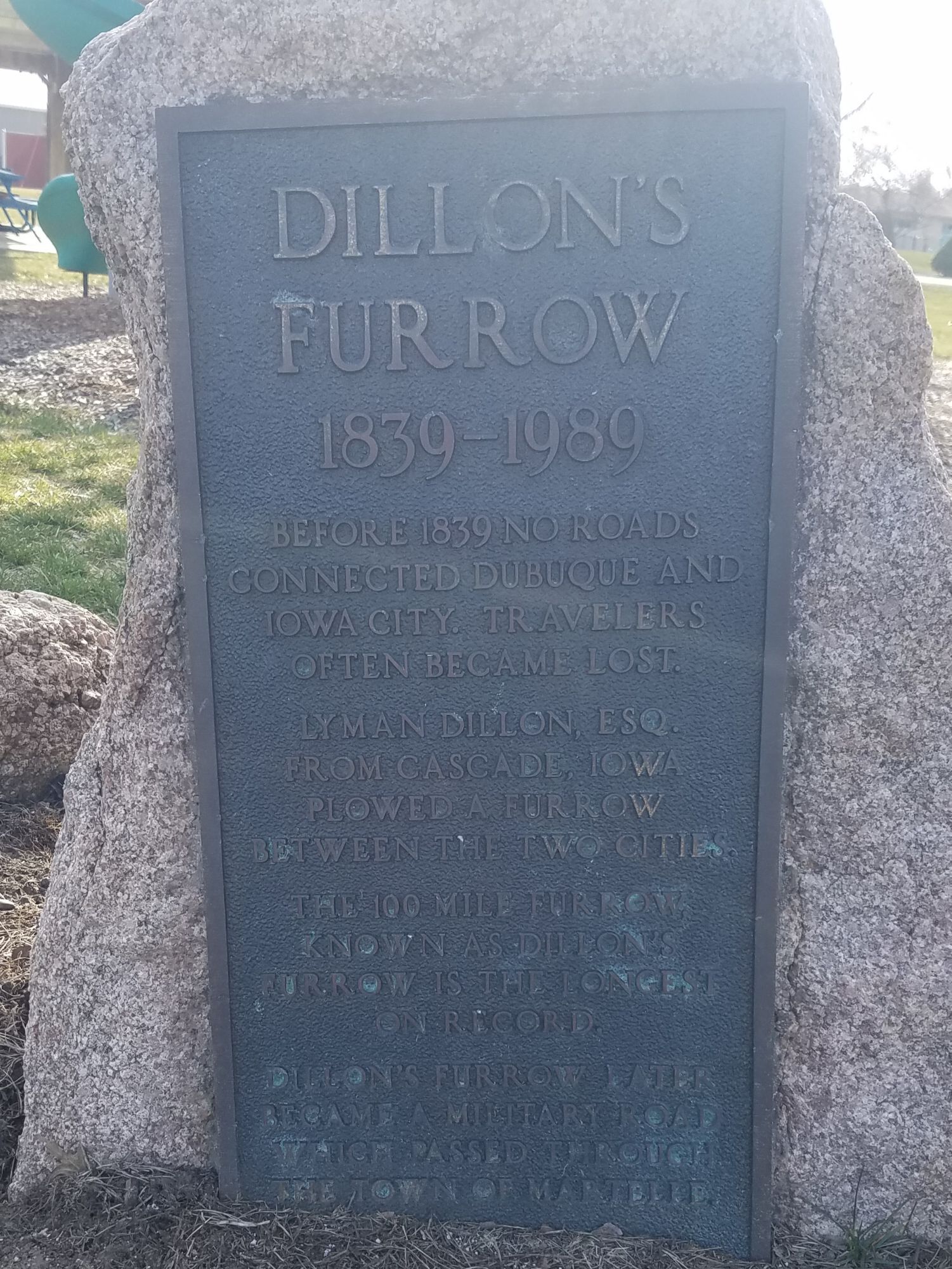
Back when Iowa was a territory, a fellow named Lyman Dillon plowed a furrow from Iowa City to Dubuque so travelers could find their way from one city to the other. Iowa City was designated the territorial capitol in 1839, and Dubuque was a center of commerce, notably for fur trading, lumber, and lead mining. I stopped at the only marker I know and took this photo while enroute along the former Dillon’s Furrow. I went to Monticello to buy garden fertilizer.
Midwestern BioAg distributes bagged, composted chicken manure which many friends use in organic farming operations. I bought 150 pounds for $57.78. It should last through the growing season. I don’t know their process, but this stuff is the best in terms of ease of handling and results.
Farmers have been out in gigantic fields preparing the ground for row crops. Monticello is in Jones County where my spouse’s ancestors farmed after the Civil War. A family cemetery is within spitting distance of Highway 151 near Langworthy. It is a small farm community cemetery where cattle had gotten inside the fence and knocked down some of the grave markers.
If I plant potatoes on Good Friday (today), I’ll need the fertilizer. I’m ready to start digging soil. We’ll see if frost is out of the ground later today.
With ambient temperatures in the twenties and thirties it has been a chilly early spring, of a kind that has me lingering indoors to find things to do. It is what it is. I hope to plant potatoes on Friday, yet if it’s too cold, I will delay. In the life cycle of Midwestern gardening, the growing season is extended by a warming climate and a few days doesn’t matter that much.
I plant potatoes in containers so the soil is less accessible to rodents. I move them each year, using the soil dug to bury them plus some soil mix and compost all blended with a cup or so of fertilizer in each tub. So far no critters dug their way into the tubs to eat the tubers.
A company in Monticello sells composted chicken manure, which is used by a lot of organic growers. I need to get over there and buy this year’s supply which is 150 pounds. There will likely be the annual discussion of which sales person gets credit for my sale. A few years ago we established that mine is a “house account” which means no sales person gets credit as I just walk into the office to buy it. Since beginning to use fertilizer, garden yields have improved.
Based on last year’s experience, I delayed planting peppers last weekend. Timing of seeding to planting time is more important for peppers and tomatoes. Any more, I don’t see an advantage of germinating early. I am cutting back on peppers and tomatoes this year with fewer varieties. For peppers to be successful in this climate, I need to install drip irrigation. I have been unwilling to do so, and there is an abundance of peppers when they come in around the county. I do plan to plant the varieties that grow well with my sparing watering.
I inspected the garlic and it is looking quite good. Taking time to loosen the straw mulch compacted over winter facilitated growth. It looks to be another great harvest.
When the weather finally breaks, there will be a lot of outdoors work to do. I am ready for it, even if there is plenty of indoors work to keep me busy.
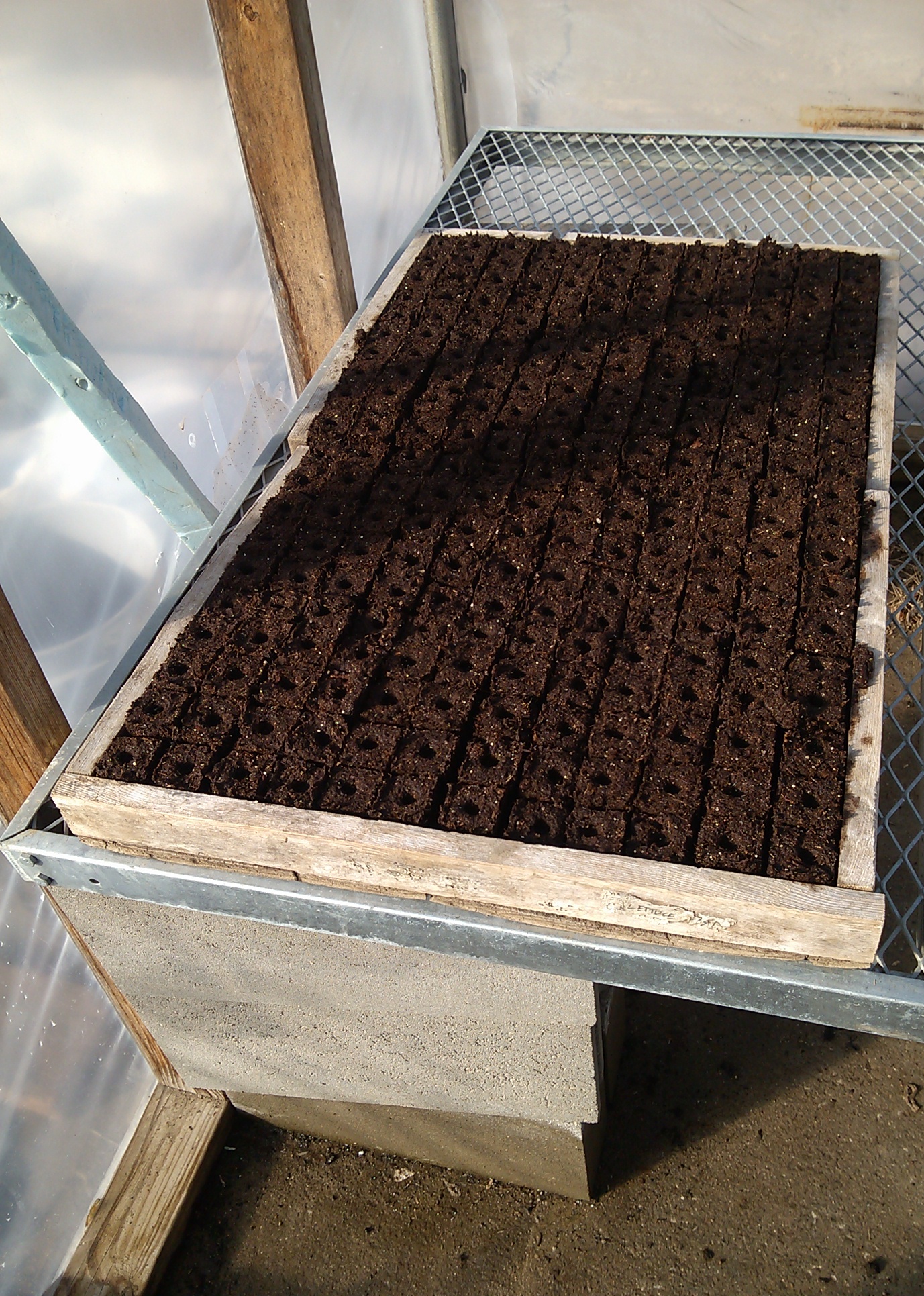
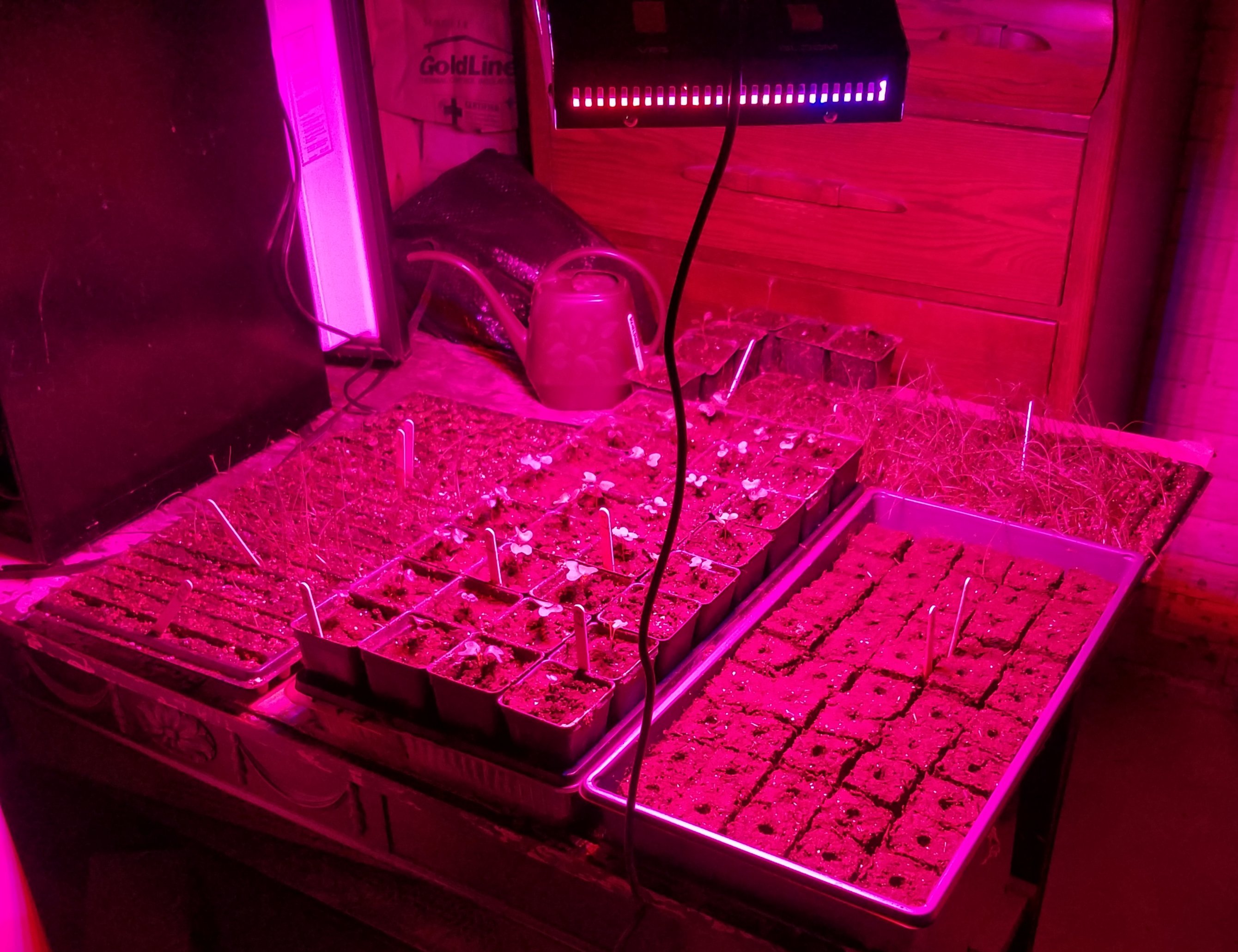
About 200 cell blocks with broccoli, kale, chard, collards, celery, herbs and more on March 2, 2024.
Yesterday a large flock of pelicans arrived on the lake. It’s a sign spring is coming.
While checking the mail, someone I’ve known since we moved here in 1993 was walking their dog. We had a discussion about the weather and about my garden which is one of the largest in the area. Our consensus of two was it is going to freeze again. It is too early to start digging garden plots.
In my fourth week of indoor seed planting, things seem to be going well. Most seeds have sprouted on schedule, and despite growing indoors, are developing in a way that will make for sound seedlings. Soon it will be time to assemble the portable greenhouse and move some outside.
There was a Red Flag Warning on Sunday, which means a risk of wildfires. I will delay brush burning until the warning ends.
I got these on Saturday at the Solon Public Library Annual Used Book Sale for a free will donation.
On Saturday I went to the public library and bought three books at their used book sale. I began reading the Pete Souza book as soon as I got home and couldn’t put it down until I turned all the pages. It is incomprehensible we went from Obama as depicted in these photos to Trump. I began to tear up a couple times while reading it. I am usually more reserved.
This led me to thinking about the presidents during my lifetime and this brief rating:
Truman: Don’t recall as president.
Eisenhower: Okay for a Republican/Interstate Highway System
Kennedy: Favorable
LBJ: Vietnam/Voting rights/Medicare
Nixon: OMG!
Ford: Not Nixon
Carter: Malaise/Camp Davis Accords
Reagan: JFC!
George Bush: Reagan-lite
Clinton: +/- Neocon
George W. Bush: Bad, very bad
Obama: My president
Trump: Nightmare/insurrectionist
Biden: What I expect from a Democrat
Spring is two weeks away and the days tick by much faster than I’d like. By my count, I can expect 14 more springs during my lifetime. I plan to find enjoyment in each of them. Hopefully pelicans will be a part of them.
It was time to get soil mix for seed starting. The amount leftover from last year wasn’t enough to get through this weekend’s planting of herbs, cauliflower and broccoli. I emailed the dirt company (yes, we have those in Iowa) to make sure they had what I needed and drove over near Tipton yesterday to get it. The sun was so bright I had to wear sunglasses.
I enjoy that drive. When I was a paid political campaign consultant I got to know Cedar County quite well, both cities and rural areas. I could name the owners of some of the farms as I passed. The direct route to the dirt company is over gravel roads. While the car needs a wash when I finish the trip, I feel comfortable in that geography without a map. I have driven those roads so much I don’t need one.
It was also a great day to be outdoors driving along massive fields coming out of winter. There were a few pieces of farm equipment on the roads, yet most of the fields haven’t been touched this year. Corn stubble left from the 2023 harvest was everywhere. The Cedar River seemed lower than usual, likely a result of continuing drought conditions. It seemed like the end of winter, although with spring not far away.
It has been more than ten years since I had a pickup truck. I miss those days. To get the soil mix to fit in our subcompact, I had to remove the shelf in the back window and flip down the seats. I laid a couple of towels over everything so it wouldn’t get dirty. The subcompact held to the roads pretty well as I am an experienced rural driver.
I figure there are 14 more gardens in me before I get too old to grow them. Back in the day when we first married I just stuck tomato plants in the ground and hoped they produced. I added some skills in the 41 years since those first plantings. It helped to work on a vegetable farm for eight years.
The new portable greenhouse arrived, my fourth since I began using them. One was damaged in a straight line wind storm, the next by the August 2020 derecho, and last year the zipper tore loose. With a new one, this year should be fine. I’d prefer a permanent greenhouse yet even with the replacements it has been much cheaper to use the portable ones. We have plenty of uses for any extra cash, so the savings is welcome.
The kale seedlings are sprouting their third leaves so it’s time to put them in a bigger container before planting. With new soil mix in the garage, I’m ready.
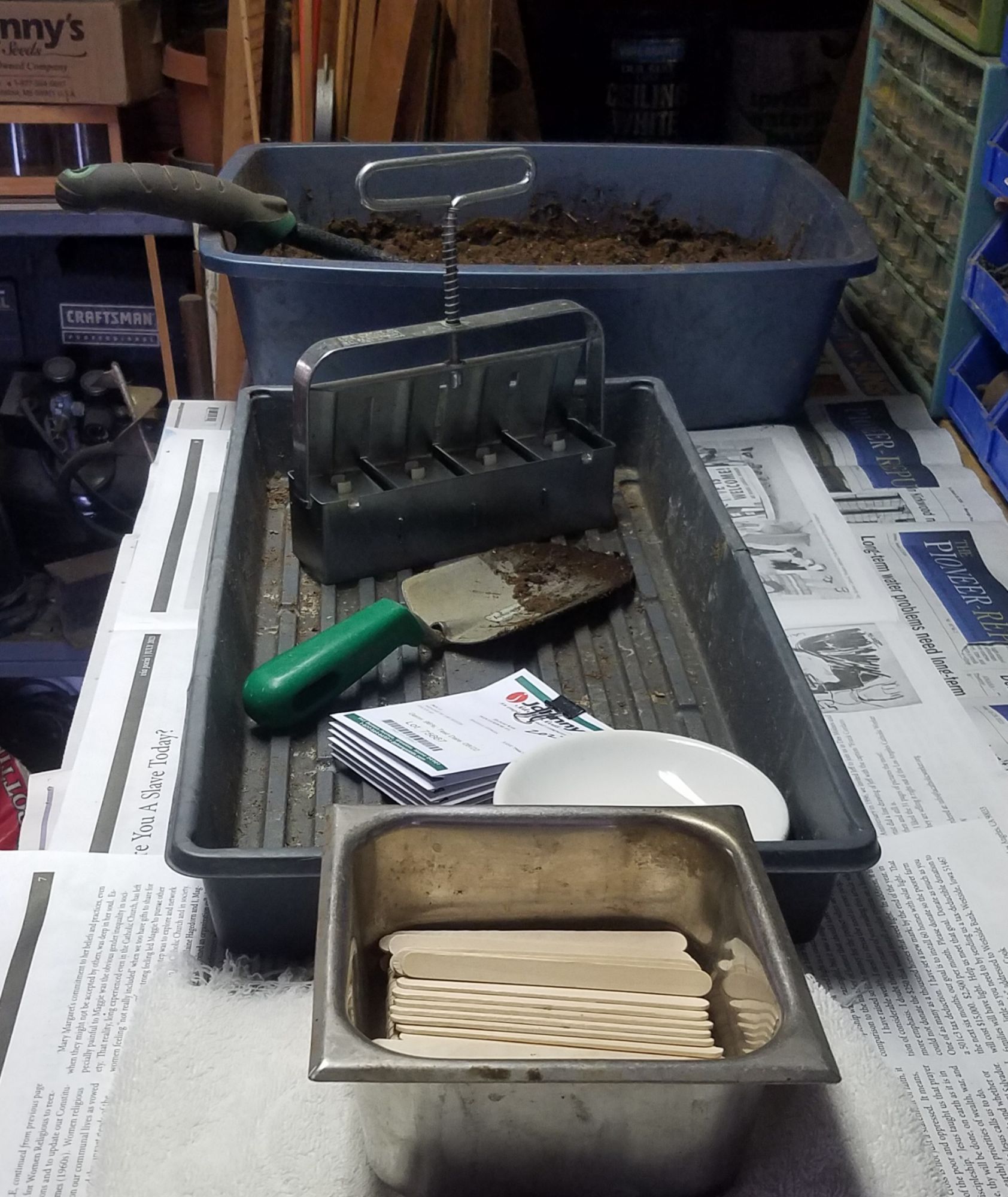
Tools to make the first tray of garden seedlings. Kale went in on Feb. 3.
I’ve been chatting it up with some neighbors on social media. There was consensus we hunkered down inside our homes for most of January because of snow and freezing ambient temperatures. There is hope for a break in winter and we’d just as soon move into spring. Personal productivity lags in winter. It’s time to step up the pace.
The idea of a “week” still resonates. Monday means start of the week, Friday is for closing down activities, Saturday is to perform a number of small household tasks, plus help our child with their small business. Sunday remains a day of rest, sort of. It’s not the same as when I worked full time. Then I knew that Friday usually meant casual clothes, voluntary trips to the office, and time to pursue my writing and family life.
I walked about the garden. The green I saw from the kitchen was collards that had been eaten more than I could tell from a distance. I had no interest in picking through the leaves, especially with a freezer full already available. I suppose the cruciferous vegetable-eating insects that survive the cold don’t have a lot to choose from in winter.
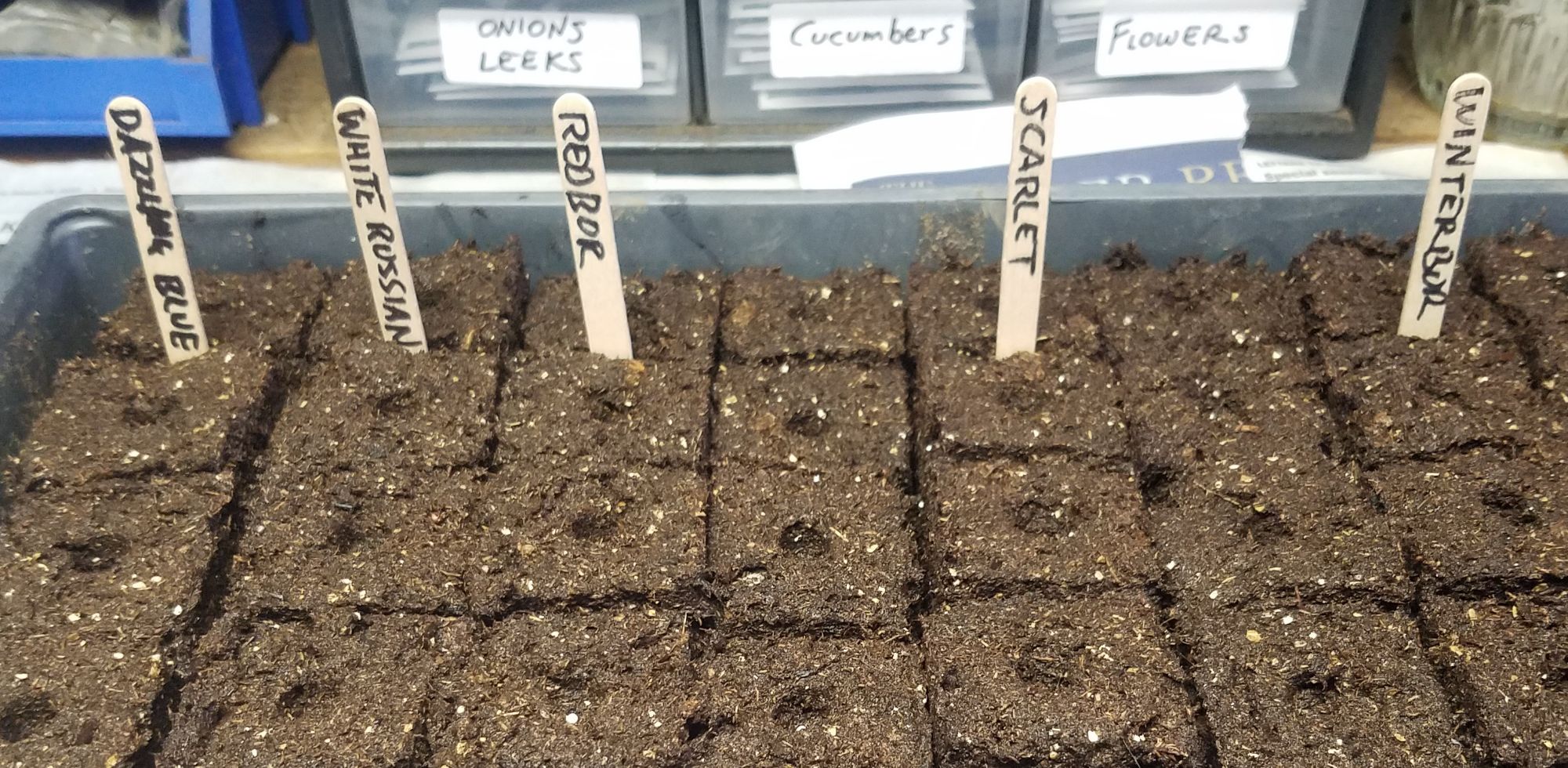
On Saturday I planted the first seeds for the garden and put the tray on a heating pad under a grow lamp. They are mostly last year’s seeds and that should not be a problem for kale. Kale is one of the vegetables I have mastered growing. It was something to see the tools lined up and ready to start. I worked with the garage door open for the fresh air and because we seem to be exiting the Iowa deep freeze.
February is an indoor planting month so I cleared the table where seedlings will go. First up this weekend is a tray of kale and selected herbs. Next it’s weekly planting until the garden soil is warm enough to sustain transplants or direct seeding. I bought new row cover as the old wore out and it helps grow herbs and lettuce like I never was previously able. Gardening 2024 has begun.
The Social Security Administration life expectancy calculator forecasts I will live for 13.9 more years. Based on that, and continued good health, I have 13 more gardens to grow. I already began scaling back.
Drip irrigation would make some vegetables grow better. Instead of learning about and installing it, I’m eliminating water-demanding vegetables like bell peppers, winter squash and carrots. None of these grew well here, and they are cheap to buy at the farmers market or grocery store. I’m focusing on what I grow best and leveraging the food system for the rest of our pantry.
A main driver in gardening changes has been changes in how we eat. My spouse changed to vegan during the coronavirus pandemic, so that changed how I cook shared meals. Cooking without dairy, especially butter, is a challenge. It renders large sections of cookbooks obsolete… especially the dessert section. We haven’t had meat in our home cooking since we married, so some of this is not new. Losing dairy makes a big difference, though, one to which I haven’t yet adjusted.
Nonetheless, growing a big garden is important to our way of life. The time to begin is now. I’m looking forward to the pinkish light illuminating trays of fledgling kale and broccoli.
My spouse went vegan a while back and I didn’t. I’m having to re-learn how to cook for both of us and I’m okay with that. It’s more work than expected, but I shouldn’t just kick back and grow old according to my former ways. This vegan bent in cooking, combined with other dietary restrictions we follow, led to a long list of food we don’t buy or seldom eat. Long-time readers may be familiar with some of them.
A pox on avocados because popular demand leads to deforestation with avocados being planted beneath the canopies of tropical rain forests before the rain forests are cut down. Either we are serious about preserving rain forests or we are not. That means no guacamole or avocado toast in our household.
Coconut oil? It’s a saturated fat people! Don’t be eating it when other, healthier options are available. I read the summaries pertaining to lauric acid. Still don’t eat it.
I forget why we don’t like mushrooms, yet there hasn’t been one of those in the kitchen for decades.
We never bothered being pescatarian enroute to vegetarianism. Folks should lay off fish for the sake of maintaining our fisheries. If unchecked, humans would take every fish that swims in the seas. If you missed it, sushi is usually some kind of fish, so avoid it.
Don’t get me started on jackfruit. Leave that one in Mexico or Guatemala. See the first item about deforestation.
Seitan is fine unless one has a sensitivity to wheat. We don’t eat it regularly.
After a long search for a recipe to make vegan pumpkin bread with my wealth of frozen Casper pumpkin flesh, I developed this one, which was good.
Vegan Pumpkin Bread
Dry ingredients:
2 cups all purpose flour
1/2 cup granulated sugar
1 teaspoon baking soda
1 teaspoon baking powder
1 scant teaspoon pumpkin pie spice plus extra cinnamon to taste
Pinch of sea salt
Wet ingredients
2 teaspoons vanilla extract
1/3 cup water at room temperature
1/3 cup apple sauce
1-1/2 cups pumpkin puree (or 15-ounce can prepared pumpkin)
Preheat convection oven to 350 degrees Fahrenheit.
Mix dry and wet ingredients separately then add wet to dry. Mix thoroughly, although not too much. Pour into a loaf pan greased and lined with parchment paper. Bake 55 minutes or until a toothpick comes out clean. Remove to a rack and let sit for 10 minutes. Makes 8-10 slices.
There is a frost warning tonight and that means one more garden gleaning before sundown. I expect to get kale, parsley, and maybe some tomatoes. I also expect this will be a hard frost, unlike previous nights that turned deciduous trees into paintbrushes full of color. Evolving what used to be cooking into a kitchen garden has been engaging and fulfilling. It changed — in a substantial way — how I cook meals with what grows on our property.
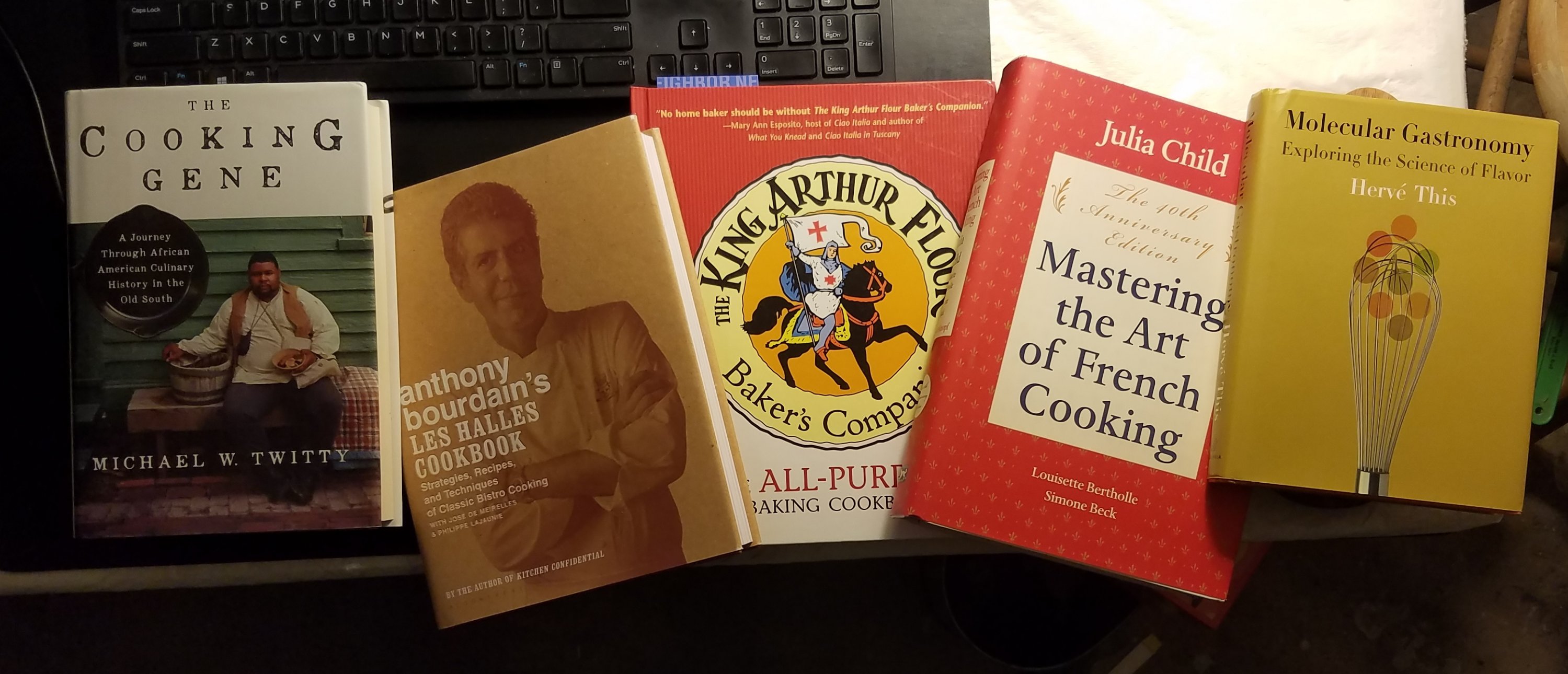
I have been a collector of cookbooks yet no more. These days I cook for weeks without opening one or consulting a recipe. When I make something sensational it is often unlikely the dish can be repeated. The reasons are many, whether it be living in the moment, freshness of ingredients, temperature and distribution of cooking heat, or how seasonings blend together. We bought a new range in May. It cooks differently from the previous one and continues to take time to understand settings, temperatures, and uses of the five cook top burners and oven.
A couple of posts ago I wrote about cooking grits and posted the photo on social media. People replied with variations I could make to improve the recipe. Thing is, the bowl of grits is rooted in ingredients already in my pantry and refrigerator. It is also rooted in my cooking process, which in this moment was to stand over the pot stirring constantly. The boiling liquid I used was half made by me vegetable broth and half two percent cow’s milk. I used Cabot’s extra sharp cheddar cheese I keep as a staple in the refrigerator. This particular bowl of grits was also rooted in that moment of creation and it seems unlikely I will get the same results the next time I make it.
Canned salmon was a big deal back when we had five digits in our private (as compared to party line) telephone numbers. In our 1950s and ’60s household, salmon patties were a once in a while treat on Fridays when we fasted from eating meat. The school I attended published a cookbook that lists multiple dishes to be made with this innovation found in the canned goods aisle at large grocery stores. Then, large grocery stores were also an innovation. Salmon salad, moist salmon loaf, salmon and vegetables in a dish, salmon custard, salmon in rice nests, salmon loaf, and other recipes were listed on the pages of the Holy Family School P.T.A. Cook Book. These days there is an abundance of fresh salmon available so the idea of using canned salmon is outdated. In 2010, when I was in Montana visiting friends, we went to the store and bought salmon steaks for a family meal. The meal was memorable. Canned salmon was revolutionary, as are the modern industrial salmon fisheries and farms. As a mostly ovo-lacto vegetarian, salmon wouldn’t be a part of any meal we prepared at home today.
People I know use recipes as a jump point in meal preparation. They search the internet, use a single purpose recipe application, or look through magazines and cookbooks to find something for dinner. They then modify the recipe to match personal preferences or ingredients on hand. I think most home cooks follow one of these methods.
I use internet searches when I have an abundance from the garden. For example, I recently searched garlic, tomatillos and chili peppers and came up with several ideas about how to preserve them as a condiment until the next crop is available. My home made apple cider vinegar is used as a preservative, making the dish ultra local. There are currently about a dozen jars of chili sauce in the refrigerator and pantry, no two of which are the same. It keeps things interesting while also using the harvest.
Another spontaneous aspect of cooking is using “my recipes,” meaning personally developed dishes, the recipe for which resides in memory or is written down in a notebook, 3 x 5 index card, or in the margins of cook books. We all have dishes like this. In our case, they form the framework of a weekly menu. Stir fried tofu with vegetables and rice is a complicated undertaking and we do that every week or two. Big batches of home made soup and chili stored in quart jars in the refrigerator are go-to meals when we don’t feel like cooking. Tacos are another mainstay. We use uncooked flour tortillas from the wholesale store and on hand ingredients from the garden and pantry for filling. The ingredients follow the seasons year-around with fresh tomatoes when they are available and frozen greens in winter. When we cook like this, there are few reasons to consult with a cookbook or recipe unless we’re understanding how to cook a new dish.
Morning has turned to afternoon and I haven’t been to the garden yet. I’d better get going. Thanks for reading.
I let my southern roots show by making grits for breakfast. There is no recipe, just an approximation. For a single large serving bring two cups of liquid to a boil (half milk/half vegetable broth) and add half a cup of grits. Salt and pepper to taste and cook on medium low heat until the texture of ground corn begins to show. Add one tablespoon of butter and then half a cup of shredded extra sharp cheddar cheese. Stir until every thing melts and the dish comes together. When the grits are soft, they are finished.
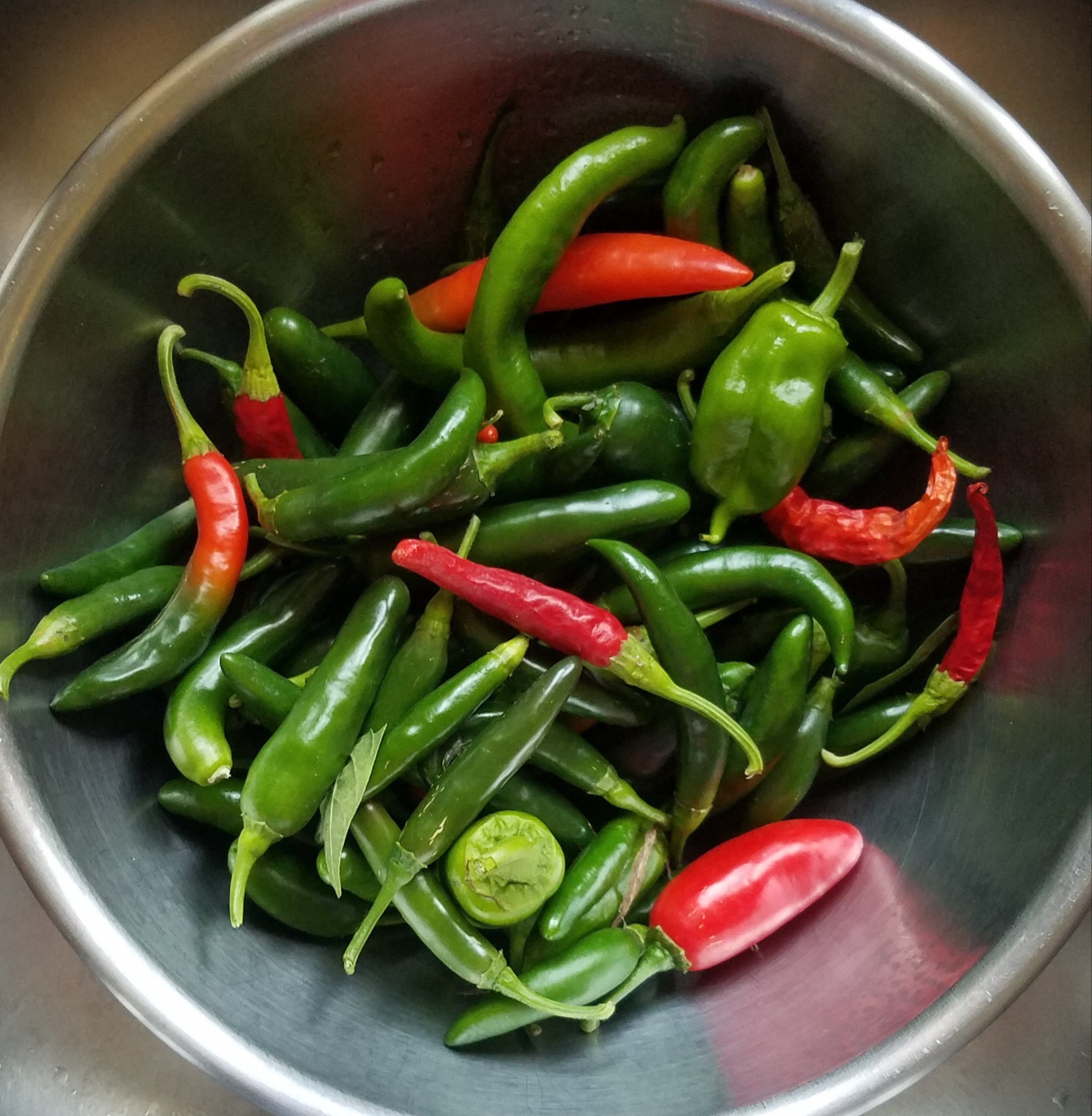
Last of the hot peppers as I cut the pepper plants down to clear the plot.
I’m taking down the third garden plot because I need a place to store tomato cages over winter. This was a hot pepper, fennel, eggplant and tomato plot. Fennel is coming back to life so I may get enough for a stir fry or two. To preserve the ground cover for another year, I cut the plants off close to the ground, remove the staples, and lift it off gently to get minimal tearing. Reusing assets like ground cover is a key economic factor in gardening.
Looks like we’ll get a hard frost over the weekend. It’s about time. I rely on cold weather to suppress garden pests. In addition, I already have enough hot peppers and kale to last until next year.
A local farm had a bumper crop of specialty pumpkins this year. Everything was priced half off over the weekend. I bought a large Casper pumpkin for pumpkin bread. I’ll bake it all and freeze it in amounts to fit the recipe. What they don’t sell will be fed to their cattle. Cattle enjoy eating pumpkins, apparently.
That’s all for this life in Iowa. Thanks for reading and make it a great day!
After turning soil in the new garlic plot the next steps are breaking up the heads of seed garlic to pick the best 100 cloves, spreading composted chicken manure over the plot, and running the rototiller until the soil is thoroughly mixed. This year the soil is a bit diverse with composted wood chips, compost from the large garden waste composter, and a variety of soil types from planting a diverse mix of vegetables here. Gardening is always an experiment. We’ll see how garlic in this mixed plot goes.
Garlic marks the last planting of the year. From here, garden work consists of taking down all the fencing and caging and stacking it for next year. I don’t always finish that work, leaving some of it for spring.
My posts about garlic are among the most popular on this blog.
Seed garlic 2023.
Last night, two of my political friends Laura Bergus and Pauline Taylor won their primary to advance to the City Council ballot in November. Here in Big Grove, the November election is not significant. As I covered previously, there are two incumbents running for two school board seats and that’s it. Our household plans to vote.
U.S. Senator Joni Ernst and U.S. Representative Mariannette Miller-Meeks were both on a trip to the Middle East when Hamas attacked Israel. Miller-Meeks returned early for the House Speaker election today, and Senator Ernst met with Prime Minister Netanyahu on Tuesday. Ernst is co-chair of the Abraham Accords Caucus and a member of the Senate Armed Services Committee. While she was there, Israel had begun bombing Gaza. The situation in the Middle East is complicated. The Hamas attack on Israel is not and the United States stepped up to help.
I am working my way off Twitter. I uninstalled the application from my mobile device and read it only on my desktop. There continue to be too many newsworthy accounts and too many valued friends and acquaintances there to give it up completely. Eventually, though, I will. Not having the application on my mobile lets me know how much I relied on it. That needs changing.
Rain is forecast around noon today. I hope to have garlic planted before it comes. It has been unseasonably warm, so if I miss the window, there will be another.







 Journey Home
You must be logged in to post a comment.