Kale is a money crop in my garden. By that I mean I learned how to grow it and have had success most years since. I distribute a lot of free kale to friends and neighbors. Today was the day to plant it along with broccoli. The varieties are:
Something was weird about the Calabrese seeds from Ferry-Morse. It appeared broccoli seeds were mixed with another kind, rendering the packet pretty useless for predictability. I planted some of each as the main broccoli crop will be Imperial anyway. We’ll see what happens.
Sundays in the greenhouse have become a day to which I look forward. The goats are due to drop kids any day, and of course we are well into lambing season. Our crew of five or six people works well together. I enjoy the conversation with twenty-somethings, although some of them will soon turn thirty.
I’m not sure the onions planted previously will make it. Some of them are tall and spindly. Others haven’t come up. The soil is damp so we’ll see how they come out. At this point if they fail I can get starts elsewhere.
My small, portable greenhouse arrived this week. Instead of keeping flats of seedlings on a short stack of pallets near the garage door and moving them inside at night, I’ll keep them here. I’m not sure how exactly it works, but look forward to learning.
The weather has made this year’s start better than 2019. Let’s hope it continues.
I planted our first Big Grove Township garden in Spring 1994. What I grew is lost in memory.
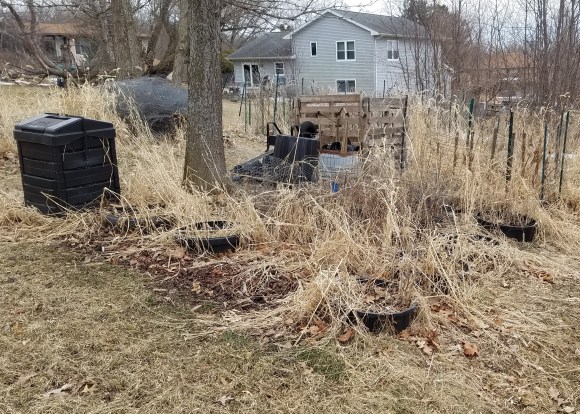
Yesterday the original plot looked a wreck with desiccated weeds and a hodge-podge of sunken containers, fencing, two composters, a wheel barrow, an old wash tub, six-inch pieces of drainage tile resting on a couple of pallets, and a locust tree. The locust tree was intended for transplant but it got away from me.
I don’t know if the locust tree will recover from last winter’s extremely cold temperatures. The tips of branches in the crown did not leaf out last spring. If it doesn’t recover I’ll take the tree out even though the shade it provides protects plants and conserves moisture during our increasingly hot, dry summers. The plot was not meant to be a permanent residence for trees.
A friend in Cedar County gave me black plastic tubs in which feed for their animals was delivered. I cut large holes in the bottom for drainage and buried them to grow potatoes, radishes, lettuce, basil and sundry root crops. Mostly it was for potatoes which when planted in the ground fed small rodents who thrive with us in the garden. The containers worked to keep them away from the roots.
Composters are necessary for a garden to turn organic matter into fertilizer. One is an open air composter made from pallets retrieved from the home, farm and auto supply store. Garden waste goes in there. The other is a sealed, black plastic container for organic household waste such as peelings, fruit cores, and other fruit and vegetable matter generated from the kitchen. That is, it used to be sealed. Over the years something got inside and has been pushing stuff out of the entry point chewed into the plastic. I should fix or replace it. Until I do it remains a place to dump the kitchen compost bucket and produces some usable compost. The next time I move it there will be compost.
If I had a garden shed I would not use the plot for storage. I continue to think about building a shed, but that’s as far as it has gotten. It won’t be this year, or probably next.
Despite all the useful clutter, the plot continues to be productive. Last year I grew broccoli, eggplant, radishes, basil and beets there. The year before I grew cucumbers. The containers are always busy with multiple crops each year. As I plan this year’s garden I see better utilization of this plot.
Ideas about 2020 in plot #1: Belgian lettuce on or about March 2; potatoes in containers on Good Friday; radishes in a container; a crop of something, cucumbers, eggplant, or maybe hot peppers to change from cruciferous vegetables planted here last year. These are ideas, and the beginning of planning. We’ll see how it unfolds, although Belgian lettuce seems certain a week ahead of the date.
I remember digging this plot in 1994, measuring the distance from the property line, a memory of nothing growing in the yard except grasses and a mulberry tree in the Northeast corner. I barely knew how to garden then. In the interim, my views of how to garden have changed for the better.
Based on the 15-day weather forecast, winter is finished. As temperatures climb and the remaining snow melts we had just better accept it we won’t have had much of a winter. It is time to lean into the growing season as soon as Mother Natures enables us. Soon it will be Spring.
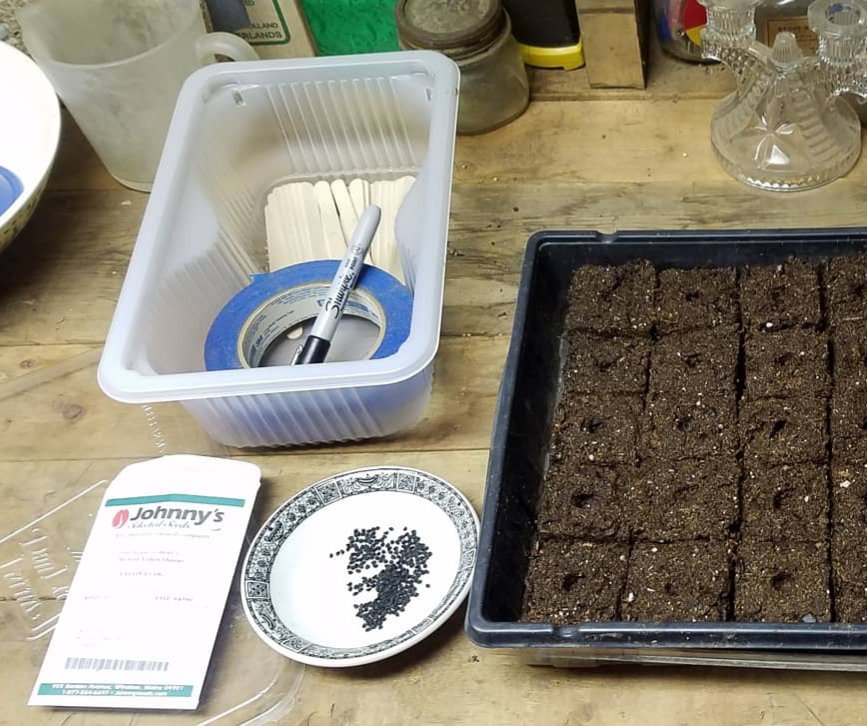
I planted leeks in soil blocks at home today. They were,
King Richard, Johnny’s Selected Seeds, 75 days. One row of ten.
Megaton, Johnny’s Selected Seeds, 90 days. Three rows of ten.
American Flag, Ferry-Morse, 150 days. One row of ten.
This is a further experiment in starting plants at home. In the past I hadn’t paid attention to different leek growing times but American Flag is double that of King Richard. I double seeded King Richard and American Flag because they are from previous seasons. If both seeds sprout in each cell I’ll thin them.
Pulling plastic at Wild Woods Farm, Feb. 23, 2020.
Sunday a group of us gathered at Wild Woods Farm to pull plastic over the new greenhouse.
Pulling plastic takes a couple of experienced team leaders and a crew that can follow directions. The idea is to make the plastic covering as taught as possible then secure it with wiggle wire for years of use. The work proceeded as planned on a warm, clear and calm day.
It’s pruning time for grape vines, fruit trees, and any kind of tree. This weekend people were pruning in t-shirts because it was so warm. The concern is sap begins to flow before the cuts heal, creating an entry point for disease. Fingers crossed I got mine pruned in time. Folks are preparing to tap maple tree sap for syrup so we are at the in between time for finishing pruning.
My onions and shallots have sprouted and I moved them to the landing to get more light. They seem feeble at this stage. I’m not sure what else I can do but make sure they have moisture and light. This is the second year I tried starting them myself. The first didn’t produce usable onion sets. This year’s experiment is for the crew at Sundog Farm to start some of my shallot seeds as well to compare results. Eventually I’ll get this right, hopefully this year.
While garden and yard work beckons it is still winter. Piles of snow remain on the ground. Snow is forecast this week. There is hope for spring, but it is a false hope. It’s best to use the time to catch up on indoors work so when true spring arrives we are ready.
Panel of regional farm mentors. L. to R. Dayna Burtness, Nettle Valley Farm; Zachary Couture, Luthern Services in Iowa Global Greens; Alfred Matiyabo, Moving 4Ward Farm; and Derek Roller, Echollective Farm on Feb. 20, 2020 in North Liberty, Iowa
“The Johnson County Historic Poor Farm provides a public space for connecting to the land and local history through inclusive community-led opportunities,” said Vanessa Fixmer-Oraiz, farm project manager. She spoke at last night’s Johnson County Food Policy Council public forum where the poor farm was a featured topic.
This was my first forum as a member of the council. I brought a five gallon beverage jug, lemonade, coffee condiments, and a 20-pound bag of ice. One attraction of the event was a catered meal from a local food-centered restaurant. Attendance we good at about 80 people. We ran out of lemonade.
Solid ideas were discussed, centering around how to help beginning farmers get access to land, capital and markets. A number of “eaters,” a.k.a. consumers, were present, leading to discussions about pricing, quality, and health issues related to food. There was no lack of discussion and much of it was captured on audio-video or written down.
The county poor farm is not a priority for me. Some of the same people who attended a similar local food forum eight years ago were present last night. It seemed little progress has been made in establishing a vibrant local food system. The challenges are many, the approaches individualistic. There are activities, such as farmers markets and public events held at farms. This forum was an example of a public, food-related event. Discussion is positive, yet what is lacking is something to tie them all together in a coherent system. I don’t believe the poor farm will be that string of twine.
In 2017, the Johnson County Supervisors decided to revitalize the poor farm as a “New Century Farm.” The 3-2 decision was depicted as contentious by the local newspaper. Then supervisors Rod Sullivan, Mike Carberry and Kurt Friese voted to adopt this plan. Lisa Green-Douglass and Janelle Rettig did not. Friese died in office and Carberry lost his re-election bid, yet county support for the site persists. The forum was an opportunity to discuss how the poor farm might fit into a fledgling, disjointed local food system.
What made the 2017 supervisor meeting “contentious” was the discussion of affordable housing at the poor farm. Affordable housing is a key county issue, although I’m not sure of the benefit of sticking a development off Melrose Avenue, which is distant from the city-center and amenities like grocery stores. The poor farm is currently on the Iowa City bus route, but that route is being considered for elimination. There are logistical challenges to be addressed if the poor farm will be used for housing for people besides those who work or farm there.
One of the forum panelists, Alfred Matiyabo, gained access to land via the poor farm and this seems an excellent use of the resource. Land access is a key need of beginning farmers. More of that, as well as development of the planned trails and facilities, could create another valued farm incubator, conservation, and recreation site within the county.
My sense is two and a half years after adoption of the plan for the poor farm the community conversation is just beginning. As long as the supervisors have the will to fund activities, the project should be encouraged and supported. However, we can’t let it distract us from the bigger issue of engendering a local food system that matters in terms of satisfied consumers, economically viable farmers, and ecologically improved farming practices. The Historic Poor Farm fits in to the system, but is just one aspect among many.
The best part of last night was networking with friends and people I hadn’t met. If this is what being a member of the food policy council leads to, I’m ready for more.
The ten year old ran to the greenhouse to tell us, “There’s a lamb! I’m not kidding. She went to get the towel!”
The shepherdess left behind her power drill and rushed to the barn.
So began my eighth spring helping at Local Harvest CSA. More lambs dropped that evening and the goats are due soon. I’ve been around animals enough to recognize their pregnancy.
My job is to make soil blocks. I made enough for 3,120 seedlings. Once the seeds germinate and are established they will be transplanted in the high tunnel for a spring share of greens and lettuce. One of the farm partners was present planting flower seeds as well.
Yesterday had a couple of challenges. The hydrant outside the greenhouse was frozen so I carried water from another in buckets. The soil mix was frozen and required breaking up with a garden rake as I mixed it with water. Compared to previous February activities everything proceeded easily.
The seeding crew moved in and out of the greenhouse. There were a total of eight of us happy to be there and looking forward to spring.
I’m experimenting with shallots this year. My friend Simone grew them so I know they can be grown in Iowa. I’m also planting them both at the farm and at home using different techniques.
For a recipe I got out my copy of the Holy Family School PTA cookbook. I like this book for the familiar names of the recipe authors, some of whom I knew. Monsignor T.V. Lawlor served as the church’s second pastor from 1943 until 1961 and his photograph is printed inside the front cover of the book. This dates the cookbook in the 1950s most likely, after the school moved to the location I attended a couple of blocks south of the church on Fillmore Street.
I chose a banana bread recipe contributed by Mrs. H.A. Tholen. It called for shortening, although I substituted butter and kept everything else the same. Here are the ingredients as written:
1/2 cup sugar, 1/2 cup shortening, 2 eggs, 3 bananas mashed, 1 teaspoon baking powder, 1/2 teaspoon soda, 1-3/4 cup flour, and a pinch of salt.
Instructions are, “Mix in the order given and bake in a slow oven.”
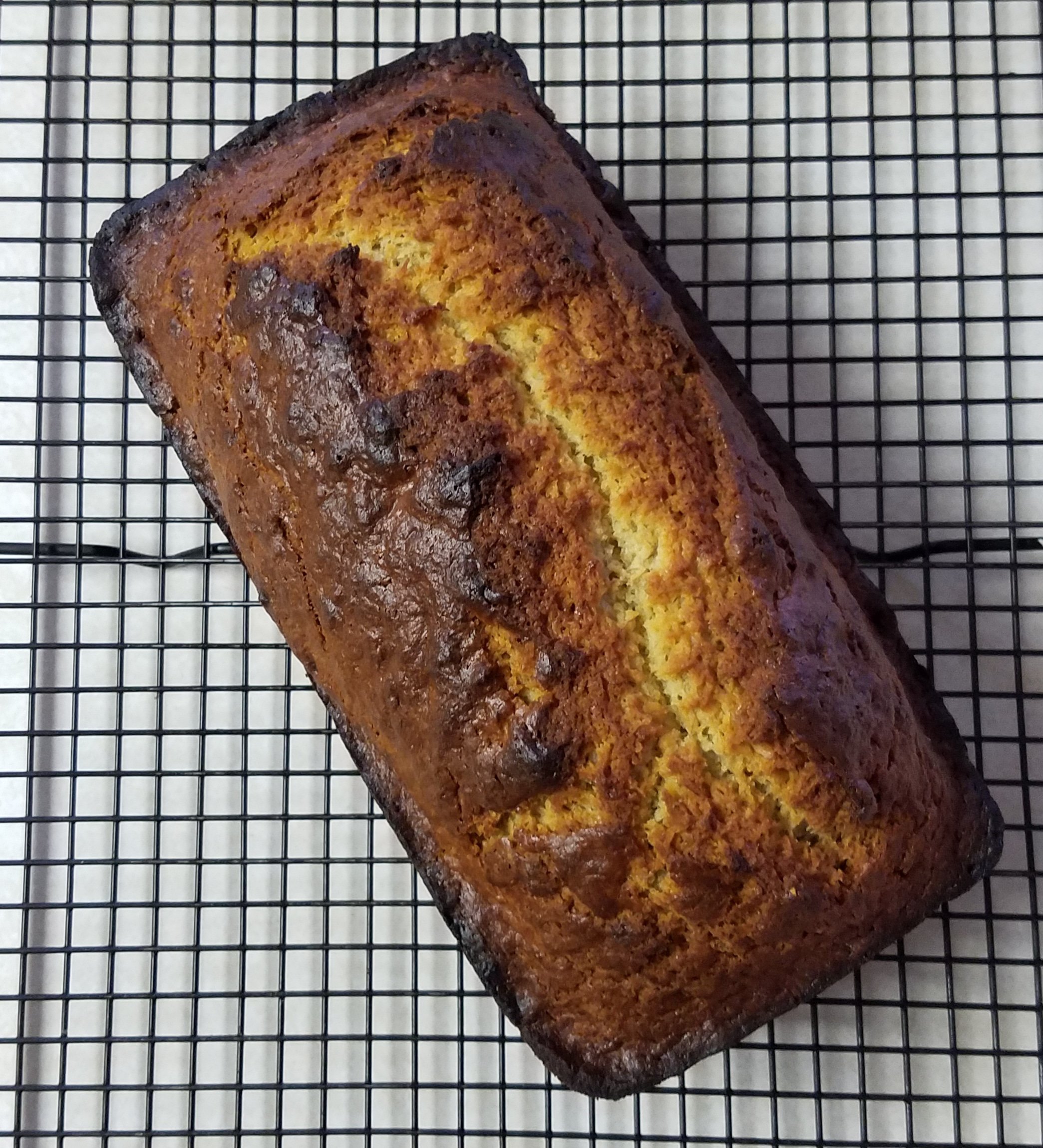
Well that won’t do. Looking at other sweet breads in the book I decided on a 350 degree oven for 50 minutes. It turned out great as you can see in the image.
Making banana bread from overly ripe bananas is a cultural inheritance not only from my mother and maternal grandmother, but from a broader society where fruit like the Cavendish banana is readily and cheaply available. However, like most mass marketed fruit and vegetables it is subject to change from climate and from other pressures, forcing old habits and patterns to change.
There was something positive in yesterday’s bakery. It was a warning too, that life is fragile and ever changing. We seek comfort in what we know, delaying the embrace of what is coming. I don’t just mean what’s coming for Cavendish bananas.
My 2013 decision to develop a barter arrangement with my friend Susan Jutz helped resolve a couple of issues.
I needed the cash income plus a share of the vegetables she grew. More importantly than income, I wanted to become a better gardener and needed a mentor.
By almost any measure our relationship was successful and endured even as Susan sold her farm and moved out of state.
On Feb. 1, 2013 I sent this email proposing an arrangement at her Local Harvest CSA:
Susan:
Hope you are staying warm. I have an interest in developing a deeper relationship with producing local foods. While our kitchen garden is doing well, I want to explore the possibility of doing more with local foods to provide a source of income. This is a long range project, and if you offer it, I would like to exchange my labor for a share of your CSA this season.
I think you would find this a cheap and reliable source of farm labor, and what I would get out of it would be a deeper knowledge of how you do your work.
What do you think?
Regards, Paul
We worked through details that lasted not only that season but established a continuing relationship now entering its eighth year. I expect the conversation about local food to continue this month with Carmen, Susan’s successor. Greenhouse work usually begins in February.
The Community Supported Agriculture model is the workhorse of the local food system. Instead of producing a few fungible commodities, CSA farms produce many types of vegetables in many varieties, providing a weekly share for members who buy in at the beginning of the season. They also leverage other producers to provide eggs, meat, bread, jellies, jams, and other items they don’t produce for their customers. On Carmen’s farm she produces grass-fed lambs and goats. The presence of livestock on a farm is an important part of reducing reliance on chemical fertilizers. Some CSA farms are more diverse than others but the salient feature is that the main consumer model is changed to include a share the farmer provides.
Operating a small farm is challenging. It requires hard work and specific knowledge about a wide variety of issues. It seems like more work than people with a big job at a large-sized employer are used to. There is also more risk during a growing season. Most local food farmers I know do something off the farm to supplement farm income. Every one of them has a positive disposition despite the challenges.
There is an ongoing discussion about alternatives to the CSA model.
Chris Newman of Sylvanaqua Farm in Virginia posted an article on Medium in which he wrote, “The romance of neoliberal peasant farming blinds us to our collective power.” Newman’s assertion is small family farms are not competition for, or a sustainable answer to burgeoning consolidation of agriculture. He touched on a number of obvious points, beginning with farmers markets.
Farmers markets are nice for consumers, but expensive to participate in. If some local food farmers produce for the seasonal markets they compromise their flexibility and scalability, he said. I don’t know about the operational advantages of a local food cooperative because many farmers already coordinate activities with each other. A farmer of meat, vegetables, flowers or the like can do better to avoid such markets. At a minimum one requires additional outlets to extend sales beyond the farmers market season.
Newman lays out the challenges small family farms face regarding workforce in a labor intensive business. Putting together a workforce that accomplishes weeding, cultivation, planting, harvesting, pest control, and everything else isn’t easy when the operating assumption is some percentage of workforce will volunteer or work for very low wages. Newman’s idea of forming a cooperative addresses the wage issue but also seems overly idealistic.
In his book The New Farm: Our Ten Years on the Front of the Good Food Revolution, Ontario farmer Brent Preston tells the story about how he and his spouse found sustainability in the local food movement by transitioning away from farmers markets to wholesale production and sales. This book is a must read for people interested in the local food movement.
Michelle Kenyon, executive director of Field to Family, is establishing a food hub in Johnson County. She’s been featured in the local newspaper. The idea is simple from a farmer’s perspective. Got too much basil? Bundle it to specs and sell to the food hub.
Having an outlet for a farm’s produce is important. Few local farmers follow the traditional CSA model of sharing the farm produce exclusively with members. That would mean all of the extra basil in my example would go to members who would presumably become rich in pesto and pasta sauce. Separating food production from CSA membership provides options for additional revenue streams such as selling to a food hub, to restaurants and to retailers.
A smart farm operator won’t put all their eggs and produce in single basket. They manage a portfolio of revenue streams based on farm production, but include variation in how customers are approached. So often, just having an item when others don’t makes a big difference in exploiting some types of “pop-up” marketing opportunities.
I would like to establish independence from the farms on which I’ve worked since 2013. Controlling everything would free me from outside responsibilities and enable re-designing my garden to expand and produce extra crops that could be sold to others. That has always been a small part of my garden operation but as I progress through my transition to “retirement,” any income generated could help supplement our structure of pension, Social Security and savings. For the time being, I look forward to returning to the farm for another spring of soil blocking. Looking back at this email to Susan, it’s clear I was not wrong to pursue the opportunity.
Preparing to cook red beans and rice has been a year-long process because most of the ingredients were produced in my garden or on farms where I work.
The garden produced red beans, okra, tomatoes and celery. Local farms produced onions, garlic and bell peppers. I also grew red pepper flakes and blended the powdered dry spices. Pantry staples of extra virgin olive oil, all purpose flour, and long grain brown rice were USDA organic but not produced in Iowa.
I invested several hours preparing a luncheon meal and time was worth it because of the flavor.
In the morning we discussed my 5-1/2 quart Dutch oven, the enamel of which is wearing off the inside. I’m don’t favor replacing it. Not because of the $350 price tag for a new one from Le Creuset. With a bit of cooking oil on the bottom to prevent rusting it will serve many more years. It is my go-to pan for making red beans and rice. It has been a reliable part of our kitchen.
Cooking is a ritual that evokes memory and skill in bringing a dish together. I soaked a cup of dried red beans in the Dutch oven overnight, then cooked them with half a diced red onion until tender but not mushy. I drained the beans and reserved the cooking liquid, letting them sit on the counter until ready to make the dish.
Around 10 a.m. I started work.
I fried a couple of home made vegetarian burger patties from the freezer and set them aside to drain. (Andouille sausage would be more traditional).
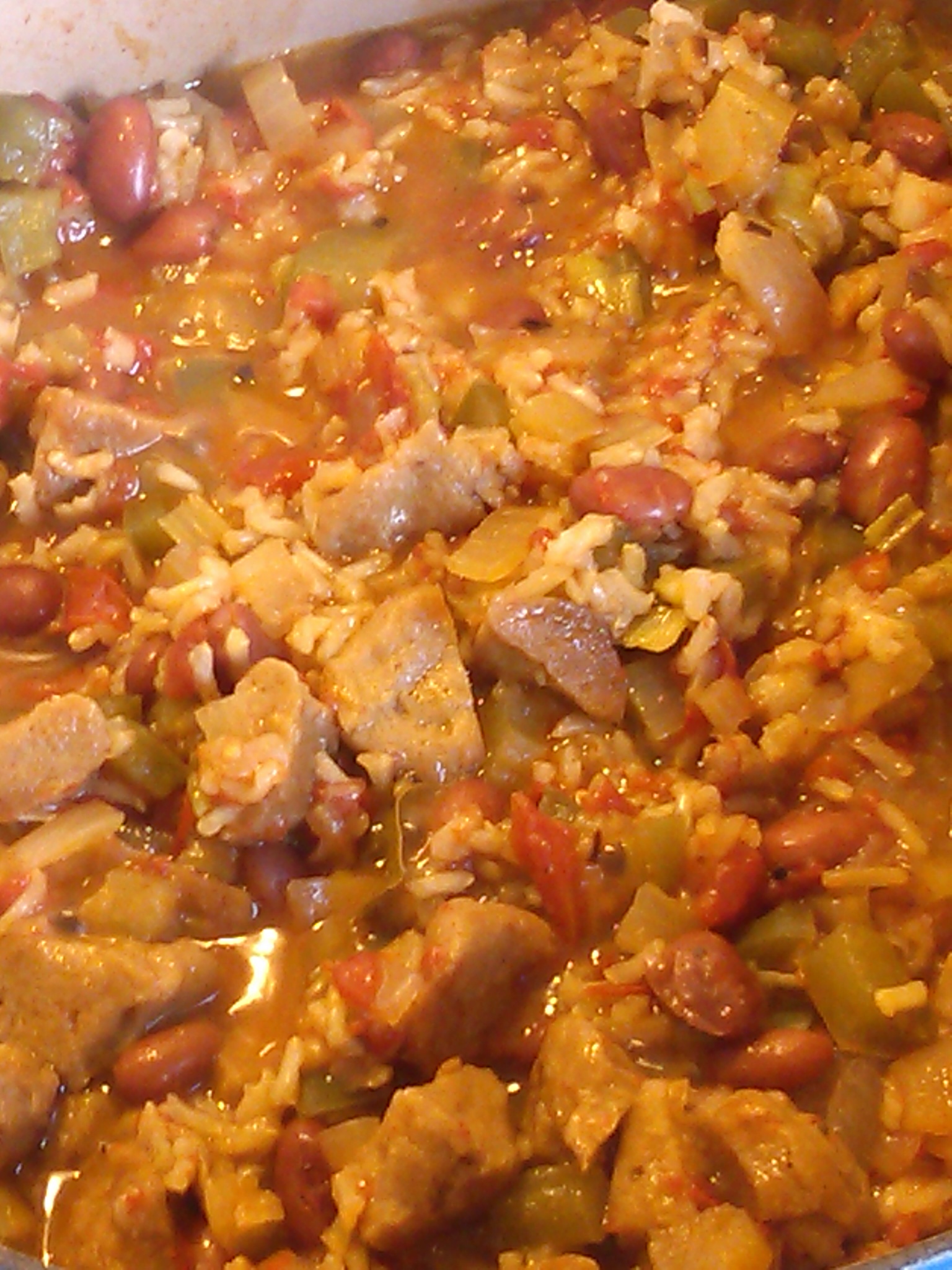
Heating the dutch oven, I added two tablespoons of extra virgin olive oil and cooked a generous tablespoon of red pepper flakes. I diced half a large onion, red bell peppers, and celery stalks and sautéed them in the oil-pepper mixture with a little salt. Once they began to soften I added two cloves of minced garlic and added home made seasoning — think powdered garlic, curry powder, paprika, and powdered hot, red peppers. I added a few dashes of prepared hot sauce from the refrigerator and stirred until everything was incorporated.
Next came additions. I deglazed the pan with a pint of diced tomatoes. Next, a cup each of sliced okra and long grain, brown rice. I stirred in two tablespoons of all purpose flour, then the cooked beans, until everything was incorporated. I tried not to bust up the beans.
What liquid to use was an open question. This time my answer was two cups of the bean cooking liquid (that’s all there was) plus two cups of water. Other options I considered were canned tomato juice and home made vegetable broth. The flavor of the bean cooking liquid made it a good decision.
Stirring everything together, I brought it to a boil then turned the heat down to a simmer, cooking until the rice was done and most of the liquid had been absorbed. Toward the end of cooking I crumbled the burger patties and folded them into the mixture.
It was ready to eat at noon, making four to five portions.
We seek opportunity to follow our creative impulses and cooking is primal. It provides an opportunity to shed anxiety from quotidian affairs, if only for a few hours. A recipe makes the experience replicable but not really. Cooking is a story of how we sustain ourselves in a turbulent world.




 Journey Home
You must be logged in to post a comment.