When gleaning the garden I picked a number of green cayenne peppers. Not wanting to mix them with the red ones, I ground them into a fine powder and have been using it in lieu of hot sauce on Mexican-style dishes. It is an unexpected treat.
While making tacos on our Taco Tuesday, I used the last of the fresh kale from the refrigerator. We almost made it to 2026. Now we turn to the freezer for leafy green vegetables. There is plenty for household use.
We make tofu stir fry on rice as a main course. I have been experimenting with pureed garlic. It is made with extra virgin olive oil and garden garlic. In stir fry, it mixes with the water used as a cooking medium and forms a tasty sauce. I will be pureeing more garlic as we use up the initial batches.
It’s almost time for another pot of barley-lentil vegetable soup. I will raid the freezer for ingredients, including grated zucchini and summer squash, diced celery, prepared pumpkin, and collards. A warm bowl of soup is appreciated this time of year.
I cleaned off my writing table because I spilled a giant cup of coffee on it. The damage was minimal but the drop cloth that protects it got wet and is draped over the car to dry. I found a bottle of furniture cleaner and treated the surface. Nothing says you are ready for what’s next like a clean writing surface.
Coffee mug made by Alea when we worked together at the orchard.
I will spend my two Friday afternoon work blocks getting ready for the arrival of our child. Mainly, that means cooking. Great Northern beans soaked overnight and are heading for a traditional bean soup made with carrots, onion, celery, and bay leaves cooked in homemade vegetable broth. There will also be homemade cornbread. I am debating whether to make applesauce cake or pumpkin bread for dessert. We’ll see what happens. It goes without saying, supper will be completely vegan.
Ever since the fire ran them out of their apartment building, first to temporary quarters and then to a new rental in a western suburb, our home became a storage depot for stuff not needed now, but was worth keeping. More storage items are enroute as I type these words. I created a storage platform with the loft bed I made for their college dormitory. It serves.
This is a tribal time. We don’t spend time together at the end of year holidays, so this is what we do. Have a bean soup supper two weeks before Christmas Day. Life is good.
My spouse’s trip to her sister’s home extended into a third week. A typical behavior when I’m home alone is going through the pantry to see what new ideas I can experiment with while my mate is gone. I found we have a LOT of quinoa. Some I bought on discount at the home, farm and auto supply company before the pandemic, and the two boxes came from mail order. I decided to cook a quart of it in vegetable broth and see where things went.
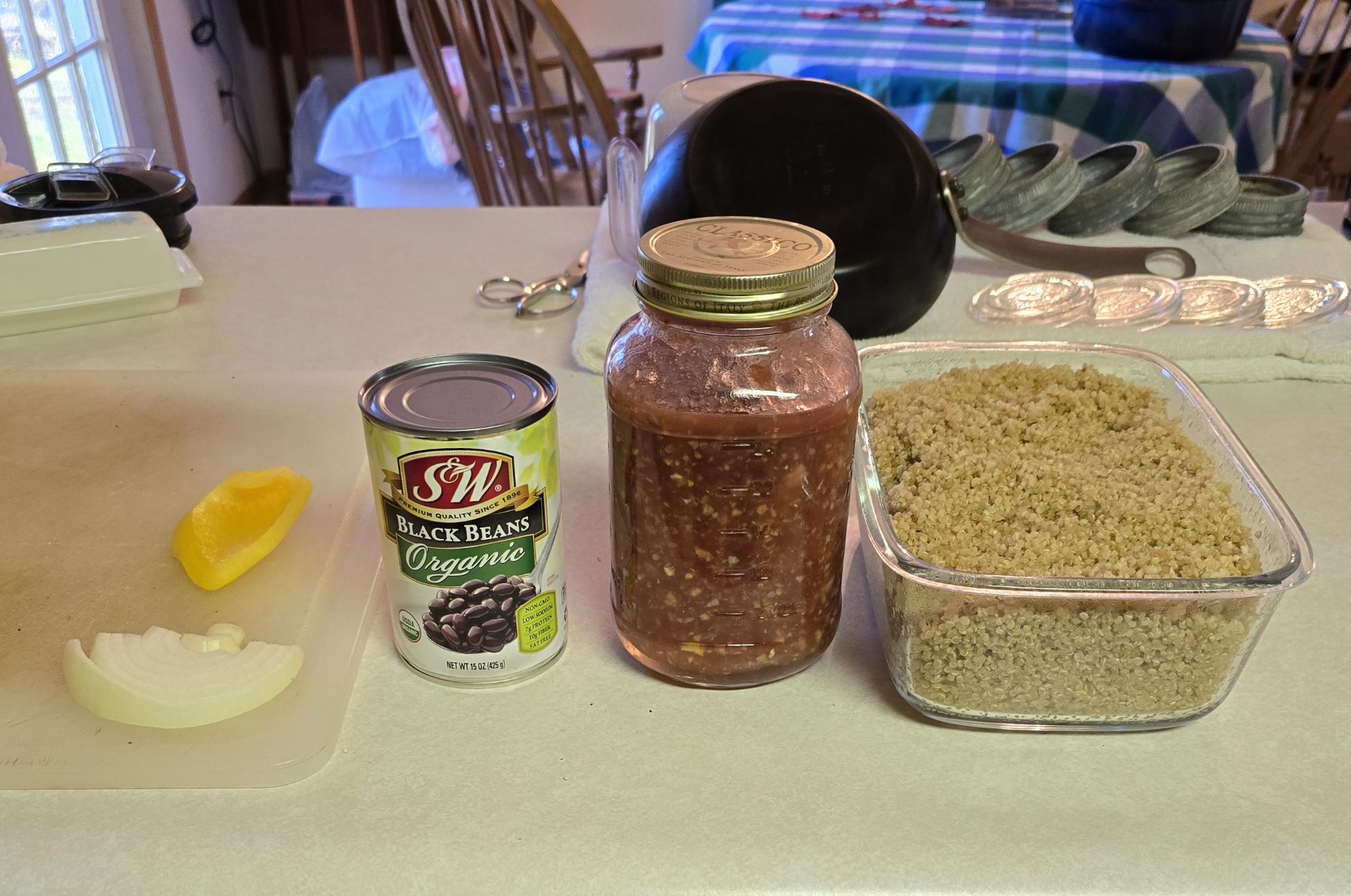
Quinoa bowl ingredients, including less than half the prepared quinoa.
I discovered a quart of uncooked quinoa makes a GIGANTIC amount of cooked. I tried some after cooking the batch and found it quite good by itself. It’s a nice change from other grains. I did research about using it and came upon the quinoa bowl. There will be a lot of those during the next week to ten days.
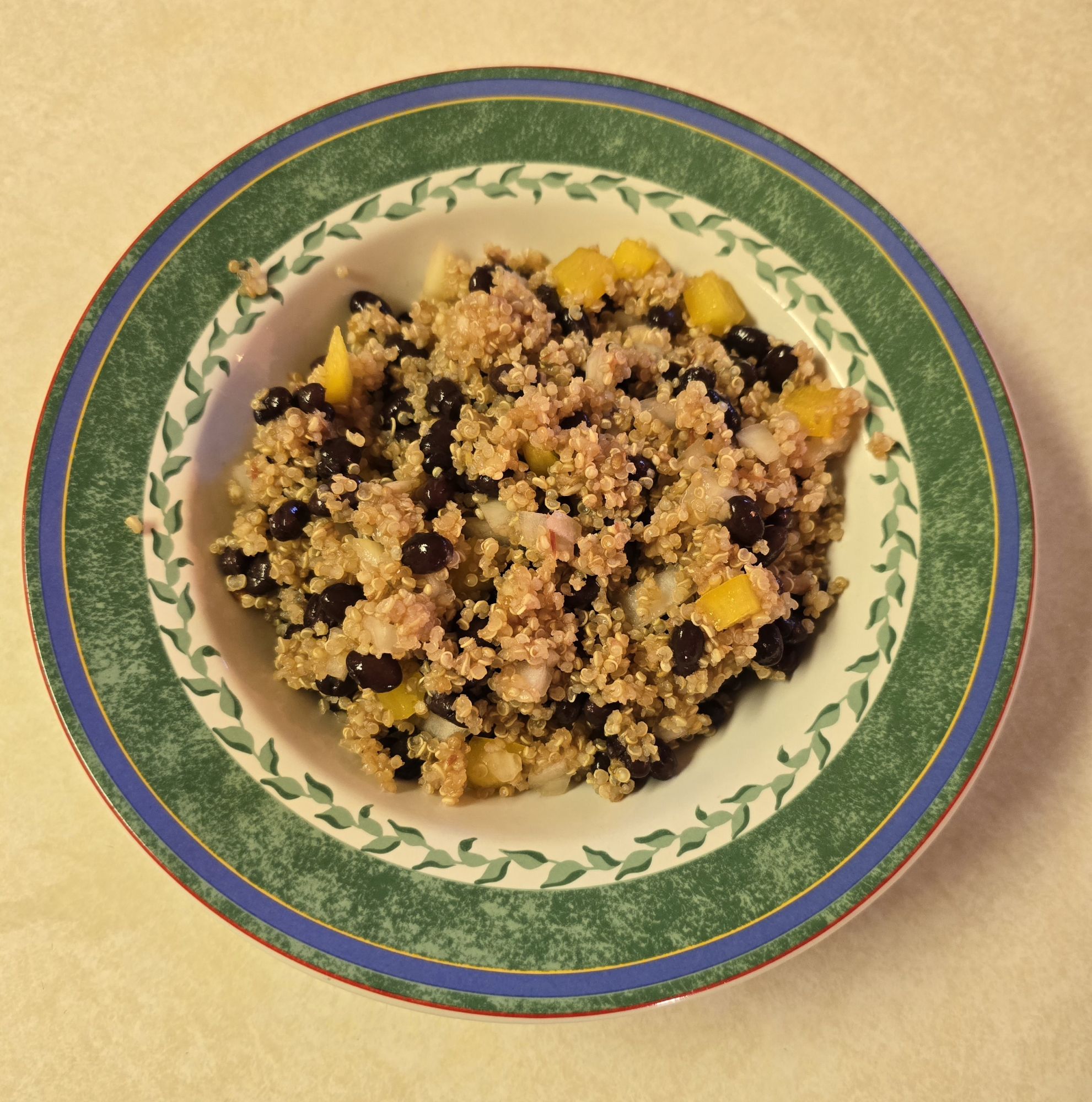
The premise is basic: use a base of cooked quinoa and mix it with other things. First up was a Mexican-style quinoa bowl. I used quinoa, canned black beans, homemade salsa, onion, and bell pepper. The vegetables were raw, and everything else cold. I put the ingredients in a bowl and mixed, and voilà: dinner is served. It hardly made a dent in the quinoa. As far as taste goes, I rate it 8 of 10.
Quinoa bowl.
These are going to be quick, simple, inexpensive, and tasty meals. Now the search for other inspiration begins.
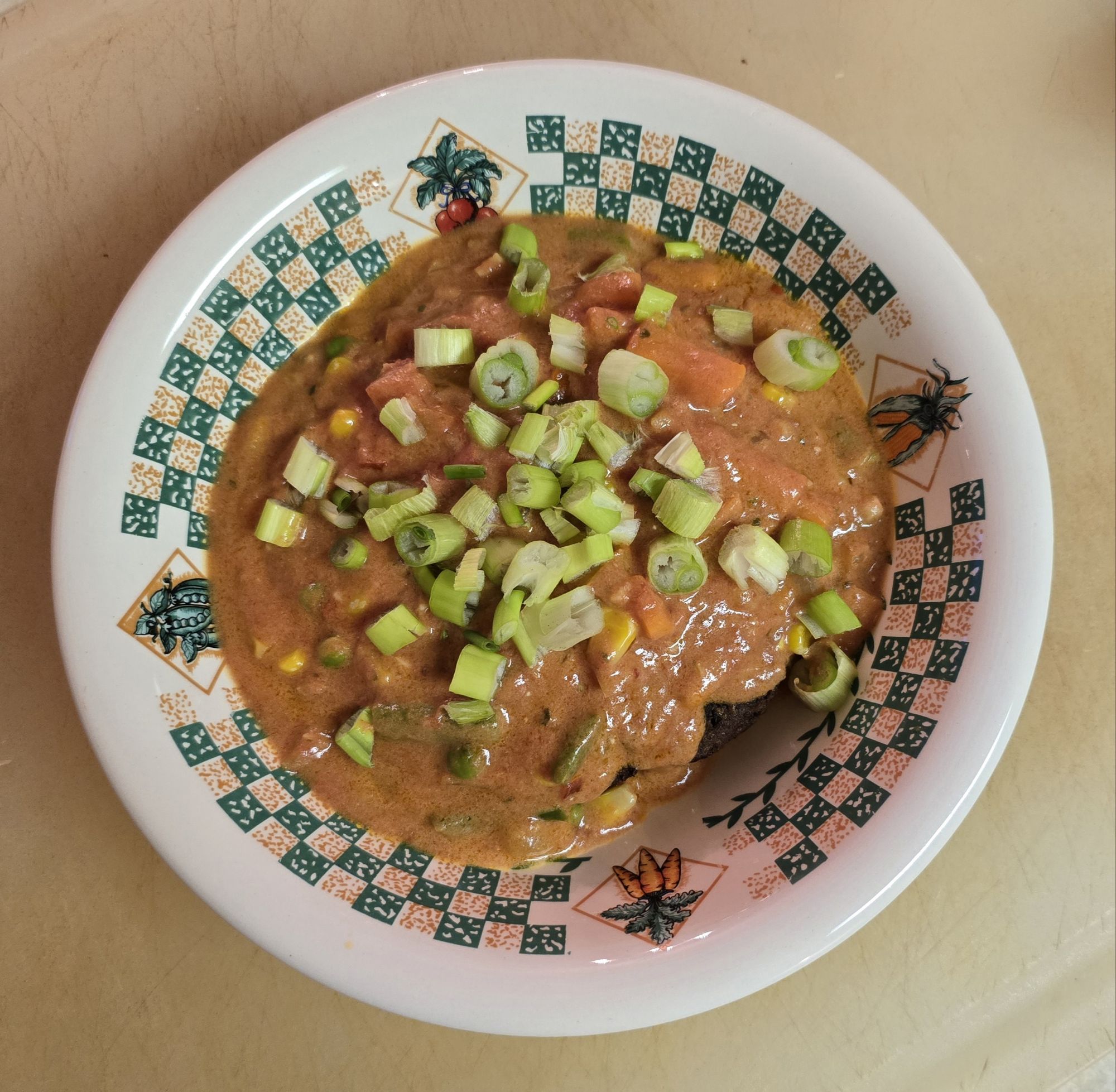
It began with opening the refrigerator and looking inside. I felt like cooking dinner for myself on Thursday night, yet wanted something different. I had a vague idea about cooking a frozen black bean burger and putting a sauce on it. I saw the half-used jar of tomato purée and a couple of tablespoons of sour cream on the top shelf. There was a partly used onion and bell pepper. Our kitchen always has plenty of garlic. I had just ground some cayenne peppers in the green state right before first frost. “I can make a dish out of that,” I said to myself.
Next came the mixing. I poured about a cup of tomatoes into a measuring cup, then scraped the remaining sour cream out of the container and added it. As the kids say, “Mixy, mixy.” It seemed too thin so I got out a jar of vegetable broth with miso paste and arrowroot dissolved in it, shook it up and added about a half cup. Finally, I added a scant teaspoon of cayenne pepper flakes and gave it a final stir.
I got out two frying pans, the smaller for the black bean burger and the larger for the sauce. Coating the bottom of each with extra virgin olive oil, I put the heat on. It takes about 10 minutes to cook the burger so I got the sauce going by sauteing the onion, bell pepper, and a diced jalapeño pepper until softened. Garlic next and as it cooked, it didn’t look like enough vegetables. I got a bag of mixed vegetables from the freezer and added a generous handful. I cooked the veg until everything was heated through and done. I added some powdered cayenne pepper to make sure the heat was at the right level.
Once the vegetables were ready, I poured on the sauce and cooked long enough to heat it through and let the arrowroot do its thickening work. There was some reduction yet that wasn’t the main feature of my cookery. I tasted it, and adjusted seasoning.
To serve, I put a spoonful of sauce on the bottom of a small bowl with the burger on top. I poured the rest of the sauce over it and garnished with sliced green onions. Not too much heat, and the plate stayed warm until it was eaten. This is what no-recipe cooking can look like.
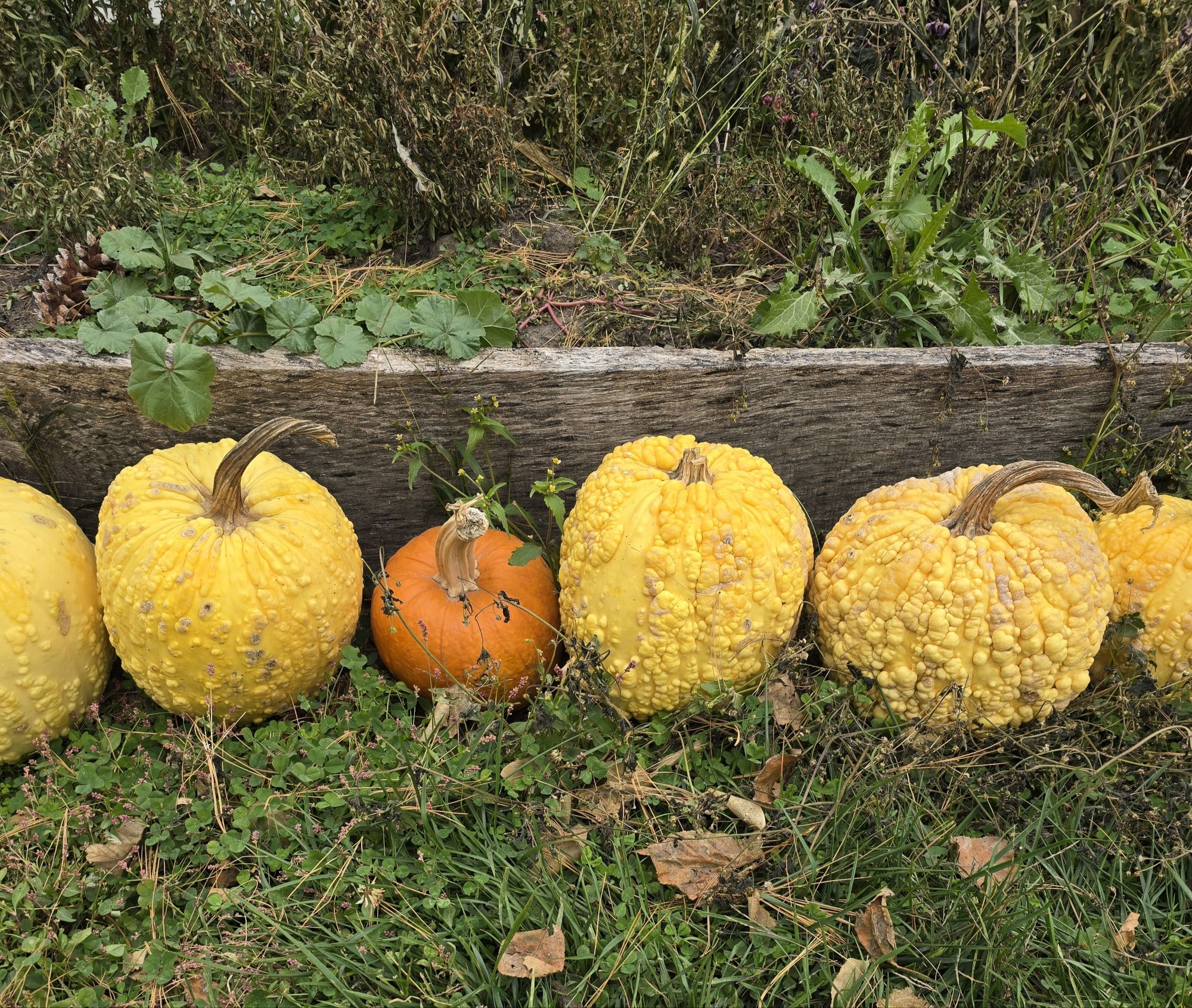
It has been a couple of years since I froze pumpkin for smoothies so Saturday I went to Kroul Farms which specializes in growing pumpkins. They have orange pumpkins and specialty pumpkins: a lot of them.
Specialty pumpkins at Kroul Farms.More specialty pumpkins and a little pie pumpkin.
I took mine home for seven dollars and on Sunday I processed it.
First, cut it in half and remove the seeds.
This pumpkin yielded a cup and a half of seeds for roasting.
Cup and a half of pumpkin seeds.
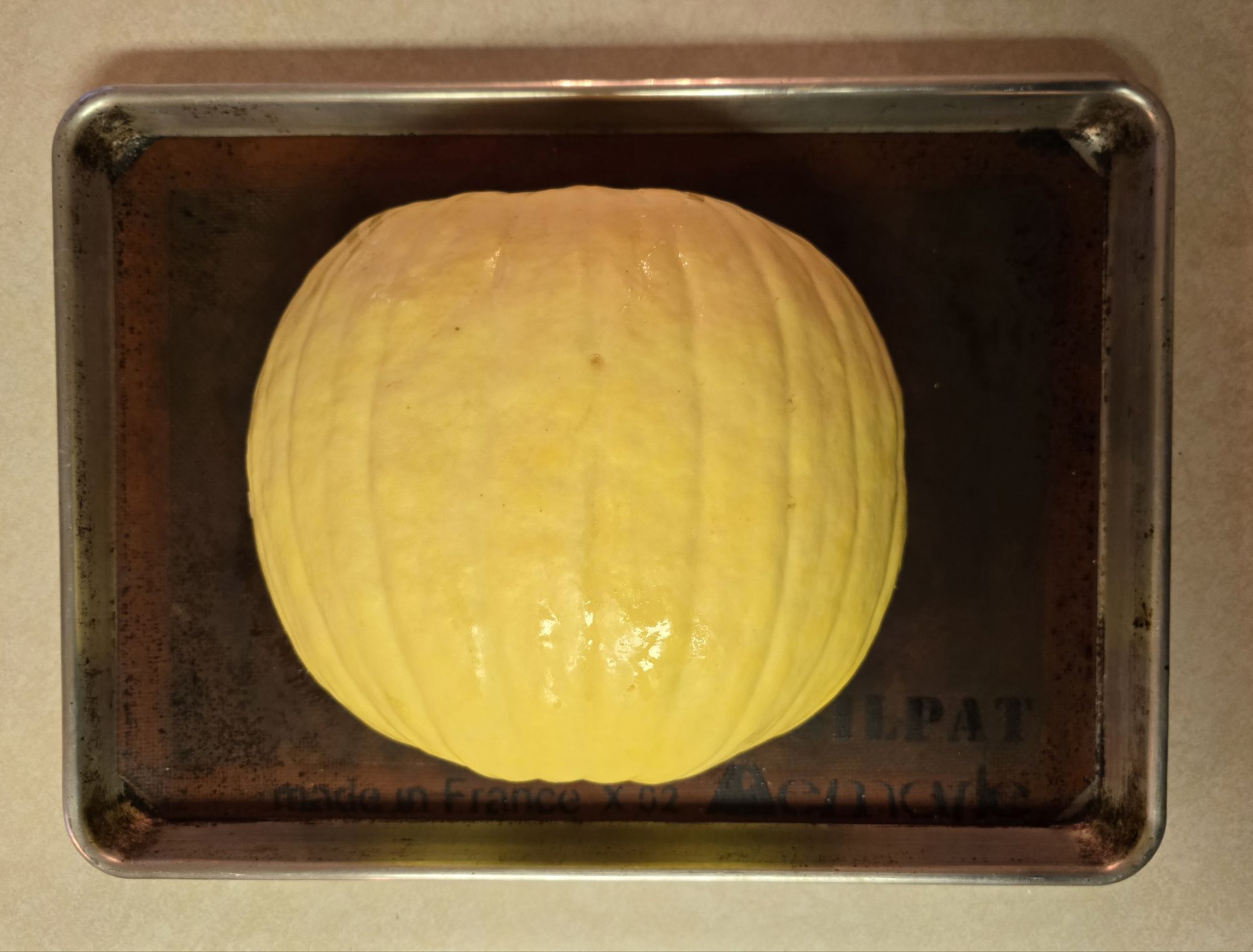
Both halves went into a 400 degree oven and baked about 90 minutes until tender. The timing varies depending upon size of pumpkin and quality of the oven.
Baked pumpkin.
I let them continue cooking on the counter. Next I skinned them and put the flesh of both halves into a large bowl. The use for this pumpkin is smoothies. Since it will go into a blender, I only did a rough mash using a potato masher. The flesh was too wet for smoothies, so I used my conical strainer to drain it. It extracted 4-5 cups of liquid which will go into soup.
Straining the pumpkin flesh.
I cleaned the baking pans and then used an ice cream scoop to make portions on a piece of parchment paper lining the pans. They went into the freezer. Once thoroughly frozen, they go into a Ziploc freezer bag for storage.
Garden with seven plots assigned letters for this post. Photo is from late October 2022.
Garlic will soon be in the ground, which means gardening season is officially wrapping up. What a year it was — easily the most productive garden I’ve had. There’s nothing left to do except pick the occasional, persistent leaf of kale and live from the pantry and freezer for a while. Time for a quick recap of how 2025 went. I labeled the plots on this October 2022 photo so you can follow along.
Plot A is a utility storage plot and has been at least since 2022. If I were to build a garden shed, it would go here. Two composters work here and the rest is a weedy mess with a lingering fence. Some spring flower bulbs I brought from Indiana mark the northern edge. There are a few Iris hidden in the weeds. The original Iris bulbs came from my in-law’s home soon after we moved here. The idea is to remove them and replant in front of the house. This was a garlic patch one year. The remains of garlic bulbs grow year after year. I harvest some of the scapes and let them go. The two oak trees I planted from acorns aren’t big now but eventually will be. That will consume nutrients from the nearby soil. I am leaving them both for now. The rest of the plot needs a good clearing when I have energy.
Plot B is a problem plot. The last time I planted the whole thing in a single crop was garlic harvested in 2024. The problem is when I first dug it I planted a row of tree seedlings. I got so busy at work I managed to transplant only two of them and a locust tree grew to be very large. It blew over in the Aug. 10, 2020 derecho, leaving a stump. This year I used the stump site as a burn pile in hope the stump would also be burned. I did plant a covered row on the west edge. In it grew some of the best lettuce and herbs I’ve yet had from our garden. When I clean it up, this is where next year’s leafy green vegetable plot will be.
Plot C is a large, main plot. This year I grew bell peppers, eggplant, multiple summer and winter squash varieties, four varieties of cucumbers, celery and green beans. Conditions were great for all of these. I made regular trips, sometimes twice a week, to local food pantries with extra squash and cucumbers. I restocked the freezer with grated zucchini and yellow squash for soup. I diced celery and froze it in pint bags, also for soup. I pickled enough cucumbers to last for a while. Green beans were particularly abundant with enough to freeze some. Next year, this plot returns to tomatoes. It is just the right size to hold my 70 cages.
Plot D was fallow this year, except for a 4×20 fenced area for hot peppers. Like everything else this year, the peppers grew in abundance. I piled grass clippings on the rest of the plot for use as garlic mulch. Tuesday I cleared all the clippings and next comes turning over the soil and tilling. I hope to plant 125 or so cloves this week.
Plot E was tomatoes. There are only three plots big enough to hold all of my tomato cages, plots C, D and E. The spring decision to plant more Granadero and Amish Paste plum tomatoes was solid. I made my canning plan for two dozen pints of sauce and had plenty for fresh eating. As a byproduct, I get a tomato liquid I can and use when making soup. The cherry tomatoes were abundant. I tried dehydrating cherry tomatoes and San Marzano plum tomatoes. The resulting nuggets have a rich tomato flavor and I can use them in a number of dishes or eat them for a snack. I plan more of that next year. As in recent years, I took the extra tomatoes to local food pantries.
Plot F was mostly leafy greens and cruciferous vegetables. This plot is a mainstay and it reflects how our eating habits changed. In spring I froze all the greens we need for the coming year. The quality was exceptional. During spring, I also make and can vegetable broth using greens and scraps from the garden. This is mostly for soup making and cooking rice. I harvested fennel, cauliflower, broccoli, and cabbage here. Greens will continue to produce past first frost, well into November or December. The most popular greens I give away are collards. My favorites are kale and chard. A person cannot have enough stored cabbage.
Plot G was this year’s garlic crop. Because I had COVID last year during garlic planting time, it didn’t get into the ground until spring. There were more smaller cloves, yet I got enough big ones to use as seed, and there are plenty of decent-sized heads to use in the kitchen.
The two small trees in the photo are Zestar! and Crimson Crisp apple trees. This year was the first they produced enough to do something with the fruit. The pear and other apple trees are across the yard and they had a banner year as well.
So that’s the big picture of my 2025 garden. I can’t wait to get the garlic planted and take it easy for a while.
Apple cider vinegar fermenting on the counter on Oct. 10, 2025.
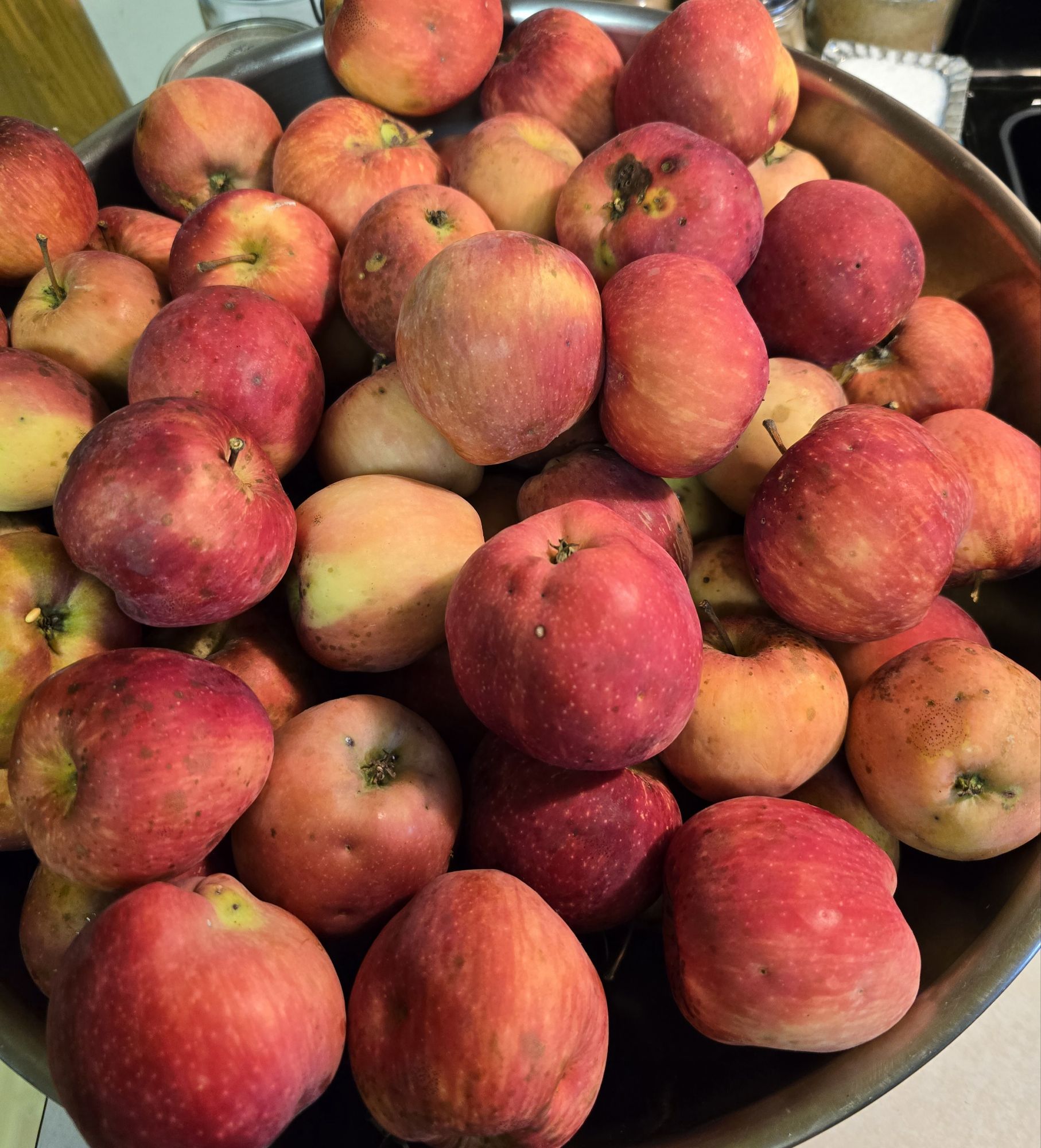
On Friday, I finished the last jar of apple cider vinegar. It’s been a big apple year, and it’s not over yet. Red Delicious still hang on the tree, and three bushels wait by the furnace. The remaining apples are for snacking or recipes like applesauce cake and cider. We don’t drink much cider, but the stuff from the backyard is every bit as good as what you’d get at an orchard or the store.
In 2013, a neighbor introduced me to home vinegar making. I’ve written about it half a dozen times on this blog and it is really simple. Here is a handy process outline:
Have home grown apples or know someone who does. It is too expensive to buy apples from a retailer for vinegar.
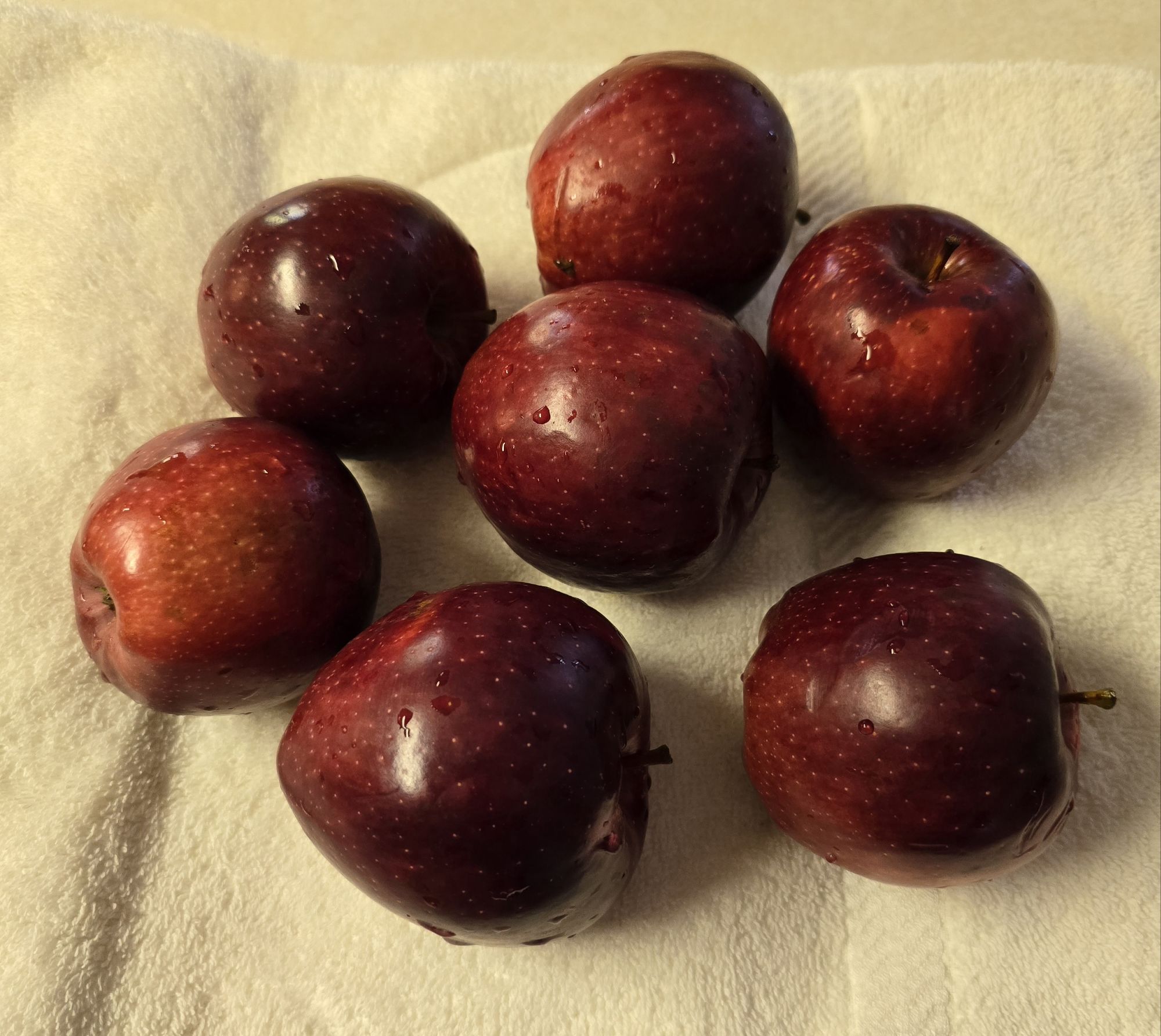
Apple selection is important. I don’t spray my trees, or do much of anything to grow bigger apples. I use Red Delicious apples for cider vinegar because I have so many of them in good years. They are also sweet with plenty of sugars for fermentation. After they ripen, I harvest a large quantity and sort them into categories: near perfect fruit (for refrigerator storage), best (fresh eating), seconds (culinary uses), gnarly apples with some usable flesh, and wildlife food. I find the gnarly apples make excellent cider because in paring them to cut away the bad spots, more apple skin goes into the juicer and gives the liquid a darker, more desirable color.
Equipment. My toolbox includes a Juiceman Juicer (the kind advertised on television back in the ancient days when I viewed the medium), a paring knife and a chef’s knife with large cutting board, two large Rubbermaid plastic pitchers, two different cone funnels, a large slotted spoon for skimming apple scum after juicing, a basting tool, and ten half gallon Mason jars. Vinegar will ferment on its own yet to speed up the process, I add an eighth of a teaspoon of Red Star Premier Blanc yeast, used primarily in wine-making. While not really hardware, it is a tool.
Set up work stations. You will need five: an apple sorting area (mine’s near the furnace), an apple washing station, a cutting station, a juicing station, and a fermentation station. Once fermentation begins, I have a shelf in a dark pantry where it finishes.
I did not keep time records. From the washing station to the fermentation station took roughly 12-15 hours to produce five half gallons over six daily shifts.
Make the vinegar.
Here are some notes.
Things go more quickly if larger apples are used. In a home garden that is not always possible. As mentioned, I use gnarly apples which takes more time.
Do a lot of work at each station. For example, cut and pare a large pile of apples at a time. Accumulate a big bowl or two of cut apples before juicing them. Focusing on a single task for a longer duration seems easier.
Keep the juicer clean. Stop juicing as many times as needed to ensure the solids are not backing up and blocking something.
The liquid coming from the juicer has four main components. A buoyant pulp that should be skimmed off and composted before pouring the extract into the Rubbermaid pitchers through a cone funnel. Allow the liquid to rest in the pitchers until it separates. There will be three layers: the top is grated bits of apple skins and flesh, the middle is the amber cider, and some apple particles sink to the bottom. If I have a quart or less left over at the end of a shift, I put that in a Mason jar and let it separate overnight.
Prepare the jars. Pour out what’s left in them — a mix of last year’s vinegar and the mother. I always keep a little vinegar in the jars to protect the mother until I’m ready for a new batch. Once the jars are clean and dry, place some of the mother back in and pour enough of last year’s vinegar to cover it.
I use the baster to get through the top layer to the cider in the middle. One baster at a time I transfer the liquid to the half gallon jars. When the jar is half filled, I add the one eighth teaspoon of yeast so it gets mixed in adequately.
Leave at least one inch of headspace in the jars. Then cover them with a cotton cloth secured by a rubber band.
Now we wait for fermentation to begin. it won’t take long, within a hour or so. As it begins, make sure there is enough headspace. Every batch is a little different depending on the fruit. I give fermentation a couple of days on the counter to get started. A reason I leave them on the counter a couple of days is so I don’t forget they are active. Once you finish this step they can be moved to pantry.
If I miss a few years, I have plenty of vinegar stored in one liter bottles to last. Like with anything, I use the oldest vinegar first. Pro tip: Clean all the equipment, especially the juicer, every day at the end of the shift. You will be glad you did.
The fall abundance of hot peppers found its resolution in jars of homemade pepper paste. This thick, tangy blend of peppers, garlic, sugar, and salt—simmered in a vinegar-and-water solution—became the perfect answer to the bags of jalapeño, serrano, Santo Domingo, and Anaheim peppers piling up in the refrigerator. The cayenne peppers were easier: they went to the dehydrator and became red pepper flakes. Yet this hot pepper paste, the result of weeks of simmering, blending, and refining, was a more patient project—one that bottled the heat of summer for the cold months ahead. It may be a permanent resolution of fall pepper abundance.
As hot peppers came from the garden into the kitchen in late summer I tried things. First, I made a quart of salsa to put on Mexican-style fare. Next I sliced jalapeño peppers and pickled them in home made apple cider vinegar. Two quarts of pickled peppers stored in the refrigerator will provide condiments for a full year. Then I began taking excess to the food pantry. I made cold pickled serranos and jalapeños. This was only the beginning of the crop. What next?
After stemming and slicing the peppers in half, I brought each batch to a boil in a mix of 1½ cups 5% white vinegar and 1 cup water. Once boiling, I turned the heat down to a simmer and let them go for about 20 more minutes. At first, I strained away most of the vinegar-water solution and put the peppers in a blender and pulsed until they were pureed. This produced a thick paste to use on tacos, or as an ingredient to replace fresh hot peppers when the season is over. I felt I was on to something.
As harvest continued I tried different pepper blends and moisture contents. A number of experimental jars collected in the refrigerator. The concept seemed good, yet our refrigerator is already too full to handle the abundance. I decide to try water bath canning the product and learned about pH.
I made the final product with all but a few reserved hot peppers from the refrigerator and the solution described. To that I added six ounces of garlic cloves, generous tablespoons of sugar and kosher salt. Once simmered, I put the mix into the blender, liquid and all. The coloring is due to jalapeño peppers that ripened to red. I returned the puree to the cooking pot and took all the jars of earlier experiments from the refrigerator and stirred them in. Once warm, I put the paste into pint Mason jars and water bath canned them.
I don’t know how others deal with excess hot peppers, yet I don’t know how else I would do it. Experimentation is an important part of my kitchen-garden. This hot pepper paste is something I will use and probably use up before next year’s harvest. Everything about the process makes life better.
The Iowa story of the Red Delicious apple is best told on the Stark Bro’s website. What stands out to me is that 1893, the year of the first International New Fruit Show where Jesse Hiatt of Peru, Iowa exhibited his chance seedling, the Hawkeye apple, also saw the World’s Columbian Exposition in Chicago. The Exposition embodied the late nineteenth century’s drive to catalog, classify, and display the world’s cultures, species, and artifacts—a hallmark of the Age of Imperialism.
Clarence Stark was not a fan of the Ben Davis apple widely planted in Iowa and the Midwest at that time. While Ben Davis stood up to winter, grew almost anywhere, and did not bruise easily, it lacked flavor. Stark literally got on his horse and went out to find better. When he found the Hawkeye at the New Fruit Show, he immediately liked it. Somehow Hiatt’s association with it had gotten lost. The two came together at the second show.
Clarence was elated. He could not get to Iowa fast enough. The Stark brothers made the trip immediately and bought the sole rights from Hiatt, named the apple “Stark® Delicious” (only after naming ‘Golden Delicious’ in 1914 did it become ‘Red Delicious’) and secured a registered trademark. (A Delicious Discovery: Red Delicious Apple, Stark Bro’s Nurseries and Orchards).
That Red Delicious was first found in Iowa is the reason I planted it in my backyard in April 1995. It has been a good tree. Even with large parts of it damaged in wind storms and the Aug. 10, 2020 derecho, it produces an amazing amount of fruit every other year. If Stark Bro’s propagated it to the extent flavor was diminished after adapting the cultivar to mass markets, the tree in my backyard continues to produce great-tasting fruit. I’d say they were delicious, but that would be too punny.
I am thankful to have planted this Red Delicious tree 30 years ago. It came from a time of robber barons seeking to buy anything of value and profit from it. To a minor extent, Stark Bro’s did that as well. As the apple business changes, stores are less reliant on Red Delicious. Because of the flavor, I wouldn’t trade my tree for anything.
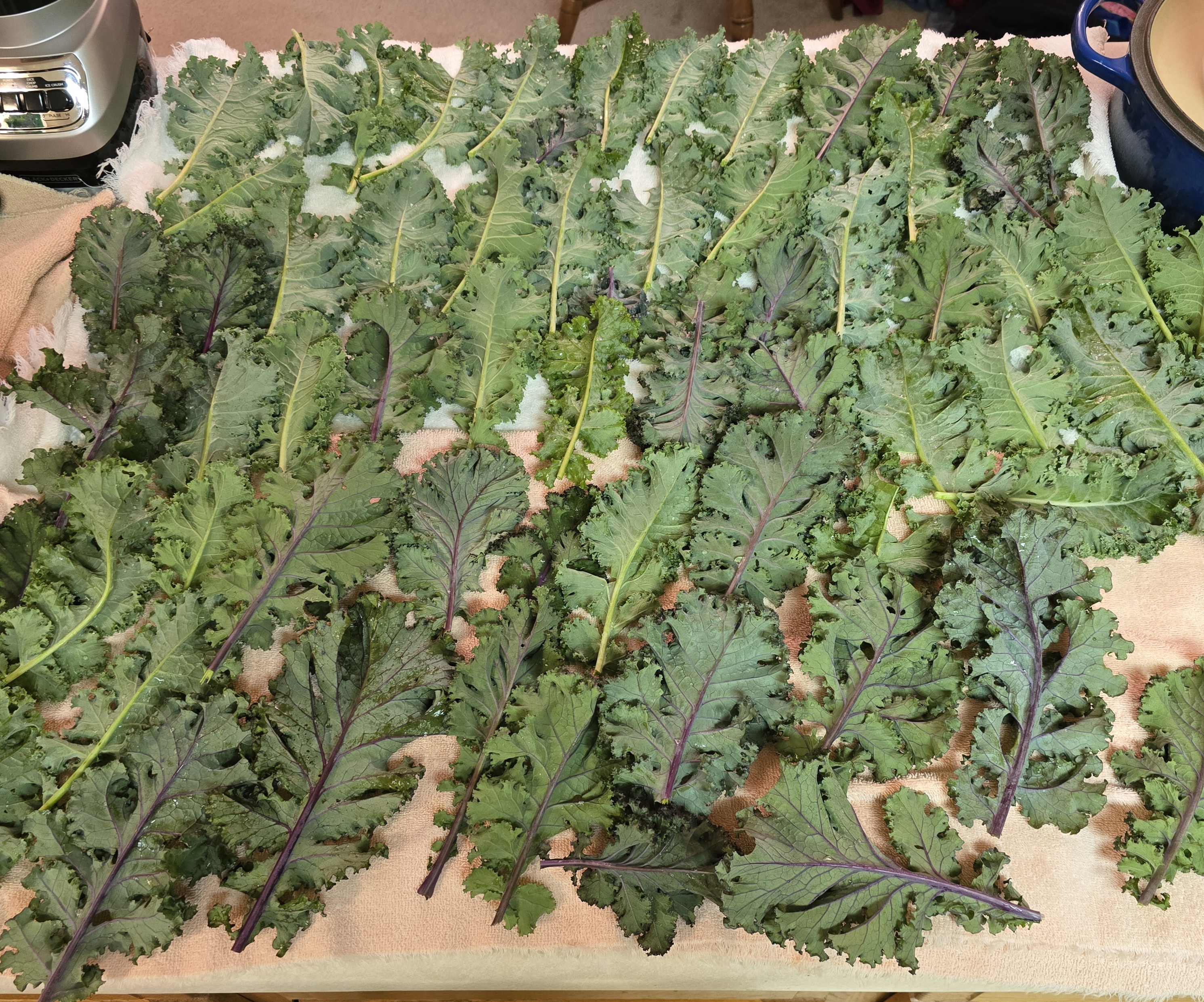
On the last day of September I walked through the greens plot and picked what looked good. It included this kale plus a generous amount of collards and chard. While it was challenging to push through the tall foxtail weeds, at the end of season I leave them so small birds can light on them and eat the seeds. I washed and stored everything we did not eat for supper in the refrigerator. Wednesday morning for breakfast, I cooked and ate a bag of collards picked on August 30. Cruciferous vegetables store well in the refrigerator, although the oldest should be used first. They truly are a mainstay ingredient in our kitchen garden.
On some days I sit at my desk without an idea of where I will go with the day’s writing. I do sit down, though. Perhaps that is a sign of habit and discipline of the kind required by a writer. I am mostly sure I will ground what I write in some kind of local reality, like the greens harvest I just finished.
As I have written before, this blog is a way to get my writing juices flowing. I keep the posts short so they can be finished early in the day and I can move on to whatever creative endeavor is next. As fall progresses, that is usually a couple of hours writing and editing my autobiography. It also includes other work around the property. Writing is the foundation of my current life.
Writing in public is distinguished from producing a journal, email, or other private writing. This blog serves that purpose and because I get feedback in the form of comments, contact from people I know via telephone, text, or email. Each post is a work in progress after it is posted. While most posts remain unmodified, the conversations I have result in changing wording or changing how I think about a topic. My writing here is the public facing part of my life. It is essential.
Some call my writing political, yet I don’t know about that. When I write about politics, my personal experience and perspective are adjacent to it. It is better to criticize the administration about inflation by talking about how much the cost of a home-brewed cup of coffee increased this year than talk in vague generalities influenced by journalism and social media. In the end, political topics must necessarily be grounded in this place I call home to be meaningful.
I didn’t know I would be harvesting greens on Tuesday. I didn’t know how far I would get in the apple harvest this week. These are pragmatic unknowns with which a writer lives every day. Through practicing the craft of writing, without presumptions of what it should be, we can get better at it. That’s something I hope I am doing.







 Journey Home
You must be logged in to post a comment.