I met Finn Harries in Cedar Rapids at Al Gore’s 2014 Climate Reality Leadership Corps training. The diminutive Brit showed up only for the days Gore gave his Inconvenient Truth lecture. Harries and his twin brother Jack had millions of subscribers on their YouTube channel JacksGap. With a fame of his own, Finn Harries had specific intent in attending the Iowa training.
During the last ten years, the brothers developed a process to address the climate crisis. Finn is working on regenerative agriculture and Jack started Earthrise Studio. The transformation of their YouTube channel is ongoing at Earthrise Studio.
This channel is currently undergoing an exciting transformation. In 2011 we launched JacksGap, a creative storytelling project featuring short travel films by Jack and Finn Harries. Since then we’ve been on the most incredible journey covering stories all around the world and increasingly learning about the significant environmental issues we face. Today 10 years later we are re launching this channel as Earthrise, a digital media platform and creative studio dedicated to communicating the climate crisis. Earthrise tells stories for a new world. Radical stories of hope, of new possibility. Stories from the future that help us navigate the now. We’re so excited for this next chapter and hope you’ll join us!
Their channel has grown to 3.63 million subscribers.
On Tuesday, Jan. 16, I received this email with a link to their first video about fossil fuels. Please take 11 minutes to view it. It presents a different picture of the geopolitical impact of fossil fuels and leads into the same discussion about renewables.
A year ago, we set out on a journey to investigate the origins of the global energy crisis, an issue that took the world by storm and resulted in extortionate energy bills for people everywhere.
Fast forward to today, we’re so excited to share that the first episode of POWER has just gone live on our YouTube channel. But first, a quick recap on how we got here…
February: We decided to make a series about fossil fuels.
March: We went to our audience to crowdsource questions.
April: We began writing the series.
July: We kicked off production in our new filming studio.
December: We wrapped filming.
Yesterday: We held an in-person premiere for our community.
Today: We hit upload on Episode 1, and you can now stream it on our YouTube channel using the link below.
Has the Iowa Democratic Party hit rock bottom? At Monday’s poorly attended precinct caucuses, small groups of long-time Democratic attendees kept political embers glowing. Although we hadn’t reached “rock bottom” one could see it from there in the dim light of a fire that long ago burned through most of its fuel.
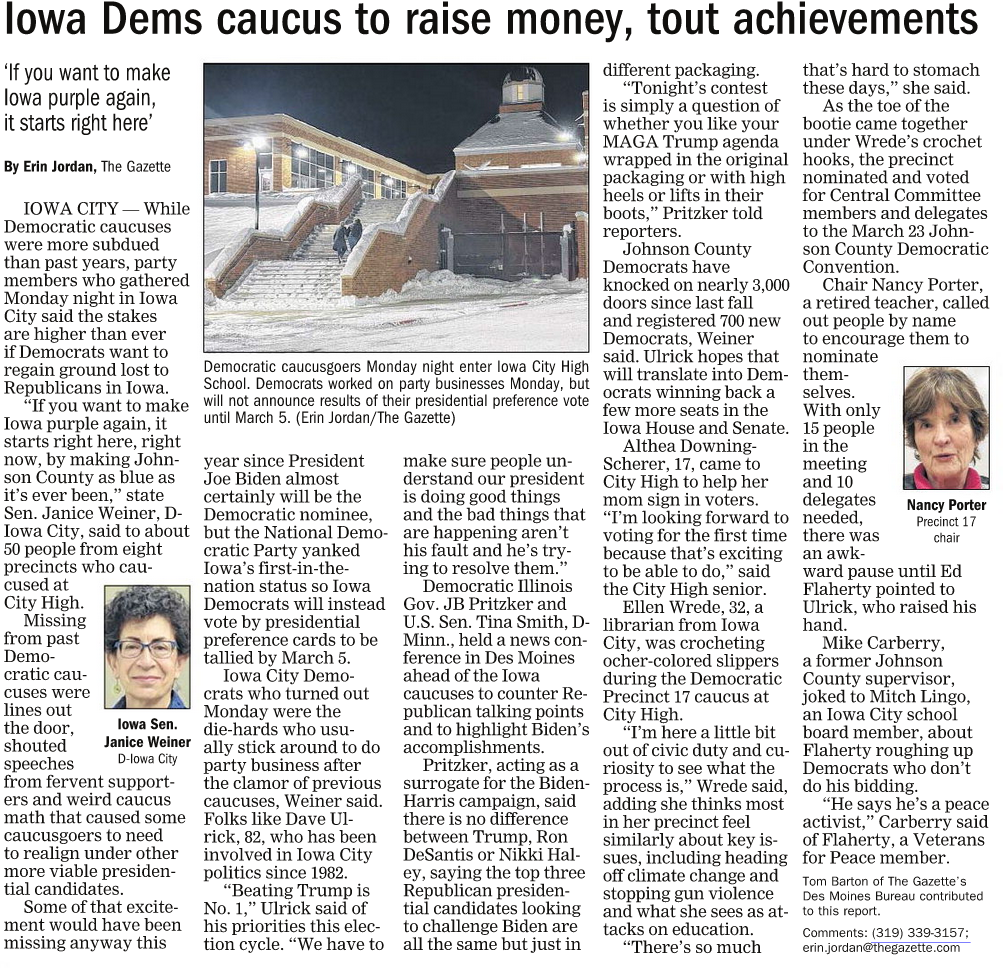
For comparison, in 2012 when President Obama was running for reelection, also the year comparable to 2024 when President Biden is running for reelection, we had 12 people at our precinct caucus. This year we had three. Combine low caucus attendance with the fact as of Jan. 12 only 8,000 Democrats had requested a presidential preference card from the state party, and it was enough to make a pail of water turn sour. Erin Jordan of the Cedar Rapids Gazette caught the mood at Iowa City Precinct 17 where Democrats had trouble filling their delegate seats to the county convention. The caucus chair called out individuals by name to recruit volunteers.
It’s not that Republicans had great caucus turnout. They didn’t. Donald J. Trump received 56,206 votes in the Iowa Republican caucus, or 7 percent of registered Republican voters. Hardly a mandate. The state had 752,249 registered Republicans on Jan. 1, 2024, and only 110,298 (15 percent) caucused. Half of Republicans who did vote wanted someone other than a Florida man facing 91 criminal counts as their presidential preference. Even Koch Industries, a powerhouse in Iowa through their shadow presence in Americans for Prosperity, was financially supporting someone else. The Republican performance definitely did not show strength. Unlike the national media we shouldn’t put too much stock in Trump’s win.
What about the vast majority of Iowa’s estimated 3.2 million people? They were not a part of this year’s caucus activity. To climb out of the hole in which we found ourselves, Democrats need a new way of thinking about politics. It must be focused on all Iowans, not just aging party activists.
Boy howdy! That’s not going to fly with the aging cohort of party regulars!
Iowa Democrats have the right idea. The slogan they wrote, “People over Politics” is the right one for this campaign because it hits on the need to address the majority of Iowans’ needs and wants, rather than a small minority. It is not enough to repeat the slogan, check off the box, and return to politics as usual. Something has to change.
Young people have a lot to lose in the 2024 election. When I talk to people in their twenties and thirties, they are angry with how our national politics is going. In particular, the treatment of Palestinians in the Israel-Hamas War has them angry with President Biden and with Republican alternatives. They definitely plan to vote. Their issues make it more complicated than a choice between the Democrat and Republican running for president. As an elder, I caution about the complexity of Middle East politics. They don’t want to hear it. What is lacking is adequate direction from Washington to end the conflict and stop the genocide of Palestinians. Such young people are not motivated to join a political party. They are not motivated to support Biden. They simply want the president and the elected government in Washington to offer viable solutions now.
“The people of Iowa appreciate balance in the federal government and the state government,” said Rita Hart, chair of the Iowa Democratic Party in the Washington Post. “It is out of whack here in Iowa because Republicans have been in power for too long, and they have overreached.” I can say from my experiences with young people this seemingly reasonable statement is what’s out of whack. We need less characterization of the electorate in national media and more action to deliver positive results to more people. The elder in me says stay the course and let Hart lead. The young person in me wants to upset any existing balance and get a new set of scales.
I stay in touch with some in my Iowa high school cohort which entered its eighth decade of living. A common sentiment among them is “Oh Iowa. What are you thinking?” At its core, the concern is one for the future. A reaction to the Trump win like this can only be from consuming conventional news media. Our current national and local media environments have lost interest in the common good and propagate whatever content garners eyeballs. We need a new way of seeing the news and what we are doing now isn’t it. I am devoted to Heather Cox Richardson’s Letters from an American because it injects each day with a dose of the logic, reason, and perspective of a historian. Many in my cohort have not heard of her. Indeed, her one voice is not enough.
Donald Trump Jr. said, “A win is a win” on caucus night. I used to look at elections that way. When a party can’t draw enough people to a meeting to fill convention delegate positions, the system is not working. While I enjoyed conversations with my old friends at the caucus. Iowa politics has to be something more than a social hour. Unless we make it so, the embers will finally be extinguished. I hope to do my part in creating change we need using my platform. What about you readers?
We got a dusting of snow last night, enough to use the electric snow blower on the driveway after sunrise. The forecast next week is for rain after ambient temperatures dip well below freezing this weekend. Is this the end of winter? I doubt it. I hope not.
In two weeks I begin planting seeds in indoor trays for the garden. This year I bought all nursery-started onions, so the first seeds into soil mix will be varieties of kale. Kale is a mainstay of our kitchen and the early start brings an early crop. After kale, I follow a time-tested, weekly procession of seedling starts that continues until the first week in May when I plant squash. I learned and developed this process while working for area vegetable farmers.
While I’m ready for spring, I’m not ready for winter to end. So much remains undone. I nudged my autobiography along, but have not had the long writing spells needed to finish the work this year. Based on feedback from a reader, I returned to part one for some revisions. I could easily spend another year there while part two remains in infancy. Partly this is a process of learning how to write. In part, I want to declare the work finished. The present obstacle is boxes and boxes of artifacts needing review and disposition before finalizing the narrative. I need external prompts to generate the narrative.
I began to dream during the blizzard. They have been dreams about travel, and topics I can’t remember. I don’t think much about dreams, they have little significance to me. I do notice the change in sleep patterns. For the most part, I’m sleeping through the night for a solid five or six hours.
I stand at the dining room window and look at the snow-covered garden. I have the plan about half worked out. Garlic is in the ground and I left space for a covered row on the west side of that plot. Tomatoes are planned with a return to my previous fencing method to keep deer from jumping it and eating tender seedlings. The next task is picking a spot for cruciferous vegetables. If I keep looking at the space, a plan for the rest will emerge.
Like much of my eighth decade of living, time goes too quickly. Part of me wants to apply discipline to get things quickly done. Part of me wants to take it easy, something I was unable to do much during my working years. Somehow I’ll find a balance as I understand what it means to age in America during a time of political turbulence. There is no universal understanding. We do the best we can.
Caucus-goer signing nominating petitions at the 2010 Iowa Democratic caucuses.
I counted 22 people present for the 2024 Democratic caucuses at Lakeview Elementary School on Jan. 15. Our location had five precincts. It was a good gathering of old friends. “Old” is the operative word. Age of participating Democrats is a problem for the Iowa Democratic Party. Well, that and this cohort is dying off, depleting our numbers. A couple of new faces were present, so that was good. We kept the embers of the Iowa Democratic Party going for another election year.
Our age was a constant companion during the caucuses. Doors opened at 5 p.m. for set up. People began arriving shortly after that for the 7 p.m. event. Set up didn’t take long and there was a lot of catching up to do. I talked more about Ohio politics than about Iowa. I noticed the average age of those present and was told to stop complaining and volunteer. We discussed the changes in door knocking over the years. One friend said if they went door knocking they would have to use their mother’s walker to get around. Someone suggested the reception at the doors might be better if they did.
The state party has kept the mail-in presidential preference vote a virtual secret. A few long-time Democrats at the caucus didn’t know what to do to get a ballot. We remedied that right away. According to the Cedar Rapids Gazette last Friday only about 8,000 ballots had been requested statewide. When we consider there were 176,352 initial alignment votes in the 2020 presidential preference vote, the response this year is underwhelming.
There were three of us in the Big Grove caucus. I chaired and made quick work of party business. We elected myself as chair and a friend as secretary. No one wanted to be on the county central committee and we only elected one of three delegates to the county convention. No one volunteered for convention committee work, except I told the organizer for the arrangements committee I would help at the convention. She was in another precinct at our site. I read the Diversity, Equity and Inclusion statement to meet the requirement. We signed, sealed, and delivered the documents to the box destined to go to the county seat that evening.
The weather was cold, yet not that bad. The roads were plowed and although there was some ice on them, an experienced driver could navigate safely. Weather was not what kept Democrats away from the caucuses. The Washington Post released an article about the issues. Here’s a taste of it:
At this time in 2020, Democrats held three of Iowa’s four congressional seats. They had three statewide elected officials, and they were just kicking off the Democratic presidential nominating process.
Four years later, Iowa Democrats have no representatives in Congress, only one statewide elected official — the state auditor — and their prized spot at the head of the nominating calendar has been ripped away from them.
Beyond that, they have seen former president Donald Trump twice carry the state by comfortable margins after victories in 2008 and 2012 by Barack Obama.
“It has been painful for Democrats in Iowa,” said Scott Brennan, a former chair of the state party.
As Iowa Republicans began their party’s presidential nominating process with Monday’s caucuses, many Democrats concede that their party has hit rock bottom. The state, once a presidential battleground, has joined Ohio, also a longtime swing state, in moving to the right. Few expect the Democrats to be competitive in Iowa in the presidential race in November.
Our group of oldsters kept a party on life support going for another little while. I don’t agree we hit “rock bottom,” yet one could see it from the 2024 Democratic precinct caucuses.
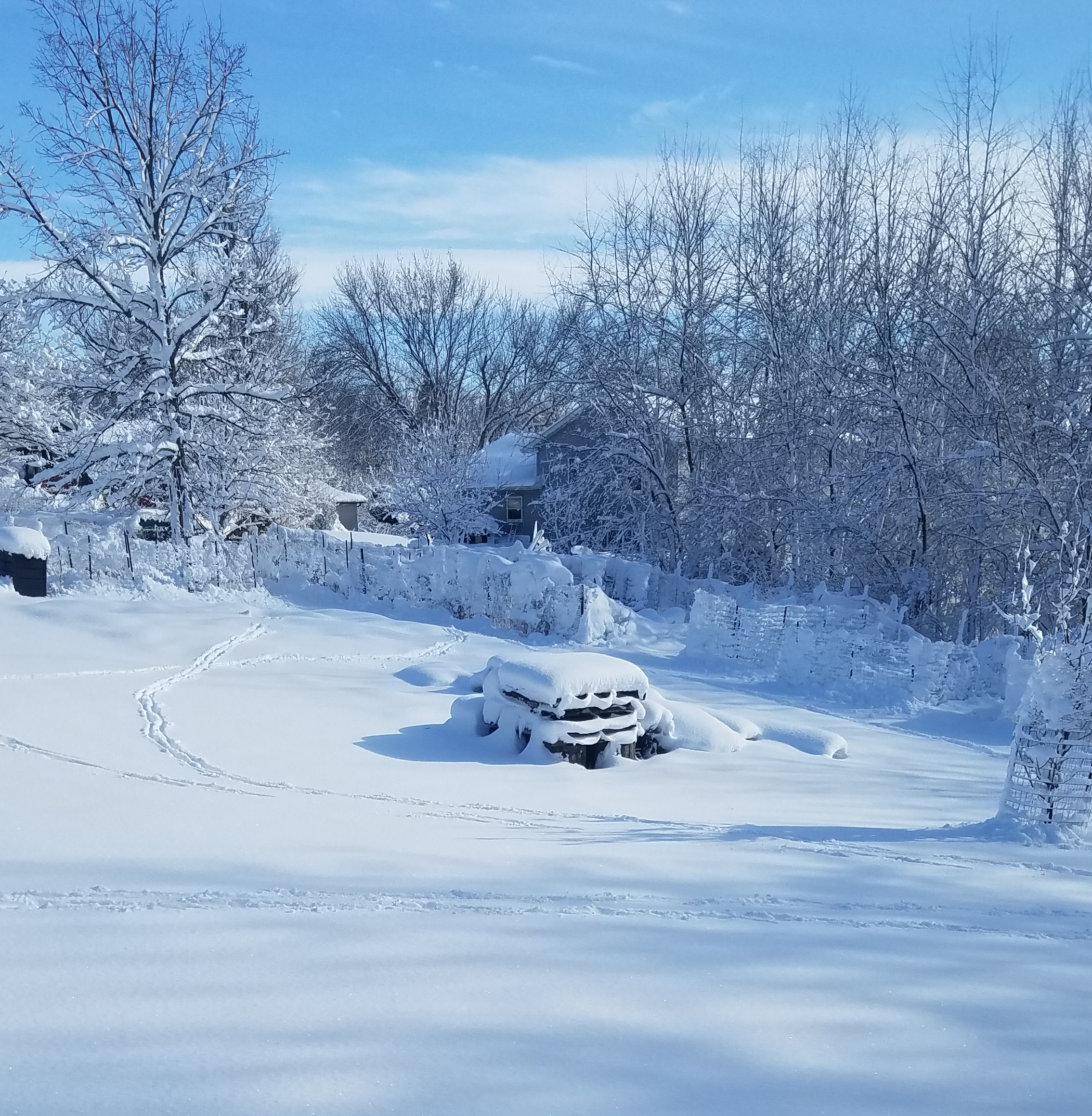
Saturday the snow stopped and I blew the driveway for the fifth or sixth time this week. Yes, that’s right, I can’t remember how many times. The work went quickly and with the snow finished for now, all I’ll have to deal with is wind-blown drifts.
Attire is a thing during a blizzard. For outdoors work, I donned my Star Wars Mos Eisley t-shirt, my Chicago Bulls sweat shirt from when Michael Jordan was playing, relatively new Levis blue jeans and J.C. Penney rubberized boots, a scarf Mother knitted me while I served in the military, a stocking cap from that same era, and a Carhartt jacket bought on sale when I worked at the home, farm, and auto supply store before the coronavirus pandemic. Working together, it all kept me warm as the snow flew around my electric snow blower. I did feel a bit like a walking logo store, yet I’m not going to get rid of serviceable clothing.
Sunday started with ambient outdoor temperatures below minus ten degrees Fahrenheit. With no reason to go outdoors, I kept the garage door closed while we regulated indoors temperatures. The new furnace worked well and the space heater took the chill off my downstairs work room. There was a two-hour planning session with our child and the rest of the day is for planning the beginning of the year for me. In a stable environment, what the weather does is less of a worry than running out of time.
We take days like these in stride. Without a paying job, what the weather does has less impact. The blizzard provided a reason to stay indoors and work on long delayed projects. Later today I must venture to town to lead our precinct caucus. The blizzard will keep all but the most devoted from participating. Some years it is like that, blizzard or not.
When the Iowa Legislature convened on Monday, House Majority Leader Pat Grassley reprised his position on banning books in schools. The Cedar Rapids Gazette reported:
Grassley doubled down on House Republicans’ efforts to remove books with sexual content from public school libraries and said Republicans may pass additional legislation to clarify or expand on the existing law.
In December, a federal judge temporarily blocked much of a law passed last year, Senate File 496, that banned books that depicted or described any of a list of sex acts from public schools and prohibited teaching about gender identity and sexual orientation before seventh grade, among a host of other regulations.
Lawmakers vow tax cuts, grieve school shooting by Caleb McCullough and Erin Burphy, Cedar Rapids Gazette, Jan. 9, 2024.
We couldn’t read Catcher in the Rye by J.D. Salinger in K-12 when I attended in the 1960s. It was no big deal. I used my newspaper route money to buy a copy at the book store. Since when do we need government intrusion in work that school teachers, librarians and parents should already be doing? We don’t. In some ways, the focus on banning books is a distraction from a more significant problem: K-6 reading skills.
Would-be book banners argue that readers can still purchase books they can no longer access through public libraries the way I did when I was a grader. That is only true for those with the financial resources to do so. For many, particularly children and young adults, schools and public libraries are the only means to access literature.
When people talk about the “culture wars,” control of books available to K-6 students is a core issue. USA Today summarized:
Banned books are not new, but they have gained new relevance in an escalating culture war that puts books centering racism, sexuality and gender identity at risk in public schools and libraries.
A dramatic uptick in challenged books over the past few years, an escalation of censorship tactics, and the coordinated harassment of teachers and librarians has regularly put book banning efforts in news headlines.
Book bans are on the rise. What are the most banned books and why? by Barbara VanDenBurgh, USA Today, Sept. 29, 2023.
There is a basic tenant of society, supported by research, that children of less educated parents will read less and society will be the worse for it. The corollary is children of well-educated parents will read more and in so doing expand their horizons to see a better life beyond immediate family. Teaching reading in school has been a mainstay of elevating children above the social station in which they were born, creating possibilities for life that would otherwise rely upon chance and happenstance.
Government should fund programs that encourage reading, make sure funds are not abused, and then shut the hell up. Leave reading curricula to those who know it best: teachers, librarians and parents. Passing a new law revising a state book banning process is of value only as political fodder. It would not help with a more fundamental problem of reading skills in K-6 students.
On Friday, Jan. 12, Iowa Attorney General Brenna Bird filed notice of appeal of the federal district court’s decision to halt implementation of Senate File 496. The distraction continues.
Driveway covered with snow a few hours after clearing it. Jan. 9, 2024.
A blizzard is welcome these days, especially when one works from home. They remove most temptation to leave the property and go to town. We become isolated as much as is possible in the time of broadband access and mobile telephones. Diet changes based on what is in the pantry and freezer. Like most modern middle class families we keep a lot of extra food on hand, so we are ready to survive, come what may.
Is there gasoline for the generator? Check. Is there enough store-bought bread? Check. Is the snow blower positioned near the garage door with extension cords? Check. Is there extra drinking water in case the well goes down? Check.
Wednesday morning I made ramen my own way. I bought a 24-package box of Maruchan brand ramen noodle soup. After looking at available options, I picked soy sauce flavor, hoping it was vegetarian. It wasn’t. One of the ingredients in the flavoring packet was “beef extract,” whatever that is. I discarded the packet and made my own with one cup tomato juice, and a combination of white miso paste, vegetarian worcerstershire sauce, and home made hot sauce. It was surprisingly sweet and delicious.
My neighbor came over to help clear the end of the driveway where the plow pushed snow from the street. The two of us made quick work of it and decided we didn’t need further exercise for the day. We are both retired and need daily exercise for health reasons. The blizzard broke up the routine of trail walking.
I recently read a book titled, Blizzard by Phil Stong, written in 1955. The story is of a farm family in southeastern Iowa during a blizzard. So many neighbors and friends stopped by during the storm, it seemed very communal. I suppose that’s the way it was on a farm back in the pre-internet days. For the most part, today it’s the two of us alone in the house making do.
On day two of the storm I drove across the lakes to Costco and wore a mask indoors. There were others doing so, although very few customers were inside. Staff was talking about who would be released first to go home. The risk of contracting the coronavirus seemed minimal. I wore a mask anyway.
The car radio was filled to the max with commercials promoting 45 and Nikki Haley, but no one else. Absent adequate and recent publicly released polling it’s hard to say who will win the Republican caucus vote. It will be one of those two, I believe. Of course, the Democrats are not voting for president on caucus day.
More storms are lining up the rest of the week and we shouldn’t have to go out until they finish. For now, it’s a matter of getting the mail and seeing whether delivery trucks make it through. It’s the newest version of Iowa winter during a blizzard.
Barack Obama at the 2006 Harkin Steak Fry. I met him in this rope line.
A friend and I met for coffee across the lakes to prepare for the Iowa Democratic caucus on Jan. 15. I took along one of my volunteer sheets from the 2008 presidential campaign to discuss who we might get to volunteer this cycle.
We found ourselves asking the question, “Are they still alive?” before discussing most of them. Long story short, so many people have moved out of the precinct or died since 2008 voters have gone fully Republican here during the general elections in 2020 and 2022.
People scratch their head about how Iowa could vote for Obama twice, then for Trump twice afterward, as we did in my precinct. My interpretation is Iowans are on the move, including rural, conservative folks who want to get closer to the major metros where the jobs are, yet don’t want to live with all the liberals there. They seem to concentrate in rural and outlying subdivisions like ours. People are also on the move out of state where better job opportunities can be found. Not every one wants to become part of the industrial agriculture operations that dominate business in the state. The exodus is encouraged by repressive governance by the current crop of Republican state officials.
The caucuses are important to Democratic party officials who hope to launch an organizing miracle to turn the state purple (we’ve given up on blue). The truth staring us in the face is without the presidential preference part of the caucuses, people lose interest.
There has been good coverage of the caucuses in the Cedar Rapids Gazette with a special section with all the locations in the Sunday paper. People have every reason to know about the caucuses. We’ll see if they turn out and at what level. For perspective, we had 12 Democrats show for caucus in 2012, Obama’s re-election year. If we did that number a week from today, I’d be reasonably happy.
Dubai, UAE site of COP 28 – Photo by Aleksandar Pasaric on Pexels.com
I met with State Senator Joe Bolkcom before he retired to discuss ways to mitigate the effects of climate change. He told me something important as we finished our conversation. “Join a group and get active,” he said. What does that mean?
With a challenge so big it involves all of the populated regions of the globe, one person’s impact is not as useful as when we work with others to solve the climate crisis. As we face its challenges, it is important for our own sanity to feel like we contribute to solutions as individuals. Actions like reducing gasoline use, reducing natural gas use, reducing electricity use, eating less meat and dairy, and growing some of our own food are all important. These actions matter, yet what matters more is what we, as a society, do collectively. That was Bolkcom’s point.
On Dec. 13, 2023, delegates to the 28th Conference of the Parties (COP 28) agreed to transition away from fossil fuels. This despite heavy lobbying from delegates representing fossil fuel interests to do nothing.
Nearly 200 countries struck a breakthrough climate agreement Wednesday, calling for a transition away from fossil fuels in an unprecedented deal that targets the greatest contributors to the planet’s warming. The deal came swiftly — with no discussion or objection — in a packed room in Dubai following two weeks of negotiations and rising contention. It is the first time a global climate deal has specifically called to curb the use of fossil fuels.
Is the cup half full or half empty? Citizens engaged in solving the climate crisis should take the positive which this agreement represents even though it falls short of our aspirations.
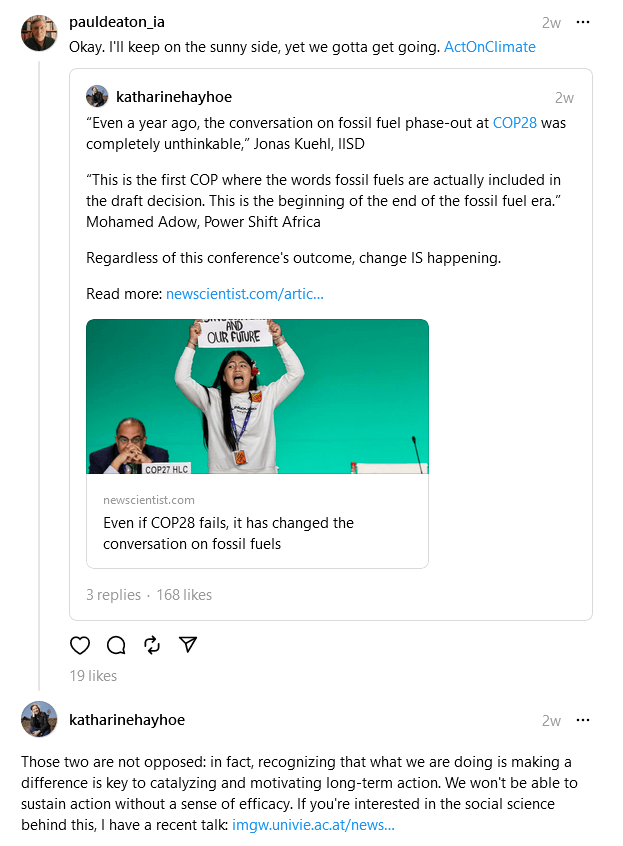
When I activated an account on Threads, one of the first accounts I followed was climate scientist Katharine Hayhoe who is active on that platform. We had this exchange about COP 28, in which I quote-posted her report from COP 28:
As Hayhoe said in the talk referenced above (Here is a link), the challenge is to move from worried to activated. It is not only possible, it is imperative that advocates for solving the climate crisis do so.
Back to my question, is the cup half full or half empty when progress toward transitioning from fossil fuels saw such resistance at COP 28?
Senator Sheldon Whitehouse (D-RI) said after COP 28 closed, “A small, self-interested minority of states cannot be allowed to block the progress necessary to put our entire planet on a path to climate safety.”
2023 was a disastrous year for our climate. We experienced the hottest year on record and the extended Iowa drought impacted corn and soybean yields. Rivers and lakes began to dry up. What gets overlooked is that just as the climate crisis seems to get worse, actions to tackle the problem are ramping up. There were environmental wins out of COP 28:
The cost of solar power has fallen by around 90% and wind by 70% in the past decade.
The majority of new energy capacity being added in the U.S. and globally is solar, wind, and battery storage; these renewables already account for nearly 14% of the U.S. energy production and 12% worldwide.
Electric vehicles are becoming cheaper and more attractive. For the first time, more than one million EVs have been sold in the United States in a calendar year.
At COP28, delegates took a historic step in establishing a loss and damage fund, the latest development in a three-decades-long fight to have wealthy, high-emitting countries compensate vulnerable, developing ones for the harms of climate change.
For more positive news, read Katarina Zimmer’s complete article on Atmos.
Despite its shortcomings, COP 28 marked a major step forward for the environmental movement. For the first time ever, a COP agreement explicitly acknowledges the main culprit responsible for the climate crisis is fossil fuels. While the agreement falls short of what many of us wanted, it still reflects progress in a decades long struggle to address the climate crisis. We should keep on the sunny side and build on this progress by finding other, like-minded people and getting active.
Editor’s Note: This is an excerpt from my autobiographical work in progress.
In life, the world seems unknown until one lives it. Whether or not I would have found CRST, Inc. without my job search is an open question.
CRST, Inc. exploited the 1980 Motor Carrier Act that deregulated trucking and helped break the teamsters’ unions. This legislation passed during the Carter administration and was implemented during the Reagan years. While some trucking employees continued to be represented by the union, their numbers diminished after deregulation. Shippers benefited from lower costs and the expense reduction came mostly from new, non-union companies, made possible by lower wages and fewer benefits for employees. It was another feature of the Reagan Revolution.
Founded as Cedar Rapids Steel Transportation, Inc., on March 1, 1955, when I joined the firm on March 29, 1984, it was very much a “Company on the Grow.” While founder Herald Smith did not have a business education, through entrepreneurial energy, an ability to carve out a niche in the highly regulated transportation business, and a willingness to confront unions and union rules, he was able to establish CRST as a viable entity in the years before de-regulation. When the Motor Carrier Act of 1980 deregulated trucking, Smith, and people like him, took advantage of the new operating environment.
According to In It for the Long Haul: The Story of CRST, published to note the company’s 50th anniversary in 2005, CRST Inc. was the third company in the nation to secure 48-state operating authority after deregulation. Smith sought to eliminate the part of his business that was unionized, reducing pay and benefits, and creating cost efficiencies to support a lower rate structure. He did this by hiring independent contractors who owned and leased their own tractor-trailer rigs to CRST, Inc. and by acquiring companies that had non-union company drivers and then keeping them that way. This practice kept the number of union employees in decline as the company continued to grow.
By the time I joined the company, annual revenues were about $60 million and the “tough on employees” environment that characterizes many entrepreneurial businesses was evident throughout the organization. To me, it was something new and exciting, a natural extension of having served in the United States Army. I looked forward to the new opportunity.
I remember walking into the operations office during my job interview and saying to myself, “I hope I don’t have to work in that room.” In the office of what had previously been an LTL cross dock, was the core of the operation: van operations from the Midwest to the east coast, flatbed, and trip lease. Van operations had an island of workstations in the center, with additional work stations around the perimeter. A number of employees were smokers and a grey haze of tobacco smoke filled the room. The language was on the blue side, indicating an acceptable means of expression and interacting with others. It was a mostly male environment, although there were some women, most of them working in clerical positions behind a glass wall on the East side of the room when I entered that first day.
I had applied for a position in the shop, but my interviewer thought I was overly qualified for the position. He referred me to operations. The supervisor had been with the company a long time, was a Vietnam veteran, and had an office in the operations department. He interviewed me and then introduced me to the person who managed a company called Lincoln Sales and Service, which was becoming the growing, non-union part of the company.
Lincoln Sales and Service sought to hire management trainees, train them in the business and then have them open growth terminals throughout the country. All three interviewers treated me well, and with my military experience, they viewed me as having the “aggressive” personality traits they were seeking for management staff.
CRST, Inc. characterized itself in the newspaper ad to which I responded, “CRST is an aggressive, rapidly growing, major motor carrier transportation company based in Cedar Rapids. To help us in our expansion plans, we need a dedicated, career minded individual to fill a management trainee opening in our maintenance department.” Emphasis was on being “aggressive.”
I took notes after my interviews, writing on March 13, 1984: “Impressions: A good company, Iowa owned, they offer good benefits, and an entry a step ahead of other management positions I’ve been looking at. I feel the benefits of the other interviews to date.”
I was interviewed on March 12, went for a company physical on March 13 and was offered the job the same day. That night, I laid out the pros and cons: “PRO: good pay, pay incentives, location, benefits good, family owned (vs. public), I can relate to the people to whom I talked, expanding company, 65/100 of major carriers, chance for advancement, yearly evaluations, interesting, leadership, use more of my skills. CON: 2nd or 3rd shift, relocation in a year.” As indicated, I began work on March 29.
I did my research on CRST, Inc. and the characteristics of the job and company met my expectations.
…the Interstate Commerce Commission’s rigid controls on who could carry what freight at what rates over the nation’s highways were reduced almost to the vanishing point by the Motor Carrier Act of 1980 and by greater leniency on the part of the commission itself. Since 1981, about 9,000 new carriers have thronged into the field. When the 1982 recession almost simultaneously reduced the amount of available freight to be handled, an orgy of rate-cutting and discounting resulted…
…Nevertheless, a few companies, such as CRST, are enlarging their volume and profits even at a time when the industry’s excess capacity still is holding down freight rates. CRST’s success at swimming against the tide is all the more notable because it isn’t one of the giants of the trucking business and because it is a full-load carrier where the competition is the hottest.
Wall Street Journal, Feb. 13, 1984.
Goals for CRST, Inc.
Keep a business journal with entries at least monthly.
Learn the basic elements of the trucking industry…sales, maintenance, administration, terminal operations, etc.
Develop as a person, increasing my ability to communicate and motivate subordinates.
Write an article about my entry level experiences.
Demonstrate my competence prior to the six month review date.
Within one month, draw up a list of quantitative goals and achieve them.
Demonstrate that I am the one in a hundred who can best do the job.
Business journal entry, March 28, 1984.
I started work on March 29 and was one of a class of 16 management trainee and new exempt employees who began training on April 2, 1984. Of the 16, Mike Gannon, now Groups President of CRST International, Inc., is the only remaining person at the company as of this writing.
It was an exciting time, and I was glad to be a part of this growing, Iowa-based company. Too, the initial salary of $17,000 per year was enough to enable Jacque to stay at home while we tried to start a family. Things looked pretty good in March of 1984. Jacque left me a note the morning I left home for my first day of work as a maintenance coordinator.
I encountered no surprises during my first two days with CRST. I trained with the first shift breakdown coordinator in the shop. He was located in the maintenance office, where I met him and other employees who worked there. I got a good feeling for the operations of the company, where they are, and what kinds of maintenance problems the drivers experience on the road. My initial impression is that these are people dedicated to getting the job done right.
[…]
Having been an Army officer, I appreciated the approach the company made to providing training to assimilate me into the company. As a company with growth plans, they recognized the need for training, and while there was not a specific training agenda, the company wanted me to think like the management team did regarding operations. At the same time, having managed soldiers in Germany, I possessed a firm sense of myself and quickly cut through the inefficiencies of my predecessor in the position to make changes to what I felt were more viable solutions to daily problems.
Having this awareness from the beginning of my employment enabled me to make good suggestions for process improvement and at the same time contributed to a disengagement from the prevailing management outlook at CRST. This would be a positive for my career in the first couple of years of my work in transportation. My stock within the company would grow in value. There was a direct consequence on my writing and home life.







 Journey Home
You must be logged in to post a comment.