February is an indoor planting month so I cleared the table where seedlings will go. First up this weekend is a tray of kale and selected herbs. Next it’s weekly planting until the garden soil is warm enough to sustain transplants or direct seeding. I bought new row cover as the old wore out and it helps grow herbs and lettuce like I never was previously able. Gardening 2024 has begun.
The Social Security Administration life expectancy calculator forecasts I will live for 13.9 more years. Based on that, and continued good health, I have 13 more gardens to grow. I already began scaling back.
Drip irrigation would make some vegetables grow better. Instead of learning about and installing it, I’m eliminating water-demanding vegetables like bell peppers, winter squash and carrots. None of these grew well here, and they are cheap to buy at the farmers market or grocery store. I’m focusing on what I grow best and leveraging the food system for the rest of our pantry.
A main driver in gardening changes has been changes in how we eat. My spouse changed to vegan during the coronavirus pandemic, so that changed how I cook shared meals. Cooking without dairy, especially butter, is a challenge. It renders large sections of cookbooks obsolete… especially the dessert section. We haven’t had meat in our home cooking since we married, so some of this is not new. Losing dairy makes a big difference, though, one to which I haven’t yet adjusted.
Nonetheless, growing a big garden is important to our way of life. The time to begin is now. I’m looking forward to the pinkish light illuminating trays of fledgling kale and broccoli.
Solon Economist – 2016. This building was sold and torn down since the photo was taken.
The Daily Iowan, the independent newspaper of the University of Iowa, announced this week it is buying the Solon Economist and Mount Vernon Sun beginning Feb. 1. The stated intent is to provide learning opportunities for journalism students. Fine with me. The newspaper seemed likely to fold as it changed hands multiple times since Doug and Lori Lindner sold the Solon Economist in 2011.
It is also fine with the current staff who posted on social media they are positive about the change and hope it will yield more advertising revenue and more subscribers. Presumably deep university pockets will backstop it if new ownership doesn’t make the paper financially successful. Like the employees, I’m optimistic and hopeful for a positive outcome.
My question is about the University of Iowa owning these weekly newspapers, after they bought Mercy Hospital. What’s going on over there? Public entities shouldn’t acquire private businesses whether or not there is an educational purpose. In this the Mercy deal is much more significant in size and community impact. Buying newspapers is in the same vein. Ownership of the Daily Iowan and these new acquisitions is by the non-profit corporation Student Publications, Inc., so there is a firewall between them and the university. The final structure of Mercy under the university is not finalized, yet there is expected to be a firewall there as well.
Because of our relationship working as freelance reporters for the Solon paper, Economist Editor Chris Umscheid publishes my letters to the editor of the 600 subscription paper. There are a few locals who write letters, each with our own distinct issues. There is very little news in the paper, but that’s been the case since Brian Fleck owned it before selling to the Lindners. If the state eliminated the requirement to publish government docs like budgets and council meeting minutes, I doubt the Economist would survive without that revenue. Maybe the acquisition by the Daily Iowan will help.
I’m waiting for the dust to settle. I may have more to say when it does, or after I read the first few editions under the new owners. That’s the news from Big Grove Township on a Wednesday.
I hadn’t breathed fresh air since Saturday. Even though it was too early for mail, I opened the garage door and walked to the box. Basking in an ambient temperature of 35 degrees, surrounded by sunlight, I breathed. This winter writing life is my best life. From time to time I get outdoors to stay grounded.
This morning I awoke dreaming about California. Where did that come from? There is a post in that.
There was a 1960s trip in the family station wagon so Father could attend a union convention. Mother and we kids went along and spent time with our aunt and uncle in Anaheim, including trips to Disneyland and Knott’s Berry Farm. I wore a madras sports coat and a shirt with a Nehru collar. We visited another uncle in Simi Valley whose residence was surrounded by pastures. California didn’t seem much different from Iowa in the 1960s. Maybe that’s because so many Iowans were migrating there.
In 2006 I attended Oracle OpenWorld in San Francisco. Our company was installing one of the Oracle transportation management software programs. The project taught me a lot about business software. This contemporaneous blog post by John K. Waters describes the conference scene:
My dogs are still barking after five days at Oracle OpenWorld 2006. The Big O took up all three wings of San Francisco’s Moscone Center last week for this humongous event, filled every available downtown hotel conference room, and blocked off Howard Street with tents and Vegas-sized video displays. About 42,000 conference attendees swarmed over three square blocks of the City by the Bay for keynotes, educational sessions, vendor exhibits, and special events. On Tuesday night, about 20,000 attendees spilled into the Cow Palace for a conference-sponsored rock concert. On the bill: Elton John, Joan Jett, Berlin, and Devo. A football-field-length stage with seven (count ’em, seven) massive video displays dominated the keynote auditorium. Conference organizers even put Oracle CEO Larry Ellison’s racing yacht on display at the foot of the escalators in the North Hall. It was easily the biggest and flashiest local conference I’ve seen in 10 years of tech-trade-show hopping.
Oracle OpenWorld 2006: The Tech Conference that Ate San Francisco, ADT MAG, Oct. 30, 2006.
I stayed away from the conference at a hotel in Chinatown. Because of jet lag, I couldn’t sleep and jogged through the streets in the middle of the night. Hundreds of homeless people slept and lived on Market Street. I suppose there is a post there, I may have written it in my journal in the pre-internet writing days. What seems memorable from the conference is exposure to many of the CEOs of tech companies and hearing their views of the future of technology. I also determined one hasn’t really lived until seeing Larry Ellison on stage with a penguin.
I made other trips to California yet these two stand out. It is so far away. Most of my interaction with California originated in media experiences through actors, writers and producers who made things for mass culture: movies, television, some books and music. There was Joan Didion’s interpretation of California. It helped more than anything to form my views of the state.
Not long after OpenWorld I started on modern social media in 2007 when our child left Iowa after college. It was a way to stay in touch as they became their own adult person. Since then, social media has become a form of creative expression while learning to live in a complex world. The immediacy of it all was shocking at first, and I have grown to depend upon it as an important way to see the world. Social media includes my first blog, which also began in 2007.
More than anything I write, people read my blogs and letters to the editors of newspapers. I don’t write for the attention, although like today’s sunlight I enjoy being surrounded by it. In a way, I need it. After almost 50 years of writing in public, blog writing is just the current manifestation of my search for a way of seeing to inform my way of living. It serves. As long as it does, I will continue to write blog posts.
I’m trying to cut back on outside activities, including politics. Apparently, I’m in too deep to get out of the pool. New and experienced people continue to call me to discuss local politics. I thought I cut the cord on Jan. 15. Just when I thought I was out, they pull me back in.
There were only three people in attendance at our precinct caucus. None of us wanted to be on the county central committee caucus night so we turned the page in with those spots blank. I may have to go to the committee and get elected at a meeting to fill this role. Maybe not, we’ll see.
What do I plan to do regarding politics? As I age, I’m changing what I’m willing to do and made a list.
Continue to get most news before it appears in local newspapers.
I have a TV which is off most days.
Focus on local races. My US Senators are not up this cycle.
Help good people get elected.
Politics is about personal networking.
Social media is a small part of personal networking, very small.
Maintain good health.
Vote and encourage others to do so.
That’s a lot. That’s enough.
It’s just a matter of time before I make some commitments. So there it is. Happy 2024 election cycle!
Roe v. Wade was America’s compromise on abortion and a large majority of Americans support its protections. When the 45th president appointed three U.S. Supreme Court justices during his term, his intention was clear: overturn Roe v. Wade and create chaos so the country could go through the debate that resulted in Roe once again. Elections matter and so we are.
Christina Bohannan is a law professor who read all 200 Iowa court decisions related to abortion. Below is a recent video in which she discusses them and lays out a common sense approach to the controversial issue the 1973 Supreme Court decision represented. Her opponent, incumbent Congresswoman Mariannette Miller-Meeks sponsored the “Life at Conception Act,” which prohibits abortion and included no exceptions for rape, incest, or to save a woman’s life.
This week, on the anniversary of Roe v. Wade, President Biden rolled out his agenda to protect women’s rights, including codifying the protection of women’s rights outlined in Roe. To do that, Biden will need more Democratic members of Congress, beginning with replacing Miller-Meeks with Christina Bohannan in Iowa’s First Congressional District.
I hope you will watch the video and help Bohannan win in November. Follow Christina Bohannan on Facebook, and Instagram. Sign up with her campaign at bohannanforcongress.com/
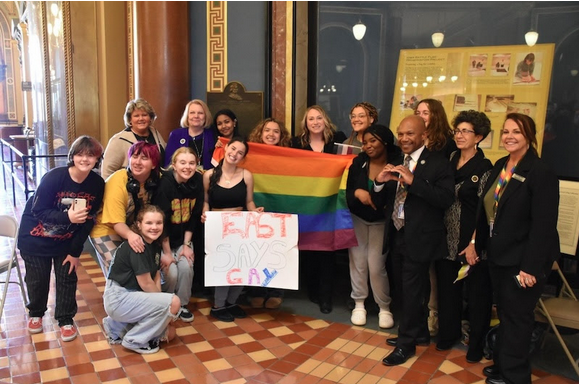
Image from an email from Iowa State Senator Liz Bennett
Let’s just get into this. Conversion therapy is wrong and Iowa Republicans want statewide control in how communities approach it. In case you’ve been sleeping, conversion therapy is at best a pseudoscience intended to change an individual’s sexual orientation. At worst it harms people. It is not even a legitimate form of therapy, wrote Douglas C. Haldeman in The Case Against Conversion “Therapy.” Here are the basics:
Conversion therapy is the pseudoscientific practice of attempting to change an individual’s sexual orientation, gender identity, or gender expression to align with heterosexual and cisgender norms. Methods that have been used to this end include forms of brain surgery, surgical or hormonal castration, aversive treatments such as electric shocks, nausea-inducing drugs, hypnosis, counseling, spiritual interventions, visualization, psychoanalysis, and arousal reconditioning.
There is a scientific consensus that conversion therapy is ineffective at changing a person’s sexual orientation or gender identity and that it frequently causes significant long-term psychological harm. The position of current evidence-based medicine and clinical guidance is that homosexuality, bisexuality and gender variance are natural and healthy aspects of human sexuality. Historically, conversion therapy was the treatment of choice for individuals who disclosed same-sex attractions or exhibited gender nonconformity, which were formerly assumed to be pathologies by the medical establishment. When performed today, conversion therapy may constitute fraud and when performed on minors, a form of child abuse; it has been described by experts as torture, cruel, inhuman, or degrading treatment, and contrary to human rights.
An increasing number of jurisdictions around the world have passed laws against conversion therapy.
Allow me to repeat, “When performed today, conversion therapy may constitute fraud and when performed on minors, a form of child abuse; it has been described by experts as torture, cruel, inhuman, or degrading treatment, and contrary to human rights.” Why wouldn’t the State of Iowa ban this harmful practice? We should. The scientific consensus is it doesn’t work as intended.
“Iowa Republicans want to ban LGBTQ+ conversion therapy bans,” House Minority Leader Jennifer Konfrst wrote in an email. “Yes, you read that right. While Iowa is one of the few states without a statewide ban on conversion therapy (not a great start), individual cities and towns have implemented their own bans on conversion therapy. The Iowa GOP would like to take away that local control.”
“Linn County passed its ban on conversion therapy in mid-2022, prohibiting conversion or reparative therapies for people under the age of 18,” wrote Valeree Dunn of Iowa News Now. “The City of Davenport has had its own ban on conversion therapy since 2020.”
“Far-right extremist Sen. Salmon introduced SF 2037 which would prevent cities and counties in Iowa from banning conversion therapy,” Senator Bennett wrote. “As the only out LGBTQ+ senator in Iowa, this feels like not only a personal attack on me, but also an attack on our entire community and state.”
This bill is an assault, not only on one LGBTQ+ individual, it is an assault on everything that should be important to Iowans, including local control of our communities, recognition of the validity of the scientific methods used in research, and plain common sense.
The bill passed subcommittee on Wednesday, Jan. 17, and seems likely to clear the full committee should it meet on the bill.
Contact your state legislature to oppose this ill-advised and regressive legislation. Better than that, work to add Democratic State Senators to their caucus in the November election to regain a majority. If you can spare some dollars, here is the link to support the Iowa Senate Democrats.
This winter I lost the power of imagination when it comes to cooking. I know skills of cooking and the pantry, refrigerator, and freezer are full of food. Yet I give a blank stare when asked what we should have for evening meal.
Last night I made a vegan version of red beans and rice. It was based on the “holy trinity” of bell pepper, onion and celery. I added canned red beans and tomato sauce, garlic and kale from the garden, and seasoned with salt, dried thyme, and parsley. The dish came together with a slurry of white miso, tomato juice and arrowroot. Served on rice with a side of cooked corn, it was a satisfying meal. We discussed and are putting red beans and rice in the rotation.
The Iowa Legislature is in session and OMG! These Republicans are one paternalistic, low-IQ, incompetent group — filthy with unpleasant habits, brutes in human form, resembling human beings far too closely for the liking of most Iowans. (h/t Jonathan Swift). Where should I start?
We, as a society, have to elect enough Democrats to stop their madness by regaining the majority in both chambers of the legislature. When we held a majority in the senate, the radical craziness was held at bay. It wouldn’t hurt to retake the governor’s office.
Here’s a short list of legislative issues with Republicans:
Conversion therapy ban ban. Prevent local jurisdictions from banning this discredited pseudoscience as any decent person would.
Restrictions from use of information from the American Library Association in public school libraries.
Reduce services by the Area Education Agencies which serve disabled children.
Continue to do nothing with nursing homes where another patient recently died of neglect.
After the court enjoined their book ban bill for public schools, they doubled down with a book ban in public libraries.
School children would be required to sing the national anthem at the beginning of each day.
Politicization of the investment of public funds like the Iowa Employee Retirement System.
The chair of a subcommittee humiliated speakers addressing a bill concerning loss of local control for guaranteed income programs for the poor.
Good grief! The session is just beginning, so the worst is yet to come.
2024 is the time, now more than ever, to get involved in the political process. Even if it just means letting family members know it is important to vote.
Katie Tritt went to sleep on Sunday and didn’t wake up. Yesterday the family announced her remains were donated to the University of Iowa College of Medicine. There will be a gathering in late February. On Saturday she attended a sports event and was living her best life. Now, she’s gone.
I didn’t know Katie well after she graduated high school in 1968, yet she and her family were a significant part of my growing up in Northwest Davenport. Her obituary is here.
When I think of life with my family before college, Katie was a person who made good where she was born and lived her life. There is something positive about that. She was a good person.
She worked her first job at the Dairy Queen at Five Points in Davenport, where all of us kids went when we could. She attended the same high school I did, two years ahead of me. She graduated from the University of Iowa, after which she taught school in the public elementary school where I attended Kindergarten and in the parochial grade school where I attended seventh and eighth grade. She was a substitute teacher until she passed. She was active in the community as an adult, in a way I was not destined to be.
When my spouse and I married, Mother held a reception for us in her home. Katie attended and we have some snapshots of her there. Even in 1982 there was a sense of neighborhood where we shared obligations to each other. The neighborhood as I knew it no longer exists.
Death strikes closer as we age. I hope the rest of my life can be as good as Katie’s was. May she rest in peace.
Before the contractor installed the driveway we parked on the chip and seal road. We specified a concrete driveway, although in retrospect, today I’d install asphalt. Concrete held up over 30 years and is good for many more. The asphalt just looks better and its dark color absorbs heat from the sun, benefits I hadn’t considered in 1993. Rain is forecast, so the concrete cracks will soon be showing themselves again. It’s just a thing in the life of a septuagenarian who lived in the same place for more than 30 years.
In the end, our home suited me as a writer. In a rural subdivision we are far from city life, yet there are enough people around to help in case of an emergency. The state park is a three minute walk with its five-mile hiking trail. Because of the lakes, there is an abundance of waterfowl. I believe we’ve seen specimens of every bird native to Iowa here. We also see most kinds of mammals, a snake or two, and amphibious creatures at certain times of the year. There is a lot of inspiration in that.
As home construction began I made at least weekly trips to observe progress. One time I parked on the street and walked over to the high wall that had been dug for the foundation. I sat on the edge and had a moment’s quiet while I looked over the footings toward the lake. I felt then this would be our home base for many years to come.
I left on and returned from a lot of trips on our driveway. Other family members did too. Travel is mostly finished except for errands and visits to immediate family.
As I begin year three of my eighth decade on Earth there is a lot to do. I have a reasonable rasher of good health, a secure home, plenty of good food to eat, and enough of a pension that finances get tight yet we make ends meet. Importantly, my ability to think remains reasonably sound, as far as I can tell. I do forget things now and then. It seems like more than I did, but not enough to worry. All of this, combined with seven decades of experience, and there is plenty of material for writing.
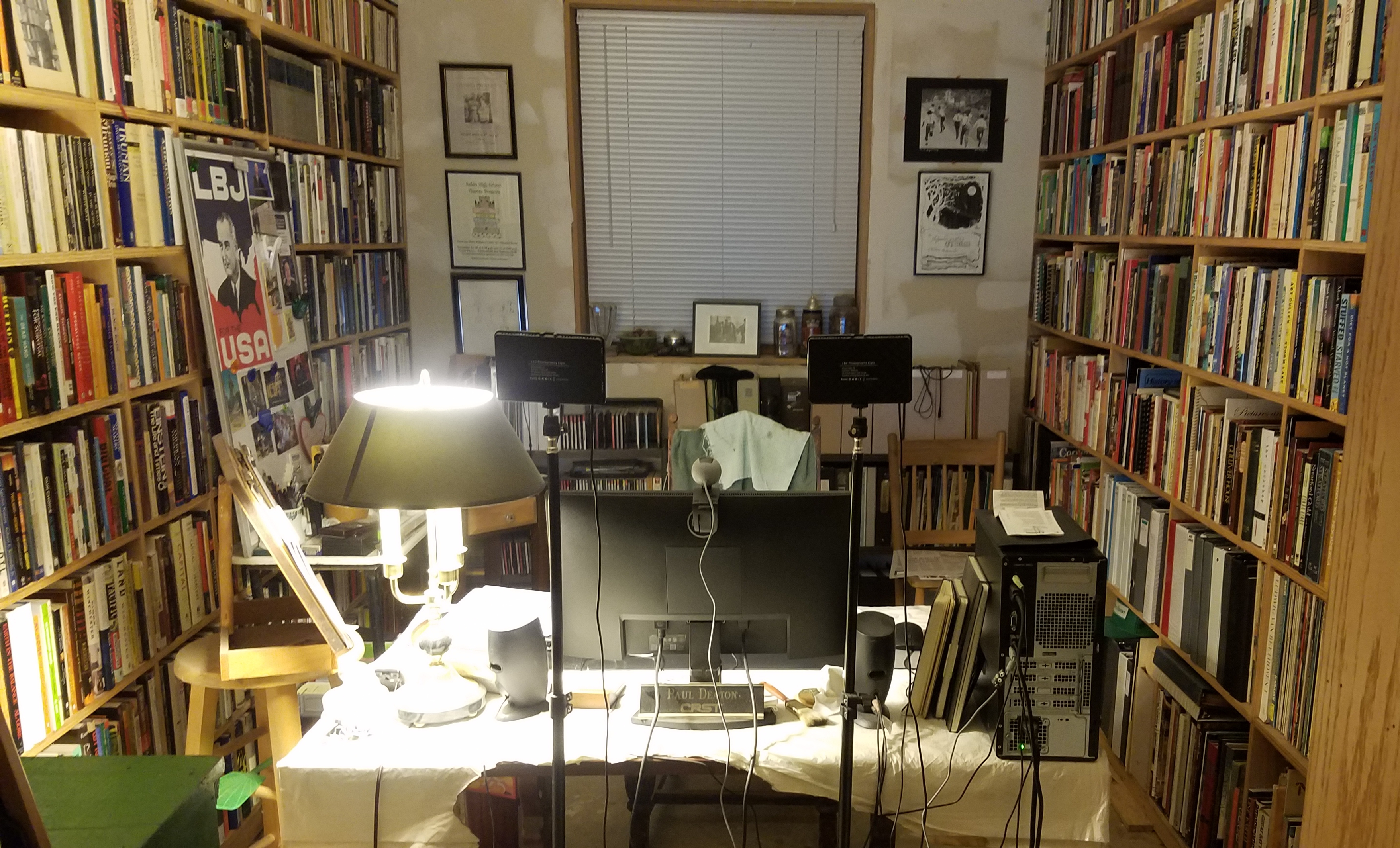
Writing table.
The challenge of aging, especially in America, becomes dealing with isolation. I wrote about this before. Being a writer requires a balance between isolation and being with people, so writing is a natural occupation for a septuagenarian. The scales tip toward the isolation side as we age. Without the continuous commotion of being at events or with other people, I’ve been able to discover myself in a way that was unexpected. At some point, I’ll know who I am and be ready for a new debut in society. If anyone will have me, that is.
The recent winter storm brought me indoors. For a while, I need that. I’ll also be ready for spring and trips to the vendors that support my garden. There is a lot of catching up to do. For now, I’m feeling isolation and coping with it by writing. It is the one thing I know how to do that works.
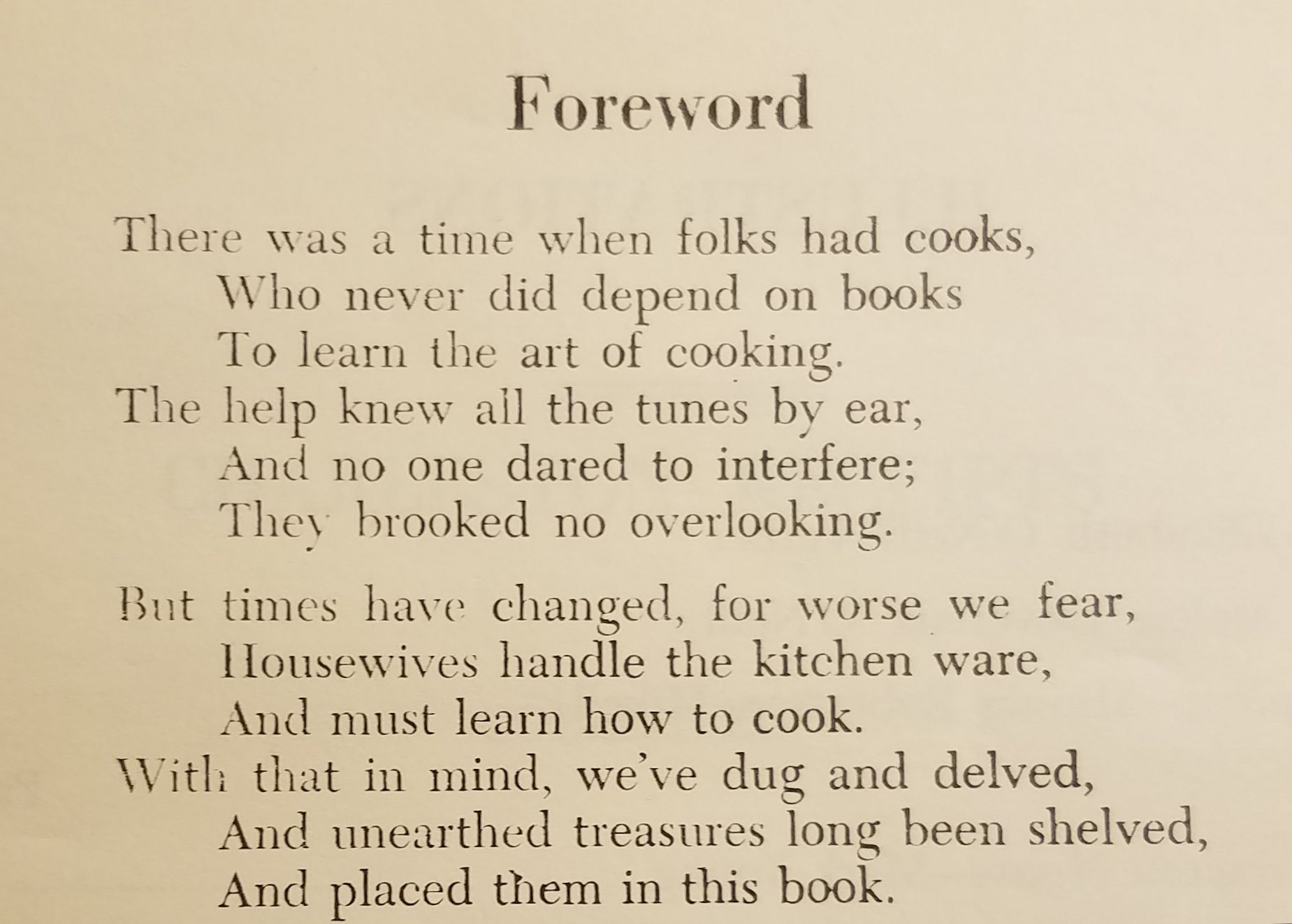
Excerpt from Charleston Receipts by The Junior League of Charleston, South Carolina, 1950.
I don’t know about this forward to a 1950s cookbook, Charleston Receipts. The unspoken part is cooks in the first verse were mostly black women, and housewives in the second were white. It is not overtly stated, but I’m certain it was implied. This book trades on fond remembrance of antebellum food culture. The word plantation is used in the names of some of the receipts (not recipes, per the author).
A large number of white women and girls worked as servants in the United States. It is possible the reference is not racist. Home cooking and cleaning were common employment for female Irish immigrants and those of other nationalities. When Grandmother left the Minnesota farm in the 1910s, she was employed as a servant in a home in Minneapolis. She worked as a cook well into her sixties. In the 1970s, people I knew in southern Indiana continued to employee a black woman as a home cook. It bothered me then, and it bothers me now. A person has to live, but not like this.
I have two copies of the book and one was missing its binder. Copies were readily available in thrift stores and used book stores. I read all the pages and saved a few from the volume without a binder to refresh my memory. There was a multi-page section about hominy, “long a favorite in the Carolina Low Country.” The section begins, “Man, w’en’e hongry, ‘e teck sum egg or cheese an’ ting an ‘eat till e’ full. But ‘ooman boun’ fuh meck wuck an’ trouble. ‘E duh cook!” I don’t recall the name of this type of language but it is stereotyped and hearkens to minstrel shows of the 1830s, which characterized blacks as lazy, ignorant, superstitious, hypersexual, and prone to thievery and cowardice. Charleston Receipts is racist, although I am confident the Junior League of Charleston, which published the book, would deny it.
When I stopped in Charleston enroute to military service in Germany, I had a couple days before dropping off my pick up truck at the port. Charleston traded in slave culture then, and they do now. I saw for the first time up close, slave auction blocks, shackles, and whips used on enslaved humans. I searched the internet and found today there is the Old Slave Mart Museum that tells Charleston’s role in slave trade from 1856 to 1863. They were domestic slave traders then, one of the biggest in the country for collecting and selling human chattel.
In writing my autobiography I find the racist side of my personal history was in plain sight. I didn’t understand that then, mostly because my parents taught me a person is a person and that was that. It helped this outlook to have made a family trip to the plantation where Grandfather was on work release from prison and see my father sharing memories with a group of black men we encountered there. They seemed like old friends. It was a formative experience.
Racism never died out, although I forgot about it for a while… until I began writing my story. In that context, it is hard to miss, even in old cookbooks.








 Journey Home
You must be logged in to post a comment.