Gibson Les Paul electric guitar. Photo Credit – Wikimedia Commons.
When I played in a band, there were about a half dozen six-string, electric guitars to use. Either a Fender Stratocaster or Telecaster, a Gibson Les Paul or an SG, and maybe, just maybe, a Gretsch, Epiphone or Rickenbacker. There were others, but those are the ball game. In 1974, I bought a Fender Telecaster Thinline.
The purpose of the Telecaster Thinline was to reduce the amount of Ash used in the body. Apparently the wood was in short supply in the 1970s. The guitar served its purpose and years later I sold it to a friend for the same price for which I bought it.
Nothing defined me as a rhythm and blues artist like that Telecaster. It had a distinctive sound, and I looked the part of a musician while playing it. However, when the band broke up and I took off for Europe, I did not return to playing electric guitar in public. My prospects as a professional musician were not bright.
I played it some. It traveled to Lake County, Indiana with the family. Our child enjoyed playing it without an amplifier in the garage. It found a good home in Arizona, delivered by a friend’s parents.
Why didn’t I get a Les Paul? I didn’t think I was cool enough. Most of the excellent local Les Paul players I knew were way above my skill level. It also seems like a guitar for people of short stature. I recognized early on I would not be a Les Paul guy. I am okay with being a Fender man.
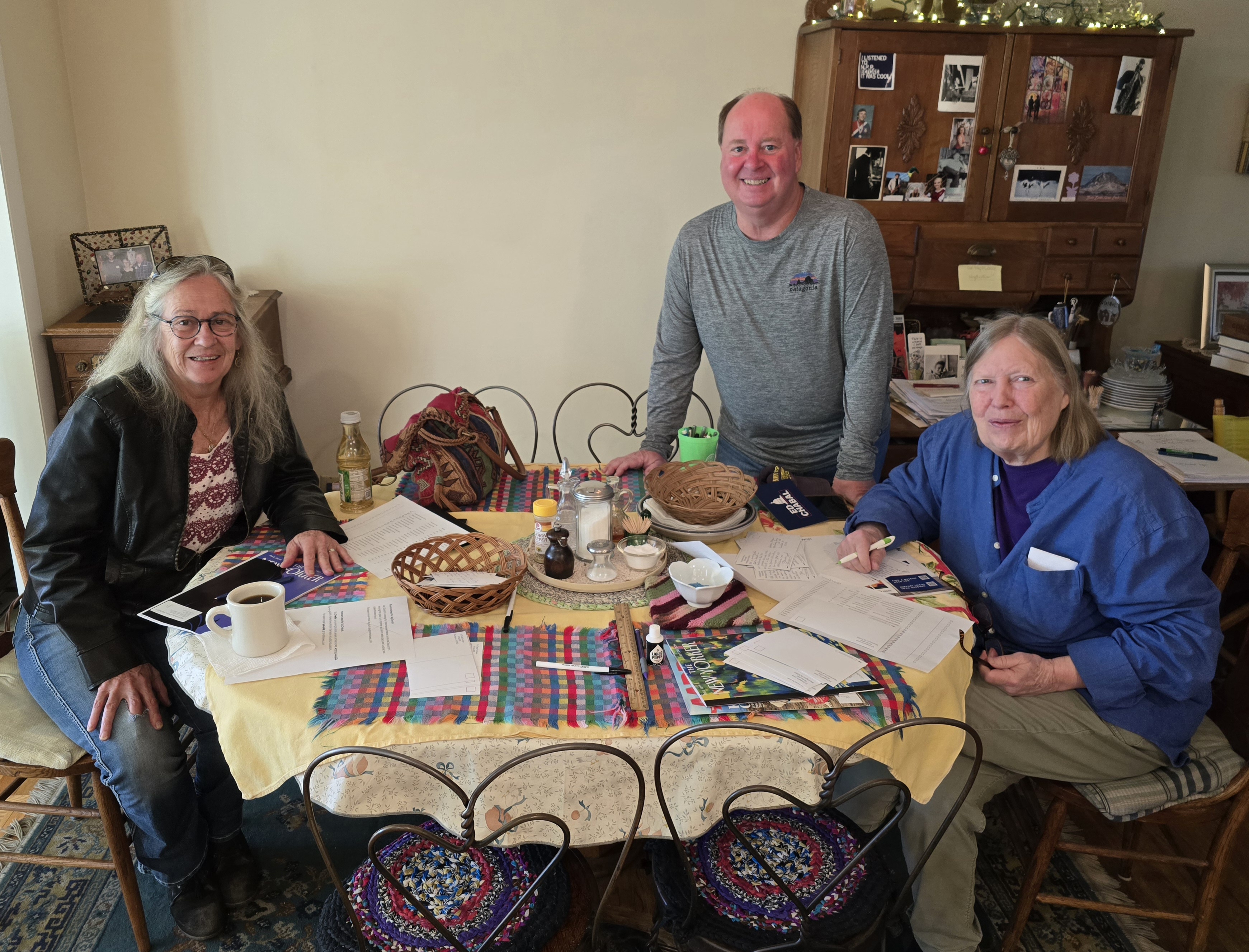
Local political activists writing postcards for state senate candidate Ed Chabal (center).
My cohort of septuagenarian and octogenarian political activist friends organized an event before the primary. (Some nonagenarians are still around, yet are taking a well-deserved break. Their work beginning with the Adlai Stevenson campaign is appreciated, they earned their spurs). We held a “meet the candidates” event for local voters, something not often done these days. All five primary candidates for county supervisor showed up to speak briefly and to shake hands and chat for a couple of hours.
In August, we fired the engines for the fall campaign to put on another meet the candidate event, which also served as our kick-off event. First Congressional District candidate Christina Bohannan was our keynote speaker. We had eight candidates in all and more than 65 attendees. It was good turnout for a small, rural city.
After kicking off the campaign we began planning and doing: we finished our third postcard party with seven people writing postcards to voters for our house and state senate candidates; planned a meet and greet event for a state representative who is not well known after redistricting; deployed a sign crew to get out the word about our candidates; and are deploying a door knocking crew to the far western part of our new state house district, where one of our members was raised. I started a special newsletter to facilitate communication, although most of our planning is done in person and via email. Phone calls? Only when we have to. Text messages? No. I would describe this as off grid organizing.
What does off grid organizing mean? Barack Obama described it as well as anyone could last night: “It was great to be back in Pennsylvania today. If this election is making you feel excited or scared or hopeful or frustrated or anything in between, don’t just sit back and hope for the best. Vote for Kamala Harris and Tim Walz. Vote for Democrats up and down the ballot who will fight for you. Then help your friends, family members, neighbors and coworkers register and make a plan to vote.”
With the demise of the coordinated campaign, we feel left on our own. The county party was able to hire a couple of organizers that work out of the First Congressional District campaign office in the county seat, yet we rely on them only when we have to. We know what we need to do and just do it. If there is a bill for advertising, we split it up and pay it. To promote our local races, we reach out directly to the state house candidates and find they are very willing to have us support them. In any case, a state house campaign is separate and different from a district wide or statewide campaign. Down ballot races are very important, so a cookie-cutter campaign doesn’t work well.
The county organizers telephone us to ask for our help. We do what we can. What hinders us, especially door knocking, is the large number of our group that have trouble moving around and are in the midst of cataract surgery, hip or knee replacement, diabetes, arthritis, or other ailments of aging. We had a conversation this week about door knocking and to a person felt it is not the kind of campaign that is needed. The number of doors a campaign knocks is no longer a meaningful metric. How deeply we penetrate social networks matters so much more. When the campaign office calls us, we politely decline.
The 2022 election cycle was my last experience door knocking and it was an eye opener. I tried to make it to every door knocking event that was in my county and my state house district. To a person, people contacted required no additional information about the election or candidates. They knew the candidates, had a plan to vote, and did it mostly on their own. If they were not going to vote, no entreaties from a stranger would change their minds. People yelled at me from behind closed doors, “Go away!” The world has changed since I re-activated in politics during the 2004 campaign.
So what do we do to get Democrats out to vote? We talk to people, in person or via the telephone. We talk to people we have known for years, and in some cases, for decades. We make sure they plan to vote. We don’t take this for granted. We ask if they need a ride to the polls. We share information and discuss issues in the campaign.These are normal conversations between rational voters. We need more of that.
Eventually my cohort and I are going to die or move to a home. Until we do, at least this campaign, we are activated.
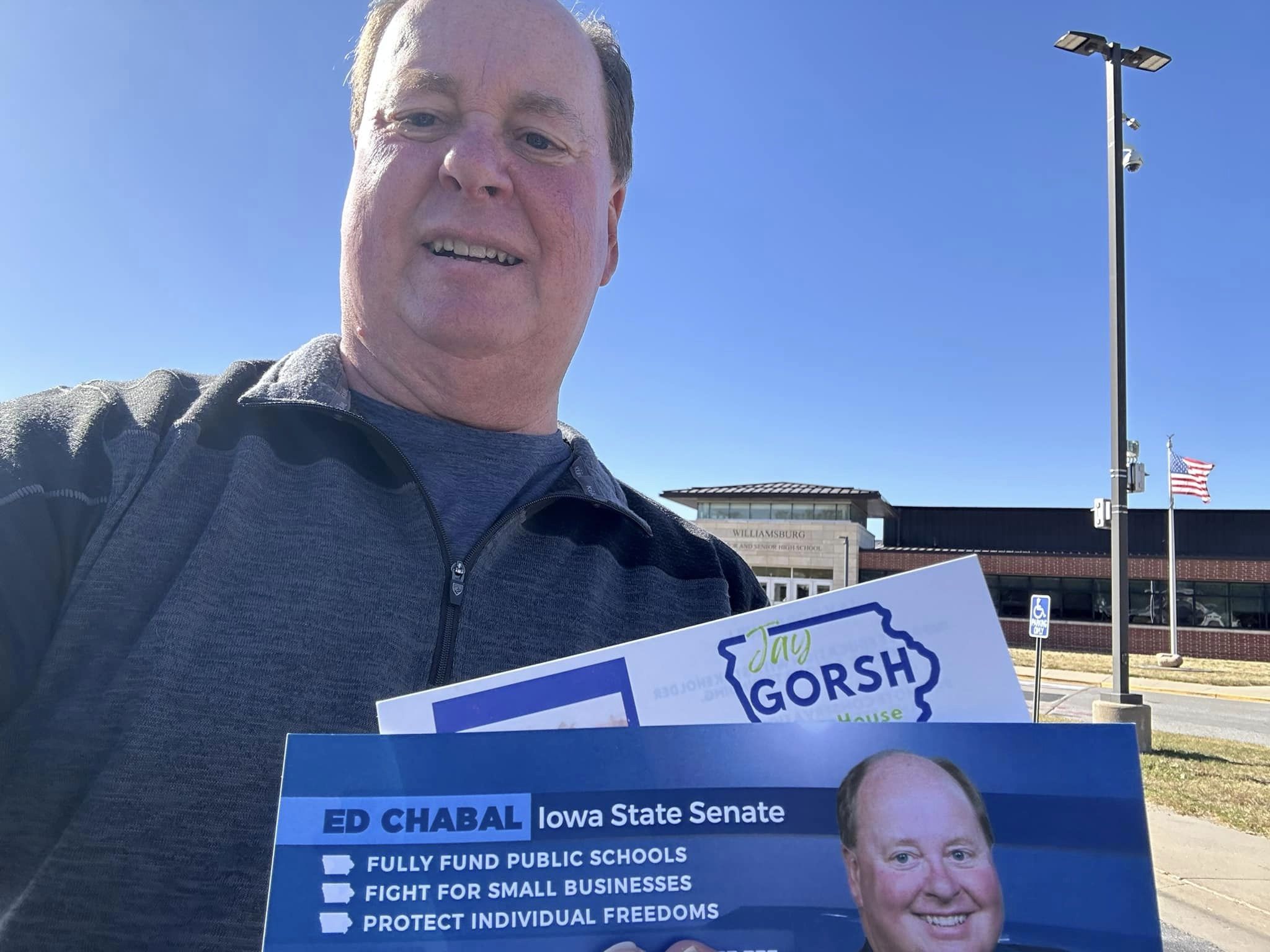
With all the education talk before the Nov. 5 election, Ed Chabal should be a shoo-in to be elected to the Iowa state senate in District 46 (located in Iowa, Washington, and parts of Johnson counties). He served as director of business and finance for the Mount Pleasant Community School District from 1997 until this summer. He knows school finance inside and out, and education is the largest part of the state’s annual budget. Do the math and district voters should vote for Chabal because of this expertise.
When last April the Iowa City Community School District announced closure of Hills Elementary School, local residents were taken aback by the speed at which things moved. Chabal’s opponent, incumbent state senator Dawn Driscoll, was johnny on the spot to devise a solution, one that included consolidating Hills with Lone Tree elementary schools.
My bone of contention is that had Driscoll been doing a better job of funding rural public schools while in the legislature, the whole thing may have been averted. Hills may have retained its school. Driscoll’s April “solutions” discussion with city council and the community is duplicitous insofar as she was helping solve a problem she created by under-funding public education. Ed Chabal knows better than this.
Why do citizens vote against their best interests? Education received in the K-12 system contributes to this. Let’s make Iowa’s K-12 education system the best in the nation again, beginning by electing Ed Chabal to the state senate in District 46 on Nov. 5.
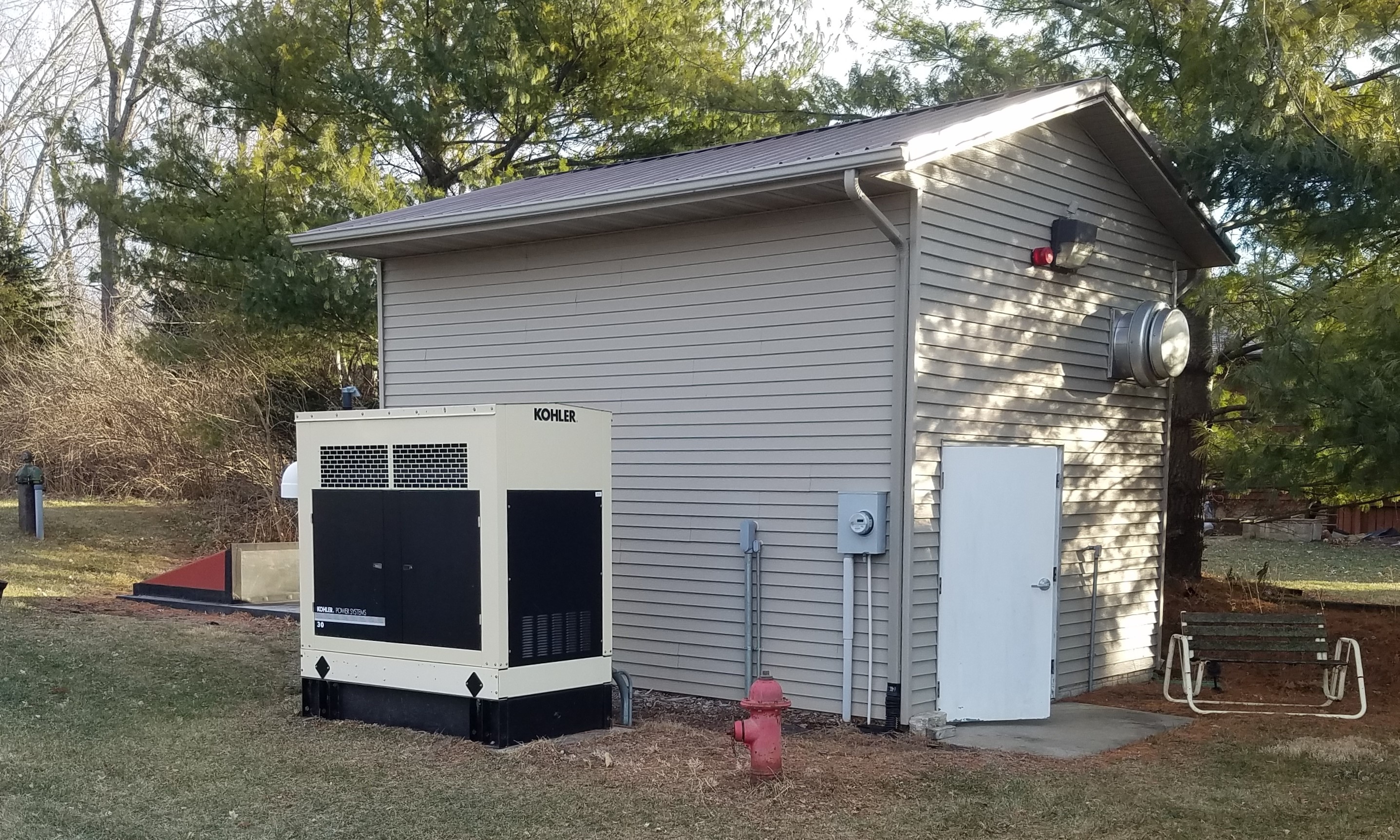
Public water system well water treatment building.
The annual meeting of my home owners association last summer was good. Thanks to all of our board members for their volunteer work. It was a pleasant evening in Randall Park. As is usual, very few members showed up for the picnic-style meal and conversation.
We discussed the association water system and the need to meet new compliance standards. The most recent compliance issue is inventorying the type of pipes bringing public water from the well to and inside our homes. I began following our public water system shortly after we moved here in 1993. We comply with new numbers as they come along. When we cannot get into compliance, we make an investment in extraordinary measures. For example, we spent $400,000+ to comply with revised arsenic standards.
I said this at the meeting and it bears repeating:
The water coming out of the well house into the community water pipes is fit to drink and use. It meets state and federal standards for a public water system. The board sent our annual water quality report in the last mailing. Read it!
We talked about water softeners. When Bob was president, he announced that water softeners were no longer necessary after installation of the new arsenic treatment facility. I’m not sure that information was adequately distributed at the time. However, the quality of water in a home is a matter of personal preference and expense.
Is the water delivered to our homes potable without treatment? Yes, it is. We have data to back that up. Do you want to wash your white clothes in untreated water? Maybe, maybe not. Since the new water treatment system was installed, there have been surges with heavy concentration of iron in it. A whole house filter combined with a water softener buffers users against such anomalies.
One set of data that assists in decisions about whether to treat water in our homes is a water hardness test. Those are locally available, usually for no cost, plus a volunteer in the association is willing to test your water without charge. If you have questions about using a softener, that is a beginning place.
The wastewater treatment facility was built in 1994. While it was maintained as things broke, there is a significant project in the near term future of refurbishing the physical plant. Chloride compliance is a different question. The reason for all the attention to chlorine and salt usage is in pursuit of a reduction in the amount of chloride entering the wastewater stream. Hopefully we can get chloride numbers into compliance and avoid doing something to divert effluent flow from Lake Macbride to somewhere else more acceptable to Iowa Department of Natural Resources.
Here is some additional information:
Iowa’s recent inventory of public water supply systems was 1,838. The percentage of systems in compliance with all health-based standards in 2022 was 96.2%, while the percentage of population served by systems compliant with all health-based standards was 98.9%. Not perfect, but good.
The other segment of well water, which is significant in Iowa, is the use of private wells for household water needs. Private wells fall under the jurisdiction of the Iowa Department of Natural Resources. There is a recommended testing and treatment program for private well owners that includes free annual testing, and money for shock chlorination, well plugging, well reconstruction, and the like. There is also a fully developed program on their website. I couldn’t find information about the level of compliance with the voluntary standards.
They say water is life, and it really is. It seems important to know what the standards are and whether what comes from the tap is safe to drink. In our community we invested a lot to make sure it is.
I understand what Thom Hartmann wrote his new book, The Hidden History of the American Dream: The Demise of the Middle Class — And How to Rescue Our Future. However, the book is less likely written for a boomer like me than for millennials and younger people who did not live through the Reagan Revolution. Hartmann said as much in an email:
“I wrote this book mostly to Zoomers, Gen-Xers, and other younger-generation Americans who don’t understand how we got a widespread middle class in the first place (it was FDR’s government intervention in the so-called “free market”) or why it shrank from two-thirds of us when Reagan came into office to a mere 43-47 percent of us today (Reagan’s 1981 mission was to gut the middle class to “preserve stability”).
When I came of age after finishing graduate school, Ronald Reagan was president and despite an advanced degree, military service, and being a white male with the privilege that means, the American Dream was the stuff of legends rather than something attainable. In his book, Hartmann explains the history of how the Middle Class came to be and what happened after Reagan was sworn in as president. The idea of an “American Dream” is still relevant, he said in a recent interview. His message is one of hope for restoring the American Dream, economic opportunity, and a strong Middle Class.
What makes this book relevant now is the fact that in the November 2024 election, the country is facing a choice between the Democratic Republic upon which we were founded and a rich person’s paradise where privatization of government functions and economic deregulation are the norm.
On Sept. 17, the author interviewed Hartmann about his new book. Click here to listen to the 27-minute interview. You will be glad you did. Hartmann discusses his view of the American Dream, the impact of Reaganism, K-12 and higher education, right to work, and more.
Thom Hartmann is a four-time winner of the Project Censored Award, a New York Times bestselling author, and America’s number one progressive talk show host. His show is syndicated on local for-profit and nonprofit stations and broadcasts nationwide and worldwide. It is also simulcast on television in nearly 60 million U.S. and Canadian homes.
To buy a copy of The Hidden History of the American Dream:The Demise of the Middle Class — And How to Rescue Our Future,click here.
Just as a concertina began the musical Carnival! — slow, isolated, and alone — the path to writing again is picking up the rusty squeezebox and getting started. As I renew effort on this important project, I will be joined by a full orchestra with instruments, players, and settings while engaged in a jamboree of my life in the post-Reagan era. Everything that will fit in 250 pages, I will.
I learned a lot finishing the first part. Blending the past with the future, in terms of the time line was important to style. My omniscient narrator’s voice has the ability to span my entire life at once and I did. Anything else would be fakery. In the chapter on Joan Didion, I began with my discovery of her writing in while I lived at Five Points after military service, and blended my experiences with her writing through her death in 2021. By weaving the whole story into a single chapter, I both told the history and previewed what her writing meant to me. I can’t imaging splitting this story up. So it was with other topics.
The length of part one was about right at just less than 250 pages in the final book. I should keep part two a similar length despite the fact there is more to tell. Exercising disciple in sticking to a narrative is important for the research, and for the writing. I decided to hang the narrative on a timeline based on where we lived, beginning in Cedar Rapids, then Merrillville, Indiana (the Calumet), and returning to live in Big Grove Township in Johnson County, Iowa. Because the Big Grove section is so much longer, more than 30 years at present, I subdivide that with three breaks: my retirement from transportation in 2009, taking work at the home, farm and auto supply store in 2015, and the onset of the coronavirus pandemic in 2020.
The second layer is tracing the history of trucking industry deregulation. This includes the Motor Carrier Act of 1980, signed into law by President Jimmy Carter, Ronald Reagan’s reaction to the PATCO strike, and Bill Clinton’s NAFTA. The impact on American society of these things was broad and deep. My career in transportation positioned me to be in the middle of it as it unfolded. Plenty of books have been written about this. I want to write my story. I have been driving Interstate 80 to Des Moines the last few months. It is remarkable how truck traffic has changed. There is a story behind that.
The third layer is a broad brush approach to our family life in Iowa and Indiana. Ours was not a typical family life, beginning with our vegetarian food culture. We also thought differently about everything from politics to education to banking and finance to transportation to recreation. I hope this layer will be particularly meaningful to our child.
The fourth layer will be the impact of climate change on our lives and on our life in society. A changing environment, warmer temperatures, extreme weather, and public service, including my six years on the county board of health, all play a role.
The fifth layer is how my writing and intellect progressed. If I planned to focus on writing when we married, such focus diffused in the existential struggle to provide for a family. We divided labor in a somewhat traditional way, with me being the primary wage earner, and Jacque working at home during the early years. This had consequences for my writing and for our living. We had a good life, yet there were challenges.
Woven into these layers is my history of working on political campaigns, travel for business, gardening, and learning to live in the post-Reagan society leading up to the 2016 election.
Nothing is cast in concrete. This post is a start. Off we go! Now where did I put my concertina?
My writing process was decimated during September. It will take time to get back in the swing of things. With four weeks left until the election, I probably won’t get in the saddle until mid-November. I just don’t feel like engaging in writing for the moment.
I doubt many of my candidates will beat the Republicans in this precinct. Politics won’t take a holiday until after the election. If it is like in 2020, the malarkey from Trump won’t end until January 2025 if he loses. I expect him to win Iowa yet lose in the electoral college.
Just a brief post today… to let readers know I’m alive. My interview with Thom Hartmann posts Monday. It may be the best one I’ve done with him. I hope you’ll return and listen to it.
So for now, it’s back to the kitchen and meal prep. When I’m cooking for one, one dish can make multiple meals.
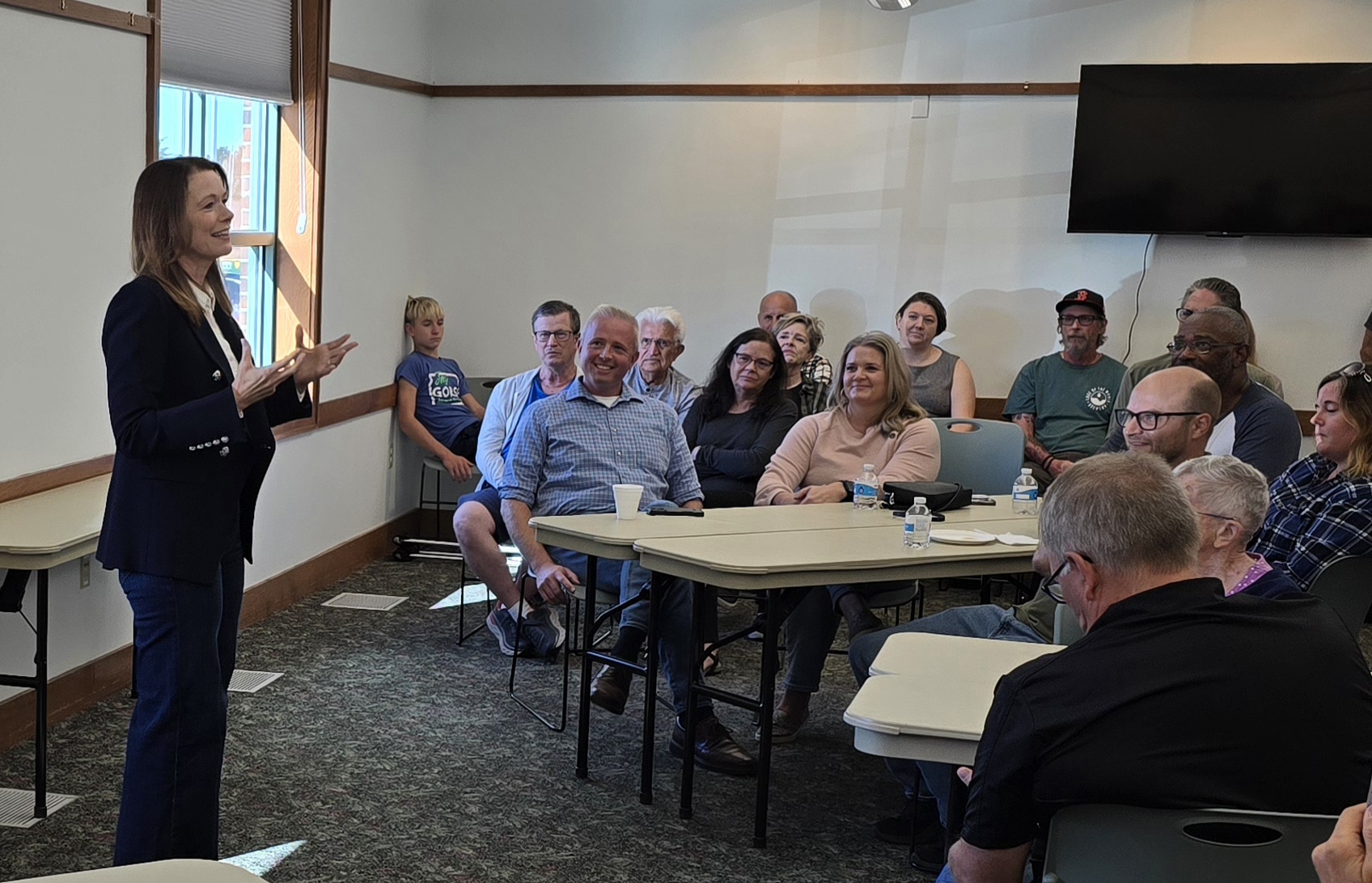
Christina Bohannan at the Solon Public Library on Sept. 28, 2024.
Solon Area Democrats got together for a meet the candidates event on Sept. 28 at the Solon Public Library. The room was packed. Eight candidates and elected officials spoke, then we broke the group for one-on-one conversations between candidates and voters. We could feel the energy in the room.
Our featured speaker was congressional candidate Christina Bohannan, who has been rising in the polls. We have a distance to go to elect her, yet it seems possible this cycle. The aforementioned energy will hopefully carry her across the finish line.
Most notable about the event was the reunion of many area people who worked on previous campaigns, including a nonagenarian whose first political campaigning was for the Adlai Stevenson. She wasn’t the only nonagenarian present. It was good to see old friends again. The point of the day was to kick off the final push into the November 5 election. This group has been activated. What will they do?
I scheduled a door-knocking event in the afternoon but it was a bust due to lack of volunteers. The house and state senate candidates from my district took a walk list. I did too. That was it. While in person voter contact can be a positive motivator, that contact will have to come from other places this cycle. It will come from the 65+ people who attended our event. The method will be word of mouth among family and friends about the importance of this election.
In a recent post, I suggested there is a new way to canvass, and based on Saturday’s experience, that is both likely and correct. The number of doors a campaign knocks is no longer a meaningful metric. How deeply we penetrate social networks matters so much more.
37 days from the election there is excitement among Democrats. One hopes we will make some gains in closing the gap between us and the Republican majority this cycle. At minimum, we should be able to break the Republican super majority in the state senate and increase the number of Democratic state representatives. There is no time for analytics. We must continue to do two or three things each day to elect Democrats. That is how we will win and move forward.
Iowa farmers are harvesting soybeans. It seems early, yet when the beans are ready, they are ready. I’ve been burning up Interstate 80 on family business for a few weeks and in addition to changing colors in fields, the soybean harvest is the most prominent activity. Corn is Iowa’s biggest crop yet there remains a lot of green in the leaves, indicating it’s too moist to harvest.
A few farmers have been harvesting hay in large round bales. Iowa generates some $119 million worth of hay each year. It ranks in the top ten commodities. Hay holds a dim lamp to the major crops of corn, soybeans, hogs, cattle, chicken eggs, and dairy products.
I don’t particularly like all the driving of late. At least I can pay attention to something uniquely Iowan. When I returned home I grabbed a bucket and picked some tomatoes. The tomato harvest has been abundant, although it will soon be over. I found nice ones on the vines, though.
This week I made it into the clinic for my six-month check up and the news was not good. I was referred to an outside clinic for a foot problem, and had a chest x-ray which revealed liquid in my lungs. My numbers on the blood test are mostly okay, yet some important ones are going the wrong direction. There will be reconsideration of lifestyle once I get beyond today’s political events. I know now that changing my exercise routine and eating habits are both necessary.
September is not over yet it has been a pisser. The six-month check up served its purpose, even if I don’t like what I am seeing. As we support family in Des Moines, I’ll be seeing more of the fall harvest as days unfold.
Time is flashing by in the run up to the Nov. 5, general election. I had our county organizer run walk lists for our event on Sept. 28. I hope to work some of them before then. Election day will be here in 43 days, so no time to lose.
I have only a couple of priorities. Encourage Democrats to vote. Encourage people to vote the whole ballot. Encourage voters to have friends and relatives to do likewise. That’s pretty much the ball game.
I read in the Washington Post House Speaker Mike Johnson cannot wrangle his caucus and doesn’t have the votes to prevent the government from running out of money on Sept. 30. That means he will again rely on Democrats to keep the government open. It would be an electoral disaster for Republicans to shut the government down right before the election and they know it.
Expectations for the election 43 days out are that Trump will win Iowa by a lesser margin than in 2020. Two of the U.S. House races are competitive and Democrats Christina Bohannan in first district and Lanon Baccam in third district stand a chance of flipping those seats. It is important to note that flipping five or six U.S. House seats nationally is all it would take to flip the House to Democratic control. Iowa Senate Democrats need one more seat to break the Republican super majority. They seem likely to do that, yet unlikely to flip the chamber because their numbers are so far down. In the Iowa House, Minority Leader Jennifer Konfrst said she would like to see the minority move from the current 36 to somewhere in the 40s. That, too, seems possible.
I had hoped to be out of elective politics by age 72. That won’t happen this year, and I continue to do two or three daily things related to the election. I will continue for the next 43 days.




 Journey Home
You must be logged in to post a comment.