For the second day in a row ambient temperatures reached the high 90s with a “feels like” over 100 degrees. Farmers and gardeners were up at sunrise and curtailed outdoor activities by noon — a simple adaptation to unseasonable weather.
It was too damn hot.
While picking up the final spring share at the farm a fruit farmer friend arrived. We talked about the weather, then joined two farmers who were loading the truck for share deliveries in Cedar Rapids. They read my new T-shirt, which is red and says, “The United States of America Established 1776.”
“Very patriotic,” they opined.
The irony is the tee was made in China. They offered to screen print the farm logo on a new shirt at the next farm get-together. After the farmers left for the city we discussed politics until we gathered our shares and returned home.
I left seedlings outside in the morning, but well before noon, the pepper plants began to wilt. I brought them inside and they perked back up in the moist darkness. When I watered toward sundown the tomatoes, eggplant, cucumber and zucchini seedlings looked healthy — giving them plenty of water appears to be the key to survival. One kale plant looked worse for the heat and unlikely to be revived. Regrettably, I turned all the extra kale seedlings into salad the day before, so there will be a hole in that row.
Concerned about my ability to stand the heat, the afternoon and evening was spent indoors reading, cooking and working on my memoir. There is a lot of that kind of work to do and if the weather won’t cooperate with my gardening wants and needs, a person has to do something.
The good news is the forecast today is for highs in the high 80s. I’ll be out there as soon as the sun comes up.
Despite extreme heat tomatoes were planted yesterday.
Temperatures set new records throughout the state. Here it was 96 degrees by noon. I began planting at sunrise and finished around 10:30 a.m. when it became too hot. Snow last fell on April 15, so spring, if we can call it that, lasted about five weeks.
It is shaping up to be a punk vegetable season although it’s far from over. The heat stresses cucumbers and zucchini requiring a close watch to make sure they get enough water to survive. Likewise tomatoes. Some plants won’t survive and I reserved the extra seedlings to get through initial planting and establishment. Gardeners will adapt as best we can to weird and unseasonable weather. It’s what we do in a time of global warming.
Tomato Worksheet
That said, the tomato seedlings survived planting and the heat.
This year I planted eight varieties, Martha Washington, German Pink, Brandywine, Soldacki, Nepal, Red Pearl, Taxi and Clementine. If they all make it, harvest should include a variety of textures, colors and flavors.
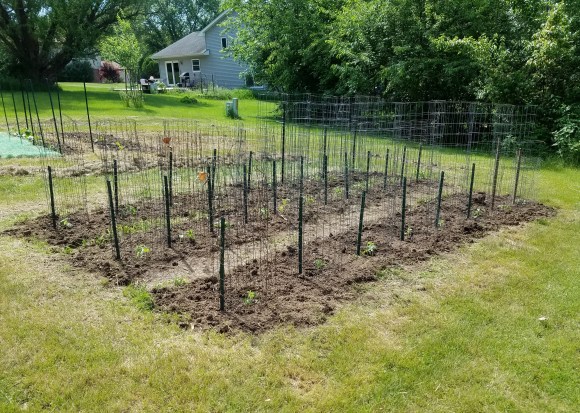
The process was to dig three yard wide trenches in the designated plot. Using a hoe I broke up the clods of dirt then fertilized. Next I used a garden rake to further break up the dirt then fertilized again. Finally I smoothed everything over with a rake.
Down the center of the plot I spaced Soldacki and Brandywine seedlings about 18 inches apart — a bit close together but it allowed a dozen plants in the row. These varieties will produce fruit that weighs less than a pound.
I began the east row with German Pink. This variety grows fruit up to two pounds and I planted all five seedlings that germinated, spacing them more generously. It is one of my favorites because of the large slices it produces. Next I planted four each of Taxi, Red Pearl and Clementine bunched together. Each stake held two cages in which two each of the seedlings were planted together. These three varieties are smaller, with fruit weighing from 20 to 150 grams each.
In the west row I planted four each Nepal and Martha Washington spaced at 24 inches. These slicers will produce fruit weighing less than a pound. It’s the first time trying them both.
With seedlings planted, next is mulching. I need to harvest grass clippings for that, which got pushed off because of the heat.
Farmers Market Asparagus
After planning to skip the Solon Fire Fighters Pancake Breakfast, I showered and went to town after five hours in the garden. The morning crowd had dissipated so there was no line and plenty of food.
The big news was announcement of a $5 million fund raising goal to build a new fire station near the Dairy Queen. According to the handout, the building will be funded by private donations, donated goods, services and labor, and via loans. The goal is to raise the money by Jan. 1, 2020, although $5 million is a lot for our community comprised of a small city and four townships. “We’ll donate something,” I told first assistant chief Scott Wolfe.
It’s been a bad spring for asparagus with none from the farm this year as the farmer tries to reclaim her asparagus field. To make up for it, I went to the farmers market in the county seat on Saturday and found some. We featured it for dinner last night — steamed with butter and a seasoning mix. It was fit reward for a hot, tiring day.
The idea of banking early votes among infrequent voters rose to prominence after the turn of the century.
I recall the tactic while working on the first Obama general election campaign. It served a useful purpose that combined data analysis, field organizing and canvassing to focus on maximizing voter turnout among potential Obama voters. The targets were not predictable voters — the ones who showed up reliably for every election — but registered voters whose voting record indicated a propensity to skip elections. The idea was to leave nothing to chance, get their votes cast for preferred candidates, and once banked move on to other campaign work. Both Democrats and Republicans employ this tactic today.
Individuals use early voting in a number of ways. For me it was a way to participate when my work schedule had me out of town on election day. I also voted early for convenience. For example, when I went to the county seat to pay my property tax bill, I stopped at the auditor’s office to cast my vote. Recent discussions about the shortened early voting period (from 40 to 29 days) have little to do with people like me. It is related to a curtailment of opportunities for campaigns to bank early votes — less time equals a more compressed campaign schedule.
In a primary election like the current one, there are so many moving parts early voting seems less important. Something game-changing could and did happen after the beginning of early voting and before the election. This week’s events are a case in point.
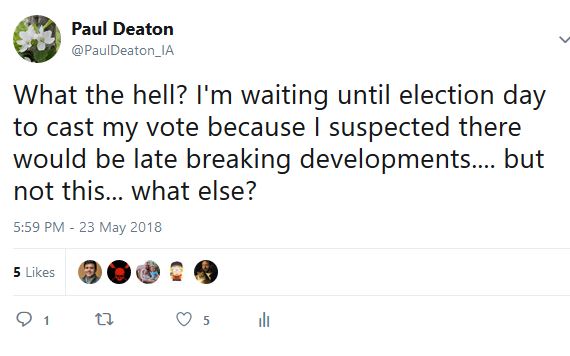
On Wednesday, May 23, the Des Moines Register broke a story that three women accused gubernatorial candidate Nate Boulton of sexual misconduct. By Thursday, Boulton suspended his campaign and Iowa Senate Minority Leader Janet Peterson called for his resignation from the state senate. According to Iowa Secretary of State Paul Pate some 13,000 Democrats have already cast early ballots and there is no process to re-do those votes according to Iowa Code. Boulton voters who haven’t cast their ballots are likely to pick one of the remaining five candidates in reaction to the news.
While rumors about sexual misconduct were circulating around Boulton prior to this week, those whispers did not make their way into mainstream political discussion in Big Grove. It caught me by surprise:
Voters rarely base decisions on having “all the information” about a candidate. I recall the first time our daughter attended the Iowa caucus in 2004. She had not decided for whom to caucus when we arrived at the Middle School. She carried a copy of the Solon Economist with a candidate comparison to read at the event. After years of political canvassing, I believe more voters are like our daughter than not. Decisions are made late in the election cycle and I submit, even later in a primary. Why vote early if one doesn’t have enough information?
Well organized campaigns can be expected to use every aspect of voting law to maximize turnout for their candidates. There is a need for early voting to make elections accessible to more people but I’m not sure of what tactic it serves in the June 5 primary.
Here in Big Grove, as elsewhere in Iowa, we play according to rules established by others and use the tools of the trade to work on campaigns. If that means waiting until election day to vote, we will.
I’m happy to participate in Iowa politics. At the same time, it is not the sine qua non of living in society.
Despite a long patriarchal lineage of political engagement, beginning in Virginia 100 years prior to the American Revolution, I don’t care for the gossipy, back-biting, outrage-invoking folderol modern politics has become in the age of FOX News.
I’d rather be working in our garden.
Two weeks before the June 5 primary election a couple of political things are worth noting.
With so many races that matter on the ballot, it is hard to focus energy. There’s the gubernatorial race with six Democratic candidates, secretary of state with two, state Senate District 37 with four, and county supervisor with three for two positions. It’s hard to pick a uniform, actionable slate because the support matrix differs so much among voters. Mine is Norris-DeJear-Wahls-Carberry-Rettig.
There is a lot of energy around female candidates, Heiden and Weiner particularly. That energy is positive for their campaigns. With it, each of them created a viable path to the nomination.
Let’s talk about that. Two people I respect, Jean Lloyd-Jones and Maggie Tinsman, created a non-partisan, issue-neutral organization dedicated to achieving political equity for women — 50-50 in 2020. In Johnson County there is a slate to help get there, including Janice Weiner for Senate District 37 and Pat Heiden for county supervisor. Both candidates are well organized and made themselves to be contenders. They are also well-qualified. Within the people who support them is a politically correct idea about electing women. The narrative goes something like what I heard when Weiner’s campaign door knocked our house. “Janice is a well-qualified candidate in a field of good candidates, who happens to be a woman.” We’ll find out after the primary whether that kind of campaign has legs. It might.
After the disastrous for Democrats 2016 Iowa caucuses and general election, a group called Our Revolution organized the shrapnel from the Bernie Sanders campaign in an attempt to avoid assimilation with the party. I don’t know if that’s good or bad, but the history of such groups includes eventual assimilation into Iowa politics whether organizers like it or not. Iowa political history is laden with the ghosts of past third party movements like the Liberal Republicans, the Greenback Movement, the Populist Movement and the familiar-sounding Progressive Movement.
The June 5 primary will test the mettle of Our Revolution which has endorsed Cathy Glasson for governor and Deidre DeJear for secretary of state. Recent polling by the Des Moines Register suggests Glasson hasn’t got the votes to win June 5. The impact the primary has on Our Revolution will be most notable in the Johnson County Supervisor race where Mike Carberry was a prominent spokesman for Bernie Sanders during the run up to the Iowa caucuses and is part of Our Revolution. I’m supporting Carberry, but if Heiden picks him off, the local efficacy of Our Revolution is sketchy at best. I would argue such groups serve a limited long-term purpose.
Lastly, voters I know have been relatively quiet about the primary. I’m the only person in our subdivision with any political yard signs displayed. That may be because so many candidates are running and topics like gardening are more appealing than politics in neighborhood discussions. It may also be because of a lack of interest in the primary and disgust with politics more generally. The expectation among politically engaged folks I know is turnout will be good because of the disastrous Trump administration and 87th Iowa General Assembly. After the votes are counted, we’ll see how engaged Jane or Joe Democrat was. This close to the primary I don’t see any need to handicap the races.
First things first. I need to get the garden in, after which I can devote more time to politics.
A couple of weeks ago our association held a community cleanup.
We own a well, a wastewater treatment plant, two vacant lots, 25 acres of woods, roads, and sundry open spaces which require attention from time to time.
Teams policed up trash, landscaped near the well house, trimmed trees, inspected roads, and repaired a retaining wall around the community parking lot near access to the state park.
A group of us — men about my age — worked near an intersection where a tree blocked the view of oncoming traffic. We made quick work of the tree and piled the trimmed branches at the edge of the nearby parking lot. An adjacent retaining wall had fallen over and we couldn’t get the cement blocks to fit back into place. A retired contractor walked the short distance home and returned with a couple of paint scrapers to remove dirt built up along the joints of the blocks.
“It will only take an eighth of an inch,” he said.
We made short work of the wall and returned home for the rest of our day. As the African proverb says, “Many hands make light work.”
Our lives can be like these projects — they are our lives as we work them. We forget our origins and become crusted with habits accumulated in complex living to get by. To make a life work, we scrape off the residue of the past and make things fit in the present.
It rained yesterday and I went to town.
I recycled glass jars near the former grocery store on Dodge Street and drove into the county seat. En route I spotted a Charles Bukowski bumper sticker on a car not far from where John Irving lived and wrote during his early years.
There are always an abundance of construction detours in this UNESCO City of Literature. Parking in one of the ramps off Burlington, I walked past a construction site toward the jewelry store.
Wedding band in a pocket, I planned to resize it so it didn’t pinch and deform my ring finger more than it had. The jewelry store was gone… long gone from the look of it. I guess being a customer once every 36 years is not enough to sustain a local business. At first I didn’t know what to do.
I walked around the corner and found another jeweler. This one was established in 1854, 12 years after Iowa statehood. Staff was friendly and efficient. We determined one size larger would make the ring fit again. I’ll pick up the resized ring after farm work on Friday.
After waiting for an LTL carrier to back into the crowded construction site near the ramp I drove to Coralville.
This was my second shopping trip this month. The combination of adequate income, a worn out French press, and a wet, rainy day precipitated it. The fitting where the long rod of the plunger connected to the screen had become stripped with use. I researched on line and the Target store at the mall had what I wanted — something as close as possible to the French press I’d used for many years. It took me a while to locate it in the large box store.
I picked up a few items at other stores — necessities that fit our lives. I splurged on a bottle of Trader Joe’s organic ranch dressing. We usually make our own salad dressing but this is the season of spring salads and I craved something different. It cost $2.79. I visited the home, farm and auto supply store and bought three 16-quart bags of organic soil mix to transplant seedlings for further growth before planting. I appreciated the employee discount.
While rain kept me from gardening, the time was easy to fill with the habits of a creative life. We require a platform to create things the way my contractor friend kept tools to repair the retaining wall in his home workshop. Often that means fitting the bits and pieces of a seemingly random life into something stable and predictable — measured in fractions of an inch.
Plants and seeds are going into the ground — the main spring event in a kitchen garden.
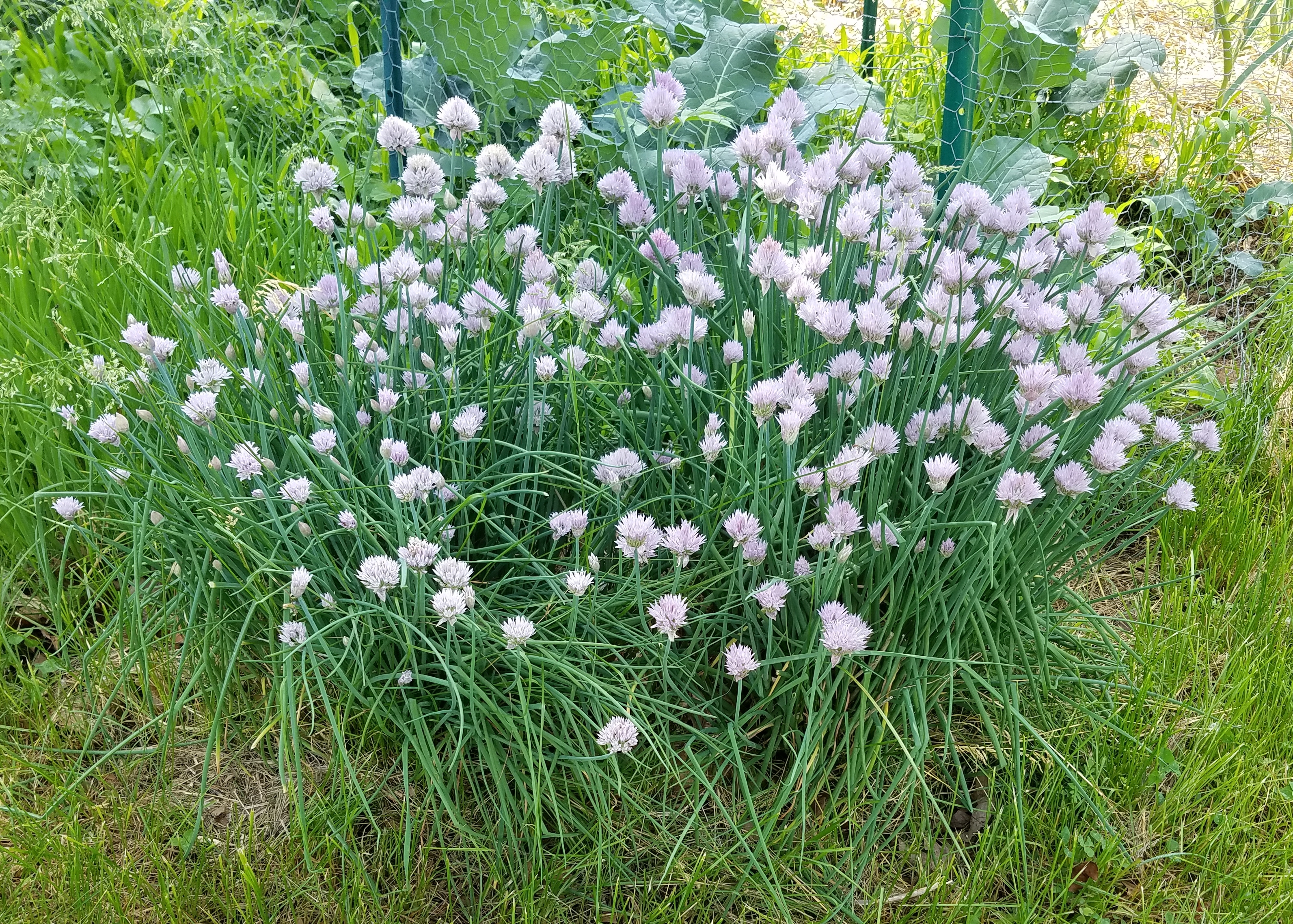
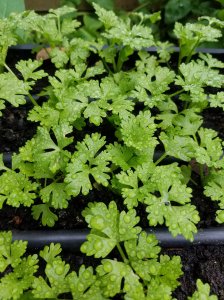
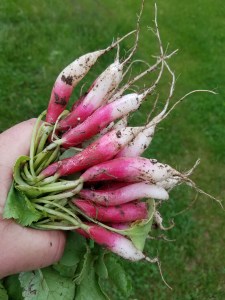
Harvest is ramping up with d’Avignon radishes, spinach, cilantro and chives heading to the kitchen.
I planned cilantro for my gardener’s lunch, and the spinach has been cleaned — some frozen and some in a big, recycled plastic clam shell chilling in the ice box. Chives will be for dinner and the radishes for snacks and salads.
This is why we have a kitchen garden.
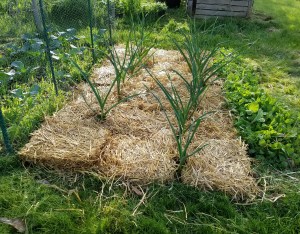
Yesterday I spent ten hours working in the garden. Big projects were making a space for zucchini and Marketmore cucumber seedlings, and mowing the lawn for the grass clipping mulch. I removed seedling rings from the kale, mulched garlic with a bale of wheat straw, and studied small sprouts to determine which were from planted seeds and which weeds. It’s not clear. Weeding and mulching are so commonplace it’s almost not worth recounting. It’s assumed.
Garlic Patch
Weather was perfect for being outdoors.
The harvest began before the garden is fully planted. Tomato and pepper seedlings mature in the greenhouse while celery plants are ready to go into the ground as soon as I can find time and a space. There are pickling cucumbers and green beans to go somewhere, winter squash to plant. The combination of planting, harvesting and cooking — kitchen gardening — will continue throughout the growing season.
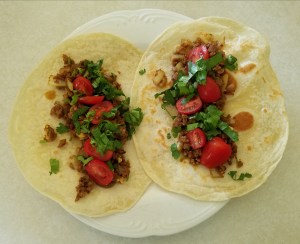
I stopped around noon and made lunch — fresh cilantro tacos.
Fresh Cilantro Tacos
Using pantry ingredients — storage onions, garlic, recipe crumbles, salt and home blended seasonings — I made a filling. I cooked tortillas in a large frying pan, and finely cut cilantro stems and ribboned the leaves. I topped the filling with halved grape tomatoes from California and fresh cilantro, which made the dish.
I bartered for a spring share at the farm so there are bags of greens in the ice box. We had a tub of firm tofu, so I decided on stir fry for dinner. Making stir fry is a way to use up vegetables.
I started two cups of raw brown rice in a quart of home made vegetable broth. I fried the tofu in olive oil, cut in half-inch by one and a half inch square slabs, then set them aside.
Included in the stir fry were baby kale (stems and leaves), carrots, onion, celery, garlic, pine nuts, halved grape tomatoes, red cabbage, a teaspoon of lemon juice and salt. Once the vegetables were soft, I spooned the mixture over a bed of rice and topped with spring onions and chives. It made four servings.
I texted Carmen to get the work forecast at the farm on Sunday. A light load of seedling trays is planned. After farm work, it’s back to the kitchen garden.
Flowers began to fall from lilac bushes. Air is fragrant with sweet smell.
It won’t last long. It is spring, which continues as it has for millennia, reminding us we are but a speck of dust in time by comparison.
It’s the last day before the end of my hiatus from the home, farm and auto supply store.
Two days a week isn’t much to work. When quitting time on the second day rolls around I feel I accomplished something but am not committed. That’s what I want.
I’m reading Natchez Burning by Greg Iles. Part of me likes it and part doesn’t. What I like is it was checked out from our digital library during recent rainfall and I’m reading it on my mobile device. It’s an easy read, a thriller. The story moves along and while I’m reading it’s easy to finish a chapter. What I don’t like is the obvious handles which are part of the narrative. Characters, settings, the former music store, iconography of popular culture — it all seems too easy a construct and such awareness while reading is a distraction. There are thousands of on line reviews of the book, so it’s easy to find people who agree with me. Many others liked the book. Because of the convenience and quick pace I’ll read on for now. If I don’t finish before the lending period is over, I’m not sure I will renew. Life’s long enough to try it, but too short to follow the novel to its conclusion through sheer determination.
Rain fell and it’s been good. Green up is here and the clean look of leaves and branches before insects get to work is inspiring. Time to weed the garden and harvest spinach and spring onions.
Two months into retirement I’ve learned how to avoid hungry dog syndrome and choose activities that conserve resources and contribute to improving our lives in Big Grove.
During personality tests taken while working in transportation and logistics I was identified with a “driven personality.” In retirement I’ve learned to hold my driving social style in abeyance and let others lead group activities. Part of retirement is moving to the side of the arena and letting others take the spotlight. I’m okay with that.
Stepping back has had positive consequences for our homelife. While I’m still in the mode of letting the turbulence settle in order to assess where we are, a few things stand out.
There are plenty of uses for the extra cash two days a week at the home, farm and auto supply store generates. My Social Security pension pays our basic bills. The extra cash can be applied to debt or go toward occasional shopping trips to improve home operations. Taking things slowly and considering each expenditure created a process to get our material lives in shape.
Through limiting the number of shifts of paid work, my plantar fasciitis is healing. The physical examination by a medical doctor informs what needs doing to maintain my health. Tracking health data helps me keep on my goals.
I remain interested in politics and stay informed about the campaigns in our districts. If needs are identified, I attempt to meet them and feel comfortable in a supporting role limited to within district borders.
There is time to work on things. I just go to one of my half dozen work spots and stay busy as long as I can. Then I rest and try it again while rebuilding my stamina. The process seems haphazard but helps me stay focused on tasks at hand. It’s a work in progress.
There has been more time to read and write. It’s been a slow reveal as to what my creative process will be going forward. I like what I see thus far.
I’m ready for retirement and in the early stage of figuring out what that means. Creative endeavor of youth is transformed into something more tangible and useful as we age. While I’ve been living a long time, I feel like I’m just getting started. That makes all the difference.
Fishing Trip with Maciej Nadolski (seated with beard)
The political, social and economic environment in Iowa deteriorated substantially over the last few years. What I mean is the 87th Iowa General Assembly was a pisser. What’s a person to do?
First thought was to chuck it all and move near our daughter in Florida. Father attended Leon High School in Tallahassee, and I worked for several months in nearby Ochlocknee, Georgia. I became enamored of the Spanish moss hanging from trees lining Highway 319 as I drove back and forth to the Tallahassee airport. “You and mom wouldn’t like it here,” our daughter wisely said.
If the sunshine state is out, what about Minnesota? It’s not far away and we have family roots there. They also have Democratic U.S. Senators — what’s not to like about that?
Our family doesn’t know much about why great, great grandfather left the Pennsylvania coal mines and moved to Lincoln County, Minnesota in the last decades of the 19th Century. Maciej Nadolski bought land from the railroad and settled a couple miles west of Wilno where he would go to town, drink adult beverages, and sleep in the wagon as the horse took him home. He did so even after his spouse joined him from Poland.
Wilno was the creation of the Chicago and Northwestern Railroad, the Polish National Alliance and the Catholic Church, according to Wikipedia. It seemed a lot like Iowa. I visited Saint John Cantius Church (established 1883) after Grandmother died and met briefly with the parish priest. He mailed our grandmother’s baptismal record. I drove the route the horse took to the home place where the then current owners let me look around. People in Ivanhoe, the county seat, weren’t wealthy and a bit scrappier than in Iowa. I was related to a number of people I met — shirt tail relatives were everywhere.
A few stories about farm life survived through family oral history. We know farming did not work out for the large Nadolski family. After 20 years in Lincoln County, they moved north near Argyle and tried it again. After ten years in Argyle, most of the family moved near LaSalle, Illinois.
Other parts of Minnesota might not be so bad. Grandmother worked as a maid in Minneapolis when she was young. We don’t like city life so much, but there are small rural cities like the one we live near today. Why not Minnesota?
I’ll tell you why. I was born in Iowa and this is my state. If the political, social and economic climate is not to my liking, I’d better damn well get busy and work to fix it. Thing is, my values are not that different from the values of most people I know. This creates an opportunity for change.
If my first reaction to the 87th Iowa General Assembly was “Nuts! I’m moving to Minnesota,” it is natural to revert to who we are in crisis. Now that we’re home, it’s time to get up from the wagon, sleep off the booze, and get busy building the environment in which we want to live. It can be done, it should be, and we’re up to the task.





 Journey Home
You must be logged in to post a comment.