Text on the postcard: “Underwood Motel, 1100 Lincoln Highway, Schererville, Indiana 46375. Heated Pool – Air Conditioned – Room Phones – Free TV – Honor Most Credit Cards – Located on U.S. #30 – Just West of U.S. #41 Near Calumet Expressway to Chicago Loop. Phone: 219-865-2451. Handwritten note: $19.80 per night.
When I transferred with work to manage a Schererville, Indiana trucking terminal for a company called Lincoln Sales and Service, I stayed at the Underwood Motel. It took a while to manage our move, maybe six to eight weeks. We ended up buying a house in nearby Merrillville, Indiana.
Our fuel attendant worked at the motel and that plus the low price is why I stayed there.
The six years we lived in Northwest Indiana were busy. It would change my view of work forever. The country was in transition from what it was post World War II, to what it is now. Due to the Reagan revolution, it was hard on workers. I lost track of how many potential drivers I interviewed during this time… more than ten thousand. Theirs was a story of dehumanization of workers laid off by companies that felt they had to to be “competitive,” whatever that meant. It was a time of ubiquitous management consulting firms who restructured businesses to direct more revenue and earnings to owners, share holders, and high-level managers. It was busy because most of the time I worked in uncharted territory with little guidance unless there was a lawsuit or workers compensation claim.
I’m glad for the experience. I hated the experience. In the crucible of manufacturing in transition, thousands of workers were trying to adjust. I was there to listen and heard one hella story. I hired some of them, doing what I could to ease the transition.
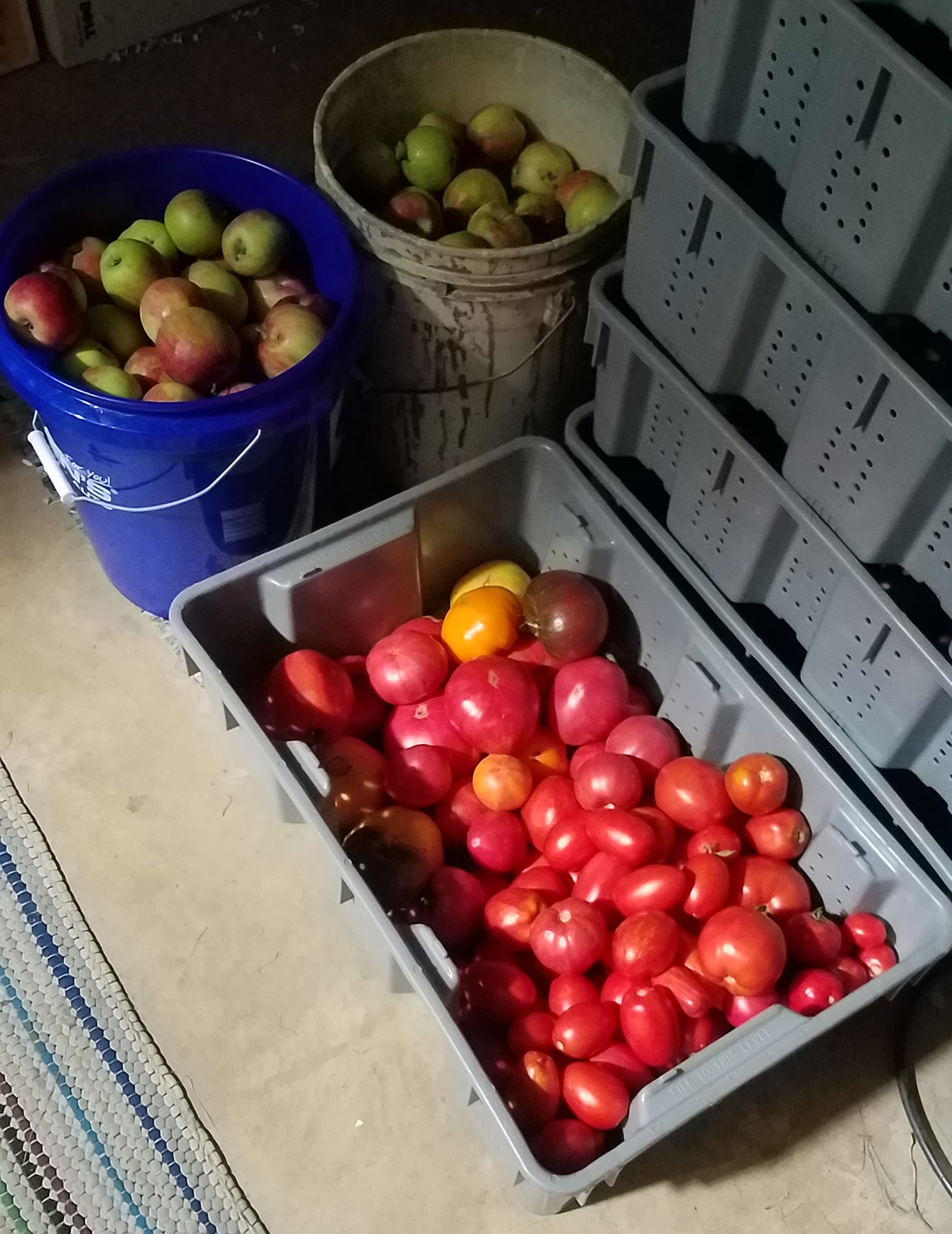
Tomatoes, apples, onions and potatoes waiting to be used.
Signs of summer’s end are everywhere.
We knew fall was arriving last week when someone published the school bus pickup and delivery times on our community Facebook page. K-12 schools start tomorrow in our district.
The Iowa legislature and governor expressed an interest in dictating how schools would approach the ongoing coronavirus pandemic. They issued a written dictum through the Iowa Department of Public Health. Click here to see it. My main takeaway is that everyone should wear a mask and get vaccinated if they can, although neither can be mandated by the local school board. IDPH has adjusted COVID-19 surveillance to follow the influenza model, focusing on outbreaks and vulnerable populations.
We’re ready for fall with four home test kits for COVID-19 resting on the stairs for potential use. We restricted activities outside home during the return of students at a nearby university and the surge in hospital admissions for COVID-19. If there’s one thing we learned during the pandemic it is isolating from others is a good way to prevent respiratory disease, including COVID-19.
Political campaigning takes a holiday during summer. With Iowa Democrats seeking to regain some of the ground lost in 2020, activity is percolating to our attention. There is a U.S. Senate primary coming, with four announced candidates. There is one for governor with two. Yet most political activity remains unseen as summer ends.
As of this writing, our congressional district has neither been adjusted after the U.S. Census, nor identified any candidate for congress. The Iowa Legislative Services Agency is working on a redistricting map after last week’s arrival of U.S. Census data, and a candidate for congress or two make preparations to announce their campaigns for the June 2022 Democratic primary election. There is plenty of time to engage in campaigns. Most voters are loathe to do it and the recent trend is to wait until the last possible moment to evaluate candidates and cast a vote.
The garden reached the high water mark and the rest of the season is finishing tomatoes, tomatillos and peppers; taking greens as needed in the kitchen; and working toward a couple more crops of lettuce. The season will end with Brussels sprouts and Red Delicious apples in late September or October.
The calendar says autumn begins on Sept. 22 yet we’ve already begun to make the turn. I’m thinking about where to plant garlic, how to deal with apples still on the trees, and how to engage in politics this cycle. Comme d’habitude, I’m taking some time for myself until the Labor Day weekend. It looks to be a busy fall.
Rouge vif D’Etampes pumpkin from Johnny’s Selected Seeds.
Radicchio
I successfully grew radicchio this season, yet haven’t figured out how it fits into the kitchen garden. I pickled some of the leaves, added it to soup and stir fries, and besides saying I have it, there’s not much value in the crop. I have seeds leftover and may plant half a dozen head next season. Unless something happens in the kitchen to encourage the use, I won’t be buying more.
Rouge vif D’Etampes
These seeds produced four decent and visually appealing pumpkins. I haven’t roasted one of them yet although if the flavor is good, I’ll grow the remaining seeds next year. The trouble is pumpkins want to take over the space in which they are planted. They need their own plot. Regular Jack-O-Lantern and cooking pumpkins are ubiquitous in this area, so buying one is an easy solution to our pumpkin needs if the garden runs out of space. I still have two cups of frozen pumpkin flesh left from last season.
Cantaloupe
The seeds started but the vines didn’t do anything. Not sure of the reason but they were next to pumpkins, which may have dominated the smaller plant. Organic cantaloupe are available inexpensively at the grocery store, so this is another one that may be better to buy and use the garden space for something else.
Mustard Greens
Mustard grew well but it doesn’t fit in our kitchen. Because I want to have a variety of greens available, I’ll likely plant it for the third time next year. The main use has been to make pesto from the spicy greens. I also give it away.
Onions
The onion crop was what I wanted: plenty of onions in six varieties. I successfully started onions indoors, although next season the seeds should be started in December for a longer growing period before transplant. The starts I bought from the seed company performed well and I’ll get more in 2022.
Beets
Once again the beet crop mostly failed. I started them indoors and transferred them outside where a late frost killed most of them. I tried starting a second batch but it didn’t take. My goal is to produce enough to pickle a couple of quarts for the pantry. They taste so good, I’ll try again next year after reading up on cultivation practices.
Lettuce, tomatoes, peppers and the rest
The 2021 garden was my most successful yet. The variety of produce was good, as was the quality. I made planned improvements, including a patch of kitchen greens with kale, chard, mustard, turnips and kohlrabi. The container potatoes produced well. Garlic is still curing and the heads are large and appear to be disease free. I’ll use my own to plant next year’s crop. There were plenty of cucumbers, eggplant, and other crops to make the effort worth while.
Moving lettuce under row cover made all the difference. We had plenty of lettuce until a week or so ago. There is a fall crop growing now. I grew four or five crops of lettuce in succession.
I grew the most tomato plants ever both in quantity and variety. The quality was excellent. I figured out how to vine cherry tomatoes so they produce a lot and are accessible and separate from the main tomato crop. The trick is planting them in a straight row. I used cages but one could use stakes and welded wire fence with the indeterminate vines. If I were buying new, I’d get six-foot fencing. There will be enough Roma-type tomatoes to can whole and plenty of slicers to give away. One thing I know is how to grow tomatoes.
The second year of the new pepper process produced good results. Ace is the main producer. I tried seeds sent free from a supplier for the rest, but it didn’t produce as expected. Watering peppers adequately is important. If I ever use drip tape for a crop, it would be for peppers first.
A gardener’s life is one of constant learning and experimentation. To be effective one has to spend time in the garden observing. We planted our first tomatoes at home in 1983 and grew a garden every year since then, except one. As I approach 40 years in the garden, I hope to continue for many more.
We are bunkering in for another lock down. In Iowa, the governor doesn’t believe in mandatory lock downs and schools are opening without mandates to wear a face mask or to get vaccinated. It is a setup for disaster. I bought an extra 30-pack of toilet tissue at the wholesale club and am ready.
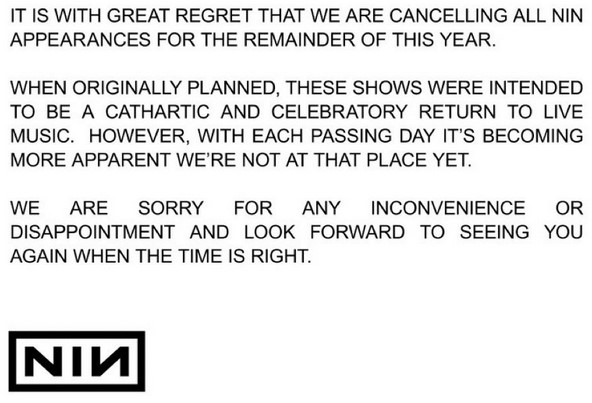
While I would not recognize their music, last night the band Nine Inch Nails summed up where American society is two months into Summer 2021:
We will come out of the coronavirus pandemic eventually, either walking upright or six feet under. Am hoping it’s the former.
My current project is structuring a week that makes sense to a retiree. The seven-day pattern is a bit arbitrary, yet it is what I’m used to, what cultural resonance that remains encourages. Friday is my day.
On Fridays I eschew shopping and leaving the property to focus on household activities. For example, on deck today is picking up fallen apples under the EarliBlaze trees, harvesting tomatoes, canning Roma tomatoes, making apple cider vinegar, wrapping up a book review for Blog for Iowa, and my usual morning routine with an added hour of reading. The end of the day usually begins with supper of a home made pizza and sometimes a beer.
If there are things to wrap up with my engagements with groups, I pay attention to them on Friday. If it can wait until Monday, it does. Friday represents a turning toward renewal over the following two days of the weekend.
I’m okay with where Fridays are landing. We have to maintain our sanity, and making Friday my day is a step in that direction.
Best wishes to my regular readers for a happy Friday!
The headline in today’s Washington Post was “Afghanistan to be ruled under sharia law, Taliban commander confirms.” No surprises here. What did we expect if not that?
As the coronavirus surges in the county where I live, people have become more isolated. If we don’t stay on media constantly, we are checking it often and the news about Afghanistan is grim.
NBC News Chief Foreign Correspondent Richard Engel began yesterday on Twitter by tweeting, “At kabul airport, military side, more order than before. Evacuations picking up. Seeing more Afghan families being taken through. Planes taking off. Base well guarded.” That was reassuring news midst the media claims of “chaos” in the country. I am deeply skeptical about media claims.
Someone asserted, “the reason all these people are stuck in Afghanistan right now is because the visa program that was created to get them here was purposely shut down by Donald Trump and Stephen Miller.” Like most Americans, I don’t recall enough of the last administration to remember this. What I do remember is the national news media, for the most part, gave Trump a pass on any hard questioning. This is being resolved by President Biden saying he assumes responsibility for the mess. Exiting our long-standing war was never going to be easy. Four presidents made the problems we see, and all of them are culpable for where we are today.
I don’t want to write about Afghanistan, yet it is on everyone’s mind. There is no avoiding the conversations, so we have them. It is not what we want to be talking about, yet we are considering a lock down again, leaving home only to exercise nearby and to secure provisions. We are stuck talking about what dominates the national news media.
A few people in the public eye take some of the pressure from us. Heather Cox Richardson writes an almost daily newsletter which explains what’s going on in the news from a historian’s perspective. Justin King, who goes by Beau of the Fifth Column, reacts to the news on YouTube almost daily from the perspective of a “Southern journalist” and former military contractor. Octogenarian and former CBS news person Dan Rather publishes an almost daily newsletter in which he brings perspective to news events. None of these writers are perfect and I suppose each has their issues. The calm demeanor with which they put things in perspective, what they choose to get upset about, and what they publish goes a distance to bring perspective to a cyclone of news that is terrible more because the reporting is inept than because events in Afghanistan are concerning.
Afghanistan persists and it is difficult for Americans to get a grip on it. Partly this has to do with the bubble in which most of us live our lives. What seems clear is the news media plays an active role in creating a narrative about ending our war. Some of these narratives are not accurate. Many of them distort the view we get of what’s going on on the ground there. Some of them are plain false. It is difficult to understand the relevance of daily events. Not all daily events presented by the news media are relevant.
As Afghanistan turns again to sharia law it is assured Westerners will not like it. To the extent our culture penetrated Afghan society, it will create problems for local citizens with the Taliban in charge. What is our responsibility? Like it or not, we have to stop propping up values that are not shared by locals and as effectively as possible withdraw our military from the country. We also need to protect those who supported us over the last 20 years. From Iowa it appears President Joe Biden is doing that. It’s messy, yet we have to support him in this endeavor.
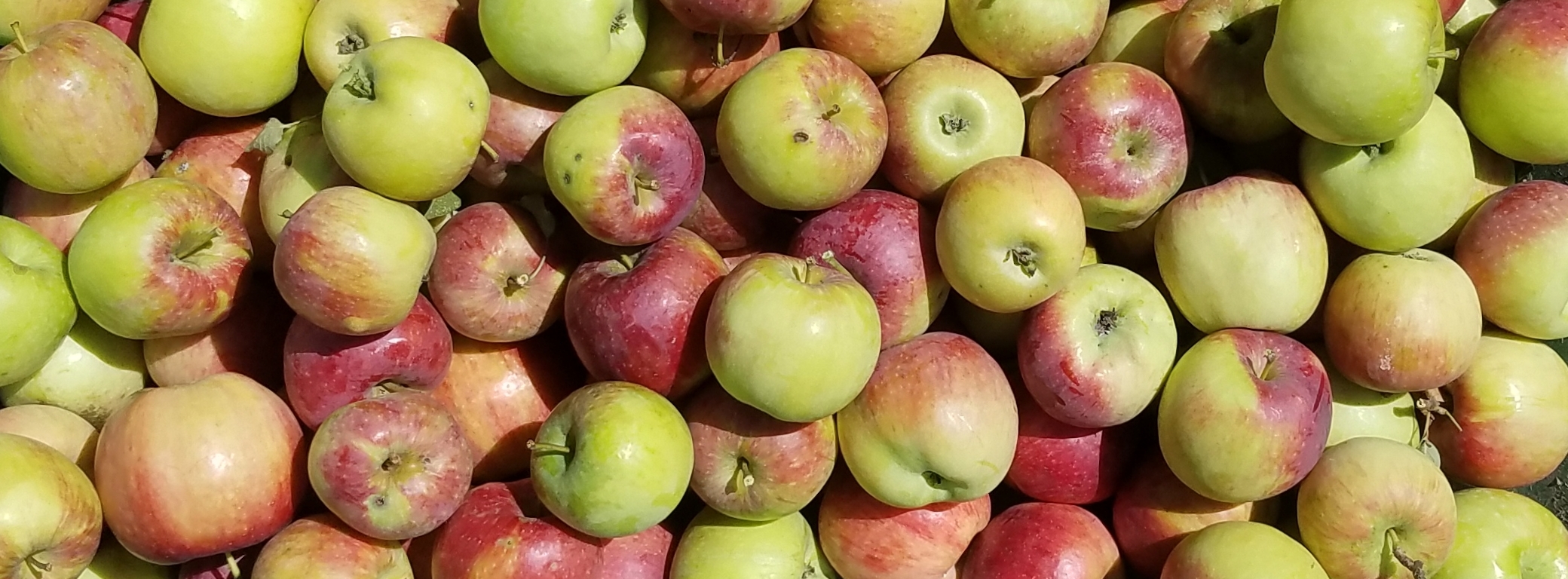
EarliBlaze apples are ready to pick. They are sweet and crunchy. I have two five-gallon buckets of them to make apple cider vinegar, although I’ve been eating down one of them and might need more.
Taking stock of the pantry, we don’t need any applesauce, apple butter, dried apples or any apple products really. Fresh eating, baking and cider vinegar will be the main uses of this August apple. A lot of them fall before they are ready to pick. Deer come each evening to help us clean them up.
When Red Delicious ripen during late September or early October, I’ll revisit the plan. I have at least one person who would like this year’s apple butter, so I may make more. Despite losing a major branch during the Aug. 10, 2020 derecho, and more during a strong wind storm this year, it will be a big crop.
I would have planted the orchard differently in the 1990s had I known what I know now about apple culture. I planted trees too closely together. The six original trees were two EarliBlaze, two Red Delicious, and one each of Lodi and Golden Delicious. Wind and disease took a toll and only one Red Delicious and two EarliBlaze remain.
The varieties I chose are not the ones I would pick today. Having worked at an apple orchard since 2013, I learned a lot about which trees do well in Iowa’s climate and how to plan continuous apple picking from late July to the first hard frost in late October. In addition, I would match the varieties to what I want to accomplish in the kitchen. Late apples are more attractive to us now and everything they mean: storage for winter, apple cider making, and of course, fresh eating. There are no do-overs for our home orchard. The main questions today are what else will be planted in our yard for fruit, and what will we do when the three trees I planted finally live their last days.
I decided to decline returning to work at the orchard this year. The reason is pretty clear. The coronavirus pandemic played a key role.
I changed my mind about working this fall and won’t be reporting for work on the 28th.
The main reason is the surge in the coronavirus pandemic in Johnson County. Hospitalizations increased close to bed capacity, there is an influx of 30,000 people to attend university (about whom we know little of their vaccination status), the University of Iowa cannot require vaccination for COVID-19, and the CDC rates our level of community transmission of the virus as substantial.
Since I wrote this, the level of community transmission has gotten worse.
In late summer, the whole garden seems to come in at once with apples being a key crop. There is pressure to deal with all of it. Not enough pressure to prevent us from enjoying the taste of summer.
Detail of White House photo of President Biden and Vice President Harris.
I want to understand the draw down of the U.S. military and diplomatic presence in Afghanistan. I want to be assured people who assisted U.S. personnel during the conflict get proper protection. I want to feel like the 2,448 deaths among U.S. soldiers and more than a trillion dollars were not wasted. As Mick Jagger and Keith Richards wrote, “You can’t always get what you want.”
There are no brilliant takes. The situation in Southeast Asia is too complex for that. What I present instead are my reactions to what I am seeing and hearing from my perch in Iowa.
My friend Ed left a voicemail to call him on Sunday. When I did the next day we talked for 15 minutes and agreed we had to support President Biden’s decision to end the war. After Ed, me, and eight others organized the Iowa Chapter of Veterans for Peace we protested our endless war in Afghanistan many times–in rallies, in letters to the newspapers, and by bringing speakers to Iowa to discuss this war and other U.S. military engagements around the world. Either one wants the war to end or one doesn’t. Either choice can get ugly.
I listened to President Biden’s speech Monday afternoon. It was a good speech that addressed the issues from the perspective of someone who knows U.S. foreign policy better than any president since George H.W. Bush. A couple of things stood out.
“Our only vital national interest in Afghanistan remains today what it has always been: preventing a terrorist attack on American homeland.”
“Our mission in Afghanistan was never supposed to have been nation building. It was never supposed to be creating a unified, centralized democracy.”
“I stand squarely behind my decision. After 20 years, I’ve learned the hard way that there was never a good time to withdraw U.S. forces.”
“I will not repeat the mistakes we’ve made in the past — the mistake of staying and fighting indefinitely in a conflict that is not in the national interest of the United States, of doubling down on a civil war in a foreign country, of attempting to remake a country through the endless military deployments of U.S. forces.”
“Our current military mission will be short in time, limited in scope, and focused in its objectives: Get our people and our allies to safety as quickly as possible.”
Biden’s speech is unlikely to convince the naysayers. There is no hope for them anyway.
Before the speech I received an email from U.S. Senator Joni Ernst. She “fervently disagreed” with the decision to withdraw from Afghanistan. Among things she said was this: “Women and girls who were just starting to enjoy their freedoms are again faced with oppression and subjugation by a ruthless Taliban regime.” What of that?
The concern is the Taliban will re-establish a caliphate which will repress Afghan citizens, forcing women into traditional roles. It is a legitimate concern. However, if Ernst valued the “freedoms” of women, she would support a woman’s right to choose right here in Iowa. Instead, in early 2020, she joined an amicus brief with 206 other members of congress calling on the U.S. Supreme Court to reconsider its decision in Roe vs. Wade. The hypocrisy of conservatives like Ernst is thick.
The way President Trump negotiated the draw down of U.S. Troops and equipment created an opportunity for the Taliban to resume control of the country. By releasing 5,000 Taliban prisoners, including key leaders, President Trump set the stage for the group to organize to retake the country. The negotiated ceasefire created an environment for the Taliban to approach members of the Afghan army to gain their support. In the end, the Taliban demonstrated competence by using what they were given by the Trump administration. While the international media drew a picture of chaos in Afghanistan, describing a “backlash” to U.S. execution of the withdrawal plan, the Taliban knew exactly what they were doing and effectively, mostly peacefully, ousted the U.S. backed government.
Where does this leave my desire to understand Afghanistan? Unsatisfied. I recall that throughout history others have had the same problem, going back to the Persian empire of Darius the Great. Seven months into his first term, President Joe Biden recognized the challenge of Afghanistan. With our mission there long accomplished, he did what three previous presidents would not. He initiated withdrawal of U.S. forces and, for now, closed the embassy. It was the right thing to do.
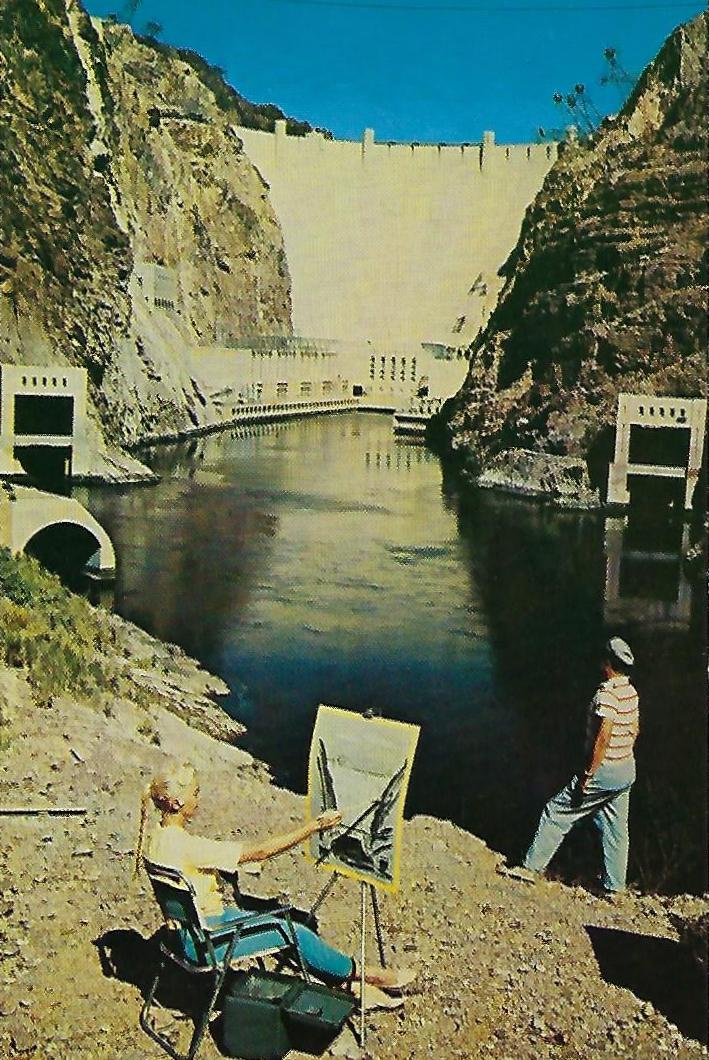
Hoover Dam. Photo credit: Las Vegas News Bureau, undated.
Text on the postcard: “Looking towards the outlet tunnels and huge powerhouse below the world’s highest Dam. This $125,000,000 project is one of man’s greatest engineering achievements. Height 727 feet above bedrock, crest 1,244 feet, and 650 feet thick at the base.”
When I was in high school our family went to California so my parents could attend a union convention. We made a family vacation of it, the last one before Father died. Mother’s two brothers lived in the Los Angeles area so we spent time with each of them. We stopped to see Hoover Dam on the way home.
Today, Lake Mead, the reservoir created by the Hoover Dam, is at its lowest level since it was built. The continuing drought in the West will have a significant impact on people who live there. It’s clear we must act to slow global warming.
~ I’ve been writing about Afghanistan for what seems like forever. Here are two posts, the first was written as the surge happened and our company participated in deployment of equipment to Afghanistan. The second reiterated how long the United States has been involved in Afghanistan. As the U.S. makes a hasty and long overdue exit, and the Taliban resumes control, one has to wonder about the human cost of U.S. engagement.
The War Machine Goes On March 11, 2009
As I write this post, the military equipment moved from the depot to the coast continues its progress towards Afghanistan. There were hundreds of truckloads of vehicles and provisions moving out in a very large deployment over the past two weeks. We did not hear a lot about this in the mainstream media. If anything, this deployment would have gone on unnoticed, except for some of us in Big Grove.
For those of us who would rather see a world at peace combined with economic stability, we have been doubly disappointed. If the defense industry were to falter at this point, it would be another short circuit of an economy already on the fritz. The deployment to Afghanistan furthers the military spending, and while we agree that the influence of Osama Bin Laden and his followers should be neutralized, beyond that, it is difficult to see the importance of the Afghanistan-Pakistan issue.
So, as I drink morning coffee and turn down the heat to go into the office, I wonder how we can realize a sustainable peace in the world. With continued drought, famine, genocide and poverty, the global community is ripe for more conflict as populations move, oppressive regimes assert dominance and the United Stated assumes a larger role as “peace keeper” by these military deployments around the globe. In the words of John Lennon, “all we are saying is give peace a chance.”
An Iowan’s View of Afghanistan December 11, 2009
When I hear people talking about the 8th anniversary of the invasion of Afghanistan I shake my head. We should be marking the 30th anniversary of our Afghanistan policy because we have been engaging in Afghanistan’s affairs since at least 1979, when the former Soviet Union invaded that country.
The Soviet invasion of Afghanistan combined with the ongoing Islamic Revolution in neighboring Iran, and the United States view of the importance of Middle East oil, complicated the presidency of Jimmy Carter. In his memoir, Keeping Faith, former President Jimmy Carter wrote about the threat of the Soviet invasion of Afghanistan, “A successful takeover of Afghanistan would give the Soviets a deep penetration between Iran and Pakistan, and pose a threat to the rich oil fields of the Persian Gulf area and to the critical waterways through which so much of the world’s energy supplies had to pass.” There were also American interests. UNOCAL, a US company, was seeking to build an oil pipeline from Turkmenistan to Pakistan through Afghanistan at that time. For President Carter these were vital US interests and he felt it critical to address the Soviet aggression. As many of us remember, Carter was in the middle of his campaign for a second term, and believed that campaigning actively was inappropriate. Among other things, he canceled his participation in a nationally televised debate in Des Moines, Iowa and initiated a US boycott of the 1980 Olympic Games in Moscow. Many of us remember President Carter as beleaguered by the challenges of Iran and Afghanistan.
In the end, President Carter forswore direct military action and implemented economic sanctions. The most notable sanction to Iowans may be the grain embargo of the former Soviet Union. His administration also decided to prop up what he called “Afghan freedom fighters.” According to Sonali Kolhatkar and James Ingalls in their book, Bleeding Afghanistan, the Afghan freedom fighters were “seven Islamist ‘Mujahideen’ or ‘jihadi’ groups based in the Afghan refugee camps in Pakistan.” These groups received monetary, military and logistical support from the United States and Saudi Arabia through a third party intermediary. This indicates indirect military action on the part of the United States interests during the Soviet aggression. According to Kolhatkar and Ingalls, U.S. military aid may have gone to a group called Makhtab al Khadimat, “a group that recruited and trained Muslim volunteers from Egypt, Algeria and other countries to fight in the Afghan war.”
Makhtab al Khadimat was founded in 1984 by the Saudi heir to a construction firm, Osama bin Laden. From the perspective of today, this all sounds too familiar, except that eight years ago, the United States intervened in Afghanistan militarily to remove a problem that it may have helped engender.
I hope the blood and treasure that we have invested in our engagement in Afghanistan serves as another reason the United States must get to energy independence. Our sons and daughters are fighting and dying in a country where our interest in oil blinded us to the values of Islamic extremists. As we were supporting the Mujahideen, and saying we could work with the Taliban, we failed to hear other voices in Afghanistan that called for an end to the Soviet occupation, but not a return to Islamic fundamentalism.
According to Zoya, a member of the Revolutionary Association of the Women of Afghanistan (RAWA), during a recent Iowa City appearance, little has changed since the Soviet withdrawal from Afghanistan in 1989. The United States continues to support Islamic extremists in the Karzai government. To the extent Afghanistan is about United States interests in oil, it is one more manifestation of our addiction to hydrocarbon fuels. We need the will to cure our addiction to hydrocarbon fuel.
I empathize with my friends who call for demonstrations over President Obama’s escalation of the troop levels in Afghanistan. I have participated in these demonstrations. At the same time, I have to ask, where were they during the first escalation earlier this year? Where were they in 1979?
What I know is that President Obama, more than any president in my memory, appears to have put together the elements of a comprehensive plan to resolve the issues related to war and our addiction to hydrocarbon fuels. If Obama can extract us from three decades of engagement in Afghanistan, he will have truly done something for peace in that region and for the world. Iowans should support President Obama on Afghanistan. He is doing the dirty work that his predecessors, beginning with Jimmy Carter, left behind.
Side dish of sliced tomatoes at our picnic lunch on Aug. 13, 2021.
Friday was a travel day during which we visited family in Chicago. It was the first family gathering at their place in a long time. We’d been preparing for the trip for over a month. To maximize visiting time, we packed a picnic lunch and ate at the apartment.
It was a good day.
Children return to school in two weeks, Iowa hospital beds are close to full with COVID-19 patients, and we haven’t had a view of the sun unobstructed by haze from the Western fires since I don’t know when. A flotilla of 14 hot air balloons rose over us near Davenport as we drove home. Their bright colors were muted by the pall over the landscape.
Beyond family, these day are not so good.
Despite difficult times we go on living.
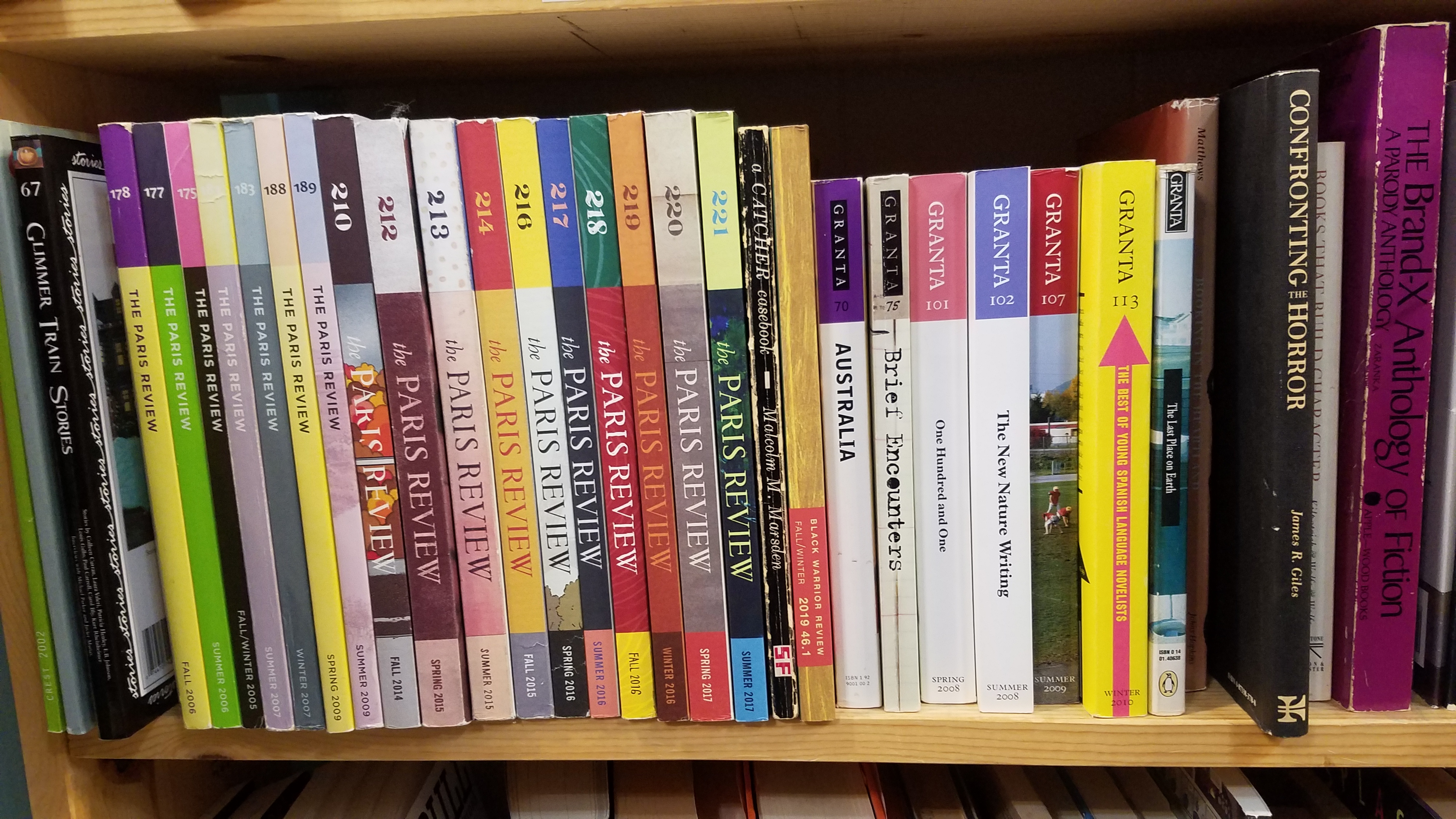
It is becoming a habit. I walked around the neighborhood where they live and ended up browsing in a used bookstore. I bought three books and got three punches in my frequent user card. Yes, I have a frequent user card, and plan to return to get all the punches. We made it home safely before sunset.







 Journey Home
You must be logged in to post a comment.