While the 2021 school board election was not momentous, it is over and provides catharsis for those of us involved in the community. Voters chose to continue the status quo this cycle.
Fall arrived and the colors are past peak. Deciduous trees began to shed leaves and shelter the buds of next year’s growth. Our Autumn Blaze maple tree dropped more than half its foliage in a few hours leaving a big puddle of fallen leaves below. There is a lot of work to do before snow flies.
The plan is to run errands in the county seat. I’ll stop by the orchard to see if Gold Rush apples are for sale. If they are, I’ll buy enough to stock the refrigerator. After that, a trip to the county administration building, and then to the landfill. I have four old printers and a computer monitor to recycle. On the way home I’ll pick up groceries, although I don’t know which store I will visit. It’s early.
We haven’t much noted year-end holidays since our child left Iowa after college. That means the next major event is hunkering down at my writing table and making progress on my autobiography while dealing with whatever winter brings. I’m not ready for winter yet. I also am.
It’s quiet in early morning. Here’s hoping it stays that way the rest of the day and beyond.
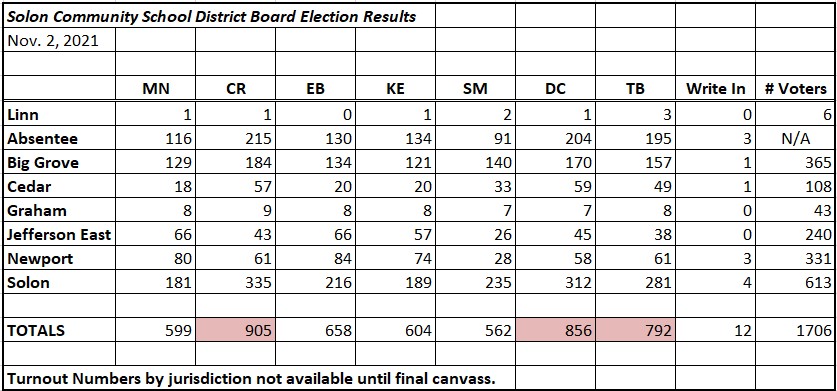
Tim Brown, Dan Coons and Cassie Rochholz bested the field of seven candidates for directors of the Solon School Board. Here are the unofficial results from the Johnson and Linn County auditors.
Combined unofficial results from Johnson and Linn Counties.
I congratulate everyone who ran for school board and wish the winners good luck in their upcoming terms. Thank you readers for following my coverage. God willing and the creek don’t rise, I’ll do it again in 2023.
Photo Credit: The American Scene Collection, American Oil Company 1969.
Reverse side: Washington Skyline, Washington, D.C. Located on the axis of the Lincoln Memorial and the Washington Monument, the Capitol Building is shown in the foreground with the Washington Monument illuminated in the background. See the U.S.A. in a Chevrolet. As you travel ask us.
Life would have been simpler if I had stuck to the same path as friends in high school. Maybe follow a narrative such as after school and military service find a job, raise a family, work it until retirement, then settle back and relax in the golden years. Simple.
Actual living was not simple. While many in my cohort married and started a family immediately after high school, I did not and that made a difference.
The trauma of being injured while young, and the subsequent hospital stay, removed me from conventional pathways. I wrote about it in 2009:
My earliest defining moment was the day, at age 3-1/2, when a swing-set set up in the basement of our Madison Street home collapsed and injured my head. My parents were horrified. I remember the pool of blood on the basement floor, holding the thumb of the ambulance driver, taking ether dripped into a funnel to anesthetize me for the stitches to mend my gashed head. I am lucky to be alive. What I learned through the injury and recovery in the hospital was that there is an infrastructure of knowledge and caring to support us when things happen. I watched the routines of the hospital staff, the doctor checking up on me, changing room mates and bed linen, daily visits from my parents and the handling of my propensity to get out of bed and walk around. This experience assured me that although we are vulnerable, we are not alone.
Over the years, Doctor Kuhl would examine the scar on my forehead and talk about my recovery when I visited him in his office. Today, I don’t think of the scar, and suspect most people do not even notice it. What I do think about is that while we are not alone, we must be part of a society that helps protect those who are most vulnerable, including the injured and infirm. When I was very young, I made a withdrawal from this bank and now the debt needs repaying.
Big Grove News, Jan. 18, 2009.
Little has changed since I wrote this. While I relied on the infrastructure of society, at high school graduation I had neither the interest nor skills to get married and start a family. I went to college instead.
In late 1968 or 1969, I sought Father’s approval while figuring out what to do after high school. Maybe I would study engineering, I told him. The practical, rational approach of an engineer to problem-solving was appealing. He neither approved nor disapproved. He looked surprised it was on my mind. He was completing his own education and perhaps was preoccupied. He would be gone soon afterward.
During senior year in high school we made a class trip to Washington, D.C. and New York City. It was my first trip on a commercial aircraft. We saw the U.S. Capitol and Washington monument depicted in this postcard at about the time it was printed. We played cards for nickels and dimes in our room each night. My winnings paid for incidental expenses through New York. In some ways the class trip was the beginning of living on my own and experiencing the world outside my home town. It seems appropriate it would start with the nation’s capitol.
My life divides into segments: preschool, education, work and family, moving to Indiana, and moving back to Iowa. Each was important for different reasons. As I went through time I didn’t know how each step would unfold.
My education, including military service and graduate school, had the momentum of youth. When I finished school at age 29, I was ready to do great things. Available opportunities were a disappointment. The trajectory of youth found me alone and unsettled, without a career or path forward. I would have to make my own way and that complicated things. In retrospect it was a good complication. If I hadn’t left my home town permanently for university, life may have been simpler.
I’m glad my circumstances gave me the chance to leave home and be different.
Image of Earth 7-6-15 from DSCOVR (Deep Space Climate Observatory)
We witnessed climate change in Eastern Iowa. For me, it’s personal.
• The 1993 flood delayed progress building our home as we moved from Indiana.
• We experienced multiple straight line wind events that damaged the house, uprooted trees, blew down large branches, and tore through our neighborhood.
• Record flooding in 2008 filled much of the Iowa and Cedar River basins, backing up water into the Lake Macbride watershed to within 100 yards of our home. It made roads around us impassible and devastated many nearby places.
• Record drought in 2012 made life outdoors miserable. It negatively impacted crops. Corn yield in Johnson County decreased from 171.9 bushels per acre in 2011 to 132.4 in 2012, a 23 percent drop.
• There was a derecho on Aug. 10, 2020. In our yard it took down one tree and damaged several others. My greenhouse lifted into the air like Dorothy’s farmhouse in the Wizard of Oz. Winds up to 140 miles per hour destroyed 70 percent of the tree canopy in Cedar Rapids.
I know about climate change from living it, as do most Iowans. It’s time for our Republican members of Congress to work with Democrats and take action to mitigate it.
~ Published in the Iowa City Press Citizen on Oct. 30, 2021.
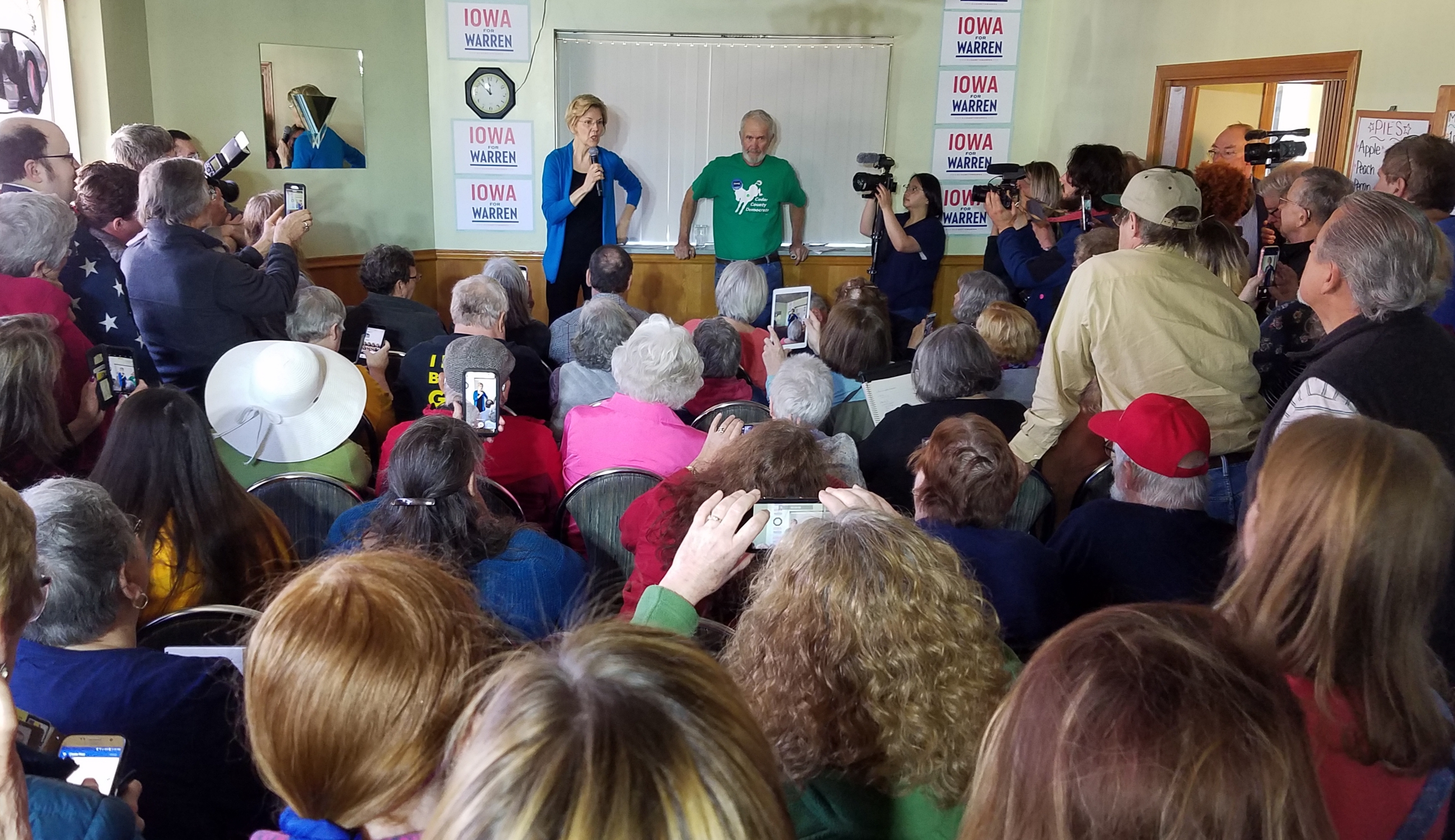
Elizabeth Warren Meet and Greet in Tipton, Iowa. April 26, 2019
I was invested in Elizabeth Warren’s campaign for president and attended some events about which she wrote in Persist, her memoir published this year.
Like tens of thousands of others I waited in a selfie line and got my moment. I don’t recall what we talked about. Of all the things I thought about Warren during the campaign and afterward, the book is about something I hadn’t considered much: she’s a woman living in what largely was and remains a patriarchy.
The book is worth reading whether you are a fan or not. It explains some of her major policies in a way only a teacher could: clearly and rationally. For example, I didn’t understand the importance of child care to society until I read her explanation in Persist. When talking with friends and Democratic acquaintances during the run up to the Iowa caucuses, I heard the discussions about whether we should run another woman for president, whether a woman could win against Donald Trump. Those questions weren’t asked of men. Warren recounts these attitudes and what they meant in detail. I knew there would be wonkish policy stuff yet I didn’t expect the book to be as good as it was.
I couldn’t live the kind of life Warren does, mostly because I’m not as smart and don’t have the same kind of drive she does. The book serves as an example of a life worth living, an example of how to deal with prejudice, sexism, racism, economic injustice and more. It inspires us to dream big, fight hard and be better citizens.
We’ll never know what the United States would have been like with President Elizabeth Warren. For the time being we can be glad she’s in it with a position of power. We can also follow her suggestion and persist.
A hard frost is coming. This is Iowa and it has usually been here by now. We wait.
Lilacs near the front door are beginning to bud, so it’s crazy warm. Rain is in the forecast, although chances seem slight. A dry spell would be better so the lawn can be mowed one last time. Outside my personal world, we could use more rain. We could also use a hard frost. I went walking on the state park trail since we had neither.
Determining where I left my autobiography this spring is not as easy as I thought it would be. I know where the major documents are located and the ideas I had for structure (sigh of relief!) yet things migrated elsewhere in the intervening months. The main trouble is when one has written consistently since 1974, and has access to much of that writing, it is hard to get through it to see where the narrative should go. These things don’t write themselves, I’m finding. At present I want it grounded in some kind of reality. That could change, yet not now.
Year two of this autobiographical writing will proceed differently. I must lay out a timeline and hang documents and artifacts on it. I accumulated stacks of three ring binders for the purpose. I wrote extensively about some key moments in my life, others come to mind frequently, and some I haven’t even touched. Need to organize, fill our the voids, and pare down repetition. If by spring I have a set of binders on a shelf with documents arranged in chronological order in them, this year’s writing will be deemed successful.
Friday was good. I have positive feelings about the coming weekend. We will make through winter again, I believe. On the other side awaits a new garden and fresh opportunity of the kind spring in the Northern Hemisphere can bring.
We anticipate the renewal which begins here and now. Yet first we want a hard frost.
Last week was arguably the best summer weather we have had in many years. Temperatures were moderate and humidity low; some rain, but not too much; and glorious partly cloudy skies coupled with a light breeze. A bit of imitation vanilla extract on the nose, and even swarms of gnats couldn’t spoil the enjoyment.
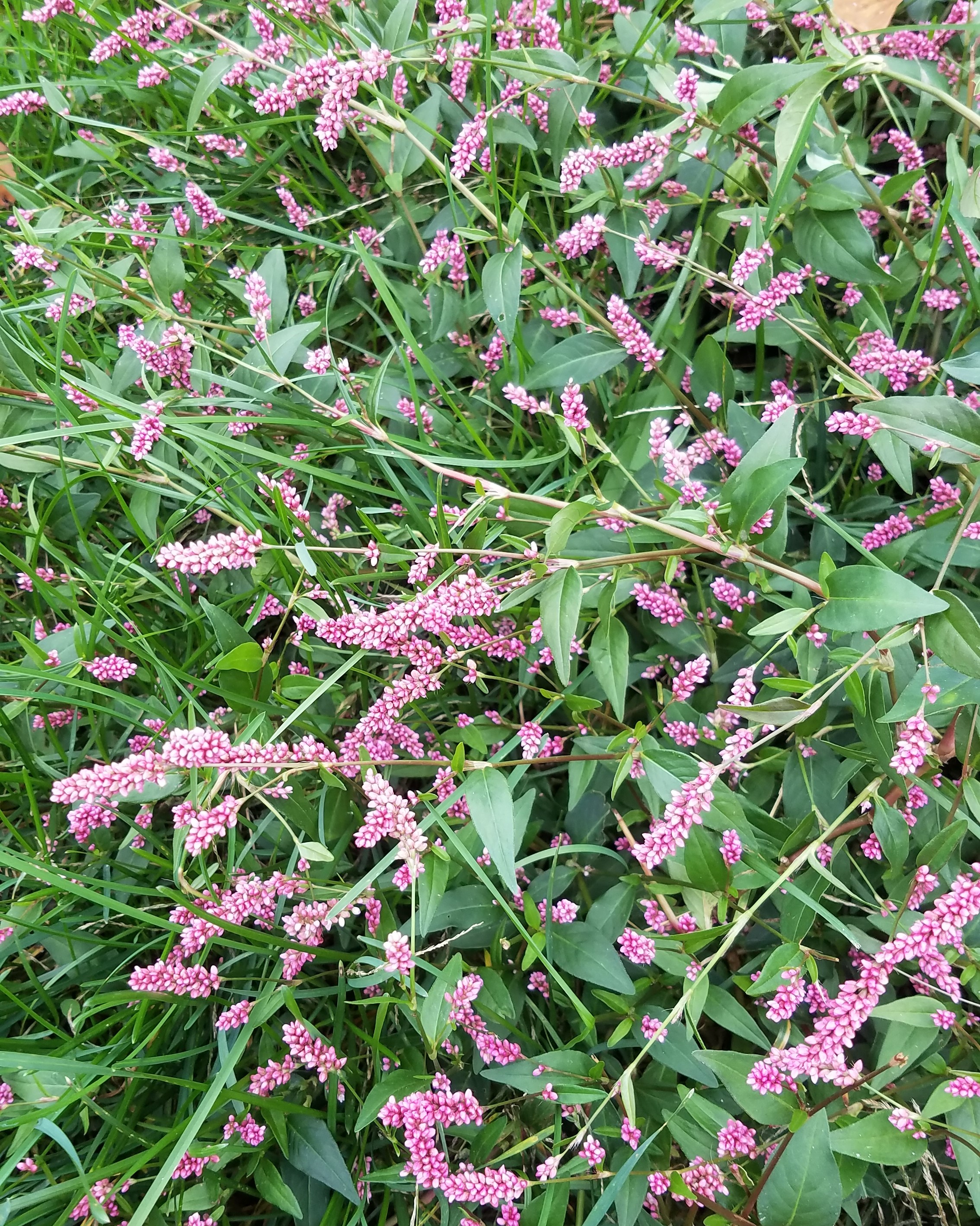
Everyone I know who has a garden is having an abundant year of produce. Foragers can find plenty of black raspberries, and while the Iowa DNR sprayed the lily pads on Lake Macbride near Solon, one more toxic substance in the water won’t kill us — we hope.
Climate change is real. Any question that greenhouse gases are warming the planet, and are caused by human activity has fallen away to leave the more appropriate one, “what will we do about climate change?” The crazy weather we have been experiencing recedes from view on days like last week, while coal and natural gas power plants continue to dump CO2 pollution into the atmosphere like it was an open sewer to air-condition our homes. There are two issues: protecting what we hold dear from the effects of climate change, and doing something to address the causes of greenhouse gas emissions.
While addressing climate change is complicated, things we can do to help are not. Reduce energy use at home by turning off lights after leaving a room and unplug your computer and mobile phone chargers when they are not in use. Change how we think about transportation by consolidating errands. We should be doing these things anyway.
The point is not to radically change how we live, but to join the vast majority of Americans in acknowledging that climate change is real, and poses a tangible threat to how we live. Then take steps to personally do something about it. You will be glad you did.
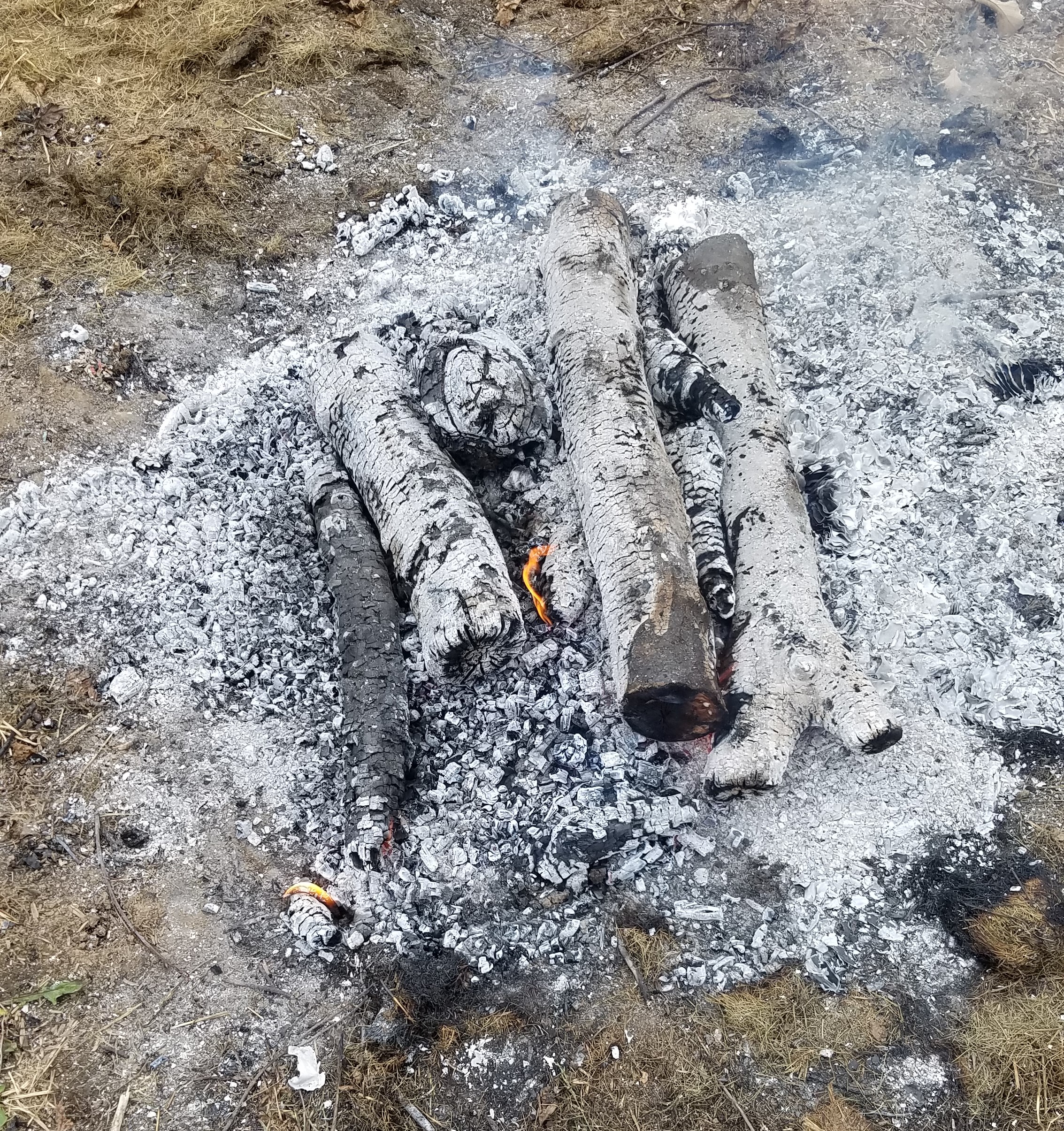
The brush pile included the last branches blown down by the Aug. 10, 2020 derecho. With enough rain to sate the drought, it was time to burn it. By nightfall it was reduced to ash, then a steady rain fell until morning.
One more mowing and I will get the John Deere serviced. After that, it will rest in the garage until spring. Deconstruction of the garden is ahead. I’ll need the mowed lawn to spread things out and organize for winter storage. I want to salvage and reuse landscaping fabric and the staples used to hold it in place.
The compost piles need to be moved and turned. I want to clear the garden plot where they are for more productive use. As my gardening skills improve I want more planting space next year. I have many wants.
I sat on the grass and watched the fire burn. I re-stacked the burning logs with a garden hoe and reduced the perimeter of the fire as it burned. I used old business cards mixed with shredded paper to start the fire. A pile of them lay under the burning branches. Once I turned them over they ignited.
We had an unexpected overnight visitor. I made a pot of chili using a fresh tomato, canned whole tomatoes, two kinds of frozen tomato sauce, and a can of organic tomato paste. It provided flexibility for supper time so we could focus on conversation.
A new day begins in our post derecho lives. The brush pile is gone, preparing a path toward garden’s end and winter.
Trail walking at Lake Macbride State Park on Oct. 25, 2021.
By the end of the year I will be seventy years old. More than anything, I’m glad to have lived this long. The plan is to go on living.
My work life ended last year because of the coronavirus pandemic. I would like a new source of income to supplement our pensions, yet there is only slight financial pressure to locate one. I am not ready to return to retail or any public-facing job as I’m not convinced it would be good for me. Each day without work outside home seems a little weird. I’m trying to adjust to a new path. It isn’t going well.
There is no bucket list because I did most of what I intended going through my days. The list of things I want to accomplish isn’t long: organize and write an autobiography; maintain good health and a decent quality of life. I need to be here for those who depend upon me.
How childcare was handled during my life helped me become who I am. Mother stayed home with us while Father worked at the meat packing plant. She was there for most of the important moments of my life. I don’t know how they made it on less than $100 per week yet we had a good quality of life even after Dad died and as I left home for college. When our daughter was born, I earned enough for my spouse to provide full time childcare while I worked outside home. It freed me for jobs that demanded time and energy. I was able to travel much of the country and see things of which I had no idea. My life would have been different had these childcare arrangements not existed. Now my concern is who will care for me as I become infirm.
Having taken a course on aging in America in graduate school, I feel ready for what is ahead. Coping with sadness and loss is here. So is dealing with physical limitations. I can sense the isolation and loneliness coming. With turbulence in society there is concern for our physical security. Most of all, changes in the environment, in our neighborhood, and in myself will require attention I hadn’t anticipated. For the time being I feel hope these changes can be adequately addressed.
Today it feels comfortable to get in the car and go on a couple hundred mile trip. That won’t always be the case and I’m ready to let go of driving when the time comes. For the moment, our 2002 Subaru won’t last another five years so it will need to be replaced. I did a study of how much we can afford to spend on big purchases over the next ten years based on our income. It is not as much as I would have liked. Fingers crossed, it will be enough.
What I’ll do with my remaining time is unknown. The framework is two stages: the next ten years, and those afterward. If I maintain my health and avoid common diseases (cardio-respiratory, cancer, diabetes, dementia and Alzheimer’s disease, and depression) the septuagenarian years will be a time of getting bigger projects done: writing, home repair and refurbishing, and gardening. After age eighty, should I live so long, the pace of things is expected to slow down. Both my mother and maternal grandmother were mentally alert and active until age 90 so I’m hopeful.
Time goes so fast!
I walk on the trail as often as I can. It is exercise. It is a chance to reflect on my life. It is an opportunity to consider the future. Mostly, though, it is walking. As long as I’m doing it I feel I’ll live forever, even if I know differently. It is always a journey home.
Inch by inch, row by row. That’s how a gardener builds a life. I need a couple of days away from the blog after 97 daily posts in a row. While I’m gone, here’s Arlo Guthrie teaching us how to sing a song. Hope you have a happy time zone!






 Journey Home
You must be logged in to post a comment.